Comenius project
“Mutual Cultural Influence of
Colonization and Migration”
     General Secondary School
          “Hristo Botev”,
          Aytos, Bulgaria
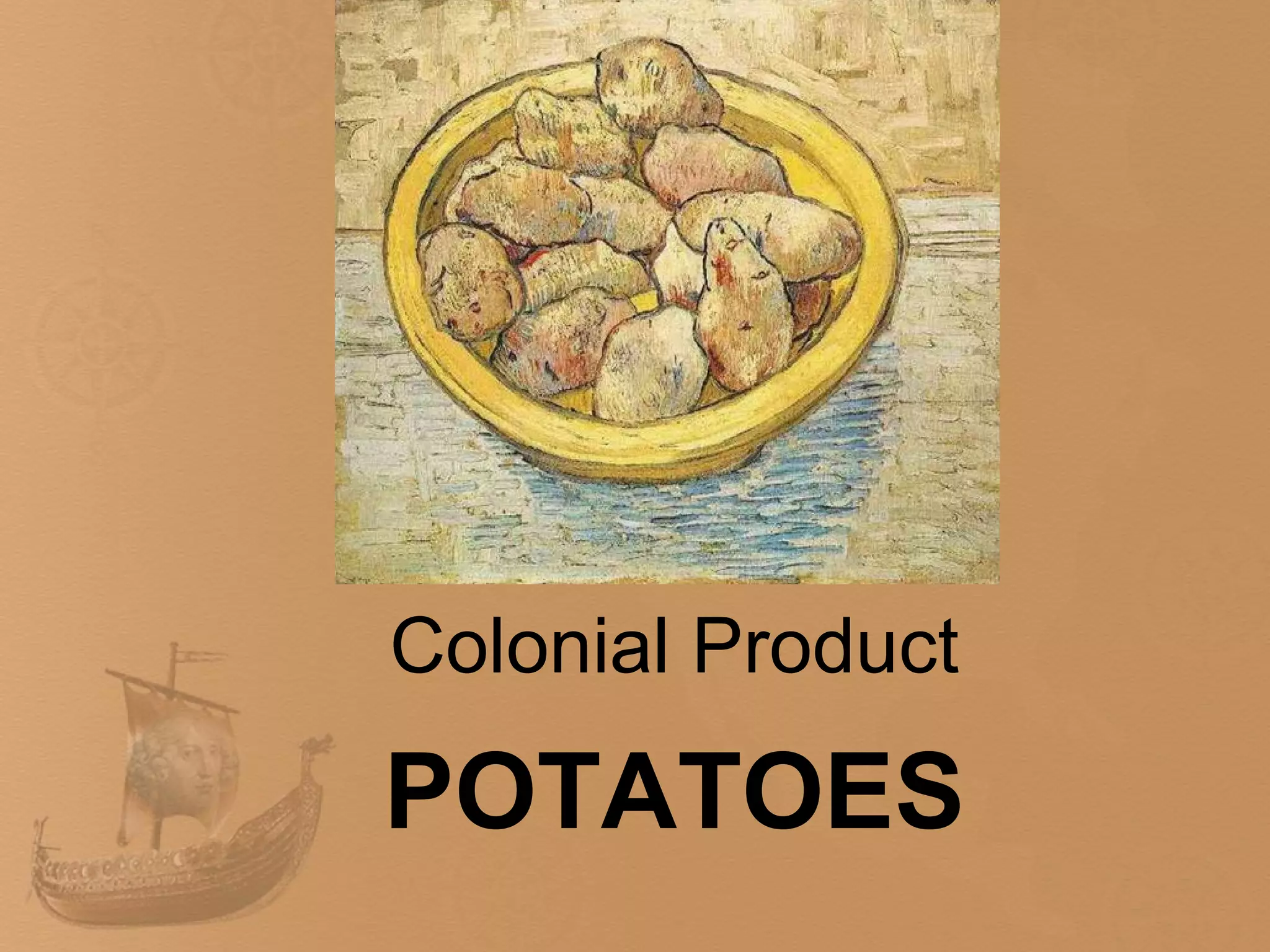
Colonial Product

POTATOES
History of the potatoes
• The earliest known potatoes were discovered in
  the high mountains of South America, Peru and
  Chile. The earliest such remains of potatoes
  date to 400 B.C. They were found at
  archaeological sites at Chiripa, on the shores of
  Lake Titicaca. Other findings have been in
  Bolivia, Lima, Peru; and on the coast of northern
  Chile.
• After its discovery by Spanish conquistadors,
  the potato was taken to Europe. Although the
  Spanish took the Inca empire for gold, the
  potato proved to be the richest treasure they
  carried home. Potatoes , planted and cultivated ,
  provided food for millions.
It took nearly two centuries…
 • Spanish records show that it entered
   Seville in 1570 and was used to feed
   hospital patients in 1573. It then
   travelled to Italy, Germany, and into
   the Orient. Later a royal Swedish
   edict compelled Sweden to grow the
   crop.
 • It took nearly two centuries,
   following the potato's introduction
   from South America, before it really
   achieved common acceptance.
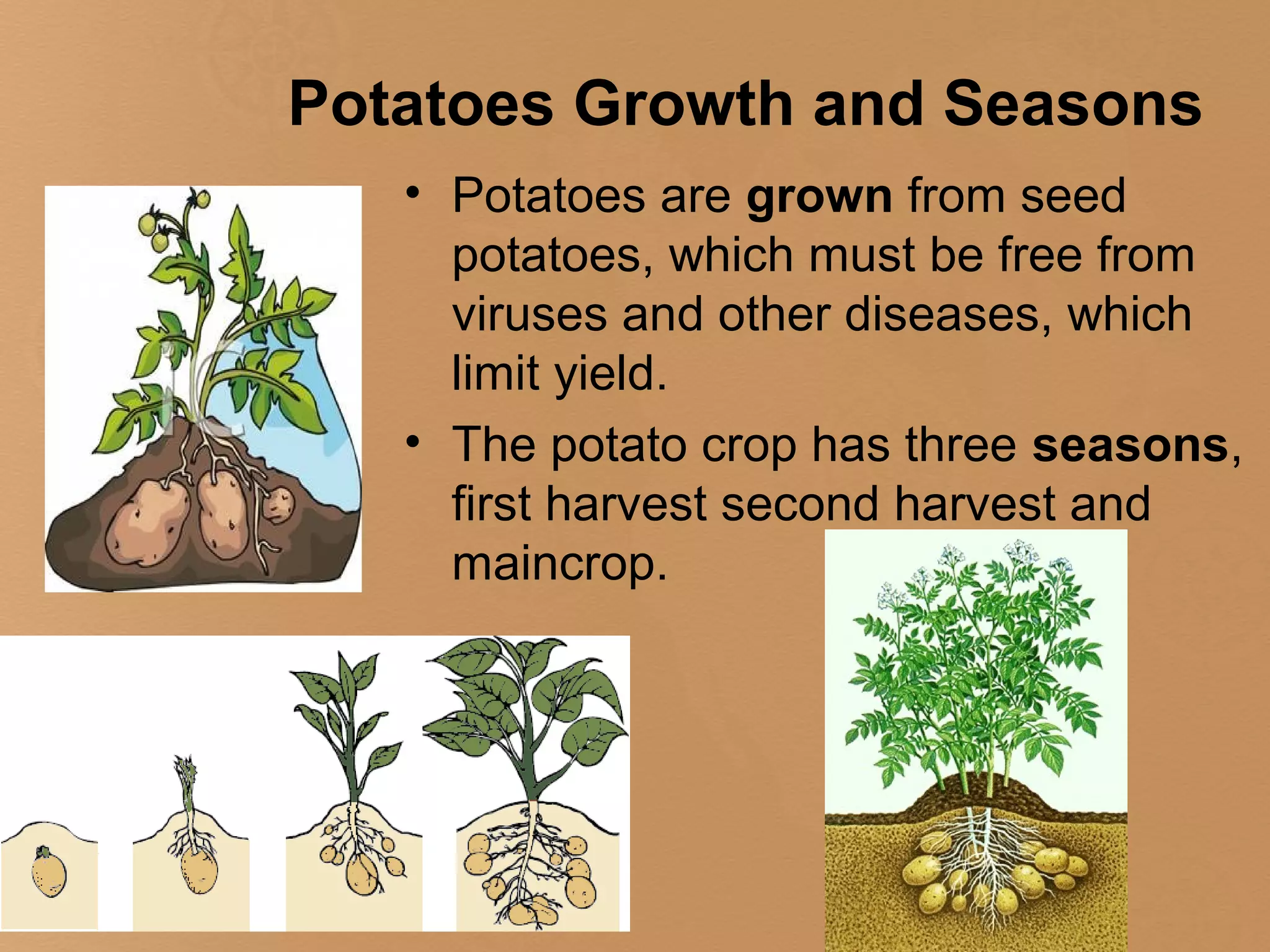
Potatoes Growth and Seasons
   • Potatoes are grown from seed
     potatoes, which must be free from
     viruses and other diseases, which
     limit yield.
   • The potato crop has three seasons,
     first harvest second harvest and
     maincrop.
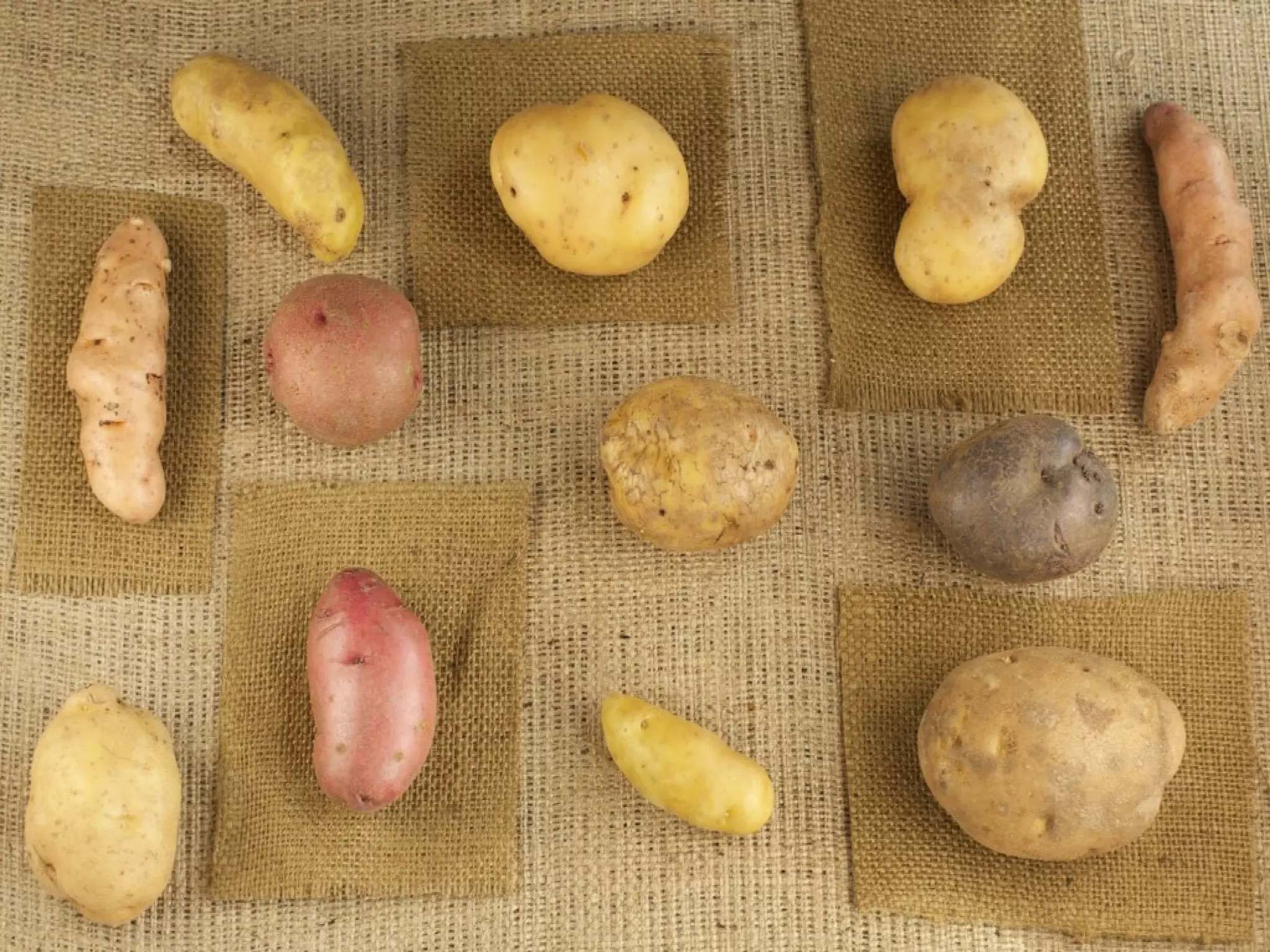
Types & varieties
• More then 130 potatoes varieties have
  been developed for various uses. Depends
  on its use, potatoes differs between:
 Steady Potatoes
 Predominantly Steady Potatoes
 Mealy Potatoes
• The most famous Bulgarian varieties
  created in Vegetables Research Institute
  in Plovdiv are:
   Иверце - Ivertse
   Надежда - Nadejda
   Перун - Perun
   Рожен – Rojen
   Орфей - Orpheus
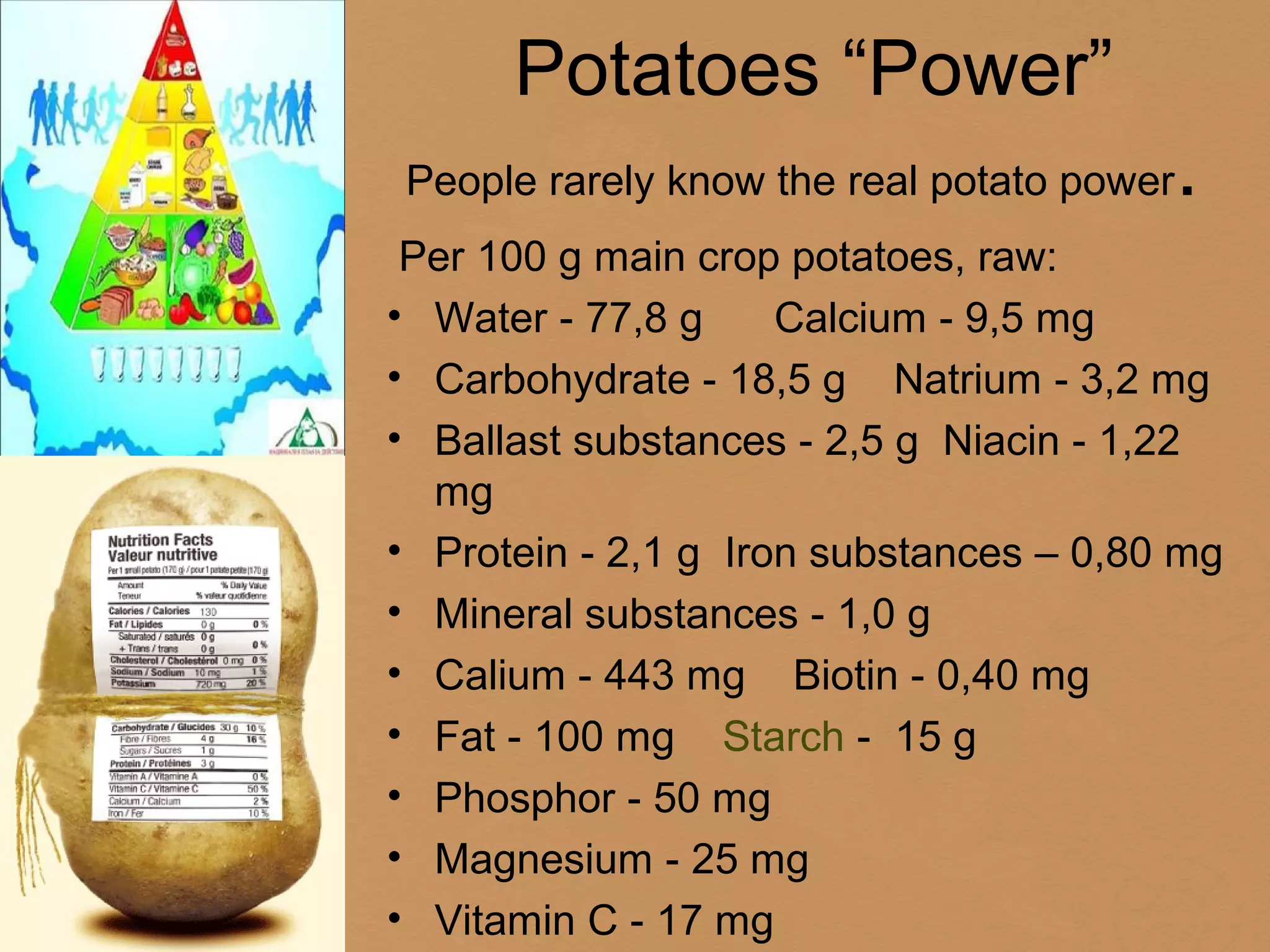
Potatoes “Power”
People rarely know the real potato power   .
 Per 100 g main crop potatoes, raw:
• Water - 77,8 g     Calcium - 9,5 mg
• Carbohydrate - 18,5 g Natrium - 3,2 mg
• Ballast substances - 2,5 g Niacin - 1,22
  mg
• Protein - 2,1 g Iron substances – 0,80 mg
• Mineral substances - 1,0 g
• Calium - 443 mg Biotin - 0,40 mg
• Fat - 100 mg Starch - 15 g
• Phosphor - 50 mg
• Magnesium - 25 mg
• Vitamin C - 17 mg
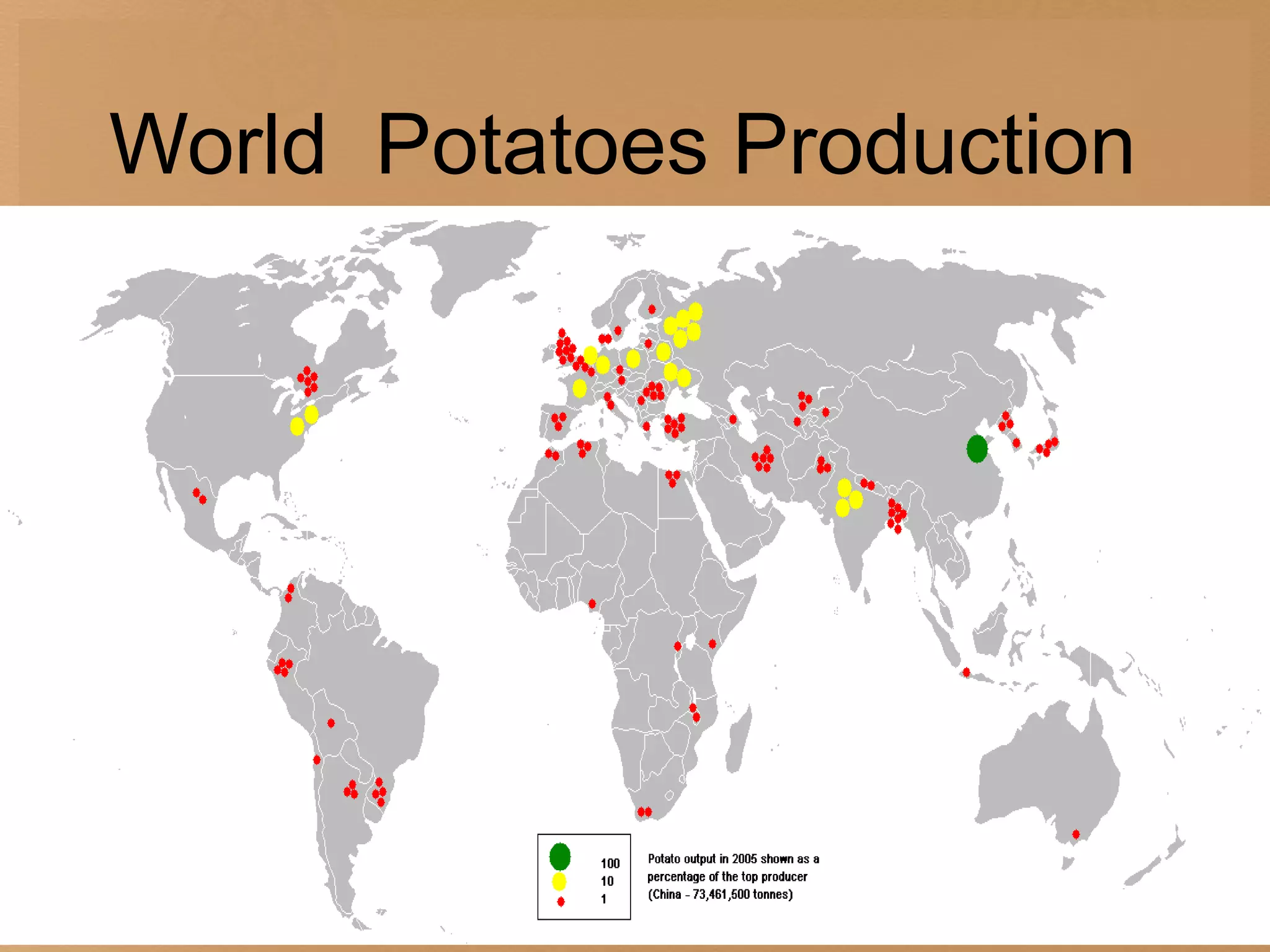
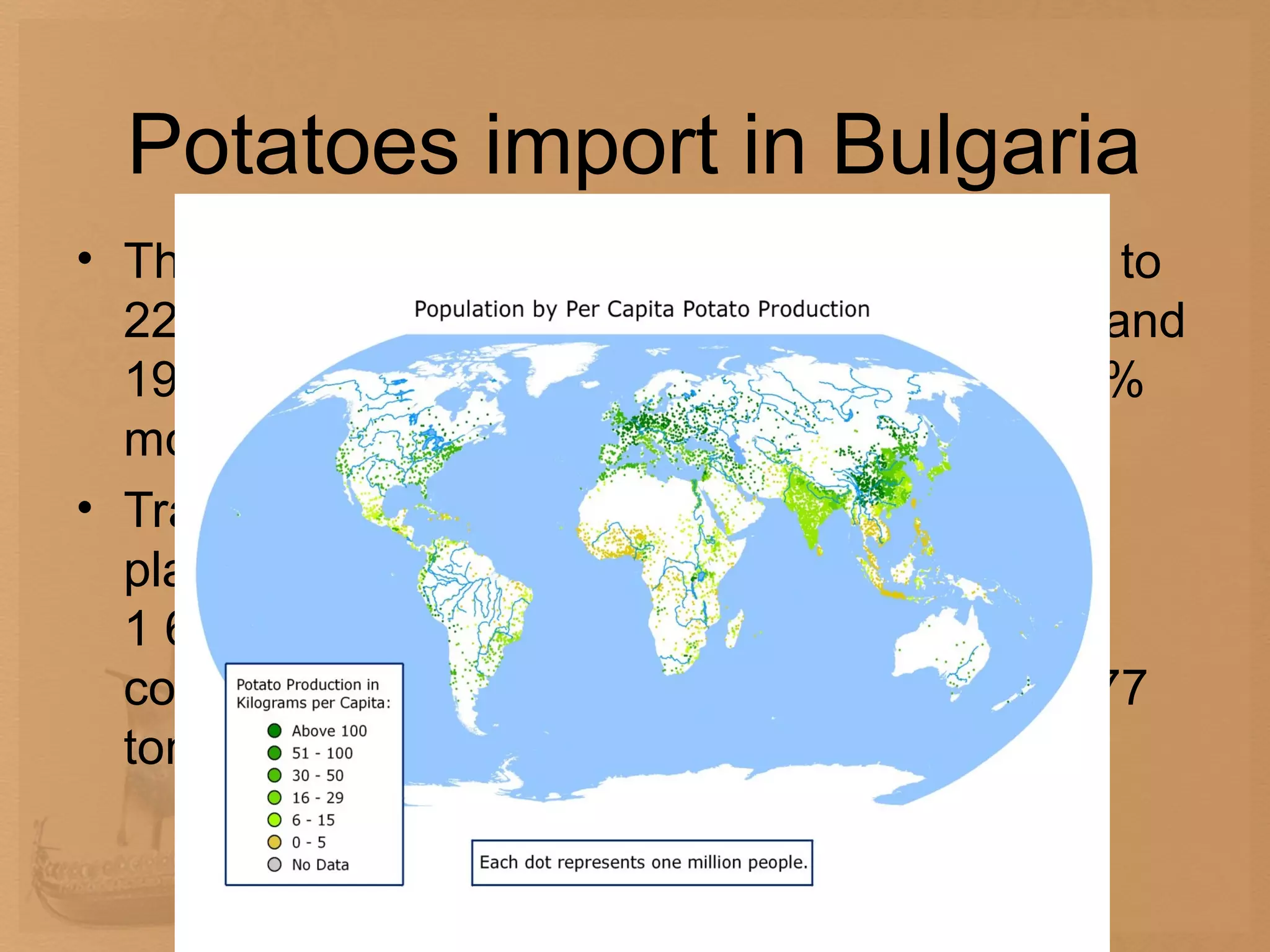
World Potatoes Production
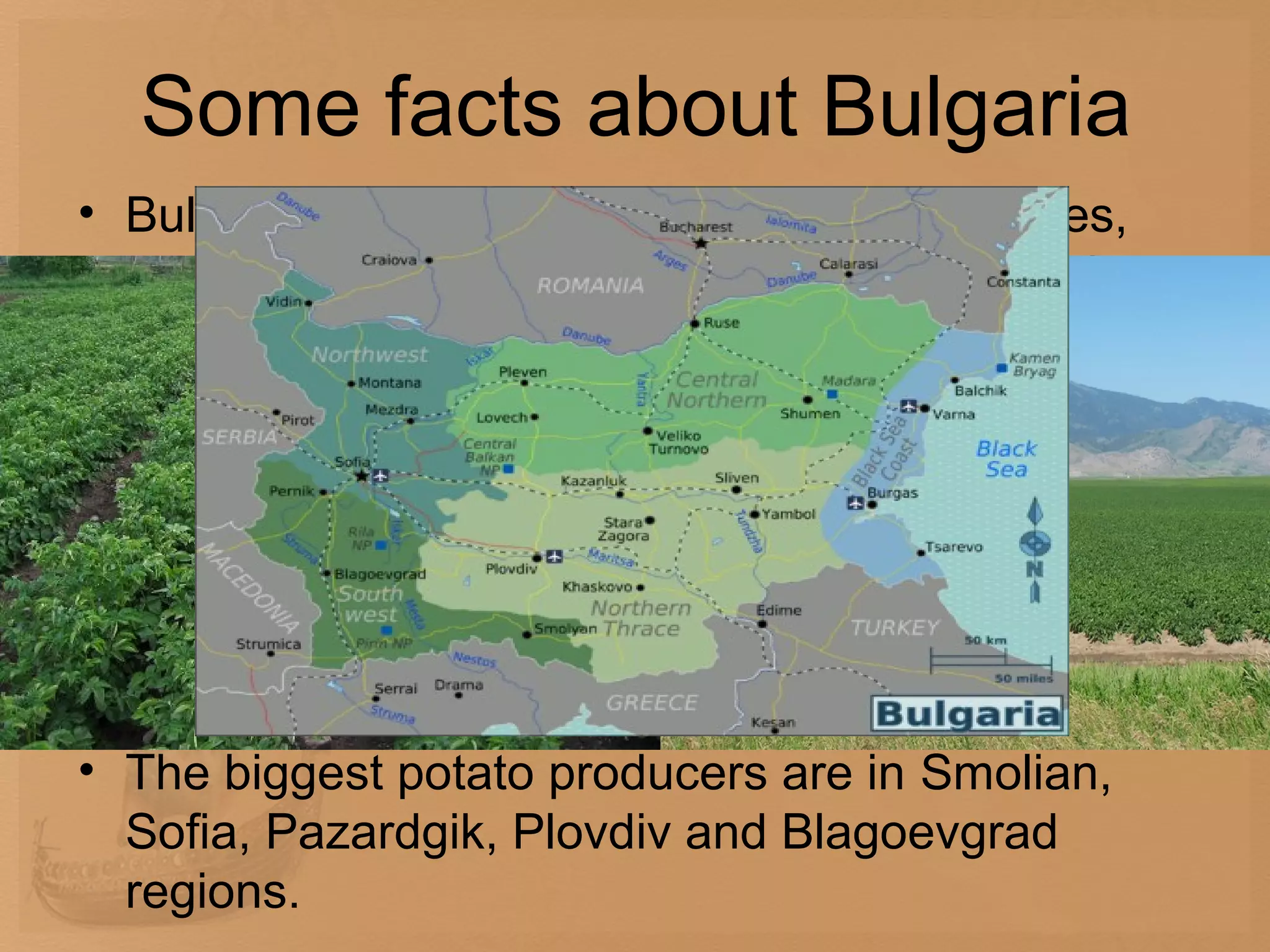
Some facts about Bulgaria
• Bulgaria is a major supplier of grapes, apples,
  and tomatoes to Europe and the former Soviet
  Union. Potatoes and paprika are also important
  crops. Production in 2004 included (in thousands
  of tons): grapes, 400; apples, 30; tomatoes, 400;
  and potatoes, 574.
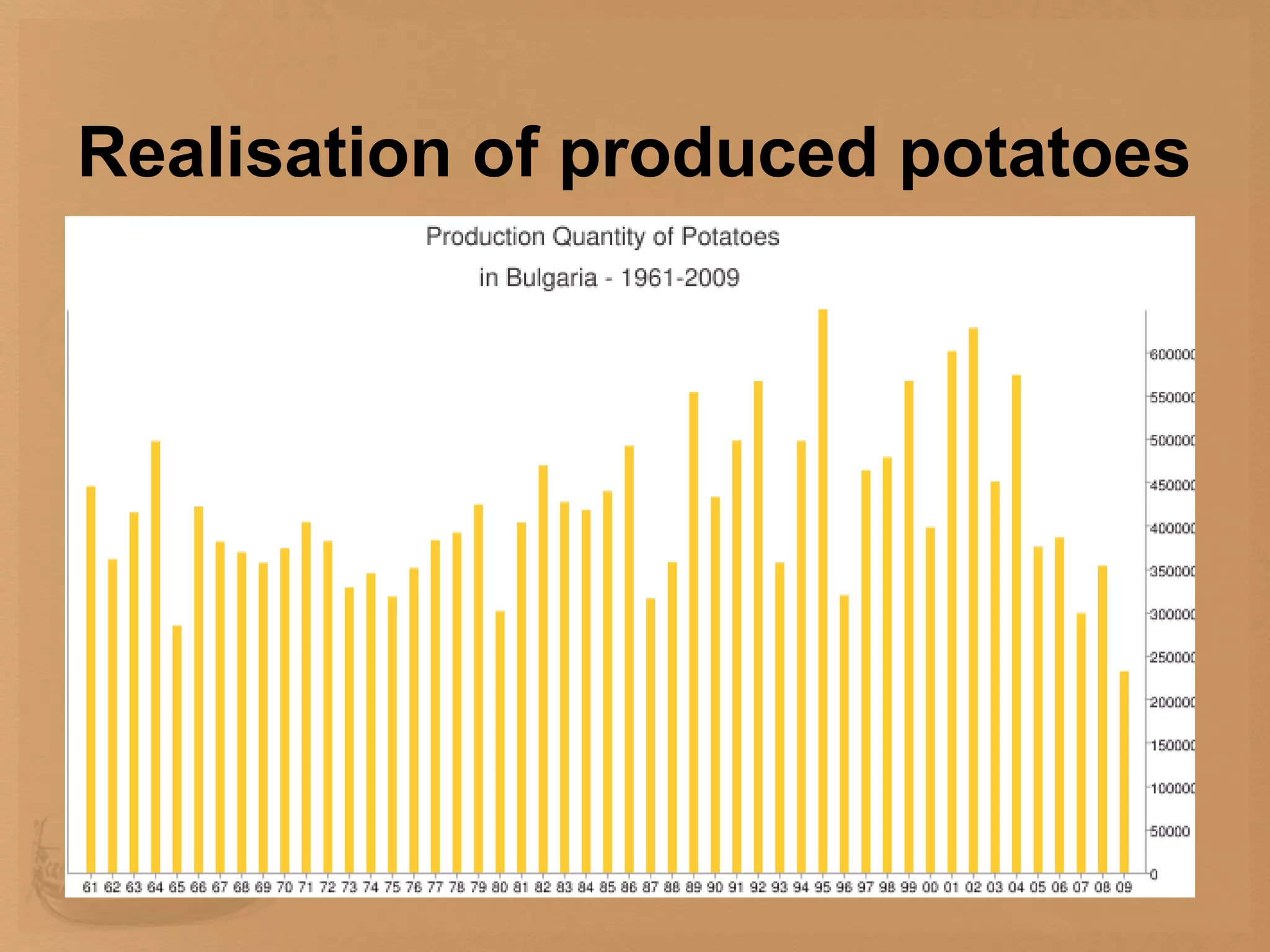
• According to the data of ‘Agro-statistic’ in 2002
  the total output of potatoes was 627,000 tonnes
  from 52,000 hectares.
• The biggest potato producers are in Smolian,
  Sofia, Pazardgik, Plovdiv and Blagoevgrad
  regions.
Realisation of produced potatoes
• Potato utilisation by industry is small; only 2% and limited to chips
  and frozen potatoes producing. No potatoes are used for non-food
  uses in Bulgaria.
  Realisation of produced potatoes (%) for 2004
 For consumption For market             For industry
    45%                    53%              2%
• During the commercial 2009 the production of potatoes is the
  largest – 232 000 tons.
• In 2009 there are 30 480 tons of fresh vegetables exported, such as
  potatoes and mushrooms. The main export is to EU member states.
• The exported quantities of potatoes for consumption have
  decreased in comparison to the previous year by 92%, down to 53
  tons. There is export of potatoes for planting realized (42 tons). The
  main market for this is Romania.
Potatoes import in Bulgaria
• The import of fresh potatoes in 2009 adds up to
  22 001 tons (including 2 528 tons for sowing and
  19 473 tons for consumption), which is by 23%
  more than in the previous year.
• Traditionally, the main import of high quality
  planting supplies comes from Netherlands –
  1 675 tons. Larger quantities of potatoes for
  consumption are imported from Turkey – 9 377
  tons and Germany – 4 340 tons.
Potatoes nowadays
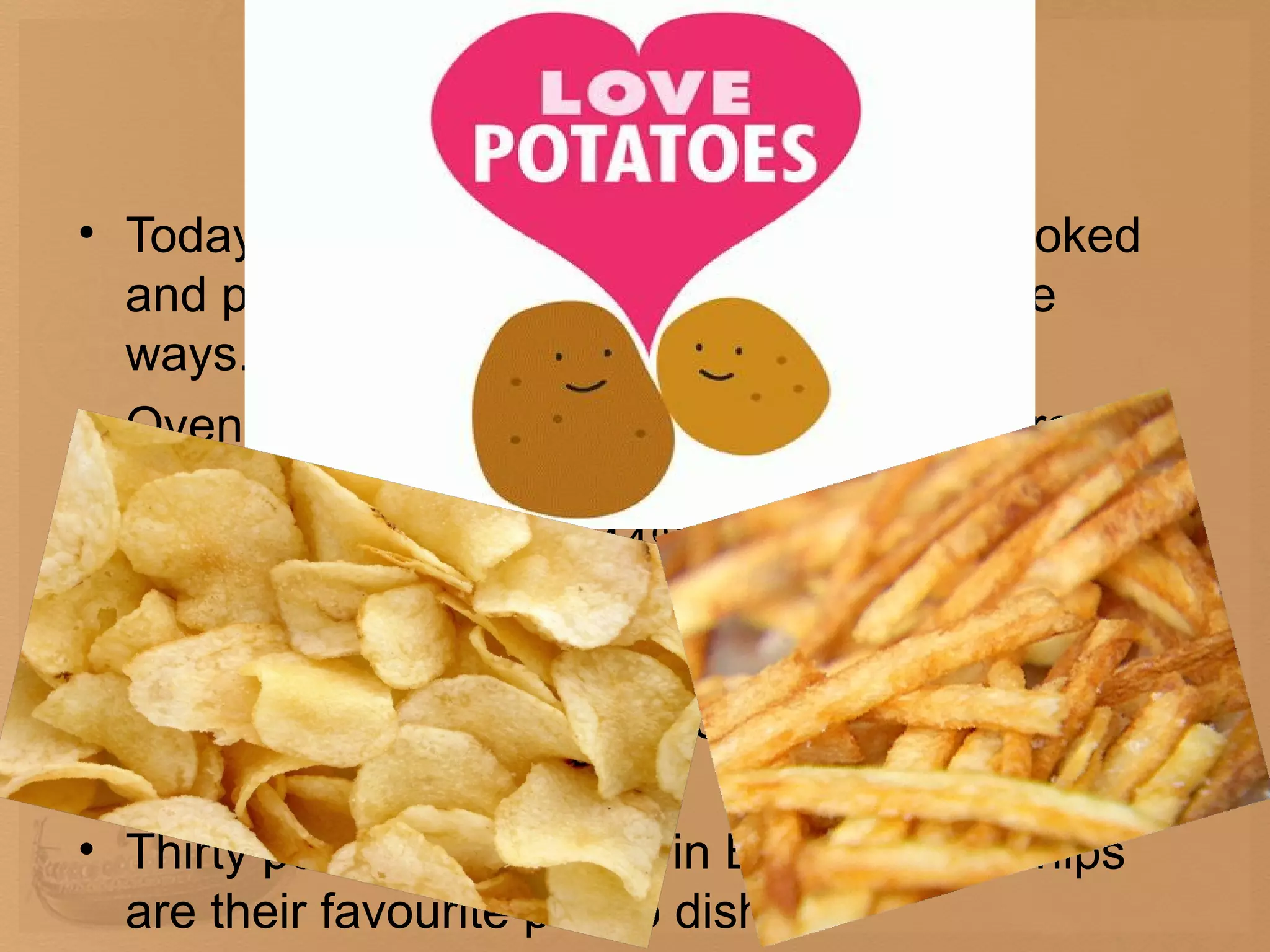
• Today it is the most popular vegetable, cooked
  and prepared in many tasty and innovative
  ways.
• Oven chips can be found in more and more
  shopping trolleys, but fresh chips are still
  prepared at home by 44% of housewives,
  according to new research by National Statistic
  Institute. Most consumers (51%) still use a
  traditional chip pan, while 34% prefer a deep-fat
  fryer.
• Thirty per cent of people in Bulgaria say chips
  are their favourite potato dish.
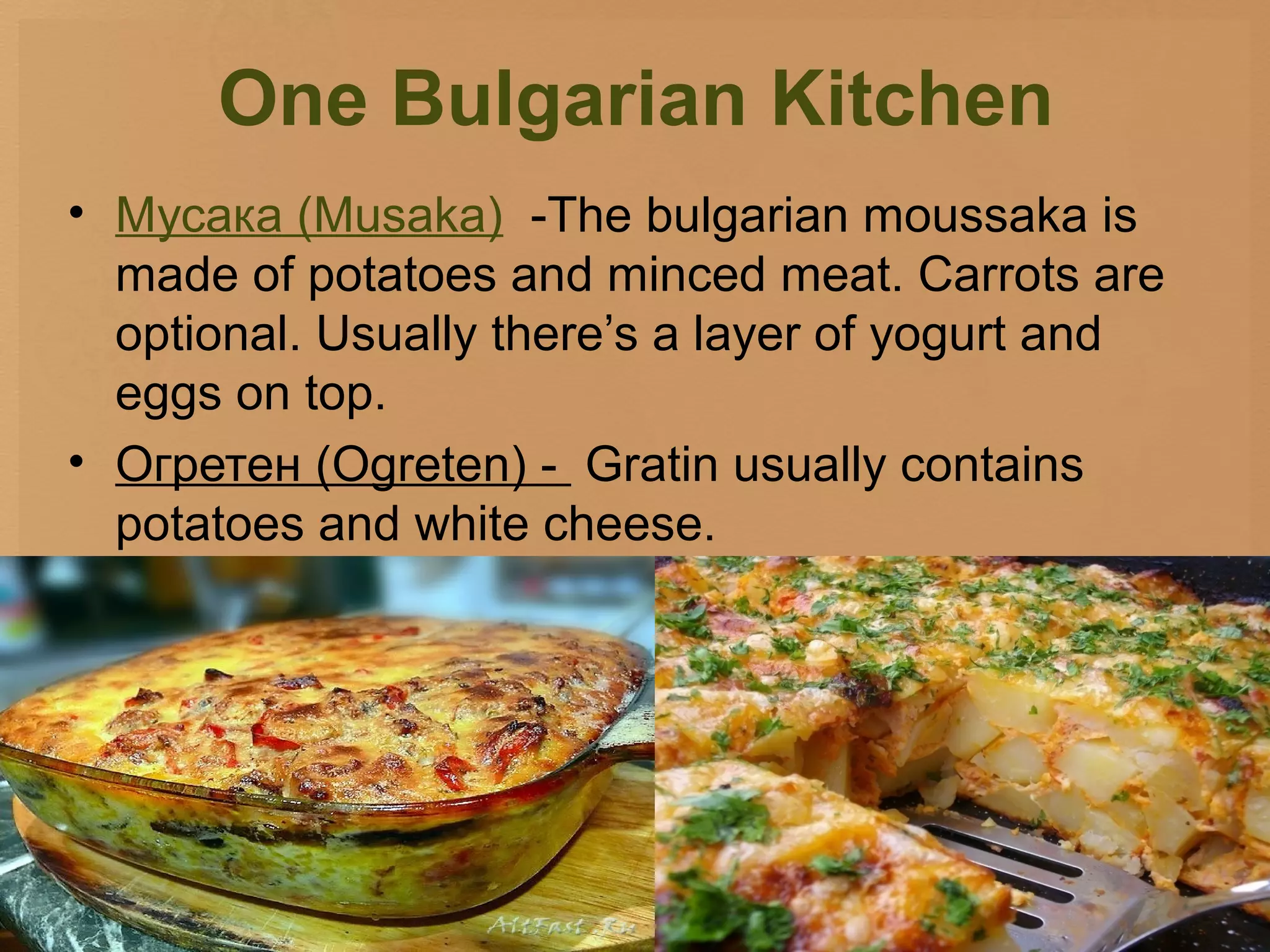
One Bulgarian Kitchen
• Мусака (Musaka) -The bulgarian moussaka is
  made of potatoes and minced meat. Carrots are
  optional. Usually there’s a layer of yogurt and
  eggs on top.
• Огретен (Ogreten) - Gratin usually contains
  potatoes and white cheese.
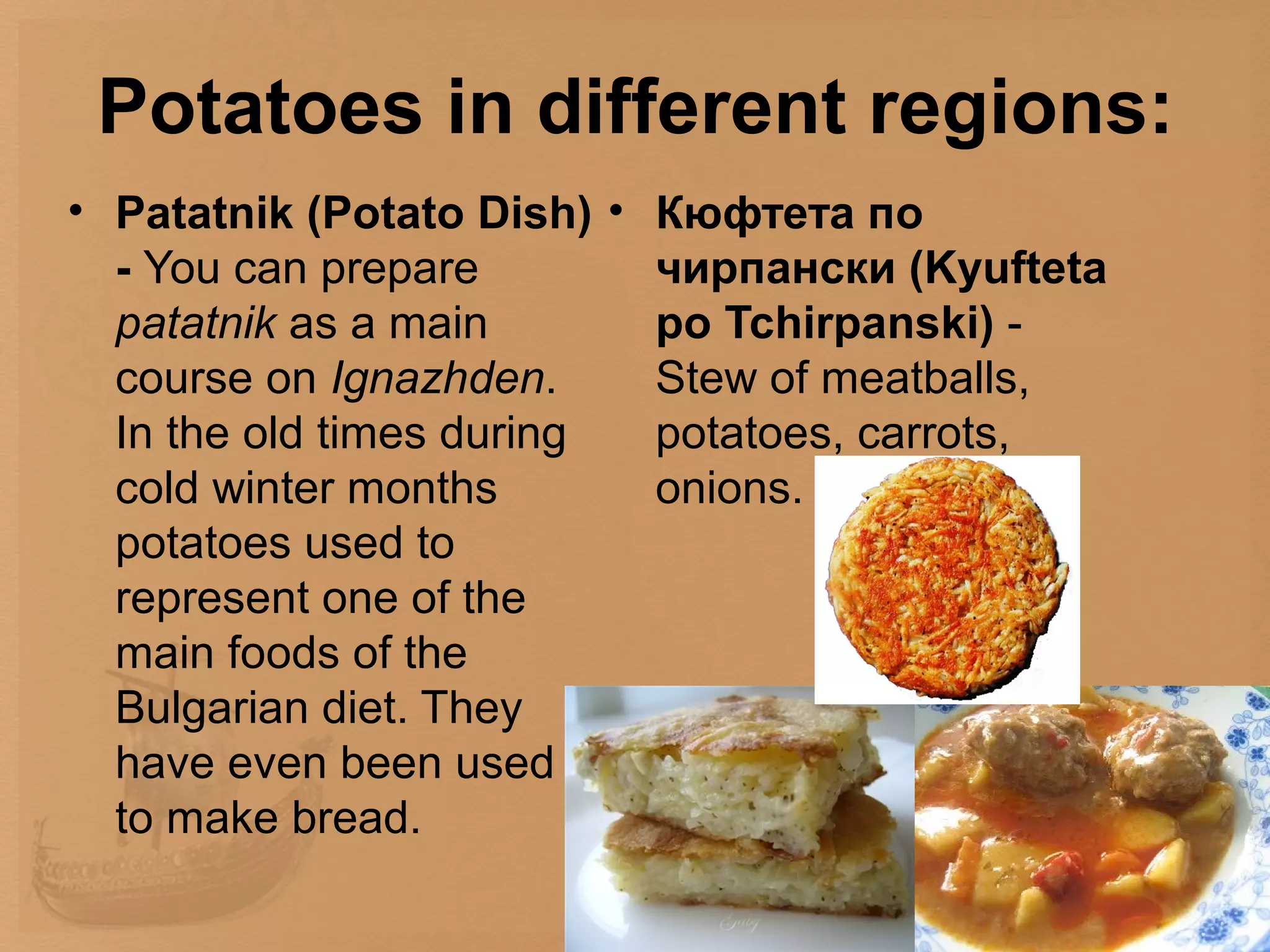
Potatoes in different regions:
• Patatnik (Potato Dish) • Кюфтета по
  - You can prepare        чирпански (Kyufteta
  patatnik as a main       po Tchirpanski) -
  course on Ignazhden.     Stew of meatballs,
  In the old times during  potatoes, carrots,
  cold winter months       onions.
  potatoes used to
  represent one of the
  main foods of the
  Bulgarian diet. They
  have even been used
  to make bread.
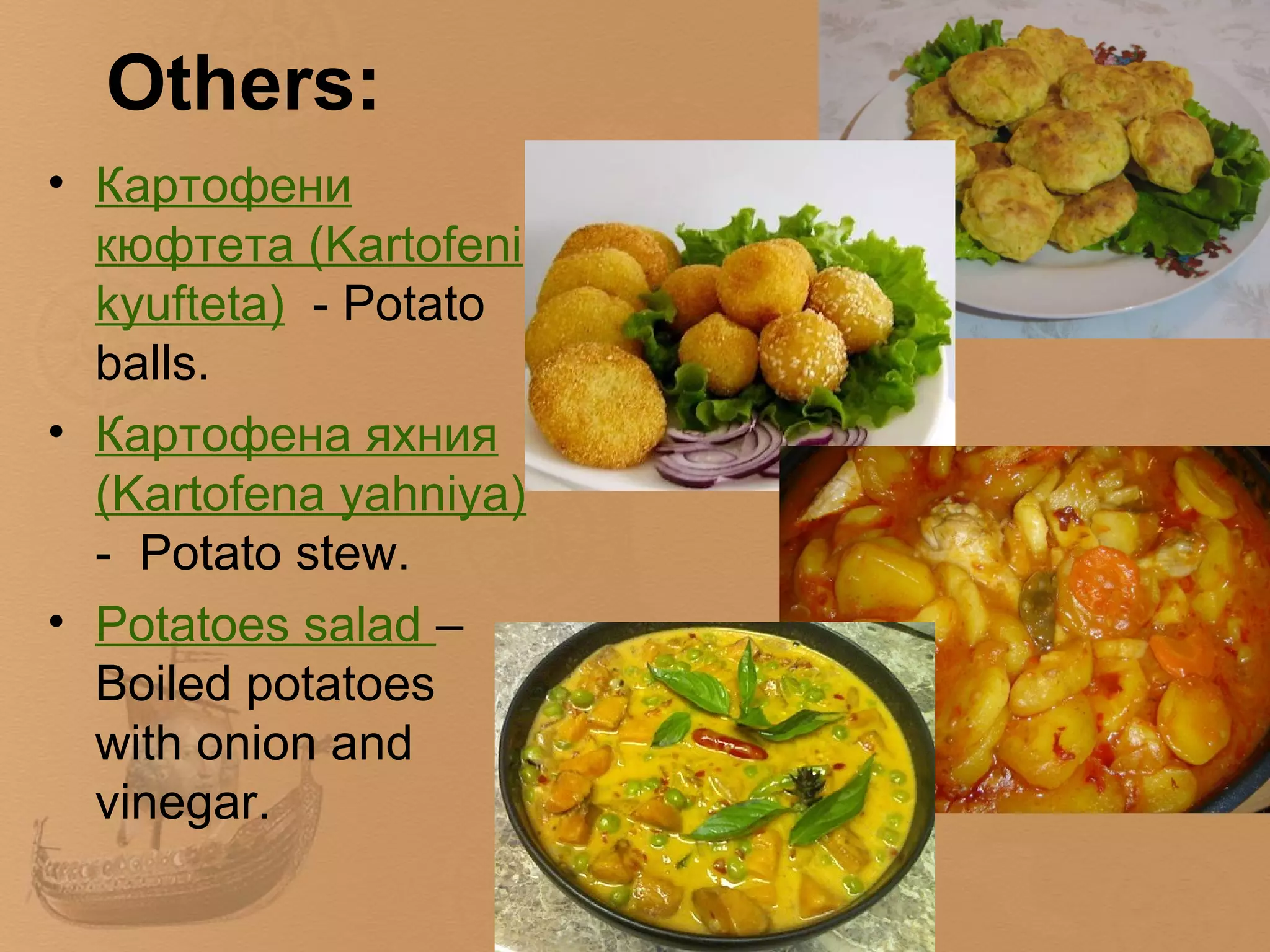
Others:
• Картофени
  кюфтета (Kartofeni
  kyufteta) - Potato
  balls.
• Картофена яхния
  (Kartofena yahniya)
  - Potato stew.
• Potatoes salad –
  Boiled potatoes
  with onion and
  vinegar.
This project has been funded with
support     from     the    European
Commission.
This presentation reflects the views
only of the author, and the
Commission       cannot   be     held
responsible for any use which may be
made of the information contained
therein.
Thanks     for    your    attention!

B ulgarian potatoes_2003 - final

  • 1.
    Comenius project “Mutual CulturalInfluence of Colonization and Migration” General Secondary School “Hristo Botev”, Aytos, Bulgaria
  • 2.
  • 3.
    History of thepotatoes • The earliest known potatoes were discovered in the high mountains of South America, Peru and Chile. The earliest such remains of potatoes date to 400 B.C. They were found at archaeological sites at Chiripa, on the shores of Lake Titicaca. Other findings have been in Bolivia, Lima, Peru; and on the coast of northern Chile. • After its discovery by Spanish conquistadors, the potato was taken to Europe. Although the Spanish took the Inca empire for gold, the potato proved to be the richest treasure they carried home. Potatoes , planted and cultivated , provided food for millions.
  • 4.
    It took nearlytwo centuries… • Spanish records show that it entered Seville in 1570 and was used to feed hospital patients in 1573. It then travelled to Italy, Germany, and into the Orient. Later a royal Swedish edict compelled Sweden to grow the crop. • It took nearly two centuries, following the potato's introduction from South America, before it really achieved common acceptance.
  • 5.
    Potatoes Growth andSeasons • Potatoes are grown from seed potatoes, which must be free from viruses and other diseases, which limit yield. • The potato crop has three seasons, first harvest second harvest and maincrop.
  • 6.
    Types & varieties •More then 130 potatoes varieties have been developed for various uses. Depends on its use, potatoes differs between:  Steady Potatoes  Predominantly Steady Potatoes  Mealy Potatoes • The most famous Bulgarian varieties created in Vegetables Research Institute in Plovdiv are:  Иверце - Ivertse  Надежда - Nadejda  Перун - Perun  Рожен – Rojen  Орфей - Orpheus
  • 7.
    Potatoes “Power” People rarelyknow the real potato power . Per 100 g main crop potatoes, raw: • Water - 77,8 g Calcium - 9,5 mg • Carbohydrate - 18,5 g Natrium - 3,2 mg • Ballast substances - 2,5 g Niacin - 1,22 mg • Protein - 2,1 g Iron substances – 0,80 mg • Mineral substances - 1,0 g • Calium - 443 mg Biotin - 0,40 mg • Fat - 100 mg Starch - 15 g • Phosphor - 50 mg • Magnesium - 25 mg • Vitamin C - 17 mg
  • 8.
  • 9.
    Some facts aboutBulgaria • Bulgaria is a major supplier of grapes, apples, and tomatoes to Europe and the former Soviet Union. Potatoes and paprika are also important crops. Production in 2004 included (in thousands of tons): grapes, 400; apples, 30; tomatoes, 400; and potatoes, 574. • According to the data of ‘Agro-statistic’ in 2002 the total output of potatoes was 627,000 tonnes from 52,000 hectares. • The biggest potato producers are in Smolian, Sofia, Pazardgik, Plovdiv and Blagoevgrad regions.
  • 10.
    Realisation of producedpotatoes • Potato utilisation by industry is small; only 2% and limited to chips and frozen potatoes producing. No potatoes are used for non-food uses in Bulgaria. Realisation of produced potatoes (%) for 2004  For consumption For market For industry 45% 53% 2% • During the commercial 2009 the production of potatoes is the largest – 232 000 tons. • In 2009 there are 30 480 tons of fresh vegetables exported, such as potatoes and mushrooms. The main export is to EU member states. • The exported quantities of potatoes for consumption have decreased in comparison to the previous year by 92%, down to 53 tons. There is export of potatoes for planting realized (42 tons). The main market for this is Romania.
  • 11.
    Potatoes import inBulgaria • The import of fresh potatoes in 2009 adds up to 22 001 tons (including 2 528 tons for sowing and 19 473 tons for consumption), which is by 23% more than in the previous year. • Traditionally, the main import of high quality planting supplies comes from Netherlands – 1 675 tons. Larger quantities of potatoes for consumption are imported from Turkey – 9 377 tons and Germany – 4 340 tons.
  • 12.
    Potatoes nowadays • Todayit is the most popular vegetable, cooked and prepared in many tasty and innovative ways. • Oven chips can be found in more and more shopping trolleys, but fresh chips are still prepared at home by 44% of housewives, according to new research by National Statistic Institute. Most consumers (51%) still use a traditional chip pan, while 34% prefer a deep-fat fryer. • Thirty per cent of people in Bulgaria say chips are their favourite potato dish.
  • 13.
    One Bulgarian Kitchen •Мусака (Musaka) -The bulgarian moussaka is made of potatoes and minced meat. Carrots are optional. Usually there’s a layer of yogurt and eggs on top. • Огретен (Ogreten) - Gratin usually contains potatoes and white cheese.
  • 14.
    Potatoes in differentregions: • Patatnik (Potato Dish) • Кюфтета по - You can prepare чирпански (Kyufteta patatnik as a main po Tchirpanski) - course on Ignazhden. Stew of meatballs, In the old times during potatoes, carrots, cold winter months onions. potatoes used to represent one of the main foods of the Bulgarian diet. They have even been used to make bread.
  • 15.
    Others: • Картофени кюфтета (Kartofeni kyufteta) - Potato balls. • Картофена яхния (Kartofena yahniya) - Potato stew. • Potatoes salad – Boiled potatoes with onion and vinegar.
  • 16.
    This project hasbeen funded with support from the European Commission. This presentation reflects the views only of the author, and the Commission cannot be held responsible for any use which may be made of the information contained therein. Thanks for your attention!