1
TOPIC
Azure Digital Twins
Marco Parenzan
@marco_parenzan
BASIC SPONSOR
PREMIUM SPONSOR
Thanks to all the sponsors
Who I am
marco_parenzan
marco.parenzan
marcoparenzan
Marco Parenzan
Solutions Sales Specialist @ Insight
Microsoft MVP 2018-2019 for Azure
Community Lead per 1nn0va
Approaching an IoT project
IoT Hub «state of the art»
Telemetry Ingestion and Controlling
You have seen lot of times
https://www.slideshare.net/marco.parenzan/sviluppare-un-
portale-per-gestire-la-tua-soluzione-iot-hub
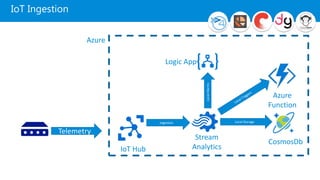
IoT Ingestion
Telemetry
Azure
IoT Hub
Stream
Analytics
CosmosDb
Azure
Function
Local StorageIngestion
LocalAlarms
Logic App
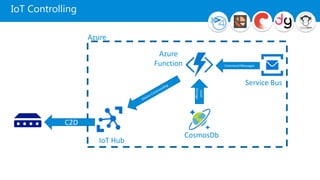
IoT Controlling
Azure
IoT Hub
Azure
Function
C2D
Local
Storage
CosmosDb
Command Messages
Service Bus
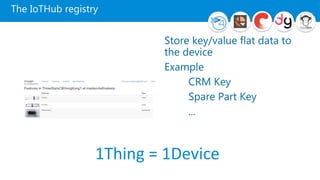
The IoTHub registry
Store key/value flat data to
the device
Example
CRM Key
Spare Part Key
...
1Thing = 1Device
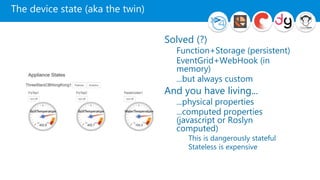
The device state (aka the twin)
Solved (?)
Function+Storage (persistent)
EventGrid+WebHook (in
memory)
...but always custom
And you have living...
...physical properties
...computed properties
(javascript or Roslyn
computed)
This is dangerously stateful
Stateless is expensive
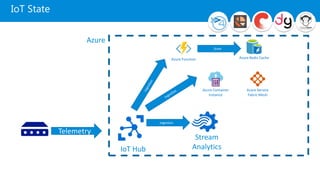
IoT State
Telemetry
Azure
IoT Hub
Stream
Analytics
Ingestion
Azure Container
Instance
Azure Service
Fabric Mesh
Azure Function Azure Redis Cache
State
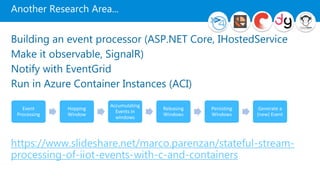
Another Research Area...
Building an event processor (ASP.NET Core, IHostedService
Make it observable, SignalR)
Notify with EventGrid
Run in Azure Container Instances (ACI)
https://www.slideshare.net/marco.parenzan/stateful-stream-
processing-of-iiot-events-with-c-and-containers
Event
Processing
Hopping
Window
Accumulating
Events in
windows
Releasing
Windows
Persisting
Windows
Generate a
(new) Event
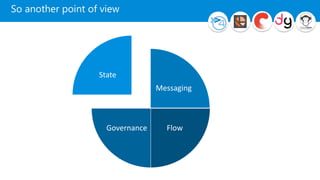
So another point of view
Messaging
FlowGovernance
State
The PaaS of the IoT State
Any idea?
What is Digital Twins
What is Digital Twin?
It is another point of view modeling your real infrastructure
in the cloud
Focused mainly on resources, where there are the devices
too...
Not only devices!
Using «spatial intelligence» graphs
Inheritance (security, for example)
Filtering
Traversing (the graph, different levels)
Scalability (it’s a DB...)
Extensible (with customizable enumerations and ontologies)
The difference between DeviceTwin and
Digital Twin
Twin is a cloud based rapresentation of something that is
remote
DeviceTwin is
A key/value flat representation of
Desired configuration
Reported configuration
Keys to match to an external database
Digital Twin is
A graph (tree…someone asking for graph)
Richer semantics
Also not only devices
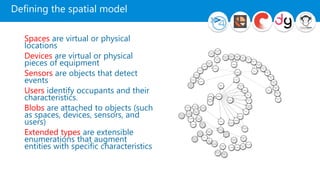
Defining the spatial model
Spaces are virtual or physical
locations
Devices are virtual or physical
pieces of equipment
Sensors are objects that detect
events
Users identify occupants and their
characteristics.
Blobs are attached to objects (such
as spaces, devices, sensors, and
users)
Extended types are extensible
enumerations that augment
entities with specific characteristics
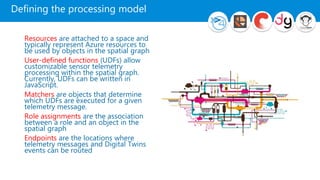
Defining the processing model
Resources are attached to a space and
typically represent Azure resources to
be used by objects in the spatial graph
User-defined functions (UDFs) allow
customizable sensor telemetry
processing within the spatial graph.
Currently, UDFs can be written in
JavaScript.
Matchers are objects that determine
which UDFs are executed for a given
telemetry message.
Role assignments are the association
between a role and an object in the
spatial graph
Endpoints are the locations where
telemetry messages and Digital Twins
events can be routed
Other part of the model
Ontologies represent a set of extended types
Property keys and values are custom characteristics of
spaces, devices, sensors, and users
Roles are sets of permissions assigned to users and devices
in the spatial graph
Security key stores provide the security keys for all devices
in the hierarchy under a given space object to allow the
device to securely communicate with Digital Twins.
Space
This is the first methaphor in Digital Twins
You can create hierarchies of spaces
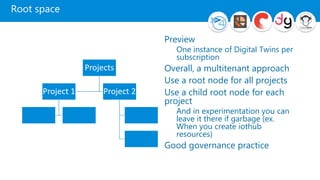
Root space
Projects
Project 1 Project 2
Preview
One instance of Digital Twins per
subscription
Overall, a multitenant approach
Use a root node for all projects
Use a child root node for each
project
And in experimentation you can
leave it there if garbage (ex.
When you create iothub
resources)
Good governance practice
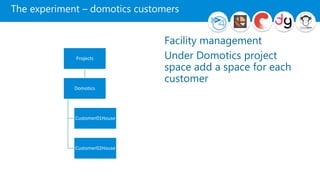
The experiment – domotics customers
Projects
Domotics
Customer01House
Customer02House
Facility management
Under Domotics project
space add a space for each
customer
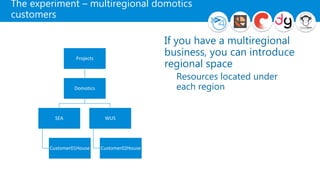
The experiment – multiregional domotics
customers
Projects
Domotics
SEA
Customer01House
WUS
Customer02House
If you have a multiregional
business, you can introduce
regional space
Resources located under
each region
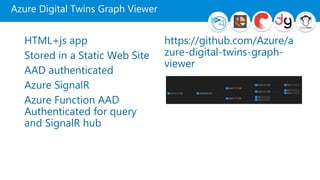
Azure Digital Twins Graph Viewer
https://github.com/Azure/a
zure-digital-twins-graph-
viewer
HTML+js app
Stored in a Static Web Site
AAD authenticated
Azure SignalR
Azure Function AAD
Authenticated for query
and SignalR hub
The static website
Interacting with the API
Swagger for the API
Generate the code with NSwagStudio (for example)
https://github.com/RSuter/NSwag/wiki/NSwagStudio
Pro
Automatic
Consistent
Cons
Verbose
Some semantics is lost (lists)
Query your devices in a multilevel tree
YOUR_MANAGEMENT_API_URL/devices?maxLevel=1 returns all devices attached to root spaces.
YOUR_MANAGEMENT_API_URL/devices?minLevel=2&maxLevel=4 returns all devices attached to spaces of
levels 2, 3 or 4.
YOUR_MANAGEMENT_API_URL/devices?spaceId=mySpaceId returns all devices directly attached to
mySpaceId.
YOUR_MANAGEMENT_API_URL/devices?spaceId=mySpaceId&traverse=Down returns all devices attached
to mySpaceId or one of its descendants.
YOUR_MANAGEMENT_API_URL/devices?spaceId=mySpaceId&traverse=Down&minLevel=1&minRelative=t
rue returns all devices attached to descendants of mySpaceId, excluding mySpaceId.
YOUR_MANAGEMENT_API_URL/devices?spaceId=mySpaceId&traverse=Down&minLevel=1&minRelative=t
rue&maxLevel=1&maxRelative=true returns all devices attached to immediate children of mySpaceId.
YOUR_MANAGEMENT_API_URL/devices?spaceId=mySpaceId&traverse=Up&maxLevel=-
1&maxRelative=true returns all devices attached to one of the ancestors of mySpaceId.
YOUR_MANAGEMENT_API_URL/devices?spaceId=mySpaceId&traverse=Down&maxLevel=5 returns all
devices attached to descendants of mySpaceId that are at level smaller than or equal to 5.
YOUR_MANAGEMENT_API_URL/devices?spaceId=mySpaceId&traverse=Span&minLevel=0&minRelative=tr
ue&maxLevel=0&maxRelative=true returns all devices attached to spaces that are at the same level as
mySpaceId.
IoTHub
Is a resource for the graph
You associate to a space
Use in descendant devices
During the preview
One per DT
Auto provisioned, not
external
Hungs during deployment in
West Europe (currently
working in East US)
AddSpaces
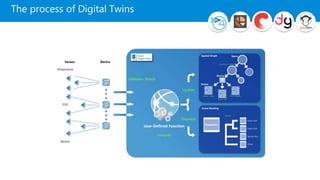
The process of Digital Twins
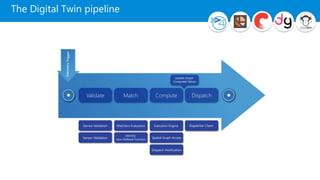
The Digital Twin pipeline
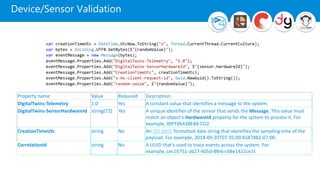
Device/Sensor Validation
Property name Value Required Description
DigitalTwins-Telemetry 1.0 Yes A constant value that identifies a message to the system.
DigitalTwins-SensorHardwareId string(72) Yes A unique identifier of the sensor that sends the Message. This value must
match an object's HardwareId property for the system to process it. For
example, 00FF0643BE88-CO2.
CreationTimeUtc string No An ISO 8601 formatted date string that identifies the sampling time of the
payload. For example, 2018-09-20T07:35:00.8587882-07:00.
CorrelationId string No A UUID that's used to trace events across the system. For
example, cec16751-ab27-405d-8fe6-c68e1412ce1f.
Data processing
A UDF in Javascript handles/process the value
Multiple UDFs can be defined
A set of matchers decide which UDF handles
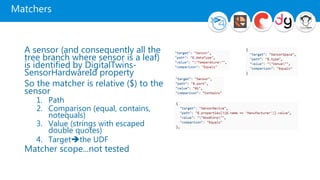
Matchers
A sensor (and consequently all the
tree branch where sensor is a leaf)
is identified by DigitalTwins-
SensorHardwareId property
So the matcher is relative ($) to the
sensor
1. Path
2. Comparison (equal, contains,
notequals)
3. Value (strings with escaped
double quotes)
4. Targetthe UDF
Matcher scope...not tested
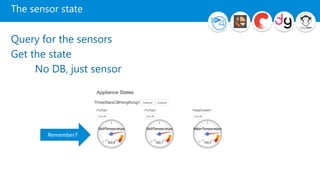
The sensor state
Query for the sensors
Get the state
No DB, just sensor
Remember?
SetTemperatureSensorValueUDF
SendFakeData
WatchData
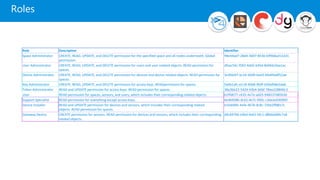
Roles
Role Description Identifier
Space Administrator CREATE, READ, UPDATE, and DELETE permission for the specified space and all nodes underneath. Global
permission.
98e44ad7-28d4-4007-853b-b9968ad132d1
User Administrator CREATE, READ, UPDATE, and DELETE permission for users and user-related objects. READ permission for
spaces.
dfaac54c-f583-4dd2-b45d-8d4bbc0aa1ac
Device Administrator CREATE, READ, UPDATE, and DELETE permission for devices and device-related objects. READ permission for
spaces.
3cdfde07-bc16-40d9-bed3-66d49a8f52ae
Key Administrator CREATE, READ, UPDATE, and DELETE permission for access keys. READpermission for spaces. 5a0b1afc-e118-4068-969f-b50efb8e5da6
Token Administrator READ and UPDATE permission for access keys. READ permission for spaces. 38a3bb21-5424-43b4-b0bf-78ee228840c3
User READ permission for spaces, sensors, and users, which includes their corresponding related objects. b1ffdb77-c635-4e7e-ad25-948237d85b30
Support Specialist READ permission for everything except access keys. 6e46958b-dc62-4e7c-990c-c3da2e030969
Device Installer READ and UPDATE permission for devices and sensors, which includes their corresponding related
objects. READ permission for spaces.
b16dd9fe-4efe-467b-8c8c-720e2ff8817c
Gateway Device CREATE permission for sensors. READ permission for devices and sensors, which includes their corresponding
related objects.
d4c69766-e9bd-4e61-bfc1-d8b6e686c7a8
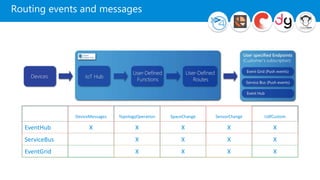
Routing events and messages
DeviceMessages TopologyOperation SpaceChange SensorChange UdfCustom
EventHub X X X X X
ServiceBus X X X X
EventGrid X X X X
AddEndpoints
GetTopologyChanges
ServiceBus
SignalR
Conclusions
It’s state
It’s not a database, but it has query semantics
It has declarative semantics as a rule-based engine
It can be infinite scalable using one only services rather then
more than one (AKS or SF or Redis)
It’s a first preview
No resource management
Scalability not evaluable
Define better integration with IoT Hub and offering
Geo/Manual Failover
DPS
IoT Edge semantics missing (device pipeline)
Difficult server-side pipeline debugging
JavaScript-only
Not observable
What is a Graph Database
A Graph Database is a Database that is modelled as a Graph
Traditional data modeling focuses on entities.
For many applications, there's also a need to model both
entities and relationships naturally.
Both vertices and edges can have an arbitrary number of
properties.
https://www.slideshare.net/marco.parenzan/graph-
databases-in-the-microsoft-ecosystem
Thanks
Questions?
marco.parenzan marco_parenzan marcoparenzan
@cloudgen_verona
#GlobalAzure
#CloudGenVerona

Azure Digital Twins

  • 1.
    1 TOPIC Azure Digital Twins MarcoParenzan @marco_parenzan
  • 2.
  • 3.
    Who I am marco_parenzan marco.parenzan marcoparenzan MarcoParenzan Solutions Sales Specialist @ Insight Microsoft MVP 2018-2019 for Azure Community Lead per 1nn0va
  • 4.
  • 5.
    IoT Hub «stateof the art» Telemetry Ingestion and Controlling You have seen lot of times https://www.slideshare.net/marco.parenzan/sviluppare-un- portale-per-gestire-la-tua-soluzione-iot-hub
  • 6.
  • 7.
  • 8.
    The IoTHub registry Storekey/value flat data to the device Example CRM Key Spare Part Key ... 1Thing = 1Device
  • 9.
    The device state(aka the twin) Solved (?) Function+Storage (persistent) EventGrid+WebHook (in memory) ...but always custom And you have living... ...physical properties ...computed properties (javascript or Roslyn computed) This is dangerously stateful Stateless is expensive
  • 10.
    IoT State Telemetry Azure IoT Hub Stream Analytics Ingestion AzureContainer Instance Azure Service Fabric Mesh Azure Function Azure Redis Cache State
  • 11.
    Another Research Area... Buildingan event processor (ASP.NET Core, IHostedService Make it observable, SignalR) Notify with EventGrid Run in Azure Container Instances (ACI) https://www.slideshare.net/marco.parenzan/stateful-stream- processing-of-iiot-events-with-c-and-containers Event Processing Hopping Window Accumulating Events in windows Releasing Windows Persisting Windows Generate a (new) Event
  • 12.
    So another pointof view Messaging FlowGovernance State
  • 13.
    The PaaS ofthe IoT State Any idea?
  • 14.
  • 15.
    What is DigitalTwin? It is another point of view modeling your real infrastructure in the cloud Focused mainly on resources, where there are the devices too... Not only devices! Using «spatial intelligence» graphs Inheritance (security, for example) Filtering Traversing (the graph, different levels) Scalability (it’s a DB...) Extensible (with customizable enumerations and ontologies)
  • 16.
    The difference betweenDeviceTwin and Digital Twin Twin is a cloud based rapresentation of something that is remote DeviceTwin is A key/value flat representation of Desired configuration Reported configuration Keys to match to an external database Digital Twin is A graph (tree…someone asking for graph) Richer semantics Also not only devices
  • 17.
    Defining the spatialmodel Spaces are virtual or physical locations Devices are virtual or physical pieces of equipment Sensors are objects that detect events Users identify occupants and their characteristics. Blobs are attached to objects (such as spaces, devices, sensors, and users) Extended types are extensible enumerations that augment entities with specific characteristics
  • 18.
    Defining the processingmodel Resources are attached to a space and typically represent Azure resources to be used by objects in the spatial graph User-defined functions (UDFs) allow customizable sensor telemetry processing within the spatial graph. Currently, UDFs can be written in JavaScript. Matchers are objects that determine which UDFs are executed for a given telemetry message. Role assignments are the association between a role and an object in the spatial graph Endpoints are the locations where telemetry messages and Digital Twins events can be routed
  • 19.
    Other part ofthe model Ontologies represent a set of extended types Property keys and values are custom characteristics of spaces, devices, sensors, and users Roles are sets of permissions assigned to users and devices in the spatial graph Security key stores provide the security keys for all devices in the hierarchy under a given space object to allow the device to securely communicate with Digital Twins.
  • 20.
    Space This is thefirst methaphor in Digital Twins You can create hierarchies of spaces
  • 21.
    Root space Projects Project 1Project 2 Preview One instance of Digital Twins per subscription Overall, a multitenant approach Use a root node for all projects Use a child root node for each project And in experimentation you can leave it there if garbage (ex. When you create iothub resources) Good governance practice
  • 22.
    The experiment –domotics customers Projects Domotics Customer01House Customer02House Facility management Under Domotics project space add a space for each customer
  • 23.
    The experiment –multiregional domotics customers Projects Domotics SEA Customer01House WUS Customer02House If you have a multiregional business, you can introduce regional space Resources located under each region
  • 24.
    Azure Digital TwinsGraph Viewer https://github.com/Azure/a zure-digital-twins-graph- viewer HTML+js app Stored in a Static Web Site AAD authenticated Azure SignalR Azure Function AAD Authenticated for query and SignalR hub
  • 25.
  • 26.
    Interacting with theAPI Swagger for the API Generate the code with NSwagStudio (for example) https://github.com/RSuter/NSwag/wiki/NSwagStudio Pro Automatic Consistent Cons Verbose Some semantics is lost (lists)
  • 27.
    Query your devicesin a multilevel tree YOUR_MANAGEMENT_API_URL/devices?maxLevel=1 returns all devices attached to root spaces. YOUR_MANAGEMENT_API_URL/devices?minLevel=2&maxLevel=4 returns all devices attached to spaces of levels 2, 3 or 4. YOUR_MANAGEMENT_API_URL/devices?spaceId=mySpaceId returns all devices directly attached to mySpaceId. YOUR_MANAGEMENT_API_URL/devices?spaceId=mySpaceId&traverse=Down returns all devices attached to mySpaceId or one of its descendants. YOUR_MANAGEMENT_API_URL/devices?spaceId=mySpaceId&traverse=Down&minLevel=1&minRelative=t rue returns all devices attached to descendants of mySpaceId, excluding mySpaceId. YOUR_MANAGEMENT_API_URL/devices?spaceId=mySpaceId&traverse=Down&minLevel=1&minRelative=t rue&maxLevel=1&maxRelative=true returns all devices attached to immediate children of mySpaceId. YOUR_MANAGEMENT_API_URL/devices?spaceId=mySpaceId&traverse=Up&maxLevel=- 1&maxRelative=true returns all devices attached to one of the ancestors of mySpaceId. YOUR_MANAGEMENT_API_URL/devices?spaceId=mySpaceId&traverse=Down&maxLevel=5 returns all devices attached to descendants of mySpaceId that are at level smaller than or equal to 5. YOUR_MANAGEMENT_API_URL/devices?spaceId=mySpaceId&traverse=Span&minLevel=0&minRelative=tr ue&maxLevel=0&maxRelative=true returns all devices attached to spaces that are at the same level as mySpaceId.
  • 28.
    IoTHub Is a resourcefor the graph You associate to a space Use in descendant devices During the preview One per DT Auto provisioned, not external Hungs during deployment in West Europe (currently working in East US)
  • 29.
  • 30.
    The process ofDigital Twins
  • 31.
    The process ofDigital Twins
  • 32.
  • 33.
    Device/Sensor Validation Property nameValue Required Description DigitalTwins-Telemetry 1.0 Yes A constant value that identifies a message to the system. DigitalTwins-SensorHardwareId string(72) Yes A unique identifier of the sensor that sends the Message. This value must match an object's HardwareId property for the system to process it. For example, 00FF0643BE88-CO2. CreationTimeUtc string No An ISO 8601 formatted date string that identifies the sampling time of the payload. For example, 2018-09-20T07:35:00.8587882-07:00. CorrelationId string No A UUID that's used to trace events across the system. For example, cec16751-ab27-405d-8fe6-c68e1412ce1f.
  • 34.
    Data processing A UDFin Javascript handles/process the value Multiple UDFs can be defined A set of matchers decide which UDF handles
  • 35.
    Matchers A sensor (andconsequently all the tree branch where sensor is a leaf) is identified by DigitalTwins- SensorHardwareId property So the matcher is relative ($) to the sensor 1. Path 2. Comparison (equal, contains, notequals) 3. Value (strings with escaped double quotes) 4. Targetthe UDF Matcher scope...not tested
  • 36.
    The sensor state Queryfor the sensors Get the state No DB, just sensor Remember?
  • 37.
  • 38.
    Roles Role Description Identifier SpaceAdministrator CREATE, READ, UPDATE, and DELETE permission for the specified space and all nodes underneath. Global permission. 98e44ad7-28d4-4007-853b-b9968ad132d1 User Administrator CREATE, READ, UPDATE, and DELETE permission for users and user-related objects. READ permission for spaces. dfaac54c-f583-4dd2-b45d-8d4bbc0aa1ac Device Administrator CREATE, READ, UPDATE, and DELETE permission for devices and device-related objects. READ permission for spaces. 3cdfde07-bc16-40d9-bed3-66d49a8f52ae Key Administrator CREATE, READ, UPDATE, and DELETE permission for access keys. READpermission for spaces. 5a0b1afc-e118-4068-969f-b50efb8e5da6 Token Administrator READ and UPDATE permission for access keys. READ permission for spaces. 38a3bb21-5424-43b4-b0bf-78ee228840c3 User READ permission for spaces, sensors, and users, which includes their corresponding related objects. b1ffdb77-c635-4e7e-ad25-948237d85b30 Support Specialist READ permission for everything except access keys. 6e46958b-dc62-4e7c-990c-c3da2e030969 Device Installer READ and UPDATE permission for devices and sensors, which includes their corresponding related objects. READ permission for spaces. b16dd9fe-4efe-467b-8c8c-720e2ff8817c Gateway Device CREATE permission for sensors. READ permission for devices and sensors, which includes their corresponding related objects. d4c69766-e9bd-4e61-bfc1-d8b6e686c7a8
  • 39.
    Routing events andmessages DeviceMessages TopologyOperation SpaceChange SensorChange UdfCustom EventHub X X X X X ServiceBus X X X X EventGrid X X X X
  • 40.
  • 41.
  • 42.
    It’s state It’s nota database, but it has query semantics It has declarative semantics as a rule-based engine It can be infinite scalable using one only services rather then more than one (AKS or SF or Redis)
  • 43.
    It’s a firstpreview No resource management Scalability not evaluable Define better integration with IoT Hub and offering Geo/Manual Failover DPS IoT Edge semantics missing (device pipeline) Difficult server-side pipeline debugging JavaScript-only Not observable
  • 44.
    What is aGraph Database A Graph Database is a Database that is modelled as a Graph Traditional data modeling focuses on entities. For many applications, there's also a need to model both entities and relationships naturally. Both vertices and edges can have an arbitrary number of properties. https://www.slideshare.net/marco.parenzan/graph- databases-in-the-microsoft-ecosystem
  • 45.
  • 46.