Triple Bottom Line(TBL) Principle
• Introduced by John Elkington in 1994.
• A framework for measuring business success
beyond financial profits.
• Considers three key dimensions:
• People (Social impact)
• Planet (Environmental impact)
• Profit (Economic performance)
• Encourages sustainable development in
organizations.
3.
The Three Pillarsof TBL
• People (Social Responsibility)
• Planet (Environmental Responsibility)
• Profit (Economic Viability)
4.
The Three Pillarsof TBL
• People (Social Responsibility)
• Focuses on fair labor practices, community
engagement, and employee well-being.
• Companies invest in:
• Employee health and safety.
• Ethical labor practices.
• Diversity and inclusion.
• Community development projects.
5.
The Three Pillarsof TBL
• Planet (Environmental Responsibility)
• Encourages sustainable use of resources and
environmental conservation.
• Key aspects:
• Reducing carbon footprint.
• Waste management and recycling.
• Energy efficiency and renewable energy adoption.
• Water conservation.
6.
The Three Pillarsof TBL
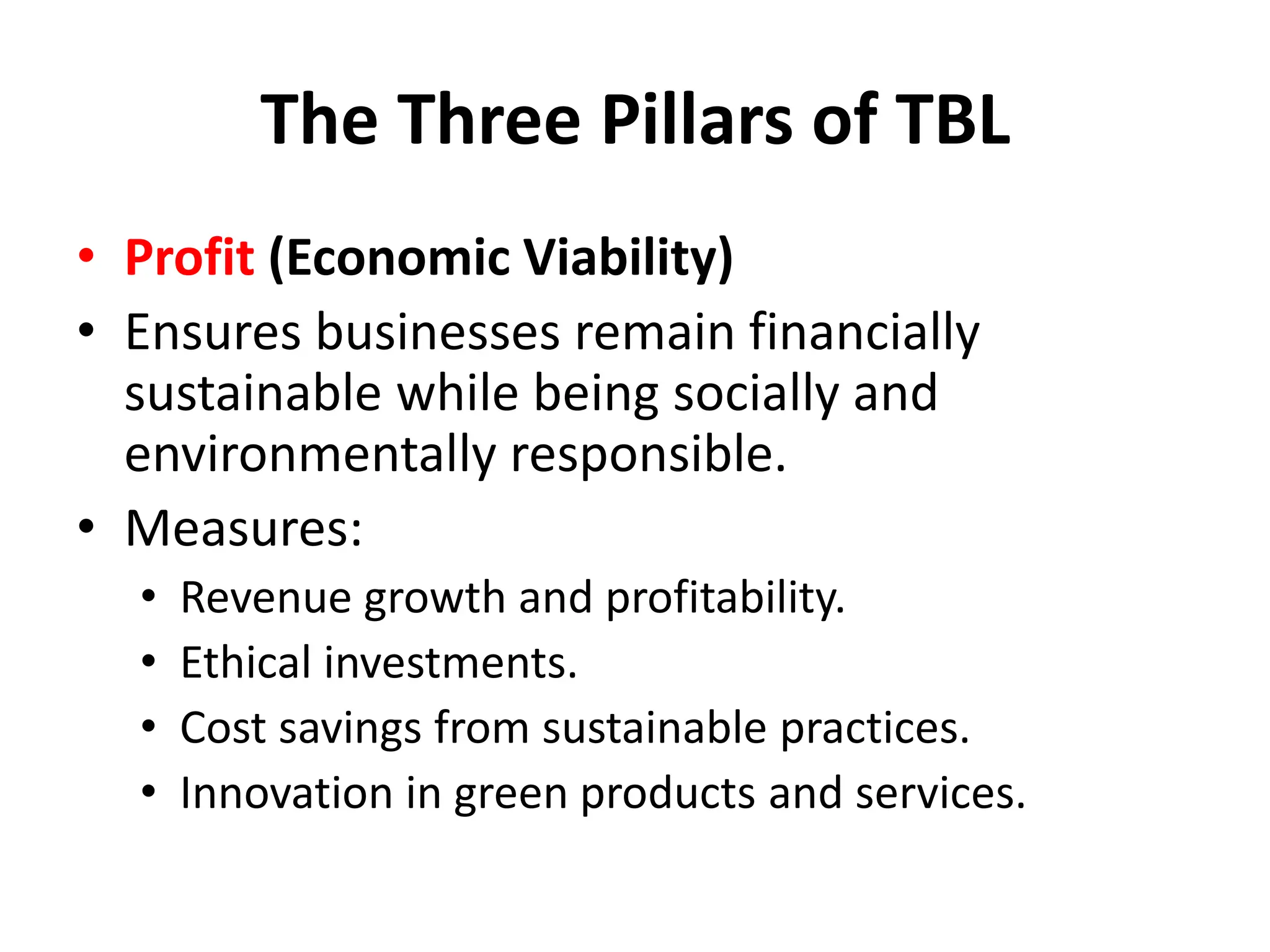
• Profit (Economic Viability)
• Ensures businesses remain financially
sustainable while being socially and
environmentally responsible.
• Measures:
• Revenue growth and profitability.
• Ethical investments.
• Cost savings from sustainable practices.
• Innovation in green products and services.
7.
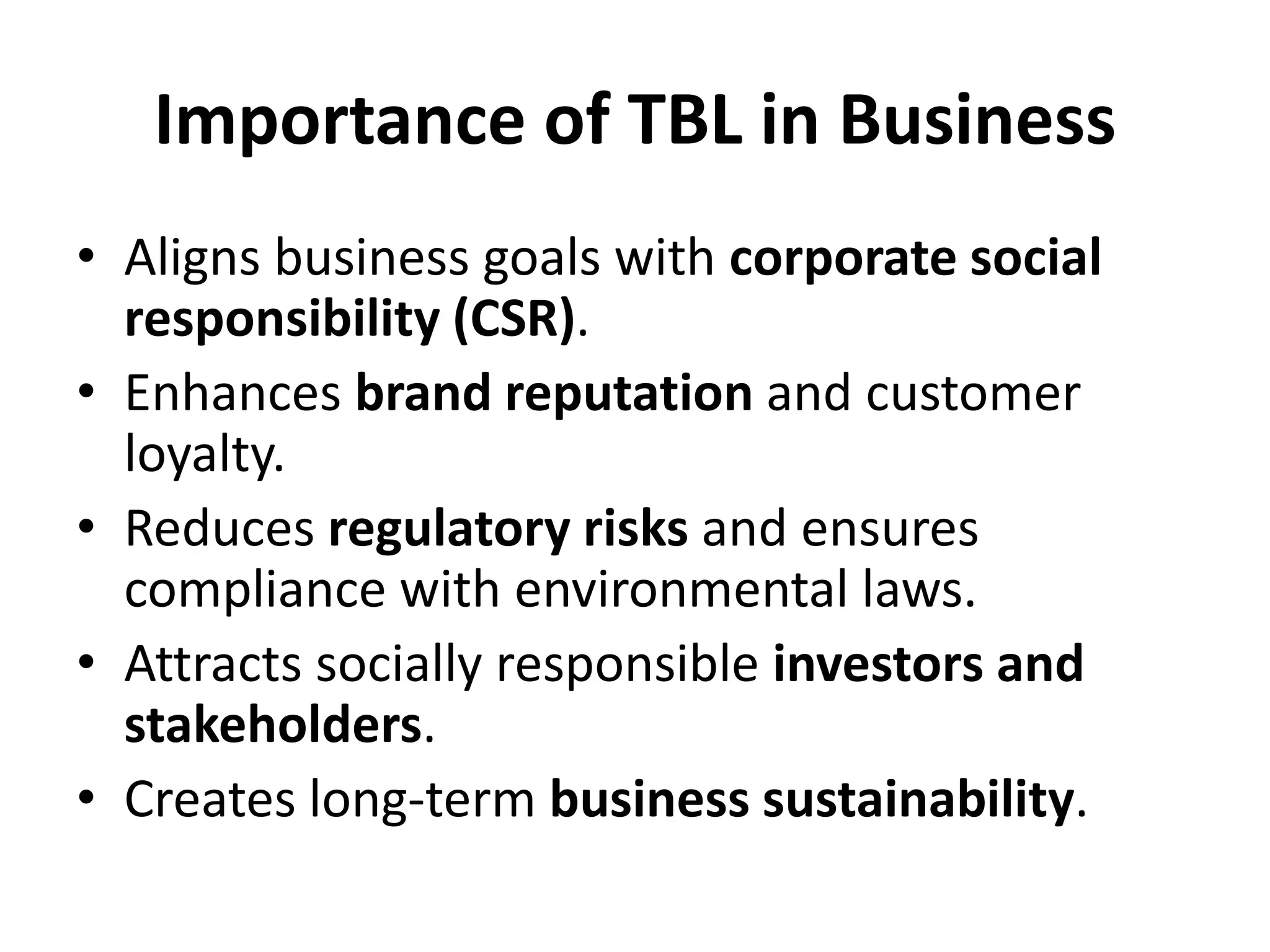
Importance of TBLin Business
• Aligns business goals with corporate social
responsibility (CSR).
• Enhances brand reputation and customer
loyalty.
• Reduces regulatory risks and ensures
compliance with environmental laws.
• Attracts socially responsible investors and
stakeholders.
• Creates long-term business sustainability.
8.
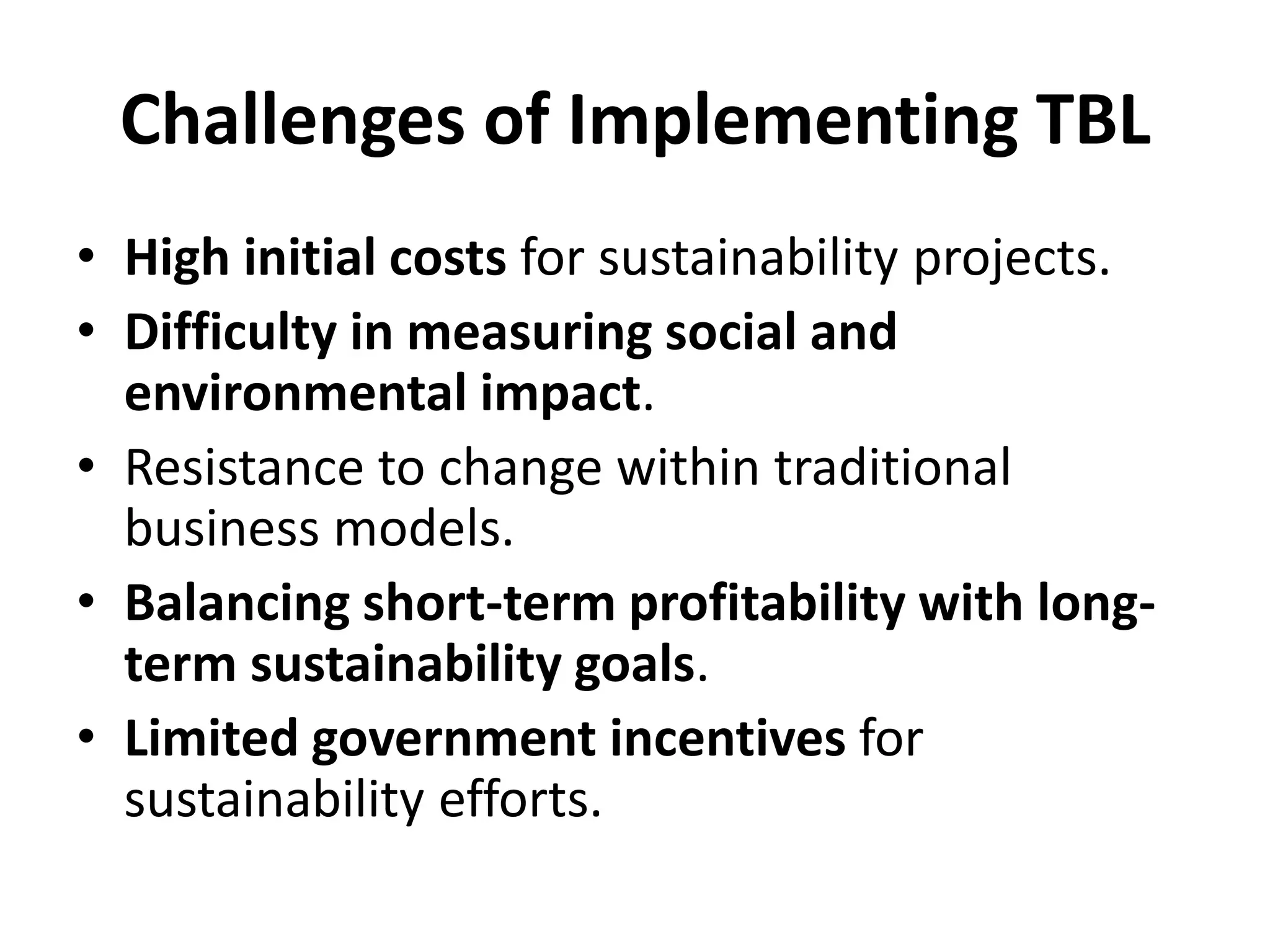
Challenges of ImplementingTBL
• High initial costs for sustainability projects.
• Difficulty in measuring social and
environmental impact.
• Resistance to change within traditional
business models.
• Balancing short-term profitability with long-
term sustainability goals.
• Limited government incentives for
sustainability efforts.
9.
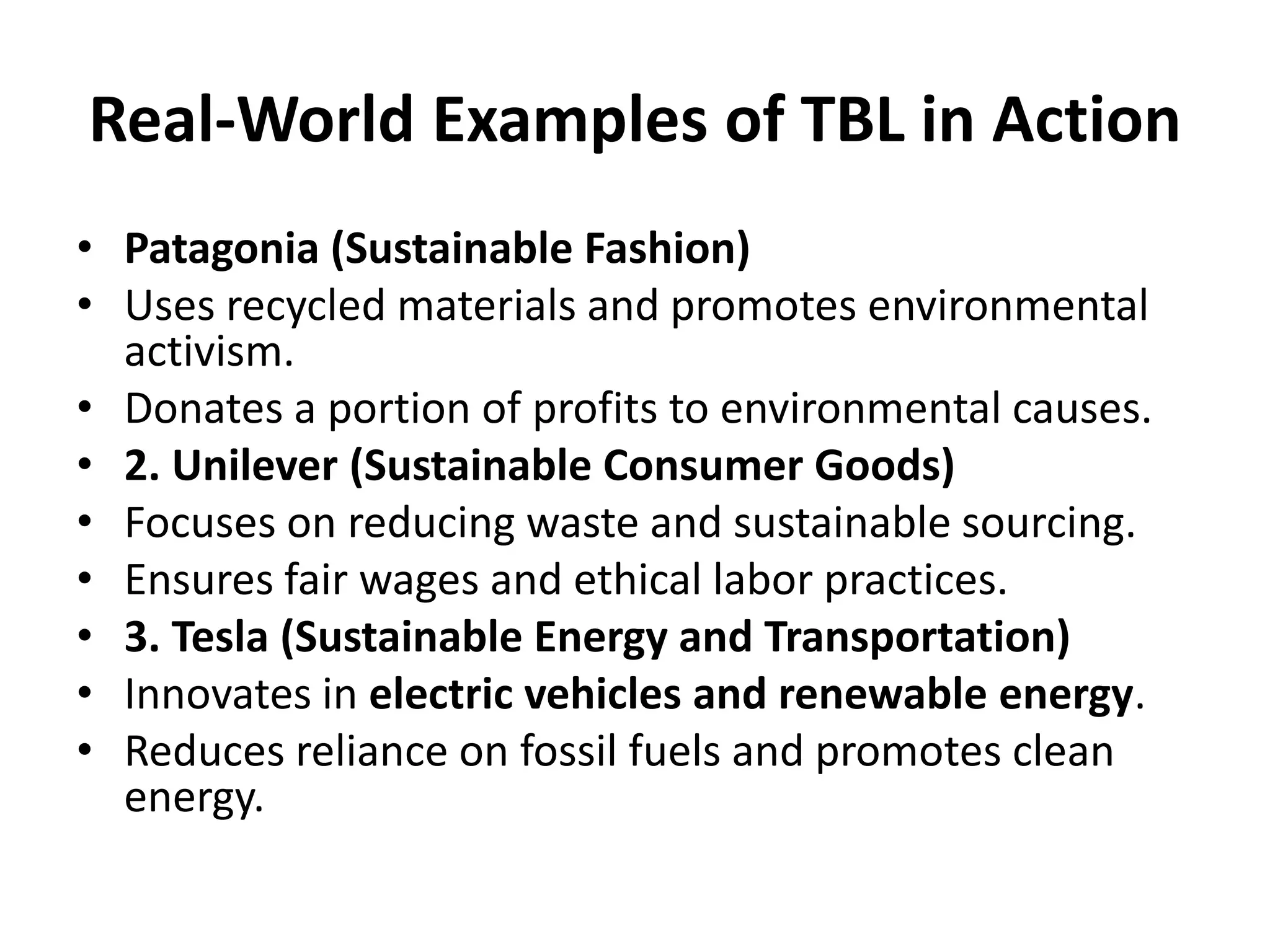
Real-World Examples ofTBL in Action
• Patagonia (Sustainable Fashion)
• Uses recycled materials and promotes environmental
activism.
• Donates a portion of profits to environmental causes.
• 2. Unilever (Sustainable Consumer Goods)
• Focuses on reducing waste and sustainable sourcing.
• Ensures fair wages and ethical labor practices.
• 3. Tesla (Sustainable Energy and Transportation)
• Innovates in electric vehicles and renewable energy.
• Reduces reliance on fossil fuels and promotes clean
energy.
10.
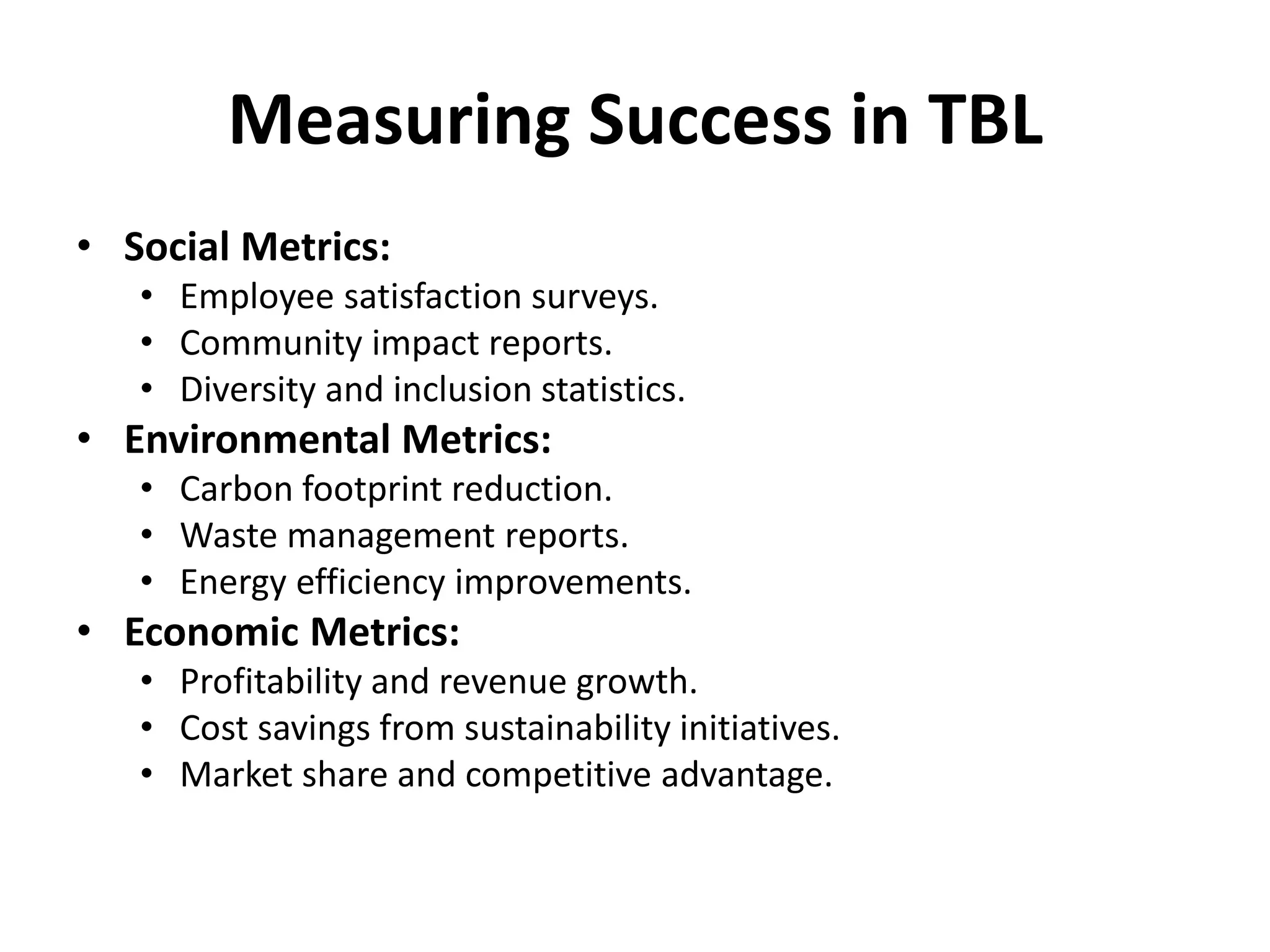
Measuring Success inTBL
• Social Metrics:
• Employee satisfaction surveys.
• Community impact reports.
• Diversity and inclusion statistics.
• Environmental Metrics:
• Carbon footprint reduction.
• Waste management reports.
• Energy efficiency improvements.
• Economic Metrics:
• Profitability and revenue growth.
• Cost savings from sustainability initiatives.
• Market share and competitive advantage.
11.
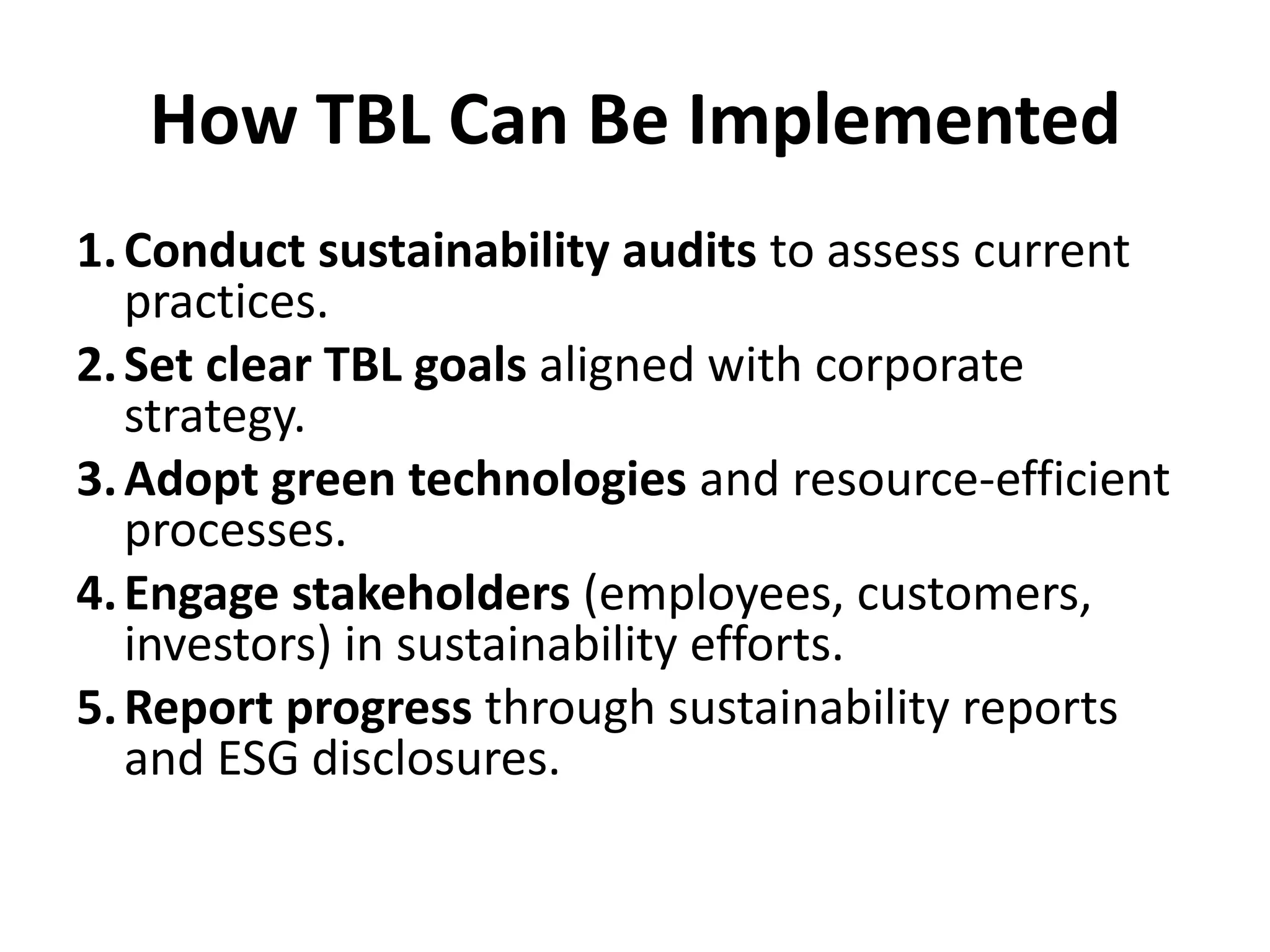
How TBL CanBe Implemented
1.Conduct sustainability audits to assess current
practices.
2.Set clear TBL goals aligned with corporate
strategy.
3.Adopt green technologies and resource-efficient
processes.
4.Engage stakeholders (employees, customers,
investors) in sustainability efforts.
5.Report progress through sustainability reports
and ESG disclosures.