Abdul Wali Khan University Mardan Pakistan. http://www.awkum.edu.pk/
ABDUL WALI KHAN UNIVESITY
MARDAN
Abdul Wali Khan University Mardan Pakistan. www.awkum.edu.pk
LANGUAGE IN EDUCATION: GLOBAL ENGLISHES
TOPIC: “CURRENT DEBATES IN GLOBAL
ENGLISHES”
“STANDARDS ACROSS CHANNELS”
PRESENTED BY: UMAIR KHAN
COURSE TUTOR: Prof. Dr. Ayaz Ahmad
Abdul Wali Khan University Mardan Pakistan. www.awkum.edu.pk
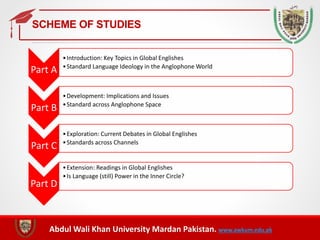
SCHEME OF STUDIES
Part A
•Introduction: Key Topics in Global Englishes
•Standard Language Ideology in the Anglophone World
Part B
•Development: Implications and Issues
•Standard across Anglophone Space
Part C
•Exploration: Current Debates in Global Englishes
•Standards across Channels
Part D
•Extension: Readings in Global Englishes
•Is Language (still) Power in the Inner Circle?
Abdul Wali Khan University Mardan Pakistan. www.awkum.edu.pk
Part A: Introduction: Standard Language Ideology in
the Anglophone World
 Standard Language is the variety of a language that is considered to be the norm.
 Optimum for educational use and used as a yardstick.
 Prestige Variety, spoken by minority, Milroy (2001, 532).

Abdul Wali Khan University Mardan Pakistan. www.awkum.edu.pk
3….Comparison between Dialect and Register
A dialect generally refers to a variety of a language that is a characteristic of a particular
group of the language's speakers while a register is a variety of a language used for a
particular purpose or in a particular social setting.
A dialect generally refers to a variety of a language that is a characteristic of a particular
group of the language's speakers while a register is a variety of a language used for a
particular purpose or in a particular social setting.
Dialect: refers to a variety of a language that can signal the speaker’s regional or social
background. • Dialect is a variety of language which differs grammatically, phonologically
and lexically from other varieties, and which is associated with a particular social class or
status group. • Examples : Australian dialect, Indian dialect. Dialects
4. Kinds of dialects 1. Regional Dialects • A regional dialect is a variety associated with a
place • Examples : Dialect brebes, Dialect tegal
CONTINUED……….
Abdul Wali Khan University Mardan Pakistan. www.awkum.edu.pk
4…….CONTINUED
Register • A register is a variety of a language used for a particular purpose or in a
particular social setting • Registers can simply be described as variations of the language
according to its use, while the dialect as a language variation based on users registers on
this concept is not limited to the choice of words (such as the notion registers in the
traditional theory) but also includes the choice of the use of text structure, and texture. •
Example : English journalist
. Style • Style relates to the typical ways in which one or more people do a particular thing.
• Examples : - Formal – Informal.
In German-speaking Switzerland, for example, most speakers use their local nonstandard
dialect in nearly all social situations and for nearly all purposes. Thus it is that one may
hear, in the corridors of the University of Berne, two philosophy professors discussing the
works of Kant using all the appropriate philosophical vocabulary while using the
phonology and grammar of their local dialect.
Abdul Wali Khan University Mardan Pakistan. www.awkum.edu.pk
5……Synchronic and Diachronic Studies
Synchronic study: A study that is done at a single point in time rather than over the course
of a period of time (longitudinally).
A synchronic approach (from Greek συν- "together" and χρόνος "time") considers a
language at a moment in time without taking its history into account. ... By contrast,
a diachronic approach (from δια- "through" and χρόνος "time") considers the development
and evolution of a language through history.
Diachronic linguistics is the study of the changes in language over
time. Synchronic linguistics is the study of the linguistic elements and usage of a language
at a particular moment. Diachronic analysis can be the general evolution of all languages
or the evolution of a particular language or dialect.
Lnguistics, relating to the study of a language at only one point in its history): Synchronic
comparison of two languages focuses on categorizing phenomena typologically, whereas a
diachronic comparison may be looking for common origins or causes of these phenomena,
viewed as genetic relationships.
Abdul Wali Khan University Mardan Pakistan. www.awkum.edu.pk
6….. Parallelism
Parallelism is a literary device in which parts of the sentence are grammatically the same,
or are similar in construction. It can be a word, a phrase, or an entire sentence repeated.
King's famous 'I have a dream' repetition makes the speech compelling and rhythmic, as
well as memorable.
In grammar, parallelism, also known as parallel structure or parallel construction, is a
balance within one or more sentences of similar phrases or clauses that have the same
grammatical structure. The application of parallelism affects readability and may make
texts easier to process.
Short Examples of Parallelism in Speech
They got together, conversed, and dispersed, but to no avail. He came, he saw, and he
conquered. He wanted to have a new house to live in, and a new car to drive. The applicant
was approached through telephone, email, and snail mail.
Abdul Wali Khan University Mardan Pakistan. www.awkum.edu.pk
7……Poetic Diction
Poetic diction refers to the operating language of poetry, language employed in a
manner that sets poetry apart from other kinds of speech or writing. It involves the
vocabulary, the phrasing, and the grammar considered appropriate and
inappropriate to poetry at different times.
Formal diction. Formal diction is the use of sophisticated language, without slang
or colloquialisms. ...
Informal diction. ...
Pedantic diction. ...
Colloquial diction. ...
Slang diction. ...
Abstract diction. ...
Concrete diction. ...
Poetic diction ….Continued……
Abdul Wali Khan University Mardan Pakistan. www.awkum.edu.pk
8…..continued
Diction refers to the author's choice of words and the order of the words within a poem.
Words serve multiple purposes, given their presence and arrangement. ... Diction reflects
the writer's vision and steers the reader's thought. It does not only communicate originality
in writing, but it sustains the writers' purpose.
Diction Sentence Examples.
His perfect diction never failed to be commented on. Clear diction, not a "posh voice",
was what was wanted. His diction is pure, his style correct, his versification smooth
though monotonous.
The real poetic diction, in the view of the Wordsworth, is the natural overflow of the
feelings, therefore, it is immune to the deliberate decoration of the
language. Wordsworth also attributes the quality of giving pleasure to the natural poetic
diction. It must not contain any vulgarity and disgusting element
Abdul Wali Khan University Mardan Pakistan. www.awkum.edu.pk
9….Style
The style in writing can be defined as the way a writer writes. It is the technique that an
individual author uses in his writing. It varies from author to author, and depends upon one's
syntax, word choice, and tone. It can also be described as a “voice” that readers listen to when
they read the work of a writer.
There are five main types of writing: expository, descriptive, narrative persuasive and
creative. There are many other subtypes that fall under these titles but it's easiest to
start here. Expository writing is where the author intends to inform, explain, describe or
define their subject to you.
Writing style is how the writer chooses to express himself or herself through writing.
There are four main types of writing - expository, persuasive, descriptive,
and narrative - and each one has a specific style.
The Ability to Communicate. Writing is the art of communication. ...
The Power of Observation. On some level, all authors possess the power of
observation. ...
Reasoning and Problem Solving. ...
Knowledge of Grammar, Spelling, and Punctuation. ...
Fearlessness………CONTINUED…..
Abdul Wali Khan University Mardan Pakistan. www.awkum.edu.pk
10……..CONTINUED
Poetic Style…
. Style in poetry involves the method which a poet uses to convey meaning, tone, and emotion in
his/her poem. ... Certainly, an ode or a sonnet is a more formal arrangement used more for a
serious subject (unless the poet is being satirical). Musical devices such as rhythm and rhyme are
part of a poet's style. The following are the different types with style formats.
Blank verse. Blank verse is poetry written with a precise meter—almost always iambic
pentameter—that does not rhyme. ...
Rhymed poetry. In contrast to blank verse, rhymed poems rhyme by definition, although
their scheme varies. ...
Free verse. ...
Epics. ...
Narrative poetry. ...
Haiku. ...
Pastoral poetry. ...
Sonnet.
Abdul Wali Khan University Mardan Pakistan. www.awkum.edu.pk
11.... Assonance
Assonance is the repetition of a vowel sound or diphthong in non-rhyming words. To
qualify as assonance, the words must be close enough for the repetition of the sound to be
noticeable. Assonance is a common literary technique used in poetry and prose, and is
widely found in English verse.
EXAMPLES….
Beside the lake, beneath the trees, Fluttering and dancing in the breeze. To ask if
there is some mistake. Of easy wind and downy flake.
The light of the fire is a sight. ( ...
Go slow over the road. ( ...
Peter Piper picked a peck of pickled peppers (repetition of the short e and long i
sounds)
Sally sells sea shells beside the sea shore (repetition of the short e and long e
sounds)
Try as I might, the kite did not fly.
Abdul Wali Khan University Mardan Pakistan. www.awkum.edu.pk
12…..Resonance in Poetry
Resonance is the afterglow of a poem, the thoughts and feelings that keep running through
your mind after the poem has been heard or read.
Literary Resonance in the Art of Writing. To "resonate" literally means to bounce back
and forth between two states or places. Resonate comes from the Latin word for "resound."
In sound, resonance is a prolonged response to something that caused things to vibrate.
... Resonance has long been used to impress people.
Emotion Resonance is “I feel your pain”, and can be of two types: identical resonance –
realizing that someone else is in pain and then actually feeling the pain yourself or
reactive resonance – when you sympathize with someone else's pain and feel inclined to
help (source: Ekman's taxonomy of compassion
Abdul Wali Khan University Mardan Pakistan. www.awkum.edu.pk
14,…….Alliteration
Alliteration is the repetition of the same consonant sounds at the beginning of words that
are in close proximity to each other. ... In poems, alliteration can also refer to repeated
consonant sound in the stressed syllables of a line.
To identify alliteration in a poem, look for pairs or groups of words that begin
with the same phonetic sound. Words may begin with identical letters or with letter
combinations that create similar sounds. For example, "nest" and "know"
create alliteration with similar opening sounds.
EXAMPLES
Peter Piper picked a peck of pickled peppers. ...
A good cook could cook as much cookies as a good cook who could cook cookies.
Black bug bit a big black bear. ...
Sheep should sleep in a shed.
I saw a saw that could out saw any other saw I ever saw.
Abdul Wali Khan University Mardan Pakistan. www.awkum.edu.pk
15……Metre in Poetry,,,
Meter is a stressed and unstressed syllabic pattern in a verse, or within the lines of
a poem. Stressed syllables tend to be longer, and unstressed shorter. In simple
language, meter is a poetic device that serves as a linguistic sound pattern for the verses,
as it gives poetry a rhythmical and melodious sound.
Rhythm and Meter in English Poetry. English poetry employs five basic rhythms of
varying stressed (/) and unstressed (x) syllables. The meters are iambs, trochees, spondees,
anapests and dactyls.
For example: ICE CREAM, HOT LINE, CELL PHONE. Dactyl: Three syllables, the first
of which is stressed and the next two of which are unstressed. For example, ELephant,
POSSible, TRINity. Anapest: Three syllables, the first two of which are unstressed and the
third of which is stressed.
Abdul Wali Khan University Mardan Pakistan. www.awkum.edu.pk
16……Rhyme and Rhythm
The concept of 'rhythm and rhyme' refers to a pattern of rhymes that is created by using
words that produce the same, or similar sounds. Rhythm and rhyme together refer to the
recurrence of similar sounds in prose and poetry, creating a musical, gentle effect.
Rhythm can be described as the beat and pace of a poem. Rhythm is created by the
pattern of stressed and unstressed syllables. Rhythm can help to strengthen the meaning of
words and ideas in a poem.
he Importance of Rhyme
Rhyme, along with meter, helps make a poem musical. In traditional poetry, a
regular rhyme aids the memory for recitation and gives predictable pleasure. A pattern
of rhyme, called a scheme, also helps establish the form. ... In this pattern, the lines with
the same letter rhyme with each other.
Abdul Wali Khan University Mardan Pakistan. www.awkum.edu.pk
17…..Suprasegmental Features in Linguistics and
Literature
Suprasegmental, also called prosodic feature, in phonetics, a speech feature such as
stress, tone, or word juncture that accompanies or is added over consonants and vowels;
these features are not limited to single sounds but often extend over syllables, words, or
phrases.
Suprasegmental features are things such as stressed syllables, tone, pitch, intonation. In
poetry, the pattern of stressed and unstressed syllables gives you the rhythm and meter of
the poem. In that case, a knowledge of suprasegmentals (or prosody) helps in determining
the structure and cadence of the poem.
In speech, suprasegmental refers to a phonological property of more than one sound
segment. Also called nonsegmental. As discussed in the examples and observations
below, suprasegmental information applies to several different linguistic phenomena
(such as pitch, duration, and loudness)
Abdul Wali Khan University Mardan Pakistan. www.awkum.edu.pk
18….Tropes
A literary trope is the use of figurative language, via word, phrase or an image, for artistic
effect such as using a figure of speech. The word trope has also come to be used for
describing commonly recurring literary and rhetorical devices, motifs or clichés in
creative works.
Function of Trope
Since trope is a figurative expression, its major function is to give additional meaning to
the texts, and allow readers to think profoundly, to understand the idea or a character. Also,
it creates images that produce artistic effects on the audience's senses.
Any kind of literary device or any specific example can be a trope. Most often the word
is used to refer to tropes that are widespread such as irony, metaphor, juxtaposition, and
hyperbole, or themes such as 'the noble savage' or 'the reluctant hero.
Schemes and Tropes. Schemes and tropes are figures of speech, having to do with using
language in an unusual or “figured” way: ... A trope uses a word in an unusual or
unexpected way. Scheme: An artful deviation from the ordinary arrangement of words.
A scheme is a creative alteration in the usual order of words
Abdul Wali Khan University Mardan Pakistan. www.awkum.edu.pk
19……Conflation as an Intentional Trope…
Combination of the features of two separate things in one word (intentionally), or in one's mind or thinking
(unintentionally). Intentional conflation is often a literary trope, a device. For example.
Allegory: An allegory is a work of art, such as a story or painting, in which the characters, images, and/or events act as
symbols.
Antanaclasis: Antanaclasis is to repeat a word or phrase but with a different meaning than in the first case.
Euphemism: A euphemism is a polite or mild word or expression used to refer to something embarrassing, taboo, or
unpleasant.
Irony: Irony is a contrast or incongruity between expectations for a situation and what is reality.
Meiosis: Meiosis is a figure of speech that minimizes the importance of something through euphemism.
Metaphor: A metaphor is a rhetorical figure of speech that compares two subjects without the use of “like” or “as.”
Metonymy: Metonymy is a figure of speech in which something is called by a new name that is related in meaning to the
original thing or concept.
Synecdoche: Synecdoche is a figure of speech in which a word or phrase that refers to a part of something is substituted
to stand in for the whole, or vice versa.
The American literary theorist Kenneth Burke described “the four master tropes” to be metaphor, metonymy, synecdoche,
and irony.
Abdul Wali Khan University Mardan Pakistan. www.awkum.edu.pk
20….Erroneous or Misleading Tropes
Tropes are not Bad covers the bad half of this, but there are good reasons to
remember Tropes Are Not Good, too: All tropes can be written badly. This
includes tropes that everyone thinks are good, like Magnificent Bastard or sometimes an
honest smuggler can be rewritten to qualify for this same type of fallacious tropes.
Where in classical rhetoric, a trope refers to a specific figure of speech or literary device.
When you're reading a work of literature and start to recognize that the writer is making
similar “moves” over and over, you're picking up on some of that writer's favored tropes
Abdul Wali Khan University Mardan Pakistan. www.awkum.edu.pk
21….Figurative Languages..
Figurative language is when you use a word or phrase that does not have its normal
everyday, literal meaning. ... There are a few different ways to use figurative language,
including metaphors, similes, personification and hyperbole. See the table below for
some figurative language examples and definitions.
Simile.
Metaphor.
Synecdoche.
Hyperbole.
Personificati
CONTINUED............
Abdul Wali Khan University Mardan Pakistan. www.awkum.edu.pk
22….CONTINUED
Figurative language refers to the color we use to amplify our writing. It takes an ordinary
statement and dresses it up in an evocative frock. It gently alludes to something without
directly stating it. Figurative language is a way to engage your readers, guiding them
through your writing with a more creative tone.
Although it's often debated how many types of figurative language there are, it's safe to say
there are at least five main categories. They are: metaphors, similes, personification,
hyperbole, and symbolism.
Any time your writing goes beyond the actual meanings of your words, you're using
figurative language. This allows the reader to gain new insights into your work. In this
article, we'll highlight examples of the five main branches of the figurative tree, but in
truth, this is only scratching the surface. There are many other literary devices that color
our writing, including: alliteration, idioms, irony, onomatopoeia, oxymoron, puns,
and synecdoche.
Abdul Wali Khan University Mardan Pakistan. www.awkum.edu.pk
23….THE USE OF FOREIGN LANGUAGE IN DAILY
COMMUNICATION
. A foreign language is a whole new intricate system of rules, structures, and
lexis. Learning a new language means your brain has to cope with complexity as it makes
sense of and absorbs new patterns. As our brains work out the meaning, endeavoring to
communicate, we develop key learning skills such as cognitive thinking and problem-
solving. Highly developed critical thinking skills are a significant benefit both personally
and professionally.
Use it or lose it. How many times have you heard that phrase? It is a simple fact – the more
the brain is used, the better its functions work. A new language requires not only
familiarity with vocabulary and rules, but also being able to recall and apply this
knowledge. Learning a language gives your memory a good work out in the brain gym.
This means that multilingual people have brains that are more exercised and quick to recall
names, directions, facts, and figures.
Abdul Wali Khan University Mardan Pakistan. www.awkum.edu.pk
24…..CONTINUED
A study from Spain’s University of Pompeu Fabra revealed that multilingual people are
better at observing their surroundings. They easily spot anything that is irrelevant or
deceptive. They’re also better at spotting misleading information. The study was conducted
comparing multilingual and monolingual subjects and the former notably had the edge. Is
it any surprise that famous, fictional detective characters such as Sherlock Holmes and
Hercule Poirot are skilled linguists?
Learning a new language makes you more conscious of the nuts and bolts of your
own language. Terms such as vocabulary, grammar, conjugation, comprehension,
idioms and sentence structure become everyday phrases, whereas your own
language is probably absorbed more intuitively. Learning a new language also
makes you a better listener as you are used to having to interpret meaning and
judge nuances.
Abdul Wali Khan University Mardan Pakistan. www.awkum.edu.pk
25….John Donne’s Poem Analysis
There is no sharp division of style or poetic ability between the two phases
of Donne's literary career. Instead, it is only the emphasis of subject matter that
changes. Donne is ever concerned with matters of the heart, be they between a man and a
woman or between a man and his Creator.
Abdul Wali Khan University Mardan Pakistan. www.awkum.edu.pk
26….Good Morrow Analysis
“The Good Morrow” is an aubade—a morning love poem—written by the English poet
John Donne, likely in the 1590s. In it, the speaker describes love as a profound experience
that's almost like a religious epiphany. Indeed, the poem claims that erotic love can
produce the same effects that religion can. Through love, the speaker’s soul awakens;
because of love, the speaker abandons the outside world; in love, the speaker finds
immortality. This is a potentially subversive argument, for two reasons. First, because the
poem suggests that all love—even love outside of marriage—might have this
transformative, enlightening effect. Second, because of the idea that romantic love can
mirror the joys and revelations of religious devotion.
Continued
Abdul Wali Khan University Mardan Pakistan. www.awkum.edu.pk
27….continued….
“The Good Morrow” is a celebration of love, which it presents as an intense and
unparalleled pleasure. All the joys that the two lovers experienced before they found each
other pale in comparison to the joy they experience together. Indeed, love is so powerful
that the speaker describes it as an awakening of the soul: it is almost a religious
experience. And like a religious experience, it reshapes the lovers’ attitude to the world at
large. Like monks or nuns who dedicate themselves to religious practice, the two lovers
dedicate themselves to love above adventure and career success. “The Good Morrow” thus
translates romantic—and erotic—love into a religious, even holy, experience. Love itself,
the speaker suggests, is capable of producing the same insights as religion.
“The Good Morrow” separates the lives of the lovers into two parts: before they found
each other, and after. The speaker describes the first part of their lives with disdain: the
pleasures they enjoyed were “childish.” Indeed, they were not even “weaned”: they were
like babies. Like children, they had a limited understanding of life. They were aware of
only some of its “country” (or lowly) pleasures, going through the motions of life without
knowing there could be something more.
CONTINUED……
Abdul Wali Khan University Mardan Pakistan. www.awkum.edu.pk
28…….continued
Enjambment
“The Good-Morrow” contains few moments of enjambment. When the poem does use
enjambment, it does not employ any strict pattern: the enjambments are scattered
irregularly throughout the poem, with one in the opening line and two more in lines 6 and
20 (recall that enjambment need not always align with punctuation, and is more concerned
with the grammatical unit of one line spilling over onto the next—which is why line 6 is
enjambed).
Notably, however, two of the poem’s three enjambments fall in the second-to-last line of a
stanza. This is potentially significant since the poem’s meter switches after those lines (line
6 and line 20): where the first six lines of each stanza are in iambic pentameter, the final
line is in iambic hexameter. The final lines (line 7 and line 21) of these two stanzas stretch
out across the added syllables, and the speaker’s thoughts stretch out with them, breaking
the pattern of keeping each thought in its own line—a boundary the speaker otherwise
largely respects. (However, the speaker is careful to avoid using this strategy too often: the
penultimate line of stanza two is not enjambed).
continued
Abdul Wali Khan University Mardan Pakistan. www.awkum.edu.pk
29,,,,,,,Continued
During his life—and afterwards—John Donne was famous for his sloppiness in the
formal aspects of poetry. Ben Jonson, one of Donne’s contemporaries, and himself
an accomplished formalist, complained: “Donne, for not keeping of accent,
deserved hanging.” Jonson was so offended by Donne’s mishandling of poetic
form that he joked (or perhaps even thought) that Donne should be executed! But
Donne’s sloppy attention to form comes with some advantages: his poems are
often unusual and original. Instead of following traditional forms, they develop their
own idiosyncratic forms.
“The Good-Morrow” is a good example of Donne's unique approach to form. The
poem has three stanzas, each with seven lines. This is very unusual: most English
stanzas have an even number of lines. This helps poets keep their rhyme
schemes orderly and symmetrical, since it’s awkward to fit an extra line into the
rhyme scheme. And Donne’s poem does have a strange rhyme scheme.
Each seven-line stanza is rhymed ABABCCC, and each can be divided into two
units: a quatrain and a tercet. The initial quatrains are rhymed ABAB, while the
final tercets are rhymed CCC. To make matters even stranger, the poem’s meter is
irregular. The first six lines of each stanza are in iambic pentameter; the final
line is in iambic hexameter.
Abdul Wali Khan University Mardan Pakistan. www.awkum.edu.pk
30….continued
e Good-Morrow” Speaker
The speaker of “The Good-Morrow” is an anonymous lover. The poem does not
provide much information about this lover; the reader does not even learn the
speaker’s name or gender (though almost all scholars assume the speaker is
male), nor the speaker’s class, profession, or nationality. Similarly, the poem
refrains from giving its readers much information about the speaker’s lover—
though it seems that, whoever he or she is, the speaker does not resent or resist
the speaker. Unlike some of Donne’s other poems, like “The Flea” where the
speaker pleads with a recalcitrant lover, “The Good-Morrow” seems to describe a
happy, mutually fulfilling love affair.
In a way, the anonymity of the speaker and his or her lover is fitting: neither of
them has any identity in the poem outside of their love for each other. “The Good-
Morrow” is a poem about how love “makes one little room an everywhere.” Love,
the speaker argues, is as good as, if not better than, seeking one’s fortune and
happiness in the outside world. The speaker seems to take this argument to heart
by allowing his or her identity to come entirely from love. Beyond that love, the
speaker is anonymous and indistinct, but within it, the speaker leads a life of
vibrancy and passion.
Abdul Wali Khan University Mardan Pakistan. www.awkum.edu.pk
31…continued….
“The Good-Morrow” Setting
The speaker of “The Good-Morrow” actively refuses to engage with the world,
preferring instead the satisfactions of an intimate, loving relationship. But the
speaker does not consider this to be a sacrifice; rather, he or she focuses on the
way that love is, in itself, an adventure as satisfying and rich as any explorer’s
journey across the sea. Love, the speaker insists, “makes one little room an
everywhere.” It seems reasonable, then, to take the speaker’s word when it comes
to the poem's setting. It likely takes places in just such a “little room”: the speaker
and his or her lover are lying next to each reflecting on the beauty and passion of
their love.
The poem thus comes from a specific relationship in a specific time and place. But
the speaker does not provide much information about that time and place, and he
or she does not allude to the historical or political events that surround the poem’s
love affair. This gives the poem a potentially universal feeling: it could describe any
relationship, in any time and any place. Although the poem was written in a
specific historical moment—the end of Queen Elizabeth’s reign in England, at the
end of the 16th century—its focus on the satisfactions of love allows it to transcend
this immediate setting and speak to nearly any point in history.
Abdul Wali Khan University Mardan Pakistan. www.awkum.edu.pk
32…continued,,,,,,
When the speaker bids “good-morrow” to “our waking souls,” he or she is likely
being literal, inviting the reader to imagine that the two lovers have spent the night
in bed together and are watching the sunrise. However, there are also several
symbols associated with the rising sun. First, the sun can symbolize rebirth.
Second, it is closely associated with Jesus Christ, in part because “sun” and “son”
sound so much alike. Finally, it can also symbolize insight or enlightenment.
Indeed, the word “enlightenment”—which means “liberated from ignorance”—
contains the word light.
Overall, the “morrow” in this poem symbolizes the experience of learning or
realizing something so important that it feels like a religious conversion or profound
insight. The literal and symbolic senses of the “morrow” are thus linked together:
because the lovers have spent the night together, they now experience an
awakening of their “souls,” which is so powerful it feels religious.
Abdul Wali Khan University Mardan Pakistan. www.awkum.edu.pk
33…. Milton’s Areopagitica: Stylistic Analysis
Milton begins his written speech for the liberty of unlicensed printing in England with
a quote from The Suppliants, a play by the Greek tragedian, Euripides. “This is true
liberty when free-born men / Having to advise the public may speak free,” Milton
quotes. “What can be juster in a state than this?” Milton addresses his speech to the
“High Court of Parliament,” which in 1643 passed a Licensing Order that mandated
“no book, pamphlet, or paper shall be henceforth printed, unless the same be first
approved and licensed by such.” Milton is fervently opposed to Parliament’s order—
at least the part that requires pre-publication licensing. He supports the portion of
the order that “preserves justly every man’s copy to himself,” and argues that “the
utmost bound of civil liberty” is attained only when “complaints are freely heard,
deeply considered and speedily reformed.” He begins with a look at censorship
through the ages and asserts that the type of pre-publication censorship mandated
by Parliament’s Licensing Order (a law Milton describes as an “authentic Spanish
policy of licensing books”), was not seen until after the year 800. Until then, Milton
contends, “books were ever as freely admitted into the world as any other birth: the
issue of the brain was no more stifled than the issue of the womb.”
CONTINUED…..
Abdul Wali Khan University Mardan Pakistan. www.awkum.edu.pk
34…..Analysis continued…..
Books and ideas weren’t censored in biblical times to such an extent either, Milton
argues, unless they were found to be heretical or defamatory. The English
Parliament meant to suppress books they considered bad, or evil, and Milton
asserts this is not only impossible but an affront to God as well. “God uses not to
captivate under a perpetual childhood of prescription,” Milton writes, “but trusts
[man] with the gift of reason to be his own chooser.” Furthermore, good and evil are
inextricably linked, within books and in man, so they are impossible to “sort
asunder.” Milton claims “it was from out the rind of one apple tasted, that the
knowledge of good and evil as two twins cleaving together leapt forth into the world.
And perhaps this is that doom which Adam fell into of knowing good and evil, that is
to say of knowing good by evil.” God never intended for humankind to live a life
independent of evil, which is why he gave Adam “reason,” and “gave him the
freedom to choose.” To eliminate evil means that each Christian’s virtue is left
untested and “is but a blank virtue, not a pure.” Without evil to reject, Adam is “a
mere artificial Adam, such an Adam as he is in the motions.” In addition to
negatively affecting the virtue of Christians, Milton maintains that Parliament’s
Licensing Order violates God’s divine authority and plan as well.
Analysis continued…..
Abdul Wali Khan University Mardan Pakistan. www.awkum.edu.pk
35…. Analysis continued…..
Areopagitica is a polemic, or an aggressive written argument, published by John
Milton in 1644. Just two years before Milton wrote Areopagitica, King
Charles’s Star Chamber Decree, which was responsible for the widespread
censorship of speech and writing, was abolished. For a short time, censorship was
nearly nonexistent in England and publications of every type began to rise. To
suppress royalist propaganda and police radical ideas, Parliament passed
the Licensing Order of 1643, which introduced several ordinances for printing
regulation, including pre-publication licensing and the registration of all authors,
printers, and publishers. Milton himself had been censored for some of his more
controversial writings, and he vehemently disagreed with Parliament’s Licensing
Order. Areopagitica, which Milton published without registration, is his argument
against Parliament’s printing regulations and the repressive influence of
the Roman Catholic Church, and he traces a historical account of censorship
through the ages. The type of sweeping censorship imposed by Parliament, Milton
argues, is a relatively recent phenomenon with roots in the Catholic Church and is
the mark of a truly oppressive society. Though Milton is not wholly against
censorship in all contexts, he believes that censoring books generally infringes on
the individual’s liberties and ability to “reason,” and is a direct offense against God.
Abdul Wali Khan University Mardan Pakistan. www.awkum.edu.pk
36…..…. Analysis continued…..
Books are repeatedly mentioned by Milton in Areopagitica and they carry a
twofold significance within his speech. First, books are symbolic of knowledge and
learning and the pursuit of truth; however, the suppression of books through
censorship is also symbolic of oppression and governmental tyranny and
overreach. Milton frequently references ancient Greece and Rome as model
societies of wise, educated men, and one of the primary sources of this wisdom
and knowledge, Milton asserts, is their tolerance for books and competing ideas.
All books and “all opinions, yea, errors, known, read and collated” are useful in
“the speedy attainment of what is truest,” Milton argues. He further asserts that the
continued censorship of books by Parliament’s Licensing Order will be to the
detriment of learning and the pursuit of truth, not only because it limits access
to what “we know already,” but because it limits “the discovery that might be yet
further made both in religious and civil wisdom.” Books, then, are a tangible
representation of the wealth of ideas and potential for truth-seeking that Milton
believes are unique to the written word, as well as the danger of those ideas being
regulated and censored by the government.
Abdul Wali Khan University Mardan Pakistan. www.awkum.edu.pk
37….…..…. Analysis continued…..
The Areopagitica quotes below are all either spoken by The English Parliament or
refer to The English Parliament. For each quote, you can also see the other
characters and themes related to it (each theme is indicated by its own dot and
icon, like this one
Best Reference from the Text:
Which though I stay not to confess ere any ask, I shall be blameless, if it be no
other than the joy and gratulation which it brings to all who wish and promote their
country’s liberty; whereof this whole discourse proposed will be a certain
testimony, if not a trophy. For this is not the liberty which we can hope, that no
grievance ever should arise in the commonwealth, that let no man in this world
expect; but when complaints are freely heard, deeply considered and speedily
reformed, then is the utmost bound of civil liberty attained, that wise men look for.
To which if I now manifest by the very sound of this which I shall utter, that we are
already in good part arrived, and yet from such a steep disadvantage of tyranny
and superstition grounded into our principles as was beyond the manhood of a
Roman recovery, it will be attributed first, as is most due, to the strong assistance
of God our deliverer, next to your faithful guidance and undaunted wisdom. Lords
and Commons of England.
.
Abdul Wali Khan University Mardan Pakistan. www.awkum.edu.pk
38…..Analysis Continued…..
The Star Chamber was an English court and major governing body of England
from about 1422 until it was abolished in 1641, three years
before Milton wrote Areopagitica. In 1637, The Star Chamber issued a decree that
was particularly restrictive of certain liberties, such as freedom of speech. It
mandated many of the same printing and publication restrictions as Parliament’s
Licensing Order, and when the Star Chamber Decree was abolished in 1641, all
the restrictions were lifted. Printing and publishing of all types exploded only to
have Parliament impose the same restrictions again just two years later.
Abdul Wali Khan University Mardan Pakistan. www.awkum.edu.pk
39..Analysis of Bacon’s Of Studies
“Of Studies” is one of the most quoted essays of Sir Francis Bacon. He has
analyzed the importance of studies; therefore, in this essay, he convinces his
readers to know its vitality. He does not only talk about bookish knowledge but also
demonstrates the importance of experience; without experience, the studies
cannot help a person, means Sir Francis Bacon. Moreover, in his eyes, studies
and education are two separate things. However, he agrees that education is the
name of studying books and experiences of life. He answers some common
questions that arise in every common mind. For instance, he answers why we
should read books; what are the impacts of studies in one’s life; why study without
experience is useless; and many other such like questions.
Continued…..
Abdul Wali Khan University Mardan Pakistan. www.awkum.edu.pk
40….Continued….
In "Of Studies," Francis Bacon argues that studies are useful for "delight,"
"ornament," and "ability." In Bacon's view, studies help enrich life for both
enjoyment and practical purposes. However, Bacon also believes that moderation
is necessary for studies to be most useful.
In Of Studies by Francis Bacon we have the theme of education, knowledge and
balance. Taken from his The Essays collection the reader realizes from the
beginning of the essay that Bacon believes that studying has three benefits.
Firstly, some people study for delight or personal use.
In the essay “Of Studies”, Bacon offers some practical
wisdom regarding studies. Studies develop and perfect a man's natural ability
and they are in turn enriched by practical experience. ... Thus only a small
number of books provide the knowledge and wisdom that are to be imbibed and
made a permanent part of oneself.
Abdul Wali Khan University Mardan Pakistan. www.awkum.edu.pk
41….continued
Francis Bacon in his writing Essays rather drives at a masculine and clear expression than
at any fineness or affectation phrases. He rejects the flowing, ornate and copious
Ciceronian style and follows the mode of Lypsian brevity and the cryptic aphoristic
Senecan sentence structure. Despite this quite paradoxically Bacon is a rhetorical writer
and his Essays are marked by the general ornateness, the fondness of imagery, the love of
analogy and metaphor, which are so much in the taste of the time. It is also very highly
Latinized. But it’s most important characteristics are its marvelous terseness and
epigrammatic force. Here is an unparalleled power of packing his thoughts into the
smallest possible space. Here is ‘infinite riches in a little room’. We will now try to access
the rhetorical devices as employed in the two essays – of studies & of Discourse.
Abdul Wali Khan University Mardan Pakistan. www.awkum.edu.pk
42,,,,,,continued…
In Of Studies Bacon uses another befitting metaphor where learned men are
compared to Marshal because like a Marshal’s management of his army in the
battlefield, learned men plan and proceed the general problems of life: “………
and to the plots and marshaling of affairs come best from those that are learned”.
Both Of Studies and Of Discourse thus have excellent examples of Bacon’s other
rhetorical devices. We can add a few examples of climaxes – a Senecan device of
partitio though typically Baconian in which an idea is first stated and then
systematically explored and developed for the sake of emphasis:
“Studies serve for Delight, for ornament and for Ability”.
In conclusion, we can say that Bacon has the prose rhetoric that has few rivals
and no superiors in English. We also appreciate what George Saintsbury says in
his A short History of English Literature -“Whether Bacon was really ‘deep’
either in knowledge or in thought, has been disputed; but he was certainly one of
the greatest rhetoricians, in the full and varied sense of rhetoric, that ever lived”.
Abdul Wali Khan University Mardan Pakistan. www.awkum.edu.pk
43……presentation skills…
Presentations skills and public speaking skills are very useful in many aspects of work and life.
Effective presentations and public speaking skills are important in business, sales and selling,
training, teaching, lecturing, and generally feeling comfortable speaking to a group of people.
Developing the confidence and capability to give good presentations, and to stand up in front of
an audience and speak well, are also extremely helpful competencies for self-development and
social situations.
Presentation skills and public speaking abilities are not limited to certain special people - anyone
can give a good presentation, or perform public speaking to a professional and impressive
standard. Like most specialisms, this requires preparation and practise.
The formats and purposes of presentations can be very different, for example: oral (spoken),
multimedia (using various media - visuals, audio, etc), powerpoint presentations, short
impromptu presentations, long planned presentations, educational or training sessions, lectures,
and simply giving a talk on a subject to a group on a voluntary basis for pleasure. Even speeches
at weddings and eulogies at funerals are types of presentations.
Yet every successful presentation uses broadly the essential techniques and structures explained
here.
Continued……..
Abdul Wali Khan University Mardan Pakistan. www.awkum.edu.pk
44…..Presentation Skills Continued
You are not alone if the thought of speaking in public scares you. On the contrary.
Everyone feels fearful of presenting and public speaking to one degree or another.
Giving a presentation is very worrying for many people. Presenting or speaking to an
audience regularly tops the list in surveys of people's top fears - more than heights, flying
or dying.
Here is a popular saying (which features in many presentations) about giving presentations
and public speaking:
"Most people would prefer to be lying in the casket rather than giving the eulogy."
I first heard a speaker called Michelle Ray use this quote in the early 1990s. The quote is
often credited to Jerry Seinfeld, although the basic message is much older. For example
(thanks Dr N Ashraf) the ancient Tamil work Thirukkural (also called Tirrukural) includes
the following words in its aptly titled chapter, Fearlessness in an Assembly:
"Many are ready to even die in battle, but few can face an assembly without
nerves." Continued
Abdul Wali Khan University Mardan Pakistan. www.awkum.edu.pk
45…..…..Presentation Skills Continued
The key to managing and controlling anything is first to understand it, especially its causes.
The cause of fear is (a feeling of) insecurity and/or an unfamiliar or uncontrollable threat.
In the context of presentations and public speaking this is usually due to:
Lack of confidence, and/or
Lack of control (or a feeling of not having control) - over the situation, other people (the
audience) and our own reactions and feelings
And (in some cases) possibly a bad memory or experience from our past
The effects of these are heightened according to the size of the audience, and potentially also
the nature of the audience/situation - which combine to represent a perceived uncontrollable
threat to us at a very basic and instinctive level (which we imagine in the form or critical
judgment, embarrassment, humiliation, etc).
This 'audience' aspect is illustrated by the following:
"Most of us would not feel very fearful if required to give a presentation to a class of 30 five-year-
old children, but we would feel somewhat more fearful if required to give a presentation to an
interview panel of three high court judges. So audience size is not everything - it's the nature of
the situation and audience too.“ (CONTINUED)
Abdul Wali Khan University Mardan Pakistan. www.awkum.edu.pk
The two big causal factors (low confidence and control) stem typically from:
Inadequate preparation/rehearsal, and/or
Low experience.
If we have a bad memory which is triggering a fear response, then it is likely that the
original situation we recall, and which prompts our feelings of anxiety, resulted from one
or both of the above factors.
Preparation and rehearsal are usually very manageable elements. It's a matter of
making the effort to prepare and rehearse before the task is upon us. Presentations
which do not work well usually do so because they have not been properly prepared
and rehearsed.
Experience can be gained simply by seeking opportunities for public speaking and
presenting to people and groups, wherever you feel most comfortable (and then try
speaking to groups where you feel less comfortable). Given that humankind and society
everywhere are arranged in all sorts of groups - schools and colleges, evening classes,
voluntary groups, open-mic nights, debating societies, public meetings, conferences, the
local pub, sports and hobby clubs, hospitals, old people's homes, etc, etc - there are
countless groups everywhere of people and potential audiences by which you can gain
speaking and presenting experience - this is not so difficult to achieve.
46…..…..Presentation Skills Continued
Abdul Wali Khan University Mardan Pakistan. www.awkum.edu.pk
47…..presentation Slides….continued….
A common physical reaction in people when having to speak in public is a release of adrenaline
and cortisol into our systems, which is sometimes likened to drinking several cups of coffee.
Even experienced speakers feel their heart thumping very excitedly indeed.
This sensational reaction to speaking in public is certainly not only felt by novices, and even
some of the great professional actors and entertainers suffer with real physical sickness before
taking the stage or podium.
So you are not alone. Speaking in public is genuinely scary for most people, including many who
outwardly seem very calm.
Our primitive brain shuts down normal functions as the 'fight or flight' impulse takes over - see
FEAR under the acronyms section (note: there is some adult content among these acronyms for
training and presentations).
But don't worry - every person in your audience wants you to succeed. The audience is on your
side (if only because they are very pleased that it's you up there in the spotlight speaking and not
them).
All you need to do is follow the guidelines contained on this page, and everything will be fine. As
the saying goes, don't try to get rid of the butterflies - just get them flying in formation.
Best of Luck with your Presentation and Assignments
Abdul Wali Khan University Mardan Pakistan. www.awkum.edu.pk
Best Wishes for your Examination
◦ Best Wishes
BEST OF LUCK

AWKUM, M.Phil Presentation.pptx

  • 1.
    Abdul Wali KhanUniversity Mardan Pakistan. http://www.awkum.edu.pk/ ABDUL WALI KHAN UNIVESITY MARDAN
  • 2.
    Abdul Wali KhanUniversity Mardan Pakistan. www.awkum.edu.pk LANGUAGE IN EDUCATION: GLOBAL ENGLISHES TOPIC: “CURRENT DEBATES IN GLOBAL ENGLISHES” “STANDARDS ACROSS CHANNELS” PRESENTED BY: UMAIR KHAN COURSE TUTOR: Prof. Dr. Ayaz Ahmad
  • 3.
    Abdul Wali KhanUniversity Mardan Pakistan. www.awkum.edu.pk SCHEME OF STUDIES Part A •Introduction: Key Topics in Global Englishes •Standard Language Ideology in the Anglophone World Part B •Development: Implications and Issues •Standard across Anglophone Space Part C •Exploration: Current Debates in Global Englishes •Standards across Channels Part D •Extension: Readings in Global Englishes •Is Language (still) Power in the Inner Circle?
  • 4.
    Abdul Wali KhanUniversity Mardan Pakistan. www.awkum.edu.pk Part A: Introduction: Standard Language Ideology in the Anglophone World  Standard Language is the variety of a language that is considered to be the norm.  Optimum for educational use and used as a yardstick.  Prestige Variety, spoken by minority, Milroy (2001, 532). 
  • 5.
    Abdul Wali KhanUniversity Mardan Pakistan. www.awkum.edu.pk 3….Comparison between Dialect and Register A dialect generally refers to a variety of a language that is a characteristic of a particular group of the language's speakers while a register is a variety of a language used for a particular purpose or in a particular social setting. A dialect generally refers to a variety of a language that is a characteristic of a particular group of the language's speakers while a register is a variety of a language used for a particular purpose or in a particular social setting. Dialect: refers to a variety of a language that can signal the speaker’s regional or social background. • Dialect is a variety of language which differs grammatically, phonologically and lexically from other varieties, and which is associated with a particular social class or status group. • Examples : Australian dialect, Indian dialect. Dialects 4. Kinds of dialects 1. Regional Dialects • A regional dialect is a variety associated with a place • Examples : Dialect brebes, Dialect tegal CONTINUED……….
  • 6.
    Abdul Wali KhanUniversity Mardan Pakistan. www.awkum.edu.pk 4…….CONTINUED Register • A register is a variety of a language used for a particular purpose or in a particular social setting • Registers can simply be described as variations of the language according to its use, while the dialect as a language variation based on users registers on this concept is not limited to the choice of words (such as the notion registers in the traditional theory) but also includes the choice of the use of text structure, and texture. • Example : English journalist . Style • Style relates to the typical ways in which one or more people do a particular thing. • Examples : - Formal – Informal. In German-speaking Switzerland, for example, most speakers use their local nonstandard dialect in nearly all social situations and for nearly all purposes. Thus it is that one may hear, in the corridors of the University of Berne, two philosophy professors discussing the works of Kant using all the appropriate philosophical vocabulary while using the phonology and grammar of their local dialect.
  • 7.
    Abdul Wali KhanUniversity Mardan Pakistan. www.awkum.edu.pk 5……Synchronic and Diachronic Studies Synchronic study: A study that is done at a single point in time rather than over the course of a period of time (longitudinally). A synchronic approach (from Greek συν- "together" and χρόνος "time") considers a language at a moment in time without taking its history into account. ... By contrast, a diachronic approach (from δια- "through" and χρόνος "time") considers the development and evolution of a language through history. Diachronic linguistics is the study of the changes in language over time. Synchronic linguistics is the study of the linguistic elements and usage of a language at a particular moment. Diachronic analysis can be the general evolution of all languages or the evolution of a particular language or dialect. Lnguistics, relating to the study of a language at only one point in its history): Synchronic comparison of two languages focuses on categorizing phenomena typologically, whereas a diachronic comparison may be looking for common origins or causes of these phenomena, viewed as genetic relationships.
  • 8.
    Abdul Wali KhanUniversity Mardan Pakistan. www.awkum.edu.pk 6….. Parallelism Parallelism is a literary device in which parts of the sentence are grammatically the same, or are similar in construction. It can be a word, a phrase, or an entire sentence repeated. King's famous 'I have a dream' repetition makes the speech compelling and rhythmic, as well as memorable. In grammar, parallelism, also known as parallel structure or parallel construction, is a balance within one or more sentences of similar phrases or clauses that have the same grammatical structure. The application of parallelism affects readability and may make texts easier to process. Short Examples of Parallelism in Speech They got together, conversed, and dispersed, but to no avail. He came, he saw, and he conquered. He wanted to have a new house to live in, and a new car to drive. The applicant was approached through telephone, email, and snail mail.
  • 9.
    Abdul Wali KhanUniversity Mardan Pakistan. www.awkum.edu.pk 7……Poetic Diction Poetic diction refers to the operating language of poetry, language employed in a manner that sets poetry apart from other kinds of speech or writing. It involves the vocabulary, the phrasing, and the grammar considered appropriate and inappropriate to poetry at different times. Formal diction. Formal diction is the use of sophisticated language, without slang or colloquialisms. ... Informal diction. ... Pedantic diction. ... Colloquial diction. ... Slang diction. ... Abstract diction. ... Concrete diction. ... Poetic diction ….Continued……
  • 10.
    Abdul Wali KhanUniversity Mardan Pakistan. www.awkum.edu.pk 8…..continued Diction refers to the author's choice of words and the order of the words within a poem. Words serve multiple purposes, given their presence and arrangement. ... Diction reflects the writer's vision and steers the reader's thought. It does not only communicate originality in writing, but it sustains the writers' purpose. Diction Sentence Examples. His perfect diction never failed to be commented on. Clear diction, not a "posh voice", was what was wanted. His diction is pure, his style correct, his versification smooth though monotonous. The real poetic diction, in the view of the Wordsworth, is the natural overflow of the feelings, therefore, it is immune to the deliberate decoration of the language. Wordsworth also attributes the quality of giving pleasure to the natural poetic diction. It must not contain any vulgarity and disgusting element
  • 11.
    Abdul Wali KhanUniversity Mardan Pakistan. www.awkum.edu.pk 9….Style The style in writing can be defined as the way a writer writes. It is the technique that an individual author uses in his writing. It varies from author to author, and depends upon one's syntax, word choice, and tone. It can also be described as a “voice” that readers listen to when they read the work of a writer. There are five main types of writing: expository, descriptive, narrative persuasive and creative. There are many other subtypes that fall under these titles but it's easiest to start here. Expository writing is where the author intends to inform, explain, describe or define their subject to you. Writing style is how the writer chooses to express himself or herself through writing. There are four main types of writing - expository, persuasive, descriptive, and narrative - and each one has a specific style. The Ability to Communicate. Writing is the art of communication. ... The Power of Observation. On some level, all authors possess the power of observation. ... Reasoning and Problem Solving. ... Knowledge of Grammar, Spelling, and Punctuation. ... Fearlessness………CONTINUED…..
  • 12.
    Abdul Wali KhanUniversity Mardan Pakistan. www.awkum.edu.pk 10……..CONTINUED Poetic Style… . Style in poetry involves the method which a poet uses to convey meaning, tone, and emotion in his/her poem. ... Certainly, an ode or a sonnet is a more formal arrangement used more for a serious subject (unless the poet is being satirical). Musical devices such as rhythm and rhyme are part of a poet's style. The following are the different types with style formats. Blank verse. Blank verse is poetry written with a precise meter—almost always iambic pentameter—that does not rhyme. ... Rhymed poetry. In contrast to blank verse, rhymed poems rhyme by definition, although their scheme varies. ... Free verse. ... Epics. ... Narrative poetry. ... Haiku. ... Pastoral poetry. ... Sonnet.
  • 13.
    Abdul Wali KhanUniversity Mardan Pakistan. www.awkum.edu.pk 11.... Assonance Assonance is the repetition of a vowel sound or diphthong in non-rhyming words. To qualify as assonance, the words must be close enough for the repetition of the sound to be noticeable. Assonance is a common literary technique used in poetry and prose, and is widely found in English verse. EXAMPLES…. Beside the lake, beneath the trees, Fluttering and dancing in the breeze. To ask if there is some mistake. Of easy wind and downy flake. The light of the fire is a sight. ( ... Go slow over the road. ( ... Peter Piper picked a peck of pickled peppers (repetition of the short e and long i sounds) Sally sells sea shells beside the sea shore (repetition of the short e and long e sounds) Try as I might, the kite did not fly.
  • 14.
    Abdul Wali KhanUniversity Mardan Pakistan. www.awkum.edu.pk 12…..Resonance in Poetry Resonance is the afterglow of a poem, the thoughts and feelings that keep running through your mind after the poem has been heard or read. Literary Resonance in the Art of Writing. To "resonate" literally means to bounce back and forth between two states or places. Resonate comes from the Latin word for "resound." In sound, resonance is a prolonged response to something that caused things to vibrate. ... Resonance has long been used to impress people. Emotion Resonance is “I feel your pain”, and can be of two types: identical resonance – realizing that someone else is in pain and then actually feeling the pain yourself or reactive resonance – when you sympathize with someone else's pain and feel inclined to help (source: Ekman's taxonomy of compassion
  • 15.
    Abdul Wali KhanUniversity Mardan Pakistan. www.awkum.edu.pk 14,…….Alliteration Alliteration is the repetition of the same consonant sounds at the beginning of words that are in close proximity to each other. ... In poems, alliteration can also refer to repeated consonant sound in the stressed syllables of a line. To identify alliteration in a poem, look for pairs or groups of words that begin with the same phonetic sound. Words may begin with identical letters or with letter combinations that create similar sounds. For example, "nest" and "know" create alliteration with similar opening sounds. EXAMPLES Peter Piper picked a peck of pickled peppers. ... A good cook could cook as much cookies as a good cook who could cook cookies. Black bug bit a big black bear. ... Sheep should sleep in a shed. I saw a saw that could out saw any other saw I ever saw.
  • 16.
    Abdul Wali KhanUniversity Mardan Pakistan. www.awkum.edu.pk 15……Metre in Poetry,,, Meter is a stressed and unstressed syllabic pattern in a verse, or within the lines of a poem. Stressed syllables tend to be longer, and unstressed shorter. In simple language, meter is a poetic device that serves as a linguistic sound pattern for the verses, as it gives poetry a rhythmical and melodious sound. Rhythm and Meter in English Poetry. English poetry employs five basic rhythms of varying stressed (/) and unstressed (x) syllables. The meters are iambs, trochees, spondees, anapests and dactyls. For example: ICE CREAM, HOT LINE, CELL PHONE. Dactyl: Three syllables, the first of which is stressed and the next two of which are unstressed. For example, ELephant, POSSible, TRINity. Anapest: Three syllables, the first two of which are unstressed and the third of which is stressed.
  • 17.
    Abdul Wali KhanUniversity Mardan Pakistan. www.awkum.edu.pk 16……Rhyme and Rhythm The concept of 'rhythm and rhyme' refers to a pattern of rhymes that is created by using words that produce the same, or similar sounds. Rhythm and rhyme together refer to the recurrence of similar sounds in prose and poetry, creating a musical, gentle effect. Rhythm can be described as the beat and pace of a poem. Rhythm is created by the pattern of stressed and unstressed syllables. Rhythm can help to strengthen the meaning of words and ideas in a poem. he Importance of Rhyme Rhyme, along with meter, helps make a poem musical. In traditional poetry, a regular rhyme aids the memory for recitation and gives predictable pleasure. A pattern of rhyme, called a scheme, also helps establish the form. ... In this pattern, the lines with the same letter rhyme with each other.
  • 18.
    Abdul Wali KhanUniversity Mardan Pakistan. www.awkum.edu.pk 17…..Suprasegmental Features in Linguistics and Literature Suprasegmental, also called prosodic feature, in phonetics, a speech feature such as stress, tone, or word juncture that accompanies or is added over consonants and vowels; these features are not limited to single sounds but often extend over syllables, words, or phrases. Suprasegmental features are things such as stressed syllables, tone, pitch, intonation. In poetry, the pattern of stressed and unstressed syllables gives you the rhythm and meter of the poem. In that case, a knowledge of suprasegmentals (or prosody) helps in determining the structure and cadence of the poem. In speech, suprasegmental refers to a phonological property of more than one sound segment. Also called nonsegmental. As discussed in the examples and observations below, suprasegmental information applies to several different linguistic phenomena (such as pitch, duration, and loudness)
  • 19.
    Abdul Wali KhanUniversity Mardan Pakistan. www.awkum.edu.pk 18….Tropes A literary trope is the use of figurative language, via word, phrase or an image, for artistic effect such as using a figure of speech. The word trope has also come to be used for describing commonly recurring literary and rhetorical devices, motifs or clichés in creative works. Function of Trope Since trope is a figurative expression, its major function is to give additional meaning to the texts, and allow readers to think profoundly, to understand the idea or a character. Also, it creates images that produce artistic effects on the audience's senses. Any kind of literary device or any specific example can be a trope. Most often the word is used to refer to tropes that are widespread such as irony, metaphor, juxtaposition, and hyperbole, or themes such as 'the noble savage' or 'the reluctant hero. Schemes and Tropes. Schemes and tropes are figures of speech, having to do with using language in an unusual or “figured” way: ... A trope uses a word in an unusual or unexpected way. Scheme: An artful deviation from the ordinary arrangement of words. A scheme is a creative alteration in the usual order of words
  • 20.
    Abdul Wali KhanUniversity Mardan Pakistan. www.awkum.edu.pk 19……Conflation as an Intentional Trope… Combination of the features of two separate things in one word (intentionally), or in one's mind or thinking (unintentionally). Intentional conflation is often a literary trope, a device. For example. Allegory: An allegory is a work of art, such as a story or painting, in which the characters, images, and/or events act as symbols. Antanaclasis: Antanaclasis is to repeat a word or phrase but with a different meaning than in the first case. Euphemism: A euphemism is a polite or mild word or expression used to refer to something embarrassing, taboo, or unpleasant. Irony: Irony is a contrast or incongruity between expectations for a situation and what is reality. Meiosis: Meiosis is a figure of speech that minimizes the importance of something through euphemism. Metaphor: A metaphor is a rhetorical figure of speech that compares two subjects without the use of “like” or “as.” Metonymy: Metonymy is a figure of speech in which something is called by a new name that is related in meaning to the original thing or concept. Synecdoche: Synecdoche is a figure of speech in which a word or phrase that refers to a part of something is substituted to stand in for the whole, or vice versa. The American literary theorist Kenneth Burke described “the four master tropes” to be metaphor, metonymy, synecdoche, and irony.
  • 21.
    Abdul Wali KhanUniversity Mardan Pakistan. www.awkum.edu.pk 20….Erroneous or Misleading Tropes Tropes are not Bad covers the bad half of this, but there are good reasons to remember Tropes Are Not Good, too: All tropes can be written badly. This includes tropes that everyone thinks are good, like Magnificent Bastard or sometimes an honest smuggler can be rewritten to qualify for this same type of fallacious tropes. Where in classical rhetoric, a trope refers to a specific figure of speech or literary device. When you're reading a work of literature and start to recognize that the writer is making similar “moves” over and over, you're picking up on some of that writer's favored tropes
  • 22.
    Abdul Wali KhanUniversity Mardan Pakistan. www.awkum.edu.pk 21….Figurative Languages.. Figurative language is when you use a word or phrase that does not have its normal everyday, literal meaning. ... There are a few different ways to use figurative language, including metaphors, similes, personification and hyperbole. See the table below for some figurative language examples and definitions. Simile. Metaphor. Synecdoche. Hyperbole. Personificati CONTINUED............
  • 23.
    Abdul Wali KhanUniversity Mardan Pakistan. www.awkum.edu.pk 22….CONTINUED Figurative language refers to the color we use to amplify our writing. It takes an ordinary statement and dresses it up in an evocative frock. It gently alludes to something without directly stating it. Figurative language is a way to engage your readers, guiding them through your writing with a more creative tone. Although it's often debated how many types of figurative language there are, it's safe to say there are at least five main categories. They are: metaphors, similes, personification, hyperbole, and symbolism. Any time your writing goes beyond the actual meanings of your words, you're using figurative language. This allows the reader to gain new insights into your work. In this article, we'll highlight examples of the five main branches of the figurative tree, but in truth, this is only scratching the surface. There are many other literary devices that color our writing, including: alliteration, idioms, irony, onomatopoeia, oxymoron, puns, and synecdoche.
  • 24.
    Abdul Wali KhanUniversity Mardan Pakistan. www.awkum.edu.pk 23….THE USE OF FOREIGN LANGUAGE IN DAILY COMMUNICATION . A foreign language is a whole new intricate system of rules, structures, and lexis. Learning a new language means your brain has to cope with complexity as it makes sense of and absorbs new patterns. As our brains work out the meaning, endeavoring to communicate, we develop key learning skills such as cognitive thinking and problem- solving. Highly developed critical thinking skills are a significant benefit both personally and professionally. Use it or lose it. How many times have you heard that phrase? It is a simple fact – the more the brain is used, the better its functions work. A new language requires not only familiarity with vocabulary and rules, but also being able to recall and apply this knowledge. Learning a language gives your memory a good work out in the brain gym. This means that multilingual people have brains that are more exercised and quick to recall names, directions, facts, and figures.
  • 25.
    Abdul Wali KhanUniversity Mardan Pakistan. www.awkum.edu.pk 24…..CONTINUED A study from Spain’s University of Pompeu Fabra revealed that multilingual people are better at observing their surroundings. They easily spot anything that is irrelevant or deceptive. They’re also better at spotting misleading information. The study was conducted comparing multilingual and monolingual subjects and the former notably had the edge. Is it any surprise that famous, fictional detective characters such as Sherlock Holmes and Hercule Poirot are skilled linguists? Learning a new language makes you more conscious of the nuts and bolts of your own language. Terms such as vocabulary, grammar, conjugation, comprehension, idioms and sentence structure become everyday phrases, whereas your own language is probably absorbed more intuitively. Learning a new language also makes you a better listener as you are used to having to interpret meaning and judge nuances.
  • 26.
    Abdul Wali KhanUniversity Mardan Pakistan. www.awkum.edu.pk 25….John Donne’s Poem Analysis There is no sharp division of style or poetic ability between the two phases of Donne's literary career. Instead, it is only the emphasis of subject matter that changes. Donne is ever concerned with matters of the heart, be they between a man and a woman or between a man and his Creator.
  • 27.
    Abdul Wali KhanUniversity Mardan Pakistan. www.awkum.edu.pk 26….Good Morrow Analysis “The Good Morrow” is an aubade—a morning love poem—written by the English poet John Donne, likely in the 1590s. In it, the speaker describes love as a profound experience that's almost like a religious epiphany. Indeed, the poem claims that erotic love can produce the same effects that religion can. Through love, the speaker’s soul awakens; because of love, the speaker abandons the outside world; in love, the speaker finds immortality. This is a potentially subversive argument, for two reasons. First, because the poem suggests that all love—even love outside of marriage—might have this transformative, enlightening effect. Second, because of the idea that romantic love can mirror the joys and revelations of religious devotion. Continued
  • 28.
    Abdul Wali KhanUniversity Mardan Pakistan. www.awkum.edu.pk 27….continued…. “The Good Morrow” is a celebration of love, which it presents as an intense and unparalleled pleasure. All the joys that the two lovers experienced before they found each other pale in comparison to the joy they experience together. Indeed, love is so powerful that the speaker describes it as an awakening of the soul: it is almost a religious experience. And like a religious experience, it reshapes the lovers’ attitude to the world at large. Like monks or nuns who dedicate themselves to religious practice, the two lovers dedicate themselves to love above adventure and career success. “The Good Morrow” thus translates romantic—and erotic—love into a religious, even holy, experience. Love itself, the speaker suggests, is capable of producing the same insights as religion. “The Good Morrow” separates the lives of the lovers into two parts: before they found each other, and after. The speaker describes the first part of their lives with disdain: the pleasures they enjoyed were “childish.” Indeed, they were not even “weaned”: they were like babies. Like children, they had a limited understanding of life. They were aware of only some of its “country” (or lowly) pleasures, going through the motions of life without knowing there could be something more. CONTINUED……
  • 29.
    Abdul Wali KhanUniversity Mardan Pakistan. www.awkum.edu.pk 28…….continued Enjambment “The Good-Morrow” contains few moments of enjambment. When the poem does use enjambment, it does not employ any strict pattern: the enjambments are scattered irregularly throughout the poem, with one in the opening line and two more in lines 6 and 20 (recall that enjambment need not always align with punctuation, and is more concerned with the grammatical unit of one line spilling over onto the next—which is why line 6 is enjambed). Notably, however, two of the poem’s three enjambments fall in the second-to-last line of a stanza. This is potentially significant since the poem’s meter switches after those lines (line 6 and line 20): where the first six lines of each stanza are in iambic pentameter, the final line is in iambic hexameter. The final lines (line 7 and line 21) of these two stanzas stretch out across the added syllables, and the speaker’s thoughts stretch out with them, breaking the pattern of keeping each thought in its own line—a boundary the speaker otherwise largely respects. (However, the speaker is careful to avoid using this strategy too often: the penultimate line of stanza two is not enjambed). continued
  • 30.
    Abdul Wali KhanUniversity Mardan Pakistan. www.awkum.edu.pk 29,,,,,,,Continued During his life—and afterwards—John Donne was famous for his sloppiness in the formal aspects of poetry. Ben Jonson, one of Donne’s contemporaries, and himself an accomplished formalist, complained: “Donne, for not keeping of accent, deserved hanging.” Jonson was so offended by Donne’s mishandling of poetic form that he joked (or perhaps even thought) that Donne should be executed! But Donne’s sloppy attention to form comes with some advantages: his poems are often unusual and original. Instead of following traditional forms, they develop their own idiosyncratic forms. “The Good-Morrow” is a good example of Donne's unique approach to form. The poem has three stanzas, each with seven lines. This is very unusual: most English stanzas have an even number of lines. This helps poets keep their rhyme schemes orderly and symmetrical, since it’s awkward to fit an extra line into the rhyme scheme. And Donne’s poem does have a strange rhyme scheme. Each seven-line stanza is rhymed ABABCCC, and each can be divided into two units: a quatrain and a tercet. The initial quatrains are rhymed ABAB, while the final tercets are rhymed CCC. To make matters even stranger, the poem’s meter is irregular. The first six lines of each stanza are in iambic pentameter; the final line is in iambic hexameter.
  • 31.
    Abdul Wali KhanUniversity Mardan Pakistan. www.awkum.edu.pk 30….continued e Good-Morrow” Speaker The speaker of “The Good-Morrow” is an anonymous lover. The poem does not provide much information about this lover; the reader does not even learn the speaker’s name or gender (though almost all scholars assume the speaker is male), nor the speaker’s class, profession, or nationality. Similarly, the poem refrains from giving its readers much information about the speaker’s lover— though it seems that, whoever he or she is, the speaker does not resent or resist the speaker. Unlike some of Donne’s other poems, like “The Flea” where the speaker pleads with a recalcitrant lover, “The Good-Morrow” seems to describe a happy, mutually fulfilling love affair. In a way, the anonymity of the speaker and his or her lover is fitting: neither of them has any identity in the poem outside of their love for each other. “The Good- Morrow” is a poem about how love “makes one little room an everywhere.” Love, the speaker argues, is as good as, if not better than, seeking one’s fortune and happiness in the outside world. The speaker seems to take this argument to heart by allowing his or her identity to come entirely from love. Beyond that love, the speaker is anonymous and indistinct, but within it, the speaker leads a life of vibrancy and passion.
  • 32.
    Abdul Wali KhanUniversity Mardan Pakistan. www.awkum.edu.pk 31…continued…. “The Good-Morrow” Setting The speaker of “The Good-Morrow” actively refuses to engage with the world, preferring instead the satisfactions of an intimate, loving relationship. But the speaker does not consider this to be a sacrifice; rather, he or she focuses on the way that love is, in itself, an adventure as satisfying and rich as any explorer’s journey across the sea. Love, the speaker insists, “makes one little room an everywhere.” It seems reasonable, then, to take the speaker’s word when it comes to the poem's setting. It likely takes places in just such a “little room”: the speaker and his or her lover are lying next to each reflecting on the beauty and passion of their love. The poem thus comes from a specific relationship in a specific time and place. But the speaker does not provide much information about that time and place, and he or she does not allude to the historical or political events that surround the poem’s love affair. This gives the poem a potentially universal feeling: it could describe any relationship, in any time and any place. Although the poem was written in a specific historical moment—the end of Queen Elizabeth’s reign in England, at the end of the 16th century—its focus on the satisfactions of love allows it to transcend this immediate setting and speak to nearly any point in history.
  • 33.
    Abdul Wali KhanUniversity Mardan Pakistan. www.awkum.edu.pk 32…continued,,,,,, When the speaker bids “good-morrow” to “our waking souls,” he or she is likely being literal, inviting the reader to imagine that the two lovers have spent the night in bed together and are watching the sunrise. However, there are also several symbols associated with the rising sun. First, the sun can symbolize rebirth. Second, it is closely associated with Jesus Christ, in part because “sun” and “son” sound so much alike. Finally, it can also symbolize insight or enlightenment. Indeed, the word “enlightenment”—which means “liberated from ignorance”— contains the word light. Overall, the “morrow” in this poem symbolizes the experience of learning or realizing something so important that it feels like a religious conversion or profound insight. The literal and symbolic senses of the “morrow” are thus linked together: because the lovers have spent the night together, they now experience an awakening of their “souls,” which is so powerful it feels religious.
  • 34.
    Abdul Wali KhanUniversity Mardan Pakistan. www.awkum.edu.pk 33…. Milton’s Areopagitica: Stylistic Analysis Milton begins his written speech for the liberty of unlicensed printing in England with a quote from The Suppliants, a play by the Greek tragedian, Euripides. “This is true liberty when free-born men / Having to advise the public may speak free,” Milton quotes. “What can be juster in a state than this?” Milton addresses his speech to the “High Court of Parliament,” which in 1643 passed a Licensing Order that mandated “no book, pamphlet, or paper shall be henceforth printed, unless the same be first approved and licensed by such.” Milton is fervently opposed to Parliament’s order— at least the part that requires pre-publication licensing. He supports the portion of the order that “preserves justly every man’s copy to himself,” and argues that “the utmost bound of civil liberty” is attained only when “complaints are freely heard, deeply considered and speedily reformed.” He begins with a look at censorship through the ages and asserts that the type of pre-publication censorship mandated by Parliament’s Licensing Order (a law Milton describes as an “authentic Spanish policy of licensing books”), was not seen until after the year 800. Until then, Milton contends, “books were ever as freely admitted into the world as any other birth: the issue of the brain was no more stifled than the issue of the womb.” CONTINUED…..
  • 35.
    Abdul Wali KhanUniversity Mardan Pakistan. www.awkum.edu.pk 34…..Analysis continued….. Books and ideas weren’t censored in biblical times to such an extent either, Milton argues, unless they were found to be heretical or defamatory. The English Parliament meant to suppress books they considered bad, or evil, and Milton asserts this is not only impossible but an affront to God as well. “God uses not to captivate under a perpetual childhood of prescription,” Milton writes, “but trusts [man] with the gift of reason to be his own chooser.” Furthermore, good and evil are inextricably linked, within books and in man, so they are impossible to “sort asunder.” Milton claims “it was from out the rind of one apple tasted, that the knowledge of good and evil as two twins cleaving together leapt forth into the world. And perhaps this is that doom which Adam fell into of knowing good and evil, that is to say of knowing good by evil.” God never intended for humankind to live a life independent of evil, which is why he gave Adam “reason,” and “gave him the freedom to choose.” To eliminate evil means that each Christian’s virtue is left untested and “is but a blank virtue, not a pure.” Without evil to reject, Adam is “a mere artificial Adam, such an Adam as he is in the motions.” In addition to negatively affecting the virtue of Christians, Milton maintains that Parliament’s Licensing Order violates God’s divine authority and plan as well. Analysis continued…..
  • 36.
    Abdul Wali KhanUniversity Mardan Pakistan. www.awkum.edu.pk 35…. Analysis continued….. Areopagitica is a polemic, or an aggressive written argument, published by John Milton in 1644. Just two years before Milton wrote Areopagitica, King Charles’s Star Chamber Decree, which was responsible for the widespread censorship of speech and writing, was abolished. For a short time, censorship was nearly nonexistent in England and publications of every type began to rise. To suppress royalist propaganda and police radical ideas, Parliament passed the Licensing Order of 1643, which introduced several ordinances for printing regulation, including pre-publication licensing and the registration of all authors, printers, and publishers. Milton himself had been censored for some of his more controversial writings, and he vehemently disagreed with Parliament’s Licensing Order. Areopagitica, which Milton published without registration, is his argument against Parliament’s printing regulations and the repressive influence of the Roman Catholic Church, and he traces a historical account of censorship through the ages. The type of sweeping censorship imposed by Parliament, Milton argues, is a relatively recent phenomenon with roots in the Catholic Church and is the mark of a truly oppressive society. Though Milton is not wholly against censorship in all contexts, he believes that censoring books generally infringes on the individual’s liberties and ability to “reason,” and is a direct offense against God.
  • 37.
    Abdul Wali KhanUniversity Mardan Pakistan. www.awkum.edu.pk 36…..…. Analysis continued….. Books are repeatedly mentioned by Milton in Areopagitica and they carry a twofold significance within his speech. First, books are symbolic of knowledge and learning and the pursuit of truth; however, the suppression of books through censorship is also symbolic of oppression and governmental tyranny and overreach. Milton frequently references ancient Greece and Rome as model societies of wise, educated men, and one of the primary sources of this wisdom and knowledge, Milton asserts, is their tolerance for books and competing ideas. All books and “all opinions, yea, errors, known, read and collated” are useful in “the speedy attainment of what is truest,” Milton argues. He further asserts that the continued censorship of books by Parliament’s Licensing Order will be to the detriment of learning and the pursuit of truth, not only because it limits access to what “we know already,” but because it limits “the discovery that might be yet further made both in religious and civil wisdom.” Books, then, are a tangible representation of the wealth of ideas and potential for truth-seeking that Milton believes are unique to the written word, as well as the danger of those ideas being regulated and censored by the government.
  • 38.
    Abdul Wali KhanUniversity Mardan Pakistan. www.awkum.edu.pk 37….…..…. Analysis continued….. The Areopagitica quotes below are all either spoken by The English Parliament or refer to The English Parliament. For each quote, you can also see the other characters and themes related to it (each theme is indicated by its own dot and icon, like this one Best Reference from the Text: Which though I stay not to confess ere any ask, I shall be blameless, if it be no other than the joy and gratulation which it brings to all who wish and promote their country’s liberty; whereof this whole discourse proposed will be a certain testimony, if not a trophy. For this is not the liberty which we can hope, that no grievance ever should arise in the commonwealth, that let no man in this world expect; but when complaints are freely heard, deeply considered and speedily reformed, then is the utmost bound of civil liberty attained, that wise men look for. To which if I now manifest by the very sound of this which I shall utter, that we are already in good part arrived, and yet from such a steep disadvantage of tyranny and superstition grounded into our principles as was beyond the manhood of a Roman recovery, it will be attributed first, as is most due, to the strong assistance of God our deliverer, next to your faithful guidance and undaunted wisdom. Lords and Commons of England. .
  • 39.
    Abdul Wali KhanUniversity Mardan Pakistan. www.awkum.edu.pk 38…..Analysis Continued….. The Star Chamber was an English court and major governing body of England from about 1422 until it was abolished in 1641, three years before Milton wrote Areopagitica. In 1637, The Star Chamber issued a decree that was particularly restrictive of certain liberties, such as freedom of speech. It mandated many of the same printing and publication restrictions as Parliament’s Licensing Order, and when the Star Chamber Decree was abolished in 1641, all the restrictions were lifted. Printing and publishing of all types exploded only to have Parliament impose the same restrictions again just two years later.
  • 40.
    Abdul Wali KhanUniversity Mardan Pakistan. www.awkum.edu.pk 39..Analysis of Bacon’s Of Studies “Of Studies” is one of the most quoted essays of Sir Francis Bacon. He has analyzed the importance of studies; therefore, in this essay, he convinces his readers to know its vitality. He does not only talk about bookish knowledge but also demonstrates the importance of experience; without experience, the studies cannot help a person, means Sir Francis Bacon. Moreover, in his eyes, studies and education are two separate things. However, he agrees that education is the name of studying books and experiences of life. He answers some common questions that arise in every common mind. For instance, he answers why we should read books; what are the impacts of studies in one’s life; why study without experience is useless; and many other such like questions. Continued…..
  • 41.
    Abdul Wali KhanUniversity Mardan Pakistan. www.awkum.edu.pk 40….Continued…. In "Of Studies," Francis Bacon argues that studies are useful for "delight," "ornament," and "ability." In Bacon's view, studies help enrich life for both enjoyment and practical purposes. However, Bacon also believes that moderation is necessary for studies to be most useful. In Of Studies by Francis Bacon we have the theme of education, knowledge and balance. Taken from his The Essays collection the reader realizes from the beginning of the essay that Bacon believes that studying has three benefits. Firstly, some people study for delight or personal use. In the essay “Of Studies”, Bacon offers some practical wisdom regarding studies. Studies develop and perfect a man's natural ability and they are in turn enriched by practical experience. ... Thus only a small number of books provide the knowledge and wisdom that are to be imbibed and made a permanent part of oneself.
  • 42.
    Abdul Wali KhanUniversity Mardan Pakistan. www.awkum.edu.pk 41….continued Francis Bacon in his writing Essays rather drives at a masculine and clear expression than at any fineness or affectation phrases. He rejects the flowing, ornate and copious Ciceronian style and follows the mode of Lypsian brevity and the cryptic aphoristic Senecan sentence structure. Despite this quite paradoxically Bacon is a rhetorical writer and his Essays are marked by the general ornateness, the fondness of imagery, the love of analogy and metaphor, which are so much in the taste of the time. It is also very highly Latinized. But it’s most important characteristics are its marvelous terseness and epigrammatic force. Here is an unparalleled power of packing his thoughts into the smallest possible space. Here is ‘infinite riches in a little room’. We will now try to access the rhetorical devices as employed in the two essays – of studies & of Discourse.
  • 43.
    Abdul Wali KhanUniversity Mardan Pakistan. www.awkum.edu.pk 42,,,,,,continued… In Of Studies Bacon uses another befitting metaphor where learned men are compared to Marshal because like a Marshal’s management of his army in the battlefield, learned men plan and proceed the general problems of life: “……… and to the plots and marshaling of affairs come best from those that are learned”. Both Of Studies and Of Discourse thus have excellent examples of Bacon’s other rhetorical devices. We can add a few examples of climaxes – a Senecan device of partitio though typically Baconian in which an idea is first stated and then systematically explored and developed for the sake of emphasis: “Studies serve for Delight, for ornament and for Ability”. In conclusion, we can say that Bacon has the prose rhetoric that has few rivals and no superiors in English. We also appreciate what George Saintsbury says in his A short History of English Literature -“Whether Bacon was really ‘deep’ either in knowledge or in thought, has been disputed; but he was certainly one of the greatest rhetoricians, in the full and varied sense of rhetoric, that ever lived”.
  • 44.
    Abdul Wali KhanUniversity Mardan Pakistan. www.awkum.edu.pk 43……presentation skills… Presentations skills and public speaking skills are very useful in many aspects of work and life. Effective presentations and public speaking skills are important in business, sales and selling, training, teaching, lecturing, and generally feeling comfortable speaking to a group of people. Developing the confidence and capability to give good presentations, and to stand up in front of an audience and speak well, are also extremely helpful competencies for self-development and social situations. Presentation skills and public speaking abilities are not limited to certain special people - anyone can give a good presentation, or perform public speaking to a professional and impressive standard. Like most specialisms, this requires preparation and practise. The formats and purposes of presentations can be very different, for example: oral (spoken), multimedia (using various media - visuals, audio, etc), powerpoint presentations, short impromptu presentations, long planned presentations, educational or training sessions, lectures, and simply giving a talk on a subject to a group on a voluntary basis for pleasure. Even speeches at weddings and eulogies at funerals are types of presentations. Yet every successful presentation uses broadly the essential techniques and structures explained here. Continued……..
  • 45.
    Abdul Wali KhanUniversity Mardan Pakistan. www.awkum.edu.pk 44…..Presentation Skills Continued You are not alone if the thought of speaking in public scares you. On the contrary. Everyone feels fearful of presenting and public speaking to one degree or another. Giving a presentation is very worrying for many people. Presenting or speaking to an audience regularly tops the list in surveys of people's top fears - more than heights, flying or dying. Here is a popular saying (which features in many presentations) about giving presentations and public speaking: "Most people would prefer to be lying in the casket rather than giving the eulogy." I first heard a speaker called Michelle Ray use this quote in the early 1990s. The quote is often credited to Jerry Seinfeld, although the basic message is much older. For example (thanks Dr N Ashraf) the ancient Tamil work Thirukkural (also called Tirrukural) includes the following words in its aptly titled chapter, Fearlessness in an Assembly: "Many are ready to even die in battle, but few can face an assembly without nerves." Continued
  • 46.
    Abdul Wali KhanUniversity Mardan Pakistan. www.awkum.edu.pk 45…..…..Presentation Skills Continued The key to managing and controlling anything is first to understand it, especially its causes. The cause of fear is (a feeling of) insecurity and/or an unfamiliar or uncontrollable threat. In the context of presentations and public speaking this is usually due to: Lack of confidence, and/or Lack of control (or a feeling of not having control) - over the situation, other people (the audience) and our own reactions and feelings And (in some cases) possibly a bad memory or experience from our past The effects of these are heightened according to the size of the audience, and potentially also the nature of the audience/situation - which combine to represent a perceived uncontrollable threat to us at a very basic and instinctive level (which we imagine in the form or critical judgment, embarrassment, humiliation, etc). This 'audience' aspect is illustrated by the following: "Most of us would not feel very fearful if required to give a presentation to a class of 30 five-year- old children, but we would feel somewhat more fearful if required to give a presentation to an interview panel of three high court judges. So audience size is not everything - it's the nature of the situation and audience too.“ (CONTINUED)
  • 47.
    Abdul Wali KhanUniversity Mardan Pakistan. www.awkum.edu.pk The two big causal factors (low confidence and control) stem typically from: Inadequate preparation/rehearsal, and/or Low experience. If we have a bad memory which is triggering a fear response, then it is likely that the original situation we recall, and which prompts our feelings of anxiety, resulted from one or both of the above factors. Preparation and rehearsal are usually very manageable elements. It's a matter of making the effort to prepare and rehearse before the task is upon us. Presentations which do not work well usually do so because they have not been properly prepared and rehearsed. Experience can be gained simply by seeking opportunities for public speaking and presenting to people and groups, wherever you feel most comfortable (and then try speaking to groups where you feel less comfortable). Given that humankind and society everywhere are arranged in all sorts of groups - schools and colleges, evening classes, voluntary groups, open-mic nights, debating societies, public meetings, conferences, the local pub, sports and hobby clubs, hospitals, old people's homes, etc, etc - there are countless groups everywhere of people and potential audiences by which you can gain speaking and presenting experience - this is not so difficult to achieve. 46…..…..Presentation Skills Continued
  • 48.
    Abdul Wali KhanUniversity Mardan Pakistan. www.awkum.edu.pk 47…..presentation Slides….continued…. A common physical reaction in people when having to speak in public is a release of adrenaline and cortisol into our systems, which is sometimes likened to drinking several cups of coffee. Even experienced speakers feel their heart thumping very excitedly indeed. This sensational reaction to speaking in public is certainly not only felt by novices, and even some of the great professional actors and entertainers suffer with real physical sickness before taking the stage or podium. So you are not alone. Speaking in public is genuinely scary for most people, including many who outwardly seem very calm. Our primitive brain shuts down normal functions as the 'fight or flight' impulse takes over - see FEAR under the acronyms section (note: there is some adult content among these acronyms for training and presentations). But don't worry - every person in your audience wants you to succeed. The audience is on your side (if only because they are very pleased that it's you up there in the spotlight speaking and not them). All you need to do is follow the guidelines contained on this page, and everything will be fine. As the saying goes, don't try to get rid of the butterflies - just get them flying in formation. Best of Luck with your Presentation and Assignments
  • 49.
    Abdul Wali KhanUniversity Mardan Pakistan. www.awkum.edu.pk Best Wishes for your Examination ◦ Best Wishes BEST OF LUCK