Wie ben ik?
PatrickKoning
Senior leraar/trainer/ontwikkelaar
Koning Willem I College
Edublogger bij Lerenontrafeld.nl
Auteur Mediawijsheid in de klas
Mediawijsheidindeklas.nl
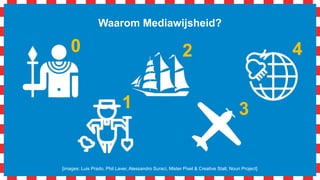
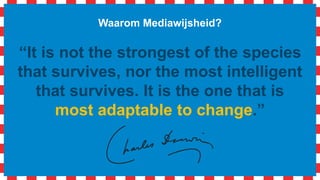
Waarom Mediawijsheid?
“It isnot the strongest of the species
that survives, nor the most intelligent
that survives. It is the one that is
most adaptable to change.”
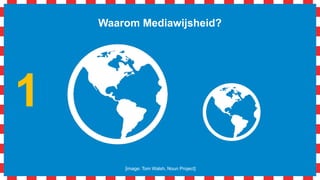
#8 Wereld wordt kleiner
Beroepen verdwijnen, veranderen en ontstaan nieuwe beroepen
Snelheid van veranderingen neemt toe.
#9 Wereld wordt kleiner
Beroepen verdwijnen, veranderen en ontstaan nieuwe beroepen
Snelheid van veranderingen neemt toe.
#10 Op basis van Computerisation bottleneck:
Perception And Manipulation - significant challenges remain for more complex perception tasks, such as identifying objects and their properties in a cluttered field of view. As such, tasks that relate to an unstructured work environment can make jobs less susceptible to computerisation. For example, most homes are unstructured, requiring the identification of a plurality of irregular objects and containing many cluttered spaces which inhibit the mobility of wheeled objects. Conversely, supermarkets, factories, warehouses, airports and hospitals have been designed for large wheeled objects, making it easier for robots to navigate in performing non-routine manual tasks. The difficulty of perception has ramifications for manipulation tasks, and,in particular, the handling of irregular objects, for which robots are yet to reach human levels of aptitude.
Creative intelligence tasks - The psychological processes underlying human creativity are difficult to specify. According to Boden (2003), creativity is the ability to come up with ideas or artifacts that are novel and valuable. Ideas, in a broader sense, include concepts, poems, musical compositions, scientific theories, cooking recipes and jokes, whereas artifacts are objects such as paintings, sculptures, machinery, and pottery.
Social intelligence tasks - Human social intelligence is important in a wide range of work tasks, such as those involving negotiation, persuasion and care.
Op basis hiervan de Probability of Probability of ComputerisationComputerisation
#11 Wereld wordt kleiner
Beroepen verdwijnen, veranderen en ontstaan nieuwe beroepen
Snelheid van veranderingen neemt toe.
#12 Wereld wordt kleiner
Beroepen verdwijnen, veranderen en ontstaan nieuwe beroepen
Snelheid van veranderingen neemt toe.
#13 Wereld wordt kleiner
Beroepen verdwijnen, veranderen en ontstaan nieuwe beroepen
Snelheid van veranderingen neemt toe.
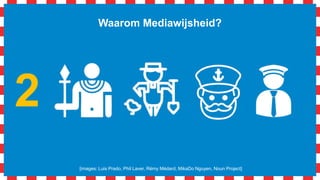
#19 Pre-internet tijdperk was docent actief en aan het consumeren, participeren en produceren.

![Waarom Mediawijsheid?
[image: Tom Walsh, Noun Project]
1](https://image.slidesharecdn.com/avo-caf-150922104406-lva1-app6891/85/AVO-Cafe-7-320.jpg)
![Waarom Mediawijsheid?
[images: Luis Prado, Phil Laver, Rémy Médard, MikaDo Nguyen, Noun Project]
2](https://image.slidesharecdn.com/avo-caf-150922104406-lva1-app6891/85/AVO-Cafe-8-320.jpg)
![Waarom Mediawijsheid?
[bron: The future of jobs – The unrushing wave, The Economist]
Kans dat automatisering voor baanverlies zorgt de komende 20 jaar](https://image.slidesharecdn.com/avo-caf-150922104406-lva1-app6891/85/AVO-Cafe-9-320.jpg)
![Waarom Mediawijsheid?
[images: Aha-Soft, Noun Project]
3](https://image.slidesharecdn.com/avo-caf-150922104406-lva1-app6891/85/AVO-Cafe-10-320.jpg)
![Hoe Mediawijsheid?
[images: Creative Stall, MikaDo Nguyen, Noun Project]
Docent
Mediawijsheid
Mediawijze
docent
Doel Middel](https://image.slidesharecdn.com/avo-caf-150922104406-lva1-app6891/85/AVO-Cafe-17-320.jpg)
![Mediawijze
docent
Hoe Mediawijsheid?
[images: Creative Stall, MikaDo Nguyen, Noun Project]
Middel
“Mediawijsheid in de vak- en
beroepscontext vraagt
een actieve inzet van de
lerende jongere.”](https://image.slidesharecdn.com/avo-caf-150922104406-lva1-app6891/85/AVO-Cafe-18-320.jpg)
![Mediawijze
docent
Hoe Mediawijsheid?
[images: Creative Stall, MikaDo Nguyen, Noun Project]
Middel
“Laat jongeren al
consumerend, participerend
en producerend experts
worden in onderwerpen.”](https://image.slidesharecdn.com/avo-caf-150922104406-lva1-app6891/85/AVO-Cafe-19-320.jpg)
![Mediawijze
docent
Hoe Mediawijsheid?
[images: Creative Stall, MikaDo Nguyen, Noun Project]
Middel
“Het belang van online
geletterdheid hierin is
evident ;-)”](https://image.slidesharecdn.com/avo-caf-150922104406-lva1-app6891/85/AVO-Cafe-20-320.jpg)