For updated information, please visit www.ibef.org June 2018
AVIATION
Table of Content
Executive Summary………………….….…….3
Advantage India……………………...….……..4
Market Overview ………………………….…..6
Recent trends and Strategies….…..………..17
Growth Drivers…………………….................20
Opportunities…….……….......………………31
Industry Associations……………....…...…...33
Useful Information……….......……………….35
For updated information, please visit www.ibef.orgAviation3
EXECUTIVE SUMMARY
Travel and Tourism Total Contribution to GDP* (US$ billion)
234.03 251.64
492.21
0
200
400
600
2017 2018E 2028F
Business and Leisure Travel Spending (US$ billion)
201.71 216.94
432.35
11.61 12.38 24.41
0.00
200.00
400.00
600.00
2017 2018E 2028F
Leisure Travel Business Travel
Air passenger traffic in India (million)
Source: World Travel and Tourism Council, Airport Authority of India
308.75
421.00
0
100
200
300
400
500
FY18 2020F
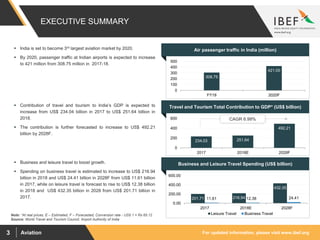
 India is set to become 3rd largest aviation market by 2020.
 By 2020, passenger traffic at Indian airports is expected to increase
to 421 million from 308.75 million in 2017-18.
 Contribution of travel and tourism to India’s GDP is expected to
increase from US$ 234.04 billion in 2017 to US$ 251.64 billion in
2018.
 The contribution is further forecasted to increase to US$ 492.21
billion by 2028F.
 Business and leisure travel to boost growth.
 Spending on business travel is estimated to increase to US$ 216.94
billion in 2018 and US$ 24.41 billion in 2028F from US$ 11.61 billion
in 2017, while on leisure travel is forecast to rise to US$ 12.38 billion
in 2018 and US$ 432.35 billion in 2028 from US$ 201.71 billion in
2017.
CAGR 6.99%
Note: *At real prices, E – Estimated, F – Forecasted, Conversion rate - US$ 1 = Rs 65.12
Aviation
ADVANTAGE INDIA
For updated information, please visit www.ibef.orgAviation5
ADVANTAGE INDIA
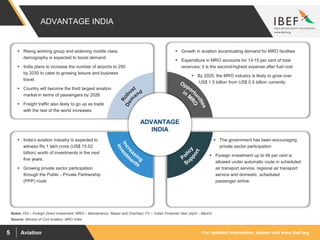
 Rising working group and widening middle class
demography is expected to boost demand
 India plans to increase the number of airports to 250
by 2030 to cater to growing leisure and business
travel
 Country will become the third largest aviation
market in terms of passengers by 2026.
 Freight traffic also likely to go up as trade
with the rest of the world increases
 Growth in aviation accentuating demand for MRO facilities
 Expenditure in MRO accounts for 13-15 per cent of total
revenues; it is the second-highest expense after fuel cost
 By 2020, the MRO industry is likely to grow over
US$ 1.5 billion from US$ 0.5 billion currently
 India’s aviation industry is expected to
witness Rs 1 lakh crore (US$ 15.52
billion) worth of investments in the next
five years.
 Growing private sector participation
through the Public - Private Partnership
(PPP) route
 The government has been encouraging
private sector participation
 Foreign investment up to 49 per cent is
allowed under automatic route in scheduled
air transport service, regional air transport
service and domestic scheduled
passenger airline.
ADVANTAGE
INDIA
Source: Ministry of Civil Aviation, MRO India
Notes: FDI – Foreign Direct Investment, MRO – Maintenance, Repair and Overhaul; FY – Indian Financial Year (April – March)
Aviation
MARKET OVERVIEW
For updated information, please visit www.ibef.orgAviation7
EVOLUTION OF THE INDIAN AVIATION SECTOR
Source: Airports Authority of India, Ministry of Statistics and Programme Implementation, Ministry of Civil Aviation
Note: * India ranks after the US and China, FY – Indian Financial Year (April – March), mn km – Million Kilometers, FY18^ - as of May 2018
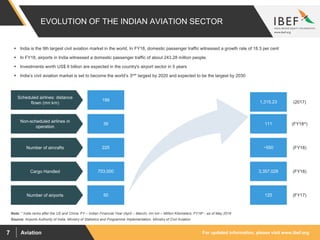
 India is the 9th largest civil aviation market in the world, In FY18, domestic passenger traffic witnessed a growth rate of 18.3 per cent
 In FY18, airports in India witnessed a domestic passenger traffic of about 243.28 million people.
 Investments worth US$ 6 billion are expected in the country's airport sector in 5 years
 India’s civil aviation market is set to become the world’s 3rd* largest by 2020 and expected to be the largest by 2030
Scheduled airlines: distance
flown (mn km)
Non-scheduled airlines in
operation
Number of aircrafts
Cargo Handled
Number of airports 50
703,000
225
39
199
125
3,357,028
~550
111
1,315.23 (2017)
(FY18^)
(FY18)
(FY18)
(FY17)
For updated information, please visit www.ibef.orgAviation8
AIRPORTS AND AIRSTRIPS
Source: Airports Authority of India
Note: AAI – Airports Authority of India, JV – Joint Venture, FY – Indian Financial Year (April – March)
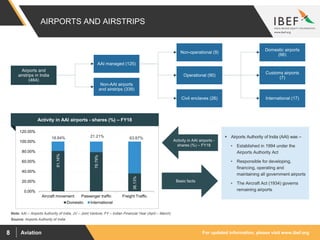
 Airports Authority of India (AAI) was –
• Established in 1994 under the
Airports Authority Act
• Responsible for developing,
financing, operating and
maintaining all government airports
• The Aircraft Act (1934) governs
remaining airports
Activity in AAI airports -
shares (%) – FY18
Basic facts
81.16%
78.79%
36.13%
18.84% 21.21% 63.87%
0.00%
20.00%
40.00%
60.00%
80.00%
100.00%
120.00%
Aircraft movement Passenger traffic Freight Traffic
Domestic International
Activity in AAI airports - shares (%) – FY18
Airports and
airstrips in India
(464)
AAI managed (125)
Non-AAI airports
and airstrips (339)
International (17)
Customs airports
(7)
Domestic airports
(66)
Non-operational (9)
Operational (90)
Civil enclaves (26)
For updated information, please visit www.ibef.orgAviation9
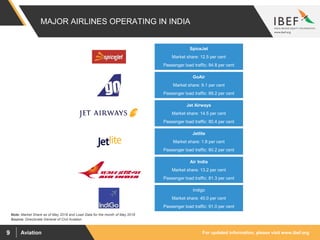
MAJOR AIRLINES OPERATING IN INDIA
Source: Directorate General of Civil Aviation
SpiceJet
Market share: 12.5 per cent
Passenger load traffic: 94.8 per cent
GoAir
Market share: 9.1 per cent
Passenger load traffic: 89.2 per cent
Jet Airways
Market share: 14.5 per cent
Passenger load traffic: 80.4 per cent
Jetlite
Market share: 1.8 per cent
Passenger load traffic: 80.2 per cent
Air India
Market share: 13.2 per cent
Passenger load traffic: 81.3 per cent
Indigo
Market share: 40.0 per cent
Passenger load traffic: 91.0 per cent
Note: Market Share as of May 2018 and Load Data for the month of May 2018
For updated information, please visit www.ibef.orgAviation10
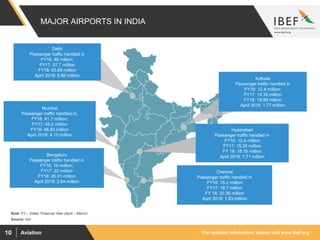
MAJOR AIRPORTS IN INDIA
Source: AAI
Note: FY – Indian Financial Year (April – March)
Bengaluru
Passenger traffic handled in
FY16: 19 million;
FY17: 22 million
FY18: 26.91 million
April 2018: 2.64 million
Mumbai
Passenger traffic handled in;
FY16: 41.7 million;
FY17: 45.2 million
FY18: 48.50 million
April 2018: 4.15 million
Chennai
Passenger traffic handled in
FY16: 15.2 million;
FY17: 16.7 million
FY 18: 20.36 million
April 2018: 1.83 million
Delhi
Passenger traffic handled in
FY16: 48 million;
FY17: 57.7 million
FY18: 65.69 million
April 2018: 5.86 million
Kolkata
Passenger traffic handled in
FY16: 12.4 million;
FY17: 14.35 million
FY18: 19.89 million
April 2018: 1.77 million
Hyderabad
Passenger traffic handled in
FY16: 12.4 million
FY17: 15.24 million
FY 18: 18.16 million
April 2018: 1.71 million
For updated information, please visit www.ibef.orgAviation11
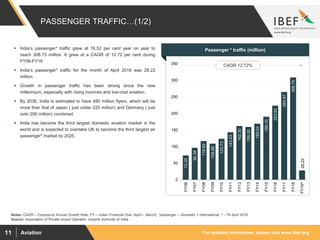
PASSENGER TRAFFIC…(1/2)
73.35
96.38
116.89
108.88
123.73
143.43
162.30
159.30
169.03
190.10
223.62
264.97
308.75
28.22
0
50
100
150
200
250
300
350
FY06
FY07
FY08
FY09
FY10
FY11
FY12
FY13
FY14
FY15
FY16
FY17
FY18
FY19^
Source: Association of Private Airport Operator, Airports Authority of India
 India’s passenger* traffic grew at 16.52 per cent year on year to
reach 308.75 million. It grew at a CAGR of 12.72 per cent during
FY06-FY18.
 India’s passenger* traffic for the month of April 2018 was 28.22
million.
 Growth in passenger traffic has been strong since the new
millennium, especially with rising incomes and low-cost aviation.
 By 2036, India is estimated to have 480 million flyers, which will be
more than that of Japan ( just under 225 million) and Germany ( just
over 200 million) combined.
 India has become the third largest domestic aviation market in the
world and is expected to overtake UK to become the third largest air
passenger* market by 2025.
Visakhapatnam port traffic (million tonnes)Passenger * traffic (million)
Notes: CAGR – Compound Annual Growth Rate, FY – Indian Financial Year (April – March), *passenger – Domestic + International, ^ - Till April 2018
CAGR 12.72%
For updated information, please visit www.ibef.orgAviation12
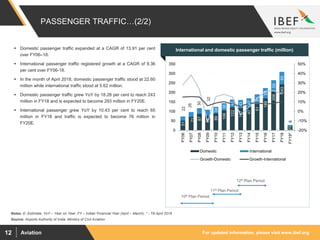
PASSENGER TRAFFIC…(2/2)
51
71
87
77
89
106
122
117
47
51
169
206
243
23
22
26
30
32
34
38
41
43
47
51
55
59
65
6
-20%
-10%
0%
10%
20%
30%
40%
50%
0
50
100
150
200
250
300
350
FY06
FY07
FY08
FY09
FY10
FY11
FY12
FY13
FY14
FY15
FY16
FY17
FY18
FY19*
Domestic International
Growth-Domestic Growth-International
Source: Airports Authority of India, Ministry of Civil Aviation
 Domestic passenger traffic expanded at a CAGR of 13.91 per cent
over FY06–18.
 International passenger traffic registered growth at a CAGR of 9.36
per cent over FY06-18.
 In the month of April 2018, domestic passenger traffic stood at 22.60
million while international traffic stood at 5.62 million.
 Domestic passenger traffic grew YoY by 18.28 per cent to reach 243
million in FY18 and is expected to become 293 million in FY20E.
 International passenger grew YoY by 10.43 per cent to reach 65
million in FY18 and traffic is expected to become 76 million in
FY20E.
Visakhapatnam port traffic (million tonnes)International and domestic passenger traffic (million)
10th Plan Period
11th Plan Period
12th Plan Period
Notes: E- Estimate, YoY – Year on Year, FY – Indian Financial Year (April – March), * - Till April 2018
For updated information, please visit www.ibef.orgAviation13
FREIGHT TRAFFIC…(1/2)
920
1,023
1,147
1,149
1,271
1,496
1,468
1,407
1,440
1,542
1,658
1,855
2,144
484
530
568
552
689
852
812
784
840
986
1,046
1,123
1,213
0
500
1,000
1,500
2,000
2,500
3,000
3,500
4,000
FY06
FY07
FY08
FY09
FY10
FY11
FY12
FY13
FY14
FY15
FY16
FY17
FY18
International( '000 Tonnes) Domestic ('000 Tonnes)
Source: Airports Authority of India
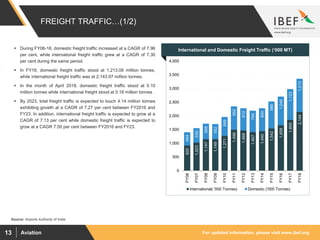
 During FY06-18, domestic freight traffic increased at a CAGR of 7.96
per cent, while international freight traffic grew at a CAGR of 7.30
per cent during the same period.
 In FY18, domestic freight traffic stood at 1,213.06 million tonnes,
while international freight traffic was at 2,143.97 million tonnes.
 In the month of April 2018, domestic freight traffic stood at 0.10
million tonnes while international freight stood at 0.18 million tonnes .
 By 2023, total freight traffic is expected to touch 4.14 million tonnes
exhibiting growth at a CAGR of 7.27 per cent between FY2016 and
FY23. In addition, international freight traffic is expected to grow at a
CAGR of 7.13 per cent while domestic freight traffic is expected to
grow at a CAGR 7.50 per cent between FY2016 and FY23.
Visakhapatnam port traffic (million tonnes)International and Domestic Freight Traffic (‘000 MT)
For updated information, please visit www.ibef.orgAviation14
FREIGHT TRAFFIC…(2/2)
1.40
1.55
1.72
1.70
1.96
2.35
2.28
2.19
2.28
2.53
2.70
2.98
3.36
0.00
0.50
1.00
1.50
2.00
2.50
3.00
3.50
4.00
FY06
FY07
FY08
FY09
FY10
FY11
FY12
FY13
FY14
FY15
FY16
FY17
FY18
Source: Airports Authority of India
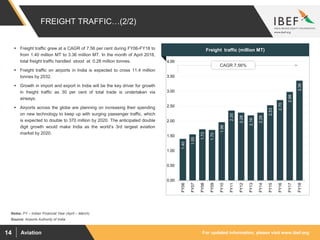
 Freight traffic grew at a CAGR of 7.56 per cent during FY06-FY18 to
from 1.40 million MT to 3.36 million MT. In the month of April 2018,
total freight traffic handled stood at 0.28 million tonnes.
 Freight traffic on airports in India is expected to cross 11.4 million
tonnes by 2032.
 Growth in import and export in India will be the key driver for growth
in freight traffic as 30 per cent of total trade is undertaken via
airways.
 Airports across the globe are planning on increasing their spending
on new technology to keep up with surging passenger traffic, which
is expected to double to 370 million by 2020. The anticipated double
digit growth would make India as the world’s 3rd largest aviation
market by 2020.
Visakhapatnam port traffic (million tonnes)Freight traffic (million MT)
Notes: FY – Indian Financial Year (April – March)
CAGR 7.56%
For updated information, please visit www.ibef.orgAviation15
AIRCRAFT MOVEMENT
1.31
1.31
1.31
1.33
1.39
1.54
1.48
1.54
1.60
1.80
2.05
2.32
-10%
-5%
0%
5%
10%
15%
20%
0.00
0.50
1.00
1.50
2.00
2.50
FY07
FY08
FY09
FY10
FY11
FY12
FY13
FY14
FY15
FY16
FY17
FY18
Aircraft movement Growth in Aircraft movement
Source: Association of Private Airport Operators, Airports Authority of India
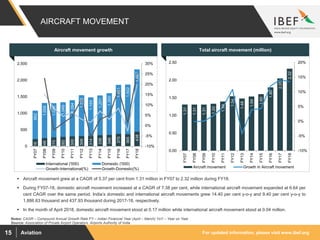
 Aircraft movement grew at a CAGR of 5.37 per cent from 1.31 million in FY07 to 2.32 million during FY18.
 During FY07-18, domestic aircraft movement increased at a CAGR of 7.38 per cent, while international aircraft movement expanded at 6.64 per
cent CAGR over the same period. India’s domestic and international aircraft movements grew 14.40 per cent y-o-y and 9.40 per cent y-o-y to
1,886.63 thousand and 437.93 thousand during 2017-18, respectively.
 In the month of April 2018, domestic aircraft movement stood at 0.17 million while international aircraft movement stood at 0.04 million.
Visakhapatnam port traffic (million tonnes)Total aircraft movement (million)
Notes: CAGR – Compound Annual Growth Rate FY – Indian Financial Year (April – March) YoY – Year on Year
216
249
270
282
300
309
314
336
346
375
365
438
862
1,059
1,036
1,049
1,094
1,235
1,165
1,201
1,260
1,481
1,502
1,887
-10%
-5%
0%
5%
10%
15%
20%
25%
30%
0
500
1,000
1,500
2,000
2,500
FY07
FY08
FY09
FY10
FY11
FY12
FY13
FY14
FY15
FY16
FY17
FY18
International ('000) Domestic ('000)
Growth-International(%) Growth-Domestic(%)
Visakhapatnam port traffic (million tonnes)Aircraft movement growth
For updated information, please visit www.ibef.orgAviation16
KEY PUBLIC AND PRIVATE SECTOR PLAYERS
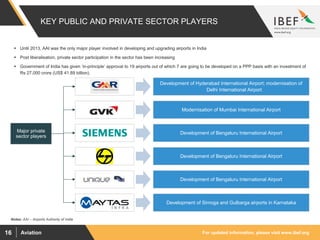
 Until 2013, AAI was the only major player involved in developing and upgrading airports in India
 Post liberalisation, private sector participation in the sector has been increasing
 Government of India has given ‘in-principle’ approval to 19 airports out of which 7 are going to be developed on a PPP basis with an investment of
Rs 27,000 crore (US$ 41.89 billion).
Major private
sector players
Development of Hyderabad International Airport; modernisation of
Delhi International Airport
Modernisation of Mumbai International Airport
Development of Bengaluru International Airport
Development of Simoga and Gulbarga airports in Karnataka
Notes: AAI – Airports Authority of India
Aviation
RECENT TRENDS
AND STRATEGIES
For updated information, please visit www.ibef.orgAviation18
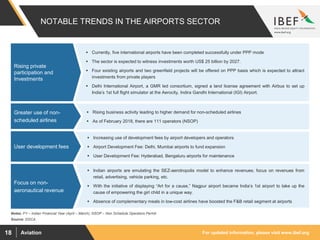
 Currently, five international airports have been completed successfully under PPP mode
 The sector is expected to witness investments worth US$ 25 billion by 2027.
 Four existing airports and two greenfield projects will be offered on PPP basis which is expected to attract
investments from private players
 Delhi International Airport, a GMR led consortium, signed a land license agreement with Airbus to set up
India’s 1st full flight simulator at the Aerocity, Indira Gandhi International (IGI) Airport.
Rising private
participation and
Investments
 Rising business activity leading to higher demand for non-scheduled airlines
 As of February 2018, there are 111 operators (NSOP)
 Increasing use of development fees by airport developers and operators
 Airport Development Fee: Delhi, Mumbai airports to fund expansion
 User Development Fee: Hyderabad, Bengaluru airports for maintenance
 Indian airports are emulating the SEZ-aerotropolis model to enhance revenues; focus on revenues from
retail, advertising, vehicle parking, etc.
 With the initiative of displaying “Art for a cause,” Nagpur airport became India’s 1st airport to take up the
cause of empowering the girl child in a unique way.
 Absence of complementary meals in low-cost airlines have boosted the F&B retail segment at airports
Rising private
participation and
Investments
Rising private
participation and
Investments
Rising private
participation and
Investments
NOTABLE TRENDS IN THE AIRPORTS SECTOR
Rising private
participation and
Investments
Source: DGCA
Greater use of non-
scheduled airlines
Notes: FY – Indian Financial Year (April – March), NSOP – Non Schedule Operators Permit
User development fees
Focus on non-
aeronautical revenue
For updated information, please visit www.ibef.orgAviation19
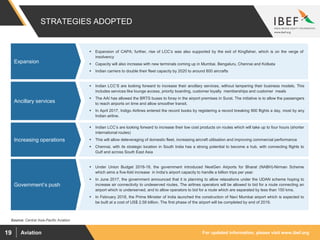
 Indian LCC’S are looking forward to increase their ancillary services, without tampering their business models. This
includes services like lounge access, priority boarding, customer loyalty memberships and customer meals
 The AAI has allowed the BRTS buses to foray in the airport premises in Surat. The initiative is to allow the passengers
to reach airports on time and allow smoother transit.
 In April 2017, Indigo Airlines entered the record books by registering a record breaking 900 flights a day, most by any
Indian airline.
 Indian LCC’s are looking forward to increase their low cost products on routes which will take up to four hours (shorter
international routes)
 This will allow deleveraging of domestic fleet, increasing aircraft utilisation and improving commercial performance
 Chennai, with its strategic location in South India has a strong potential to become a hub, with connecting flights to
Gulf and across South East Asia
 Under Union Budget 2018-19, the government introduced NextGen Airports for Bharat (NABH)-Nirman Scheme
which aims a five-fold increase in India’s airport capacity to handle a billion trips per year.
 In June 2017, the government announced that it is planning to allow relaxations under the UDAN scheme hoping to
increase air connectivity to undeserved routes. The airlines operators will be allowed to bid for a route connecting an
airport which is underserved, and to allow operators to bid for a route which are separated by less than 150 kms.
 In February 2018, the Prime Minister of India launched the construction of Navi Mumbai airport which is expected to
be built at a cost of US$ 2.58 billion. The first phase of the airport will be completed by end of 2019.
Rising private
participation and
Investments
Rising private
participation and
Investments
Rising private
participation and
Investments
 Expansion of CAPA; further, rise of LCC’s was also supported by the exit of Kingfisher, which is on the verge of
insolvency
 Capacity will also increase with new terminals coming up in Mumbai, Bengaluru, Chennai and Kolkata
 Indian carriers to double their fleet capacity by 2020 to around 800 aircrafts
Rising private
participation and
Investments
STRATEGIES ADOPTED
Expansion
Ancillary services
Source: Central Asia-Pacific Aviation
Increasing operations
Government’s push
Aviation
GROWTH DRIVERS
For updated information, please visit www.ibef.orgAviation21
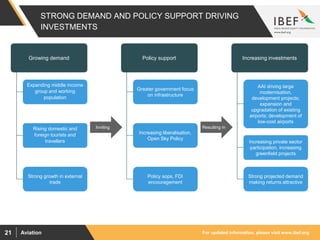
STRONG DEMAND AND POLICY SUPPORT DRIVING
INVESTMENTS
Strong
government
support
Inviting Resulting in
Policy support Increasing investmentsGrowing demandGrowing demand
Rising domestic and
foreign tourists and
travellers
Strong growth in external
trade
Greater government focus
on infrastructure
Increasing liberalisation,
Open Sky Policy
AAI driving large
modernisation,
development projects;
expansion and
upgradation of existing
airports; development of
low-cost airports
Increasing private sector
participation, increasing
greenfield projects
Expanding middle income
group and working
population
Policy sops, FDI
encouragement
Strong projected demand
making returns attractive
For updated information, please visit www.ibef.orgAviation22
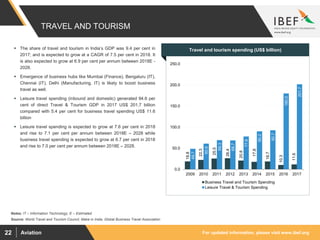
TRAVEL AND TOURISM
18.8
22.3
25.5
26.4
20.8
17.8
18.7
10.3
11.6
48.7
60.9
69.3
68.7
77.9
90.2
92.7
180.0
201.7
0.0
50.0
100.0
150.0
200.0
250.0
2009 2010 2011 2012 2013 2014 2015 2016 2017
Business Travel and Tourism Spending
Leisure Travel & Tourism Spending
Source: World Travel and Tourism Council, Make in India, Global Business Travel Association
 The share of travel and tourism in India’s GDP was 9.4 per cent in
2017; and is expected to grow at a CAGR of 7.5 per cent in 2018. It
is also expected to grow at 6.9 per cent per annum between 2018E -
2028.
 Emergence of business hubs like Mumbai (Finance), Bengaluru (IT),
Chennai (IT), Delhi (Manufacturing, IT) is likely to boost business
travel as well.
 Leisure travel spending (inbound and domestic) generated 94.6 per
cent of direct Travel & Tourism GDP in 2017 US$ 201.7 billion
compared with 5.4 per cent for business travel spending US$ 11.6
billion
 Leisure travel spending is expected to grow at 7.6 per cent in 2018
and rise to 7.1 per cent per annum between 2018E – 2028 while
business travel spending is expected to grow at 6.7 per cent in 2018
and rise to 7.0 per cent per annum between 2018E – 2028.
Visakhapatnam port traffic (million tonnes)Travel and tourism spending (US$ billion)
Notes: IT – Information Technology, E – Estimated
For updated information, please visit www.ibef.orgAviation23
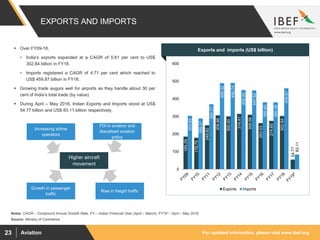
EXPORTS AND IMPORTS
185.29
178.75
249.82
305.96
300.40
314.41
309.56
262.03
274.65
302.84
54.77
303.69
288.37
369.77
489.32
490.74
450.20
447.52
380.60
380.38
459.67
83.11
0
100
200
300
400
500
600
Exports Imports
Source: Ministry of Commerce
 Over FY09-18,
• India’s exports expanded at a CAGR of 5.61 per cent to US$
302.84 billion in FY18.
• Imports registered a CAGR of 4.71 per cent which reached to
US$ 459.87 billion in FY18.
 Growing trade augurs well for airports as they handle about 30 per
cent of India’s total trade (by value)
 During April – May 2018, Indian Exports and Imports stood at US$
54.77 billion and US$ 83.11 billion respectively.
Visakhapatnam port traffic (million tonnes)Exports and imports (US$ billion)
Notes: CAGR – Compound Annual Growth Rate, FY – Indian Financial Year (April – March), FY19* - April – May 2018
Higher aircraft
movement
Increasing airline
operators
Rise in freight traffic
Growth in passenger
traffic
FDI in aviation and
liberalised aviation
policy
For updated information, please visit www.ibef.orgAviation24
Rising private
participation and
Investments
POLICY SUPPORT…(1/3)
Notes: India currently has bilateral air service agreements with 104 countries. These include Brazil, 27 members of the EU, and China. In 2008 traffic rights were been enhanced with
Mexico, Saudi Arabia, Netherlands, Qatar, Iran, Japan and Turkey, FDI – Foreign Direct Investment, GOI – Government of India
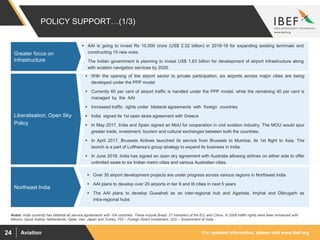
 Over 30 airport development projects are under progress across various regions in Northeast India
 AAI plans to develop over 20 airports in tier II and III cities in next 5 years
 The AAI plans to develop Guwahati as an inter-regional hub and Agartala, Imphal and Dibrugarh as
intra-regional hubs
Rising private
participation and
Investments
Northeast India
 With the opening of the airport sector to private participation, six airports across major cities are being
developed under the PPP model
 Currently 60 per cent of airport traffic is handled under the PPP model, while the remaining 40 per cent is
managed by the AAI
 Increased traffic rights under bilateral agreements with foreign countries
 India signed its 1st open skies agreement with Greece
 In May 2017, India and Spain signed an MoU for cooperation in civil aviation industry. The MOU would spur
greater trade, investment, tourism and cultural exchanges between both the countries.
 In April 2017, Brussels Airlines launched its service from Brussels to Mumbai, its 1st flight to Asia. The
launch is a part of Lufthansa’s group strategy to expand its business in India.
 In June 2018, India has signed an open sky agreement with Australia allowing airlines on either side to offer
unlimited seats to six Indian metro cities and various Australian cities.
Rising private participation
and Investments
Liberalisation, Open Sky
Policy
 AAI is going to invest Rs 15,000 crore (US$ 2.32 billion) in 2018-19 for expanding existing terminals and
constructing 15 new ones.
 The Indian government is planning to invest US$ 1.83 billion for development of airport infrastructure along
with aviation navigation services by 2026.
Rising private
participation and
Investments
Rising private participation
and Investments
Greater focus on
infrastructure
For updated information, please visit www.ibef.orgAviation25
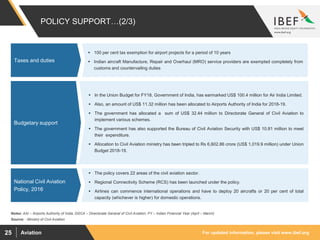
 The policy covers 22 areas of the civil aviation sector.
 Regional Connectivity Scheme (RCS) has been launched under the policy.
 Airlines can commence international operations and have to deploy 20 aircrafts or 20 per cent of total
capacity (whichever is higher) for domestic operations.
 100 per cent tax exemption for airport projects for a period of 10 years
 Indian aircraft Manufacture, Repair and Overhaul (MRO) service providers are exempted completely from
customs and countervailing duties
 In the Union Budget for FY18, Government of India, has earmarked US$ 100.4 million for Air India Limited.
 Also, an amount of US$ 11.32 million has been allocated to Airports Authority of India for 2018-19.
 The government has allocated a sum of US$ 32.44 million to Directorate General of Civil Aviation to
implement various schemes.
 The government has also supported the Bureau of Civil Aviation Security with US$ 10.81 million to meet
their expenditure.
 Allocation to Civil Aviation ministry has been tripled to Rs 6,602.86 crore (US$ 1,019.9 million) under Union
Budget 2018-19.
Rising private
participation and
Investments
Rising private
participation and
Investments
POLICY SUPPORT…(2/3)
Source: : Ministry of Civil Aviation
Budgetary support
Notes: AAI – Airports Authority of India, DGCA – Directorate General of Civil Aviation, FY – Indian Financial Year (April – March)
Rising private participation
and Investments
Taxes and duties
Rising private participation
and Investments
National Civil Aviation
Policy, 2016
For updated information, please visit www.ibef.orgAviation26
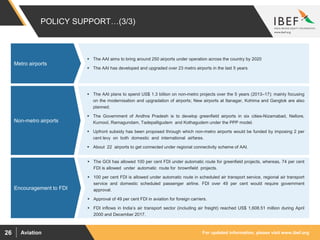
 The AAI plans to spend US$ 1.3 billion on non-metro projects over the 5 years (2013–17); mainly focusing
on the modernisation and upgradation of airports; New airports at Itanagar, Kohima and Gangtok are also
planned.
 The Government of Andhra Pradesh is to develop greenfield airports in six cities-Nizamabad, Nellore,
Kurnool, Ramagundam, Tadepalligudem and Kothagudem under the PPP model.
 Upfront subsidy has been proposed through which non-metro airports would be funded by imposing 2 per
cent levy on both domestic and international airfares.
 About 22 airports to get connected under regional connectivity scheme of AAI.
Rising private
participation and
Investments
Non-metro airports
 The AAI aims to bring around 250 airports under operation across the country by 2020
 The AAI has developed and upgraded over 23 metro airports in the last 5 years
Rising private
participation and
Investments
POLICY SUPPORT…(3/3)
Metro airports
Rising private
participation and
Investments
 The GOI has allowed 100 per cent FDI under automatic route for greenfield projects, whereas, 74 per cent
FDI is allowed under automatic route for brownfield projects.
 100 per cent FDI is allowed under automatic route in scheduled air transport service, regional air transport
service and domestic scheduled passenger airline. FDI over 49 per cent would require government
approval.
 Approval of 49 per cent FDI in aviation for foreign carriers.
 FDI inflows in India’s air transport sector (including air freight) reached US$ 1,608.51 million during April
2000 and December 2017.
Rising private
participation and
Investments
Encouragement to FDI
For updated information, please visit www.ibef.orgAviation27
PRIVATE SECTOR INVESTMENT IN AIRPORTS RISING
… (1/2)
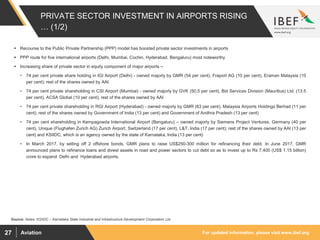
 Recourse to the Public Private Partnership (PPP) model has boosted private sector investments in airports
 PPP route for five international airports (Delhi, Mumbai, Cochin, Hyderabad, Bengaluru) most noteworthy
 Increasing share of private sector in equity component of major airports –
• 74 per cent private share holding in IGI Airport (Delhi) - owned majorly by GMR (54 per cent), Fraport AG (10 per cent), Eraman Malaysia (10
per cent); rest of the shares owned by AAI
• 74 per cent private shareholding in CSI Airport (Mumbai) - owned majorly by GVK (50.5 per cent), Bid Services Division (Mauritius) Ltd. (13.5
per cent), ACSA Global (10 per cent); rest of the shares owned by AAI
• 74 per cent private shareholding in RGI Airport (Hyderabad) - owned majorly by GMR (63 per cent), Malaysia Airports Holdings Berhad (11 per
cent); rest of the shares owned by Government of India (13 per cent) and Government of Andhra Pradesh (13 per cent)
• 74 per cent shareholding in Kempagowda International Airport (Bengaluru) – owned majorly by Siemens Project Ventures, Germany (40 per
cent), Unique (Flughafen Zurich AG) Zurich Airport, Switzerland (17 per cent), L&T, India (17 per cent); rest of the shares owned by AAI (13 per
cent) and KSIIDC, which is an agency owned by the state of Karnataka, India (13 per cent)
• In March 2017, by selling off 2 offshore bonds, GMR plans to raise US$250-300 million for refinancing their debt. In June 2017, GMR
announced plans to refinance loans and divest assets in road and power sectors to cut debt so as to invest up to Rs 7,400 (US$ 1.15 billion)
crore to expand Delhi and Hyderabad airports.
Source: Notes: KSIIDC – Karnataka State Industrial and Infrastructure Development Corporation Ltd.
For updated information, please visit www.ibef.orgAviation28
PRIVATE SECTOR INVESTMENT IN AIRPORTS RISING
… (2/2)
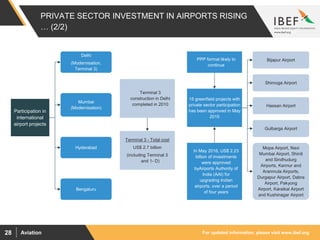
Gulbarga Airport
Hassan Airport
Shimoga Airport
Bijapur Airport
Bengaluru
Participation in
international
airport projects
Terminal 3
construction in Delhi
completed in 2010
Terminal 3 - Total cost
US$ 2.7 billion
(including Terminal 3
and 1- D)
15 greenfield projects with
private sector participation
has been approved in May
2015
PPP format likely to
continue
In May 2016, US$ 2.23
billion of investments
were approved
byAirports Authority of
India (AAI) for
upgrading Indian
airports, over a period
of four years
Mumbai
(Modernisation)
Hyderabad
Delhi
(Modernisation,
Terminal 3)
Mopa Airport, Navi
Mumbai Airport, Shirdi
and Sindhudurg
Airports, Kannur and
Aranmula Airports,
Durgapur Airport, Dabra
Airport, Pakyong
Airport, Karaikal Airport
and Kushinagar Airport
For updated information, please visit www.ibef.orgAviation29
SUCCESSFUL PPP AIRPORTS IN INDIA
Source: Association of Private Airport Operators
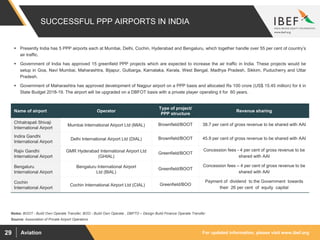
 Presently India has 5 PPP airports each at Mumbai, Delhi, Cochin, Hyderabad and Bengaluru, which together handle over 55 per cent of country’s
air traffic.
 Government of India has approved 15 greenfield PPP projects which are expected to increase the air traffic in India. These projects would be
setup in Goa, Navi Mumbai, Maharashtra, Bijapur, Gulbarga, Karnataka, Kerala, West Bengal, Madhya Pradesh, Sikkim, Puducherry and Uttar
Pradesh.
 Government of Maharashtra has approved development of Nagpur airport on a PPP basis and allocated Rs 100 crore (US$ 15.45 million) for it in
State Budget 2018-19. The airport will be upgraded on a DBFOT basis with a private player operating it for 60 years.
Notes: BOOT - Build Own Operate Transfer; BOO - Build Own Operate , DBFTO – Design Build Finance Operate Transfer
Name of airport Operator
Type of project/
PPP structure
Revenue sharing
Chhatrapati Shivaji
International Airport
Mumbai International Airport Ltd (MIAL) Brownfield/BOOT 38.7 per cent of gross revenue to be shared with AAI
Indira Gandhi
International Airport
Delhi International Airport Ltd (DIAL) Brownfield/BOOT 45.9 per cent of gross revenue to be shared with AAI
Rajiv Gandhi
International Airport
GMR Hyderabad International Airport Ltd
(GHIAL)
Greenfield/BOOT
Concession fees - 4 per cent of gross revenue to be
shared with AAI
Bengaluru
International Airport
Bengaluru International Airport
Ltd (BIAL)
Greenfield/BOOT
Concession fees – 4 per cent of gross revenue to be
shared with AAI
Cochin
International Airport
Cochin International Airport Ltd (CIAL) Greenfield/BOO
Payment of dividend to the Government towards
their 26 per cent of equity capital
For updated information, please visit www.ibef.orgAviation30
FOREIGN PLAYERS
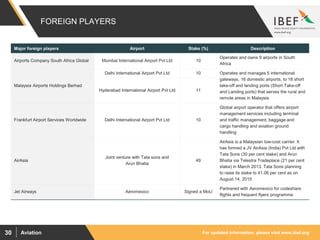
Major foreign players Airport Stake (%) Description
Airports Company South Africa Global Mumbai International Airport Pvt Ltd 10
Operates and owns 9 airports in South
Africa
Malaysia Airports Holdings Berhad
Delhi International Airport Pvt Ltd 10 Operates and manages 5 international
gateways, 16 domestic airports, to 18 short
take-off and landing ports (Short Take-off
and Landing ports) that serves the rural and
remote areas in Malaysia
Hyderabad International Airport Pvt Ltd 11
Frankfurt Airport Services Worldwide Delhi International Airport Pvt Ltd 10
Global airport operator that offers airport
management services including terminal
and traffic management, baggage and
cargo handling and aviation ground
handling
AirAsia
Joint venture with Tata sons and
Arun Bhatia
49
AirAsia is a Malaysian low-cost carrier. It
has formed a JV AirAsia (India) Pvt Ltd with
Tata Sons (30 per cent stake) and Arun
Bhatia via Telestra Tradeplace (21 per cent
stake) in March 2013. Tata Sons planning
to raise its stake to 41.06 per cent as on
August 14, 2015
Jet Airways Aeromexico Signed a MoU
Partnered with Aeromexico for codeshare
flights and frequent flyers programme
Aviation
OPPORTUNITIES
For updated information, please visit www.ibef.orgAviation32
OPPORTUNITIES
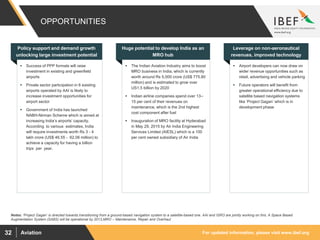
 Success of PPP formats will raise
investment in existing and greenfield
airports
 Private sector participation in 6 existing
airports operated by AAI is likely to
increase investment opportunities for
airport sector
 Government of India has launched
NABH-Nirman Scheme which is aimed at
increasing India’s airports’ capacity.
According to various estimates, India
will require investments worth Rs 3 - 4
lakh crore (US$ 46.55 - 62.06 million) to
achieve a capacity for having a billion
trips per year.
Policy support and demand growth
unlocking large investment potential
 The Indian Aviation Industry aims to boost
MRO business in India, which is currently
worth around Rs 5,000 crore (US$ 775.80
million) and is estimated to grow over
US1.5 billion by 2020
 Indian airline companies spend over 13–
15 per cent of their revenues on
maintenance, which is the 2nd highest
cost component after fuel
 Inauguration of MRO facility at Hyderabad
in May 29, 2015 by Air India Engineering
Services Limited (AIESL) which is a 100
per cent owned subsidiary of Air India
Huge potential to develop India as an
MRO hub
 Airport developers can now draw on
wider revenue opportunities such as
retail, advertising and vehicle parking
 Future operators will benefit from
greater operational efficiency due to
satellite based navigation systems
like ‘Project Gagan’ which is in
development phase
Leverage on non-aeronautical
revenues, improved technology
Notes: ‘Project Gagan’ is directed towards transitioning from a ground-based navigation system to a satellite-based one. AAI and ISRO are jointly working on this. A Space Based
Augmentation System (SABS) will be operational by 2013,MRO – Maintenance, Repair and Overhaul
Aviation
INDUSTRY
ASSOCIATIONS
For updated information, please visit www.ibef.orgAviation34
INDUSTRY ORGANISATIONS
Airports Authority of India (AAI)
Address: Aurbindo Marg, Opp. Safdarjung Airport,
New Delhi –110 003
Phone: 91 11 24622495
Fax: 91 11 24629221
E-mail: dri@dgca.nic.in, dfa@dgca.nic.in
Address: Rajiv Gandhi Bhawan, Safdarjung Airport,
New Delhi –110 003
Phone: 91 11 24632950
Directorate General of Civil Aviation (DGCA)
Aviation
USEFUL
INFORMATION
For updated information, please visit www.ibef.orgAviation36
GLOSSARY
 AAI: Airports Authority of India
 ACI: Airport Council International
 CAGR: Compound Annual Growth Rate
 FDI: Foreign Direct Investment
 FY: Indian Financial Year (April to March)
 So FY10 implies April 2009 to March 2010
 GOI: Government of India
 INR: Indian Rupee
 MRO: Maintenance, Repair and Overhaul
 PPP: It could denote two things (mentioned in the presentation accordingly) –
• Purchasing Power Parity (used in calculating per-capita GDP – slide 12, GROWTH DRIVERS)
• Public Private Partnership (a type of joint venture between the public and private sectors)
For updated information, please visit www.ibef.orgAviation37
EXCHANGE RATES
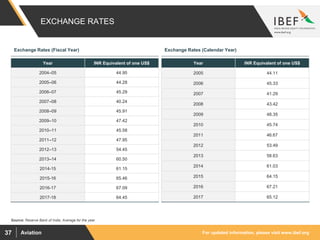
Exchange Rates (Fiscal Year) Exchange Rates (Calendar Year)
Year INR Equivalent of one US$
2004–05 44.95
2005–06 44.28
2006–07 45.29
2007–08 40.24
2008–09 45.91
2009–10 47.42
2010–11 45.58
2011–12 47.95
2012–13 54.45
2013–14 60.50
2014-15 61.15
2015-16 65.46
2016-17 67.09
2017-18 64.45
Year INR Equivalent of one US$
2005 44.11
2006 45.33
2007 41.29
2008 43.42
2009 48.35
2010 45.74
2011 46.67
2012 53.49
2013 58.63
2014 61.03
2015 64.15
2016 67.21
2017 65.12
Source: Reserve Bank of India, Average for the year
For updated information, please visit www.ibef.orgAviation38
DISCLAIMER
India Brand Equity Foundation (IBEF) engaged Aranca to prepare this presentation and the same has been prepared by Aranca in consultation
with IBEF.
All rights reserved. All copyright in this presentation and related works is solely and exclusively owned by IBEF. The same may not be reproduced,
wholly or in part in any material form (including photocopying or storing it in any medium by electronic means and whether or not transiently or
incidentally to some other use of this presentation), modified or in any manner communicated to any third party except with the written approval
of IBEF.
This presentation is for information purposes only. While due care has been taken during the compilation of this presentation to ensure that the
information is accurate to the best of Aranca and IBEF’s knowledge and belief, the content is not to be construed in any manner whatsoever as a
substitute for professional advice.
Aranca and IBEF neither recommend nor endorse any specific products or services that may have been mentioned in this presentation and nor do
they assume any liability or responsibility for the outcome of decisions taken as a result of any reliance placed on this presentation.
Neither Aranca nor IBEF shall be liable for any direct or indirect damages that may arise due to any act or omission on the part of the user due to any
reliance placed or guidance taken from any portion of this presentation.

Aviation Sector Report June 2018

  • 1.
    For updated information,please visit www.ibef.org June 2018 AVIATION
  • 2.
    Table of Content ExecutiveSummary………………….….…….3 Advantage India……………………...….……..4 Market Overview ………………………….…..6 Recent trends and Strategies….…..………..17 Growth Drivers…………………….................20 Opportunities…….……….......………………31 Industry Associations……………....…...…...33 Useful Information……….......……………….35
  • 3.
    For updated information,please visit www.ibef.orgAviation3 EXECUTIVE SUMMARY Travel and Tourism Total Contribution to GDP* (US$ billion) 234.03 251.64 492.21 0 200 400 600 2017 2018E 2028F Business and Leisure Travel Spending (US$ billion) 201.71 216.94 432.35 11.61 12.38 24.41 0.00 200.00 400.00 600.00 2017 2018E 2028F Leisure Travel Business Travel Air passenger traffic in India (million) Source: World Travel and Tourism Council, Airport Authority of India 308.75 421.00 0 100 200 300 400 500 FY18 2020F  India is set to become 3rd largest aviation market by 2020.  By 2020, passenger traffic at Indian airports is expected to increase to 421 million from 308.75 million in 2017-18.  Contribution of travel and tourism to India’s GDP is expected to increase from US$ 234.04 billion in 2017 to US$ 251.64 billion in 2018.  The contribution is further forecasted to increase to US$ 492.21 billion by 2028F.  Business and leisure travel to boost growth.  Spending on business travel is estimated to increase to US$ 216.94 billion in 2018 and US$ 24.41 billion in 2028F from US$ 11.61 billion in 2017, while on leisure travel is forecast to rise to US$ 12.38 billion in 2018 and US$ 432.35 billion in 2028 from US$ 201.71 billion in 2017. CAGR 6.99% Note: *At real prices, E – Estimated, F – Forecasted, Conversion rate - US$ 1 = Rs 65.12
  • 4.
  • 5.
    For updated information,please visit www.ibef.orgAviation5 ADVANTAGE INDIA  Rising working group and widening middle class demography is expected to boost demand  India plans to increase the number of airports to 250 by 2030 to cater to growing leisure and business travel  Country will become the third largest aviation market in terms of passengers by 2026.  Freight traffic also likely to go up as trade with the rest of the world increases  Growth in aviation accentuating demand for MRO facilities  Expenditure in MRO accounts for 13-15 per cent of total revenues; it is the second-highest expense after fuel cost  By 2020, the MRO industry is likely to grow over US$ 1.5 billion from US$ 0.5 billion currently  India’s aviation industry is expected to witness Rs 1 lakh crore (US$ 15.52 billion) worth of investments in the next five years.  Growing private sector participation through the Public - Private Partnership (PPP) route  The government has been encouraging private sector participation  Foreign investment up to 49 per cent is allowed under automatic route in scheduled air transport service, regional air transport service and domestic scheduled passenger airline. ADVANTAGE INDIA Source: Ministry of Civil Aviation, MRO India Notes: FDI – Foreign Direct Investment, MRO – Maintenance, Repair and Overhaul; FY – Indian Financial Year (April – March)
  • 6.
  • 7.
    For updated information,please visit www.ibef.orgAviation7 EVOLUTION OF THE INDIAN AVIATION SECTOR Source: Airports Authority of India, Ministry of Statistics and Programme Implementation, Ministry of Civil Aviation Note: * India ranks after the US and China, FY – Indian Financial Year (April – March), mn km – Million Kilometers, FY18^ - as of May 2018  India is the 9th largest civil aviation market in the world, In FY18, domestic passenger traffic witnessed a growth rate of 18.3 per cent  In FY18, airports in India witnessed a domestic passenger traffic of about 243.28 million people.  Investments worth US$ 6 billion are expected in the country's airport sector in 5 years  India’s civil aviation market is set to become the world’s 3rd* largest by 2020 and expected to be the largest by 2030 Scheduled airlines: distance flown (mn km) Non-scheduled airlines in operation Number of aircrafts Cargo Handled Number of airports 50 703,000 225 39 199 125 3,357,028 ~550 111 1,315.23 (2017) (FY18^) (FY18) (FY18) (FY17)
  • 8.
    For updated information,please visit www.ibef.orgAviation8 AIRPORTS AND AIRSTRIPS Source: Airports Authority of India Note: AAI – Airports Authority of India, JV – Joint Venture, FY – Indian Financial Year (April – March)  Airports Authority of India (AAI) was – • Established in 1994 under the Airports Authority Act • Responsible for developing, financing, operating and maintaining all government airports • The Aircraft Act (1934) governs remaining airports Activity in AAI airports - shares (%) – FY18 Basic facts 81.16% 78.79% 36.13% 18.84% 21.21% 63.87% 0.00% 20.00% 40.00% 60.00% 80.00% 100.00% 120.00% Aircraft movement Passenger traffic Freight Traffic Domestic International Activity in AAI airports - shares (%) – FY18 Airports and airstrips in India (464) AAI managed (125) Non-AAI airports and airstrips (339) International (17) Customs airports (7) Domestic airports (66) Non-operational (9) Operational (90) Civil enclaves (26)
  • 9.
    For updated information,please visit www.ibef.orgAviation9 MAJOR AIRLINES OPERATING IN INDIA Source: Directorate General of Civil Aviation SpiceJet Market share: 12.5 per cent Passenger load traffic: 94.8 per cent GoAir Market share: 9.1 per cent Passenger load traffic: 89.2 per cent Jet Airways Market share: 14.5 per cent Passenger load traffic: 80.4 per cent Jetlite Market share: 1.8 per cent Passenger load traffic: 80.2 per cent Air India Market share: 13.2 per cent Passenger load traffic: 81.3 per cent Indigo Market share: 40.0 per cent Passenger load traffic: 91.0 per cent Note: Market Share as of May 2018 and Load Data for the month of May 2018
  • 10.
    For updated information,please visit www.ibef.orgAviation10 MAJOR AIRPORTS IN INDIA Source: AAI Note: FY – Indian Financial Year (April – March) Bengaluru Passenger traffic handled in FY16: 19 million; FY17: 22 million FY18: 26.91 million April 2018: 2.64 million Mumbai Passenger traffic handled in; FY16: 41.7 million; FY17: 45.2 million FY18: 48.50 million April 2018: 4.15 million Chennai Passenger traffic handled in FY16: 15.2 million; FY17: 16.7 million FY 18: 20.36 million April 2018: 1.83 million Delhi Passenger traffic handled in FY16: 48 million; FY17: 57.7 million FY18: 65.69 million April 2018: 5.86 million Kolkata Passenger traffic handled in FY16: 12.4 million; FY17: 14.35 million FY18: 19.89 million April 2018: 1.77 million Hyderabad Passenger traffic handled in FY16: 12.4 million FY17: 15.24 million FY 18: 18.16 million April 2018: 1.71 million
  • 11.
    For updated information,please visit www.ibef.orgAviation11 PASSENGER TRAFFIC…(1/2) 73.35 96.38 116.89 108.88 123.73 143.43 162.30 159.30 169.03 190.10 223.62 264.97 308.75 28.22 0 50 100 150 200 250 300 350 FY06 FY07 FY08 FY09 FY10 FY11 FY12 FY13 FY14 FY15 FY16 FY17 FY18 FY19^ Source: Association of Private Airport Operator, Airports Authority of India  India’s passenger* traffic grew at 16.52 per cent year on year to reach 308.75 million. It grew at a CAGR of 12.72 per cent during FY06-FY18.  India’s passenger* traffic for the month of April 2018 was 28.22 million.  Growth in passenger traffic has been strong since the new millennium, especially with rising incomes and low-cost aviation.  By 2036, India is estimated to have 480 million flyers, which will be more than that of Japan ( just under 225 million) and Germany ( just over 200 million) combined.  India has become the third largest domestic aviation market in the world and is expected to overtake UK to become the third largest air passenger* market by 2025. Visakhapatnam port traffic (million tonnes)Passenger * traffic (million) Notes: CAGR – Compound Annual Growth Rate, FY – Indian Financial Year (April – March), *passenger – Domestic + International, ^ - Till April 2018 CAGR 12.72%
  • 12.
    For updated information,please visit www.ibef.orgAviation12 PASSENGER TRAFFIC…(2/2) 51 71 87 77 89 106 122 117 47 51 169 206 243 23 22 26 30 32 34 38 41 43 47 51 55 59 65 6 -20% -10% 0% 10% 20% 30% 40% 50% 0 50 100 150 200 250 300 350 FY06 FY07 FY08 FY09 FY10 FY11 FY12 FY13 FY14 FY15 FY16 FY17 FY18 FY19* Domestic International Growth-Domestic Growth-International Source: Airports Authority of India, Ministry of Civil Aviation  Domestic passenger traffic expanded at a CAGR of 13.91 per cent over FY06–18.  International passenger traffic registered growth at a CAGR of 9.36 per cent over FY06-18.  In the month of April 2018, domestic passenger traffic stood at 22.60 million while international traffic stood at 5.62 million.  Domestic passenger traffic grew YoY by 18.28 per cent to reach 243 million in FY18 and is expected to become 293 million in FY20E.  International passenger grew YoY by 10.43 per cent to reach 65 million in FY18 and traffic is expected to become 76 million in FY20E. Visakhapatnam port traffic (million tonnes)International and domestic passenger traffic (million) 10th Plan Period 11th Plan Period 12th Plan Period Notes: E- Estimate, YoY – Year on Year, FY – Indian Financial Year (April – March), * - Till April 2018
  • 13.
    For updated information,please visit www.ibef.orgAviation13 FREIGHT TRAFFIC…(1/2) 920 1,023 1,147 1,149 1,271 1,496 1,468 1,407 1,440 1,542 1,658 1,855 2,144 484 530 568 552 689 852 812 784 840 986 1,046 1,123 1,213 0 500 1,000 1,500 2,000 2,500 3,000 3,500 4,000 FY06 FY07 FY08 FY09 FY10 FY11 FY12 FY13 FY14 FY15 FY16 FY17 FY18 International( '000 Tonnes) Domestic ('000 Tonnes) Source: Airports Authority of India  During FY06-18, domestic freight traffic increased at a CAGR of 7.96 per cent, while international freight traffic grew at a CAGR of 7.30 per cent during the same period.  In FY18, domestic freight traffic stood at 1,213.06 million tonnes, while international freight traffic was at 2,143.97 million tonnes.  In the month of April 2018, domestic freight traffic stood at 0.10 million tonnes while international freight stood at 0.18 million tonnes .  By 2023, total freight traffic is expected to touch 4.14 million tonnes exhibiting growth at a CAGR of 7.27 per cent between FY2016 and FY23. In addition, international freight traffic is expected to grow at a CAGR of 7.13 per cent while domestic freight traffic is expected to grow at a CAGR 7.50 per cent between FY2016 and FY23. Visakhapatnam port traffic (million tonnes)International and Domestic Freight Traffic (‘000 MT)
  • 14.
    For updated information,please visit www.ibef.orgAviation14 FREIGHT TRAFFIC…(2/2) 1.40 1.55 1.72 1.70 1.96 2.35 2.28 2.19 2.28 2.53 2.70 2.98 3.36 0.00 0.50 1.00 1.50 2.00 2.50 3.00 3.50 4.00 FY06 FY07 FY08 FY09 FY10 FY11 FY12 FY13 FY14 FY15 FY16 FY17 FY18 Source: Airports Authority of India  Freight traffic grew at a CAGR of 7.56 per cent during FY06-FY18 to from 1.40 million MT to 3.36 million MT. In the month of April 2018, total freight traffic handled stood at 0.28 million tonnes.  Freight traffic on airports in India is expected to cross 11.4 million tonnes by 2032.  Growth in import and export in India will be the key driver for growth in freight traffic as 30 per cent of total trade is undertaken via airways.  Airports across the globe are planning on increasing their spending on new technology to keep up with surging passenger traffic, which is expected to double to 370 million by 2020. The anticipated double digit growth would make India as the world’s 3rd largest aviation market by 2020. Visakhapatnam port traffic (million tonnes)Freight traffic (million MT) Notes: FY – Indian Financial Year (April – March) CAGR 7.56%
  • 15.
    For updated information,please visit www.ibef.orgAviation15 AIRCRAFT MOVEMENT 1.31 1.31 1.31 1.33 1.39 1.54 1.48 1.54 1.60 1.80 2.05 2.32 -10% -5% 0% 5% 10% 15% 20% 0.00 0.50 1.00 1.50 2.00 2.50 FY07 FY08 FY09 FY10 FY11 FY12 FY13 FY14 FY15 FY16 FY17 FY18 Aircraft movement Growth in Aircraft movement Source: Association of Private Airport Operators, Airports Authority of India  Aircraft movement grew at a CAGR of 5.37 per cent from 1.31 million in FY07 to 2.32 million during FY18.  During FY07-18, domestic aircraft movement increased at a CAGR of 7.38 per cent, while international aircraft movement expanded at 6.64 per cent CAGR over the same period. India’s domestic and international aircraft movements grew 14.40 per cent y-o-y and 9.40 per cent y-o-y to 1,886.63 thousand and 437.93 thousand during 2017-18, respectively.  In the month of April 2018, domestic aircraft movement stood at 0.17 million while international aircraft movement stood at 0.04 million. Visakhapatnam port traffic (million tonnes)Total aircraft movement (million) Notes: CAGR – Compound Annual Growth Rate FY – Indian Financial Year (April – March) YoY – Year on Year 216 249 270 282 300 309 314 336 346 375 365 438 862 1,059 1,036 1,049 1,094 1,235 1,165 1,201 1,260 1,481 1,502 1,887 -10% -5% 0% 5% 10% 15% 20% 25% 30% 0 500 1,000 1,500 2,000 2,500 FY07 FY08 FY09 FY10 FY11 FY12 FY13 FY14 FY15 FY16 FY17 FY18 International ('000) Domestic ('000) Growth-International(%) Growth-Domestic(%) Visakhapatnam port traffic (million tonnes)Aircraft movement growth
  • 16.
    For updated information,please visit www.ibef.orgAviation16 KEY PUBLIC AND PRIVATE SECTOR PLAYERS  Until 2013, AAI was the only major player involved in developing and upgrading airports in India  Post liberalisation, private sector participation in the sector has been increasing  Government of India has given ‘in-principle’ approval to 19 airports out of which 7 are going to be developed on a PPP basis with an investment of Rs 27,000 crore (US$ 41.89 billion). Major private sector players Development of Hyderabad International Airport; modernisation of Delhi International Airport Modernisation of Mumbai International Airport Development of Bengaluru International Airport Development of Bengaluru International Airport Development of Bengaluru International Airport Development of Simoga and Gulbarga airports in Karnataka Notes: AAI – Airports Authority of India
  • 17.
  • 18.
    For updated information,please visit www.ibef.orgAviation18  Currently, five international airports have been completed successfully under PPP mode  The sector is expected to witness investments worth US$ 25 billion by 2027.  Four existing airports and two greenfield projects will be offered on PPP basis which is expected to attract investments from private players  Delhi International Airport, a GMR led consortium, signed a land license agreement with Airbus to set up India’s 1st full flight simulator at the Aerocity, Indira Gandhi International (IGI) Airport. Rising private participation and Investments  Rising business activity leading to higher demand for non-scheduled airlines  As of February 2018, there are 111 operators (NSOP)  Increasing use of development fees by airport developers and operators  Airport Development Fee: Delhi, Mumbai airports to fund expansion  User Development Fee: Hyderabad, Bengaluru airports for maintenance  Indian airports are emulating the SEZ-aerotropolis model to enhance revenues; focus on revenues from retail, advertising, vehicle parking, etc.  With the initiative of displaying “Art for a cause,” Nagpur airport became India’s 1st airport to take up the cause of empowering the girl child in a unique way.  Absence of complementary meals in low-cost airlines have boosted the F&B retail segment at airports Rising private participation and Investments Rising private participation and Investments Rising private participation and Investments NOTABLE TRENDS IN THE AIRPORTS SECTOR Rising private participation and Investments Source: DGCA Greater use of non- scheduled airlines Notes: FY – Indian Financial Year (April – March), NSOP – Non Schedule Operators Permit User development fees Focus on non- aeronautical revenue
  • 19.
    For updated information,please visit www.ibef.orgAviation19  Indian LCC’S are looking forward to increase their ancillary services, without tampering their business models. This includes services like lounge access, priority boarding, customer loyalty memberships and customer meals  The AAI has allowed the BRTS buses to foray in the airport premises in Surat. The initiative is to allow the passengers to reach airports on time and allow smoother transit.  In April 2017, Indigo Airlines entered the record books by registering a record breaking 900 flights a day, most by any Indian airline.  Indian LCC’s are looking forward to increase their low cost products on routes which will take up to four hours (shorter international routes)  This will allow deleveraging of domestic fleet, increasing aircraft utilisation and improving commercial performance  Chennai, with its strategic location in South India has a strong potential to become a hub, with connecting flights to Gulf and across South East Asia  Under Union Budget 2018-19, the government introduced NextGen Airports for Bharat (NABH)-Nirman Scheme which aims a five-fold increase in India’s airport capacity to handle a billion trips per year.  In June 2017, the government announced that it is planning to allow relaxations under the UDAN scheme hoping to increase air connectivity to undeserved routes. The airlines operators will be allowed to bid for a route connecting an airport which is underserved, and to allow operators to bid for a route which are separated by less than 150 kms.  In February 2018, the Prime Minister of India launched the construction of Navi Mumbai airport which is expected to be built at a cost of US$ 2.58 billion. The first phase of the airport will be completed by end of 2019. Rising private participation and Investments Rising private participation and Investments Rising private participation and Investments  Expansion of CAPA; further, rise of LCC’s was also supported by the exit of Kingfisher, which is on the verge of insolvency  Capacity will also increase with new terminals coming up in Mumbai, Bengaluru, Chennai and Kolkata  Indian carriers to double their fleet capacity by 2020 to around 800 aircrafts Rising private participation and Investments STRATEGIES ADOPTED Expansion Ancillary services Source: Central Asia-Pacific Aviation Increasing operations Government’s push
  • 20.
  • 21.
    For updated information,please visit www.ibef.orgAviation21 STRONG DEMAND AND POLICY SUPPORT DRIVING INVESTMENTS Strong government support Inviting Resulting in Policy support Increasing investmentsGrowing demandGrowing demand Rising domestic and foreign tourists and travellers Strong growth in external trade Greater government focus on infrastructure Increasing liberalisation, Open Sky Policy AAI driving large modernisation, development projects; expansion and upgradation of existing airports; development of low-cost airports Increasing private sector participation, increasing greenfield projects Expanding middle income group and working population Policy sops, FDI encouragement Strong projected demand making returns attractive
  • 22.
    For updated information,please visit www.ibef.orgAviation22 TRAVEL AND TOURISM 18.8 22.3 25.5 26.4 20.8 17.8 18.7 10.3 11.6 48.7 60.9 69.3 68.7 77.9 90.2 92.7 180.0 201.7 0.0 50.0 100.0 150.0 200.0 250.0 2009 2010 2011 2012 2013 2014 2015 2016 2017 Business Travel and Tourism Spending Leisure Travel & Tourism Spending Source: World Travel and Tourism Council, Make in India, Global Business Travel Association  The share of travel and tourism in India’s GDP was 9.4 per cent in 2017; and is expected to grow at a CAGR of 7.5 per cent in 2018. It is also expected to grow at 6.9 per cent per annum between 2018E - 2028.  Emergence of business hubs like Mumbai (Finance), Bengaluru (IT), Chennai (IT), Delhi (Manufacturing, IT) is likely to boost business travel as well.  Leisure travel spending (inbound and domestic) generated 94.6 per cent of direct Travel & Tourism GDP in 2017 US$ 201.7 billion compared with 5.4 per cent for business travel spending US$ 11.6 billion  Leisure travel spending is expected to grow at 7.6 per cent in 2018 and rise to 7.1 per cent per annum between 2018E – 2028 while business travel spending is expected to grow at 6.7 per cent in 2018 and rise to 7.0 per cent per annum between 2018E – 2028. Visakhapatnam port traffic (million tonnes)Travel and tourism spending (US$ billion) Notes: IT – Information Technology, E – Estimated
  • 23.
    For updated information,please visit www.ibef.orgAviation23 EXPORTS AND IMPORTS 185.29 178.75 249.82 305.96 300.40 314.41 309.56 262.03 274.65 302.84 54.77 303.69 288.37 369.77 489.32 490.74 450.20 447.52 380.60 380.38 459.67 83.11 0 100 200 300 400 500 600 Exports Imports Source: Ministry of Commerce  Over FY09-18, • India’s exports expanded at a CAGR of 5.61 per cent to US$ 302.84 billion in FY18. • Imports registered a CAGR of 4.71 per cent which reached to US$ 459.87 billion in FY18.  Growing trade augurs well for airports as they handle about 30 per cent of India’s total trade (by value)  During April – May 2018, Indian Exports and Imports stood at US$ 54.77 billion and US$ 83.11 billion respectively. Visakhapatnam port traffic (million tonnes)Exports and imports (US$ billion) Notes: CAGR – Compound Annual Growth Rate, FY – Indian Financial Year (April – March), FY19* - April – May 2018 Higher aircraft movement Increasing airline operators Rise in freight traffic Growth in passenger traffic FDI in aviation and liberalised aviation policy
  • 24.
    For updated information,please visit www.ibef.orgAviation24 Rising private participation and Investments POLICY SUPPORT…(1/3) Notes: India currently has bilateral air service agreements with 104 countries. These include Brazil, 27 members of the EU, and China. In 2008 traffic rights were been enhanced with Mexico, Saudi Arabia, Netherlands, Qatar, Iran, Japan and Turkey, FDI – Foreign Direct Investment, GOI – Government of India  Over 30 airport development projects are under progress across various regions in Northeast India  AAI plans to develop over 20 airports in tier II and III cities in next 5 years  The AAI plans to develop Guwahati as an inter-regional hub and Agartala, Imphal and Dibrugarh as intra-regional hubs Rising private participation and Investments Northeast India  With the opening of the airport sector to private participation, six airports across major cities are being developed under the PPP model  Currently 60 per cent of airport traffic is handled under the PPP model, while the remaining 40 per cent is managed by the AAI  Increased traffic rights under bilateral agreements with foreign countries  India signed its 1st open skies agreement with Greece  In May 2017, India and Spain signed an MoU for cooperation in civil aviation industry. The MOU would spur greater trade, investment, tourism and cultural exchanges between both the countries.  In April 2017, Brussels Airlines launched its service from Brussels to Mumbai, its 1st flight to Asia. The launch is a part of Lufthansa’s group strategy to expand its business in India.  In June 2018, India has signed an open sky agreement with Australia allowing airlines on either side to offer unlimited seats to six Indian metro cities and various Australian cities. Rising private participation and Investments Liberalisation, Open Sky Policy  AAI is going to invest Rs 15,000 crore (US$ 2.32 billion) in 2018-19 for expanding existing terminals and constructing 15 new ones.  The Indian government is planning to invest US$ 1.83 billion for development of airport infrastructure along with aviation navigation services by 2026. Rising private participation and Investments Rising private participation and Investments Greater focus on infrastructure
  • 25.
    For updated information,please visit www.ibef.orgAviation25  The policy covers 22 areas of the civil aviation sector.  Regional Connectivity Scheme (RCS) has been launched under the policy.  Airlines can commence international operations and have to deploy 20 aircrafts or 20 per cent of total capacity (whichever is higher) for domestic operations.  100 per cent tax exemption for airport projects for a period of 10 years  Indian aircraft Manufacture, Repair and Overhaul (MRO) service providers are exempted completely from customs and countervailing duties  In the Union Budget for FY18, Government of India, has earmarked US$ 100.4 million for Air India Limited.  Also, an amount of US$ 11.32 million has been allocated to Airports Authority of India for 2018-19.  The government has allocated a sum of US$ 32.44 million to Directorate General of Civil Aviation to implement various schemes.  The government has also supported the Bureau of Civil Aviation Security with US$ 10.81 million to meet their expenditure.  Allocation to Civil Aviation ministry has been tripled to Rs 6,602.86 crore (US$ 1,019.9 million) under Union Budget 2018-19. Rising private participation and Investments Rising private participation and Investments POLICY SUPPORT…(2/3) Source: : Ministry of Civil Aviation Budgetary support Notes: AAI – Airports Authority of India, DGCA – Directorate General of Civil Aviation, FY – Indian Financial Year (April – March) Rising private participation and Investments Taxes and duties Rising private participation and Investments National Civil Aviation Policy, 2016
  • 26.
    For updated information,please visit www.ibef.orgAviation26  The AAI plans to spend US$ 1.3 billion on non-metro projects over the 5 years (2013–17); mainly focusing on the modernisation and upgradation of airports; New airports at Itanagar, Kohima and Gangtok are also planned.  The Government of Andhra Pradesh is to develop greenfield airports in six cities-Nizamabad, Nellore, Kurnool, Ramagundam, Tadepalligudem and Kothagudem under the PPP model.  Upfront subsidy has been proposed through which non-metro airports would be funded by imposing 2 per cent levy on both domestic and international airfares.  About 22 airports to get connected under regional connectivity scheme of AAI. Rising private participation and Investments Non-metro airports  The AAI aims to bring around 250 airports under operation across the country by 2020  The AAI has developed and upgraded over 23 metro airports in the last 5 years Rising private participation and Investments POLICY SUPPORT…(3/3) Metro airports Rising private participation and Investments  The GOI has allowed 100 per cent FDI under automatic route for greenfield projects, whereas, 74 per cent FDI is allowed under automatic route for brownfield projects.  100 per cent FDI is allowed under automatic route in scheduled air transport service, regional air transport service and domestic scheduled passenger airline. FDI over 49 per cent would require government approval.  Approval of 49 per cent FDI in aviation for foreign carriers.  FDI inflows in India’s air transport sector (including air freight) reached US$ 1,608.51 million during April 2000 and December 2017. Rising private participation and Investments Encouragement to FDI
  • 27.
    For updated information,please visit www.ibef.orgAviation27 PRIVATE SECTOR INVESTMENT IN AIRPORTS RISING … (1/2)  Recourse to the Public Private Partnership (PPP) model has boosted private sector investments in airports  PPP route for five international airports (Delhi, Mumbai, Cochin, Hyderabad, Bengaluru) most noteworthy  Increasing share of private sector in equity component of major airports – • 74 per cent private share holding in IGI Airport (Delhi) - owned majorly by GMR (54 per cent), Fraport AG (10 per cent), Eraman Malaysia (10 per cent); rest of the shares owned by AAI • 74 per cent private shareholding in CSI Airport (Mumbai) - owned majorly by GVK (50.5 per cent), Bid Services Division (Mauritius) Ltd. (13.5 per cent), ACSA Global (10 per cent); rest of the shares owned by AAI • 74 per cent private shareholding in RGI Airport (Hyderabad) - owned majorly by GMR (63 per cent), Malaysia Airports Holdings Berhad (11 per cent); rest of the shares owned by Government of India (13 per cent) and Government of Andhra Pradesh (13 per cent) • 74 per cent shareholding in Kempagowda International Airport (Bengaluru) – owned majorly by Siemens Project Ventures, Germany (40 per cent), Unique (Flughafen Zurich AG) Zurich Airport, Switzerland (17 per cent), L&T, India (17 per cent); rest of the shares owned by AAI (13 per cent) and KSIIDC, which is an agency owned by the state of Karnataka, India (13 per cent) • In March 2017, by selling off 2 offshore bonds, GMR plans to raise US$250-300 million for refinancing their debt. In June 2017, GMR announced plans to refinance loans and divest assets in road and power sectors to cut debt so as to invest up to Rs 7,400 (US$ 1.15 billion) crore to expand Delhi and Hyderabad airports. Source: Notes: KSIIDC – Karnataka State Industrial and Infrastructure Development Corporation Ltd.
  • 28.
    For updated information,please visit www.ibef.orgAviation28 PRIVATE SECTOR INVESTMENT IN AIRPORTS RISING … (2/2) Gulbarga Airport Hassan Airport Shimoga Airport Bijapur Airport Bengaluru Participation in international airport projects Terminal 3 construction in Delhi completed in 2010 Terminal 3 - Total cost US$ 2.7 billion (including Terminal 3 and 1- D) 15 greenfield projects with private sector participation has been approved in May 2015 PPP format likely to continue In May 2016, US$ 2.23 billion of investments were approved byAirports Authority of India (AAI) for upgrading Indian airports, over a period of four years Mumbai (Modernisation) Hyderabad Delhi (Modernisation, Terminal 3) Mopa Airport, Navi Mumbai Airport, Shirdi and Sindhudurg Airports, Kannur and Aranmula Airports, Durgapur Airport, Dabra Airport, Pakyong Airport, Karaikal Airport and Kushinagar Airport
  • 29.
    For updated information,please visit www.ibef.orgAviation29 SUCCESSFUL PPP AIRPORTS IN INDIA Source: Association of Private Airport Operators  Presently India has 5 PPP airports each at Mumbai, Delhi, Cochin, Hyderabad and Bengaluru, which together handle over 55 per cent of country’s air traffic.  Government of India has approved 15 greenfield PPP projects which are expected to increase the air traffic in India. These projects would be setup in Goa, Navi Mumbai, Maharashtra, Bijapur, Gulbarga, Karnataka, Kerala, West Bengal, Madhya Pradesh, Sikkim, Puducherry and Uttar Pradesh.  Government of Maharashtra has approved development of Nagpur airport on a PPP basis and allocated Rs 100 crore (US$ 15.45 million) for it in State Budget 2018-19. The airport will be upgraded on a DBFOT basis with a private player operating it for 60 years. Notes: BOOT - Build Own Operate Transfer; BOO - Build Own Operate , DBFTO – Design Build Finance Operate Transfer Name of airport Operator Type of project/ PPP structure Revenue sharing Chhatrapati Shivaji International Airport Mumbai International Airport Ltd (MIAL) Brownfield/BOOT 38.7 per cent of gross revenue to be shared with AAI Indira Gandhi International Airport Delhi International Airport Ltd (DIAL) Brownfield/BOOT 45.9 per cent of gross revenue to be shared with AAI Rajiv Gandhi International Airport GMR Hyderabad International Airport Ltd (GHIAL) Greenfield/BOOT Concession fees - 4 per cent of gross revenue to be shared with AAI Bengaluru International Airport Bengaluru International Airport Ltd (BIAL) Greenfield/BOOT Concession fees – 4 per cent of gross revenue to be shared with AAI Cochin International Airport Cochin International Airport Ltd (CIAL) Greenfield/BOO Payment of dividend to the Government towards their 26 per cent of equity capital
  • 30.
    For updated information,please visit www.ibef.orgAviation30 FOREIGN PLAYERS Major foreign players Airport Stake (%) Description Airports Company South Africa Global Mumbai International Airport Pvt Ltd 10 Operates and owns 9 airports in South Africa Malaysia Airports Holdings Berhad Delhi International Airport Pvt Ltd 10 Operates and manages 5 international gateways, 16 domestic airports, to 18 short take-off and landing ports (Short Take-off and Landing ports) that serves the rural and remote areas in Malaysia Hyderabad International Airport Pvt Ltd 11 Frankfurt Airport Services Worldwide Delhi International Airport Pvt Ltd 10 Global airport operator that offers airport management services including terminal and traffic management, baggage and cargo handling and aviation ground handling AirAsia Joint venture with Tata sons and Arun Bhatia 49 AirAsia is a Malaysian low-cost carrier. It has formed a JV AirAsia (India) Pvt Ltd with Tata Sons (30 per cent stake) and Arun Bhatia via Telestra Tradeplace (21 per cent stake) in March 2013. Tata Sons planning to raise its stake to 41.06 per cent as on August 14, 2015 Jet Airways Aeromexico Signed a MoU Partnered with Aeromexico for codeshare flights and frequent flyers programme
  • 31.
  • 32.
    For updated information,please visit www.ibef.orgAviation32 OPPORTUNITIES  Success of PPP formats will raise investment in existing and greenfield airports  Private sector participation in 6 existing airports operated by AAI is likely to increase investment opportunities for airport sector  Government of India has launched NABH-Nirman Scheme which is aimed at increasing India’s airports’ capacity. According to various estimates, India will require investments worth Rs 3 - 4 lakh crore (US$ 46.55 - 62.06 million) to achieve a capacity for having a billion trips per year. Policy support and demand growth unlocking large investment potential  The Indian Aviation Industry aims to boost MRO business in India, which is currently worth around Rs 5,000 crore (US$ 775.80 million) and is estimated to grow over US1.5 billion by 2020  Indian airline companies spend over 13– 15 per cent of their revenues on maintenance, which is the 2nd highest cost component after fuel  Inauguration of MRO facility at Hyderabad in May 29, 2015 by Air India Engineering Services Limited (AIESL) which is a 100 per cent owned subsidiary of Air India Huge potential to develop India as an MRO hub  Airport developers can now draw on wider revenue opportunities such as retail, advertising and vehicle parking  Future operators will benefit from greater operational efficiency due to satellite based navigation systems like ‘Project Gagan’ which is in development phase Leverage on non-aeronautical revenues, improved technology Notes: ‘Project Gagan’ is directed towards transitioning from a ground-based navigation system to a satellite-based one. AAI and ISRO are jointly working on this. A Space Based Augmentation System (SABS) will be operational by 2013,MRO – Maintenance, Repair and Overhaul
  • 33.
  • 34.
    For updated information,please visit www.ibef.orgAviation34 INDUSTRY ORGANISATIONS Airports Authority of India (AAI) Address: Aurbindo Marg, Opp. Safdarjung Airport, New Delhi –110 003 Phone: 91 11 24622495 Fax: 91 11 24629221 E-mail: dri@dgca.nic.in, dfa@dgca.nic.in Address: Rajiv Gandhi Bhawan, Safdarjung Airport, New Delhi –110 003 Phone: 91 11 24632950 Directorate General of Civil Aviation (DGCA)
  • 35.
  • 36.
    For updated information,please visit www.ibef.orgAviation36 GLOSSARY  AAI: Airports Authority of India  ACI: Airport Council International  CAGR: Compound Annual Growth Rate  FDI: Foreign Direct Investment  FY: Indian Financial Year (April to March)  So FY10 implies April 2009 to March 2010  GOI: Government of India  INR: Indian Rupee  MRO: Maintenance, Repair and Overhaul  PPP: It could denote two things (mentioned in the presentation accordingly) – • Purchasing Power Parity (used in calculating per-capita GDP – slide 12, GROWTH DRIVERS) • Public Private Partnership (a type of joint venture between the public and private sectors)
  • 37.
    For updated information,please visit www.ibef.orgAviation37 EXCHANGE RATES Exchange Rates (Fiscal Year) Exchange Rates (Calendar Year) Year INR Equivalent of one US$ 2004–05 44.95 2005–06 44.28 2006–07 45.29 2007–08 40.24 2008–09 45.91 2009–10 47.42 2010–11 45.58 2011–12 47.95 2012–13 54.45 2013–14 60.50 2014-15 61.15 2015-16 65.46 2016-17 67.09 2017-18 64.45 Year INR Equivalent of one US$ 2005 44.11 2006 45.33 2007 41.29 2008 43.42 2009 48.35 2010 45.74 2011 46.67 2012 53.49 2013 58.63 2014 61.03 2015 64.15 2016 67.21 2017 65.12 Source: Reserve Bank of India, Average for the year
  • 38.
    For updated information,please visit www.ibef.orgAviation38 DISCLAIMER India Brand Equity Foundation (IBEF) engaged Aranca to prepare this presentation and the same has been prepared by Aranca in consultation with IBEF. All rights reserved. All copyright in this presentation and related works is solely and exclusively owned by IBEF. The same may not be reproduced, wholly or in part in any material form (including photocopying or storing it in any medium by electronic means and whether or not transiently or incidentally to some other use of this presentation), modified or in any manner communicated to any third party except with the written approval of IBEF. This presentation is for information purposes only. While due care has been taken during the compilation of this presentation to ensure that the information is accurate to the best of Aranca and IBEF’s knowledge and belief, the content is not to be construed in any manner whatsoever as a substitute for professional advice. Aranca and IBEF neither recommend nor endorse any specific products or services that may have been mentioned in this presentation and nor do they assume any liability or responsibility for the outcome of decisions taken as a result of any reliance placed on this presentation. Neither Aranca nor IBEF shall be liable for any direct or indirect damages that may arise due to any act or omission on the part of the user due to any reliance placed or guidance taken from any portion of this presentation.