Auxiliar verbs
TO BE- A FI TO HAVE – A AVEA
I am – Eu sunt I have – Eu am
You are – Tu esti eshti You have – Tu ai
He/She is – El/Ea este He/She has – El/ea are
We are – Noi suntem We have – Noi avem
You are – Voi sunteti suntezzi You have – Voi aveti avetzi
They are – Ei/Ele sunt They have – Ei/Ele Au
How old are you?
Cati ani ai?-Am 20 de ani (20 years)
Diferences between TO BE/TO HAVE – A FI/A AVEA
- In romanian the TO BE-A FI is used to indicate the place where you
are, to introduce yourself eg. Eu sunt Mirela. – I’m Mirela
- TO HAVE is used to indicate the posesions; I have a nice room- (Eu)
am o camera draguta.
Where are you from?
I am from Poland-Sunt din Polonia.
Articles-Articolul
a) Articolul hotarat ( definite article)
The book- cartea carte-without article
The letter-scrisoarea scrisoare
The idea-ideea
The telephone-telefonul telefon
The pencil-creionul creion
- for feminine the definite article finish In „a” and for masculine
In „l” In the most cases
b) Articolul nehotarat (indefinite article)
One book- o carte
One letter – o scrisoare
One phone- un telefon
One pencil – un creion
om man
prieten friend
fată girl
copii children, kids
în faţă in front
brânză cheese
foarte very
veche old (for objects)
stea star
albastră blue (f)
frumoasă beautiful (f)
mâncare food
bere beer
mîine
Tomorrow
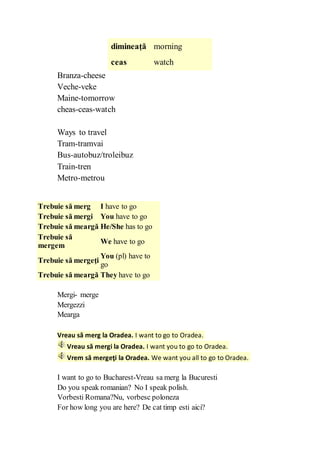
dimineaţă morning
ceas watch
Branza-cheese
Veche-veke
Maine-tomorrow
cheas-ceas-watch
Ways to travel
Tram-tramvai
Bus-autobuz/troleibuz
Train-tren
Metro-metrou
Trebuie să merg I have to go
Trebuie să mergi You have to go
Trebuie să meargă He/She has to go
Trebuie să
mergem
We have to go
Trebuie să mergeţi
You (pl) have to
go
Trebuie să meargă They have to go
Mergi- merge
Mergezzi
Mearga
Vreau să merg la Oradea. I want to go to Oradea.
Vreau să mergi la Oradea. I want you to go to Oradea.
Vrem să mergeţi la Oradea. We want you all to go to Oradea.
I want to go to Bucharest-Vreau sa merg la Bucuresti
Do you speak romanian? No I speak polish.
Vorbesti Romana?Nu, vorbesc poloneza
For how long you are here? De cat timp esti aici?
I am here for Three days- Sunt aici de trei zile
Future tense
TO BE
I will be –Eu voi fi
You will be – Tu vei fi
He/She will be- El/ea va fi
We will be-noi vom fi
You will be-voi veti fi vetzi
They will be-ei vor fi
I will be In Romania In two weks-Eu voi fi In Romania peste doua
saptamani
TO HAVE
I will have-Eu voi avea
You will have-tu vei avea
El/ea va avea-he/she will have
We will have-noi vom avea
You will have- voi veti avea
They will have-ei vor avea
Tomorrow I will have the final exam-Maine voi avea examenul final.
Reflexive pronoun
I look at her- Ma uit la ea
You look at Her—te uiti la ea
He/she looks at Her –El/ea Se uita la ea
We look at Her –noi Ne uitam la ea
You look at Her-voi va uitati la ea
They look at Her-ei se uita la ea
Possesiveadjectives
My-al. meu
Your-al. Tau
His/Her- al. Lui/al. Ei
Our-al. Nostru
Your-al. Vostru
Your-al. Dumneavoastra/ al. Lor=their notebook
DUM-NEA-VOAS-TRA
I don’thave Money-Nu am bani
I’m lost-M-am ratacit
http://www.romanianlessons.com/Lesson1.htm site

Auxiliar verbs

  • 1.
    Auxiliar verbs TO BE-A FI TO HAVE – A AVEA I am – Eu sunt I have – Eu am You are – Tu esti eshti You have – Tu ai He/She is – El/Ea este He/She has – El/ea are We are – Noi suntem We have – Noi avem You are – Voi sunteti suntezzi You have – Voi aveti avetzi They are – Ei/Ele sunt They have – Ei/Ele Au How old are you? Cati ani ai?-Am 20 de ani (20 years) Diferences between TO BE/TO HAVE – A FI/A AVEA - In romanian the TO BE-A FI is used to indicate the place where you are, to introduce yourself eg. Eu sunt Mirela. – I’m Mirela - TO HAVE is used to indicate the posesions; I have a nice room- (Eu) am o camera draguta. Where are you from? I am from Poland-Sunt din Polonia. Articles-Articolul a) Articolul hotarat ( definite article) The book- cartea carte-without article The letter-scrisoarea scrisoare
  • 2.
    The idea-ideea The telephone-telefonultelefon The pencil-creionul creion - for feminine the definite article finish In „a” and for masculine In „l” In the most cases b) Articolul nehotarat (indefinite article) One book- o carte One letter – o scrisoare One phone- un telefon One pencil – un creion om man prieten friend fată girl copii children, kids în faţă in front brânză cheese foarte very veche old (for objects) stea star albastră blue (f) frumoasă beautiful (f) mâncare food bere beer mîine Tomorrow
  • 3.
    dimineaţă morning ceas watch Branza-cheese Veche-veke Maine-tomorrow cheas-ceas-watch Waysto travel Tram-tramvai Bus-autobuz/troleibuz Train-tren Metro-metrou Trebuie să merg I have to go Trebuie să mergi You have to go Trebuie să meargă He/She has to go Trebuie să mergem We have to go Trebuie să mergeţi You (pl) have to go Trebuie să meargă They have to go Mergi- merge Mergezzi Mearga Vreau să merg la Oradea. I want to go to Oradea. Vreau să mergi la Oradea. I want you to go to Oradea. Vrem să mergeţi la Oradea. We want you all to go to Oradea. I want to go to Bucharest-Vreau sa merg la Bucuresti Do you speak romanian? No I speak polish. Vorbesti Romana?Nu, vorbesc poloneza For how long you are here? De cat timp esti aici?
  • 4.
    I am herefor Three days- Sunt aici de trei zile Future tense TO BE I will be –Eu voi fi You will be – Tu vei fi He/She will be- El/ea va fi We will be-noi vom fi You will be-voi veti fi vetzi They will be-ei vor fi I will be In Romania In two weks-Eu voi fi In Romania peste doua saptamani TO HAVE I will have-Eu voi avea You will have-tu vei avea El/ea va avea-he/she will have We will have-noi vom avea You will have- voi veti avea They will have-ei vor avea Tomorrow I will have the final exam-Maine voi avea examenul final. Reflexive pronoun I look at her- Ma uit la ea You look at Her—te uiti la ea He/she looks at Her –El/ea Se uita la ea We look at Her –noi Ne uitam la ea You look at Her-voi va uitati la ea They look at Her-ei se uita la ea
  • 5.
    Possesiveadjectives My-al. meu Your-al. Tau His/Her-al. Lui/al. Ei Our-al. Nostru Your-al. Vostru Your-al. Dumneavoastra/ al. Lor=their notebook DUM-NEA-VOAS-TRA I don’thave Money-Nu am bani I’m lost-M-am ratacit http://www.romanianlessons.com/Lesson1.htm site