sales@bisresearch.com | www.bisresearch.com
Key Questions Answered in the Report
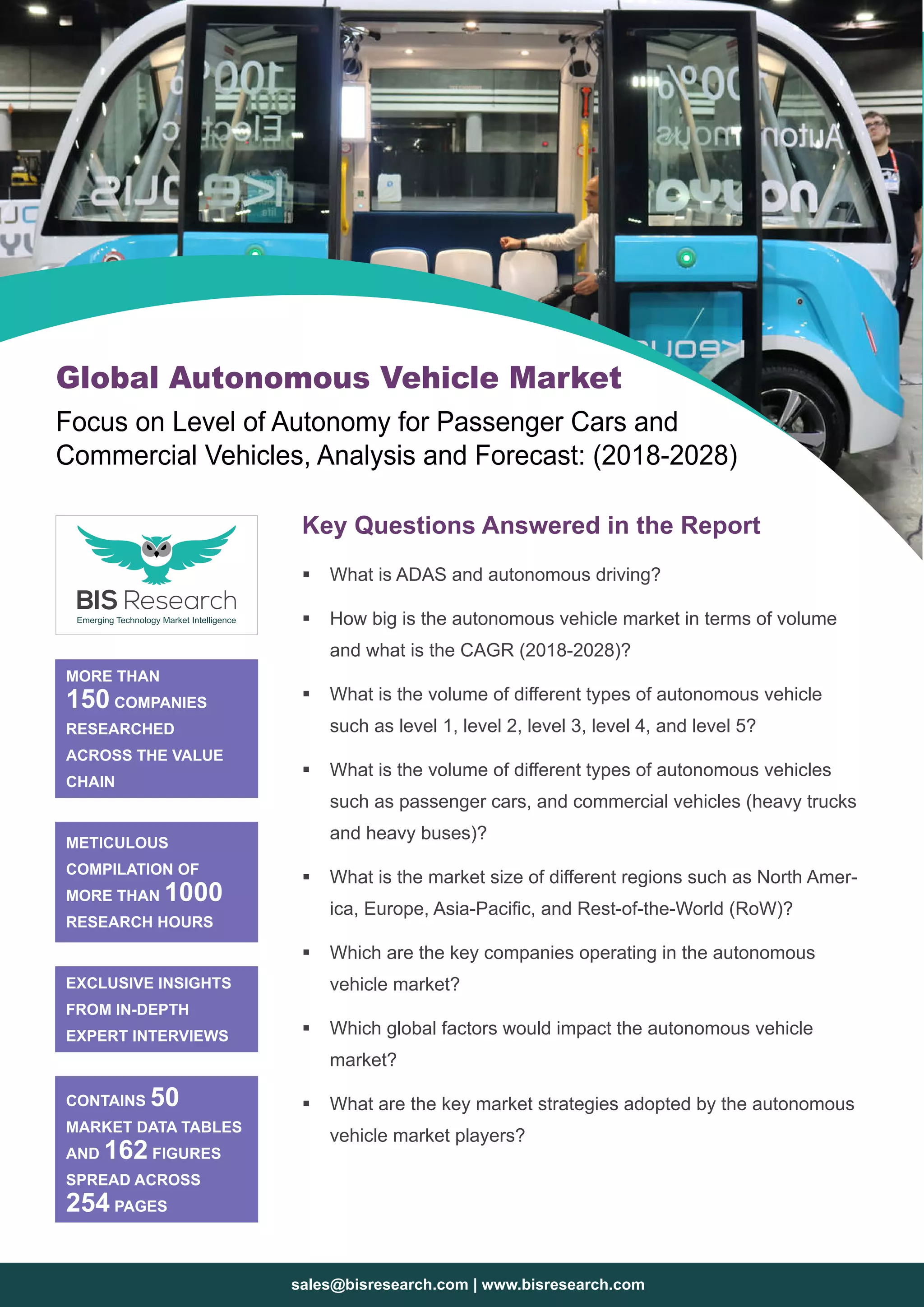
ƒƒ What is ADAS and autonomous driving?
ƒƒ How big is the autonomous vehicle market in terms of volume
and what is the CAGR (2018-2028)?
ƒƒ What is the volume of different types of autonomous vehicle
such as level 1, level 2, level 3, level 4, and level 5?
ƒƒ What is the volume of different types of autonomous vehicles
such as passenger cars, and commercial vehicles (heavy trucks
and heavy buses)?
ƒƒ What is the market size of different regions such as North Amer-
ica, Europe, Asia-Pacific, and Rest-of-the-World (RoW)?
ƒƒ Which are the key companies operating in the autonomous
vehicle market?
ƒƒ Which global factors would impact the autonomous vehicle
market?
ƒƒ What are the key market strategies adopted by the autonomous
vehicle market players?
MORE THAN
150 COMPANIES
RESEARCHED
ACROSS THE VALUE
CHAIN
METICULOUS
COMPILATION OF
MORE THAN 1000
RESEARCH HOURS
EXCLUSIVE INSIGHTS
FROM IN-DEPTH
EXPERT INTERVIEWS
CONTAINS 50
MARKET DATA TABLES
AND 162 FIGURES
SPREAD ACROSS
254 PAGES
Global Autonomous Vehicle Market
Focus on Level of Autonomy for Passenger Cars and
Commercial Vehicles, Analysis and Forecast: (2018-2028)
sales@bisresearch.com | www.bisresearch.com
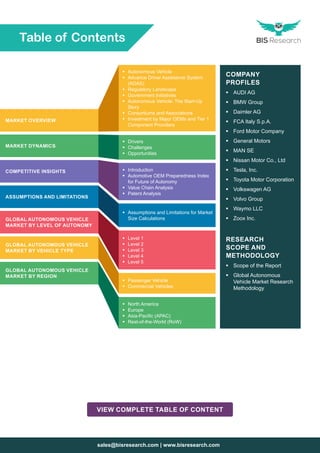
Table of Contents
COMPANY
PROFILES
ƒƒ AUDI AG
ƒƒ BMW Group
ƒƒ Daimler AG
ƒƒ FCA Italy S.p.A.
ƒƒ Ford Motor Company
ƒƒ General Motors
ƒƒ MAN SE
ƒƒ Nissan Motor Co., Ltd
ƒƒ Tesla, Inc.
ƒƒ Toyota Motor Corporation
ƒƒ Volkswagen AG
ƒƒ Volvo Group
ƒƒ Waymo LLC
ƒƒ Zoox Inc.
RESEARCH
SCOPE AND
METHODOLOGY
ƒƒ Scope of the Report
ƒƒ Global Autonomous
Vehicle Market Research
Methodology
VIEW COMPLETE TABLE OF CONTENT
ƒƒ Drivers
ƒƒ Challenges
ƒƒ Opportunities
ƒƒ Autonomous Vehicle
ƒƒ Advance Driver Assistance System
(ADAS)
ƒƒ Regulatory Landscape
ƒƒ Government Initiatives
ƒƒ Autonomous Vehicle: The Start-Up
Story
ƒƒ Consortiums and Associations
ƒƒ Investment by Major OEMs and Tier 1
Component Providers
ƒƒ Introduction
ƒƒ Automotive OEM Preparedness Index
for Future of Autonomy
ƒƒ Value Chain Analysis
ƒƒ Patent Analysis
ƒƒ Assumptions and Limitations for Market
Size Calculations
ƒƒ Level 1
ƒƒ Level 2
ƒƒ Level 3
ƒƒ Level 4
ƒƒ Level 5
ƒƒ Passenger Vehicle
ƒƒ Commercial Vehicles
ƒƒ North America
ƒƒ Europe
ƒƒ Asia-Pacific (APAC)
ƒƒ Rest-of-the-World (RoW)
MARKET OVERVIEW
MARKET DYNAMICS
COMPETITIVE INSIGHTS
ASSUMPTIONS AND LIMITATIONS
GLOBAL AUTONOMOUS VEHICLE
MARKET BY LEVEL OF AUTONOMY
GLOBAL AUTONOMOUS VEHICLE
MARKET BY VEHICLE TYPE
GLOBAL AUTONOMOUS VEHICLE
MARKET BY REGION
sales@bisresearch.com | www.bisresearch.com
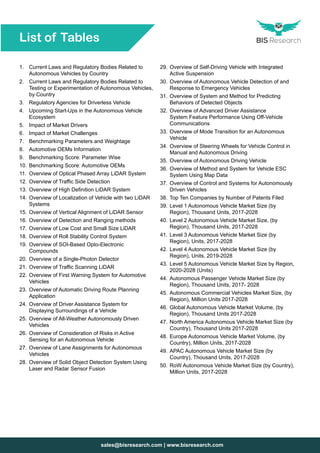
List of Tables
1.	 Current Laws and Regulatory Bodies Related to
Autonomous Vehicles by Country
2.	 Current Laws and Regulatory Bodies Related to
Testing or Experimentation of Autonomous Vehicles,
by Country
3.	 Regulatory Agencies for Driverless Vehicle
4.	 Upcoming Start-Ups in the Autonomous Vehicle
Ecosystem
5.	 Impact of Market Drivers
6.	 Impact of Market Challenges
7.	 Benchmarking Parameters and Weightage
8.	 Automotive OEMs Information
9.	 Benchmarking Score: Parameter Wise
10.	Benchmarking Score: Automotive OEMs
11.	 Overview of Optical Phased Array LiDAR System
12.	Overview of Traffic Side Detection
13.	Overview of High Definition LiDAR System
14.	Overview of Localization of Vehicle with two LiDAR
Systems
15.	Overview of Vertical Alignment of LiDAR Sensor
16.	Overview of Detection and Ranging methods
17.	Overview of Low Cost and Small Size LiDAR
18.	Overview of Roll Stability Control System
19.	Overview of SOI-Based Opto-Electronic
Compounds
20.	Overview of a Single-Photon Detector
21.	Overview of Traffic Scanning LiDAR
22.	Overview of First Warning System for Automotive
Vehicles
23.	Overview of Automatic Driving Route Planning
Application
24.	Overview of Driver Assistance System for
Displaying Surroundings of a Vehicle
25.	Overview of All-Weather Autonomously Driven
Vehicles
26.	Overview of Consideration of Risks in Active
Sensing for an Autonomous Vehicle
27.	Overview of Lane Assignments for Autonomous
Vehicles
28.	Overview of Solid Object Detection System Using
Laser and Radar Sensor Fusion
29.	Overview of Self-Driving Vehicle with Integrated
Active Suspension
30.	Overview of Autonomous Vehicle Detection of and
Response to Emergency Vehicles
31.	Overview of System and Method for Predicting
Behaviors of Detected Objects
32.	Overview of Advanced Driver Assistance
System Feature Performance Using Off-Vehicle
Communications
33.	Overview of Mode Transition for an Autonomous
Vehicle
34.	Overview of Steering Wheels for Vehicle Control in
Manual and Autonomous Driving
35.	Overview of Autonomous Driving Vehicle
36.	Overview of Method and System for Vehicle ESC
System Using Map Data
37.	Overview of Control and Systems for Autonomously
Driven Vehicles
38.	Top Ten Companies by Number of Patents Filed
39.	Level 1 Autonomous Vehicle Market Size (by
Region), Thousand Units, 2017-2028
40.	Level 2 Autonomous Vehicle Market Size, (by
Region), Thousand Units, 2017-2028
41.	Level 3 Autonomous Vehicle Market Size (by
Region), Units, 2017-2028
42.	Level 4 Autonomous Vehicle Market Size (by
Region), Units, 2019-2028
43.	Level 5 Autonomous Vehicle Market Size by Region,
2020-2028 (Units)
44.	Autonomous Passenger Vehicle Market Size (by
Region), Thousand Units, 2017- 2028
45.	Autonomous Commercial Vehicles Market Size, (by
Region), Million Units 2017-2028
46.	Global Autonomous Vehicle Market Volume, (by
Region), Thousand Units 2017-2028
47.	North America Autonomous Vehicle Market Size (by
Country), Thousand Units 2017-2028
48.	Europe Autonomous Vehicle Market Volume, (by
Country), Million Units, 2017-2028
49.	APAC Autonomous Vehicle Market Size (by
Country), Thousand Units, 2017-2028
50.	RoW Autonomous Vehicle Market Size (by Country),
Million Units, 2017-2028
sales@bisresearch.com | www.bisresearch.com
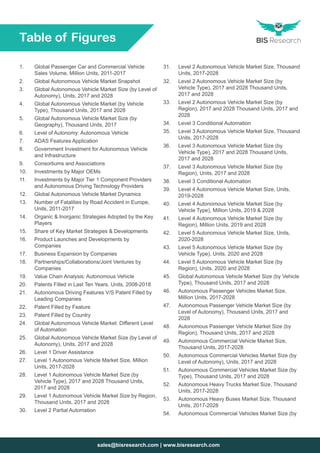
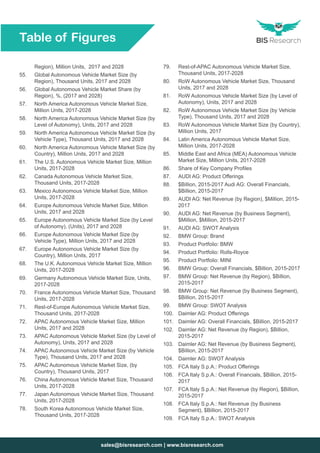
1.	 Global Passenger Car and Commercial Vehicle
Sales Volume, Million Units, 2011-2017
2.	 Global Autonomous Vehicle Market Snapshot
3.	 Global Autonomous Vehicle Market Size (by Level of
Autonomy), Units, 2017 and 2028
4.	 Global Autonomous Vehicle Market (by Vehicle
Type), Thousand Units, 2017 and 2028
5.	 Global Autonomous Vehicle Market Size (by
Geography), Thousand Units, 2017
6.	 Level of Autonomy: Autonomous Vehicle
7.	 ADAS Features Application
8.	 Government Investment for Autonomous Vehicle
and Infrastructure
9.	 Consortiums and Associations
10.	 Investments by Major OEMs
11.	 Investments by Major Tier 1 Component Providers
and Autonomous Driving Technology Providers
12.	 Global Autonomous Vehicle Market Dynamics
13.	 Number of Fatalities by Road Accident in Europe,
Units, 2011-2017
14.	 Organic  Inorganic Strategies Adopted by the Key
Players
15.	 Share of Key Market Strategies  Developments
16.	 Product Launches and Developments by
Companies
17.	 Business Expansion by Companies
18.	 Partnerships/Collaborations/Joint Ventures by
Companies
19.	 Value Chain Analysis: Autonomous Vehicle
20.	 Patents Filled in Last Ten Years, Units, 2008-2018
21.	 Autonomous Driving Features V/S Patent Filled by
Leading Companies
22.	 Patent Filled by Feature
23.	 Patent Filled by Country
24.	 Global Autonomous Vehicle Market: Different Level
of Automation
25.	 Global Autonomous Vehicle Market Size (by Level of
Autonomy), Units, 2017 and 2028
26.	 Level 1 Driver Assistance
27.	 Level 1 Autonomous Vehicle Market Size, Million
Units, 2017-2028
28.	 Level 1 Autonomous Vehicle Market Size (by
Vehicle Type), 2017 and 2028 Thousand Units,
2017 and 2028
29.	 Level 1 Autonomous Vehicle Market Size by Region,
Thousand Units, 2017 and 2028
30.	 Level 2 Partial Automation
31.	 Level 2 Autonomous Vehicle Market Size, Thousand
Units, 2017-2028
32.	 Level 2 Autonomous Vehicle Market Size (by
Vehicle Type), 2017 and 2028 Thousand Units,
2017 and 2028
33.	 Level 2 Autonomous Vehicle Market Size (by
Region), 2017 and 2028 Thousand Units, 2017 and
2028
34.	 Level 3 Conditional Automation
35.	 Level 3 Autonomous Vehicle Market Size, Thousand
Units, 2017-2028
36.	 Level 3 Autonomous Vehicle Market Size (by
Vehicle Type), 2017 and 2028 Thousand Units,
2017 and 2028
37.	 Level 3 Autonomous Vehicle Market Size (by
Region), Units, 2017 and 2028
38.	 Level 3 Conditional Automation
39.	 Level 4 Autonomous Vehicle Market Size, Units,
2019-2028
40.	 Level 4 Autonomous Vehicle Market Size (by
Vehicle Type), Million Units, 2019  2028
41.	 Level 4 Autonomous Vehicle Market Size (by
Region), Million Units, 2019 and 2028
42.	 Level 5 Autonomous Vehicle Market Size, Units,
2020-2028
43.	 Level 5 Autonomous Vehicle Market Size (by
Vehicle Type), Units, 2020 and 2028
44.	 Level 5 Autonomous Vehicle Market Size (by
Region), Units, 2020 and 2028
45.	 Global Autonomous Vehicle Market Size (by Vehicle
Type), Thousand Units, 2017 and 2028
46.	 Autonomous Passenger Vehicles Market Size,
Million Units, 2017-2028
47.	 Autonomous Passenger Vehicle Market Size (by
Level of Autonomy), Thousand Units, 2017 and
2028
48.	 Autonomous Passenger Vehicle Market Size (by
Region), Thousand Units, 2017 and 2028
49.	 Autonomous Commercial Vehicle Market Size,
Thousand Units, 2017-2028
50.	 Autonomous Commercial Vehicles Market Size (by
Level of Autonomy), Units, 2017 and 2028
51.	 Autonomous Commercial Vehicles Market Size (by
Type), Thousand Units, 2017 and 2028
52.	 Autonomous Heavy Trucks Market Size, Thousand
Units, 2017-2028
53.	 Autonomous Heavy Buses Market Size, Thousand
Units, 2017-2028
54.	 Autonomous Commercial Vehicles Market Size (by
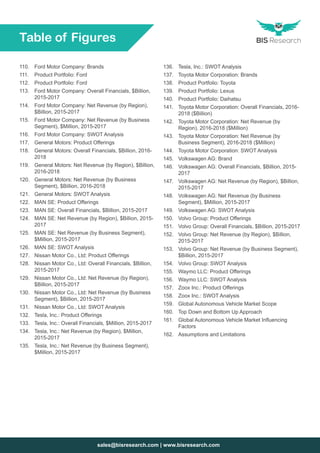
Table of Figures
sales@bisresearch.com | www.bisresearch.com
Region), Million Units, 2017 and 2028
55.	 Global Autonomous Vehicle Market Size (by
Region), Thousand Units, 2017 and 2028
56.	 Global Autonomous Vehicle Market Share (by
Region), %, (2017 and 2028)
57.	 North America Autonomous Vehicle Market Size,
Million Units, 2017-2028
58.	 North America Autonomous Vehicle Market Size (by
Level of Autonomy), Units, 2017 and 2028
59.	 North America Autonomous Vehicle Market Size (by
Vehicle Type), Thousand Units, 2017 and 2028
60.	 North America Autonomous Vehicle Market Size (by
Country), Million Units, 2017 and 2028
61.	 The U.S. Autonomous Vehicle Market Size, Million
Units, 2017-2028
62.	 Canada Autonomous Vehicle Market Size,
Thousand Units, 2017-2028
63.	 Mexico Autonomous Vehicle Market Size, Million
Units, 2017-2028
64.	 Europe Autonomous Vehicle Market Size, Million
Units, 2017 and 2028
65.	 Europe Autonomous Vehicle Market Size (by Level
of Autonomy), (Units), 2017 and 2028
66.	 Europe Autonomous Vehicle Market Size (by
Vehicle Type), Million Units, 2017 and 2028
67.	 Europe Autonomous Vehicle Market Size (by
Country), Million Units, 2017
68.	 The U.K. Autonomous Vehicle Market Size, Million
Units, 2017-2028
69.	 Germany Autonomous Vehicle Market Size, Units,
2017-2028
70.	 France Autonomous Vehicle Market Size, Thousand
Units, 2017-2028
71.	 Rest-of-Europe Autonomous Vehicle Market Size,
Thousand Units, 2017-2028
72.	 APAC Autonomous Vehicle Market Size, Million
Units, 2017 and 2028
73.	 APAC Autonomous Vehicle Market Size (by Level of
Autonomy), Units, 2017 and 2028
74.	 APAC Autonomous Vehicle Market Size (by Vehicle
Type), Thousand Units, 2017 and 2028
75.	 APAC Autonomous Vehicle Market Size, (by
Country), Thousand Units, 2017
76.	 China Autonomous Vehicle Market Size, Thousand
Units, 2017-2028
77.	 Japan Autonomous Vehicle Market Size, Thousand
Units, 2017-2028
78.	 South Korea Autonomous Vehicle Market Size,
Thousand Units, 2017-2028
79.	 Rest-of-APAC Autonomous Vehicle Market Size,
Thousand Units, 2017-2028
80.	 RoW Autonomous Vehicle Market Size, Thousand
Units, 2017 and 2028
81.	 RoW Autonomous Vehicle Market Size (by Level of
Autonomy), Units, 2017 and 2028
82.	 RoW Autonomous Vehicle Market Size (by Vehicle
Type), Thousand Units, 2017 and 2028
83.	 RoW Autonomous Vehicle Market Size (by Country),
Million Units, 2017
84.	 Latin America Autonomous Vehicle Market Size,
Million Units, 2017-2028
85.	 Middle East and Africa (MEA) Autonomous Vehicle
Market Size, Million Units, 2017-2028
86.	 Share of Key Company Profiles
87.	 AUDI AG: Product Offerings
88.	 $Billion, 2015-2017 Audi AG: Overall Financials,
$Billion, 2015-2017
89.	 AUDI AG: Net Revenue (by Region), $Million, 2015-
2017
90.	 AUDI AG: Net Revenue (by Business Segment),
$Million, $Million, 2015-2017
91.	 AUDI AG: SWOT Analysis
92.	 BMW Group: Brand
93.	 Product Portfolio: BMW
94.	 Product Portfolio: Rolls-Royce
95.	 Product Portfolio: MINI
96.	 BMW Group: Overall Financials, $Billion, 2015-2017
97.	 BMW Group: Net Revenue (by Region), $Billion,
2015-2017
98.	 BMW Group: Net Revenue (by Business Segment),
$Billion, 2015-2017
99.	 BMW Group: SWOT Analysis
100.	 Daimler AG: Product Offerings
101.	 Daimler AG: Overall Financials, $Billion, 2015-2017
102.	 Daimler AG: Net Revenue (by Region), $Billion,
2015-2017
103.	 Daimler AG: Net Revenue (by Business Segment),
$Billion, 2015-2017
104.	 Daimler AG: SWOT Analysis
105.	 FCA Italy S.p.A.: Product Offerings
106.	 FCA Italy S.p.A.: Overall Financials, $Billion, 2015-
2017
107.	 FCA Italy S.p.A.: Net Revenue (by Region), $Billion,
2015-2017
108.	 FCA Italy S.p.A.: Net Revenue (by Business
Segment), $Billion, 2015-2017
109.	 FCA Italy S.p.A.: SWOT Analysis
Table of Figures
sales@bisresearch.com | www.bisresearch.com
Table of Figures
110.	 Ford Motor Company: Brands
111.	 Product Portfolio: Ford
112.	 Product Portfolio: Ford
113.	 Ford Motor Company: Overall Financials, $Billion,
2015-2017
114.	 Ford Motor Company: Net Revenue (by Region),
$Billion, 2015-2017
115.	 Ford Motor Company: Net Revenue (by Business
Segment), $Million, 2015-2017
116.	 Ford Motor Company: SWOT Analysis
117.	 General Motors: Product Offerings
118.	 General Motors: Overall Financials, $Billion, 2016-
2018
119.	 General Motors: Net Revenue (by Region), $Billion,
2016-2018
120.	 General Motors: Net Revenue (by Business
Segment), $Billion, 2016-2018
121.	 General Motors: SWOT Analysis
122.	 MAN SE: Product Offerings
123.	 MAN SE: Overall Financials, $Billion, 2015-2017
124.	 MAN SE: Net Revenue (by Region), $Billion, 2015-
2017
125.	 MAN SE: Net Revenue (by Business Segment),
$Million, 2015-2017
126.	 MAN SE: SWOT Analysis
127.	 Nissan Motor Co., Ltd: Product Offerings
128.	 Nissan Motor Co., Ltd: Overall Financials, $Billion,
2015-2017
129.	 Nissan Motor Co., Ltd: Net Revenue (by Region),
$Billion, 2015-2017
130.	 Nissan Motor Co., Ltd: Net Revenue (by Business
Segment), $Billion, 2015-2017
131.	 Nissan Motor Co., Ltd: SWOT Analysis
132.	 Tesla, Inc.: Product Offerings
133.	 Tesla, Inc.: Overall Financials, $Million, 2015-2017
134.	 Tesla, Inc.: Net Revenue (by Region), $Million,
2015-2017
135.	 Tesla, Inc.: Net Revenue (by Business Segment),
$Million, 2015-2017
136.	 Tesla, Inc.: SWOT Analysis
137.	 Toyota Motor Corporation: Brands
138.	 Product Portfolio: Toyota
139.	 Product Portfolio: Lexus
140.	 Product Portfolio: Daihatsu
141.	 Toyota Motor Corporation: Overall Financials, 2016-
2018 ($Billion)
142.	 Toyota Motor Corporation: Net Revenue (by
Region), 2016-2018 ($Million)
143.	 Toyota Motor Corporation: Net Revenue (by
Business Segment), 2016-2018 ($Million)
144.	 Toyota Motor Corporation: SWOT Analysis
145.	 Volkswagen AG: Brand
146.	 Volkswagen AG: Overall Financials, $Billion, 2015-
2017
147.	 Volkswagen AG: Net Revenue (by Region), $Billion,
2015-2017
148.	 Volkswagen AG: Net Revenue (by Business
Segment), $Million, 2015-2017
149.	 Volkswagen AG: SWOT Analysis
150.	 Volvo Group: Product Offerings
151.	 Volvo Group: Overall Financials, $Billion, 2015-2017
152.	 Volvo Group: Net Revenue (by Region), $Billion,
2015-2017
153.	 Volvo Group: Net Revenue (by Business Segment),
$Billion, 2015-2017
154.	 Volvo Group: SWOT Analysis
155.	 Waymo LLC: Product Offerings
156.	 Waymo LLC: SWOT Analysis
157.	 Zoox Inc.: Product Offerings
158.	 Zoox Inc.: SWOT Analysis
159.	 Global Autonomous Vehicle Market Scope
160.	 Top Down and Bottom Up Approach
161.	 Global Autonomous Vehicle Market Influencing
Factors
162.	 Assumptions and Limitations
sales@bisresearch.com | www.bisresearch.com
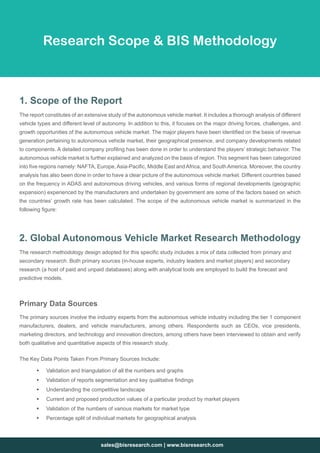
1. Scope of the Report
The report constitutes of an extensive study of the autonomous vehicle market. It includes a thorough analysis of different
vehicle types and different level of autonomy. In addition to this, it focuses on the major driving forces, challenges, and
growth opportunities of the autonomous vehicle market. The major players have been identified on the basis of revenue
generation pertaining to autonomous vehicle market, their geographical presence, and company developments related
to components. A detailed company profiling has been done in order to understand the players’ strategic behavior. The
autonomous vehicle market is further explained and analyzed on the basis of region. This segment has been categorized
into five regions namely: NAFTA, Europe,Asia-Pacific, Middle East andAfrica, and SouthAmerica. Moreover, the country
analysis has also been done in order to have a clear picture of the autonomous vehicle market. Different countries based
on the frequency in ADAS and autonomous driving vehicles, and various forms of regional developments (geographic
expansion) experienced by the manufacturers and undertaken by government are some of the factors based on which
the countries’ growth rate has been calculated. The scope of the autonomous vehicle market is summarized in the
following figure:
2. Global Autonomous Vehicle Market Research Methodology
The research methodology design adopted for this specific study includes a mix of data collected from primary and
secondary research. Both primary sources (in-house experts, industry leaders and market players) and secondary
research (a host of paid and unpaid databases) along with analytical tools are employed to build the forecast and
predictive models.
Research Scope  BIS Methodology
Primary Data Sources
The primary sources involve the industry experts from the autonomous vehicle industry including the tier 1 component
manufacturers, dealers, and vehicle manufacturers, among others. Respondents such as CEOs, vice presidents,
marketing directors, and technology and innovation directors, among others have been interviewed to obtain and verify
both qualitative and quantitative aspects of this research study.
The Key Data Points Taken From Primary Sources Include:
ƒƒ Validation and triangulation of all the numbers and graphs
ƒƒ Validation of reports segmentation and key qualitative findings
ƒƒ Understanding the competitive landscape
ƒƒ Current and proposed production values of a particular product by market players
ƒƒ Validation of the numbers of various markets for market type
ƒƒ Percentage split of individual markets for geographical analysis
sales@bisresearch.com | www.bisresearch.com
Secondary Data Sources
This research study involves the usage of extensive secondary research, directories, company websites, and annual
reports. It also makes use of databases, such as Hoovers, Bloomberg, Business-week, and Factiva, to collect useful and
effective information for an extensive, technical, market-oriented, and commercial study of the global market. In addition
to the data sources mentioned above, the study has been completed with the help of other data sources and websites
such as: www.weforum.org and www.govt.uk
Secondary research was done in order to obtain crucial information about the industry’s value chain, revenue models,
market’s monetary chain, total pool of key players, and the current and potential use cases and applications.
The key data points taken from secondary research include:
ƒƒ Segmentation breakups, split-ups, and percentage shares
ƒƒ Data for market value
ƒƒ Key industry trends of the top players of the market
ƒƒ Qualitative insights into various aspects of the market, key trends, and emerging areas of innovation
ƒƒ Quantitative data for mathematical and statistical calculations
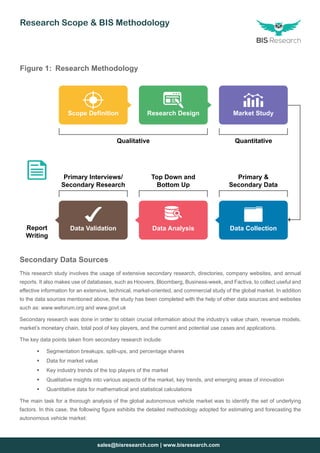
The main task for a thorough analysis of the global autonomous vehicle market was to identify the set of underlying
factors. In this case, the following figure exhibits the detailed methodology adopted for estimating and forecasting the
autonomous vehicle market:
Figure 1:	 Research Methodology
Scope Definition
Data Validation
Research Design
Data Analysis
Market Study
Data Collection
Qualitative Quantitative
Primary 
Secondary Data
Top Down and
Bottom Up
Primary Interviews/
Secondary Research
Report
Writing
Research Scope  BIS Methodology
sales@bisresearch.com | www.bisresearch.com
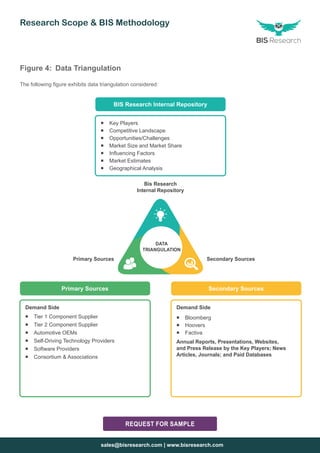
Figure 4:	 Data Triangulation
The following figure exhibits data triangulation considered:
Primary Sources
Demand Side
ƒƒ Tier 1 Component Supplier
ƒƒ Tier 2 Component Supplier
ƒƒ Automotive OEMs
ƒƒ Self-Driving Technology Providers
ƒƒ Software Providers
ƒƒ Consortium  Associations
Demand Side
ƒƒ Bloomberg
ƒƒ Hoovers
ƒƒ Factiva
Annual Reports, Presentations, Websites,
and Press Release by the Key Players; News
Articles, Journals; and Paid Databases
Secondary Sources
Primary Sources
Bis Research
Internal Repository
Secondary Sources
DATA
TRIANGULATION
BIS Research Internal Repository
ƒƒ Key Players
ƒƒ Competitive Landscape
ƒƒ Opportunities/Challenges
ƒƒ Market Size and Market Share
ƒƒ Influencing Factors
ƒƒ Market Estimates
ƒƒ Geographical Analysis
Research Scope  BIS Methodology
REQUEST FOR SAMPLE
sales@bisresearch.com | www.bisresearch.com
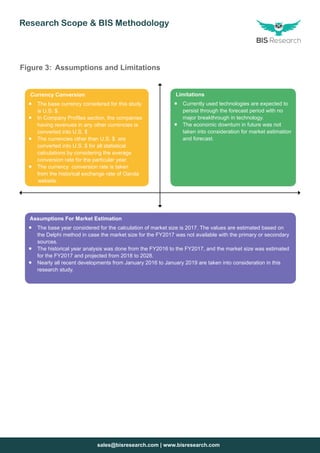
Figure 3:	 Assumptions and Limitations
Currency Conversion
ƒƒ The base currency considered for this study
is U.S. $.
ƒƒ In Company Profiles section, the companies
having revenues in any other currencies is
converted into U.S. $
ƒƒ The currencies other than U.S. $ are
converted into U.S. $ for all statistical
calculations by considering the average
conversion rate for the particular year.
ƒƒ The currency conversion rate is taken
from the historical exchange rate of Oanda
website.
Limitations
ƒƒ Currently used technologies are expected to
persist through the forecast period with no
major breakthrough in technology.
ƒƒ The economic downturn in future was not
taken into consideration for market estimation
and forecast.
Assumptions For Market Estimation
ƒƒ The base year considered for the calculation of market size is 2017. The values are estimated based on
the Delphi method in case the market size for the FY2017 was not available with the primary or secondary
sources.
ƒƒ The historical year analysis was done from the FY2016 to the FY2017, and the market size was estimated
for the FY2017 and projected from 2018 to 2028.
ƒƒ Nearly all recent developments from January 2016 to January 2019 are taken into consideration in this
research study.
Research Scope  BIS Methodology
sales@bisresearch.com | www.bisresearch.comsales@bisresearch.com | www.bisresearch.com
BIS Research
39111 Paseo Padre PKWY STE 313,
Fremont CA 94538-1686,
Tel: +1-510-404-8135
Global Delivery Centre
Tapasya Corp Heights, Subarea,
Sector 126, Noida, NCR-201303 India
Tel: +91 120 4261540 / +91 120 4261544
To know more about us, please visit our website:
bisresearch.com
For other queries contact:
sales@bisresearch.com

Autonomous Vehicle Market Study (2018-2028)

  • 1.
    sales@bisresearch.com | www.bisresearch.com KeyQuestions Answered in the Report ƒƒ What is ADAS and autonomous driving? ƒƒ How big is the autonomous vehicle market in terms of volume and what is the CAGR (2018-2028)? ƒƒ What is the volume of different types of autonomous vehicle such as level 1, level 2, level 3, level 4, and level 5? ƒƒ What is the volume of different types of autonomous vehicles such as passenger cars, and commercial vehicles (heavy trucks and heavy buses)? ƒƒ What is the market size of different regions such as North Amer- ica, Europe, Asia-Pacific, and Rest-of-the-World (RoW)? ƒƒ Which are the key companies operating in the autonomous vehicle market? ƒƒ Which global factors would impact the autonomous vehicle market? ƒƒ What are the key market strategies adopted by the autonomous vehicle market players? MORE THAN 150 COMPANIES RESEARCHED ACROSS THE VALUE CHAIN METICULOUS COMPILATION OF MORE THAN 1000 RESEARCH HOURS EXCLUSIVE INSIGHTS FROM IN-DEPTH EXPERT INTERVIEWS CONTAINS 50 MARKET DATA TABLES AND 162 FIGURES SPREAD ACROSS 254 PAGES Global Autonomous Vehicle Market Focus on Level of Autonomy for Passenger Cars and Commercial Vehicles, Analysis and Forecast: (2018-2028)
  • 2.
    sales@bisresearch.com | www.bisresearch.com Tableof Contents COMPANY PROFILES ƒƒ AUDI AG ƒƒ BMW Group ƒƒ Daimler AG ƒƒ FCA Italy S.p.A. ƒƒ Ford Motor Company ƒƒ General Motors ƒƒ MAN SE ƒƒ Nissan Motor Co., Ltd ƒƒ Tesla, Inc. ƒƒ Toyota Motor Corporation ƒƒ Volkswagen AG ƒƒ Volvo Group ƒƒ Waymo LLC ƒƒ Zoox Inc. RESEARCH SCOPE AND METHODOLOGY ƒƒ Scope of the Report ƒƒ Global Autonomous Vehicle Market Research Methodology VIEW COMPLETE TABLE OF CONTENT ƒƒ Drivers ƒƒ Challenges ƒƒ Opportunities ƒƒ Autonomous Vehicle ƒƒ Advance Driver Assistance System (ADAS) ƒƒ Regulatory Landscape ƒƒ Government Initiatives ƒƒ Autonomous Vehicle: The Start-Up Story ƒƒ Consortiums and Associations ƒƒ Investment by Major OEMs and Tier 1 Component Providers ƒƒ Introduction ƒƒ Automotive OEM Preparedness Index for Future of Autonomy ƒƒ Value Chain Analysis ƒƒ Patent Analysis ƒƒ Assumptions and Limitations for Market Size Calculations ƒƒ Level 1 ƒƒ Level 2 ƒƒ Level 3 ƒƒ Level 4 ƒƒ Level 5 ƒƒ Passenger Vehicle ƒƒ Commercial Vehicles ƒƒ North America ƒƒ Europe ƒƒ Asia-Pacific (APAC) ƒƒ Rest-of-the-World (RoW) MARKET OVERVIEW MARKET DYNAMICS COMPETITIVE INSIGHTS ASSUMPTIONS AND LIMITATIONS GLOBAL AUTONOMOUS VEHICLE MARKET BY LEVEL OF AUTONOMY GLOBAL AUTONOMOUS VEHICLE MARKET BY VEHICLE TYPE GLOBAL AUTONOMOUS VEHICLE MARKET BY REGION
  • 3.
    sales@bisresearch.com | www.bisresearch.com Listof Tables 1. Current Laws and Regulatory Bodies Related to Autonomous Vehicles by Country 2. Current Laws and Regulatory Bodies Related to Testing or Experimentation of Autonomous Vehicles, by Country 3. Regulatory Agencies for Driverless Vehicle 4. Upcoming Start-Ups in the Autonomous Vehicle Ecosystem 5. Impact of Market Drivers 6. Impact of Market Challenges 7. Benchmarking Parameters and Weightage 8. Automotive OEMs Information 9. Benchmarking Score: Parameter Wise 10. Benchmarking Score: Automotive OEMs 11. Overview of Optical Phased Array LiDAR System 12. Overview of Traffic Side Detection 13. Overview of High Definition LiDAR System 14. Overview of Localization of Vehicle with two LiDAR Systems 15. Overview of Vertical Alignment of LiDAR Sensor 16. Overview of Detection and Ranging methods 17. Overview of Low Cost and Small Size LiDAR 18. Overview of Roll Stability Control System 19. Overview of SOI-Based Opto-Electronic Compounds 20. Overview of a Single-Photon Detector 21. Overview of Traffic Scanning LiDAR 22. Overview of First Warning System for Automotive Vehicles 23. Overview of Automatic Driving Route Planning Application 24. Overview of Driver Assistance System for Displaying Surroundings of a Vehicle 25. Overview of All-Weather Autonomously Driven Vehicles 26. Overview of Consideration of Risks in Active Sensing for an Autonomous Vehicle 27. Overview of Lane Assignments for Autonomous Vehicles 28. Overview of Solid Object Detection System Using Laser and Radar Sensor Fusion 29. Overview of Self-Driving Vehicle with Integrated Active Suspension 30. Overview of Autonomous Vehicle Detection of and Response to Emergency Vehicles 31. Overview of System and Method for Predicting Behaviors of Detected Objects 32. Overview of Advanced Driver Assistance System Feature Performance Using Off-Vehicle Communications 33. Overview of Mode Transition for an Autonomous Vehicle 34. Overview of Steering Wheels for Vehicle Control in Manual and Autonomous Driving 35. Overview of Autonomous Driving Vehicle 36. Overview of Method and System for Vehicle ESC System Using Map Data 37. Overview of Control and Systems for Autonomously Driven Vehicles 38. Top Ten Companies by Number of Patents Filed 39. Level 1 Autonomous Vehicle Market Size (by Region), Thousand Units, 2017-2028 40. Level 2 Autonomous Vehicle Market Size, (by Region), Thousand Units, 2017-2028 41. Level 3 Autonomous Vehicle Market Size (by Region), Units, 2017-2028 42. Level 4 Autonomous Vehicle Market Size (by Region), Units, 2019-2028 43. Level 5 Autonomous Vehicle Market Size by Region, 2020-2028 (Units) 44. Autonomous Passenger Vehicle Market Size (by Region), Thousand Units, 2017- 2028 45. Autonomous Commercial Vehicles Market Size, (by Region), Million Units 2017-2028 46. Global Autonomous Vehicle Market Volume, (by Region), Thousand Units 2017-2028 47. North America Autonomous Vehicle Market Size (by Country), Thousand Units 2017-2028 48. Europe Autonomous Vehicle Market Volume, (by Country), Million Units, 2017-2028 49. APAC Autonomous Vehicle Market Size (by Country), Thousand Units, 2017-2028 50. RoW Autonomous Vehicle Market Size (by Country), Million Units, 2017-2028
  • 4.
    sales@bisresearch.com | www.bisresearch.com 1. Global Passenger Car and Commercial Vehicle Sales Volume, Million Units, 2011-2017 2. Global Autonomous Vehicle Market Snapshot 3. Global Autonomous Vehicle Market Size (by Level of Autonomy), Units, 2017 and 2028 4. Global Autonomous Vehicle Market (by Vehicle Type), Thousand Units, 2017 and 2028 5. Global Autonomous Vehicle Market Size (by Geography), Thousand Units, 2017 6. Level of Autonomy: Autonomous Vehicle 7. ADAS Features Application 8. Government Investment for Autonomous Vehicle and Infrastructure 9. Consortiums and Associations 10. Investments by Major OEMs 11. Investments by Major Tier 1 Component Providers and Autonomous Driving Technology Providers 12. Global Autonomous Vehicle Market Dynamics 13. Number of Fatalities by Road Accident in Europe, Units, 2011-2017 14. Organic Inorganic Strategies Adopted by the Key Players 15. Share of Key Market Strategies Developments 16. Product Launches and Developments by Companies 17. Business Expansion by Companies 18. Partnerships/Collaborations/Joint Ventures by Companies 19. Value Chain Analysis: Autonomous Vehicle 20. Patents Filled in Last Ten Years, Units, 2008-2018 21. Autonomous Driving Features V/S Patent Filled by Leading Companies 22. Patent Filled by Feature 23. Patent Filled by Country 24. Global Autonomous Vehicle Market: Different Level of Automation 25. Global Autonomous Vehicle Market Size (by Level of Autonomy), Units, 2017 and 2028 26. Level 1 Driver Assistance 27. Level 1 Autonomous Vehicle Market Size, Million Units, 2017-2028 28. Level 1 Autonomous Vehicle Market Size (by Vehicle Type), 2017 and 2028 Thousand Units, 2017 and 2028 29. Level 1 Autonomous Vehicle Market Size by Region, Thousand Units, 2017 and 2028 30. Level 2 Partial Automation 31. Level 2 Autonomous Vehicle Market Size, Thousand Units, 2017-2028 32. Level 2 Autonomous Vehicle Market Size (by Vehicle Type), 2017 and 2028 Thousand Units, 2017 and 2028 33. Level 2 Autonomous Vehicle Market Size (by Region), 2017 and 2028 Thousand Units, 2017 and 2028 34. Level 3 Conditional Automation 35. Level 3 Autonomous Vehicle Market Size, Thousand Units, 2017-2028 36. Level 3 Autonomous Vehicle Market Size (by Vehicle Type), 2017 and 2028 Thousand Units, 2017 and 2028 37. Level 3 Autonomous Vehicle Market Size (by Region), Units, 2017 and 2028 38. Level 3 Conditional Automation 39. Level 4 Autonomous Vehicle Market Size, Units, 2019-2028 40. Level 4 Autonomous Vehicle Market Size (by Vehicle Type), Million Units, 2019 2028 41. Level 4 Autonomous Vehicle Market Size (by Region), Million Units, 2019 and 2028 42. Level 5 Autonomous Vehicle Market Size, Units, 2020-2028 43. Level 5 Autonomous Vehicle Market Size (by Vehicle Type), Units, 2020 and 2028 44. Level 5 Autonomous Vehicle Market Size (by Region), Units, 2020 and 2028 45. Global Autonomous Vehicle Market Size (by Vehicle Type), Thousand Units, 2017 and 2028 46. Autonomous Passenger Vehicles Market Size, Million Units, 2017-2028 47. Autonomous Passenger Vehicle Market Size (by Level of Autonomy), Thousand Units, 2017 and 2028 48. Autonomous Passenger Vehicle Market Size (by Region), Thousand Units, 2017 and 2028 49. Autonomous Commercial Vehicle Market Size, Thousand Units, 2017-2028 50. Autonomous Commercial Vehicles Market Size (by Level of Autonomy), Units, 2017 and 2028 51. Autonomous Commercial Vehicles Market Size (by Type), Thousand Units, 2017 and 2028 52. Autonomous Heavy Trucks Market Size, Thousand Units, 2017-2028 53. Autonomous Heavy Buses Market Size, Thousand Units, 2017-2028 54. Autonomous Commercial Vehicles Market Size (by Table of Figures
  • 5.
    sales@bisresearch.com | www.bisresearch.com Region),Million Units, 2017 and 2028 55. Global Autonomous Vehicle Market Size (by Region), Thousand Units, 2017 and 2028 56. Global Autonomous Vehicle Market Share (by Region), %, (2017 and 2028) 57. North America Autonomous Vehicle Market Size, Million Units, 2017-2028 58. North America Autonomous Vehicle Market Size (by Level of Autonomy), Units, 2017 and 2028 59. North America Autonomous Vehicle Market Size (by Vehicle Type), Thousand Units, 2017 and 2028 60. North America Autonomous Vehicle Market Size (by Country), Million Units, 2017 and 2028 61. The U.S. Autonomous Vehicle Market Size, Million Units, 2017-2028 62. Canada Autonomous Vehicle Market Size, Thousand Units, 2017-2028 63. Mexico Autonomous Vehicle Market Size, Million Units, 2017-2028 64. Europe Autonomous Vehicle Market Size, Million Units, 2017 and 2028 65. Europe Autonomous Vehicle Market Size (by Level of Autonomy), (Units), 2017 and 2028 66. Europe Autonomous Vehicle Market Size (by Vehicle Type), Million Units, 2017 and 2028 67. Europe Autonomous Vehicle Market Size (by Country), Million Units, 2017 68. The U.K. Autonomous Vehicle Market Size, Million Units, 2017-2028 69. Germany Autonomous Vehicle Market Size, Units, 2017-2028 70. France Autonomous Vehicle Market Size, Thousand Units, 2017-2028 71. Rest-of-Europe Autonomous Vehicle Market Size, Thousand Units, 2017-2028 72. APAC Autonomous Vehicle Market Size, Million Units, 2017 and 2028 73. APAC Autonomous Vehicle Market Size (by Level of Autonomy), Units, 2017 and 2028 74. APAC Autonomous Vehicle Market Size (by Vehicle Type), Thousand Units, 2017 and 2028 75. APAC Autonomous Vehicle Market Size, (by Country), Thousand Units, 2017 76. China Autonomous Vehicle Market Size, Thousand Units, 2017-2028 77. Japan Autonomous Vehicle Market Size, Thousand Units, 2017-2028 78. South Korea Autonomous Vehicle Market Size, Thousand Units, 2017-2028 79. Rest-of-APAC Autonomous Vehicle Market Size, Thousand Units, 2017-2028 80. RoW Autonomous Vehicle Market Size, Thousand Units, 2017 and 2028 81. RoW Autonomous Vehicle Market Size (by Level of Autonomy), Units, 2017 and 2028 82. RoW Autonomous Vehicle Market Size (by Vehicle Type), Thousand Units, 2017 and 2028 83. RoW Autonomous Vehicle Market Size (by Country), Million Units, 2017 84. Latin America Autonomous Vehicle Market Size, Million Units, 2017-2028 85. Middle East and Africa (MEA) Autonomous Vehicle Market Size, Million Units, 2017-2028 86. Share of Key Company Profiles 87. AUDI AG: Product Offerings 88. $Billion, 2015-2017 Audi AG: Overall Financials, $Billion, 2015-2017 89. AUDI AG: Net Revenue (by Region), $Million, 2015- 2017 90. AUDI AG: Net Revenue (by Business Segment), $Million, $Million, 2015-2017 91. AUDI AG: SWOT Analysis 92. BMW Group: Brand 93. Product Portfolio: BMW 94. Product Portfolio: Rolls-Royce 95. Product Portfolio: MINI 96. BMW Group: Overall Financials, $Billion, 2015-2017 97. BMW Group: Net Revenue (by Region), $Billion, 2015-2017 98. BMW Group: Net Revenue (by Business Segment), $Billion, 2015-2017 99. BMW Group: SWOT Analysis 100. Daimler AG: Product Offerings 101. Daimler AG: Overall Financials, $Billion, 2015-2017 102. Daimler AG: Net Revenue (by Region), $Billion, 2015-2017 103. Daimler AG: Net Revenue (by Business Segment), $Billion, 2015-2017 104. Daimler AG: SWOT Analysis 105. FCA Italy S.p.A.: Product Offerings 106. FCA Italy S.p.A.: Overall Financials, $Billion, 2015- 2017 107. FCA Italy S.p.A.: Net Revenue (by Region), $Billion, 2015-2017 108. FCA Italy S.p.A.: Net Revenue (by Business Segment), $Billion, 2015-2017 109. FCA Italy S.p.A.: SWOT Analysis Table of Figures
  • 6.
    sales@bisresearch.com | www.bisresearch.com Tableof Figures 110. Ford Motor Company: Brands 111. Product Portfolio: Ford 112. Product Portfolio: Ford 113. Ford Motor Company: Overall Financials, $Billion, 2015-2017 114. Ford Motor Company: Net Revenue (by Region), $Billion, 2015-2017 115. Ford Motor Company: Net Revenue (by Business Segment), $Million, 2015-2017 116. Ford Motor Company: SWOT Analysis 117. General Motors: Product Offerings 118. General Motors: Overall Financials, $Billion, 2016- 2018 119. General Motors: Net Revenue (by Region), $Billion, 2016-2018 120. General Motors: Net Revenue (by Business Segment), $Billion, 2016-2018 121. General Motors: SWOT Analysis 122. MAN SE: Product Offerings 123. MAN SE: Overall Financials, $Billion, 2015-2017 124. MAN SE: Net Revenue (by Region), $Billion, 2015- 2017 125. MAN SE: Net Revenue (by Business Segment), $Million, 2015-2017 126. MAN SE: SWOT Analysis 127. Nissan Motor Co., Ltd: Product Offerings 128. Nissan Motor Co., Ltd: Overall Financials, $Billion, 2015-2017 129. Nissan Motor Co., Ltd: Net Revenue (by Region), $Billion, 2015-2017 130. Nissan Motor Co., Ltd: Net Revenue (by Business Segment), $Billion, 2015-2017 131. Nissan Motor Co., Ltd: SWOT Analysis 132. Tesla, Inc.: Product Offerings 133. Tesla, Inc.: Overall Financials, $Million, 2015-2017 134. Tesla, Inc.: Net Revenue (by Region), $Million, 2015-2017 135. Tesla, Inc.: Net Revenue (by Business Segment), $Million, 2015-2017 136. Tesla, Inc.: SWOT Analysis 137. Toyota Motor Corporation: Brands 138. Product Portfolio: Toyota 139. Product Portfolio: Lexus 140. Product Portfolio: Daihatsu 141. Toyota Motor Corporation: Overall Financials, 2016- 2018 ($Billion) 142. Toyota Motor Corporation: Net Revenue (by Region), 2016-2018 ($Million) 143. Toyota Motor Corporation: Net Revenue (by Business Segment), 2016-2018 ($Million) 144. Toyota Motor Corporation: SWOT Analysis 145. Volkswagen AG: Brand 146. Volkswagen AG: Overall Financials, $Billion, 2015- 2017 147. Volkswagen AG: Net Revenue (by Region), $Billion, 2015-2017 148. Volkswagen AG: Net Revenue (by Business Segment), $Million, 2015-2017 149. Volkswagen AG: SWOT Analysis 150. Volvo Group: Product Offerings 151. Volvo Group: Overall Financials, $Billion, 2015-2017 152. Volvo Group: Net Revenue (by Region), $Billion, 2015-2017 153. Volvo Group: Net Revenue (by Business Segment), $Billion, 2015-2017 154. Volvo Group: SWOT Analysis 155. Waymo LLC: Product Offerings 156. Waymo LLC: SWOT Analysis 157. Zoox Inc.: Product Offerings 158. Zoox Inc.: SWOT Analysis 159. Global Autonomous Vehicle Market Scope 160. Top Down and Bottom Up Approach 161. Global Autonomous Vehicle Market Influencing Factors 162. Assumptions and Limitations
  • 7.
    sales@bisresearch.com | www.bisresearch.com 1.Scope of the Report The report constitutes of an extensive study of the autonomous vehicle market. It includes a thorough analysis of different vehicle types and different level of autonomy. In addition to this, it focuses on the major driving forces, challenges, and growth opportunities of the autonomous vehicle market. The major players have been identified on the basis of revenue generation pertaining to autonomous vehicle market, their geographical presence, and company developments related to components. A detailed company profiling has been done in order to understand the players’ strategic behavior. The autonomous vehicle market is further explained and analyzed on the basis of region. This segment has been categorized into five regions namely: NAFTA, Europe,Asia-Pacific, Middle East andAfrica, and SouthAmerica. Moreover, the country analysis has also been done in order to have a clear picture of the autonomous vehicle market. Different countries based on the frequency in ADAS and autonomous driving vehicles, and various forms of regional developments (geographic expansion) experienced by the manufacturers and undertaken by government are some of the factors based on which the countries’ growth rate has been calculated. The scope of the autonomous vehicle market is summarized in the following figure: 2. Global Autonomous Vehicle Market Research Methodology The research methodology design adopted for this specific study includes a mix of data collected from primary and secondary research. Both primary sources (in-house experts, industry leaders and market players) and secondary research (a host of paid and unpaid databases) along with analytical tools are employed to build the forecast and predictive models. Research Scope BIS Methodology Primary Data Sources The primary sources involve the industry experts from the autonomous vehicle industry including the tier 1 component manufacturers, dealers, and vehicle manufacturers, among others. Respondents such as CEOs, vice presidents, marketing directors, and technology and innovation directors, among others have been interviewed to obtain and verify both qualitative and quantitative aspects of this research study. The Key Data Points Taken From Primary Sources Include: ƒƒ Validation and triangulation of all the numbers and graphs ƒƒ Validation of reports segmentation and key qualitative findings ƒƒ Understanding the competitive landscape ƒƒ Current and proposed production values of a particular product by market players ƒƒ Validation of the numbers of various markets for market type ƒƒ Percentage split of individual markets for geographical analysis
  • 8.
    sales@bisresearch.com | www.bisresearch.com SecondaryData Sources This research study involves the usage of extensive secondary research, directories, company websites, and annual reports. It also makes use of databases, such as Hoovers, Bloomberg, Business-week, and Factiva, to collect useful and effective information for an extensive, technical, market-oriented, and commercial study of the global market. In addition to the data sources mentioned above, the study has been completed with the help of other data sources and websites such as: www.weforum.org and www.govt.uk Secondary research was done in order to obtain crucial information about the industry’s value chain, revenue models, market’s monetary chain, total pool of key players, and the current and potential use cases and applications. The key data points taken from secondary research include: ƒƒ Segmentation breakups, split-ups, and percentage shares ƒƒ Data for market value ƒƒ Key industry trends of the top players of the market ƒƒ Qualitative insights into various aspects of the market, key trends, and emerging areas of innovation ƒƒ Quantitative data for mathematical and statistical calculations The main task for a thorough analysis of the global autonomous vehicle market was to identify the set of underlying factors. In this case, the following figure exhibits the detailed methodology adopted for estimating and forecasting the autonomous vehicle market: Figure 1: Research Methodology Scope Definition Data Validation Research Design Data Analysis Market Study Data Collection Qualitative Quantitative Primary Secondary Data Top Down and Bottom Up Primary Interviews/ Secondary Research Report Writing Research Scope BIS Methodology
  • 9.
    sales@bisresearch.com | www.bisresearch.com Figure4: Data Triangulation The following figure exhibits data triangulation considered: Primary Sources Demand Side ƒƒ Tier 1 Component Supplier ƒƒ Tier 2 Component Supplier ƒƒ Automotive OEMs ƒƒ Self-Driving Technology Providers ƒƒ Software Providers ƒƒ Consortium Associations Demand Side ƒƒ Bloomberg ƒƒ Hoovers ƒƒ Factiva Annual Reports, Presentations, Websites, and Press Release by the Key Players; News Articles, Journals; and Paid Databases Secondary Sources Primary Sources Bis Research Internal Repository Secondary Sources DATA TRIANGULATION BIS Research Internal Repository ƒƒ Key Players ƒƒ Competitive Landscape ƒƒ Opportunities/Challenges ƒƒ Market Size and Market Share ƒƒ Influencing Factors ƒƒ Market Estimates ƒƒ Geographical Analysis Research Scope BIS Methodology REQUEST FOR SAMPLE
  • 10.
    sales@bisresearch.com | www.bisresearch.com Figure3: Assumptions and Limitations Currency Conversion ƒƒ The base currency considered for this study is U.S. $. ƒƒ In Company Profiles section, the companies having revenues in any other currencies is converted into U.S. $ ƒƒ The currencies other than U.S. $ are converted into U.S. $ for all statistical calculations by considering the average conversion rate for the particular year. ƒƒ The currency conversion rate is taken from the historical exchange rate of Oanda website. Limitations ƒƒ Currently used technologies are expected to persist through the forecast period with no major breakthrough in technology. ƒƒ The economic downturn in future was not taken into consideration for market estimation and forecast. Assumptions For Market Estimation ƒƒ The base year considered for the calculation of market size is 2017. The values are estimated based on the Delphi method in case the market size for the FY2017 was not available with the primary or secondary sources. ƒƒ The historical year analysis was done from the FY2016 to the FY2017, and the market size was estimated for the FY2017 and projected from 2018 to 2028. ƒƒ Nearly all recent developments from January 2016 to January 2019 are taken into consideration in this research study. Research Scope BIS Methodology
  • 11.
    sales@bisresearch.com | www.bisresearch.comsales@bisresearch.com| www.bisresearch.com BIS Research 39111 Paseo Padre PKWY STE 313, Fremont CA 94538-1686, Tel: +1-510-404-8135 Global Delivery Centre Tapasya Corp Heights, Subarea, Sector 126, Noida, NCR-201303 India Tel: +91 120 4261540 / +91 120 4261544 To know more about us, please visit our website: bisresearch.com For other queries contact: sales@bisresearch.com