An Autonomous Drone
Presentedby
Group No. 10
Tauseef Ahamd Malik: (CSE-21-18)
Faheem Firdous: (CSE-21-25)
Haziq Zubair: (CSE-21-SL-72)
Department of Computer Science and Engineering
Islamic University of Science & Technology, Kashmir – 192122
December, 2024
2.
Introduction
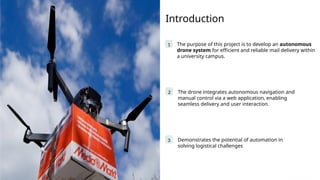
1 The purposeof this project is to develop an autonomous
drone system for efficient and reliable mail delivery within
a university campus.
The drone integrates autonomous navigation and
manual control via a web application, enabling
seamless delivery and user interaction.
2
3 Demonstrates the potential of automation in
solving logistical challenges
3.
Problem statement
1 InefficientTransport
Time-consuming and labor-
intensive.
2 Weather Constraints
Harsh conditions hinder
efficiency.
3 Human Strain
Physical demands on employees.
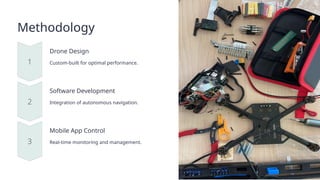
Methodology
Drone Design
Custom-built foroptimal performance.
Software Development
Integration of autonomous navigation.
Mobile App Control
Real-time monitoring and management.
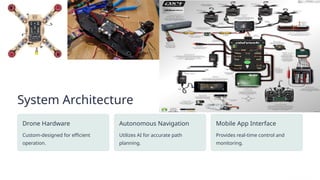
System Architecture
Drone Hardware
Custom-designedfor efficient
operation.
Autonomous Navigation
Utilizes AI for accurate path
planning.
Mobile App Interface
Provides real-time control and
monitoring.
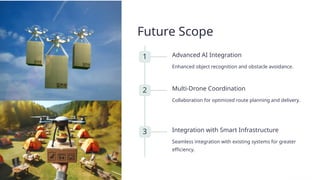
Future Scope
1 AdvancedAI Integration
Enhanced object recognition and obstacle avoidance.
2 Multi-Drone Coordination
Collaboration for optimized route planning and delivery.
3 Integration with Smart Infrastructure
Seamless integration with existing systems for greater
efficiency.
10.
References
1. Emimi, M.,Khaleel, M., & Alkrash, A. (2023). The current opportunities and challenges in drone technology. Int. J. Electr. Eng. and Sustain., 74-89.
2. Vergouw, B., Nagel, H., Bondt, G., & Custers, B. (2016). Drone technology: Types, payloads, applications, frequency spectrum issues, and future developments. The Future of Drone Use: Opportunities and
Threats from Ethical and Legal Perspec- tives, 21-45.
3. Nonami, K. (2016). Drone technology, cutting-edge drone business, and future prospects. Journal of Robotics and Mechatronics, 28(3), 262-272.
4. Tashildar, A., Shah, N., Gala, R., Giri, T., & Chavhan, P. (2020). Application development using Flutter. International Research Journal of Modernization in Engineering Technology and Science, 2(8), 1262-
1266.
5. Mamoun, R., Nasor, M., & Abulikailik, S. H. (2021). Design and development of mobile healthcare application prototype using Flutter. 2020 International Confer- ence on Computer, Control, Electrical, and
Electronics Engineering (ICCCEEE), 1-6.
6. Alsalemi, A., et al. (2017). Real-time communication network using Firebase cloud IoT platform for ECMO simulation. 2017 IEEE International Conference on Internet of Things (iThings), 178-182.
7. Chougale, P., et al. (2021). Firebase-overview and usage. International Research Journal of Modernization in Engineering Technology and Science, 3(12), 1178-1183.
8. Dainton, M., & Aylor, B. (2002). Patterns of communication channel use in the maintenance of long-distance relationships. Communication Research Reports, 19(2), 118-129.
Noviello, C., et al. (2022). An overview of down-looking UAV-based GPR systems.Remote Sensing, 14(14), 3245.
9. Thakkar, D., et al. (2019). Design and implementation of autonomous UAV track- ing system using GPS and GPRS. Progress in Advanced Computing and Intelligent Engineering, 433-439.
10. Kangunde, V., et al. (2021). A review on drones controlled in real-time. Interna- tional Journal of Dynamics and Control, 9(4), 1832-1846.
11. Liu, J., et al. (2018). Application of drone in solving last-mile parcel delivery.Journal of Systems Science and Information, 6(4), 302-319.
12. Gatteschi, V., et al. (2015). New frontiers of delivery services using drones: A prototype system exploiting a quadcopter for autonomous drug shipments. IEEE Computer Software and Applications Conference
(COMPSAC), 39th Annual.