THOUGHT LEADERS FOR MANUFACTURING & SUPPLY CHAIN
ARC INSIGHTS
By Larry O’Brien
Global uncertainty, lower oil prices,
continued reductions in capital spending,
and no significant increases in capacity
utilization are all contributing to the
inertia of the automation market today,
and it will take some significant changes
to jumpstart this lethargic business.
INSIGHT# 2003-19M
APRIL 23, 2003
Automation Business Remains in a
Holding Pattern
Keywords
Automation, Suppliers, Capital Spending, Market
Summary
After sliding into recession in the third quarter of fiscal 2002, the automa-
tion market failed to rally in the fourth quarter and will remain sluggish
through the first half of 2003. Global uncertainty, lower oil prices, contin-
ued reductions in capital spending, and no significant increases in capacity
utilization are all contributing to the inertia of the
automation market today, and it will take some
significant changes to jumpstart this lethargic
business.
Growth among some suppliers continues to be
driven primarily by acquisition and market con-
solidation. Total automation market revenue
growth among our pool of publicly traded suppliers was 1.5 percent in Q4
2002 versus the same period in 2001. Taking acquisition and other activity
into account, the total automation market declined slightly in Q4 2002.
ARC believes the overall automation market was flat between 2001 and
2002. While capital spending continued to shrink and many major projects
remained on hold, economic growth accelerated in 2002. US GDP for ex-
ample, grew at a rate of over 2 percent between 2001 and 2002, while
growth between 2000 and 2001 was only 0.2 percent. There are still many
pockets of reliable growth in the automation business. Industries such as
pharmaceuticals, food & beverage, upstream oil & gas, and wood products
continue to perform well.
Analysis
Automation Suppliers Report Mixed Results
ABB remains focused on cost reduction and bringing its business back on
track after some major management changes and reorganization. The com-
ARC Insights, Page 2
©2003 • ARC • 3 Allied Drive • Dedham, MA 02026 USA • 781-471-1000 • ARCweb.com
pany’s automation related businesses, which reside in the Industries and
Automation Technologies divisions. Combined, both divisions experienced
a consolidated increase of 5 percent in Q4 2002 compared to the same quar-
ter in 2001. Demand was especially strong in Petroleum, Chemical & Life
Sciences businesses.
AspenTech’s total revenues for its second fiscal quarter decreased slightly
compared to Q2 of last year. The company continues to win significant
project orders from user such as BP, ConocoPhillips, TotalFinaElf, Fluor
Daniel, and Bristol Myers Squibb.
Emerson’s sales in its Process Control business declined slightly in the first
quarter of its 2003 fiscal year. While the company’s systems sales remain
strong, the company reported that maintenance and repair opportunities
for its control valve and instrument business were soft. The company con-
tinues to capitalize on Asset Management Solutions software and fieldbus
benefits provided by the PlantWeb architecture.
Flowserve experienced an increase in sales for its fourth quarter, but this
was primarily due to the acquisition of IFC and strong activity in its seals
business. The company reported overall weak spending conditions in the
chemicals and power business.
Honeywell Automation and Control Solutions revenues were essentially
flat for the fourth quarter. Sales of the company’s new Experion platform
should boost ACS performance through 2003, and the company has already
announced a revenues increase for ACS in the first quarter of 2003.
Invensys has announced that they will not report their year end results un-
til the end of May. While their financial results are not reported here, it is
important to note that the company has made some significant announce-
ments regarding its impending restructuring. The company is planning to
sell off Baan and much of its energy management business, including build-
ing automation, so it can focus its energies on the Production Management
division, Rail Systems, and certain elements of its energy management
business, which it believes are its core competencies. This means that In-
vensys’ core automation brands such as Foxboro, Wonderware, Eurotherm,
and Triconex will remain intact.
Metso Automation underwent a major strategic revision in 2002 and refo-
cused on industry-specific process automation solutions and its field
ARC Insights, Page 3
©2003 • ARC • 3 Allied Drive • Dedham, MA 02026 USA • 781-471-1000 • ARCweb.com
systems business. The strategic revision led to reorganization at Metso and
the company introduced new Process Automation Systems and Field Sys-
tems business units.
Rockwell Automation’s Control Systems business experienced good sales
growth in Q1 2003 compared to the same period in 2002. The company re-
ported strong North American sales, particularly in the automotive, food &
beverage, and life sciences businesses. Rockwell’s Logix business continues
to experience growth. Growth in the company’s Global Manufacturing So-
lutions business included revenues from
the recently acquired Propack Data.
Schneider Electric’s sales declined in the
second half of 2002 compared to the
same period in 2001. The company
states that currency translation contrib-
uted to the decline. In March, Schneider
outlined a plan to double its North
American automation business from
$500 million to $1 billion by 2005
through aggressive sales of its Transpar-
ent Factory automation architecture as
well strategic acquisitions.
Siemens A&D continues to deal with a continued slowdown in capital ex-
penditures in both North America and Europe, although sales for the first
quarter of Siemens’ FY 2003 were up slightly compared to the same period
in 2002. Siemens Industrial Solutions and Services (I&S) revenues declined
by almost 11 percent in the same period compared to 2002. Siemens con-
tinues to experience growth in sales of its Simatic PCS 7 control system.
Tier 2 suppliers such as GSE and Gensym, had mixed results. GSE experi-
enced a revenue decline for the quarter, but the company recently released
the next generation in its D3 control system line, and has a significant back-
log of orders to take it through the first half of 2003. GSE also had a non-
cash pre-tax write-down of its investment in Avantium. Gensym also ex-
perienced slight revenue declines and is refocusing its business back to the
world of manufacturing and automation.
74.9% 75.3% 74.8%75.4%
0.0%
10.0%
20.0%
30.0%
40.0%
50.0%
60.0%
70.0%
80.0%
December January February March
Total US Manufacturing Capacity Utilization
ARC Insights, Page 4
©2003 • ARC • 3 Allied Drive • Dedham, MA 02026 USA • 781-471-1000 • ARCweb.com
Matrikon, although a small supplier, experienced double digit revenue in-
creases in Q1 2003 compared to the same period in 2002, and has already
reported triple digit license growth in Q2 2003. Matrikon’s focus on ser-
vices and advanced software is proving that there are some bright spots in
the automation market today.
Demand Side Lethargy Will Delay Recovery
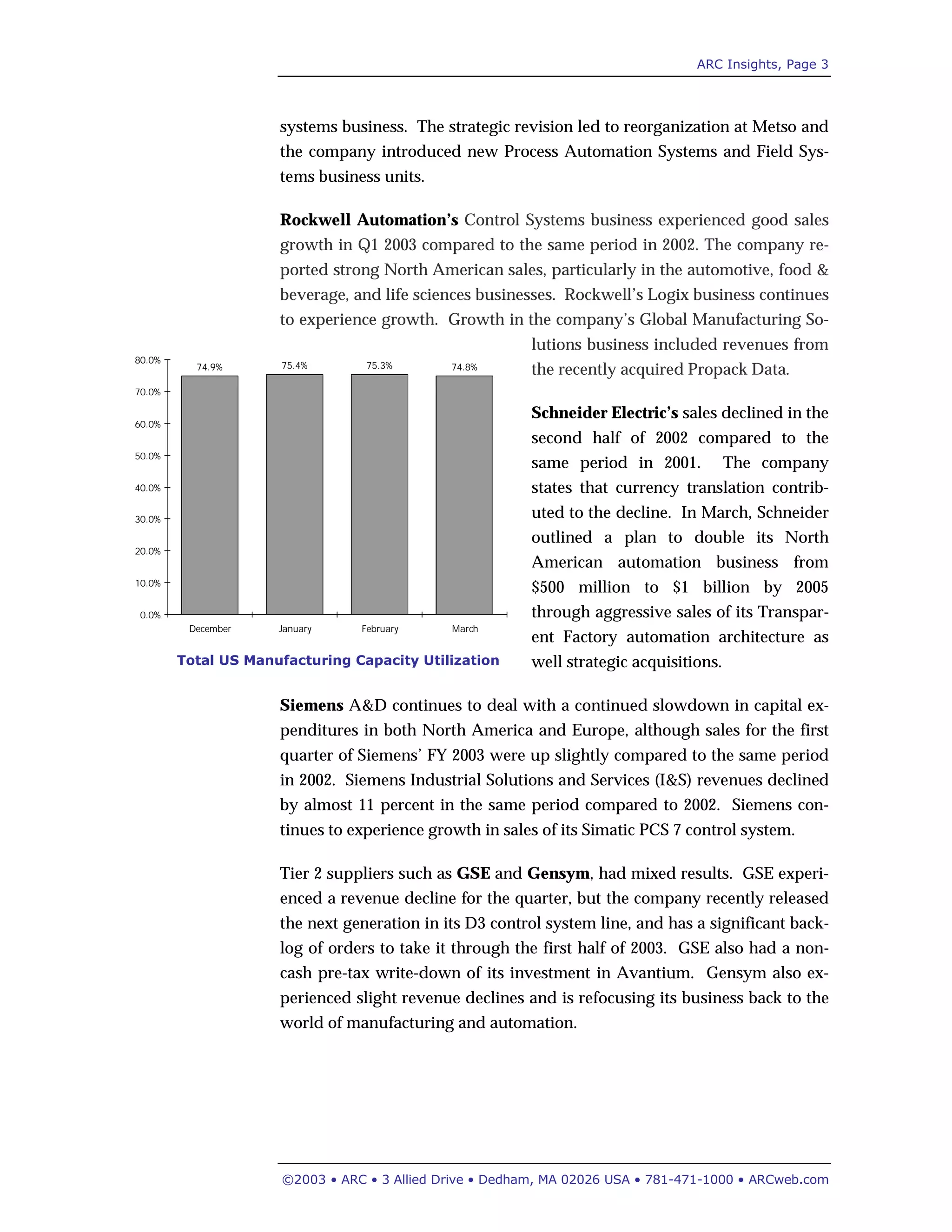
Demand side indicators for manufacturing remain weak in both North
America and Europe. Manufacturing productivity in the US, for example,
increased by a scant 0.1 percent in the fourth quarter of 2002after a 5.5 per-
cent increase in the third quarter. Overall US industrial production fell by
0.5 percent in the US in March of 2003. US Manufacturing output also de-
creased by 0.2 percent in March.
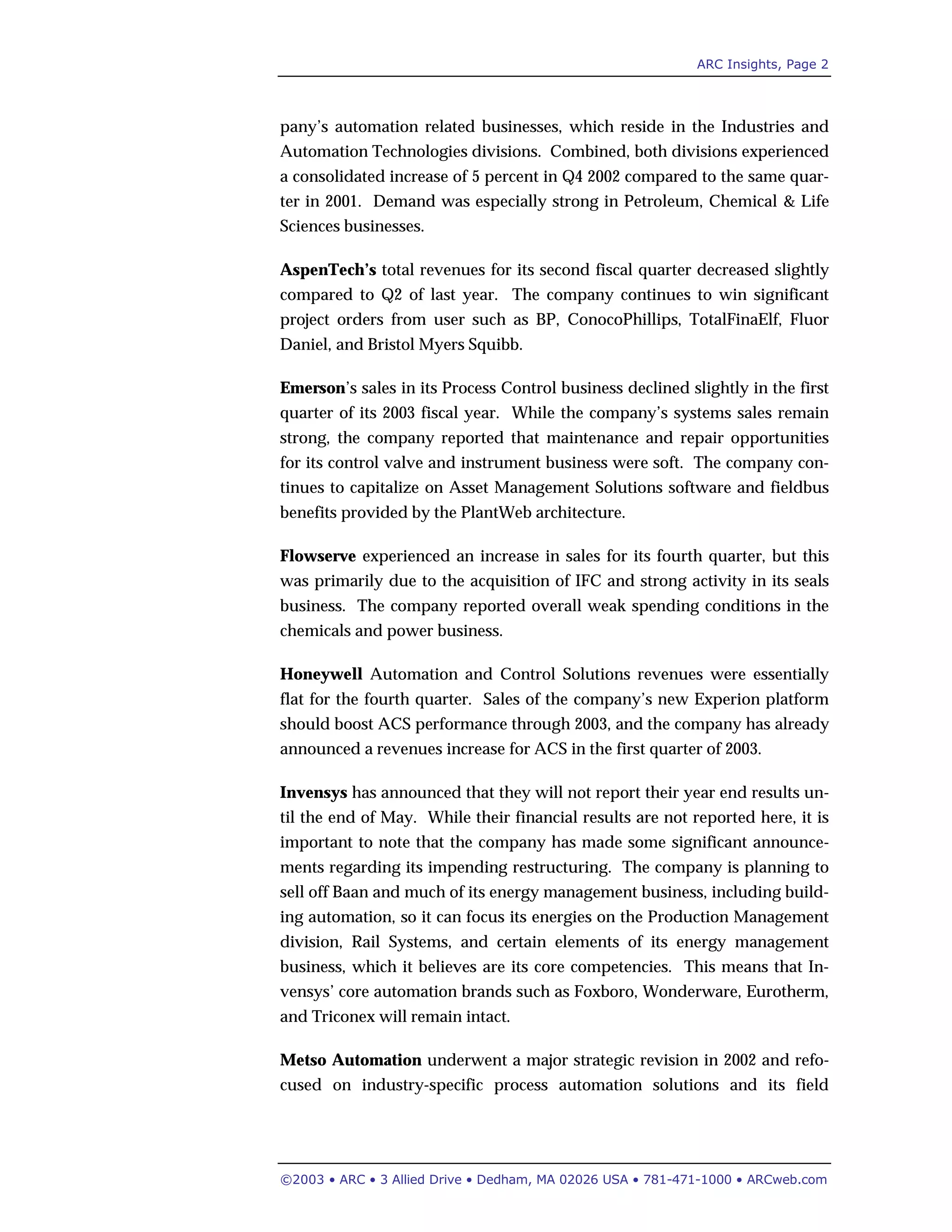
Capacity utilization is a key indicator
for spending trends in automation. In
the US, capacity utilization remains
well below the 80 percent that is usu-
ally required for manufacturers to
move into expansion mode. Capacity
utilization for total US industry actu-
ally decreased by half a percentage
point to 74.8 percent in the first quarter
of 2003 compared to the same period
in 2002.
In Europe, economists are cutting their
growth figures for the European Union
from 1.8 percent down to 1 percent in the 12 nation Euro-Zone. Manufac-
turing capacity utilization in Europe remains essentially flat, but higher
overall than capacity utilization rates in the US. As of January of 2003, in-
dustrial production in Europe was on the increase after flat results in the
fourth quarter of 2002.
The situation in key vertical industry segments remains largely unchanged.
Traditional heavy process industries such as refining, petrochemical,
power, steel, and pulp and paper continue to suffer. The pharmaceutical
industry remains the highest growth industry in the process and hybrid
segment, driven largely by 21 CFR Part 11 compliance issues. Food & bev-
erage, upstream oil & gas, and water & waste are also growth segments.
Output Per Hour for All Persons in the US
Manufacturing Industry
140.1 141.5 143.4 143.5
0
20
40
60
80
100
120
140
160
Q1 2002 Q2 2002 Q3 2002 Q4 2002
ARC Insights, Page 5
©2003 • ARC • 3 Allied Drive • Dedham, MA 02026 USA • 781-471-1000 • ARCweb.com
On the discrete side, the automotive business is largely flat, as are other
traditional discrete markets such as metal fabrication and electronics.
Commercial aerospace is also struggling. Growth spots in the discrete in-
dustries include medical products, wood products, and packaging
machinery.
Recommendations
• The overall economic environment remains harsh. In an adverse eco-
nomic climate, articulating the value that automation brings to the
manufacturing enterprise is critical. Application of a collaborative
manufacturing management (CMM) philosophy and implementation of
a real-time performance management (RPM) model are both practical
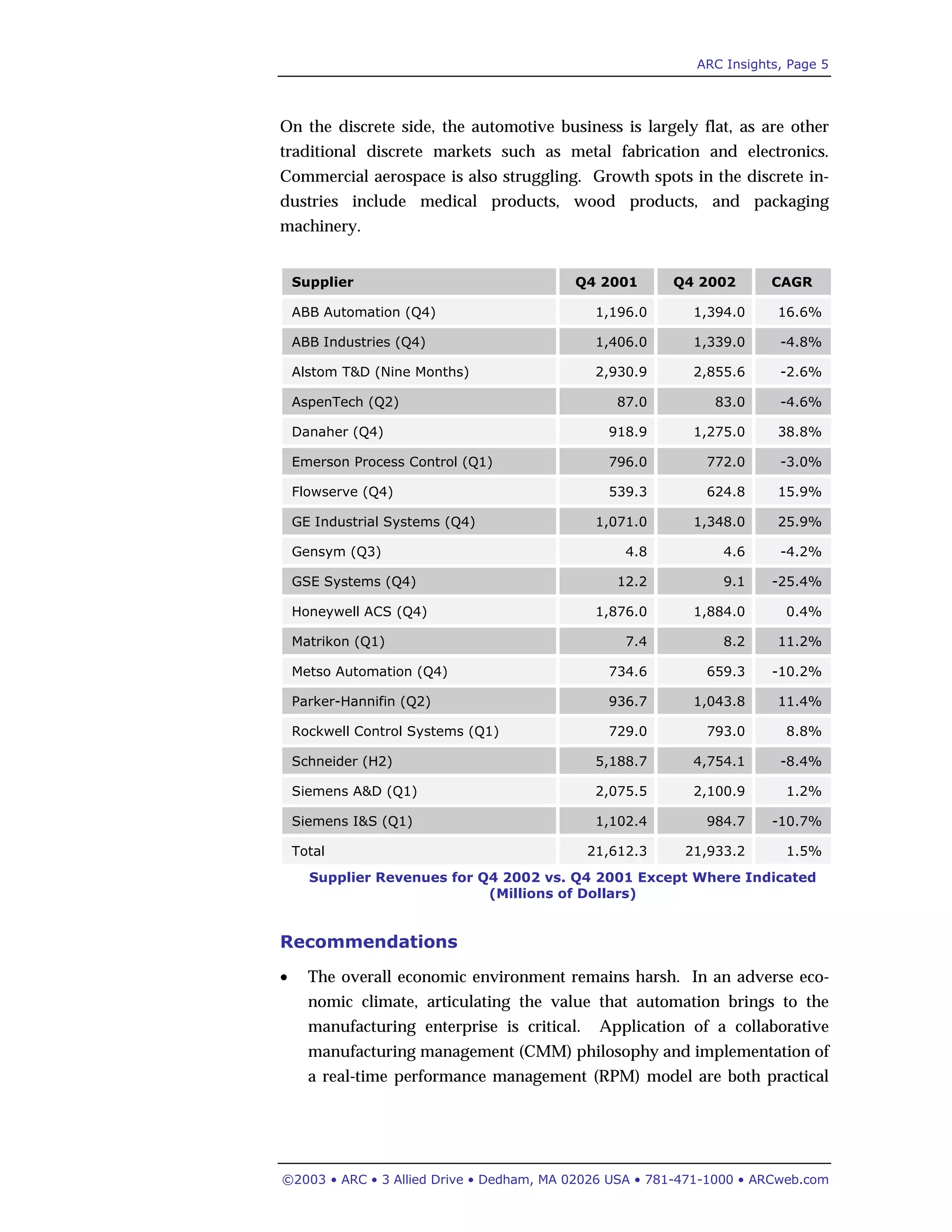
Supplier Q4 2001 Q4 2002 CAGR
ABB Automation (Q4) 1,196.0 1,394.0 16.6%
ABB Industries (Q4) 1,406.0 1,339.0 -4.8%
Alstom T&D (Nine Months) 2,930.9 2,855.6 -2.6%
AspenTech (Q2) 87.0 83.0 -4.6%
Danaher (Q4) 918.9 1,275.0 38.8%
Emerson Process Control (Q1) 796.0 772.0 -3.0%
Flowserve (Q4) 539.3 624.8 15.9%
GE Industrial Systems (Q4) 1,071.0 1,348.0 25.9%
Gensym (Q3) 4.8 4.6 -4.2%
GSE Systems (Q4) 12.2 9.1 -25.4%
Honeywell ACS (Q4) 1,876.0 1,884.0 0.4%
Matrikon (Q1) 7.4 8.2 11.2%
Metso Automation (Q4) 734.6 659.3 -10.2%
Parker-Hannifin (Q2) 936.7 1,043.8 11.4%
Rockwell Control Systems (Q1) 729.0 793.0 8.8%
Schneider (H2) 5,188.7 4,754.1 -8.4%
Siemens A&D (Q1) 2,075.5 2,100.9 1.2%
Siemens I&S (Q1) 1,102.4 984.7 -10.7%
Total 21,612.3 21,933.2 1.5%
Supplier Revenues for Q4 2002 vs. Q4 2001 Except Where Indicated
(Millions of Dollars)
ARC Insights, Page 6
©2003 • ARC • 3 Allied Drive • Dedham, MA 02026 USA • 781-471-1000 • ARCweb.com
ways to show the impact that automation and manufacturing opera-
tions have on the enterprise.
Please help us improve our deliverables to you – take our survey linked to this
transmittal e-mail or at www.arcweb.com/myarc in the Client Area. For further
information, contact your account manager or the author at lobrien@arcweb.com.
Recommended circulation: All MAS clients. ARC Insights are published and
copyrighted by ARC Advisory Group. The information is proprietary to ARC and
no part of it may be reproduced without prior permission from ARC.

Automation Business Remains in a Holding Pattern

  • 1.
    THOUGHT LEADERS FORMANUFACTURING & SUPPLY CHAIN ARC INSIGHTS By Larry O’Brien Global uncertainty, lower oil prices, continued reductions in capital spending, and no significant increases in capacity utilization are all contributing to the inertia of the automation market today, and it will take some significant changes to jumpstart this lethargic business. INSIGHT# 2003-19M APRIL 23, 2003 Automation Business Remains in a Holding Pattern Keywords Automation, Suppliers, Capital Spending, Market Summary After sliding into recession in the third quarter of fiscal 2002, the automa- tion market failed to rally in the fourth quarter and will remain sluggish through the first half of 2003. Global uncertainty, lower oil prices, contin- ued reductions in capital spending, and no significant increases in capacity utilization are all contributing to the inertia of the automation market today, and it will take some significant changes to jumpstart this lethargic business. Growth among some suppliers continues to be driven primarily by acquisition and market con- solidation. Total automation market revenue growth among our pool of publicly traded suppliers was 1.5 percent in Q4 2002 versus the same period in 2001. Taking acquisition and other activity into account, the total automation market declined slightly in Q4 2002. ARC believes the overall automation market was flat between 2001 and 2002. While capital spending continued to shrink and many major projects remained on hold, economic growth accelerated in 2002. US GDP for ex- ample, grew at a rate of over 2 percent between 2001 and 2002, while growth between 2000 and 2001 was only 0.2 percent. There are still many pockets of reliable growth in the automation business. Industries such as pharmaceuticals, food & beverage, upstream oil & gas, and wood products continue to perform well. Analysis Automation Suppliers Report Mixed Results ABB remains focused on cost reduction and bringing its business back on track after some major management changes and reorganization. The com-
  • 2.
    ARC Insights, Page2 ©2003 • ARC • 3 Allied Drive • Dedham, MA 02026 USA • 781-471-1000 • ARCweb.com pany’s automation related businesses, which reside in the Industries and Automation Technologies divisions. Combined, both divisions experienced a consolidated increase of 5 percent in Q4 2002 compared to the same quar- ter in 2001. Demand was especially strong in Petroleum, Chemical & Life Sciences businesses. AspenTech’s total revenues for its second fiscal quarter decreased slightly compared to Q2 of last year. The company continues to win significant project orders from user such as BP, ConocoPhillips, TotalFinaElf, Fluor Daniel, and Bristol Myers Squibb. Emerson’s sales in its Process Control business declined slightly in the first quarter of its 2003 fiscal year. While the company’s systems sales remain strong, the company reported that maintenance and repair opportunities for its control valve and instrument business were soft. The company con- tinues to capitalize on Asset Management Solutions software and fieldbus benefits provided by the PlantWeb architecture. Flowserve experienced an increase in sales for its fourth quarter, but this was primarily due to the acquisition of IFC and strong activity in its seals business. The company reported overall weak spending conditions in the chemicals and power business. Honeywell Automation and Control Solutions revenues were essentially flat for the fourth quarter. Sales of the company’s new Experion platform should boost ACS performance through 2003, and the company has already announced a revenues increase for ACS in the first quarter of 2003. Invensys has announced that they will not report their year end results un- til the end of May. While their financial results are not reported here, it is important to note that the company has made some significant announce- ments regarding its impending restructuring. The company is planning to sell off Baan and much of its energy management business, including build- ing automation, so it can focus its energies on the Production Management division, Rail Systems, and certain elements of its energy management business, which it believes are its core competencies. This means that In- vensys’ core automation brands such as Foxboro, Wonderware, Eurotherm, and Triconex will remain intact. Metso Automation underwent a major strategic revision in 2002 and refo- cused on industry-specific process automation solutions and its field
  • 3.
    ARC Insights, Page3 ©2003 • ARC • 3 Allied Drive • Dedham, MA 02026 USA • 781-471-1000 • ARCweb.com systems business. The strategic revision led to reorganization at Metso and the company introduced new Process Automation Systems and Field Sys- tems business units. Rockwell Automation’s Control Systems business experienced good sales growth in Q1 2003 compared to the same period in 2002. The company re- ported strong North American sales, particularly in the automotive, food & beverage, and life sciences businesses. Rockwell’s Logix business continues to experience growth. Growth in the company’s Global Manufacturing So- lutions business included revenues from the recently acquired Propack Data. Schneider Electric’s sales declined in the second half of 2002 compared to the same period in 2001. The company states that currency translation contrib- uted to the decline. In March, Schneider outlined a plan to double its North American automation business from $500 million to $1 billion by 2005 through aggressive sales of its Transpar- ent Factory automation architecture as well strategic acquisitions. Siemens A&D continues to deal with a continued slowdown in capital ex- penditures in both North America and Europe, although sales for the first quarter of Siemens’ FY 2003 were up slightly compared to the same period in 2002. Siemens Industrial Solutions and Services (I&S) revenues declined by almost 11 percent in the same period compared to 2002. Siemens con- tinues to experience growth in sales of its Simatic PCS 7 control system. Tier 2 suppliers such as GSE and Gensym, had mixed results. GSE experi- enced a revenue decline for the quarter, but the company recently released the next generation in its D3 control system line, and has a significant back- log of orders to take it through the first half of 2003. GSE also had a non- cash pre-tax write-down of its investment in Avantium. Gensym also ex- perienced slight revenue declines and is refocusing its business back to the world of manufacturing and automation. 74.9% 75.3% 74.8%75.4% 0.0% 10.0% 20.0% 30.0% 40.0% 50.0% 60.0% 70.0% 80.0% December January February March Total US Manufacturing Capacity Utilization
  • 4.
    ARC Insights, Page4 ©2003 • ARC • 3 Allied Drive • Dedham, MA 02026 USA • 781-471-1000 • ARCweb.com Matrikon, although a small supplier, experienced double digit revenue in- creases in Q1 2003 compared to the same period in 2002, and has already reported triple digit license growth in Q2 2003. Matrikon’s focus on ser- vices and advanced software is proving that there are some bright spots in the automation market today. Demand Side Lethargy Will Delay Recovery Demand side indicators for manufacturing remain weak in both North America and Europe. Manufacturing productivity in the US, for example, increased by a scant 0.1 percent in the fourth quarter of 2002after a 5.5 per- cent increase in the third quarter. Overall US industrial production fell by 0.5 percent in the US in March of 2003. US Manufacturing output also de- creased by 0.2 percent in March. Capacity utilization is a key indicator for spending trends in automation. In the US, capacity utilization remains well below the 80 percent that is usu- ally required for manufacturers to move into expansion mode. Capacity utilization for total US industry actu- ally decreased by half a percentage point to 74.8 percent in the first quarter of 2003 compared to the same period in 2002. In Europe, economists are cutting their growth figures for the European Union from 1.8 percent down to 1 percent in the 12 nation Euro-Zone. Manufac- turing capacity utilization in Europe remains essentially flat, but higher overall than capacity utilization rates in the US. As of January of 2003, in- dustrial production in Europe was on the increase after flat results in the fourth quarter of 2002. The situation in key vertical industry segments remains largely unchanged. Traditional heavy process industries such as refining, petrochemical, power, steel, and pulp and paper continue to suffer. The pharmaceutical industry remains the highest growth industry in the process and hybrid segment, driven largely by 21 CFR Part 11 compliance issues. Food & bev- erage, upstream oil & gas, and water & waste are also growth segments. Output Per Hour for All Persons in the US Manufacturing Industry 140.1 141.5 143.4 143.5 0 20 40 60 80 100 120 140 160 Q1 2002 Q2 2002 Q3 2002 Q4 2002
  • 5.
    ARC Insights, Page5 ©2003 • ARC • 3 Allied Drive • Dedham, MA 02026 USA • 781-471-1000 • ARCweb.com On the discrete side, the automotive business is largely flat, as are other traditional discrete markets such as metal fabrication and electronics. Commercial aerospace is also struggling. Growth spots in the discrete in- dustries include medical products, wood products, and packaging machinery. Recommendations • The overall economic environment remains harsh. In an adverse eco- nomic climate, articulating the value that automation brings to the manufacturing enterprise is critical. Application of a collaborative manufacturing management (CMM) philosophy and implementation of a real-time performance management (RPM) model are both practical Supplier Q4 2001 Q4 2002 CAGR ABB Automation (Q4) 1,196.0 1,394.0 16.6% ABB Industries (Q4) 1,406.0 1,339.0 -4.8% Alstom T&D (Nine Months) 2,930.9 2,855.6 -2.6% AspenTech (Q2) 87.0 83.0 -4.6% Danaher (Q4) 918.9 1,275.0 38.8% Emerson Process Control (Q1) 796.0 772.0 -3.0% Flowserve (Q4) 539.3 624.8 15.9% GE Industrial Systems (Q4) 1,071.0 1,348.0 25.9% Gensym (Q3) 4.8 4.6 -4.2% GSE Systems (Q4) 12.2 9.1 -25.4% Honeywell ACS (Q4) 1,876.0 1,884.0 0.4% Matrikon (Q1) 7.4 8.2 11.2% Metso Automation (Q4) 734.6 659.3 -10.2% Parker-Hannifin (Q2) 936.7 1,043.8 11.4% Rockwell Control Systems (Q1) 729.0 793.0 8.8% Schneider (H2) 5,188.7 4,754.1 -8.4% Siemens A&D (Q1) 2,075.5 2,100.9 1.2% Siemens I&S (Q1) 1,102.4 984.7 -10.7% Total 21,612.3 21,933.2 1.5% Supplier Revenues for Q4 2002 vs. Q4 2001 Except Where Indicated (Millions of Dollars)
  • 6.
    ARC Insights, Page6 ©2003 • ARC • 3 Allied Drive • Dedham, MA 02026 USA • 781-471-1000 • ARCweb.com ways to show the impact that automation and manufacturing opera- tions have on the enterprise. Please help us improve our deliverables to you – take our survey linked to this transmittal e-mail or at www.arcweb.com/myarc in the Client Area. For further information, contact your account manager or the author at lobrien@arcweb.com. Recommended circulation: All MAS clients. ARC Insights are published and copyrighted by ARC Advisory Group. The information is proprietary to ARC and no part of it may be reproduced without prior permission from ARC.