15 March, 2017
Juha-Pekka Tolvanen
jpt@metacase.com
Automating Safety Engineering
with Model-Based Techniques
Agenda
 Motivation
 A model-based approach
 Examples
 Demonstration
 Q&A
Motivation
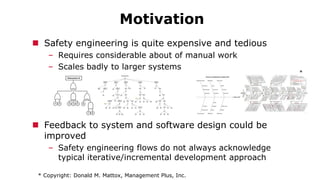
 Safety engineering is quite expensive and tedious
– Requires considerable about of manual work
– Scales badly to larger systems
 Feedback to system and software design could be
improved
– Safety engineering flows do not always acknowledge
typical iterative/incremental development approach
* Copyright: Donald M. Mattox, Management Plus, Inc.
*
Model-based approach supports
safety design by:
1. Utilizing existing specifications with model
transformations
– Safety design must be related to what is developed (or
planned to be developed – also at early stages)
– Usually such nominal specifications already exists
2. Applying directly safety concepts in models
– Safety standards suggest already now own terminology
3. Linking safety related models to analytical tools
– Use models created (automatically) with various analysis
tools
– Different tools for different purposes
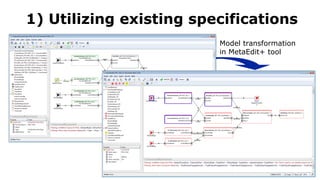
1) Utilize existing specifications
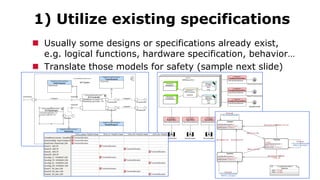
 Usually some designs or specifications already exist,
e.g. logical functions, hardware specification, behavior…
 Translate those models for safety (sample next slide)
1) Utilizing existing specifications
Model transformation
in MetaEdit+ tool
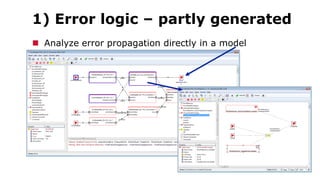
1) Error logic – partly generated
 Analyze error propagation directly in a model
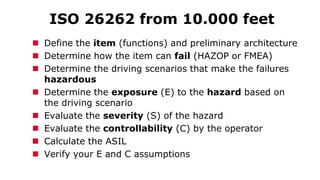
ISO 26262 from 10.000 feet
 Define the item (functions) and preliminary architecture
 Determine how the item can fail (HAZOP or FMEA)
 Determine the driving scenarios that make the failures
hazardous
 Determine the exposure (E) to the hazard based on
the driving scenario
 Evaluate the severity (S) of the hazard
 Evaluate the controllability (C) by the operator
 Calculate the ASIL
 Verify your E and C assumptions
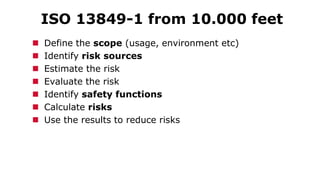
ISO 13849-1 from 10.000 feet
 Define the scope (usage, environment etc)
 Identify risk sources
 Estimate the risk
 Evaluate the risk
 Identify safety functions
 Calculate risks
 Use the results to reduce risks
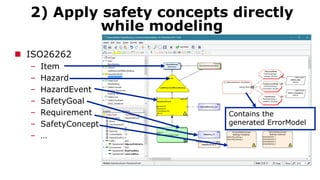
2) Apply safety concepts directly
while modeling
 ISO26262
– Item
– Hazard
– HazardEvent
– SafetyGoal
– Requirement
– SafetyConcept
– …
Contains the
generated ErrorModel
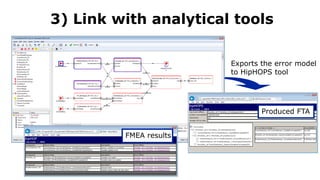
Exports the error model
to HipHOPS tool
3) Link with analytical tools
Produced FTA
FMEA results
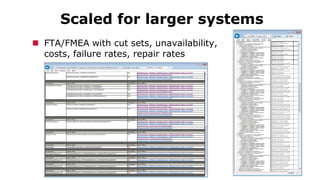
Scaled for larger systems
 FTA/FMEA with cut sets, unavailability,
costs, failure rates, repair rates
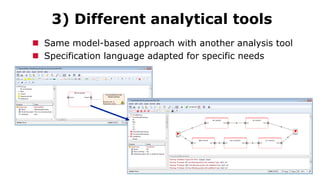
3) Different analytical tools
 Same model-based approach with another analysis tool
 Specification language adapted for specific needs
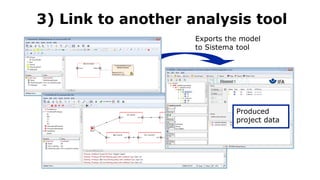
3) Link to another analysis tool
Produced
project data
Exports the model
to Sistema tool
Summary
 Use of model-based approach provides several benefits:
– Ensures that safety analysis is done for the
intended/designed architecture
– Makes safety analysis faster as it is partly automated
– Reduces error-prone routine work
– Makes safety analysis easier to use and accessible
 The presented approach is not tied to any particular tool
 Specification languages and related transformations
need to be flexible
 Extend the approach by providing feedback loop back
from analysis to original source models
Thank you!
Questions, please?
For references on examples and cases contact:
Juha-Pekka Tolvanen, jpt@metacase.com
www.metacase.com

Automating safety engineering with model based techniques

  • 1.
    15 March, 2017 Juha-PekkaTolvanen jpt@metacase.com Automating Safety Engineering with Model-Based Techniques
  • 2.
    Agenda  Motivation  Amodel-based approach  Examples  Demonstration  Q&A
  • 3.
    Motivation  Safety engineeringis quite expensive and tedious – Requires considerable about of manual work – Scales badly to larger systems  Feedback to system and software design could be improved – Safety engineering flows do not always acknowledge typical iterative/incremental development approach * Copyright: Donald M. Mattox, Management Plus, Inc. *
  • 4.
    Model-based approach supports safetydesign by: 1. Utilizing existing specifications with model transformations – Safety design must be related to what is developed (or planned to be developed – also at early stages) – Usually such nominal specifications already exists 2. Applying directly safety concepts in models – Safety standards suggest already now own terminology 3. Linking safety related models to analytical tools – Use models created (automatically) with various analysis tools – Different tools for different purposes
  • 5.
    1) Utilize existingspecifications  Usually some designs or specifications already exist, e.g. logical functions, hardware specification, behavior…  Translate those models for safety (sample next slide)
  • 6.
    1) Utilizing existingspecifications Model transformation in MetaEdit+ tool
  • 7.
    1) Error logic– partly generated  Analyze error propagation directly in a model
  • 8.
    ISO 26262 from10.000 feet  Define the item (functions) and preliminary architecture  Determine how the item can fail (HAZOP or FMEA)  Determine the driving scenarios that make the failures hazardous  Determine the exposure (E) to the hazard based on the driving scenario  Evaluate the severity (S) of the hazard  Evaluate the controllability (C) by the operator  Calculate the ASIL  Verify your E and C assumptions
  • 9.
    ISO 13849-1 from10.000 feet  Define the scope (usage, environment etc)  Identify risk sources  Estimate the risk  Evaluate the risk  Identify safety functions  Calculate risks  Use the results to reduce risks
  • 10.
    2) Apply safetyconcepts directly while modeling  ISO26262 – Item – Hazard – HazardEvent – SafetyGoal – Requirement – SafetyConcept – … Contains the generated ErrorModel
  • 11.
    Exports the errormodel to HipHOPS tool 3) Link with analytical tools Produced FTA FMEA results
  • 12.
    Scaled for largersystems  FTA/FMEA with cut sets, unavailability, costs, failure rates, repair rates
  • 13.
    3) Different analyticaltools  Same model-based approach with another analysis tool  Specification language adapted for specific needs
  • 14.
    3) Link toanother analysis tool Produced project data Exports the model to Sistema tool
  • 15.
    Summary  Use ofmodel-based approach provides several benefits: – Ensures that safety analysis is done for the intended/designed architecture – Makes safety analysis faster as it is partly automated – Reduces error-prone routine work – Makes safety analysis easier to use and accessible  The presented approach is not tied to any particular tool  Specification languages and related transformations need to be flexible  Extend the approach by providing feedback loop back from analysis to original source models
  • 16.
    Thank you! Questions, please? Forreferences on examples and cases contact: Juha-Pekka Tolvanen, jpt@metacase.com www.metacase.com