Hongik University
2019.08.23
Hwanhee Kim, Seongtaek Lee, Hyundong Lee,
Taesung Hahn, Shinjin Kang
Automatic Generation of Game Content
using a Graph-based Wave Function
Collapse Algorithm
NCSOFT
About me
Hwanhee Kim
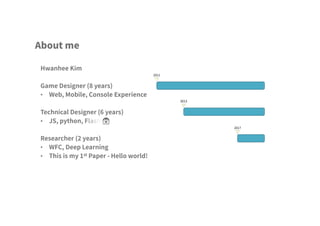
Game Designer (8 years)
• Web, Mobile, Console Experience
Technical Designer (6 years)
• JS, python, Flash 😱
Researcher (2 years)
• WFC, Deep Learning
• This is my 1st Paper - Hello world!
2011
2013
2017
4
26
34
40
43
Overview
1. Original WFC
2. Graph-based WFC
3. Experiments
4. Future works
5. References
Original WFC
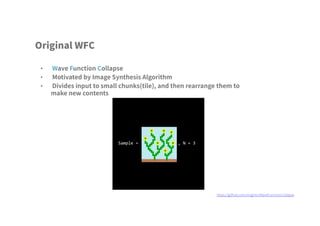
• Wave Function Collapse
• Motivated by Image Synthesis Algorithm
• Divides input to small chunks(tile), and then rearrange them to
make new contents
https://github.com/mxgmn/WaveFunctionCollapse
Original WFC
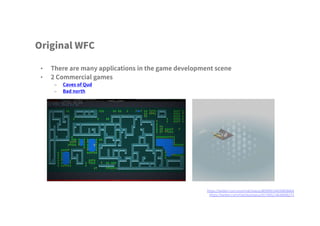
• There are many applications in the game development scene
• 2 Commercial games
– Caves of Qud
– Bad north
https://twitter.com/unormal/status/805990194939838464
https://twitter.com/OskSta/status/917405214638006273
Original WFC
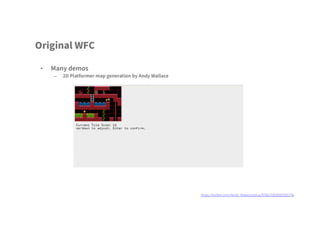
• Many demos
– 2D Platformer map generation by Andy Wallace
https://twitter.com/Andy_Makes/status/976615859069300736
Original WFC
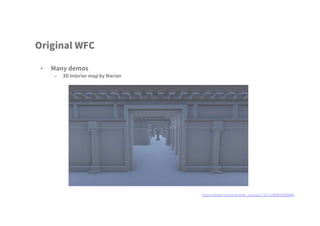
• Many demos
– 3D Interior map by Marian
https://twitter.com/marian42_/status/1137111089425059840
Original WFC
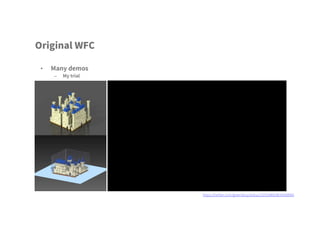
• Many demos
– My trial
https://twitter.com/greentecq/status/1025348928634408960
Original WFC
• What are the common features of the above cases?
Original WFC
• What are the common features of the above cases?
– Regularity
Original WFC
• What are the common features of the above cases?
– Regularity
– A Regular Grid is a tessellation of n-dimensional Euclidean space by congruent
parallelotopes (e.g. bricks). (Wikipedia)
https://en.wikipedia.org/wiki/Regular_grid#cite_ref-1
Original WFC
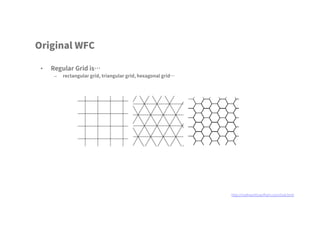
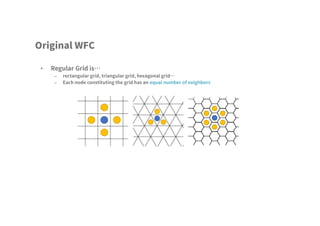
• Regular Grid is…
– rectangular grid, triangular grid, hexagonal grid…
http://mathworld.wolfram.com/Grid.html
Original WFC
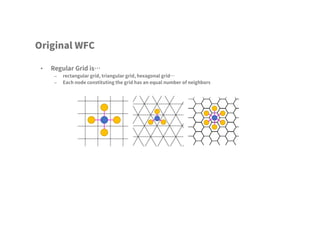
• Regular Grid is…
– rectangular grid, triangular grid, hexagonal grid…
– Each node constituting the grid has an equal number of neighbors
Original WFC
• Regular Grid is…
– rectangular grid, triangular grid, hexagonal grid…
– Each node constituting the grid has an equal number of neighbors
Original WFC
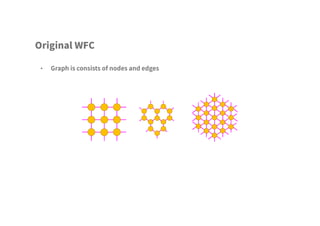
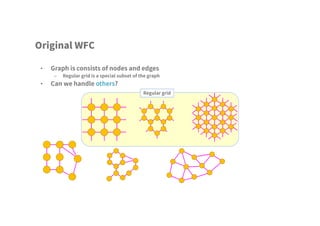
• Graph is consists of nodes and edges
Original WFC
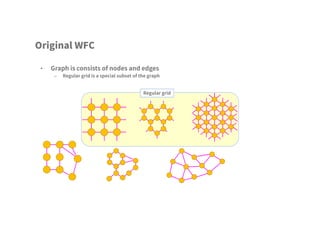
• Graph is consists of nodes and edges
– Regular grid is a special subset of the graph
Regular grid
Original WFC
• Graph is consists of nodes and edges
– Regular grid is a special subset of the graph
• Can we handle others?
Regular grid
Original WFC
• There are two key variables
• Propagator
– WFC propagates information on non-deployable tiles to neighboring nodes
– The adjacency information of two tiles is stored
– Memory size is 3D = [the number of all tiles] * [the number of directions] * [the
number of connectable tiles]
Tileset from https://www.kenney.nl/assets/road-textures
Original WFC
• Propagator
– Memory size is 3D = [the number of all tiles(7)] * [the number of directions] * [the
number of connectable tiles]
Original WFC
• Propagator
– Memory size is 3D = [the number of all tiles(7)] * [the number of directions(4)] *
[the number of connectable tiles]
left
up
right down
Original WFC
• Propagator
– Memory size is 3D = [the number of all tiles(7)] * [the number of directions(4)] *
[the number of connectable tiles(max 7)]
Original WFC
• There are two key variables
• Compatible
– The number of tiles that can be connected to any tile by direction at a particular
grid location
– This can be calculated by referring to propagator variable
– Memory size is also 3D = [the number all nodes] * [the number of all tiles] * [the
number of directions]
Original WFC
• Compatible
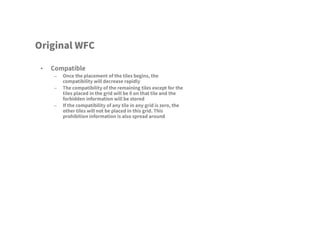
– Once the placement of the tiles begins, the
compatibility will decrease rapidly
– The compatibility of the remaining tiles except for the
tiles placed in the grid will be 0 on that tile and the
forbidden information will be stored
– If the compatibility of any tile in any grid is zero, the
other tiles will not be placed in this grid. This
prohibition information is also spread around
Original WFC
• Greedy Algorithm
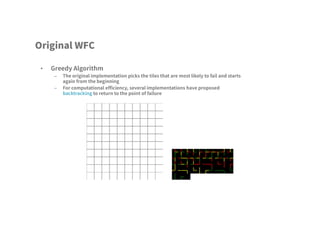
– The original implementation picks the tiles that are most likely to fail and starts
again from the beginning
– For computational efficiency, several implementations have proposed
backtracking to return to the point of failure
Original WFC
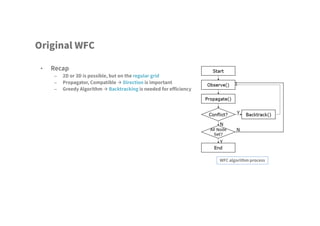
• Recap
– 2D or 3D is possible, but on the regular grid
– Propagator, Compatible  Direction is important
– Greedy Algorithm  Backtracking is needed for efficiency
WFC algorithm process
Graph-based WFC
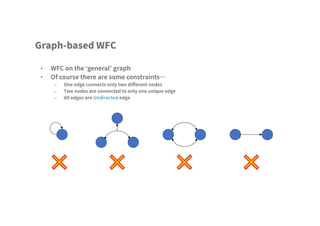
• WFC on the ‘general’ graph
• Of course there are some constraints…
– One edge connects only two different nodes
– Two nodes are connected to only one unique edge
– All edges are Undirected edge
Graph-based WFC
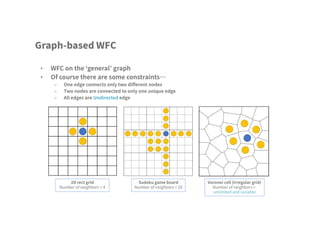
• WFC on the ‘general’ graph
• Of course there are some constraints…
– One edge connects only two different nodes
– Two nodes are connected to only one unique edge
– All edges are Undirected edge
2D rect grid
Number of neighbors = 4
Sudoku game board
Number of neighbors = 20
Voronoi cell (irregular grid)
Number of neighbors =
unlimited and variable
Graph-based WFC
• Direction checking is important in original WFC
• Since the direction has been lost, Propagator and Compatible
now becomes 2D
– Propagator : [the number of all tiles] * [the number of connectable tiles]
– Compatible : [the number all nodes] * [the number of all tiles]
• Memory usage is reduced! Is it just good?
Propagator Compatible Output
Voronoi grid (n=47)
Graph-based WFC
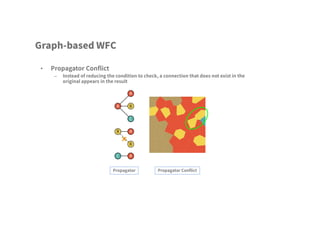
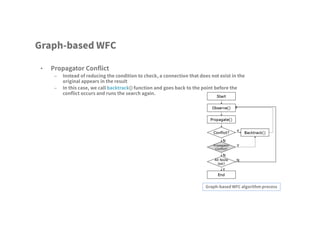
• Propagator Conflict
– Instead of reducing the condition to check, a connection that does not exist in the
original appears in the result
Propagator Propagator Conflict
Graph-based WFC
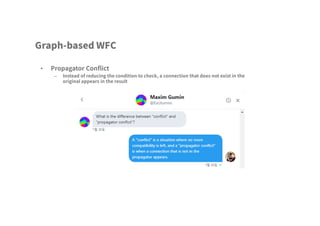
• Propagator Conflict
– Instead of reducing the condition to check, a connection that does not exist in the
original appears in the result
Graph-based WFC
• Propagator Conflict
– Instead of reducing the condition to check, a connection that does not exist in the
original appears in the result
– In this case, we call backtrack() function and goes back to the point before the
conflict occurs and runs the search again.
Graph-based WFC algorithm process
Graph-based WFC
• Propagator Conflict
– Instead of reducing the condition to check, a connection that does not exist in the
original appears in the result
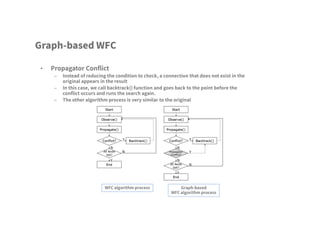
– In this case, we call backtrack() function and goes back to the point before the
conflict occurs and runs the search again.
– The other algorithm process is very similar to the original
Graph-based
WFC algorithm process
Graph-based WFC
• Recap
– WFC on the ‘general’ graph
– Direction is gone  Added Propagator Conflict
Experiments
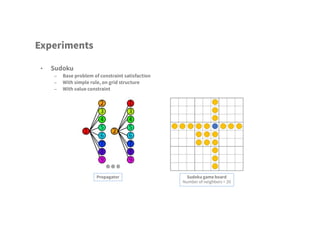
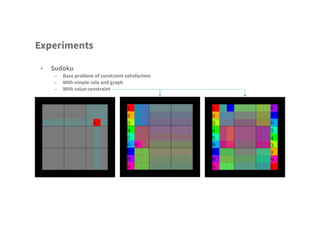
• Sudoku
– Base problem of constraint satisfaction
– With simple rule, on grid structure
– With value constraint
Sudoku game board
Number of neighbors = 20
Propagator
Experiments
• Sudoku
– Base problem of constraint satisfaction
– With simple rule and graph
– With value constraint
Experiments
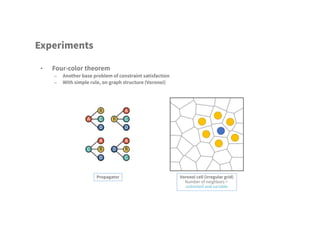
• Four-color theorem
– Another base problem of constraint satisfaction
– With simple rule, on graph structure (Voronoi)
Propagator Voronoi cell (irregular grid)
Number of neighbors =
unlimited and variable
Experiments
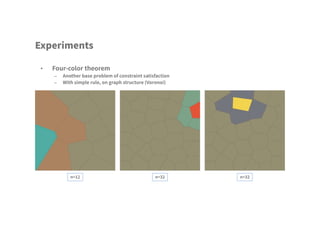
• Four-color theorem
– Another base problem of constraint satisfaction
– With simple rule, on graph structure (Voronoi)
n=12 n=32 n=32
Experiments
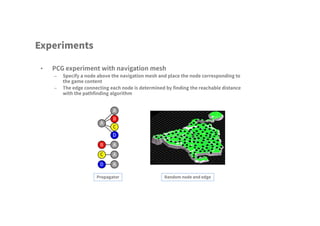
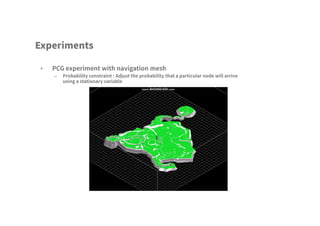
• PCG experiment with navigation mesh
– Specify a node above the navigation mesh and place the node corresponding to
the game content
– The edge connecting each node is determined by finding the reachable distance
with the pathfinding algorithm
Propagator Random node and edge
Experiments
• PCG experiment with navigation mesh
– Probability constraint : Adjust the probability that a particular node will arrive
using a stationary variable
Future works
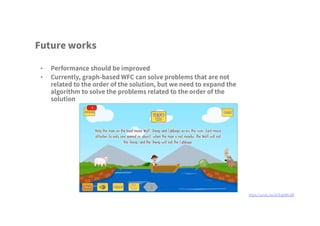
• Performance should be improved
• Currently, graph-based WFC can solve problems that are not
related to the order of the solution, but we need to expand the
algorithm to solve the problems related to the order of the
solution
https://youtu.be/et3hgNBrc88
Future works
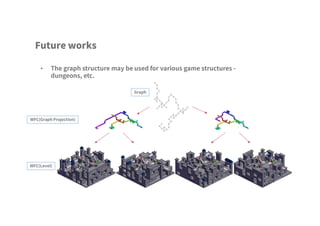
• The graph structure may be used for various game structures -
dungeons, etc.
WFC(Graph Projection)
WFC(Level)
Graph
Thank you!
You can find me at @greentecq
Twitter: @greentecq
Mail : greentec91@gmail.com
References
• Hendrikx, M., Meijer, S., Velden, J. V. D., and Iosup, A. (2013).
Procedural content generation for games: A survey. ACM
Transactions on Multimedia Computing, Communications, and
Applications 9(1):1.
• Togelius, J., Yannakakis, G., Stanley, K., and Browne, C. (2011).
Search-based procedural content generation: A taxonomy and
survey. IEEE Transactions on Computational Intelligence and AI in
Games 3(3):172186.
• Dahlskog, S., and Togelius, J. (2013). Patterns as objectives for
level generation. In Proceedings of the Second Workshop on
Design Patterns in Games, ACM.
References
• Snodgrass, S., and Ontanon, S. (2014). A hierarchical approach to
generating maps using Markov chains. In Proceedings of the
Tenth Artificial Intelligence and Interactive Digital Entertainment
Conference.
• Jain, R., Isaksen, A., Holmgrd, C., and Togelius, J. (2016).
Autoencoders for level generation, repair, and recognition. In
Proceedings of the ICCC Workshop on Computational Creativity
and Games.
• Summerville, A., Guzdial, M., Mateas, M., and Riedl, M. O. (2016).
Learning player tailored content from observation: Platformer
level generation from video traces using LSTMs. In Proceedings of
the Twelfth Artificial Intelligence and Interactive Digital
Entertainment Conference.
References
• Shin, S. B., “Game Level Generation Using Neural Networks,”
Gamasutra.
https://www.gamasutra.com/blogs/SeungbackShin/20180227/31
5017/Game%20Level%20Generation%20Using%20Neural%20Net
works.php
• Karth, I., and Smith, A. M. (2017). WaveFunctionCollapse is
constraint solving in the wild. In Proceedings of the 12th
International Conference on the Foundations of Digital Games (p.
68). ACM.
• Karth, I., and Smith, A. M. (2018). Addressing the fundamental
tension of PCGML with discriminative learning. arXiv preprint
arXiv:1809.04432.
E N D O F D O C U M E N T

Automatic Generation of Game Content using a Graph-based Wave Function Collapse Algorithm

  • 1.
    Hongik University 2019.08.23 Hwanhee Kim,Seongtaek Lee, Hyundong Lee, Taesung Hahn, Shinjin Kang Automatic Generation of Game Content using a Graph-based Wave Function Collapse Algorithm NCSOFT
  • 2.
    About me Hwanhee Kim GameDesigner (8 years) • Web, Mobile, Console Experience Technical Designer (6 years) • JS, python, Flash 😱 Researcher (2 years) • WFC, Deep Learning • This is my 1st Paper - Hello world! 2011 2013 2017
  • 3.
    4 26 34 40 43 Overview 1. Original WFC 2.Graph-based WFC 3. Experiments 4. Future works 5. References
  • 4.
    Original WFC • WaveFunction Collapse • Motivated by Image Synthesis Algorithm • Divides input to small chunks(tile), and then rearrange them to make new contents https://github.com/mxgmn/WaveFunctionCollapse
  • 5.
    Original WFC • Thereare many applications in the game development scene • 2 Commercial games – Caves of Qud – Bad north https://twitter.com/unormal/status/805990194939838464 https://twitter.com/OskSta/status/917405214638006273
  • 6.
    Original WFC • Manydemos – 2D Platformer map generation by Andy Wallace https://twitter.com/Andy_Makes/status/976615859069300736
  • 7.
    Original WFC • Manydemos – 3D Interior map by Marian https://twitter.com/marian42_/status/1137111089425059840
  • 8.
    Original WFC • Manydemos – My trial https://twitter.com/greentecq/status/1025348928634408960
  • 9.
    Original WFC • Whatare the common features of the above cases?
  • 10.
    Original WFC • Whatare the common features of the above cases? – Regularity
  • 11.
    Original WFC • Whatare the common features of the above cases? – Regularity – A Regular Grid is a tessellation of n-dimensional Euclidean space by congruent parallelotopes (e.g. bricks). (Wikipedia) https://en.wikipedia.org/wiki/Regular_grid#cite_ref-1
  • 12.
    Original WFC • RegularGrid is… – rectangular grid, triangular grid, hexagonal grid… http://mathworld.wolfram.com/Grid.html
  • 13.
    Original WFC • RegularGrid is… – rectangular grid, triangular grid, hexagonal grid… – Each node constituting the grid has an equal number of neighbors
  • 14.
    Original WFC • RegularGrid is… – rectangular grid, triangular grid, hexagonal grid… – Each node constituting the grid has an equal number of neighbors
  • 15.
    Original WFC • Graphis consists of nodes and edges
  • 16.
    Original WFC • Graphis consists of nodes and edges – Regular grid is a special subset of the graph Regular grid
  • 17.
    Original WFC • Graphis consists of nodes and edges – Regular grid is a special subset of the graph • Can we handle others? Regular grid
  • 18.
    Original WFC • Thereare two key variables • Propagator – WFC propagates information on non-deployable tiles to neighboring nodes – The adjacency information of two tiles is stored – Memory size is 3D = [the number of all tiles] * [the number of directions] * [the number of connectable tiles] Tileset from https://www.kenney.nl/assets/road-textures
  • 19.
    Original WFC • Propagator –Memory size is 3D = [the number of all tiles(7)] * [the number of directions] * [the number of connectable tiles]
  • 20.
    Original WFC • Propagator –Memory size is 3D = [the number of all tiles(7)] * [the number of directions(4)] * [the number of connectable tiles] left up right down
  • 21.
    Original WFC • Propagator –Memory size is 3D = [the number of all tiles(7)] * [the number of directions(4)] * [the number of connectable tiles(max 7)]
  • 22.
    Original WFC • Thereare two key variables • Compatible – The number of tiles that can be connected to any tile by direction at a particular grid location – This can be calculated by referring to propagator variable – Memory size is also 3D = [the number all nodes] * [the number of all tiles] * [the number of directions]
  • 23.
    Original WFC • Compatible –Once the placement of the tiles begins, the compatibility will decrease rapidly – The compatibility of the remaining tiles except for the tiles placed in the grid will be 0 on that tile and the forbidden information will be stored – If the compatibility of any tile in any grid is zero, the other tiles will not be placed in this grid. This prohibition information is also spread around
  • 24.
    Original WFC • GreedyAlgorithm – The original implementation picks the tiles that are most likely to fail and starts again from the beginning – For computational efficiency, several implementations have proposed backtracking to return to the point of failure
  • 25.
    Original WFC • Recap –2D or 3D is possible, but on the regular grid – Propagator, Compatible  Direction is important – Greedy Algorithm  Backtracking is needed for efficiency WFC algorithm process
  • 26.
    Graph-based WFC • WFCon the ‘general’ graph • Of course there are some constraints… – One edge connects only two different nodes – Two nodes are connected to only one unique edge – All edges are Undirected edge
  • 27.
    Graph-based WFC • WFCon the ‘general’ graph • Of course there are some constraints… – One edge connects only two different nodes – Two nodes are connected to only one unique edge – All edges are Undirected edge 2D rect grid Number of neighbors = 4 Sudoku game board Number of neighbors = 20 Voronoi cell (irregular grid) Number of neighbors = unlimited and variable
  • 28.
    Graph-based WFC • Directionchecking is important in original WFC • Since the direction has been lost, Propagator and Compatible now becomes 2D – Propagator : [the number of all tiles] * [the number of connectable tiles] – Compatible : [the number all nodes] * [the number of all tiles] • Memory usage is reduced! Is it just good? Propagator Compatible Output Voronoi grid (n=47)
  • 29.
    Graph-based WFC • PropagatorConflict – Instead of reducing the condition to check, a connection that does not exist in the original appears in the result Propagator Propagator Conflict
  • 30.
    Graph-based WFC • PropagatorConflict – Instead of reducing the condition to check, a connection that does not exist in the original appears in the result
  • 31.
    Graph-based WFC • PropagatorConflict – Instead of reducing the condition to check, a connection that does not exist in the original appears in the result – In this case, we call backtrack() function and goes back to the point before the conflict occurs and runs the search again. Graph-based WFC algorithm process
  • 32.
    Graph-based WFC • PropagatorConflict – Instead of reducing the condition to check, a connection that does not exist in the original appears in the result – In this case, we call backtrack() function and goes back to the point before the conflict occurs and runs the search again. – The other algorithm process is very similar to the original Graph-based WFC algorithm process WFC algorithm process
  • 33.
    Graph-based WFC • Recap –WFC on the ‘general’ graph – Direction is gone  Added Propagator Conflict
  • 34.
    Experiments • Sudoku – Baseproblem of constraint satisfaction – With simple rule, on grid structure – With value constraint Sudoku game board Number of neighbors = 20 Propagator
  • 35.
    Experiments • Sudoku – Baseproblem of constraint satisfaction – With simple rule and graph – With value constraint
  • 36.
    Experiments • Four-color theorem –Another base problem of constraint satisfaction – With simple rule, on graph structure (Voronoi) Propagator Voronoi cell (irregular grid) Number of neighbors = unlimited and variable
  • 37.
    Experiments • Four-color theorem –Another base problem of constraint satisfaction – With simple rule, on graph structure (Voronoi) n=12 n=32 n=32
  • 38.
    Experiments • PCG experimentwith navigation mesh – Specify a node above the navigation mesh and place the node corresponding to the game content – The edge connecting each node is determined by finding the reachable distance with the pathfinding algorithm Propagator Random node and edge
  • 39.
    Experiments • PCG experimentwith navigation mesh – Probability constraint : Adjust the probability that a particular node will arrive using a stationary variable
  • 40.
    Future works • Performanceshould be improved • Currently, graph-based WFC can solve problems that are not related to the order of the solution, but we need to expand the algorithm to solve the problems related to the order of the solution https://youtu.be/et3hgNBrc88
  • 41.
    Future works • Thegraph structure may be used for various game structures - dungeons, etc. WFC(Graph Projection) WFC(Level) Graph
  • 42.
    Thank you! You canfind me at @greentecq Twitter: @greentecq Mail : greentec91@gmail.com
  • 43.
    References • Hendrikx, M.,Meijer, S., Velden, J. V. D., and Iosup, A. (2013). Procedural content generation for games: A survey. ACM Transactions on Multimedia Computing, Communications, and Applications 9(1):1. • Togelius, J., Yannakakis, G., Stanley, K., and Browne, C. (2011). Search-based procedural content generation: A taxonomy and survey. IEEE Transactions on Computational Intelligence and AI in Games 3(3):172186. • Dahlskog, S., and Togelius, J. (2013). Patterns as objectives for level generation. In Proceedings of the Second Workshop on Design Patterns in Games, ACM.
  • 44.
    References • Snodgrass, S.,and Ontanon, S. (2014). A hierarchical approach to generating maps using Markov chains. In Proceedings of the Tenth Artificial Intelligence and Interactive Digital Entertainment Conference. • Jain, R., Isaksen, A., Holmgrd, C., and Togelius, J. (2016). Autoencoders for level generation, repair, and recognition. In Proceedings of the ICCC Workshop on Computational Creativity and Games. • Summerville, A., Guzdial, M., Mateas, M., and Riedl, M. O. (2016). Learning player tailored content from observation: Platformer level generation from video traces using LSTMs. In Proceedings of the Twelfth Artificial Intelligence and Interactive Digital Entertainment Conference.
  • 45.
    References • Shin, S.B., “Game Level Generation Using Neural Networks,” Gamasutra. https://www.gamasutra.com/blogs/SeungbackShin/20180227/31 5017/Game%20Level%20Generation%20Using%20Neural%20Net works.php • Karth, I., and Smith, A. M. (2017). WaveFunctionCollapse is constraint solving in the wild. In Proceedings of the 12th International Conference on the Foundations of Digital Games (p. 68). ACM. • Karth, I., and Smith, A. M. (2018). Addressing the fundamental tension of PCGML with discriminative learning. arXiv preprint arXiv:1809.04432.
  • 46.
    E N DO F D O C U M E N T