1
LOGO
An automatic framework for
3D objects-parts Learning
Omar HEROUANE, Lahcen MOUMOUN, Mohamed
CHAHHOU and Taoufiq GADI
Laboratory Informatics, Imaging and Modeling of Complex Systems (IIMSC)
Faculty of Science and Technology
University Hassan 1st,
Settat,
Morocco
(Cist'16),October 24-26, 2016, Tangier, Morocco
2
Outline :
Related Works
2
Goal
3
1
Adopted Techniques
3
3
Learning processes
4
Conclusion
6
Tests and results
3
5
(Cist'16),October 24-26, 2016, Tangier, Morocco
3
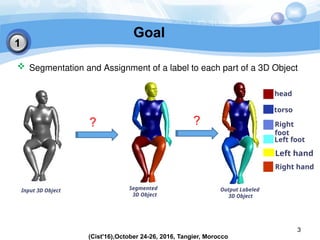
Goal
Input 3D Object Output Labeled
3D Object
head
torso
Right
foot
Left foot
Left hand
Right hand
 Segmentation and Assignment of a label to each part of a 3D Object
3
1
? ?
Segmented
3D Object
(Cist'16),October 24-26, 2016, Tangier, Morocco
Related work: 3D Objects segmentation
Shape Diameter
[Shapira et al. 10]
Randomized Cuts
[Golovinskiy and Funkhouser 08]
Random Walks
[Lai et al. 08]
Normalized Cuts
[Golovinskiy and Funkhouser 08]
3
2
(Cist'16),October 24-26, 2016, Tangier, Morocco
5
 3D objects learning methods are inspired by that applied to 2D images.
Shotton, et al. 06
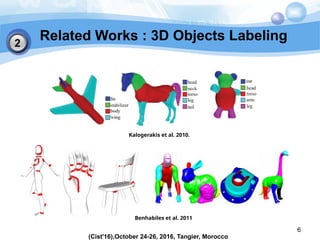
Related Works: 3D Objects Labeling
b. object-oriented image
analysis approach.
a. traditional boundary based
image analysis .
3
2
(Cist'16),October 24-26, 2016, Tangier, Morocco
6
Kalogerakis et al. 2010.
Related Works : 3D Objects Labeling
3
2
Benhabiles et al. 2011
(Cist'16),October 24-26, 2016, Tangier, Morocco
7
Kalogerakis et al. 2010.
Related Works : 3D Objects Learning
3
2
Benhabiles et al. 2011
(Cist'16),October 24-26, 2016, Tangier, Morocco
8
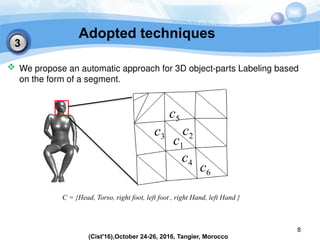
Adopted techniques
 We propose an automatic approach for 3D object-parts Labeling based
on the form of a segment.
C = {Head, Torso, right foot, left foot , right Hand, left Hand }
c1
c2
c4
c3
c5
c6
3
3
(Cist'16),October 24-26, 2016, Tangier, Morocco
9
Segmentation: Spectral Clustering algorithm
Adopted techniques
3
3
o Approach based on spectral clustering and the
minimum curvature of the mesh to find the best
cuts through the convex regions
o Technique relies on the eigenvalues and
eigenvectors of a similarity matrix to partition points
into disjoint clusters.
(Cist'16),October 24-26, 2016, Tangier, Morocco
o Technique Based on the notion of shape index :
10
Segmentation: Spectral Clustering algorithm
Adopted techniques
3
3
1. Preprocessing : Construct Affinity matrix representation of the graph
2. Decomposition:
o Construct the graph Laplacian
where
oCompute eigenvectors and eigenvalues of L and decompose them.
3. Grouping : Assign points to two or more clusters, based on the new
representation.
(Cist'16),October 24-26, 2016, Tangier, Morocco
11
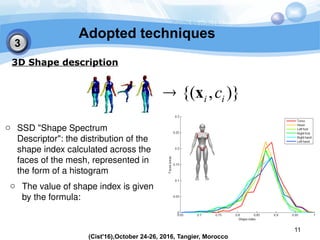
3D Shape description
o SSD "Shape Spectrum
Descriptor": the distribution of the
shape index calculated across the
faces of the mesh, represented in
the form of a histogram
o The value of shape index is given
by the formula:
Adopted techniques
3
3
{( , )}
 i i
c
x
(Cist'16),October 24-26, 2016, Tangier, Morocco
x2
x1
Learning a classifier
Adopted techniques
head
torso
Right
foot
Left foot
Left hand
Right hand
(Cist'16),October 24-26, 2016, Tangier, Morocco
{( , )}
 i i
c
x
3
3
x2
x1
?
We use the AdaBoost.M1
Learning a classifier
Adopted techniques
head
torso
Right
foot
Left foot
Left hand
Right hand
(Cist'16),October 24-26, 2016, Tangier, Morocco
3
3
?
{( , )}
 i i
c
x
14
 AdaBoost.M1 is a direct and very simple extension of AdaBoost,
except that the base learner (weak learner) is now a multiclass
learner instead of a binary one.
 One dimensional decision stumps are used as weak learners.
Adaboost.M1 Algorithm
 Learning our classification model is done using the classifier
AdaBoost.M1 [Freund and Schapire, 1997] via a corpus of 3D
mesh (Ground-truth)
Adopted techniques
3
3
(Cist'16),October 24-26, 2016, Tangier, Morocco
15
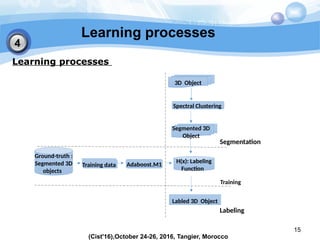
Learning processes
Learning processes
3
4
3D Object
Spectral Clustering
Ground-truth :
Segmented 3D
objects
Training data
H(x): Labeling
Function
Labled 3D Object
Adaboost.M1
Segmented 3D
Object
Training
Labeling
Segmentation
(Cist'16),October 24-26, 2016, Tangier, Morocco
16
Tests and Results
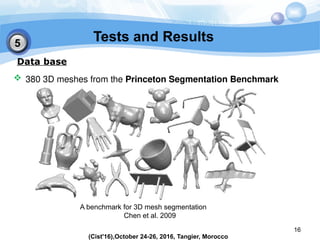
Data base
 380 3D meshes from the Princeton Segmentation Benchmark
A benchmark for 3D mesh segmentation
Chen et al. 2009
3
5
(Cist'16),October 24-26, 2016, Tangier, Morocco
17
Qualitative Evaluation - (Ground-truth)
Training data set
Testing results
Head
Torso
Right foot
Left foot
Left hand
Right hand
Tests and Results
 The following figure shows the 3D meshes used for training and
the Visual results obtained for labeling:
3
5
(Cist'16),October 24-26, 2016, Tangier, Morocco
18
APPROACH LABELING RECOGNITION RATE (%)
Adaboost.M1 91,3
Tests and Results
3
5
Quantitative Evaluation- (Ground-truth)
 Labeling recognition rate and ROC curve :
(Cist'16),October 24-26, 2016, Tangier, Morocco
ROC curves for the homogeneous and heterogeneous classes.
19
Tests and Results
3
5
Qualitative Evaluation - (Segmentation using Spectral Clustering)
(Cist'16),October 24-26, 2016, Tangier, Morocco
Segmentation results using Spectral Clustering
20
Labeling results
Left leg
Torso
Right leg
Right Hand
Left hand
head
Tail
Left ear
Left leg2
Right leg1
Right leg2
Tail
Right ear
Left leg1
Face
Torso
Tests and Results
3
5
Qualitative Evaluation - (Spectral clustering)
(Cist'16),October 24-26, 2016, Tangier, Morocco
21
 Labeling recognition rate and ROC curve :
Tests and Results
3
5
Quantitative Evaluation - (Spectral Clustering)
ROC curves for the homogeneous and heterogeneous classes.
APPROACH LABELING RECOGNITION RATE (%)
Proposed Approach 85.0
(Cist'16),October 24-26, 2016, Tangier, Morocco
22
Conclusion
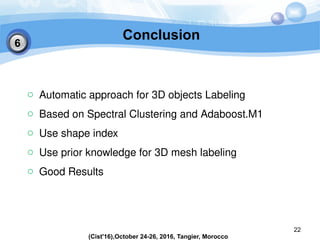
o Automatic approach for 3D objects Labeling
o Based on Spectral Clustering and Adaboost.M1
o Use shape index
o Use prior knowledge for 3D mesh labeling
o Good Results
3
6
(Cist'16),October 24-26, 2016, Tangier, Morocco
23
Thank you
(Cist'16),October 24-26, 2016, Tangier, Morocco

Automatic framework for 3D Objects-parts LearningCist'16.pptx

  • 1.
    1 LOGO An automatic frameworkfor 3D objects-parts Learning Omar HEROUANE, Lahcen MOUMOUN, Mohamed CHAHHOU and Taoufiq GADI Laboratory Informatics, Imaging and Modeling of Complex Systems (IIMSC) Faculty of Science and Technology University Hassan 1st, Settat, Morocco (Cist'16),October 24-26, 2016, Tangier, Morocco
  • 2.
    2 Outline : Related Works 2 Goal 3 1 AdoptedTechniques 3 3 Learning processes 4 Conclusion 6 Tests and results 3 5 (Cist'16),October 24-26, 2016, Tangier, Morocco
  • 3.
    3 Goal Input 3D ObjectOutput Labeled 3D Object head torso Right foot Left foot Left hand Right hand  Segmentation and Assignment of a label to each part of a 3D Object 3 1 ? ? Segmented 3D Object (Cist'16),October 24-26, 2016, Tangier, Morocco
  • 4.
    Related work: 3DObjects segmentation Shape Diameter [Shapira et al. 10] Randomized Cuts [Golovinskiy and Funkhouser 08] Random Walks [Lai et al. 08] Normalized Cuts [Golovinskiy and Funkhouser 08] 3 2 (Cist'16),October 24-26, 2016, Tangier, Morocco
  • 5.
    5  3D objectslearning methods are inspired by that applied to 2D images. Shotton, et al. 06 Related Works: 3D Objects Labeling b. object-oriented image analysis approach. a. traditional boundary based image analysis . 3 2 (Cist'16),October 24-26, 2016, Tangier, Morocco
  • 6.
    6 Kalogerakis et al.2010. Related Works : 3D Objects Labeling 3 2 Benhabiles et al. 2011 (Cist'16),October 24-26, 2016, Tangier, Morocco
  • 7.
    7 Kalogerakis et al.2010. Related Works : 3D Objects Learning 3 2 Benhabiles et al. 2011 (Cist'16),October 24-26, 2016, Tangier, Morocco
  • 8.
    8 Adopted techniques  Wepropose an automatic approach for 3D object-parts Labeling based on the form of a segment. C = {Head, Torso, right foot, left foot , right Hand, left Hand } c1 c2 c4 c3 c5 c6 3 3 (Cist'16),October 24-26, 2016, Tangier, Morocco
  • 9.
    9 Segmentation: Spectral Clusteringalgorithm Adopted techniques 3 3 o Approach based on spectral clustering and the minimum curvature of the mesh to find the best cuts through the convex regions o Technique relies on the eigenvalues and eigenvectors of a similarity matrix to partition points into disjoint clusters. (Cist'16),October 24-26, 2016, Tangier, Morocco o Technique Based on the notion of shape index :
  • 10.
    10 Segmentation: Spectral Clusteringalgorithm Adopted techniques 3 3 1. Preprocessing : Construct Affinity matrix representation of the graph 2. Decomposition: o Construct the graph Laplacian where oCompute eigenvectors and eigenvalues of L and decompose them. 3. Grouping : Assign points to two or more clusters, based on the new representation. (Cist'16),October 24-26, 2016, Tangier, Morocco
  • 11.
    11 3D Shape description oSSD "Shape Spectrum Descriptor": the distribution of the shape index calculated across the faces of the mesh, represented in the form of a histogram o The value of shape index is given by the formula: Adopted techniques 3 3 {( , )}  i i c x (Cist'16),October 24-26, 2016, Tangier, Morocco
  • 12.
    x2 x1 Learning a classifier Adoptedtechniques head torso Right foot Left foot Left hand Right hand (Cist'16),October 24-26, 2016, Tangier, Morocco {( , )}  i i c x 3 3
  • 13.
    x2 x1 ? We use theAdaBoost.M1 Learning a classifier Adopted techniques head torso Right foot Left foot Left hand Right hand (Cist'16),October 24-26, 2016, Tangier, Morocco 3 3 ? {( , )}  i i c x
  • 14.
    14  AdaBoost.M1 isa direct and very simple extension of AdaBoost, except that the base learner (weak learner) is now a multiclass learner instead of a binary one.  One dimensional decision stumps are used as weak learners. Adaboost.M1 Algorithm  Learning our classification model is done using the classifier AdaBoost.M1 [Freund and Schapire, 1997] via a corpus of 3D mesh (Ground-truth) Adopted techniques 3 3 (Cist'16),October 24-26, 2016, Tangier, Morocco
  • 15.
    15 Learning processes Learning processes 3 4 3DObject Spectral Clustering Ground-truth : Segmented 3D objects Training data H(x): Labeling Function Labled 3D Object Adaboost.M1 Segmented 3D Object Training Labeling Segmentation (Cist'16),October 24-26, 2016, Tangier, Morocco
  • 16.
    16 Tests and Results Database  380 3D meshes from the Princeton Segmentation Benchmark A benchmark for 3D mesh segmentation Chen et al. 2009 3 5 (Cist'16),October 24-26, 2016, Tangier, Morocco
  • 17.
    17 Qualitative Evaluation -(Ground-truth) Training data set Testing results Head Torso Right foot Left foot Left hand Right hand Tests and Results  The following figure shows the 3D meshes used for training and the Visual results obtained for labeling: 3 5 (Cist'16),October 24-26, 2016, Tangier, Morocco
  • 18.
    18 APPROACH LABELING RECOGNITIONRATE (%) Adaboost.M1 91,3 Tests and Results 3 5 Quantitative Evaluation- (Ground-truth)  Labeling recognition rate and ROC curve : (Cist'16),October 24-26, 2016, Tangier, Morocco ROC curves for the homogeneous and heterogeneous classes.
  • 19.
    19 Tests and Results 3 5 QualitativeEvaluation - (Segmentation using Spectral Clustering) (Cist'16),October 24-26, 2016, Tangier, Morocco Segmentation results using Spectral Clustering
  • 20.
    20 Labeling results Left leg Torso Rightleg Right Hand Left hand head Tail Left ear Left leg2 Right leg1 Right leg2 Tail Right ear Left leg1 Face Torso Tests and Results 3 5 Qualitative Evaluation - (Spectral clustering) (Cist'16),October 24-26, 2016, Tangier, Morocco
  • 21.
    21  Labeling recognitionrate and ROC curve : Tests and Results 3 5 Quantitative Evaluation - (Spectral Clustering) ROC curves for the homogeneous and heterogeneous classes. APPROACH LABELING RECOGNITION RATE (%) Proposed Approach 85.0 (Cist'16),October 24-26, 2016, Tangier, Morocco
  • 22.
    22 Conclusion o Automatic approachfor 3D objects Labeling o Based on Spectral Clustering and Adaboost.M1 o Use shape index o Use prior knowledge for 3D mesh labeling o Good Results 3 6 (Cist'16),October 24-26, 2016, Tangier, Morocco
  • 23.