Non Deterministic Automata


                      1
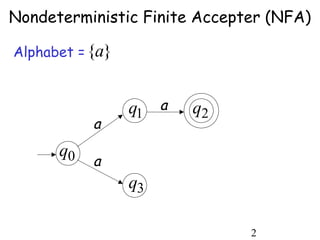
Nondeterministic Finite Accepter (NFA)

Alphabet = {a}


                 q1 a   q2
           a
      q0
           a
                 q3

                              2
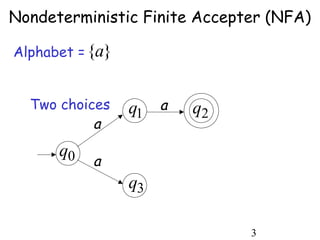
Nondeterministic Finite Accepter (NFA)

Alphabet = {a}


  Two choices    q1 a   q2
           a
      q0
           a
                 q3

                              3
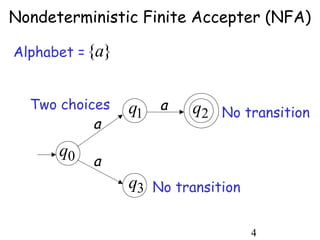
Nondeterministic Finite Accepter (NFA)

Alphabet = {a}


  Two choices    q1 a     q2 No transition
           a
      q0
           a
                 q3 No transition

                                    4
First Choice

a a


                 q1 a    q2
           a
      q0
           a
                 q3

                              5
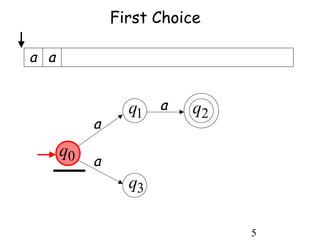
First Choice

a a


                 q1 a    q2
           a
      q0
           a
                 q3

                              6
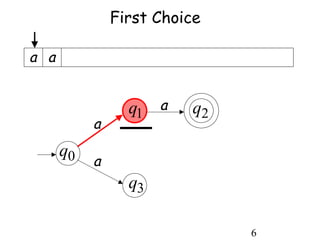
First Choice

a a


                 q1 a    q2
           a
      q0
           a
                 q3

                              7
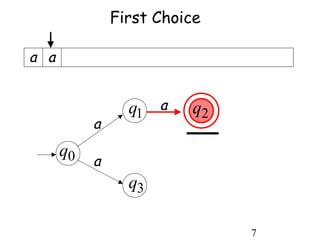
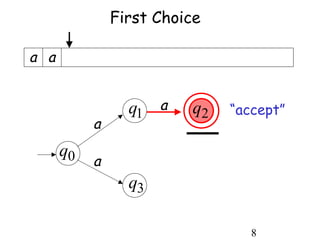
First Choice

a a


                 q1 a    q2   “accept”
           a
      q0
           a
                 q3

                                 8
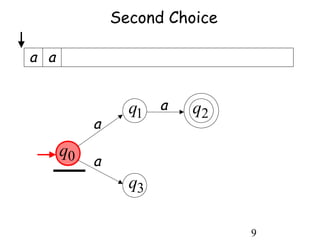
Second Choice

a a


                 q1 a   q2
           a
      q0
           a
                 q3

                               9
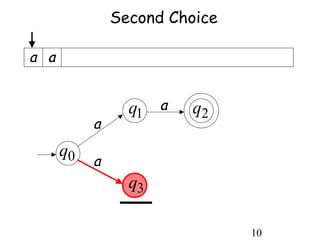
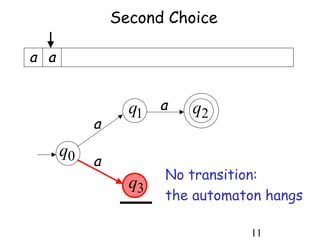
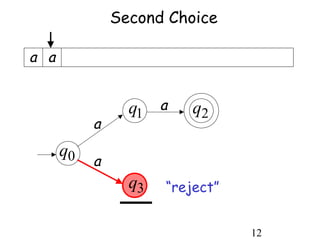
Second Choice

a a


                 q1 a   q2
           a
      q0
           a
                 q3

                               10
Second Choice

a a


                 q1 a    q2
           a
      q0
           a
                      No transition:
                 q3
                      the automaton hangs

                                 11
Second Choice

a a


                 q1 a     q2
           a
      q0
           a
                 q3   “reject”


                                 12
Observation
An NFA accepts a string
if
there is a computation of the NFA
that accepts the string


                                    13
Example

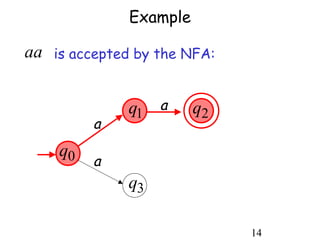
aa is accepted by the NFA:


              q1 a      q2
         a
    q0
         a
              q3

                             14
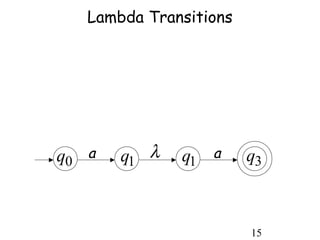
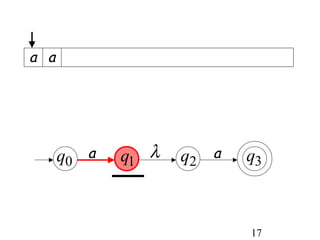
Lambda Transitions


q0 a   q1 λ   q1 a      q3


                        15
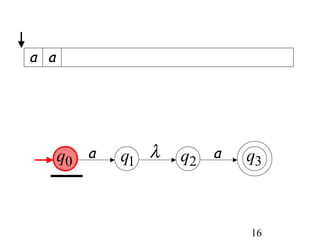
a a


      q0 a   q1 λ   q2 a   q3


                           16
a a


      q0 a   q1 λ   q2 a   q3


                           17
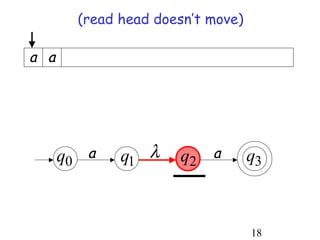
(read head doesn’t move)

a a


      q0 a    q1 λ    q2 a         q3


                                   18
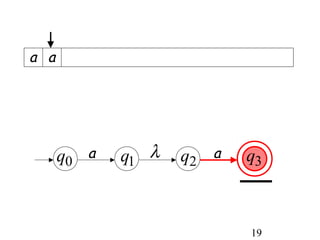
a a


      q0 a   q1 λ   q2 a   q3


                           19
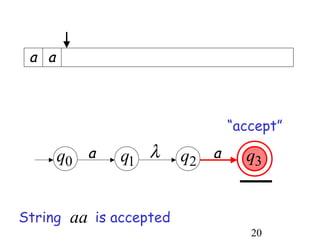
a a


                                 “accept”

       q0 a     q1 λ      q2 a     q3


String   aa is accepted
                                    20
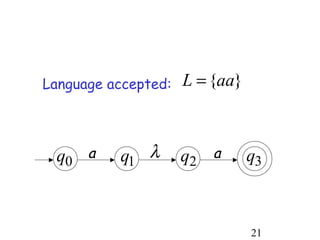
Language accepted:   L = {aa}


 q0 a     q1 λ       q2 a       q3


                                21
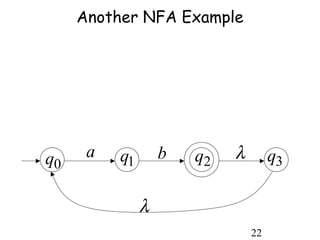
Another NFA Example


q0    a   q1       b   q2   λ        q3

               λ
                                22
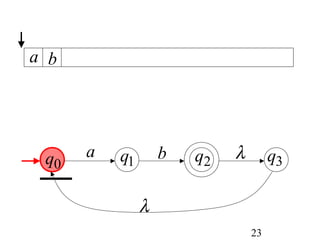
a b


 q0   a   q1       b   q2   λ        q3

               λ
                                23
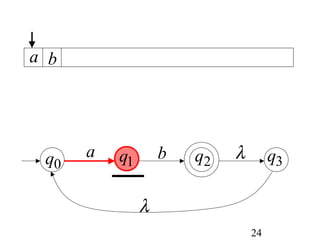
a b


 q0   a   q1       b   q2   λ        q3

               λ
                                24
a b


 q0   a   q1       b   q2   λ        q3

               λ
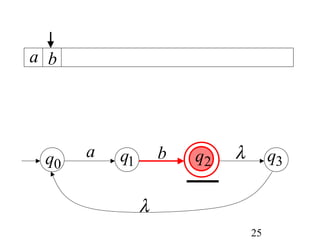
                                25
a b


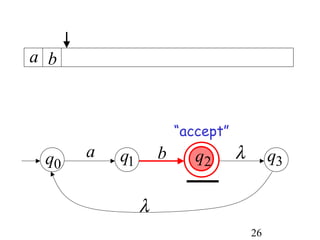
                       “accept”
 q0   a   q1       b      q2      λ        q3

               λ
                                      26
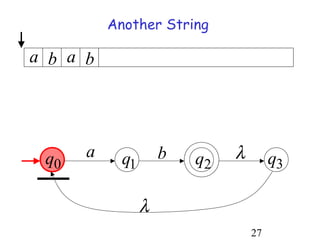
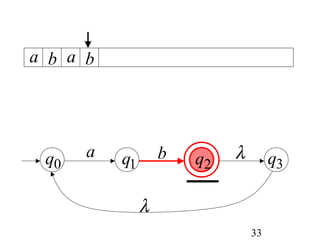
Another String

a b a b


 q0   a     q1       b   q2   λ        q3

                 λ
                                  27
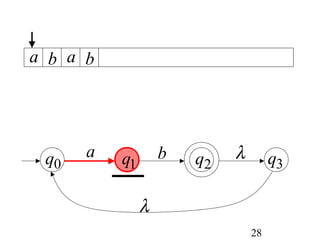
a b a b


 q0   a   q1       b   q2   λ        q3

               λ
                                28
a b a b


 q0   a   q1       b   q2   λ        q3

               λ
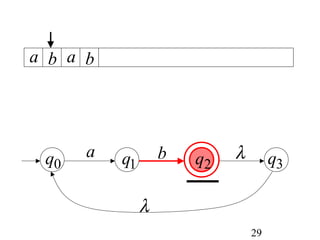
                                29
a b a b


 q0   a   q1       b   q2   λ        q3

               λ
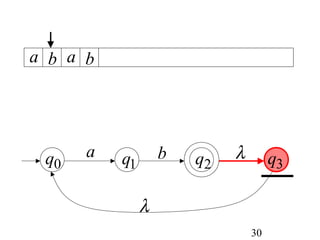
                                30
a b a b


 q0   a   q1       b   q2   λ        q3

               λ
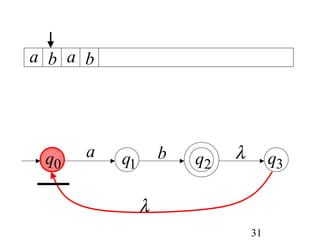
                                31
a b a b


 q0   a   q1       b   q2   λ        q3

               λ
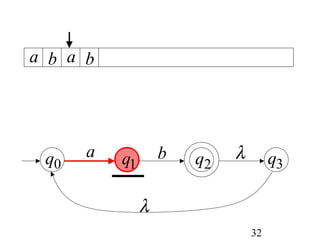
                                32
a b a b


 q0   a   q1       b   q2   λ        q3

               λ
                                33
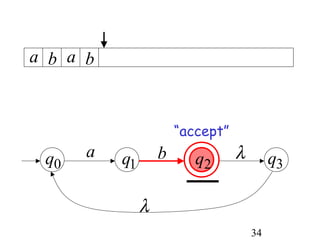
a b a b


                       “accept”
 q0   a   q1       b      q2      λ        q3

               λ
                                      34
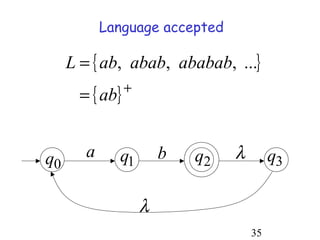
Language accepted

     L = { ab, abab, ababab, ...}
                 +
       = { ab}


q0      a     q1         b   q2   λ        q3

                     λ
                                      35
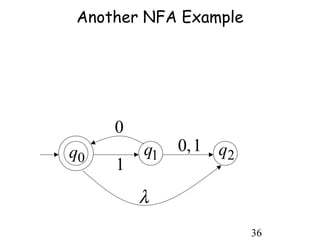
Another NFA Example


     0
q0       q1   0, 1 q2
     1
         λ
                        36
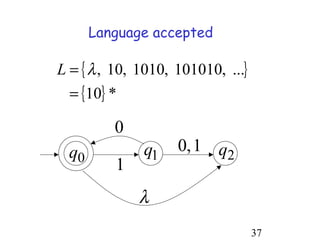
Language accepted

L = { λ , 10, 1010, 101010, ...}
  = {10} *

          0
  q0          q1    0, 1 q2
          1
              λ
                                   37
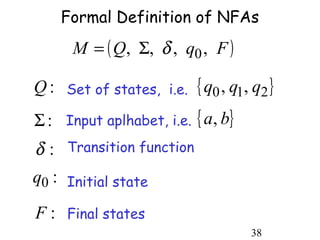
Formal Definition of NFAs
      M = ( Q, Σ, δ , q0 , F )

Q : Set of states, i.e. { q0 , q1, q2 }
Σ : Input aplhabet, i.e. { a, b}
δ:   Transition function

q0 : Initial state

F : Final states
                                   38
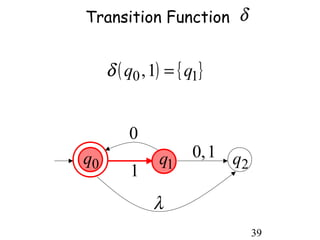
Transition Function δ


     δ ( q0 , 1) = { q1}


         0
q0             q1    0, 1 q
                           2
         1
              λ
                               39
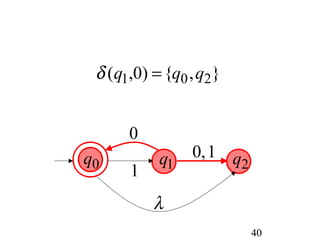
δ (q1,0) = {q0 , q2 }


      0
q0         q1    0, 1 q
                       2
      1
          λ
                           40
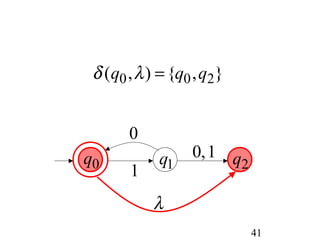
δ (q0 , λ ) = {q0 , q2 }


       0
q0           q1    0, 1 q
                         2
       1
            λ
                             41
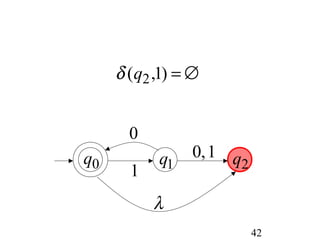
δ (q2 ,1) = ∅


       0
q0         q1   0, 1 q
                      2
       1
           λ
                          42
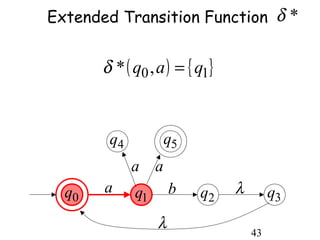
Extended Transition Function δ *


       δ * ( q0 , a ) = { q1}


        q4            q5
             a    a
  q0   a     q1       b    q2   λ        q3
                  λ
                                    43
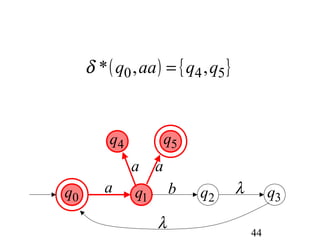
δ * ( q0 , aa ) = { q4 , q5 }


         q4            q5
              a    a
q0      a     q1       b    q2       λ        q3
                   λ
                                         44
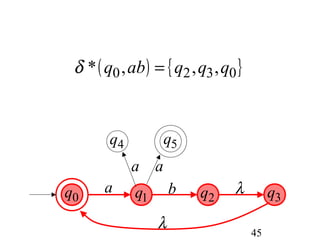
δ * ( q0 , ab ) = { q2 , q3 , q0 }


        q4            q5
             a    a
q0     a     q1       b    q2    λ         q3
                  λ
                                      45
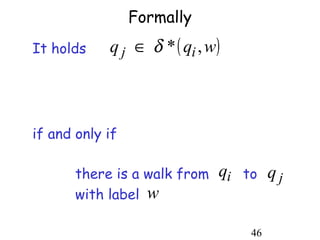
Formally
It holds    q j ∈ δ * ( qi , w)


if and only if

       there is a walk from   qi to q j
       with label w

                                  46
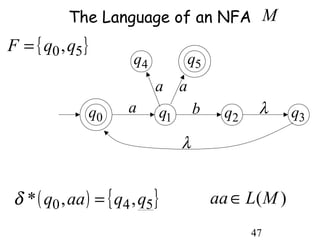
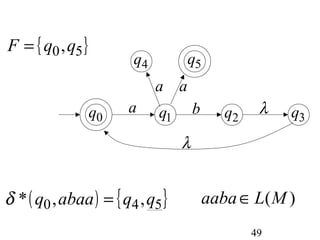
The Language of an NFA M
F = { q0 ,q5 }
                         q4               q5
                              a       a
                 q0    a         q1       b     q2    λ     q3
                                      λ


 δ * ( q0 , aa ) = { q4 , q5 }                 aa ∈ L(M )
                                                     47
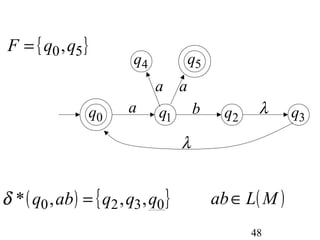
F = { q0 ,q5 }
                          q4             q5
                               a     a
                  q0     a     q1        b      q2    λ     q3
                                     λ


δ * ( q0 , ab ) = { q2 , q3 , q0 }            ab ∈ L( M )
                                                     48
F = { q0 ,q5 }
                        q4            q5
                             a    a
                 q0    a     q1       b      q2    λ   q3
                                  λ


δ * ( q0 , abaa ) = { q4 , q5 }            aaba ∈ L(M )
                                                  49
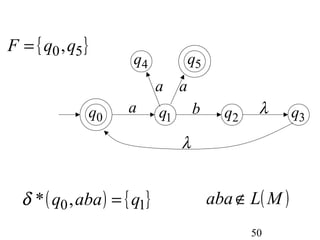
F = { q0 ,q5 }
                      q4              q5
                             a    a
                 q0   a      q1       b      q2    λ      q3
                                  λ


  δ * ( q0 , aba ) = { q1}                 aba ∉ L( M )
                                                  50
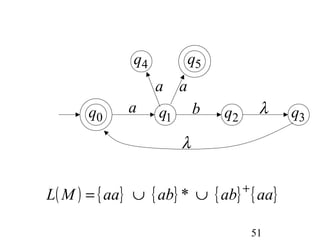
q4            q5
                   a    a
      q0     a     q1       b    q2        λ      q3
                        λ

                                      +
L( M ) = { aa} ∪ { ab} * ∪ { ab}          { aa}
                                          51
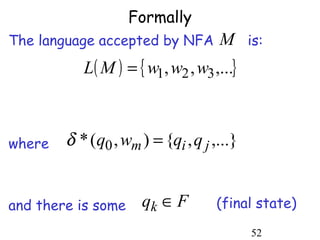
Formally
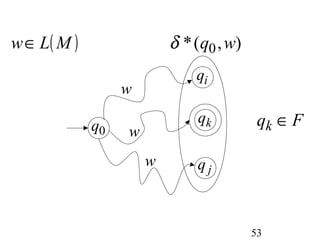
The language accepted by NFA        M is:
           L( M ) = { w1, w2 , w3 ,...}


where   δ * (q0 , wm ) = {qi , q j ,...}


and there is some     qk ∈ F        (final state)

                                           52
w∈ L( M )                δ * (q0 , w)
                             qi
                 w

            q0
                             qk          qk ∈ F
                 w
                     w       qj


                                        53
Equivalence of NFAs and DFAs


                         54
Equivalence of Machines

For DFAs or NFAs:

Machine     M1 is equivalent to machine M 2

if   L( M 1 ) = L( M 2 )


                                     55
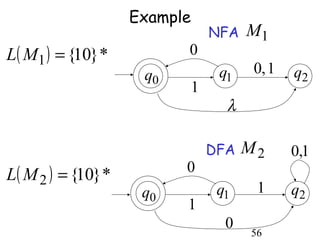
Example
                                  NFA   M1
L( M1 ) = {10} *          0
                     q0            q1    0, 1   q2
                              1
                                    λ

                                  DFA   M2      0,1
                          0
L( M 2 ) = {10} *
                     q0            q1    1      q2
                          1
                                    0
                                        56
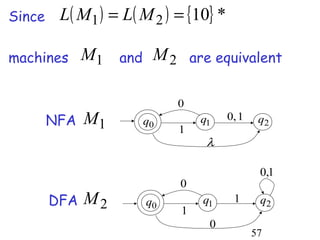
Since    L( M1 ) = L( M 2 ) = {10} *

machines      M1 and M 2 are equivalent

                            0
        NFA   M1      q0        q1     0, 1    q2
                            1
                                 λ

                                               0,1
                            0
        DFA   M2      q0        q1      1      q2
                            1
                                 0
                                              57
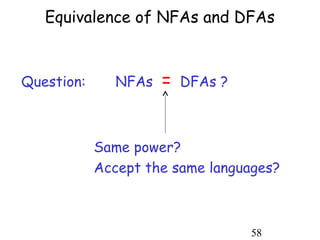
Equivalence of NFAs and DFAs


Question:      NFAs   =   DFAs ?


            Same power?
            Accept the same languages?


                                   58
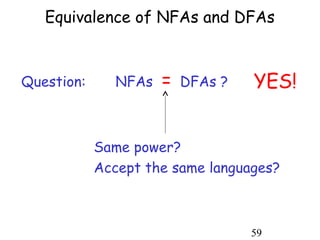
Equivalence of NFAs and DFAs


Question:      NFAs   =   DFAs ?   YES!


            Same power?
            Accept the same languages?


                                   59
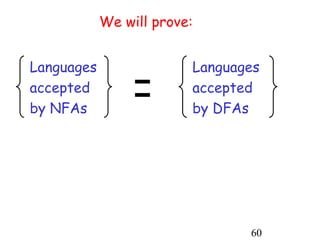
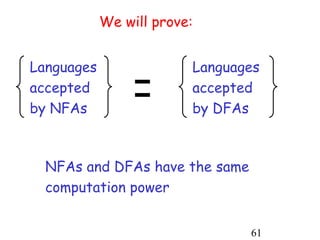
We will prove:


                 =
Languages                Languages
accepted                 accepted
by NFAs                  by DFAs


                                60
We will prove:


                 =
Languages                Languages
accepted                 accepted
by NFAs                  by DFAs


  NFAs and DFAs have the same
  computation power


                                61
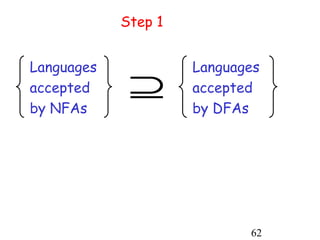
Step 1


Languages            Languages
accepted     ⊇       accepted
by NFAs              by DFAs


                            62
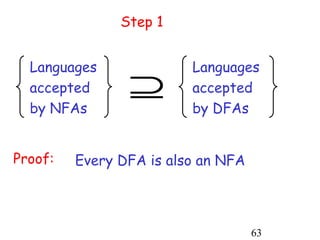
Step 1


  Languages              Languages
  accepted      ⊇        accepted
  by NFAs                by DFAs


Proof:   Every DFA is also an NFA


                                    63
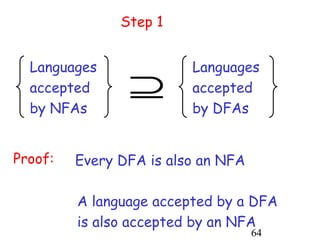
Step 1


  Languages              Languages
  accepted      ⊇        accepted
  by NFAs                by DFAs


Proof:   Every DFA is also an NFA

         A language accepted by a DFA
         is also accepted by an NFA
                                    64
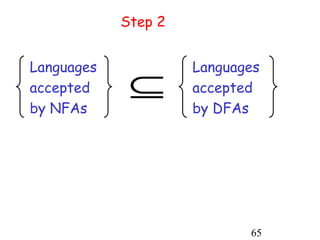
Step 2


Languages            Languages
accepted     ⊆       accepted
by NFAs              by DFAs


                            65
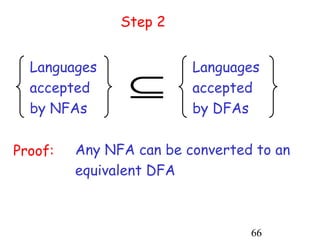
Step 2


  Languages              Languages
  accepted      ⊆        accepted
  by NFAs                by DFAs

Proof:   Any NFA can be converted to an
         equivalent DFA


                                 66
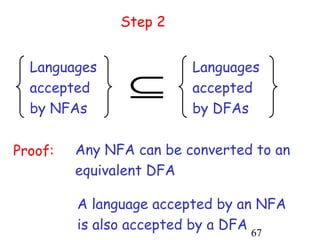
Step 2


  Languages              Languages
  accepted      ⊆        accepted
  by NFAs                by DFAs

Proof:   Any NFA can be converted to an
         equivalent DFA

         A language accepted by an NFA
         is also accepted by a DFA 67
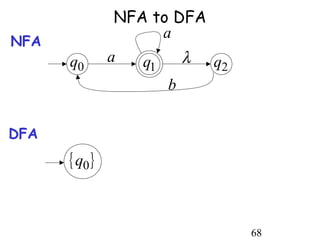
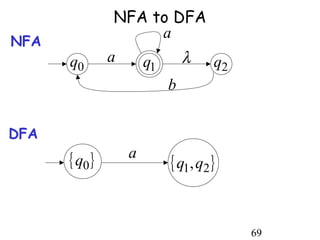
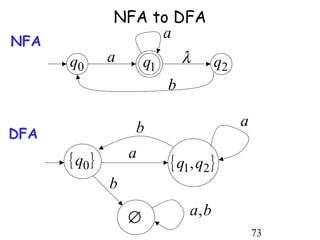
NFA to DFA
                      a
NFA
      q0       a   q1    λ q2
                       b


DFA
      { q0 }


                                68
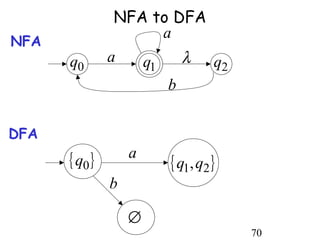
NFA to DFA
                      a
NFA
      q0       a   q1    λ q2
                       b


DFA
      { q0 }     a
                      { q1, q2 }


                                   69
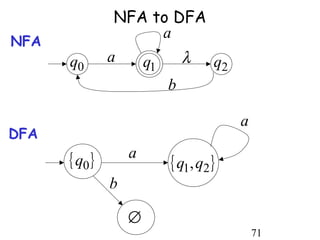
NFA to DFA
                      a
NFA
      q0       a   q1    λ q2
                       b


DFA
      { q0 }       a
                       { q1, q2 }
               b

                   ∅
                                    70
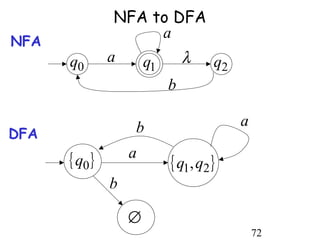
NFA to DFA
                      a
NFA
      q0       a   q1    λ q2
                       b

                                    a
DFA
      { q0 }       a
                       { q1, q2 }
               b

                   ∅
                                        71
NFA to DFA
                      a
NFA
      q0       a   q1    λ q2
                       b

                   b                a
DFA
      { q0 }       a
                       { q1, q2 }
               b

                   ∅
                                        72
NFA to DFA
                      a
NFA
      q0       a   q1    λ q2
                       b

                   b                a
DFA
      { q0 }       a
                       { q1, q2 }
               b

                   ∅       a, b
                                        73
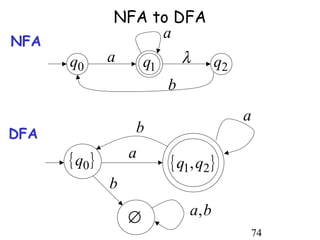
NFA to DFA
                      a
NFA
      q0       a   q1    λ q2
                       b
                                    a
DFA                b

      { q0 }       a
                       { q1, q2 }
               b

                   ∅       a, b
                                    74
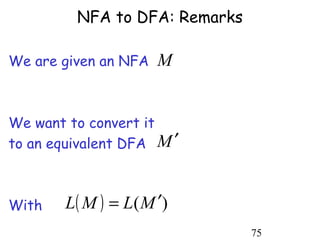
NFA to DFA: Remarks

We are given an NFA   M


We want to convert it
to an equivalent DFA M ′


With    L( M ) = L(M ′)
                               75
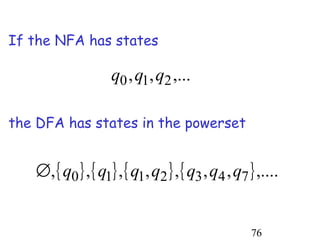
If the NFA has states

                    q0 , q1, q2 ,...

the DFA has states in the powerset


   ∅, { q0 } , { q1} , { q1, q2 } , { q3 , q4 , q7 } ,....


                                                   76
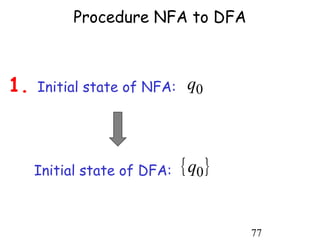
Procedure NFA to DFA


1.   Initial state of NFA:    q0


     Initial state of DFA:   { q0 }


                                      77
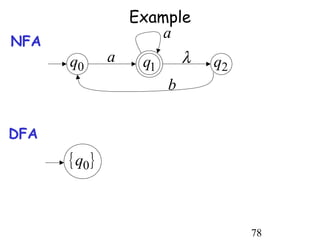
Example
                       a
NFA
      q0       a    q1       λ   q2
                         b


DFA
      { q0 }


                                      78
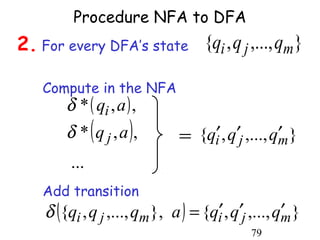
Procedure NFA to DFA
2. For every DFA’s state {qi , q j ,..., qm }

    Compute in the NFA
        δ * ( qi , a ) ,
        δ * ( q j , a ),       = {qi′ , q′j ,..., qm }
                                                   ′
         ...
    Add transition
    δ ({qi , q j ,..., qm }, a ) = {qi′ , q′j ,..., qm }
                                                     ′
                                              79
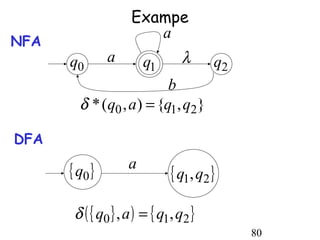
Exampe
                       a
NFA
      q0       a        q1      λ      q2
                          b
        δ * (q0 , a ) = {q1, q2}

DFA

      { q0 }        a
                              { q1, q2 }

       δ ( { q0 } , a ) = { q1, q2 }
                                            80
Procedure NFA to DFA


Repeat Step 2 for all letters in alphabet,
                until
no more transitions can be added.


                                     81
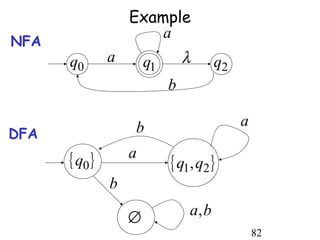
Example
                       a
NFA
      q0       a       q1       λ      q2
                            b

                   b                        a
DFA
      { q0 }       a
                            { q1, q2 }
               b

                   ∅            a, b
                                                82
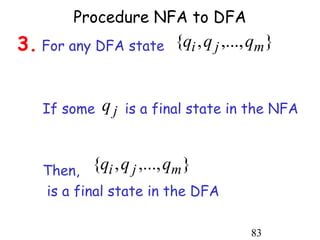
Procedure NFA to DFA
3. For any DFA state {qi , q j ,..., qm }


    If some   q j is a final state in the NFA


    Then, {qi , q j ,..., qm }
    is a final state in the DFA

                                     83
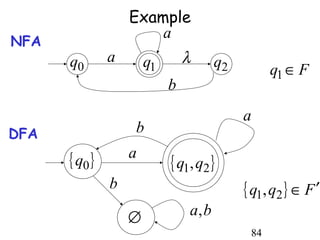
Example
                       a
NFA
      q0       a       q1       λ      q2         q1 ∈ F
                            b
                                            a
DFA                b

      { q0 }       a
                            { q1, q2 }
               b                            { q1, q2 } ∈ F ′
                   ∅            a, b
                                             84
Theorem
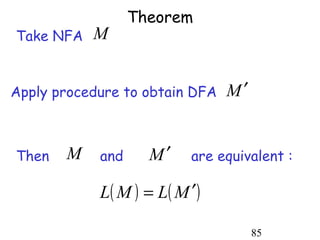
Take NFA   M


Apply procedure to obtain DFA   M′


Then   M    and     M′    are equivalent :

            L( M ) = L( M ′)

                                     85
Finally
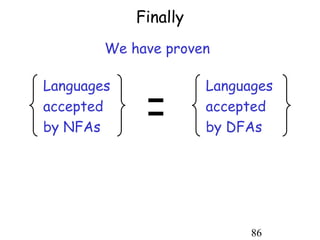
        We have proven


             =
Languages             Languages
accepted              accepted
by NFAs               by DFAs


                            86
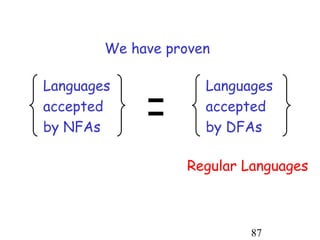
We have proven


             =
Languages            Languages
accepted             accepted
by NFAs              by DFAs

                  Regular Languages


                           87
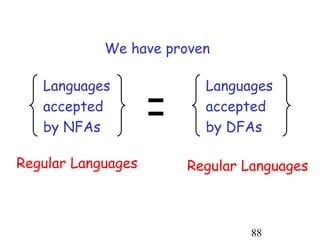
We have proven


                    =
   Languages              Languages
   accepted               accepted
   by NFAs                by DFAs

Regular Languages       Regular Languages


                                88

Automata

  • 1.
  • 2.
    Nondeterministic Finite Accepter(NFA) Alphabet = {a} q1 a q2 a q0 a q3 2
  • 3.
    Nondeterministic Finite Accepter(NFA) Alphabet = {a} Two choices q1 a q2 a q0 a q3 3
  • 4.
    Nondeterministic Finite Accepter(NFA) Alphabet = {a} Two choices q1 a q2 No transition a q0 a q3 No transition 4
  • 5.
    First Choice a a q1 a q2 a q0 a q3 5
  • 6.
    First Choice a a q1 a q2 a q0 a q3 6
  • 7.
    First Choice a a q1 a q2 a q0 a q3 7
  • 8.
    First Choice a a q1 a q2 “accept” a q0 a q3 8
  • 9.
    Second Choice a a q1 a q2 a q0 a q3 9
  • 10.
    Second Choice a a q1 a q2 a q0 a q3 10
  • 11.
    Second Choice a a q1 a q2 a q0 a No transition: q3 the automaton hangs 11
  • 12.
    Second Choice a a q1 a q2 a q0 a q3 “reject” 12
  • 13.
    Observation An NFA acceptsa string if there is a computation of the NFA that accepts the string 13
  • 14.
    Example aa is acceptedby the NFA: q1 a q2 a q0 a q3 14
  • 15.
    Lambda Transitions q0 a q1 λ q1 a q3 15
  • 16.
    a a q0 a q1 λ q2 a q3 16
  • 17.
    a a q0 a q1 λ q2 a q3 17
  • 18.
    (read head doesn’tmove) a a q0 a q1 λ q2 a q3 18
  • 19.
    a a q0 a q1 λ q2 a q3 19
  • 20.
    a a “accept” q0 a q1 λ q2 a q3 String aa is accepted 20
  • 21.
    Language accepted: L = {aa} q0 a q1 λ q2 a q3 21
  • 22.
    Another NFA Example q0 a q1 b q2 λ q3 λ 22
  • 23.
    a b q0 a q1 b q2 λ q3 λ 23
  • 24.
    a b q0 a q1 b q2 λ q3 λ 24
  • 25.
    a b q0 a q1 b q2 λ q3 λ 25
  • 26.
    a b “accept” q0 a q1 b q2 λ q3 λ 26
  • 27.
    Another String a ba b q0 a q1 b q2 λ q3 λ 27
  • 28.
    a b ab q0 a q1 b q2 λ q3 λ 28
  • 29.
    a b ab q0 a q1 b q2 λ q3 λ 29
  • 30.
    a b ab q0 a q1 b q2 λ q3 λ 30
  • 31.
    a b ab q0 a q1 b q2 λ q3 λ 31
  • 32.
    a b ab q0 a q1 b q2 λ q3 λ 32
  • 33.
    a b ab q0 a q1 b q2 λ q3 λ 33
  • 34.
    a b ab “accept” q0 a q1 b q2 λ q3 λ 34
  • 35.
    Language accepted L = { ab, abab, ababab, ...} + = { ab} q0 a q1 b q2 λ q3 λ 35
  • 36.
    Another NFA Example 0 q0 q1 0, 1 q2 1 λ 36
  • 37.
    Language accepted L ={ λ , 10, 1010, 101010, ...} = {10} * 0 q0 q1 0, 1 q2 1 λ 37
  • 38.
    Formal Definition ofNFAs M = ( Q, Σ, δ , q0 , F ) Q : Set of states, i.e. { q0 , q1, q2 } Σ : Input aplhabet, i.e. { a, b} δ: Transition function q0 : Initial state F : Final states 38
  • 39.
    Transition Function δ δ ( q0 , 1) = { q1} 0 q0 q1 0, 1 q 2 1 λ 39
  • 40.
    δ (q1,0) ={q0 , q2 } 0 q0 q1 0, 1 q 2 1 λ 40
  • 41.
    δ (q0 ,λ ) = {q0 , q2 } 0 q0 q1 0, 1 q 2 1 λ 41
  • 42.
    δ (q2 ,1)= ∅ 0 q0 q1 0, 1 q 2 1 λ 42
  • 43.
    Extended Transition Functionδ * δ * ( q0 , a ) = { q1} q4 q5 a a q0 a q1 b q2 λ q3 λ 43
  • 44.
    δ * (q0 , aa ) = { q4 , q5 } q4 q5 a a q0 a q1 b q2 λ q3 λ 44
  • 45.
    δ * (q0 , ab ) = { q2 , q3 , q0 } q4 q5 a a q0 a q1 b q2 λ q3 λ 45
  • 46.
    Formally It holds q j ∈ δ * ( qi , w) if and only if there is a walk from qi to q j with label w 46
  • 47.
    The Language ofan NFA M F = { q0 ,q5 } q4 q5 a a q0 a q1 b q2 λ q3 λ δ * ( q0 , aa ) = { q4 , q5 } aa ∈ L(M ) 47
  • 48.
    F = {q0 ,q5 } q4 q5 a a q0 a q1 b q2 λ q3 λ δ * ( q0 , ab ) = { q2 , q3 , q0 } ab ∈ L( M ) 48
  • 49.
    F = {q0 ,q5 } q4 q5 a a q0 a q1 b q2 λ q3 λ δ * ( q0 , abaa ) = { q4 , q5 } aaba ∈ L(M ) 49
  • 50.
    F = {q0 ,q5 } q4 q5 a a q0 a q1 b q2 λ q3 λ δ * ( q0 , aba ) = { q1} aba ∉ L( M ) 50
  • 51.
    q4 q5 a a q0 a q1 b q2 λ q3 λ + L( M ) = { aa} ∪ { ab} * ∪ { ab} { aa} 51
  • 52.
    Formally The language acceptedby NFA M is: L( M ) = { w1, w2 , w3 ,...} where δ * (q0 , wm ) = {qi , q j ,...} and there is some qk ∈ F (final state) 52
  • 53.
    w∈ L( M) δ * (q0 , w) qi w q0 qk qk ∈ F w w qj 53
  • 54.
  • 55.
    Equivalence of Machines ForDFAs or NFAs: Machine M1 is equivalent to machine M 2 if L( M 1 ) = L( M 2 ) 55
  • 56.
    Example NFA M1 L( M1 ) = {10} * 0 q0 q1 0, 1 q2 1 λ DFA M2 0,1 0 L( M 2 ) = {10} * q0 q1 1 q2 1 0 56
  • 57.
    Since L( M1 ) = L( M 2 ) = {10} * machines M1 and M 2 are equivalent 0 NFA M1 q0 q1 0, 1 q2 1 λ 0,1 0 DFA M2 q0 q1 1 q2 1 0 57
  • 58.
    Equivalence of NFAsand DFAs Question: NFAs = DFAs ? Same power? Accept the same languages? 58
  • 59.
    Equivalence of NFAsand DFAs Question: NFAs = DFAs ? YES! Same power? Accept the same languages? 59
  • 60.
    We will prove: = Languages Languages accepted accepted by NFAs by DFAs 60
  • 61.
    We will prove: = Languages Languages accepted accepted by NFAs by DFAs NFAs and DFAs have the same computation power 61
  • 62.
    Step 1 Languages Languages accepted ⊇ accepted by NFAs by DFAs 62
  • 63.
    Step 1 Languages Languages accepted ⊇ accepted by NFAs by DFAs Proof: Every DFA is also an NFA 63
  • 64.
    Step 1 Languages Languages accepted ⊇ accepted by NFAs by DFAs Proof: Every DFA is also an NFA A language accepted by a DFA is also accepted by an NFA 64
  • 65.
    Step 2 Languages Languages accepted ⊆ accepted by NFAs by DFAs 65
  • 66.
    Step 2 Languages Languages accepted ⊆ accepted by NFAs by DFAs Proof: Any NFA can be converted to an equivalent DFA 66
  • 67.
    Step 2 Languages Languages accepted ⊆ accepted by NFAs by DFAs Proof: Any NFA can be converted to an equivalent DFA A language accepted by an NFA is also accepted by a DFA 67
  • 68.
    NFA to DFA a NFA q0 a q1 λ q2 b DFA { q0 } 68
  • 69.
    NFA to DFA a NFA q0 a q1 λ q2 b DFA { q0 } a { q1, q2 } 69
  • 70.
    NFA to DFA a NFA q0 a q1 λ q2 b DFA { q0 } a { q1, q2 } b ∅ 70
  • 71.
    NFA to DFA a NFA q0 a q1 λ q2 b a DFA { q0 } a { q1, q2 } b ∅ 71
  • 72.
    NFA to DFA a NFA q0 a q1 λ q2 b b a DFA { q0 } a { q1, q2 } b ∅ 72
  • 73.
    NFA to DFA a NFA q0 a q1 λ q2 b b a DFA { q0 } a { q1, q2 } b ∅ a, b 73
  • 74.
    NFA to DFA a NFA q0 a q1 λ q2 b a DFA b { q0 } a { q1, q2 } b ∅ a, b 74
  • 75.
    NFA to DFA:Remarks We are given an NFA M We want to convert it to an equivalent DFA M ′ With L( M ) = L(M ′) 75
  • 76.
    If the NFAhas states q0 , q1, q2 ,... the DFA has states in the powerset ∅, { q0 } , { q1} , { q1, q2 } , { q3 , q4 , q7 } ,.... 76
  • 77.
    Procedure NFA toDFA 1. Initial state of NFA: q0 Initial state of DFA: { q0 } 77
  • 78.
    Example a NFA q0 a q1 λ q2 b DFA { q0 } 78
  • 79.
    Procedure NFA toDFA 2. For every DFA’s state {qi , q j ,..., qm } Compute in the NFA δ * ( qi , a ) , δ * ( q j , a ), = {qi′ , q′j ,..., qm } ′ ... Add transition δ ({qi , q j ,..., qm }, a ) = {qi′ , q′j ,..., qm } ′ 79
  • 80.
    Exampe a NFA q0 a q1 λ q2 b δ * (q0 , a ) = {q1, q2} DFA { q0 } a { q1, q2 } δ ( { q0 } , a ) = { q1, q2 } 80
  • 81.
    Procedure NFA toDFA Repeat Step 2 for all letters in alphabet, until no more transitions can be added. 81
  • 82.
    Example a NFA q0 a q1 λ q2 b b a DFA { q0 } a { q1, q2 } b ∅ a, b 82
  • 83.
    Procedure NFA toDFA 3. For any DFA state {qi , q j ,..., qm } If some q j is a final state in the NFA Then, {qi , q j ,..., qm } is a final state in the DFA 83
  • 84.
    Example a NFA q0 a q1 λ q2 q1 ∈ F b a DFA b { q0 } a { q1, q2 } b { q1, q2 } ∈ F ′ ∅ a, b 84
  • 85.
    Theorem Take NFA M Apply procedure to obtain DFA M′ Then M and M′ are equivalent : L( M ) = L( M ′) 85
  • 86.
    Finally We have proven = Languages Languages accepted accepted by NFAs by DFAs 86
  • 87.
    We have proven = Languages Languages accepted accepted by NFAs by DFAs Regular Languages 87
  • 88.
    We have proven = Languages Languages accepted accepted by NFAs by DFAs Regular Languages Regular Languages 88