DUAL CLUTCH
TRANSMISSION
PRESENTED BY:-
T.S.SRIVATS (1js06me045)
WHAT IS TRANSMISSION?
 Power transmission is the movement of energy
from its place of generation to a location where
it is applied to performing useful work.
 The application of the engine power to the
driving wheels is power transmission in case of
automobiles.
PURPOSE OF TRANSMISSION
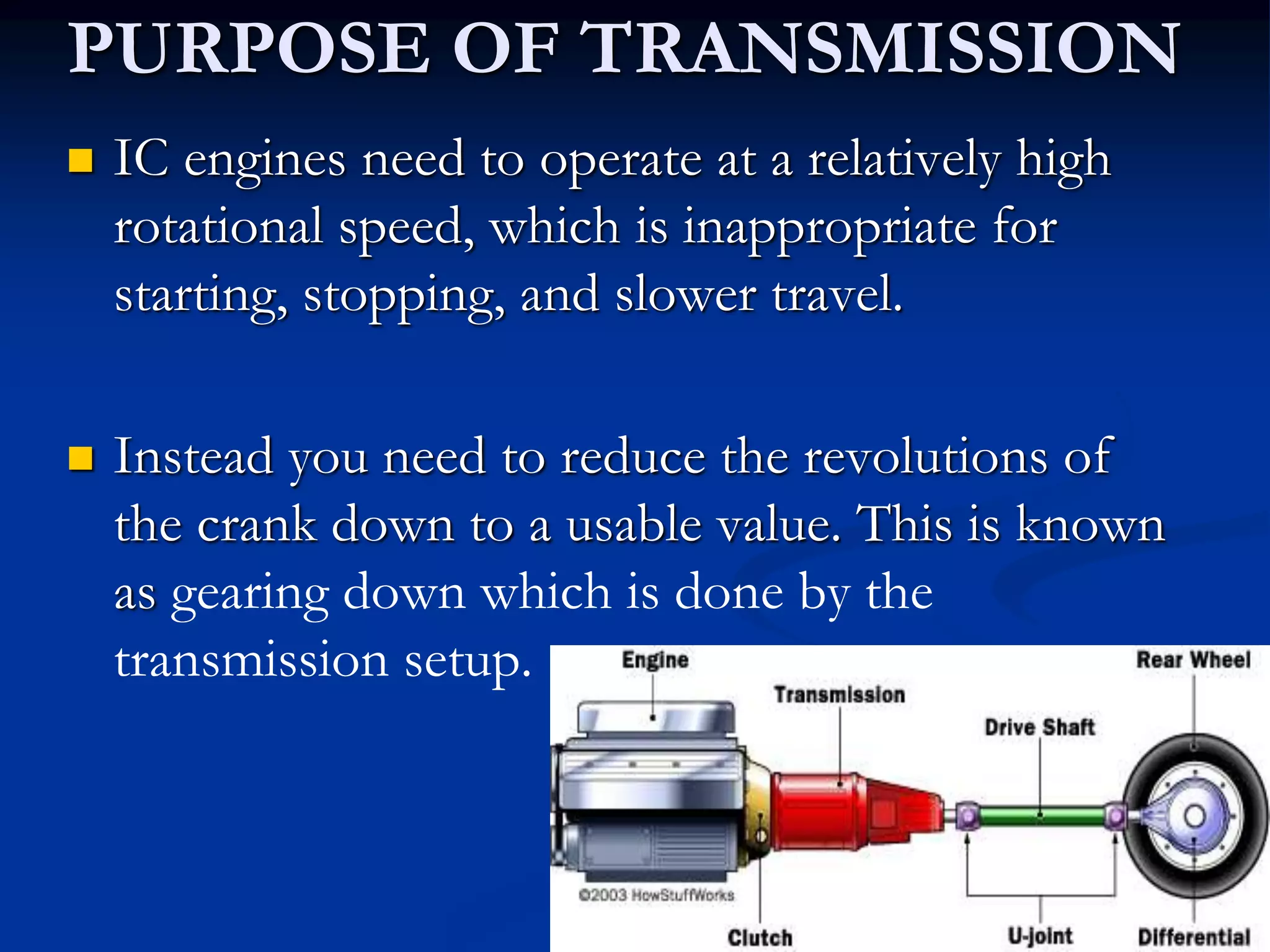
 IC engines need to operate at a relatively high
rotational speed, which is inappropriate for
starting, stopping, and slower travel.
 Instead you need to reduce the revolutions of
the crank down to a usable value. This is known
as gearing down which is done by the
transmission setup.
WHAT IS A CLUTCH?
 Clutch is a device used in the transmission system of a motor
vehicle to engage and disengage the engine to the
transmission.
 In order for a car to stop without killing the engine, the
wheels need to be disconnected from the engine this is done
by a clutch.
 It enables the running engine to be connected to driving
wheel smoothly and without shock.
Clutch plate
WORKING OF CLUTCH
 When the clutch pedal is pressed, the throw-out
bearing presses against the middle of the
diaphragm spring. This in turn causes the spring
to pull the clutch plate away from the flywheel.
 When your foot is off the pedal, the springs
push the pressure plate against the clutch disc,
which in turn presses against the flywheel.
CLUTCH PEDAL PRESSED CLUTCH PEDAL RELEASED
INSIDE A CLUTCH
SINGLE CLUTCH
TRANSMISSION
 In this kind of transmission there is only one
clutch system and when the operator has to
change a gear he needs to press the clutch pedal
to operate the gear lever.
From
clutch
SINGLE CLUTCH
TRANSMISSION
When the Clutch is engaged the lay shaft with
gears on them rotate. The helical gears is meshed
with the gears on the output shaft, making the
gears on the o/p shaft rotate. When the gear is
selected the selector fork causes the dog gear to
move left or right thus engaging the dog gear with
the gear This gear transmits its energy through the
dog gear to drive the output shaft.
DUAL CLUTCH TRANSMISSION
 Dual clutch transmission, it is two separate
manual gearboxes contained within one housing,
and working as one unit
 Sophisticated electronics and hydraulics control
the clutches. One clutch controls the odd gears
while the other controls the even gears
DCT ARRANGEMENT
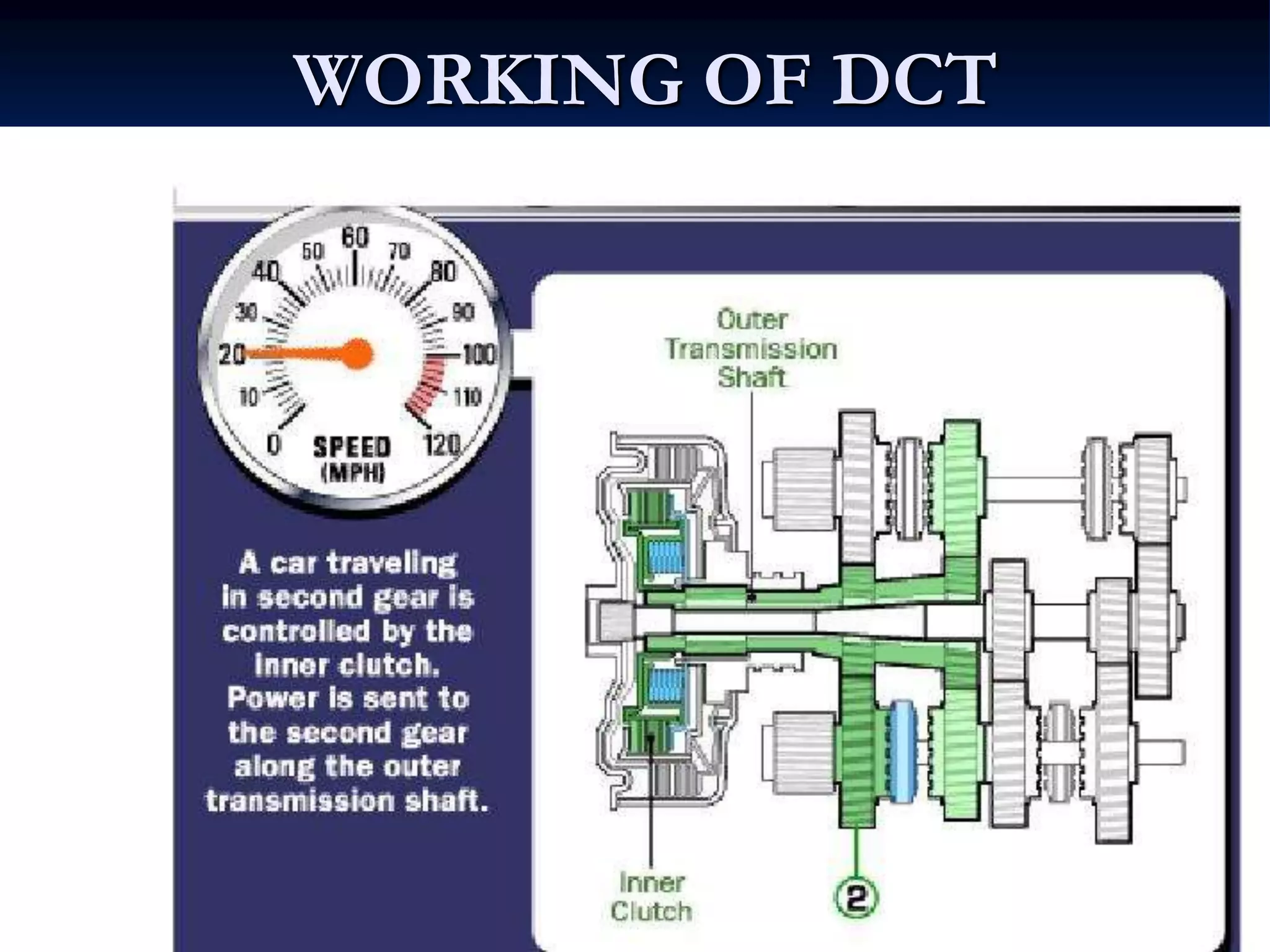
 DCT has one lay shaft like a normal gearbox, but two
output shafts. One output shaft has 1st, 3rd and 5th
gears on it whilst the other has 2nd, 4th and 6th.
 The lay shaft is actually two shafts one inside the other
connected to two concentric clutches at the end.
WORKING OF DCT
WORKING OF DCT
WORKING OF DCT
ADVANTAGES
 Better fuel economy up to 15% improvement
than conventional transmission.
 No loss of torque transmission from the engine
to the driving wheels during gear shifts
 Extremely fast up-shift time of 8 milliseconds
 Very smooth gear-shift operations.
DISADVANTAGES
 Relatively expensive to manufacture and
therefore increases new vehicle purchase price
 Heavier than a conventional manual
transmission
 Expensive transmission fluids/lubricants with
dedicated additives are required, which need
changing on a regular basis
DCT
AUTO
MT
APPLICATIONS
 DCT is used in Volkswagen cars as direct shift
gearbox (DSG)
 Used in the Bugatti Veyron one of the fastest
street legal cars in the world
 Used by Volvo in Europe for some of the
public transport vehicles
CONCLUSION
 New environmental and fuel efficiency
legislation have triggered new automated
transmission technologies. The most likely
winner that will replace traditional system will be
the dual clutch transmission (DCT) as it offers
the best of fuel efficiency as well as comfort and
performance.
REFERENCES
 Carbibles.com
 Google.com
 howstuffwork.com
 wikipedia.com
 autoworld.com
auto1.ppt

auto1.ppt

  • 1.
  • 2.
    WHAT IS TRANSMISSION? Power transmission is the movement of energy from its place of generation to a location where it is applied to performing useful work.  The application of the engine power to the driving wheels is power transmission in case of automobiles.
  • 3.
    PURPOSE OF TRANSMISSION IC engines need to operate at a relatively high rotational speed, which is inappropriate for starting, stopping, and slower travel.  Instead you need to reduce the revolutions of the crank down to a usable value. This is known as gearing down which is done by the transmission setup.
  • 4.
    WHAT IS ACLUTCH?  Clutch is a device used in the transmission system of a motor vehicle to engage and disengage the engine to the transmission.  In order for a car to stop without killing the engine, the wheels need to be disconnected from the engine this is done by a clutch.  It enables the running engine to be connected to driving wheel smoothly and without shock. Clutch plate
  • 5.
    WORKING OF CLUTCH When the clutch pedal is pressed, the throw-out bearing presses against the middle of the diaphragm spring. This in turn causes the spring to pull the clutch plate away from the flywheel.  When your foot is off the pedal, the springs push the pressure plate against the clutch disc, which in turn presses against the flywheel.
  • 6.
    CLUTCH PEDAL PRESSEDCLUTCH PEDAL RELEASED INSIDE A CLUTCH
  • 7.
    SINGLE CLUTCH TRANSMISSION  Inthis kind of transmission there is only one clutch system and when the operator has to change a gear he needs to press the clutch pedal to operate the gear lever. From clutch
  • 8.
    SINGLE CLUTCH TRANSMISSION When theClutch is engaged the lay shaft with gears on them rotate. The helical gears is meshed with the gears on the output shaft, making the gears on the o/p shaft rotate. When the gear is selected the selector fork causes the dog gear to move left or right thus engaging the dog gear with the gear This gear transmits its energy through the dog gear to drive the output shaft.
  • 9.
    DUAL CLUTCH TRANSMISSION Dual clutch transmission, it is two separate manual gearboxes contained within one housing, and working as one unit  Sophisticated electronics and hydraulics control the clutches. One clutch controls the odd gears while the other controls the even gears
  • 10.
    DCT ARRANGEMENT  DCThas one lay shaft like a normal gearbox, but two output shafts. One output shaft has 1st, 3rd and 5th gears on it whilst the other has 2nd, 4th and 6th.  The lay shaft is actually two shafts one inside the other connected to two concentric clutches at the end.
  • 11.
  • 12.
  • 13.
  • 14.
    ADVANTAGES  Better fueleconomy up to 15% improvement than conventional transmission.  No loss of torque transmission from the engine to the driving wheels during gear shifts  Extremely fast up-shift time of 8 milliseconds  Very smooth gear-shift operations.
  • 15.
    DISADVANTAGES  Relatively expensiveto manufacture and therefore increases new vehicle purchase price  Heavier than a conventional manual transmission  Expensive transmission fluids/lubricants with dedicated additives are required, which need changing on a regular basis
  • 16.
  • 17.
    APPLICATIONS  DCT isused in Volkswagen cars as direct shift gearbox (DSG)  Used in the Bugatti Veyron one of the fastest street legal cars in the world  Used by Volvo in Europe for some of the public transport vehicles
  • 18.
    CONCLUSION  New environmentaland fuel efficiency legislation have triggered new automated transmission technologies. The most likely winner that will replace traditional system will be the dual clutch transmission (DCT) as it offers the best of fuel efficiency as well as comfort and performance.
  • 19.
    REFERENCES  Carbibles.com  Google.com howstuffwork.com  wikipedia.com  autoworld.com