D.A.V. sushil kedia higherD.A.V. sushil kedia higher
secondary schoolsecondary school
PRESENTED BY : ABHISHEK KAYASTHA(1054)PRESENTED BY : ABHISHEK KAYASTHA(1054)
Devashish Regmi (10160)Devashish Regmi (10160)
KABIR BHADUR SHAH(101630KABIR BHADUR SHAH(101630
SAFAL KARKI(10170)SAFAL KARKI(10170)
SAILESH BHATTARAI(10171)SAILESH BHATTARAI(10171)
USHAN SHRESTHA(10182USHAN SHRESTHA(10182))
ACKNOWLEDGEMENT
We would like to express  our special thanks of 
gratitude to our teacher Mr Binod piya  who gave us 
the golden opportunity to do this wonderful project on 
the topic AUTISM, which also helped us in doing 
a lot of Research and we came to know about so many 
new things we are really thankful to them.
Secondly we would also like to thank my parents and 
friends who helped us a lot in finalizing this project 
within the limited time frame.
ContentContent
What is autism?
Early signs of autism
Children and autism
Related development disorde
Symptoms
Social interction
Play and behaviours
Signs and test
Medicine
Treatment
Diet
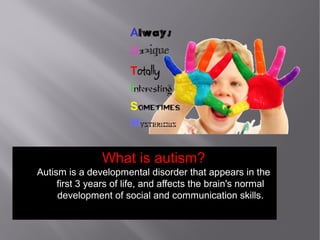
What is autism?
Autism is a developmental disorder that appears in the
first 3 years of life, and affects the brain's normal
development of social and communication skills.
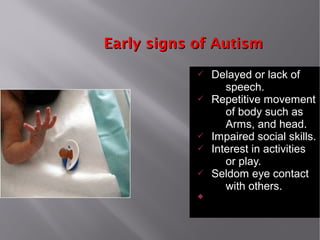
Early signs of AutismEarly signs of Autism
ü Delayed or lack of
speech.
ü Repetitive movement
of body such as
Arms, and head.
ü Impaired social skills.
ü Interest in activities
or play.
ü Seldom eye contact
with others.

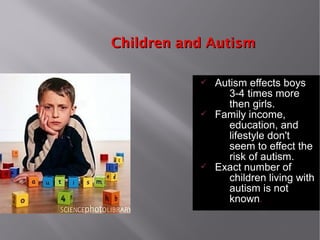
Children and AutismChildren and Autism
ü Autism effects boys
3-4 times more
then girls.
ü Family income,
education, and
lifestyle don't
seem to effect the
risk of autism.
ü Exact number of
children living with
autism is not
known.
Related Developmental DisorderRelated Developmental Disorder
ü Asperger Syndrome (similar to
autism but with normal language
development).
ü Rett Syndrome(Very different from
autism, and only occurs in
females).
ü Childhood Disintegrative Disorder
(Rare condition where a child
learns skills, then looses them
by age 10).
ü Pervasive Developmental Disorder
(Also called typical autism).
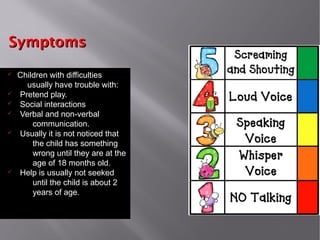
SymptomsSymptoms
ü Children with difficulties
usually have trouble with:
ü Pretend play.
ü Social interactions
ü Verbal and non-verbal
communication.
ü Usually it is not noticed that
the child has something
wrong until they are at the
age of 18 months old.
ü Help is usually not seeked
until the child is about 2
years of age.
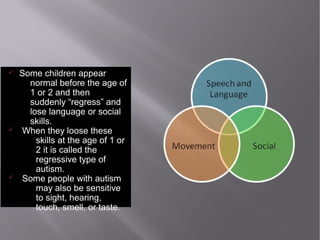
ü Some children appear
normal before the age of
1 or 2 and then
suddenly “regress” and
lose language or social
skills.
ü When they loose these
skills at the age of 1 or
2 it is called the
regressive type of
autism.
ü Some people with autism
may also be sensitive
to sight, hearing,
touch, smell, or taste.
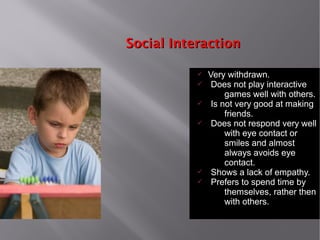
Social InteractionSocial Interaction
ü Very withdrawn.
ü Does not play interactive
games well with others.
ü Is not very good at making
friends.
ü Does not respond very well
with eye contact or
smiles and almost
always avoids eye
contact.
ü Shows a lack of empathy.
ü Prefers to spend time by
themselves, rather then
with others.
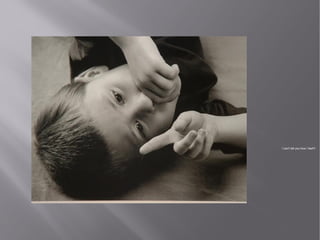
I can't tell you how I feel!!!
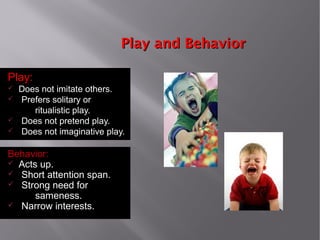
Play and BehaviorPlay and Behavior
Play:
ü Does not imitate others.
ü Prefers solitary or
ritualistic play.
ü Does not pretend play.
ü Does not imaginative play.
Behavior:
ü Acts up.
ü Short attention span.
ü Strong need for
sameness.
ü Narrow interests.
Signs and TestsSigns and Tests
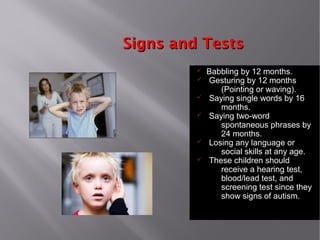
ü Babbling by 12 months.
ü Gesturing by 12 months
(Pointing or waving).
ü Saying single words by 16
months.
ü Saying two-word
spontaneous phrases by
24 months.
ü Losing any language or
social skills at any age.
ü These children should
receive a hearing test,
blood/lead test, and
screening test since they
show signs of autism.
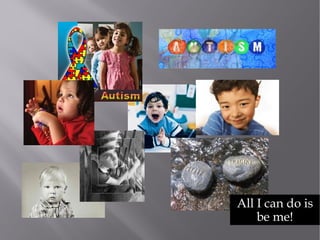
All I can do is
be me!
MedicineMedicine
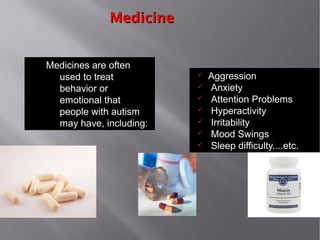
Medicines are often
used to treat
behavior or
emotional that
people with autism
may have, including:
ü Aggression
ü Anxiety
ü Attention Problems
ü Hyperactivity
ü Irritability
ü Mood Swings
ü Sleep difficulty....etc.
TreatmentTreatment
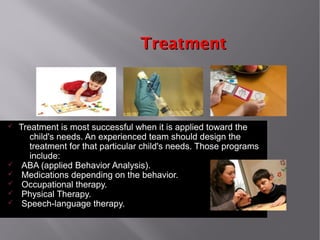
ü Treatment is most successful when it is applied toward the
child's needs. An experienced team should design the
treatment for that particular child's needs. Those programs
include:
ü ABA (applied Behavior Analysis).
ü Medications depending on the behavior.
ü Occupational therapy.
ü Physical Therapy.
ü Speech-language therapy.
Response toResponse to
SensorySensory
InformationInformationü Does not get startled or get unfocused by
loud noises.
ü Has low senses of sight, hearing, touch,
smell or taste.
ü May stay away from physical contact
because it is overwhelming or to hard to
handle/take in.
ü Rubs surfaces, mouth, or licks objects.
ü Has a high tolerance for pain.
ü It has been shown that some
children with autism react
well to gluten-free foods.
ü Gluten is found in foods that
have wheat, rye, and barley.
ü Not all studies have been
proven that a diet change
works to help people with
autism, but it has been
shown that it helps!
DIETDIET
ReferencesReferences
ü Autismsupport.dmum.org
ü Http://www.ncbi.nlm.nih.gov/pubmedhealth/PMH0002494/
ü Google images
AUTISM

AUTISM