#AUSVOTES
HOW TWITTER COVERED
 THE 2010 AUSTRALIAN
  FEDERAL ELECTION


   CATHERINE ALEXANDER
         Z3366676
Connecting people
Share views
Publicly engage in a discussion
Methods and Results
• #, @ and RTs
• Over 400,000 tweets
• More focus on the political leaders rather
  than the issues
• http://www.youtube.com/watch?
  v=tpN7VCzDTdg&feature=related
  (4.44)
Continued
• 50% of tweets consisted of @ replies or
  manual RTs
• Leaders did not take full advantage of the
  communication opportunity
• More a platform for discussion
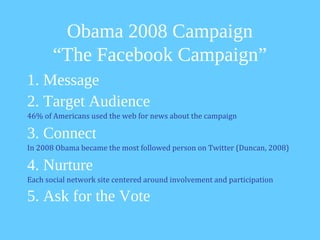
Obama 2008 Campaign
       “The Facebook Campaign”
1. Message
2. Target Audience
46% of Americans used the web for news about the campaign

3. Connect
In 2008 Obama became the most followed person on Twitter (Duncan, 2008)

4. Nurture
Each social network site centered around involvement and participation

5. Ask for the Vote
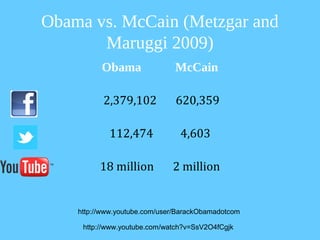
Obama vs. McCain (Metzgar and
       Maruggi 2009)
          Obama                McCain

           2,379,102           620,359

            112,474             4,603

          18 million          2 million


    http://www.youtube.com/user/BarackObamadotcom

     http://www.youtube.com/watch?v=SsV2O4fCgjk
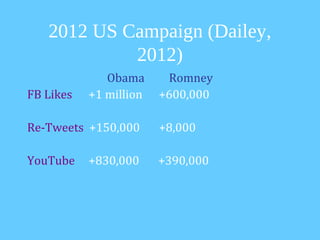
2012 US Campaign (Dailey,
            2012)
              Obama      Romney
FB Likes   +1 million   +600,000

Re-Tweets +150,000      +8,000

YouTube    +830,000     +390,000
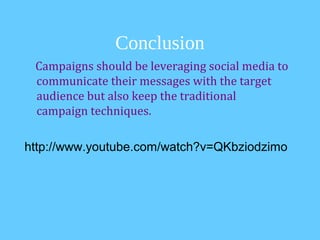
Conclusion
 Campaigns should be leveraging social media to
 communicate their messages with the target
 audience but also keep the traditional
 campaign techniques.

http://www.youtube.com/watch?v=QKbziodzimo
Activity
•   Split the room into four groups: Journalists, general public, Jane Jones and John
    Smith.
•   We want you to react the way your group would do so in the following situation,

    using the Twitter format of 140. Add #MDIA5003 and @reply or re-Tweet at least
    one other Tweet made by someone else.
•   Pretend it’s the lead up to a federal election in our fictional country “land”, it’s John
    Smith up against Jane Jones once again. During the public debate John Smith
    swears. Not in a derogatory way towards anyone in particular, he simply says the
    F-word. He is talking about his views on the National Broadband Network, and how
    they should be scrapped to pay aid to those affected by the Northern state floods (a
    statement he actually made in February 2011).
References
•   Bruns, A. and Burgess, J. 2011. How Twitter covered the 2010 Australian federal election.
    Communication, politics and culture, Vol. 44, No. 2, pp. 37-56.
•   Dailey, K. 2012. Romney v Obama on Twitter, Facebook and YouTube, BBC News Magazine,
    August 15.
•   Duncan, T. 2008. Obama08 leveraged Twitter to drive traffic to their website and help win an
    election, Part 1-Obama08 Twitter Marketing strategy. Obama 2.0 Marketing, November 8.
•   Fraser, M. And Dutta, S. 2008. Obama’s win means future elections must be fought online.
    The Guardian, Nov 7.
•   Metzgar, E. And Maruggi, A. 2009. Social media and the 2008 U.S. presidential election.
    Journal of new communications research, Vol. 4, Issue. 1.
•   Miller, C. C. 2008. How Obama’s internet campaign changed politics. The New York
    Times, Nov 7.
•   The Dragonfly Effect, How Obama won with social media.
    http://www.dragonflyeffect.com/blog/dragonfly-in-action/case-studies/the-obama-
    campaign/

Ausvotes 2

  • 1.
    #AUSVOTES HOW TWITTER COVERED THE 2010 AUSTRALIAN FEDERAL ELECTION CATHERINE ALEXANDER Z3366676
  • 2.
  • 3.
    Methods and Results •#, @ and RTs • Over 400,000 tweets • More focus on the political leaders rather than the issues • http://www.youtube.com/watch? v=tpN7VCzDTdg&feature=related (4.44)
  • 4.
    Continued • 50% oftweets consisted of @ replies or manual RTs • Leaders did not take full advantage of the communication opportunity • More a platform for discussion
  • 5.
    Obama 2008 Campaign “The Facebook Campaign” 1. Message 2. Target Audience 46% of Americans used the web for news about the campaign 3. Connect In 2008 Obama became the most followed person on Twitter (Duncan, 2008) 4. Nurture Each social network site centered around involvement and participation 5. Ask for the Vote
  • 6.
    Obama vs. McCain(Metzgar and Maruggi 2009) Obama McCain 2,379,102 620,359 112,474 4,603 18 million 2 million http://www.youtube.com/user/BarackObamadotcom http://www.youtube.com/watch?v=SsV2O4fCgjk
  • 7.
    2012 US Campaign(Dailey, 2012) Obama Romney FB Likes +1 million +600,000 Re-Tweets +150,000 +8,000 YouTube +830,000 +390,000
  • 8.
    Conclusion Campaigns shouldbe leveraging social media to communicate their messages with the target audience but also keep the traditional campaign techniques. http://www.youtube.com/watch?v=QKbziodzimo
  • 9.
    Activity • Split the room into four groups: Journalists, general public, Jane Jones and John Smith. • We want you to react the way your group would do so in the following situation, using the Twitter format of 140. Add #MDIA5003 and @reply or re-Tweet at least one other Tweet made by someone else. • Pretend it’s the lead up to a federal election in our fictional country “land”, it’s John Smith up against Jane Jones once again. During the public debate John Smith swears. Not in a derogatory way towards anyone in particular, he simply says the F-word. He is talking about his views on the National Broadband Network, and how they should be scrapped to pay aid to those affected by the Northern state floods (a statement he actually made in February 2011).
  • 10.
    References • Bruns, A. and Burgess, J. 2011. How Twitter covered the 2010 Australian federal election. Communication, politics and culture, Vol. 44, No. 2, pp. 37-56. • Dailey, K. 2012. Romney v Obama on Twitter, Facebook and YouTube, BBC News Magazine, August 15. • Duncan, T. 2008. Obama08 leveraged Twitter to drive traffic to their website and help win an election, Part 1-Obama08 Twitter Marketing strategy. Obama 2.0 Marketing, November 8. • Fraser, M. And Dutta, S. 2008. Obama’s win means future elections must be fought online. The Guardian, Nov 7. • Metzgar, E. And Maruggi, A. 2009. Social media and the 2008 U.S. presidential election. Journal of new communications research, Vol. 4, Issue. 1. • Miller, C. C. 2008. How Obama’s internet campaign changed politics. The New York Times, Nov 7. • The Dragonfly Effect, How Obama won with social media. http://www.dragonflyeffect.com/blog/dragonfly-in-action/case-studies/the-obama- campaign/

Editor's Notes

  • #6 Have a message, know where to find your target audience, 46% of Americans said they used the web for news about the presidential campaign, connect with them, Obama could connect with them as he became the most followed person on twitter in 2008 nurture the relationship, then ask for the vote Same as old school campaigning but it has just progressed with the technologies. Campaigns need to change with the technologies
  • #7 These figures come from a paper on the 2008 presidential elections. It shows how each candidate used social media outlets. The official campaign videos on this site were watched for a total of 14.5 million hours, this amount of TV hours would have cost the campaign $47 million
  • #8 It has been noted than when it comes to social media the campaigns parties are more interested in the media side than the social side. Each candidate tries to reach as many constituency groups as possible but cannot open social media as a 2 way channel to engage with every follower as they would be inundated with messages and questions. The content Obama publishes online receives significantly more attention than Romney’s. Obama;s online campaign paid off last year with some people believing that if it wasn’t for social media Obama would not have won the 2008 election. We wont know till November whether popularity of political social media sites will translate to popularity in the polls. Meanwhile