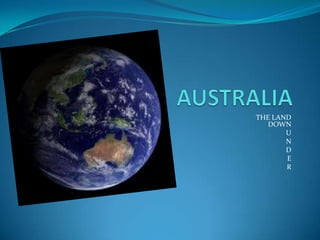
AUSTRALIATHE LAND DOWN UNDER
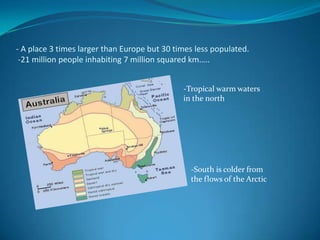
- A place 3 times larger than Europe but 30 times less populated. -21 million people inhabiting 7 million squared km…..-Tropical warm waters in the north-South is colder from the flows of the Arctic
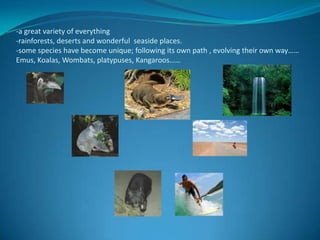
-a great variety of everything-rainforests, deserts and wonderful  seaside places.-some species have become unique; following its own path , evolving their own way…… Emus, Koalas, Wombats, platypuses, Kangaroos……
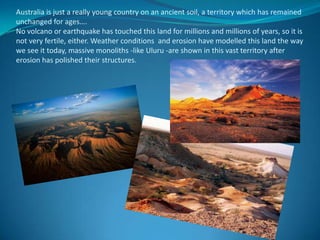
Australia is just a really young country on an ancient soil, a territory which has remained unchanged for ages…. No volcano or earthquake has touched this land for millions and millions of years, so it is not very fertile, either. Weather conditions  and erosion have modelled this land the way we see it today, massive monoliths -like Uluru -are shown in this vast territory after erosion has polished their structures.
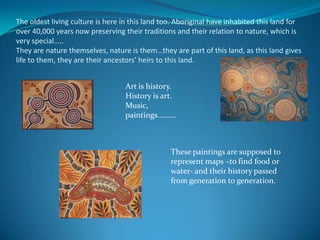
The oldest living culture is here in this land too. Aboriginal have inhabited this land for over 40,000 years now preserving their traditions and their relation to nature, which is very special….. They are nature themselves, nature is them…they are part of this land, as this land gives life to them, they are their ancestors’ heirs to this land.Art is history. History is art.Music,  paintings……….These paintings are supposed to represent maps –to find food or water- and their history passed from generation to generation.
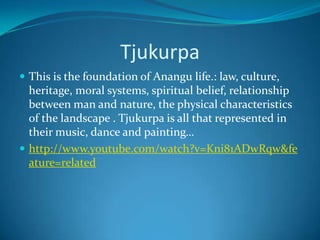
TjukurpaThis is the foundation of Anangu life.: law, culture, heritage, moral systems, spiritual belief, relationship between man and nature, the physical characteristics of the landscape . Tjukurpa is all that represented in their music, dance and painting…http://www.youtube.com/watch?v=Kni81ADwRqw&feature=related
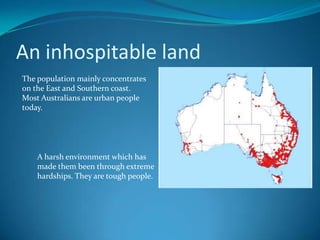
An inhospitable landThe population mainly concentrates on the East and Southern coast. Most Australians are urban people today. A harsh environment which has made them been through extreme hardships. They are tough people.
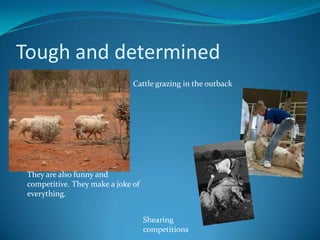
Tough and determinedCattle grazing in the outbackThey are also funny and competitive. They make a joke of everything.Shearing competitions
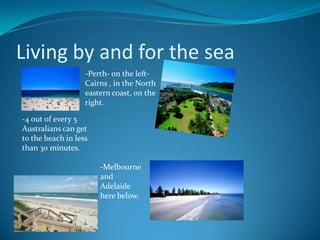
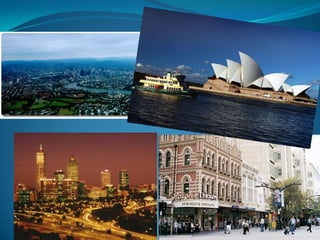
Living by and for the sea-Perth- on the left-Cairns , in the North eastern coast, on theright.-4 out of every 5 Australians can get to the beach in less than 30 minutes.-Melbourne and  Adelaide here below.
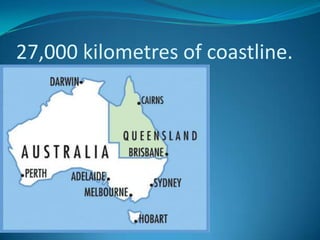
27,000 kilometres of coastline.
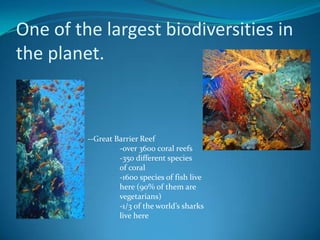
One of the largest biodiversities in the planet.--Great Barrier Reef-over 3600 coral reefs-350 different species 	of coral-1600 species of fish live 	here (90% of them are 	vegetarians)-1/3 of the world’s sharks 	live here
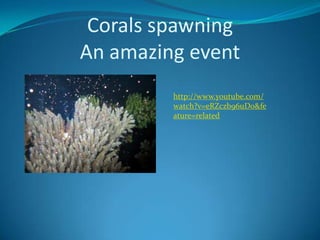
Corals spawningAn amazing eventhttp://www.youtube.com/watch?v=eRZczb96uDo&feature=related
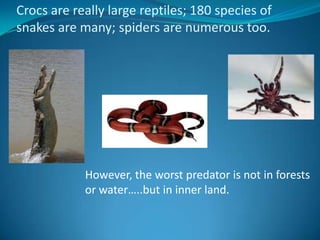
Crocs are reallylarge reptiles; 180 species of snakes are many; spiders are numeroustoo. However, the worst predator is not in forestsor water…..but in inner land.
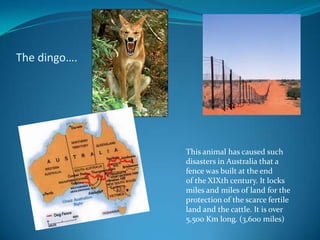
The dingo….This animal has caused such disasters in Australia that a fence was built at the end of the XIXth century. It locks miles and miles of land for the protection of the scarce fertile land and the cattle. It is over 5,500 Km long. (3,600 miles)
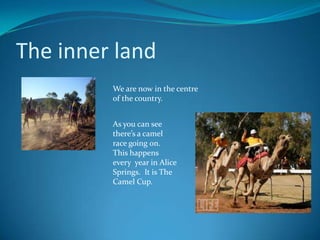
The inner land We are now in the centre of the country.  As you can see there’s a camel race going on. This happens every  year in Alice Springs.  It is The Camel Cup.
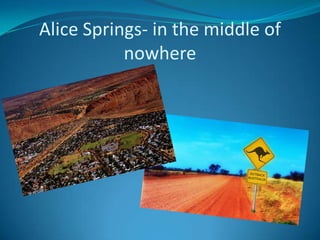
Alice Springs- in the middle of nowhere
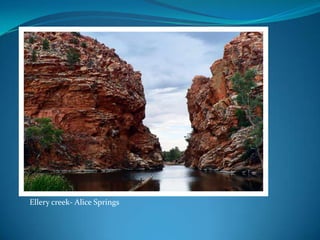
Ellery creek- Alice Springs
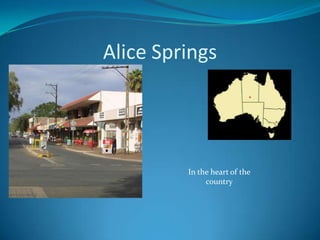
Alice Springs  In the heart of the country
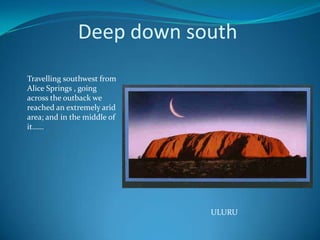
Deep down southTravelling southwest from Alice Springs , going across the outback we reached an extremely arid area; and in the middle of it……ULURU
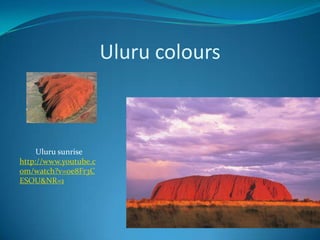
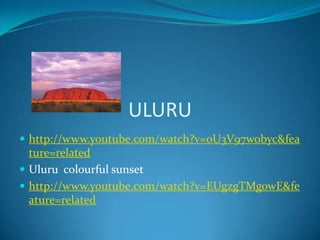
Uluru colours         Uluru sunrise  http://www.youtube.com/watch?v=0e8Fr3CESOU&NR=1
ULURUhttp://www.youtube.com/watch?v=0U3V97wobyc&feature=relatedUluru  colourful sunsethttp://www.youtube.com/watch?v=EUgzgTMgowE&feature=related
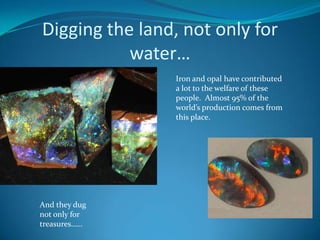
Digging the land, not only for water…Iron and opal have contributed a lot to the welfare of these people.  Almost 95% of the world’s production comes from this place.And they dug not only for treasures……
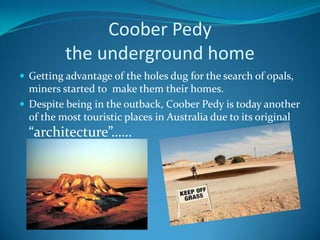
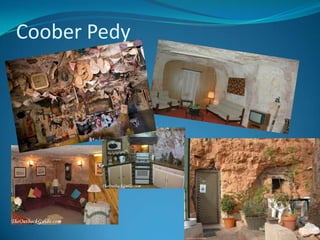
Coober Pedythe underground homeGetting advantage of the holes dug for the search of opals, miners started to  make them their homes. Despite being in the outback, Coober Pedy is today another of the most touristic places in Australia due to its original “architecture”……
Coober Pedy
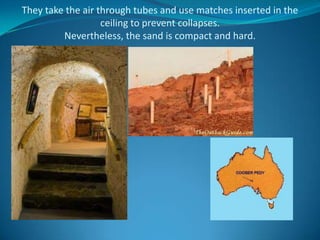
They take the air through tubes and use matches inserted in the ceiling to prevent collapses.Nevertheless, the sand is compact and hard.
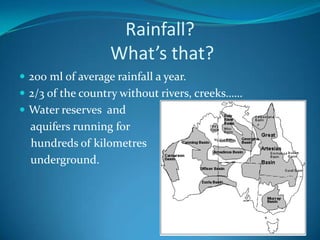
Rainfall? What’s that?200 ml of average rainfall a year.2/3 of the country without rivers, creeks……Water reserves  and     aquifers running for     hundreds of kilometres     underground.
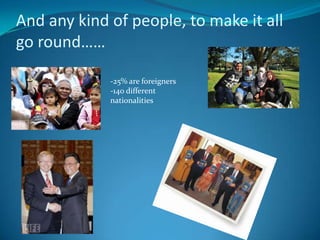
And any kind of people, to make it all go round……-25% are foreigners-140 different nationalities
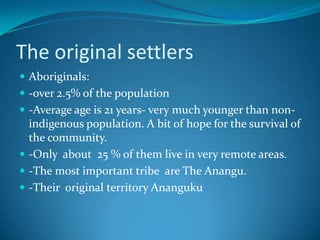
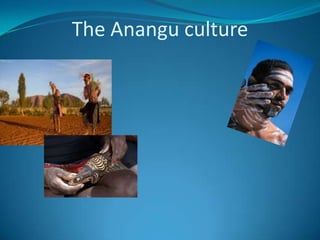
The original settlersAboriginals:-over 2.5% of the population-Average age is 21 years- very much younger than non-indigenous population. A bit of hope for the survival of the community.-Only  about  25 % of them live in very remote areas.-The most important tribe  are The Anangu.-Their  original territory Ananguku
The Anangu culture
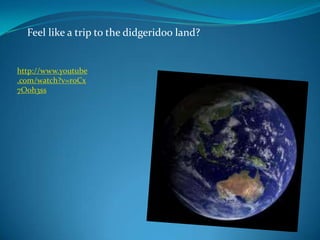
Feel like a trip to the didgeridoo land?http://www.youtube.com/watch?v=r0Cx7Ooh3ss

Australia-The land down under

  • 1.
  • 2.
    - A place3 times larger than Europe but 30 times less populated. -21 million people inhabiting 7 million squared km…..-Tropical warm waters in the north-South is colder from the flows of the Arctic
  • 3.
    -a great varietyof everything-rainforests, deserts and wonderful seaside places.-some species have become unique; following its own path , evolving their own way…… Emus, Koalas, Wombats, platypuses, Kangaroos……
  • 4.
    Australia is justa really young country on an ancient soil, a territory which has remained unchanged for ages…. No volcano or earthquake has touched this land for millions and millions of years, so it is not very fertile, either. Weather conditions and erosion have modelled this land the way we see it today, massive monoliths -like Uluru -are shown in this vast territory after erosion has polished their structures.
  • 5.
    The oldest livingculture is here in this land too. Aboriginal have inhabited this land for over 40,000 years now preserving their traditions and their relation to nature, which is very special….. They are nature themselves, nature is them…they are part of this land, as this land gives life to them, they are their ancestors’ heirs to this land.Art is history. History is art.Music, paintings……….These paintings are supposed to represent maps –to find food or water- and their history passed from generation to generation.
  • 6.
    TjukurpaThis is thefoundation of Anangu life.: law, culture, heritage, moral systems, spiritual belief, relationship between man and nature, the physical characteristics of the landscape . Tjukurpa is all that represented in their music, dance and painting…http://www.youtube.com/watch?v=Kni81ADwRqw&feature=related
  • 7.
    An inhospitable landThepopulation mainly concentrates on the East and Southern coast. Most Australians are urban people today. A harsh environment which has made them been through extreme hardships. They are tough people.
  • 8.
    Tough and determinedCattlegrazing in the outbackThey are also funny and competitive. They make a joke of everything.Shearing competitions
  • 9.
    Living by andfor the sea-Perth- on the left-Cairns , in the North eastern coast, on theright.-4 out of every 5 Australians can get to the beach in less than 30 minutes.-Melbourne and Adelaide here below.
  • 10.
  • 11.
    One of thelargest biodiversities in the planet.--Great Barrier Reef-over 3600 coral reefs-350 different species of coral-1600 species of fish live here (90% of them are vegetarians)-1/3 of the world’s sharks live here
  • 12.
    Corals spawningAn amazingeventhttp://www.youtube.com/watch?v=eRZczb96uDo&feature=related
  • 13.
    Crocs are reallylargereptiles; 180 species of snakes are many; spiders are numeroustoo. However, the worst predator is not in forestsor water…..but in inner land.
  • 14.
    The dingo….This animalhas caused such disasters in Australia that a fence was built at the end of the XIXth century. It locks miles and miles of land for the protection of the scarce fertile land and the cattle. It is over 5,500 Km long. (3,600 miles)
  • 15.
    The inner landWe are now in the centre of the country. As you can see there’s a camel race going on. This happens every year in Alice Springs. It is The Camel Cup.
  • 16.
    Alice Springs- inthe middle of nowhere
  • 17.
  • 18.
    Alice Springs In the heart of the country
  • 19.
    Deep down southTravellingsouthwest from Alice Springs , going across the outback we reached an extremely arid area; and in the middle of it……ULURU
  • 20.
    Uluru colours Uluru sunrise http://www.youtube.com/watch?v=0e8Fr3CESOU&NR=1
  • 21.
    ULURUhttp://www.youtube.com/watch?v=0U3V97wobyc&feature=relatedUluru colourfulsunsethttp://www.youtube.com/watch?v=EUgzgTMgowE&feature=related
  • 22.
    Digging the land,not only for water…Iron and opal have contributed a lot to the welfare of these people. Almost 95% of the world’s production comes from this place.And they dug not only for treasures……
  • 23.
    Coober Pedythe undergroundhomeGetting advantage of the holes dug for the search of opals, miners started to make them their homes. Despite being in the outback, Coober Pedy is today another of the most touristic places in Australia due to its original “architecture”……
  • 24.
  • 25.
    They take theair through tubes and use matches inserted in the ceiling to prevent collapses.Nevertheless, the sand is compact and hard.
  • 26.
    Rainfall? What’s that?200ml of average rainfall a year.2/3 of the country without rivers, creeks……Water reserves and aquifers running for hundreds of kilometres underground.
  • 27.
    And any kindof people, to make it all go round……-25% are foreigners-140 different nationalities
  • 28.
    The original settlersAboriginals:-over2.5% of the population-Average age is 21 years- very much younger than non-indigenous population. A bit of hope for the survival of the community.-Only about 25 % of them live in very remote areas.-The most important tribe are The Anangu.-Their original territory Ananguku
  • 29.
  • 31.
    Feel like atrip to the didgeridoo land?http://www.youtube.com/watch?v=r0Cx7Ooh3ss