Australia
Goal 14
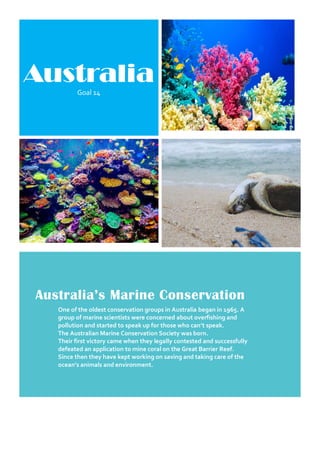
Australia’s Marine Conservation
One of the oldest conservation groups in Australia began in 1965. A
group of marine scientists were concerned about overfishing and
pollution and started to speak up for those who can’t speak.
The Australian Marine Conservation Society was born.
Their first victory came when they legally contested and successfully
defeated an application to mine coral on the Great Barrier Reef.
Since then they have kept working on saving and taking care of the
ocean’s animals and environment.
Australia’s goals and possible steps to take
Goals
Australia has different international marine conservation engagements that aspire to take care of the underwater
wildlife and the state of the oceans. Some of these are: Engagement in regional fora, the Secretariat of the Pacific
Regional environment Programme(SPREP), Pacific Ocean Litter Project, The Coral Triangle Initiative for Coral
Reefs, Fisheries and Food Security (CTI-CFF), Enchancing Pacific Ocean Governance (EPOG), International action to
protect whales, Agreements for protecting migratory species ….
Possible steps to take
Big goals are achieved by small steps. To take care of the oceans and
the planet, we need to do in our day to day lives whatever we are
capable of to keep our environment clean: volunteer in cleaning the
beaches, throwing rubbish to the bin and never to the floor, recycling,
using the products we buy for a long time and not throw it away but
find a better use for them, stop compulsive buying, avoid buying
products that use lots of plastic, get informed, buy from companies that
take care of the planet. Let’s take care of the planet, starting with our own city.
Role in the SDG’s creation
Australia’s national interest were ensured in 2015-2016. The
Department of Foreign Affairs and Trade was active in the
securing of standalone sustainable development goals for
gender equality, economic growth and peace and good
governance (the 5th, the 8th and the 16th). By doing this, it
helped strengthening the existing international frameworks,
such as the Convention on the Elimination of all Forms of Discrimination Against Women.
In order to co-ordinate Australia’s domestic and international efforts to advance the goals for 2030, the government
formed the IDC (Interdepartamental Committee)
The responsibility for each goals has an Australian Government agency and each department is responsible for
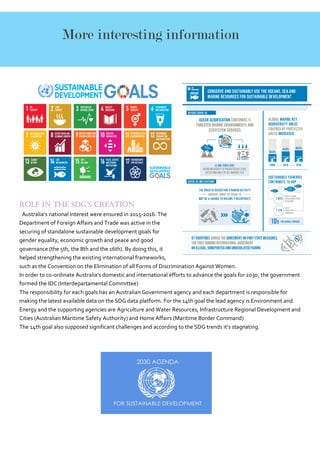
making the latest available data on the SDG data platform. For the 14th goal the lead agency is Environment and
Energy and the supporting agencies are Agriculture and Water Resources, Infrastructure Regional Development and
Cities (Australian Maritime Safety Authority) and Home Affairs (Maritime Border Command)
The 14th goal also supposed significant challenges and according to the SDG trends it’s stagnating.
More interesting information

Australia’s Marine Conservation

  • 1.
    Australia Goal 14 Australia’s MarineConservation One of the oldest conservation groups in Australia began in 1965. A group of marine scientists were concerned about overfishing and pollution and started to speak up for those who can’t speak. The Australian Marine Conservation Society was born. Their first victory came when they legally contested and successfully defeated an application to mine coral on the Great Barrier Reef. Since then they have kept working on saving and taking care of the ocean’s animals and environment.
  • 2.
    Australia’s goals andpossible steps to take Goals Australia has different international marine conservation engagements that aspire to take care of the underwater wildlife and the state of the oceans. Some of these are: Engagement in regional fora, the Secretariat of the Pacific Regional environment Programme(SPREP), Pacific Ocean Litter Project, The Coral Triangle Initiative for Coral Reefs, Fisheries and Food Security (CTI-CFF), Enchancing Pacific Ocean Governance (EPOG), International action to protect whales, Agreements for protecting migratory species …. Possible steps to take Big goals are achieved by small steps. To take care of the oceans and the planet, we need to do in our day to day lives whatever we are capable of to keep our environment clean: volunteer in cleaning the beaches, throwing rubbish to the bin and never to the floor, recycling, using the products we buy for a long time and not throw it away but find a better use for them, stop compulsive buying, avoid buying products that use lots of plastic, get informed, buy from companies that take care of the planet. Let’s take care of the planet, starting with our own city.
  • 3.
    Role in theSDG’s creation Australia’s national interest were ensured in 2015-2016. The Department of Foreign Affairs and Trade was active in the securing of standalone sustainable development goals for gender equality, economic growth and peace and good governance (the 5th, the 8th and the 16th). By doing this, it helped strengthening the existing international frameworks, such as the Convention on the Elimination of all Forms of Discrimination Against Women. In order to co-ordinate Australia’s domestic and international efforts to advance the goals for 2030, the government formed the IDC (Interdepartamental Committee) The responsibility for each goals has an Australian Government agency and each department is responsible for making the latest available data on the SDG data platform. For the 14th goal the lead agency is Environment and Energy and the supporting agencies are Agriculture and Water Resources, Infrastructure Regional Development and Cities (Australian Maritime Safety Authority) and Home Affairs (Maritime Border Command) The 14th goal also supposed significant challenges and according to the SDG trends it’s stagnating. More interesting information