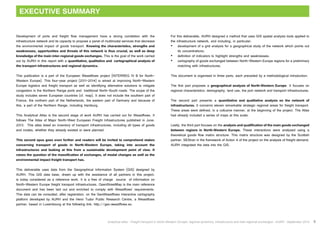
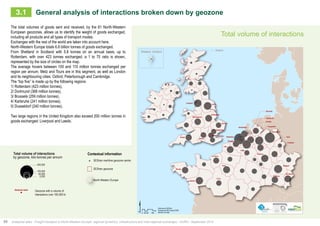
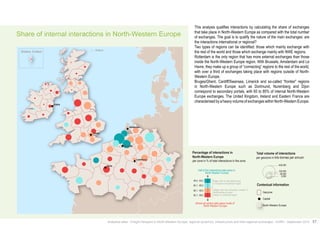
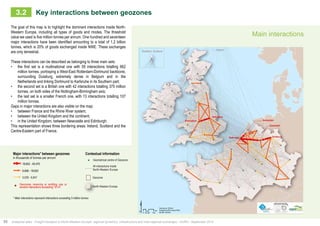
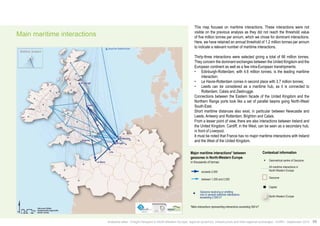
ANALYTICAL ATLAS Freight transport 
in North-Western Europe: 
regional dynamics, 
infrastructure and 
inter-regional exchanges 
Weastflows project - Action 1 - Deliverable 2 - September 2014
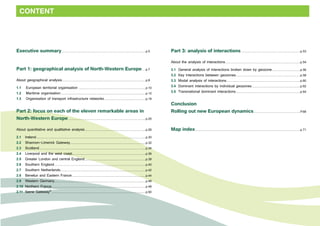
CONTENT 
Executive summary....................................................................................................p.5 
Part 1: geographical analysis of North-Western Europe.....p.7 
About geographical analysis....................................................................................................p.8 
1.1 European territorial organisation ...............................................................................p.10 
1.2 Maritime organisation.....................................................................................................p.12 
1.3 Organisation of transport infrastructure networks..................................................p.18 
Part 2: focus on each of the eleven remarkable areas in 
North-Western Europe.............................................................................................p.25 
About quantitative and qualitative analysis.........................................................................p.26 
2.1 Ireland..................................................................................................................................p.30 
2.2 Shannon-Limerick Gateway..........................................................................................p.32 
2.3 Scotland...............................................................................................................................p.34 
2.4 Liverpool and the west coast........................................................................................p.36 
2.5 Greater London and central England.........................................................................p.38 
2.6 Southern England.............................................................................................................p.40 
2.7 Southern Netherlands......................................................................................................p.42 
2.8 Benelux and Eastern France........................................................................................p.44 
2.9 Western Germany............................................................................................................p.46 
2.10 Northern France................................................................................................................p.48 
2.11 Seine Gateway®................................................................................................................p.50 
Part 3: analysis of interactions.......................................................................p.53 
About the analysis of interactions..........................................................................................p.54 
3.1 General analysis of interactions broken down by geozone..................................p.56 
3.2 Key interactions between geozones.............................................................................p.58 
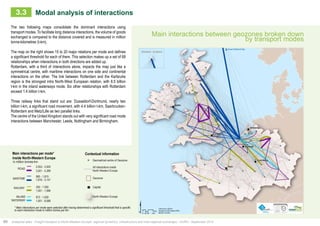
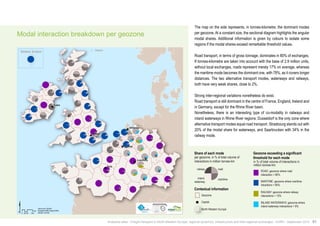
3.3 Modal analysis of interactions........................................................................................p.60 
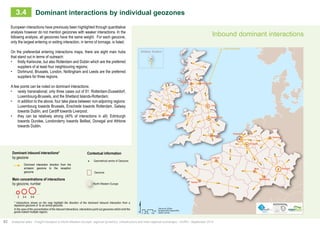
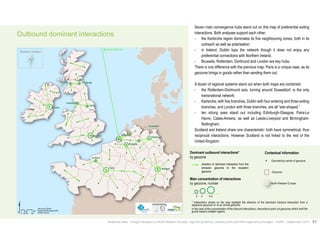
3.4 Dominant interactions by individual geozones..........................................................p.62 
3.5 Transnational dominant interactions.............................................................................p.64 
Conclusion 
Rolling out new European dynamics........................................................p.68 
Map index.............................................................................................................................p.71
North-Western Europe 
NORWAY 
Münster 
DENMARK 
Dortmund 
NETERLANDS 
Antwerp Dusseldorf 
Köln 
Den Haag 
Lille 
Shetland, Scotland Shetland 
Dundee 
UNITED 
KINGDOM 
Edinburgh 
Newcastle upon Tyne 
Sheffield 
Cambridge 
Chelmsford 
Canterbury 
Dunkerque 
Amiens 
Paris 
Glasgow 
Belfast 
Aberdeen 
Sunderland 
Armagh 
Carlisle 
Lancaster 
Dublin Leeds 
Salford 
Birmingham 
Wolverhampton 
Hereford 
Bristol 
London 
Amsterdam 
Brussel 
Kassel 
GERMANY 
Frankfurt am Main 
SWEDEN 
Nürnberg 
Mannheim 
Stuttgart 
Gent 
BELGIUM 
Charleroi 
LUXEMBOURG 
Dijon 
Reims 
Liège 
Portsmouth 
Caen 
Angers 
Southampton 
Rennes 
Nantes 
Swansea 
Augsburg 
Le Havre 
Cardiff 
Plymouth 
Luxembourg 
Saarbrücken 
Strasbourg 
Freiburg im Breisgau 
Metz 
Galway 
Limerick 
Cork 
Rouen 
Le Mans 
Tours 
Brest 
Nancy 
Orléans 
Mulhouse 
Besançon 
IRELAND 
FRANCE 
Cities 
between 45,038 and 
145,000 inhabitants 
between 145,001 and 
450,000 inhabitants 
between 450,001 and 
1,000,000 inhabitants 
over 1 million inhabitants 
Contextual information 
North-Western Europe 
Other European 
countries 
$ 
Data source powered by AURH 
Boudaries ©MBR and EuroGeographics,©ESRI 
Km 
Map data © OpenStreetMap contributors, ODbl 
®AURH -2013/06 4 Analytical atlas - Freight transport in North-Western Europe: regional dynamics, infrastructure and inter-regional exchanges - AURH - September 2014 
AUSTRIA 
ITALY 
UNITED 
KINGDOM 
SWITZERLAND 
NORTH SEA 
ATLANTIC 
OCEAN 
ENGLISH CHANNEL 
ATLANTIC 
OCEAN 
0 25 50 100 
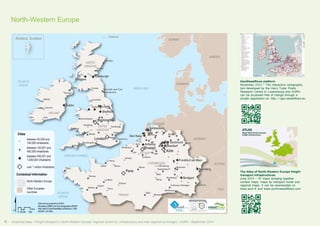
GeoWeastflows platform 
November 2013 - The interactive cartography 
tool developed by the Henri Tudor Public 
Research Centre in Luxembourg and AURH 
can be accessed free of charge through a 
simple registration at: http://geo.weastflows.eu 
ATLAS Major North-West European 
freight infrastructures 
Weastflows project - Action 1 - Deliverable 1 - June 2013 
The Atlas of North-Western Europe freight 
transport infrastructures 
June 2013 - 47 maps bringing together 
context maps, maps by transport mode and 
regional maps. It can be downloaded on 
www.aurh.fr and www.aurhinweastflows.com
Development of ports and freight flow management have a strong correlation with the 
infrastructure network and its capacity to propose a panel of multimodal services that decrease 
the environmental impact of goods transport. Knowing the characteristics, strengths and 
weaknesses, opportunities and threats of this network is thus crucial, as well as deep 
knowledge of the main inter-regional goods exchanges. This is the goal of the work carried 
out by AURH in this report with a quantitative, qualitative and cartographical analysis of 
the transport infrastructures and regional dynamics. 
This publication is a part of the European Weastflows project (INTERREG IV B for North- 
Western Europe). This four-year project (2011-2014) is aimed at improving North-Western 
Europe logistics and freight transport as well as identifying alternative solutions to mitigate 
congestion in the Northern Range ports and traditional North-South roads. The scope of the 
study includes seven European countries (cf. map). It does not include the southern part of 
France, the northern part of the Netherlands, the eastern part of Germany and because of 
this, a part of the Northern Range, including Hamburg. 
This Analytical Atlas is the second stage of work AURH has carried out for Weastflows. It 
follows The Atlas of Major North-West European Freight Infrastructures published in June, 
2013. This atlas listed an inventory of transport infrastructures, including all types of goods 
and modes, whether they already existed or were planned. 
This second opus goes even further and readers will be invited to comprehend stakes 
concerning transport of goods in North-Western Europe, taking into account the 
infrastructures and looking at this from a sustainable development point of view. It 
raises the question of the massification of exchanges, of modal changes as well as the 
environmental impact freight transport has. 
This deliverable uses data from the Geographical Information System (GIS) designed by 
AURH. This GIS data base, drawn up with the assistance of all partners in this project, 
is today considered as a reference work. It is a free of charge source of information on 
North-Western Europe freight transport infrastructures. OpenStreetMap is the main reference 
document and has been laid out and enriched to comply with Weastflows’ requirements. 
This data can be consulted, after registration, on the GeoWeastflows interactive cartography 
platform developed by AURH and the Henri Tudor Public Research Centre, a Weastflows 
partner, based in Luxembourg at the following link: http://geo.weastflows.eu 
For this deliverable, AURH designed a method that uses GIS spatial analysis tools applied to 
the infrastructure network, and including, in particular: 
• development of a grid analysis for a geographical study of the network which points out 
its concentrations; 
• definition of indicators to highlight strengths and weaknesses; 
• cartography of goods exchanged between North-Western Europe regions for a preliminary 
matching with infrastructures. 
This document is organised in three parts, each preceded by a methodological introduction. 
The first part proposes a geographical analysis of North-Western Europe. It focuses on 
regional characteristics: demography, land use, the port network and transport infrastructures. 
The second part presents a quantitative and qualitative analysis on the network of 
infrastructures. It concerns eleven remarkable strategic regional areas for freight transport. 
These areas were defined, in a collusive manner, at the beginning of the project. The Atlas 
had already included a series of maps at this scale. 
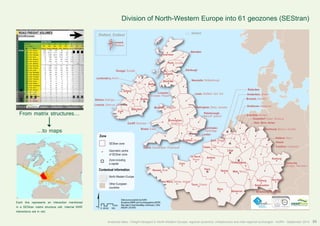
Lastly, the third part focuses on the analysis and qualification of the main goods exchanged 
between regions in North-Western Europe. These interactions were analysed using a 
theoretical goods flow matrix structure. This matrix structure was designed by the Scottish 
partner, SEStran in the framework of Action 4 of the project on the analysis of freight demand. 
AURH integrated the data into the GIS. 
Analytical atlas - Freight transport in North-Western Europe: regional dynamics, infrastructure and inter-regional exchanges - AURH - September 2014 5 
EXECUTIVE SUMMARY
Part 1 
Geographical analysis 
of North-Western Europe
About geographical analysis 
This geographical analysis provides keys allowing readers to better understand territorial and 
maritime stakes of freight transport. 
It includes three parts: 
• demographic and industrial densities; 
• port organisation; 
• transport infrastructures using the grid analysis method. 
Why use grid analysis? 
The European Union statistical system is based on a territorial division shared by the entire 
European Union called NUTS (Nomenclature of Territorial Units for Statistics). This reference 
system has three stages of division from NUTS 1 to NUTS 3. It is based on administrative 
divisions of member States correlated to population weight. Because of this, there are large 
divergences from one country to another, in particular in terms of area, which generates 
disequilibrium when comparing two zones between themselves. 
How does it work? 
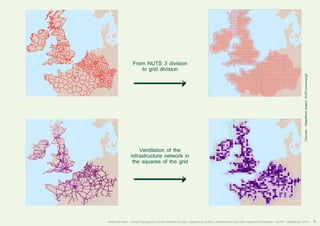
Knowing this, AURH has designed a specific grid variation that divides the North-West 
European area into 1,290 squares of 800 km2 each. This division is more precise than the 
NUTS reference system which divides the same area into 485 NUTS 3, with an average area 
of 1,650 km2. The size chosen corresponds to the area of the smallest German administration 
division, which is equivalent to districts or city districts. Each square then brings information 
stemming from crossing it with network infrastructures. 
The grid analysis method was developed for roads, railways and inland waterways as well as 
for nodal elements such as ports, railway terminals and airports: 
• the infrastructure density was measured for networks by including each square in the 
total length of the network ; 
• for nodal infrastructures (ports, railways terminal and airports), the density of infrastructures 
was measure by the total number of nodes in each square. 
By cross referencing this data, each square gives information indications on the accumulated 
lengths of intersected networks or the total number of nodal infrastrutures. In order to make 
the grid variation easier to read, a discretization of data into three classes was made, using 
the standard discretization method. Each class was qualified according to the following 
categorization: strong, average and weak for the infrastructure concentration level. 
Some squares can belong to no class at all, and thus give “absence of data” information. 
This can mean two things: 
• either there are no infrastructures at all, 
• or there are no infrastructures adapted to mass freight transport. 
Methodological interest of grid analysis 
With grid analysis, you can: 
• exceed limitations of administrative divisions or traditional statistics, 
• supply a homogeneous data repository in which each area can be compared objectively 
to the others, 
• cross reference data. 
What grid analysis shows 
Grid analysis methods, when applied to the analysis of transport infrastructures for each of 
the three modes inland waterways, and the associated nodal infrastructures (ports, railways 
terminal and airports) give a geographical analysis of freight transport infrastructures: 
• it highlights concentrated infrastructures, 
• it pre-identifies congested zones as well as sectors conducive to the development of 
intermodality, 
• it highlights the continuities and discontinuities of the network. 
The grid analysis method focuses on territorial divergences by highlighting network densities. 
8 Analytical atlas - Freight transport in North-Western Europe: regional dynamics, infrastructure and inter-regional exchanges - AURH - September 2014
Commentaires 
Fromto NgUridT Sd i3vi sdioivnision 
infraVsetrnutciltautrioen n oeft wthoerk in the squares of the grid 
(Sources : Weastflows project, AURH processing) 
Analytical atlas - Freight transport in North-Western Europe: regional dynamics, infrastructure and inter-regional exchanges - AURH - September 2014 9
" 
" 
" 
" 
" 
" 
" 
" 
" 
Warszawa 
" 
" 
" 
European territorial organisation 
$ 
Data source ©CorineLandCover2006; ©Powered by AURH 
Boudaries ©MBR and EuroGeographics,©ESRI 
Km 
Map data © OpenStreetMap contributors, ODbl 
®AURH -2013/06 0 50 100 200 
Areas with the 
highest densities 
Areas with the 
lowest densities 
" 
" 
" 
" 
" 
" 
" 
" 
Rome 
Paris 
Madrid 
Berlin 
London 
Brussels 
Wien 
Oslo 
Praha 
Zagreb 
Dublin 
Budapest 
Sarajevo 
Stockholm 
Kobenhavn 
Ljubljana 
Amsterdam 
Bratislava 
Luxembourg 
en nombre d’habitants par km² 
150 250 500 1 500 5 000 21 100 
2 50 
densités les plus faibles densités les plus fortes 
Capitales et villes européennes Dissymétrie 
Capitale européenne 
Ville de plus de 1 million d'habitants 
Éléments de contexte 
number of inhabitants per square kilometre 
lowest density highest density 
2 50 
European capitals and main cities Dissymmetry 
Capital city 
150 250 500 1 500 5 000 21 100 
City over 1 million of inhabitants 
Perimeter 
10 Analytical atlas - Freight transport in North-Western Europe: regional dynamics, infrastructure and inter-regional exchanges - AURH - September 2014 
Demographic dissymmetry 
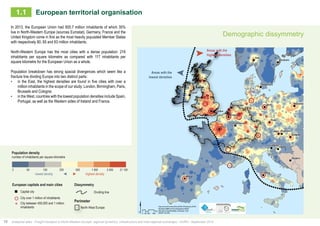
In 2013, the European Union had 505.7 million inhabitants of which 35% 
live in North-Western Europe (sources Eurostat). Germany, France and the 
United Kingdom come in first as the most heavily populated Member States 
with respectively 80, 65 and 63 million inhabitants. 
North-Western Europe has the most cities with a dense population: 216 
inhabitants per square kilometre as compared with 117 inhabitants per 
square kilometre for the European Union as a whole. 
Population breakdown has strong spacial divergences which seem like a 
fracture line dividing Europe into two distinct parts: 
• in the East, the highest densities are found in five cities with over a 
million inhabitants in the scope of our study: London, Birmingham, Paris, 
Brussels and Cologne; 
• in the West, countries with the lowest population densities include Spain, 
Portugal, as well as the Western sides of Ireland and France. 
Ligne de fracture 
Densité de population 
Ville entre 450 000 et 
1 million d'habitants 
Europe du Nord-Ouest 
Dividing line 
Population density 
City between 450,000 and 1 million 
inhabitants 
North-West Europe 
1.1
!( 
!( 
!( 
!( 
!( 
!( 
!( 
!( 
!( 
!( 
!( 
!( 
!( 
!( 
!( 
!( 
!( 
!( 
!( 
!( 
!( 
!( 
!(!( 
!( 
!( 
!( 
!( 
!( 
!( 
!( 
!( 
!( 
!( 
!( 
!( 
!( 
!( 
!( 
!( 
!( 
!( 
!( 
!( 
!( 
!( 
!( 
!( 
!( 
!( 
!( 
!( 
!( 
!( 
!( 
!( 
!( 
!( 
!( 
!( 
!( 
!( 
!( 
!( 
!( 
!( 
!( 
!( 
!( 
!( 
!( 
!( 
!( 
!( 
!( 
!( 
!( 
!( 
!( 
!( 
!( 
!( 
!( 
!( 
!( 
!( 
!( 
!( 
!( 
!( 
!( 
!( 
!( 
!( 
!( 
!( 
$ 
!( 
Data source ©CorineLandCover2006; ©Powered by AURH 
Boudaries ©MBR and EuroGeographics,©ESRI 
Map data © OpenStreetMap contributors, ODbl 
®AURH -2013/06 !( 
!( 
!( 
!( 
!( 
!( 
Warszawa 
!( 
!( 
" 
" 
" 
" 
" 
" 
" 
" 
" 
" 
" 
" 
" 
" 
" 
" 
" 
" 
" 
" 
Rome 
Paris 
Madrid 
Berlin 
London 
Brussels 
Wien 
Oslo 
Praha 
Zagreb 
Dublin 
Budapest 
Sarajevo 
Stockholm 
Kobenhavn 
Ljubljana 
Amsterdam 
Bratislava 
Luxembourg 
Km 
0 50 100 200 
Areas with the 
highest densities 
Areas with the 
lowest densities 
Densité industrielle 
surface en m² / 1 000m² dédiée à l’industrie 
5 7 12 20 43 175 
densités les plus faibles densités les plus fortes 
Volume total de marchandises 
chargées et déchargées 
Dissymétrie 
0 2 
Ligne de fracture 
Europe du Nord-Ouest NUTS 2 
maritimes 
en milliers de tonnes, par NUTS 2 
203 000 
!(!(!(!( 
Éléments de contexte 
Industrial density 
area in m² dedicated to industry 
5 7 12 20 43 175 
lowest density highest density 
Total volume of goods loaded 
and unloaded 
Dissymmetry 
0 2 
in thousands of tonnes per NUTS 2 area 
Perimeter 
Dividing line 
North-Western Europe !(!(!(!( 
Coastal NUTS 2 
area 
100 000 
60 000 
20 000 
11 000 
203,000 
100,000 
60,000 
20,000 
11,000 
Analytical atlas - Freight transport in North-Western Europe: regional dynamics, infrastructure and inter-regional exchanges - AURH - September 2014 11 
Industrial dissymmetry 
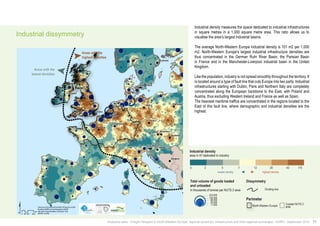
Industrial density measures the space dedicated to industrial infrastructures 
in square metres in a 1,000 square metre area. This ratio allows us to 
visualise the area’s largest industrial basins. 
The average North-Western Europe industrial density is 101 m2 per 1,000 
m2. North-Western Europe’s largest industrial infrastructure densities are 
thus concentrated in the German Ruhr River Basin, the Parisian Basin 
in France and in the Manchester-Liverpool industrial basin in the United 
Kingdom. 
Like the population, industry is not spread smoothly throughout the territory. It 
is located around a type of fault line that cuts Europe into two parts. Industrial 
infrastructures starting with Dublin, Paris and Northern Italy are completely 
concentrated along the European backbone to the East, with Poland and 
Austria, thus excluding Western Ireland and France as well as Spain. 
The heaviest maritime traffics are concentrated in the regions located to the 
East of this fault line, where demographic and industrial densities are the 
highest.
" 
Coastline of 
the British and Irish Isles 
$ 
Data source ©Eurostat 2010; ©Powered by AURH 
Boudaries ©MBR and EuroGeographics,©ESRI 
Km 
Map data © OpenStreetMap contributors, ODbl 
®AURH -2014/05 0 50 100 200 
Baltic Arc 
Mediterranean Arc 
Atlantic 
Coastline 
North Range 
Rome 
Paris 
Madrid 
Berlin 
London 
Brussels 
Wien 
Oslo 
Praha 
Zagreb 
Dublin 
Warszawa 
Budapest 
Sarajevo 
Stockholm 
Kobenhavn 
Ljubljana 
Amsterdam 
Bratislava 
Luxembourg 
" 
" 
" 
" 
" 
" 
" 
" 
" 
" 
" 
" 
" 
" 
" 
" 
" 
" 
" 
Maritime organisation 
1.2 
Range Nord 
Arc Baltique Arc Méditerranée 
Façade des Iles Britanniques 
Façade Atlantique 
North Range 
Baltic Arc Mediterranean Arc 
12 Analytical atlas - Freight transport in North-Western Europe: regional dynamics, infrastructure and inter-regional exchanges - AURH - September 2014 
European maritime facades 
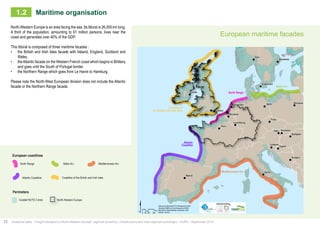
North-Western Europe is an area facing the sea. Its littoral is 26,000 km long. 
A third of the population, amounting to 61 million persons, lives near the 
coast and generates over 40% of the GDP. 
This littoral is composed of three maritime facades : 
• the British and Irish Isles facade with Ireland, England, Scotland and 
Wales, 
• the Atlantic facade on the Western French coast which begins in Brittany 
and goes until the South of Portugal border, 
• the Northern Range which goes from Le Havre to Hamburg. 
Please note the North-West European division does not include the Atlantic 
facade Façades or maritimes 
the Northern Range facade. 
Éléments de contexte 
NUTS 2 maritimes Europe du Nord-Ouest 
North-Western Europe 
European coastlines 
Perimeters 
Coastline of the British and Irish Isles 
Atlantic Coastline 
Coastal NUTS 2 area
$ 
Data source Eurostat - 2012 
Km 
Boudaries ©MBR and EuroGeographics,©ESRI 
®AURH -2014/05 0 25 50 100 
Amsterdam 
North Range 
900 Mt 
Atlantic 
Coastline 
29,8 Mt 
Coastline of 
the British and Irish Isles 
500 Mt 
Paris 
London 
Dublin 
Brussels 
Luxembourg 
Shetland, Scotland Shetland 
Trafic total de marchandises 
par principaux ports* 
en milliers de tonnes, en 2012 Range Nord 
Façades maritimes 
400 000 
100 000 
50 000 
10 000 
1 000 
Façade des Îles Britanniques 
Façade Atlantique 
Façade maritime 
500 Mt Trafic total en millions de tonnes par 
façade maritime 
*sélection des ports ayant un trafic supérieur à 
1 million de tonnes 
Éléments de contexte 
Europe du Nord-Ouest 
Capitale 
Total freight traffic 
by main ports* 
per thousand tonnes, in 2012 North Range 
Maritime coastlines 
400,000 
100,000 
50,000 
10,000 
1,000 
Coastline of the British and Irish Isles 
Atlantic coastline 
Maritime coastline 
500 Mt Total trafic in millions of tonnes per 
maritime coastline 
*selection of ports with a freight traffic 
over 1,000 thousand tonnes 
Contextual information 
North-Western Europe 
Capital city 
Analytical atlas - Freight transport in North-Western Europe: regional dynamics, infrastructure and inter-regional exchanges - AURH - September 2014 13 
Maritime port traffic 
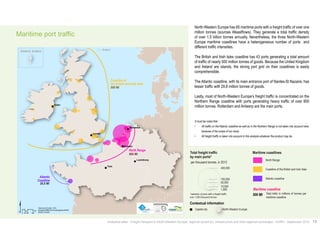
North-Western Europe has 65 maritime ports with a freight traffic of over one 
million tonnes (sources Weastflows). They generate a total traffic density 
of over 1.5 billion tonnes annually. Nevertheless, the three North-Western 
Europe maritime coastlines have a heterogeneous number of ports and 
different traffic intensities. 
The British and Irish Isles coastline has 43 ports generating a total amount 
of traffic of nearly 500 million tonnes of goods. Because the United Kingdom 
and Ireland are islands, the strong port grid on their coastlines is easily 
comprehensible. 
The Atlantic coastline, with its main entrance port of Nantes-St Nazaire, has 
lesser traffic with 29.8 million tonnes of goods. 
Lastly, most of North-Western Europe’s freight traffic is concentrated on the 
Northern Range coastline with ports generating heavy traffic of over 900 
million tonnes. Rotterdam and Antwerp are the main ports. 
It must be noted that : 
• All traffic on the Atlantic coastline as well as in the Northern Range is not taken into account here, 
because of the scope of our study. 
• All freight traffic is taken into account in this analysis whatever the product may be.
16th Edinburg (Leith) 
10th Tees and Hartlepool 
Total 1.2 billion tonnes 
= 62% of NWE traffic 
4th : Grimsby and Immingham 
! 
! ! 
! 
! 
! ! 
! 
! 
! 
! 
! 
! 
! 
! 
$ 
Data source : Eurostat - 2012 
Km 
Boudaries ©MBR and EuroGeographics,©ESRI 
®AURH -2014/05 0 25 50 100 
3rd : Amsterdam 
1st : Rotterdam 
2nd : Antwerpen 
5th : Le Havre 
20th Dublin 
11th Liverpool 
8th Milford Haven 
14th Felixstowe 
6th London 
9th Southampton 
19th Rouen 
15th Ghent 
16thDover 
13th Zeebrugge 
7th Dunkerque 
12th Nantes-St Nazaire 
17th 
Ijmuiden 
Shetland, Scotland Shetland 
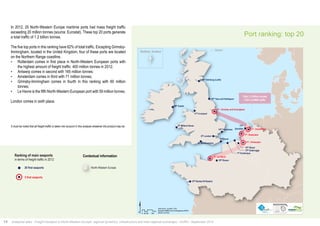
In 2012, 20 North-Western Europe maritime ports had mass freight traffic 
exceeding 20 million tonnes (source: Eurostat). These top 20 ports generate 
a total traffic of 1.2 billion tonnes. 
The five top ports in this ranking have 62% of total traffic. Excepting Grimsby- 
Immingham, located in the United Kingdom, four of these ports are located 
on the Northern Range coastline. 
• Rotterdam comes in first place in North-Western European ports with 
the highest amount of freight traffic: 400 million tonnes in 2012; 
• Antwerp comes in second with 165 million tonnes; 
• Amsterdam comes in third with 71 million tonnes; 
• Grimsby-Immingham comes in fourth in this ranking with 60 million 
tonnes; 
• Le Havre is the fifth North-Western European port with 59 million tonnes. 
London comes in sixth place. 
It must be noted that all freight traffic is taken into account in this analysis whatever the product may be. 
Ranking of main seaports 
in terms of freight traffic in 2012 
! 20 first seaports 
5 first seaports 
Élément de contexte 
Contextual information 
North-Western Europe 
Classement des ports maritimes 
d’après leur trafic de marchandises en 2012 
! 20 premiers ports 
5 premiers ports 
Europe du Nord-Ouest 
14 Analytical atlas - Freight transport in North-Western Europe: regional dynamics, infrastructure and inter-regional exchanges - AURH - September 2014 
Port ranking: top 20
Port ranking: top 5 per country 
2nd :Shannon Foynes 
Total 44 Mt 
= 89% of national traffic 
3rd : Milford Haven 
Southampton 
$ 
Data source Eurostat - 2012 
Km 
Boudaries ©MBR and EuroGeographics,©ESRI 
®AURH -2014/05 0 25 50 100 
5th: Tees and Hartlepool 
Total 216 Mt 
= 43% of national traffic 
1st : Grimsby and Immingham 
2nd : Port of London 
2nd :Dunkerque 
5th : Calais 
1st : Le Havre 
Total 167 Mt 
= 55% of national traffic 
1st : Rotterdam 
2nd : Amsterdam 
4th : Vlissigen 
Total 520 Mt 
= 96% of national traffic 
Total 1 Mt 
Total 223 Mt 
= 99% of national traffic 
4th : Rouen 
4th : 
3rd : Nantes Saint-Nazaire 
3rd : Cork 
1st : Dublin 
4th : 
Bantry Bay 
5th : 
Rosslare 
1st : Duisburg 
2nd : Krefeld 
4th : Andernach 
1st : Antwerpen 
2nd : Zeebrugge 
3rd : Ghent 
4th : Ostend 
5th : Liège 
3rd : Ijmuiden 
5th : Terneuzen 
3rd : Koeln 
5th :Wesel 
Shetland, Scotland Shetland 
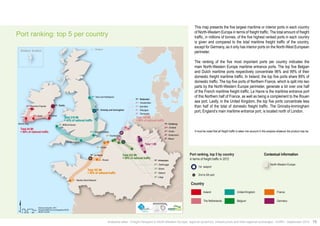
This map presents the five largest maritime or interior ports in each country 
of North-Western Europe in terms of freight traffic. The total amount of freight 
traffic, in millions of tonnes, of the five highest ranked ports in each country 
is given and compared to the total maritime freight traffic of the country, 
except for Germany, as it only has interior ports on the North-West European 
perimeter. 
The ranking of the five most important ports per country indicates the 
main North-Western Europe maritime entrance ports. The top five Belgian 
and Dutch maritime ports respectively concentrate 96% and 99% of their 
domestic freight maritime traffic. In Ireland, the top five ports share 89% of 
domestic traffic. The top five ports of Northern France, which is split into two 
parts by the North-Western Europe perimeter, generate a bit over one half 
of the French maritime freight traffic. Le Havre is the maritime entrance port 
of this Northern half of France, as well as being a complement to the Rouen 
sea port. Lastly, in the United Kingdom, the top five ports concentrate less 
than half of the total of domestic freight traffic. The Grimsby-Immingham 
port, England’s main maritime entrance port, is located north of London. 
Classement portuaire, top 5 par pays 
d’après leur trafic de marchandises en 2012 
1er port 
2ème au 5ème port 
Pays concernés par le classement 
Élément de contexte 
Europe du Nord-Ouest 
Irlande Royaume-Uni France 
Pays-Bas Belgique Allemagne 
It must be noted that all freight traffic is taken into account in this analysis whatever the product may be. 
Port ranking, top 5 by country Contextual information 
in terms of freight traffic in 2012 
North-Western Europe 
1st seaport 
2nd to 5th port 
Country 
Ireland United-Kingdom France 
The Netherlands Belgium Germany 
Analytical atlas - Freight transport in North-Western Europe: regional dynamics, infrastructure and inter-regional exchanges - AURH - September 2014 15
Shetland, Scotland 
Breakdown of import/export traffic 
1st : Edinburg (Leith) 
2nd : Tees and Hartlepool 
5th : Rouen 
4th : Glensanda 
1st : Rotterdam 
3rd :Amsterdam 
2nd :Antwerpen 
5th :Le Havre 
3rd : Sullom 
Voe 
4th : Londres 
$ 
Data source ©Ports Authority; ©Powered by AURH 
Boudaries ©MBR and EuroGeographics,©ESRI 
Km 
Map data © OpenStreetMap contributors, ODbl 
®AURH -2013/06 0 25 50 100 
Shetland 
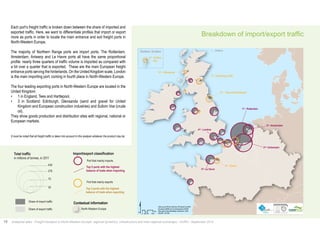
Each port’s freight traffic is broken down between the share of imported and 
exported traffic. Here, we want to differentiate profiles that import or export 
more as ports in order to locate the main entrance and exit freight ports in 
North-Western Europe. 
The majority of Northern Range ports are import ports. The Rotterdam, 
Amsterdam, Antwerp and Le Havre ports all have the same proportional 
profile: nearly three quarters of traffic volume is imported as compared with 
a bit over a quarter that is exported. These are the main European freight 
entrance ports serving the hinterlands. On the United Kingdom scale, London 
is the main importing port, coming in fourth place in North-Western Europe. 
Trafic total 
The en millions four leading de tonnes, exporting en 2011 
ports in North-Western Europe are located in the 
United Kingdom: 
• 1 in England, Tees and Hartlepool, 
• 3 in Scotland: Edinburgh, Glensanda (sand and gravel for United 
430 
276 
70 
30 
Kingdom and European construction industries) and Sullom Voe (crude 
oil). 
They show goods production and distribution sites with regional, national or 
European markets. 
Part du trafic dédié à l’import 
Part du trafic dédié à l’export 
Classification import/export 
Port majoritairement importateur 
Top 5 des ports ayant la balance 
commerciale à l’import 
la plus excédentaire 
Port majoritairement exportateur 
Top 5 des ports ayant la balance 
commerciale à l’export 
la plus excédentaire 
Élément de contexte 
It must be noted that all freight traffic is taken into account in this analysis whatever the product may be. 
Europe du Nord-Ouest 
Total traffic 
in millions of tonnes, in 2011 
Import/export classification 
430 
276 
70 
30 
Share of import traffic 
Share of export traffic 
Port that mainly imports 
Top 5 ports with the highest 
balance of trade when importing 
Port that mainly exports 
Top 5 ports with the highest 
balance of trade when exporting 
Contextual information 
North-Western Europe 
16 Analytical atlas - Freight transport in North-Western Europe: regional dynamics, infrastructure and inter-regional exchanges - AURH - September 2014
Port ranking per type of goods 
Milford Haven Amsterdam 
$ 
Data source ©ESPO, ©Autorités Portuaires 
Km 
Boudaries ©MBR and EuroGeographics,©ESRI 
®AURH -2014/05 0 25 50 100 
2 
1 1 1 
3 5 
2 3 5 
5 
4 
2 
1 
5 
3 
4 3 
2 
London 
Le Havre 
4 4 
Immingham 
Felixstowe 
Dover 
Rotterdam 
Zeebrugge 
Dunkerque 
Calais 
Antwerpen 
Shetland, Scotland Shetland 
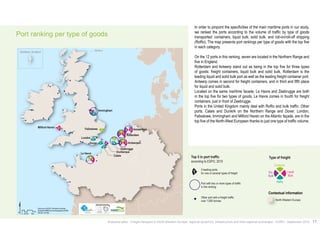
In order to pinpoint the specificities of the main maritime ports in our study, 
we ranked the ports according to the volume of traffic by type of goods 
transported: containers, liquid bulk, solid bulk, and roll-on/roll-off shipping 
(RoRo). The map presents port rankings per type of goods with the top five 
in each category. 
On the 12 ports in this ranking, seven are located in the Northern Range and 
five in England. 
Rotterdam and Antwerp stand out as being in the top five for three types 
of goods: freight containers, liquid bulk and solid bulk. Rotterdam is the 
leading liquid and solid bulk port as well as the leading freight container port. 
Antwerp comes in second for freight containers, and in third and fifth place 
for liquid and solid bulk. 
Located on the same maritime facade, Le Havre and Zeebrugge are both 
in the top five for two types of goods. Le Havre comes in fourth for freight 
containers, just in front of Zeebrugge. 
Ports in the United Kingdom mainly deal with RoRo and bulk traffic. Other 
ports, Calais and Dunkirk on the Northern Range and Dover, London, 
Felixstowe, Immingham and Milford Haven on the Atlantic façade, are in the 
top five of the North-West European thanks to just one type of traffic volume. 
Élément de contexte 
Contextual information 
North-Western Europe 
Top 5 des trafics portuaires 
d’après ESPO, 2010 
Port dans le Top 5 
pour 2 types de marchandises ou plus 
Top 5 in port traffic 
according to ESPO, 2010 
Type of freight 
Container 
Liquid 
Bulk 
Dry 
Bulk 
RoRo 
5 leading ports 
1 for one or several types of freight 
Port with two or more types of traffic 
in the ranking 
Other port with a freight traffic 
over 1,000 tonnes 
Catégories de 
marchandises 
Conteneur 
Vrac 
liquide 
Vrac 
solide 
RoRo 
5 premiers ports 
1 pour un ou plusieurs types de marchandises 
Autre port ayant un trafic 
supérieur à 1 million de tonnes 
Europe du Nord-Ouest 
Analytical atlas - Freight transport in North-Western Europe: regional dynamics, infrastructure and inter-regional exchanges - AURH - September 2014 17
1.3 Organisation of transport infrastructure networks 
Inland waterway network: grid analysis method 
$ Data sources: Weastflows project, 
Km 
powered by AURH 
®AURH - 2014/06 
0 25 50 100 
Manchester ship canal 
Thames 
Seine Valley 
Netherlands, Belgium 
and Rhine basin 
Loire 
Saône Valley 
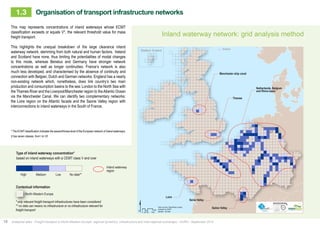
This map represents concentrations of inland waterways whose ECMT 
classification exceeds or equals V*, the relevant threshold value for mass 
freight transport. 
This highlights the unequal breakdown of the large clearance inland 
waterway network, stemming from both natural and human factors. Ireland 
and Scotland have none, thus limiting the potentialities of modal changes 
to this mode, whereas Benelux and Germany have stronger network 
concentrations as well as longer continuities. France’s network is also 
much less developed, and characterised by the absence of continuity and 
connection with Belgian, Dutch and German networks. England has a nearly 
non-existing network which, nonetheless, does link country’s two main 
production and consumption basins to the sea: London to the North Sea with 
the Thames River and the Liverpool/Manchester region to the Atlantic Ocean 
via the Manchester Canal. We can identify two complementary networks: 
the Loire region on the Atlantic facade and the Saone Valley region with 
interconnections to inland waterways in the South of France. 
Inland waterways concentration 
Type of inland waterway concentration* 
Total length of network per square 
based on inland waterways with a 
CEMT class V and over 
High Medium Low 
No data** 
Inland waterway regions 
Perimeter 
North-West Europe area 
*only are considered the relevant infrastructure 
for high level of freight transportation 
**no data can mean no infrastructures or 
no infrastructures relevant for high level of 
freight transportation 
Data sources: Weastflows project, 
powered by AURH 
Shetland, Scotland Shetland 
* The ECMT classification indicates the seaworthiness level of the European network of inland waterways. 
It has seven classes, from I to VII. 
Type of inland waterway concentration* 
based on inland waterways with a CEMT class V and over 
High Medium Low 
No data** 
Inland waterway 
region 
Contextual information 
North-Western Europe 
* only relevant freight transport infrastructures have been considered 
** no data can means no infrastructure or no infrastructure relevant for 
freight transport 
Concentration de voies navigables* 
18 Analytical atlas - Freight transport in North-Western Europe: regional dynamics, infrastructure and inter-regional exchanges - AURH - September 2014
Road network: grid analysis method 
$ Data sources: Weastflows project, 
Km 
®AURH 0 25 50 100 
powered by AURH 
- 2014/06 
North East of 
United Kingdom 
South of 
United Kingdom 
Seine Valley 
Benelux 
and Rhine basin 
South of 
Ireland 
Saône Valley 
Karlsruhe / 
Nuremberg axis 
Rhine Valley 
Belfast area 
square 
No data** 
infrastructure 
transportation 
infrastructures or 
level of 
Shetland, Scotland Shetland 
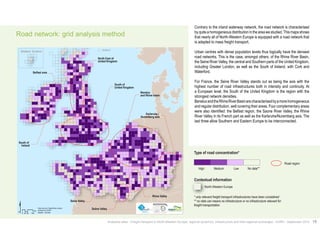
Contrary to the inland waterway network, the road network is characterised 
by quite a homogeneous distribution in the area we studied. This maps shows 
that nearly all of North-Western Europe is equipped with a road network that 
is adapted to mass freight transport. 
Urban centres with dense population levels thus logically have the densest 
road networks. This is the case, amongst others, of the Rhine River Basin, 
the Seine River Valley, the central and Southern parts of the United Kingdom, 
including Greater London, as well as the South of Ireland, with Cork and 
Waterford. 
For France, the Seine River Valley stands out as being the axis with the 
highest number of road infrastructures both in intensity and continuity. At 
a European level, the South of the United Kingdom is the region with the 
strongest network densities. 
Benelux and the Rhine River Basin are characterised by a more homogeneous 
and regular distribution, well covering their areas. Four complementary areas 
were also identified: the Belfast region, the Saone River Valley, the Rhine 
River Valley in its French part as well as the Karlsruhe/Nuremberg axis. The 
last three allow Southern and Eastern Europe to be interconnected. 
Type of road concentration* 
High Medium Low 
No data** 
Road region 
Contextual information 
North-Western Europe 
* only relevant freight transport infrastructures have been considered 
** no data can means no infrastructure or no infrastructure relevant for 
freight transportation 
Concentration de réseau routier* 
Analytical atlas - Freight transport in North-Western Europe: regional dynamics, infrastructure and inter-regional exchanges - AURH - September 2014 19
$ Data sources: Weastflows project, 
Km 
®AURH - 2014/06 0 25 50 100 
powered by AURH 
Railway network: grid analysis method 
Centre of United Kingdom 
London area 
Paris area 
Belgium 
Netherlands 
Duisburg and 
Rhine corridor 
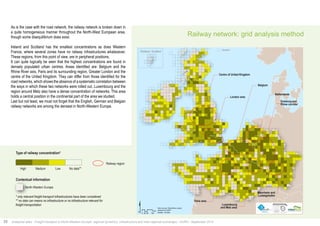
As is the case with the road network, the railway network is broken down in 
a quite homogeneous manner throughout the North-West European area, 
though some disequilibrium does exist. 
Ireland and Scotland has the smallest concentrations as does Western 
France, where several zones have no railway Railways infrastructures concentration 
whatsoever. 
These regions, from this point of view, are in peripheral positions. 
It can quite logically be seen that the highest Type concentrations of railway concentration* 
are found in 
densely populated urban centres. Areas identified Total length are: of network Belgium per square 
and the 
Rhine River axis, Paris and its surrounding region, Greater London and the 
centre of the United Kingdom. They can differ from those identified for the 
road networks, which shows the absence of a systematic correlation between 
the ways in which these two networks were rolled out. Luxembourg and the 
region around Metz also have a dense concentration of networks. This area 
holds a central position in the continental part of the area we studied. 
Last but not least, we must not forget that the English, German and Belgian 
railway networks are among the densest in North-Western Europe. 
High Medium Low 
No data** 
Railway regions 
Perimeter 
North-West Europe area 
*only are considered the relevant infrastructure 
for high level of freight transportation 
**no data can mean no infrastructures or 
no infrastructures relevant for high level of 
freight transportation 
Data sources: Weastflows project, 
powered by AURH 
Luxembourg 
and Metz area 
Mannheim and 
Ludwigshafen 
Shetland, Scotland Shetland 
Type of railway concentration* 
High Medium Low 
No data** 
Contextual information 
North-Western Europe 
* only relevant freight transport infrastructures have been considered 
** no data can means no infrastructure or no infrastructure relevant for 
freight transportation 
Concentration de réseau ferroviaire* 
Railway region 
20 Analytical atlas - Freight transport in North-Western Europe: regional dynamics, infrastructure and inter-regional exchanges - AURH - September 2014
Transport hubs: grid analysis method 
Bristol - Cardiff 
$ Km 
®AURH - 2014/06 
0 25 50 100 
Data sources: Weastflows project, 
powered by AURH 
Newcastle and Durham 
Manchester - Liverpool - Leeds axis 
London area 
Seine Valley 
Belgium, Netherlands 
and Rhine basin 
Luxembourg 
and Metz area 
Rhine 
Valley 
Glasgow - Edinburgh axis 
Shannon, Limerick 
and Cork 
Portsmouth and Southampton 
terminals 
No data** 
infrastructure 
transportation 
infrastructures or 
level of 
Shetland, Scotland Shetland 
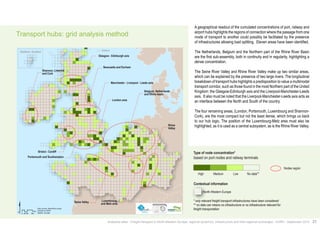
A geographical readout of the cumulated concentrations of port, railway and 
airport hubs highlights the regions of connection where the passage from one 
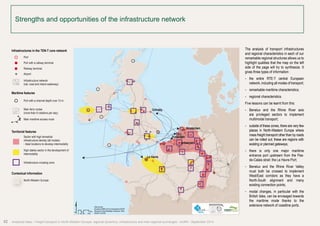
mode of transport to another could possibly be facilitated by the presence 
of infrastructures allowing load splitting. Eleven areas have been identified. 
The Netherlands, Belgium and the Northern part of the Rhine River Basin 
are the first sub-assembly, both in continuity and in regularity, highlighting a 
dense concentration. 
The Seine River Valley and Rhine River Valley make up two similar areas, 
which can be explained by the presence of two large rivers. The longitudinal 
breakdown of transport hubs highlights a predisposition to value a multimodal 
transport corridor, such as those found in the most Northern part of the United 
Kingdom: the Glasgow-Edinburgh axis and the Liverpool-Manchester-Leeds 
axis. It also must be noted that the Liverpool-Manchester-Leeds axis acts as 
an interface between the North and South of the country. 
The four remaining areas, (London, Portsmouth, Luxembourg and Shannon- 
Cork), are the most compact but not the least dense, which brings us back 
to our hub logic. The position of the Luxembourg-Metz area must also be 
highlighted, as it is used as a central subsystem, as is the Rhine River Valley. 
Type of node concentration* 
High No data** 
Contextual information 
North-Western Europe 
Concentration de noeuds* 
basée sur les ports et les terminaux ferroviaires 
Nodes region 
based on port nodes and railway terminals 
Medium Low 
* only relevant freight transport infrastructures have been considered 
** no data can means no infrastructure or no infrastructure relevant for 
freight transportation 
Analytical atlas - Freight transport in North-Western Europe: regional dynamics, infrastructure and inter-regional exchanges - AURH - September 2014 21
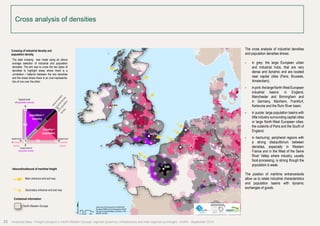
The cross analysis of industrial densities 
and population densities shows: 
• in grey: the large European urban 
and industrial hubs, that are very 
dense and dynamic and are located 
near capital cities (Paris, Brussels, 
Amsterdam); 
• in pink: the large North-West European 
industrial basins: in England, 
Manchester and Birmingham and 
in Germany, Manheim, Frankfurt, 
Karlsruhe and the Ruhr River basin; 
• in purple: large population basins with 
little industry surrounding capital cities 
or large North-West European cities: 
the outskirts of Paris and the South of 
England; 
• in hachuring: peripheral regions with 
a strong disequilibrium between 
densities, especially in Western 
France and in the West of the Seine 
River Valley where industry, usually 
food-processing, is strong though the 
population is weak. 
The position of maritime entrance/exits 
allow us to relate industrial characteristics 
and population basins with dynamic 
exchanges of goods. 
Paris 
London 
Dublin 
Amsterdam 
Brussels 
Luxembourg 
Cross analysis of densities 
Km 
0 25 50 100 
Data source ©CorineLandCover 2006/AURH 
Boudaries ©MBR and EuroGeographics,©ESRI 
Map data © OpenStreetMap contributors, ODbl 
®AURH -2013/06 
Crossing of industrial density and 
population density 
The data crossing was made using an above 
average selection of industrial and population 
densities. The aim was to cross the two types of 
densities to highlight areas where there is a 
correlation / balance between the two densities 
and the areas where there is an over-representa-tion 
balance betwen 
industrial density 
of one over the other. 
highest level 
of population density 
lowest level 
of industrial 
density 
population > 
industry 
+++ 
++ 
- ++ 
- 
lowest level of 
population density 
industry > 
population 
+++ 
Inbound/outbound of maritime freight 
Main entrance and exit way 
and population 
density 
highest level 
of industrial 
density 
Secondary entrance and exit way 
Contextual information 
North-Western Europe 
22 Analytical atlas - Freight transport in North-Western Europe: regional dynamics, infrastructure and inter-regional exchanges - AURH - September 2014
Cross analysis of infrastructure concentrations 
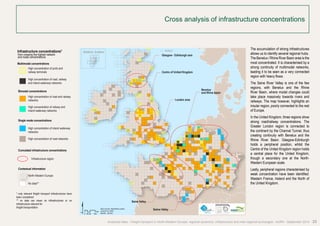
The accumulation of strong infrastructures 
allows us to identify several regional hubs. 
The Benelux / Rhine River Basin area is the 
most concentrated. It is characterised by a 
strong continuity of multimodal networks, 
leading it to be seen as a very connected 
region with heavy flows. 
The Seine River Valley is one of the few 
regions, with Benelux and the Rhine 
River Basin, where modal changes could 
take place massively towards rivers and 
railways. The map however, highlights an 
insular region, poorly connected to the rest 
of Europe. 
In the United Kingdom, three regions show 
strong road/railway concentrations. The 
Greater London region is connected to 
the continent by the Channel Tunnel, thus 
creating continuity with Benelux and the 
Rhine River Basin. Glasgow-Edinburgh 
holds a peripheral position, whilst the 
Centre of the United Kingdom region holds 
a central place for the United Kingdom, 
though a secondary one at the North- 
Western European scale. 
Lastly, peripheral regions characterised by 
weak concentration have been identified: 
Western France, Ireland and the North of 
the United Kingdom. 
d’infrastructures* Shetland, Scotland Shetland 
$ Data sources: Weastflows project, 
Km 
®AURH 0 25 50 100 
powered by AURH 
- 2014/06 
Centre of United Kingdom 
London area 
Seine Valley 
Benelux 
and Rhine basin 
Glasgow - Edinburgh axis 
Saône Valley 
concentrations 
noeuds 
routier, 
routier 
fluvial 
routier 
d’infrastructures 
transport 
transport 
pour cette 
n’y a pas 
d’infrastructure 
Infrastructure concentrations* 
from crossing the highest network 
and nodal concentrations 
Multimodal concentrations 
High concentration of ports and 
railway terminals 
High concentration of road, railway 
and inland waterway networks 
Bimodal concentrations 
High concentration of road and railway 
networks 
High concentration of railway and 
inland waterway networks 
Single mode concentrations 
High concentration of inland waterway 
networks 
High concentration of road networks 
Cumulated infrastructure concentrations 
Infrastructure region 
Contextual information 
North-Western Europe 
No data** 
* only relevant freight transport infrastructures have 
been considered 
** no data can mean no infrastructures or no 
infrastructure relevant for 
freight transportation 
Analytical atlas - Freight transport in North-Western Europe: regional dynamics, infrastructure and inter-regional exchanges - AURH - September 2014 23
Part 2 
Focus on each of the eleven 
remarkable areas 
in North-Western Europe
About quantitative and qualitative analysis 
Why use quantitative and qualitative analysis? 
Quantitative and qualitative analysis completes The Atlas of Major North-West European 
Freight Infrastructures which presented the state of the existing and upcoming freight transport 
network. It is based on a series of indicators that highlight: 
• strengths and weaknesses of the infrastructure network; 
• the potential the network has to be sustainable; 
• under-used potentials that could identify alternative routes instead of the traditional 
North/South routes. 
What geographical areas are concerned by this analysis? 
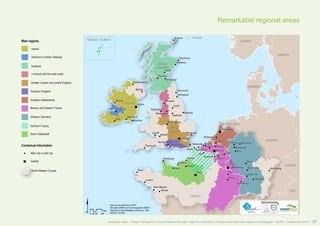
This analysis concerns eleven remarkable areas in North-Western Europe (NWE). They 
correspond to areas interesting Weastflows’ partners and highlight regions that are intense 
and/or strategic in the organisation of freight transport. For these reasons, some zones are 
not identified and thus are not included in a regional analysis (cf. map). 
What data was used? 
The analysis was carried out using data from the Geographical Information System built by 
AURH. Data included: road, railway and inland waterway networks, ferry routes, as well 
as remarkable hubs such as ports, railway terminals and airports. This basic data was 
then enriched with qualitative information such as population density, land use, port traffic, 
intermodality levels, projects of infrastructures and whether or not the network belonged to 
the strategic European network (TEN-T), thus allowing crossed analyses. 
How were the indicators defined? 
The indicators were defined through a dialogue with project partners in compliance with the 
following criteria: 
• their relevance in showing sustainability of the existing infrastructure network; 
• their capacity to ensure continuity with The Atlas of Major North-West European 
Freight Infrastructures; 
• the availability and accessibility of data in the Geographical Information System. 
What were the results? 
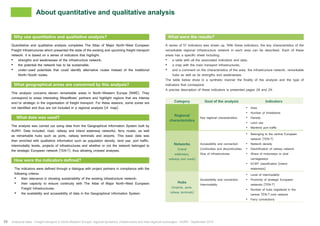
A series of 57 indicators was drawn up. With these indicators, the key characteristics of the 
remarkable regional infrastructure network in each area can be described. Each of these 
areas has a specific sheet including: 
• a table with all the associated indicators and data, 
• a map with the main transport infrastructures, 
• and a comment on the characteristics of the area, the infrastructure network, remarkable 
hubs as well as its strengths and weaknesses. 
The table below show in a synthetic manner the finality of the analysis and the type of 
indicators that correspond. 
A precise description of these indicators is presented pages 28 and 29. 
Category Goal of the analysis Indicators 
Regional 
characteristics Key regional characteristics 
26 Analytical atlas - Freight transport in North-Western Europe: regional dynamics, infrastructure and inter-regional exchanges - AURH - September 2014 
• Area 
• Number of inhabitants 
• Density 
• Land use 
• Maritime port traffic 
Networks 
(inland 
waterways, 
railways and roads) 
Accessibility and connection 
Continuities and discontinuities 
Size of infrastructures 
• Belonging to the central European 
network (TEN-T) 
• Network density 
• Electrification of railway network 
• Share of motorways or dual 
carriageways 
• ECMT classification (inland 
waterways) 
Hubs 
(Airports, ports, 
railway terminals) 
Accessibility and connection 
Intermodality 
• Level of intermodality 
• Proximity of strategic European 
networks (TEN-T) 
• Number of hubs registered in the 
central TEN-T core network 
• Ferry connections
Commentaires 
Remarkable regional areas 
NETHERLANDS 
Amsterdam 
NORWAY 
Oostende Brugge Dortmund 
Köln 
Karlsruhe 
Peterhead 
Londonderry 
Southampton 
Analytical atlas - Freight transport in North-Western Europe: regional dynamics, infrastructure and inter-regional exchanges - AURH - September 2014 27 
l’Angleterre 
Main regions 
Ireland 
Shannon-Limerick Gateway 
Scotland 
Liverpool and the west coast 
Greater London and central England 
Southern England 
Southern Netherlands 
Benelux and Eastern France 
Western Germany 
Northern France 
Seine Gateway® 
Contextual information 
Main city or port city 
Capital 
North-Western Europe 
Km 
0 25 50 100 
Data source powered by AURH 
Boudaries ©MBR and EuroGeographics,©ESRI 
Map data © OpenStreetMap contributors, ODbl 
®AURH -2013/06 
Paris 
London 
Dublin 
Brussel 
Luxembourg 
Metz 
Caen 
Cork 
Mainz 
Rouen 
Brest 
Nancy 
Leeds 
Dover 
Perth 
Essen 
Nantes 
Calais 
Dieppe 
Galway 
Lorient 
Glasgow 
Belfast 
Cardiff Bristol 
Grimsby 
Mannheim Nüremberg 
Duisburg 
Plymouth 
Kirkwall 
Limerick 
Aberdeen 
Stuttgart 
Edinburgh 
Sheffield 
Waterford 
Tynemouth 
Lancaster 
Liverpool 
Rotterdam 
Strasbourg 
Hartlepool 
Birmingham 
Portsmouth 
Felixstowe 
Manchester 
Rosslare 
Cherbourg 
Saint-Nazaire 
Le Havre 
Dunkerque 
Lille 
Charleroi Namur 
Liège 
Dusseldorf 
Gent Antwerp 
IRELAND 
FRANCE 
GERMANY 
BELGIUM 
UNITED 
KINGDOM 
LUXEMBOURG 
DENMARK 
SWEDEN 
AUSTRIA 
ITALY 
UNITED 
KINGDOM 
SWITZERLAND 
Shetland, Scotland ShetSlahnedtland
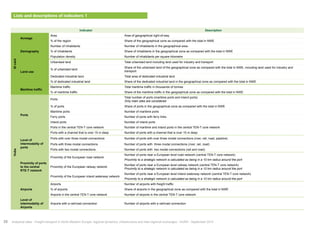
Lists and descriptions of indicators 1 
Indicator Description 
ID card 
Acreage 
Area Area of geographical right-of-way 
% of the region Share of the geographical zone as compared with the total in NWE 
Demography 
Number of inhabitants Number of inhabitants in the geographical area 
% of inhabitants Share of inhabitants in the geographical zone as compared with the total in NWE 
Population density Number of inhabitants per square kilometre 
Land use 
Urbanised land Total urbanised land including land used for industry and transport 
% of urbanised land Share of the urbanised land of the geographical zone as compared with the total in NWE, including land used for industry and 
transport 
Dedicated industrial land Total area of dedicated industrial land 
% of dedicated industrial land Share of the dedicated industrial land in the geographical zone as compared with the total in NWE 
Maritime traffic 
Maritime traffic Total maritime traffic in thousands of tonnes 
% of maritime traffic Share of the maritime traffic in the geographical zone as compared with the total in NWE 
Hubs 
Ports 
Ports Total number of ports (maritime ports and inland ports) 
Only main sites are considered 
% of ports Share of ports in the geographical zone as compared with the total in NWE 
Maritime ports Number of maritime ports 
Ferry ports Number of ports with ferry links 
Inland ports Number of inland ports 
Ports in the central TEN-T core network Number of maritime and inland ports in the central TEN-T core network 
Ports with a channel that is over 15 m deep Number of ports with a channel that is over 15 m deep 
Level of 
intermodality of 
ports 
Ports with over three modal connections Number of ports with over three modal connections (river, rail, road, pipeline) 
Ports with three modal connections Number of ports with three modal connections (river, rail, road) 
Ports with two modal connections Number of ports with two modal connections (rail and road) 
Proximity of ports 
to the central 
RTE-T network 
Proximity of the European road network 
Number of ports near a European level road network (central TEN-T core network) 
Proximity to a strategic network is calculated as being in a 10 km radius around the port 
Proximity of the European railway network Number of ports near a European level railway network (central TEN-T core network) 
Proximity to a strategic network is calculated as being in a 10 km radius around the port 
Proximity of the European inland waterway network 
Number of ports near a European level inland waterway network (central TEN-T core network) 
Proximity to a strategic network is calculated as being in a 10 km radius around the port 
Airports 
Airports Number of airports with freight traffic 
% of airports Share of airports in the geographical zone as compared with the total in NWE 
Airports in the central TEN-T core network Number of airports in the central TEN-T core network 
Level of 
intermodality of 
Airports 
Airports with a rail/road connection Number of airports with a rail/road connection 
28 Analytical atlas - Freight transport in North-Western Europe: regional dynamics, infrastructure and inter-regional exchanges - AURH - September 2014
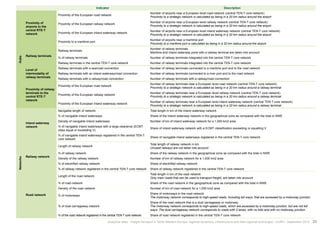
Indicator Description 
Analytical atlas - Freight transport in North-Western Europe: regional dynamics, infrastructure and inter-regional exchanges - AURH - September 2014 29 
Hubs 
Proximity of 
airports to the 
central RTE-T 
network 
Proximity of the European road network Number of airports near a European level road network (central TEN-T core network) 
Proximity to a strategic network is calculated as being in a 20 km radius around the airport 
Proximity of the European railway network Number of airports near a European level railway network (central TEN-T core network) 
Proximity to a strategic network is calculated as being in a 20 km radius around the airport 
Proximity of the European inland waterway network Number of airports near a European level inland waterway network (central TEN-T core network) 
Proximity to a strategic network is calculated as being in a 20 km radius around the airport 
Proximity to a maritime port Number of airports near a maritime port 
Proximity to a maritime port is calculated as being in a 20 km radius around the airport 
Railway terminals 
Railway terminals Number of railway terminals 
Maritime and inland waterway ports with a railway terminal are taken into account 
% of railway terminals Number of railway terminals integrated into the central TEN-T core network 
Railway terminals in the central TEN-T core network Number of railway terminals integrated into the central TEN-T core network 
Level of 
intermodality of 
railway terminals 
Railway terminals with a sea/road connection Number of railway terminals connected to a maritime port and to the road network 
Railway terminals with an inland waterway/road connection Number of railway terminals connected to a river port and to the road network 
Railway terminals with a railway/road connection Number of railway terminals with a railway/road connection 
Proximity of railway 
terminals to the 
central RTE-T 
network 
Proximity of the European road network Number of railway terminals near a European level road network (central TEN-T core network) 
Proximity to a strategic network is calculated as being in a 20 km radius around a railway terminal 
Proximity of the European railway network Number of railway terminals near a European level railway network (central TEN-T core network) 
Proximity to a strategic network is calculated as being in a 20 km radius around a railway terminal 
Proximity of the European inland waterway network Number of railway terminals near a European level inland waterway network (central TEN-T core network) 
Proximity to a strategic network is calculated as being in a 20 km radius around a railway terminal 
Networks 
Inland waterway 
network 
Navigable length of network Total length in km of the inland waterway network 
% of navigable inland waterways Share of the inland waterway network in the geographical zone as compared with the total in NWE 
Density of navigable inland waterways Number of km of inland waterway network for a 1,000 km2 area 
% of navigable inland waterways with a large clearance (ECMT 
class equal or exceeding V) Share of inland waterway network with a ECMT classification exceeding or equalling V 
% of navigable inland waterways registered in the central TEN-T 
core network Share of navigable inland waterways registered in the central TEN-T core network 
Railway network 
Length of railway network Total length of railway network in km 
Unused railways are not taken into account 
% of railway network Share of the railway network in the geographical zone as compared with the total in NWE 
Density of the railway network Number of km of railway network for a 1,000 km2 area 
% of electrified railway network Share of electrified railway network 
% of railway network registered in the central TEN-T core network Share of railway network registered in the central TEN-T core network 
Road network 
Length of the road network Total length in km of the road network 
Only main roads that can be used to transport freight, are taken into account 
% of road network Share of the road network in the geographical zone as compared with the total in NWE 
Density of the road network Number of km of road network for a 1,000 km2 area 
% of motorways Share of motorways in the road network 
The motorway network corresponds to high-speed roads, including toll ways, that are accessed by a motorway junction 
% of dual carriageway network 
Share of the road network that is a dual carriageway or motorway 
The motorway network corresponds to high-speed roads, which are accessed by a motorway junction, but are not toll 
ways. The dual carriageway network corresponds to roads with 2 lanes, with no tolls and with no motorway junction. 
% of the road network registered in the central TEN-T core network Share of road network registered in the central TEN-T core network
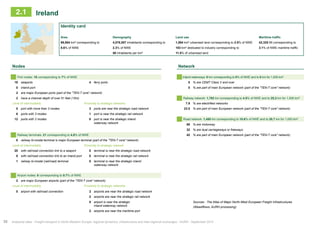
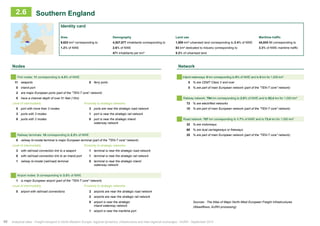
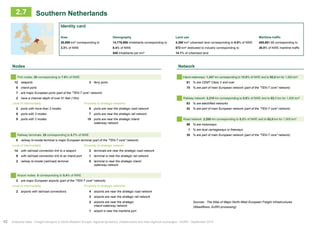
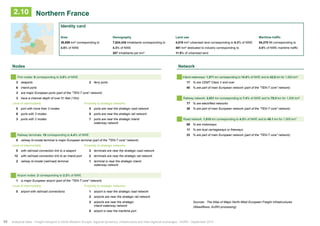
Identity card 
Area Demography Land use Maritime traffic 
69,884 km² corresponding to 4,076,557 inhabitants corresponding to 1,594 km² urbanised land corresponding to 2.5% of NWE 42,325 Mt corresponding to 
8.6% of NWE 2.3% of NWE 183 km² dedicated to industry corresponding to 3.1% of NWE maritime traffic 
58 inhabitants per km² 11.5% of urbanised land 
2.1 Ireland 
Nodes Network 
P ort nodes: 18 corresponding to 7% of NWE Inland waterways: 0 km corresponding to 0% of NWE and to 0 km for 1,000 km² 
18 seaports 4 ferry ports 0 % are CEMT Class V and over 
0 inland port 0 % are part of main European network (part of the ʺTEN-T coreʺ network) 
2 are major European ports (part of the ʺTEN-T coreʺ network) 
2 have a channel depth of over 51 feet (15m) Railway network: 1,762 km corresponding to 4.5% of NWE and to 25,2 km for 1,000 km² 
Level of intermodality Proximity to strategic networks 7.9 % are electrified networks 
0 port with more than 3 modes 3 ports are near the strategic road network 23.5 % are part of main European network (part of the ʺTEN-T coreʺ network) 
6 ports with 3 modes 1 port is near the strategic rail network 
12 ports with 2 modes 0 port is near the strategic inland Road network: 1,450 km corresponding to 10.6% of NWE and to 20,7 km for 1,000 km² 
waterway network 68 % are motorway 
32 % are dual carriageways or freeways 
Railway terminals: 21 corresponding to 4.8% of NWE 42 % are part of main European network (part of the ʺTEN-T coreʺ network) 
0 railway bi-modal terminal is major European terminal (part of the ʺTEN-T coreʺ network) 
Level of intermodality Proximity to strategic network 
20 with rail/road connection link to a seaport 0 terminal is near the strategic road network 
0 with rail/road connection link to an inland port 0 terminal is near the strategic rail network 
1 railway bi-modal (rail/road) terminal 0 terminal is near the strategic inland 
waterway network 
Airport nodes: 8 corresponding to 8.7% of NWE 
2 are major European airports (part of the ʺTEN-T coreʺ network) 
Level of intermodality Proximity to strategic networks 
0 airport with rail/road connection 2 airports are near the strategic road network 
2 airports are near the strategic rail network 
0 airport is near the strategic 
inland waterway network 
Sources : The Atlas of Major North-West European Freight Infrastructures 
(Weastflows, AURH processing) 
2 airports are near the maritime port 
30 Analytical atlas - Freight transport in North-Western Europe: regional dynamics, infrastructure and inter-regional exchanges - AURH - September 2014
! 
! 
! 
! 
! 
! 
" 
! 
Larne 
Galway 
Limerick 
Waterford 
Rosslare Harbour 
Londonderry 
Dublin 
Cork 
SShhaannnnoonn 
$0 10 20 40 
Km 
Data source powered by AURH & ©Voies Navigables de France; 
©European Commission, DG Move, TEN-Tec Information System; ©2012 National Geospatial Intelligence Agency 
©OpenStreetMap contributors, ODbl;Boudaries ©MBR and EuroGeographics,©ESRI 
Map data ©OpenStreetMap contributors, ODbl/ ®AURH -2014/05 
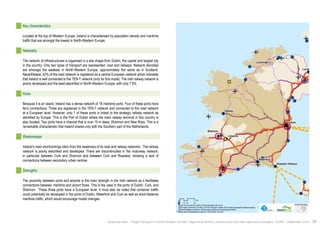
Key characteristics 
Located at the top of Western Europe, Ireland is characterised by population density and maritime 
traffic that are amongst the lowest in North-Western Europe. 
Networks 
The network of infrastructures is organised in a star shape from Dublin, the capital and largest city 
in the country. Only two types of transport are represented: road and railways. Network densities 
are amongst the weakest in North-Western Europe, approximately the same as in Scotland. 
Nevertheless, 42% of the road network is registered as a central European network which indicates 
that Ireland is well connected to the TEN-T network (only for this mode). The Irish railway network is 
poorly developed and the least electrified in North-Western Europe, with only 7.9%. 
Hubs 
Because it is an island, Ireland has a dense network of 18 maritime ports. Four of these ports have 
ferry connections; Three are registered in the TEN-T network and connected to the road network 
at a European level. However, only 1 of these ports is linked to the strategic railway network as 
identified by Europe. This is the Port of Dublin where the main railway terminal in this country is 
also located. Two ports have a channel that is over 15 m deep: Shannon and New Ross. This is a 
remarkable characteristic that Ireland shares only with the Southern part of the Netherlands. 
Weaknesses 
Ireland’s main shortcomings stem from the weakness of its road and railway networks. The railway 
network is poorly electrified and developed. There are discontinuities in the motorway network, 
in particular between Cork and Shannon and between Cork and Rosslare, showing a lack of 
connections between secondary urban centres. 
Strengths 
The proximity between ports and airports is the main strength in the Irish network as it facilitates 
connections between maritime and airport flows. This is the case in the ports of Dublin, Cork, and 
Shannon. These three ports have a European level. It must also be noted that container traffic 
could potentially be developed in the ports of Dublin, Waterford and Cork as well as short-distance 
maritime traffic, which would encourage modal changes. 
Analytical atlas - Freight transport in North-Western Europe: regional dynamics, infrastructure and inter-regional exchanges - AURH - September 2014 31
2.2 Shannon-Limerick Gateway 
Identity card 
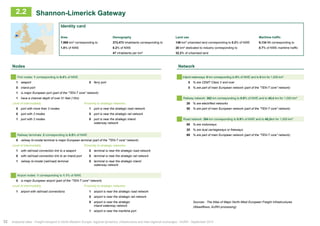
Area Demography Land use Maritime traffic 
7,968 km² corresponding to 373,473 inhabitants corresponding to 146 km² urbanised land corresponding to 0.2% of NWE 9,134 Mt corresponding to 
1.0% of NWE 0.2% of NWE 20 km² dedicated to industry corresponding to 0.7% of NWE maritime traffic 
47 inhabitants per km² 32.2% of urbanised land 
Nodes Network 
P ort nodes: 1 corresponding to 0.4% of NWE Inland waterways: 0 km corresponding to 0% of NWE and to 0 km for 1,000 km² 
1 seaport 0 ferry port 0 % are CEMT Class V and over 
0 inland port 0 % are part of main European network (part of the ʺTEN-T coreʺ network) 
1 is major European port (part of the ʺTEN-T coreʺ network) 
1 have a channel depth of over 51 feet (15m) Railway network: 362 km corresponding to 0.9% of NWE and to 45,4 km for 1,000 km² 
Level of intermodality Proximity to strategic networks 26 % are electrified networks 
0 port with more than 3 modes 1 port is near the strategic road network 50 % are part of main European network (part of the ʺTEN-T coreʺ network) 
0 port with 3 modes 0 port is near the strategic rail network 
1 port with 2 modes 0 port is near the strategic inland Road network: 384 km corresponding to 0.9% of NWE and to 48,2km for 1,000 km² 
waterway network 80 % are motorways 
20 % are dual carriageways or freeways 
Railway terminals: 2 corresponding to 0.5% of NWE 69 % are part of main European network (part of the ʺTEN-T coreʺ network) 
0 railway bi-modal terminal is major European terminal (part of the ʺTEN-T coreʺ network) 
Level of intermodality Proximity to strategic networks 
1 with rail/road connection link to a seaport 0 terminal is near the strategic road network 
0 with rail/road connection link to an inland port 0 terminal is near the strategic rail network 
1 railway bi-modal (rail/road) terminal 0 terminal is near the strategic inland 
waterway network 
Airport nodes: 1 corresponding to 1.1% of NWE 
0 is major European airport (part of the ʺTEN-T coreʺ network) 
Level of intermodality Proximity to strategic networks 
1 airport with rail/road connections 1 airport is near the strategic road network 
0 airport is near the strategic rail network 
0 airport is near the strategic 
inland waterway network 
Sources : The Atlas of Major North-West European Freight Infrastructures 
(Weastflows, AURH processing) 
1 airport is near the maritime port 
32 Analytical atlas - Freight transport in North-Western Europe: regional dynamics, infrastructure and inter-regional exchanges - AURH - September 2014
! 
! 
! 
Galway 
Limerick 
Cork 
Shannon 
$0 10 20 40 
Km 
Data source powered by AURH & ©Voies Navigables de France; 
©European Commission, DG Move, TEN-Tec Information System; ©2012 National Geospatial Intelligence Agency 
©OpenStreetMap contributors, ODbl;Boudaries ©MBR and EuroGeographics,©ESRI 
Map data ©OpenStreetMap contributors, ODbl/ ®AURH -2014/05 
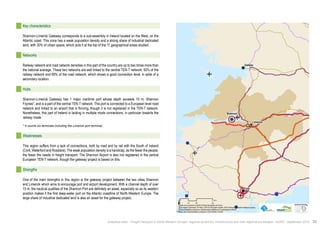
Key characteristics 
Shannon-Limerick Gateway corresponds to a sub-assembly in Ireland located on the West, on the 
Atlantic coast. This zone has a weak population density and a strong share of industrial dedicated 
land, with 30% of urban space, which puts it at the top of the 11 geographical areas studied. 
Networks 
Railway network and road network densities in this part of the country are up to two times more than 
the national average. These two networks are well linked to the central TEN-T network: 50% of the 
railway network and 69% of the road network, which shows a good connection level, in spite of a 
secondary location. 
Hubs 
Shannon-Limerick Gateway has 1 major maritime port whose depth exceeds 15 m, Shannon 
Foynes*, and is a part of the central TEN-T network. This port is connected to a European level road 
network and linked to an airport that is thriving, though it is not registered in the TEN-T network. 
Nonetheless, this part of Ireland is lacking in multiple mode connections, in particular towards the 
railway mode. 
* It counts six terminals including the Limerick port terminal. 
Weaknesses 
This region suffers from a lack of connections, both by road and by rail with the South of Ireland 
(Cork, Waterford and Rosslare). The weak population density is a handicap, as the fewer the people, 
the fewer the needs in freight transport. The Shannon Airport is also not registered in the central 
European TEN-T network, though the gateway project is based on this. 
Strengths 
One of the main strengths in this region is the gateway project between the two cities Shannon 
and Limerick which aims to encourage port and airport development. With a channel depth of over 
15 m, the nautical qualities of the Shannon Port are definitely an asset, especially so as its western 
position makes it the first deep-water port on the Atlantic coastline of North-Western Europe. The 
large share of industrial dedicated land is also an asset for the gateway project. 
Analytical atlas - Freight transport in North-Western Europe: regional dynamics, infrastructure and inter-regional exchanges - AURH - September 2014 33
2.3 Scotland 
Identity card 
Area Demography Land use Maritime traffic 
77,395 km² corresponding to 5,159,128 inhabitants corresponding to 2,067 km² urbanised land corresponding to 3.3% of NWE 30,295 Mt corresponding to 
9.5% of NWE 2.9% of NWE 328 km² dedicated to industry corresponding to 2.2% of NWE maritime traffic 
67 inhabitants per km² 15.8% of urbanised land 
Nodes Network 
P ort nodes: 35 corresponding to 13.6% of NWE Inland waterways: 0 km corresponding to 0% of NWE and to 0 km for 1,000 km² 
35 seaports 9 ferry ports 0 % are CEMT Class V and over 
0 inland port 0 % are part of main European network (part of the ʺTEN-T coreʺ network) 
2 are major European ports (part of the ʺTEN-T coreʺ network) 
1 have a channel depth of over 51 feet (15m) Railway network: 2,216 km corresponding to 5.6% of NWE and to 28,6 km for 1,000 km² 
Level of intermodality Proximity to strategic networks 20 % are electrified networks 
0 port with more than 3 modes 3 ports are near the strategic road network 25 % are part of main European network (part of the ʺTEN-T coreʺ network) 
7 ports with 3 modes 4 ports are near the strategic rail network 
28 ports with 2 modes 0 port is near the strategic inland Road network: 1,042 km corresponding to 2.5% of NWE and to 13,4 km for 1,000 km² 
waterway network 39 % are motorways 
61 % are dual carriageways or freeways 
Railway terminals: 52 corresponding to 11.9% of NWE 33 % are part of main European network (part of the ʺTEN-T coreʺ network) 
0 railway bi-modal terminal is major European terminal (part of the ʺTEN-T coreʺ network) 
Level of intermodality Proximity to strategic networks 
45 with rail/road connection link to a seaport 3 terminals are near the strategic road network 
0 with rail/road connection link to an inland port 5 terminals are near the strategic rail network 
7 railway bi-modal (rail/road) terminal 0 terminal is near the strategic inland 
waterway network 
Airport nodes: 14 corresponding to 15.2% of NWE 
2 are major European airports (part of the ʺTEN-T coreʺ network) 
Level of intermodality Proximity to strategic networks 
0 airport with rail/road connections 3 airports are near the strategic road network 
3 airports are near the strategic rail network 
0 airport is near the strategic 
inland waterway network 
Sources : The Atlas of Major North-West European Freight Infrastructures 
(Weastflows, AURH processing) 
2 airports are near the maritime port 
34 Analytical atlas - Freight transport in North-Western Europe: regional dynamics, infrastructure and inter-regional exchanges - AURH - September 2014
! 
! 
! 
! 
! 
! 
! 
! ! 
! 
Larne 
Perth 
Glasgow 
Aberdeen 
Edinburgh 
Peterhead 
Tynemouth 
Hartlepool 
Belfast 
Kirkwall 
$0 10 20 40 
Km 
Data source powered by AURH & ©Voies Navigables de France; 
©European Commission, DG Move, TEN-Tec Information System; ©2012 National Geospatial Intelligence Agency 
©OpenStreetMap contributors, ODbl;Boudaries ©MBR and EuroGeographics,©ESRI 
Map data ©OpenStreetMap contributors, ODbl/ ®AURH -2014/05 
Key characteristics 
Scotland, like Ireland, is located in the Northern part of North-Western Europe, and has a weak 
population density. Its population and industrial density are concentrated in the Glasgow-Edinburgh 
axis and on the East coast. 
Networks 
As is the case for the population, road and railway infrastructure networks are located on the 
Glasgow-Edinburgh East/West axis. Its road and railway networks are among the weakest in 
North-Western Europe. A mere 20% of the railway network is electrified. Nevertheless, this network 
offers good connections toward the United Kingdom’s economic centres of London, Birmingham, 
Manchester and Leeds. 
Hubs 
As is the case with Ireland, because it is an island, Scotland has a strong port network with 35 
ports identified. Many of them however, are small fishing ports or local ferry ports. Nine ports have 
European level ferry links. Scotland has a remarkable number of railway hubs, most of which are 
located in ports, which shows a potential for intermodality development in the railway mode. Glasgow 
and Edinburgh have the only port and airport infrastructures of the central European network. 
Weaknesses 
The network of infrastructures in the Northern part of the zone is the least developed. Consequently, 
it has not been identified in the TEN-T, even though there is heavy freight movement. For the railway 
network, Scotland suffers from capacity limited to the South of the United Kingdom, which impacts 
its connectivity with the rest of North-Western Europe. Lastly, in spite of a relatively large number 
of ports with ferry links, Scotland has very few connections of this type with other countries in the 
NWE zone. 
Strengths 
Strengths of the Scottish region include the existence of a relatively calm road network, as well 
as a large electrification programme on-going in strategic railway itineraries. There is a potential 
to expand short distance maritime links and encourage the development of intermodality both on 
railway and maritime modes. 
Analytical atlas - Freight transport in North-Western Europe: regional dynamics, infrastructure and inter-regional exchanges - AURH - September 2014 35
2.4 Liverpool and the west coast 
Identity card 
Area Demography Land use Maritime traffic 
14,180 km² corresponding to 6,886,010 inhabitants corresponding to 2,053 km² urbanised land corresponding to 9.1% of NWE 34,618 Mt corresponding to 
1.7% of NWE 3.9% of NWE 277 km² dedicated to industry corresponding to 2.6% of NWE maritime traffic 
486 inhabitants per km² 13% of urbanised land 
Nodes Network 
P ort nodes: 7 corresponding to 2.7% of NWE Inland waterways: 53 km corresponding to 0.5% of NWE and to 3,7 km for 1,000 km² 
7 seaports 2 ferry ports 100 % are CEMT Class V and over 
0 inland port 0 % are part of main European network (part of the ʺTEN-T coreʺ network) 
1 is major European port (part of the ʺTEN-T coreʺ network) 
0 have a channel depth of over 51 feet (15m) Railway network: 1 162 km corresponding to 3.0% of NWE and to 81,9 km for 1,000 km² 
Level of intermodality Proximity to strategic networks 39 % are electrified networks 
0 port with more than 3 modes 1 port is near the strategic road network 40 % are part of main European network (part of the ʺTEN-T coreʺ network) 
4 ports with 3 modes 2 ports are near the strategic rail network 
3 ports with 2 modes 0 port is near the strategic inland Road network: 863 km corresponding to 2.0% of NWE and to 60,8 km for 1,000 km² 
waterway network 78 % are motorways 
22 % are dual carriageways or freeways 
Railway terminals: 26 corresponding to 6.0% of NWE 49 % are part of main European network (part of the ʺTEN-T coreʺ network) 
0 railway bi-modal terminal is major European terminals (part of the ʺTEN-T coreʺ network) 
Level of intermodality Proximity to strategic network 
8 with rail/road connection link to a seaport 17 terminals are near the strategic road network 
0 with rail/road connection link to an inland port 17 terminals are near the strategic rail network 
18 railway bi-modal (rail/road) terminal 0 terminal is near the strategic inland 
waterway network 
Airport nodes: 4 corresponding to 4.3% of NWE 
1 is major European airport (part of the ʺTEN-T coreʺ network) 
Level of intermodality Proximity to strategic networks 
1 airport with rail/road connections 3 airports are near the strategic road network 
3 airports are near the strategic rail network 
0 airport is near the strategic 
inland waterway network 
Sources : The Atlas of Major North-West European Freight Infrastructures 
(Weastflows, AURH processing) 
1 airport is near the maritime port 
36 Analytical atlas - Freight transport in North-Western Europe: regional dynamics, infrastructure and inter-regional exchanges - AURH - September 2014
! 
! 
Bradford Leeds 
! 
! 
! 
! 
! 
Sheffield 
Lancaster 
Fleetwood 
Liverpool Manchester 
$0 10 20 40 
Km 
Data source powered by AURH & ©Voies Navigables de France; 
©European Commission, DG Move, TEN-Tec Information System; ©2012 National Geospatial Intelligence Agency 
©OpenStreetMap contributors, ODbl;Boudaries ©MBR and EuroGeographics,©ESRI 
Map data ©OpenStreetMap contributors, ODbl/ ®AURH -2014/05 
Key characteristics 
Located on the North-Western coast of England, the Liverpool/Manchester region is one of the 
most densely populated and most industrialised regions in North-Western Europe. It, however, has 
relatively weak maritime traffic density. This sector is concerned by a gateway project. 
Networks 
The transport infrastructure network has all 3 modes of land transport: roads, railways and inland 
waterways. At the scale of the British Isles, this is a remarkable achievement. The largest part of the 
infrastructure network is concentrated on a West/East axis between Liverpool and Manchester. A 
major railway axis linking Scotland to the South of England also goes through this region. Railway 
network densities are relatively high nonetheless and paradoxically, only a small part of the network 
is electrified. 
Hubs 
Four out of the 7 identified ports propose a tri-modal connection. Nevertheless, only 2 of them 
are located near a European level railway and road network: Liverpool and Lancaster. The ports 
propose many ferry connections with Ireland. The many ferry terminals are located near road and 
railways in the central TEN-T network. 
Weaknesses 
As like Scotland, the infrastructure network is limited because of the railway network which requires 
heavy investments to increase its capacity. Moreover, the small number of itineraries that link 
Liverpool and Manchester to Birmingham and London, the other English economic hubs, leads to 
congestion, also hampering the development of this zone. 
Strengths 
The main asset of these region is its gateway project, which aims to encourage use of the inland 
waterway mode for freight transport using the Manchester Ship Canal, which is currently underused. 
This project is justified by the zone’s western location, linked to the presence of the very large 
Liverpool Port and a dense population. This region can also count on a dense railway network 
which well serves the other urban centres in the country, leading to a potential in the development 
of multi-modal transport for freight. 
Analytical atlas - Freight transport in North-Western Europe: regional dynamics, infrastructure and inter-regional exchanges - AURH - September 2014 37
2.5 Greater London and central England 
Identity card 
Area Demography Land use Maritime traffic 
31,666 km² corresponding to 21,342,074 inhabitants corresponding to 5,766 km² urbanised land corresponding to 0% of NWE 116,762 Mt corresponding to 
3.9% of NWE 12.1% of NWE 619 km² dedicated to industry corresponding to 8.6% of NWE maritime traffic 
674 inhabitants per km² 10% of urbanised land 
Nodes Network 
P ort nodes: 14 corresponding to 5.4% of NWE Inland waterways: 63,6 km corresponding to 0.6% of NWE and to 2,0 km for 1,000 km² 
14 seaports 5 ferry ports 54.7 % are CEMT Class V and over 
0 inland port 0 % are part of main European network (part of the ʺTEN-T coreʺ network) 
3 are major European ports (part of the ʺTEN-T coreʺ network) 
1 have a channel depth of over 51 feet (15m) Railway network: 3,893 km corresponding to 9.9% of NWE and to 122,9 km for 1,000 km² 
Level of intermodality Proximity to strategic networks 53 % are electrified networks 
1 port with more than 3 modes 5 ports are near the strategic road network 32 % are part of main European network (part of the ʺTEN-T coreʺ network) 
5 ports with 3 modes 7 ports are near the strategic rail network 
8 ports with 2 modes 0 port is near the strategic inland Road network: 2,467 km corresponding to 5.8% of NWE and to 77,9 km for 1,000 km² 
waterway network 47 % are motorways 
53 % are dual carriageways or freeways 
Railway terminals: 26 corresponding to 6.0% of NWE 40 % are part of main European network (part of the ʺTEN-T coreʺ network) 
1 railway bi-modal terminal is major European terminal (part of the ʺTEN-T coreʺ network) 
Level of intermodality Proximity to strategic networks 
9 with rail/road connection link to a seaport 5 terminals are near the strategic road network 
0 with rail/road connection link to an inland port 8 terminals are near the strategic rail network 
18 railway bi-modal (rail/road) terminal 0 terminal is near the strategic inland 
waterway network 
Airport nodes: 7 corresponding to 7.6% of NWE 
5 are major European airports (part of the ʺTEN-T coreʺ network) 
Level of intermodality Proximity to strategic network 
2 airports with rail/road connections 3 airports are near the strategic road network 
3 airports are near the strategic rail network 
0 airport is near the strategic 
inland waterway network 
Sources : The Atlas of Major North-West European Freight Infrastructures 
(Weastflows, AURH processing) 
1 airport is near the maritime port 
38 Analytical atlas - Freight transport in North-Western Europe: regional dynamics, infrastructure and inter-regional exchanges - AURH - September 2014
! 
! 
! 
! 
! 
! 
! 
! 
! 
! 
! 
" 
Manchester 
! 
! 
! 
! 
Southampton 
! ! 
! 
Leeds 
Goole 
Barnet 
Ipswich 
Bristol 
Croydon 
Bradford 
Sheffield 
Birmingham 
Bournemouth 
Kingston upon Hull 
London 
Dover 
Newport 
Grimsby 
Liverpool 
Portsmouth 
$0 10 20 40 
Km 
Data source powered by AURH & ©Voies Navigables de France; 
©European Commission, DG Move, TEN-Tec Information System; ©2012 National Geospatial Intelligence Agency 
©OpenStreetMap contributors, ODbl;Boudaries ©MBR and EuroGeographics,©ESRI 
Map data ©OpenStreetMap contributors, ODbl/ ®AURH -2014/05 
Key characteristics 
Located in the South-Western part of the United Kingdom, this geographical area including Greater 
London and Central England up until Birmingham, is the country’s economic pulse. It concentrates 
the strongest population densities and comes in third place in North-Western Europe for maritime 
traffic. This region has an advanced gateway project: Thames Gateway. 
Networks 
Concerning transport infrastructures, this area is similar to that of Liverpool/Manchester in terms of 
density and characteristics of the network, with, for example, a navigable waterway. The Greater 
London and Central England railway network is nonetheless more compact and well developed, 
with over 50% of the network electrified. 
Hubs 
The Greater London and Central England region has a dense port network, with 14 ports, and 5 
of them offer ferry links. Three ports are a part of the central TEN-T network: London, Felixtowe 
and Dover. These ports globally have a good level of intermodality with at least 3 types of modal 
connections. Five of the 7 regional airports are a part of the central TEN-T network. This is quite 
high as compared to other regions we have studied. One airport, the London City Airport, is located 
near a strategic port. There is also a European level railway terminal located in Birmingham. 
Weaknesses 
The main weakness this zone has stems from the longitudinal organisation of its infrastructure 
network on only one axis linking London to Manchester/Liverpool, which goes through Birmingham. 
Moreover, the road network seems to be less developed than that of other regions, with a mere 47% 
of motorways. 
Strengths 
This part of England is well connected to the continent by the English Channel, which helps mitigate 
the effects of insularity by offering a regional continuity with Europe, numerous ferry connections, 
in particular with France, Germany and the Netherlands. The Thames Gateway project is also an 
asset to promote intermodality. 
Analytical atlas - Freight transport in North-Western Europe: regional dynamics, infrastructure and inter-regional exchanges - AURH - September 2014 39
2.6 Southern England 
Identity card 
Area Demography Land use Maritime traffic 
9,623 km² corresponding to 4,527,877 inhabitants corresponding to 1,500 km² urbanised land corresponding to 2.4% of NWE 44,934 Mt corresponding to 
1.2% of NWE 2.6% of NWE 83 km² dedicated to industry corresponding to 3.3% of NWE maritime traffic 
471 inhabitants per km² 5.3% of urbanised land 
Nodes Network 
P ort nodes: 11 corresponding to 4.3% of NWE Inland waterways: 0 km corresponding to 0% of NWE and to 0 km for 1,000 km² 
11 seaports 8 ferry ports 0 % are CEMT Class V and over 
0 inland port 0 % are part of main European network (part of the ʺTEN-T coreʺ network) 
2 are major European ports (part of the ʺTEN-T coreʺ network) 
0 have a channel depth of over 51 feet (15m) Railway network: 794 km corresponding to 2.0% of NWE and to 82,4 km for 1,000 km² 
Level of intermodality Proximity to strategic networks 72 % are electrified networks 
0 port with more than 3 modes 3 ports are near the strategic road network 10 % are part of main European network (part of the ʺTEN-T coreʺ network) 
3 ports with 3 modes 1 port is near the strategic rail network 
8 ports with 2 modes 0 port is near the strategic inland Road network: 707 km corresponding to 1.7% of NWE and to 73,4 km for 1,000 km² 
waterway network 32 % are motorways 
68 % are dual carriageways or freeways 
Railway terminals: 10 corresponding to 2.3% of NWE 25 % are part of main European network (part of the ʺTEN-T coreʺ network) 
0 railway bi-modal terminal is major European terminal (part of the ʺTEN-T coreʺ network) 
Level of intermodality Proximity to strategic networks 
3 with rail/road connection link to a seaport 1 terminal is near the strategic road network 
0 with rail/road connection link to an inland port 1 terminal is near the strategic rail network 
1 railway bi-modal (rail/road) terminal 0 terminal is near the strategic inland 
waterway network 
Airport nodes: 3 corresponding to 3.3% of NWE 
1 is major European airport (part of the ʺTEN-T coreʺ network) 
Level of intermodality Proximity to strategic networks 
0 airport with rail/road connections 2 airports are near the strategic road network 
2 airports are near the strategic rail network 
0 airport is near the strategic 
inland waterway network 
Sources : The Atlas of Major North-West European Freight Infrastructures 
(Weastflows, AURH processing) 
1 airport is near the maritime port 
40 Analytical atlas - Freight transport in North-Western Europe: regional dynamics, infrastructure and inter-regional exchanges - AURH - September 2014
Barnet 
! 
! 
" 
! 
Southampton 
! ! 
London 
Croydon 
Bournemouth 
Portsmouth 
$0 10 20 40 
Km 
Data source powered by AURH & ©Voies Navigables de France; 
©European Commission, DG Move, TEN-Tec Information System; ©2012 National Geospatial Intelligence Agency 
©OpenStreetMap contributors, ODbl;Boudaries ©MBR and EuroGeographics,©ESRI 
Map data ©OpenStreetMap contributors, ODbl/ ®AURH -2014/05 
Key characteristics 
Southern England, which includes the Portsmouth and Southampton ports, is located on the English 
Channel. This region can be characterised as under-represented in dedicated industrial zones, 
though its population density is one of the highest in North-Western Europe. 
Networks 
Its road and railway infrastructure network is one of the densest in North-Western Europe. It is 
organised in a star shape coming to and from London, which must be crossed when traveling to the 
North of the country. They railway network, with a 71% electrification rate, is the most developed 
one in the United Kingdom. Nevertheless, a mere 10% of it is connected to the central European 
network (25% of the road network). 
Hubs 
As is the case in other regions in the United Kingdom and Ireland, Southern England has many ports 
and 11 of them have been identified. Eight of them offer ferry links only to France. The intermodality 
level of these ports however, remains limited. Thus, 3 of them offer a railway connection but only 
one of them, Southampton, belongs to the TEN-T network. Three airports have been identified and 
2 of them are near a strategic railway network. 
Weaknesses 
The main weakness of this regional network concerns the poor integration of its infrastructure 
network into the central TEN-T network. Transport infrastructures, which all lead to London, are also 
a weakness, especially when traveling to the North of the country. 
Strengths 
Southern England has an interesting geostrategic position: near London, across from the Le Havre 
Port, one of the largest ports in North-Western Europe, and upstream from the Pas-de-Calais strait. 
This location allows it to play an important role in sourcing for the English capital, by developing in 
particular, short sea shipping. The railway network is well equipped and has a good potential for 
further development, especially as 3 ferry ports have a railway terminal: Portsmouth, Southampton 
and Newhaven. 
Analytical atlas - Freight transport in North-Western Europe: regional dynamics, infrastructure and inter-regional exchanges - AURH - September 2014 41
2.7 Southern Netherlands 
Identity card 
Area Demography Land use Maritime traffic 
26,899 km² corresponding to 14,776,966 inhabitants corresponding to 4,390 km² urbanised land corresponding to 6.9% of NWE 485,661 Mt corresponding to 
3.3% of NWE 8.4% of NWE 672 km² dedicated to industry corresponding to 36.0% of NWE maritime traffic 
549 inhabitants per km² 14.1% of urbanised land 
Nodes Network 
P ort nodes: 20 corresponding to 7.8% of NWE Inland waterways: 1,347 km corresponding to 12.0% of NWE and to 50,0 km for 1,000 km² 
12 seaports 3 ferry ports 81 % are CEMT Class V and over 
8 inland ports 75 % are part of main European network (part of the ʺTEN-T coreʺ network) 
7 are major European ports (part of the ʺTEN-T coreʺ network) 
2 have a channel depth of over 51 feet (15m) Railway network: 2,210 km corresponding to 5.6% of NWE and to 82,1 km for 1,000 km² 
Level of intermodality Proximity to strategic networks 83 % are electrified networks 
2 ports with more than 3 modes 8 ports are near the strategic road network 42 % are part of main European network (part of the ʺTEN-T coreʺ network) 
9 ports with 3 modes 7 ports are near the strategic rail network 
9 ports with 2 modes 15 ports are near the strategic inland Road network: 2,208 km corresponding to 5.2% of NWE and to 82,0 km for 1,000 km² 
waterway network 99 % are motorways 
1 % are dual carriageways or freeways 
Railway terminals: 25 corresponding to 5.7% of NWE 35 % are part of main European network (part of the ʺTEN-T coreʺ network) 
0 railway bi-modal terminal is major European terminal (part of the ʺTEN-T coreʺ network) 
Level of intermodality Proximity to strategic network 
14 with rail/road connection link to a seaport 2 terminals are near the strategic road network 
9 with rail/road connection link to an inland port 1 terminal is near the strategic rail network 
2 railway bi-modal (rail/road) terminal 0 terminal is near the strategic inland 
waterway network 
Airport nodes: 5 corresponding to 5.4% of NWE 
2 are major European airports (part of the ʺTEN-T coreʺ network) 
Level of intermodality Proximity to strategic networks 
2 airports with rail/road connections 4 airports are near the strategic road network 
3 airports are near the strategic rail network 
2 airports are near the strategic 
inland waterway network 
Sources : The Atlas of Major North-West European Freight Infrastructures 
(Weastflows, AURH processing) 
1 airport is near the maritime port 
42 Analytical atlas - Freight transport in North-Western Europe: regional dynamics, infrastructure and inter-regional exchanges - AURH - September 2014
Den Haag 
! 
" 
! 
! 
Antwerpen 
! 
! 
! 
! 
" 
! 
! 
! 
! 
! 
! 
Essen 
Liège 
Essen 
Brussel 
Amsterdam 
Köln 
Gent 
Namur 
Duisburg 
Rotterdam 
Terneuzen 
Charleroi 
Düsseldorf 
$0 10 20 40 
Km 
Data source powered by AURH & ©Voies Navigables de France; 
©European Commission, DG Move, TEN-Tec Information System; ©2012 National Geospatial Intelligence Agency 
©OpenStreetMap contributors, ODbl;Boudaries ©MBR and EuroGeographics,©ESRI 
Map data ©OpenStreetMap contributors, ODbl/ ®AURH -2014/05 
Key characteristics 
The Southern part of the Netherlands has an extremely dense population and intense maritime 
traffic corresponding to one third of the total North-Western Europe traffic. 
Networks 
Consequently, the infrastructure network, including railways, roads and inland waterways is one of 
the densest and most developed in all of North-Western Europe. Some remarkable characteristics 
include: 81% of the inland waterway network is adapted for mass freight transport, with an ECMT 
class equal to or exceeding V; 75% of this network is a part of the TEN-T central network. Over 80% 
of the railway network is electrified and the road network adapted to freight transport is exclusively 
a motorway network. 
Hubs 
The Southern part of the Netherlands has 12 maritime ports and 8 inland waterway ports. A third of 
these ports are in the central TEN-T network and 2 maritime ports have channels that are over 15 m 
deep: Rotterdam and Amsterdam. The majority of these ports proposes advanced intermodality 
solutions. Two of them have over 3 types of modal connections: Amsterdam and Rotterdam. 9 of 
them have 3. 
Weaknesses 
The risk of congestion, due to the intensity of maritime traffic correlated with a very dense population, 
with ever increasing needs in travellers and freight mobility, are potential weaknesses. There is also 
little leeway for further development of existing infrastructures. Moreover, ports in this region are 
located downstream from the Pas-de-Calais strait, a high-risk sector for maritime traffic because of 
the intensity of its traffic volume. 
Strengths 
Because of its multimodal transport infrastructures which are the most developed in North-Western 
Europe, the Southern Netherlands is the most favourable and most operational region in North- 
Western Europe for the development of intermodality. This region benefits from efficient connections 
with all of North-Western Europe, including the United Kingdom, through intense short distance 
maritime links. 
Analytical atlas - Freight transport in North-Western Europe: regional dynamics, infrastructure and inter-regional exchanges - AURH - September 2014 43
2.8 Benelux and Eastern France 
Identity card 
Area Demography Land use Maritime traffic 
105,747 km² corresponding to 17,562,943 inhabitants corresponding to 9,768 km² urbanised land corresponding to 15.4% of NWE 198,783 Mt corresponding to 
12.9% of NWE 10.0% of NWE 1,212 km² dedicated to industry corresponding to 14.7% of NWE maritime traffic 
166 inhabitants per km² 12.4% of urbanised land 
Nodes Network 
P ort nodes: 21 corresponding to 8.1% of NWE Inland waterways: 3,966 km corresponding to 36.0% of NWE and to 37,5 km for 1,000 km² 
3 seaports 2 ferry ports 39 % are CEMT Class V and over 
18 inland ports 55 % are part of main European network (part of the ʺTEN-T coreʺ network) 
11 are major European ports (part of the ʺTEN-T coreʺ network) 
0 have a channel depth of over 51 feet (15m) Railway network: 7,019 km corresponding to 17.8% of NWE and to 66,3 km for 1,000 km² 
Level of intermodality Proximity to strategic networks 72 % are electrified networks 
4 ports with more than 3 modes 17 ports are near the strategic road network 48 % are part of main European network (part of the ʺTEN-T coreʺ network) 
17 ports with 3 modes 17 ports are near the strategic rail network 
0 port with 2 modes 21 ports are near the strategic inland Road network: 4,503 km corresponding to 10.6% of NWE and to 45,5 km for 1,000 km² 
waterway network 82 % are motorways 
17 % are dual carriageways or freeways 
Railway terminals: 40 corresponding to 9.2% of NWE 44 % are part of main European network (part of the ʺTEN-T coreʺ network) 
1 railway bi-modal terminal is major European terminal (part of the ʺTEN-T coreʺ network) 
Level of intermodality Proximity to strategic networks 
3 with rail/road connection link to a seaport 7 terminals are near the strategic road network 
26 with rail/road connection link to an inland port 9 terminals are near the strategic rail network 
11 railway bi-modal (rail/road) terminal 7 terminals are near the strategic inland 
waterway network 
Airport nodes: 9 corresponding to 9.8% of NWE 
2 are major European airports (part of the ʺTEN-T coreʺ network) 
Level of intermodality Proximity to strategic network 
3 airports with rail/road connections 9 airports are near the strategic road network 
8 airports are near the strategic rail network 
5 airports are near the strategic 
inland waterway network 
Sources : The Atlas of Major North-West European Freight Infrastructures 
(Weastflows, AURH processing) 
2 airports are near the maritime port 
44 Analytical atlas - Freight transport in North-Western Europe: regional dynamics, infrastructure and inter-regional exchanges - AURH - September 2014
Duisburg Dortmund Oostende 
Dunkerque 
" 
! 
! 
" 
! 
! 
! 
! 
! 
! 
! 
! 
! 
! 
" 
! 
! 
! 
! 
! 
! 
! 
! 
! 
! 
! 
! 
Luxembourg 
Nancy 
Liège 
Essen 
Zürich 
Paris 
Brussel Köln 
Metz 
Gent 
Mainz 
Lille 
Namur 
Calais 
Brugge 
Terneuzen 
Charleroi 
Antwerpen Düsseldorf 
Strasbourg 
$0 10 20 40 
Km 
Data source powered by AURH & ©Voies Navigables de France; 
©European Commission, DG Move, TEN-Tec Information System; ©2012 National Geospatial Intelligence Agency 
©OpenStreetMap contributors, ODbl;Boudaries ©MBR and EuroGeographics,©ESRI 
Map data ©OpenStreetMap contributors, ODbl/ ®AURH -2014/05 
Key characteristics 
The largest area studied, the region including Benelux and Eastern France has 10% of Western 
Europe’s population and 14.7% of its maritime traffic. 
Networks 
In the organisation of its infrastructure network, this region is similar to Western Germany combined 
with the Southern Netherlands (Rhine River axis), thus making up a parallel system. This region 
has a high level of inland waterways; nonetheless, only a third of this network is adapted to mass 
freight transport with an ECMT class equalling or exceeding V. Seventy % of the railway network is 
electrified and 48% of it is registered in the central TEN-T network, the largest share in all of North- 
Western Europe. The road network is, in its vast majority, made up of motorways. 
Hubs 
Like the Southern Netherlands, Benelux and Eastern France have a network of maritime and inland 
waterway ports that are amongst the highest in North-Western Europe. Twenty one ports have been 
identified, and over half of them are a part of the central TEN-T network. They have a good level of 
intermodality, as 17 of them have 3 intermodal connections. Four of the have more than 3. These 
ports are also very well connected to the road, railway and inland waterway networks on a European 
scale. Only 2 of the 3 airports in this zone are a part of the central European network. Moreover, 
a railway terminal has been identified in the central TEN-T network: the Bettembourg terminal in 
Luxembourg. 
Weaknesses 
The Benelux and Eastern France region has a large clearance inland waterway network that is one 
of the best developed in North-Western Europe. It however, is connected to a network and to hubs 
with a much lower capacity in the South-Western part of the zone we studied, compared with the 
Rhine River-Alps corridor, thus limiting possibilities of long distance mass freight transport. 
Strengths 
Strengths of this geographical area stem from its central position in North-Western Europe, where 
flow routes cross, as well as its good infrastructure network connection to the central European 
network. This area has a very high potential for development of intermodality. 
Analytical atlas - Freight transport in North-Western Europe: regional dynamics, infrastructure and inter-regional exchanges - AURH - September 2014 45
2.9 Western Germany 
Identity card 
Area Demography Land use Maritime traffic 
110,877 km² corresponding to 38,775,874 inhabitants corresponding to 11,949 km² urbanised land corresponding to 18.8% of NWE 0 Mt corresponding to 
13.6% of NWE 22% of NWE 1,745 km² dedicated to industry corresponding to 0% of NWE maritime traffic 
350 inhabitants per km² 14.6% of urbanised land 
Nodes Network 
P ort nodes: 27 corresponding to 10.5% of NWE Inland waterways: 1,948 km corresponding to 18.0% of NWE and to 17,5 km for 1,000 km² 
0 seaport 0 ferry port 80 % are CEMT Class V and over 
27 inland ports 90 % are part of main European network (part of the ʺTEN-T coreʺ network) 
10 are major European ports (part of the ʺTEN-T coreʺ network) 
0 have a channel depth of over 51 feet (15m) Railway network: 7,364 km corresponding to 18.7% of NWE and to 66,4 km for 1,000 km² 
Level of intermodality Proximity to strategic networks 70 % are electrified networks 
1 port with more than 3 modes 13 ports are near the strategic road network 37 % are part of main European network (part of the ʺTEN-T coreʺ network) 
23 ports with 3 modes 24 ports are near the strategic rail network 
3 ports with 2 modes 27 ports are near the strategic inland Road network: 5,814 km corresponding to 13.7% of NWE and to 52,4 km for 1,000 km² 
waterway network 98 % are motorways 
2 % are dual carriageways or freeways 
Railway terminals: 53 corresponding to 12.2% of NWE 39 % are part of main European network (part of the ʺTEN-T coreʺ network) 
0 railway bi-modal terminal is major European terminal (part of the ʺTEN-T coreʺ network) 
Level of intermodality Proximity to strategic networks 
0 with rail/road connection link to a seaport 14 terminals are near the strategic road network 
31 with rail/road connection link to an inland port 18 terminals are near the strategic rail network 
22 railway bi-modal (rail/road) terminal 16 terminals are near the strategic inland 
waterway network 
Airport nodes: 15 corresponding to 16.3% of NWE 
4 are major European airports (part of the ʺTEN-T coreʺ network) 
Level of intermodality Proximity to strategic networks 
2 airports with rail/road connections 10 airports are near the strategic road network 
8 airports are near the strategic rail network 
5 airports are near the strategic 
inland waterway network 
Sources : The Atlas of Major North-West European Freight Infrastructures 
(Weastflows, AURH processing) 
0 airport is near the maritime port 
46 Analytical atlas - Freight transport in North-Western Europe: regional dynamics, infrastructure and inter-regional exchanges - AURH - September 2014
" 
! 
! 
! 
! 
! 
! 
! 
! 
! 
! 
! 
! 
! 
! 
! 
! 
! 
! 
Mainz 
Nancy 
Liège 
Zürich 
Hannover 
Luxembourg 
Köln 
Metz 
EsseBnochDuomrtmund 
Mannheim Nürnberg 
Duisburg 
Stuttgart 
Karlsruhe 
Düsseldorf 
Strasbourg 
Frankfurt am Main 
$0 10 20 40 
Km 
Data source powered by AURH & ©Voies Navigables de France; 
©European Commission, DG Move, TEN-Tec Information System; ©2012 National Geospatial Intelligence Agency 
©OpenStreetMap contributors, ODbl;Boudaries ©MBR and EuroGeographics,©ESRI 
Map data ©OpenStreetMap contributors, ODbl/ ®AURH -2014/05 
Key characteristics 
The Western part of Germany corresponds to the most western area in North-Western Europe, 
without any coastlines, though it does have major hubs connected to the ports of Antwerp and 
Rotterdam: Duisburg and Mannheim. This zone is very industrial and has a dense population, 
making it the main hinterland for the ports of Antwerp and Rotterdam. 
Networks 
The network of infrastructures follows a North-South axis corresponding to the Rhine River Valley 
and making up an important link in the largest European multimodal transport corridor: the Rhine 
River Valley-Alps corridor which links Rotterdam to Genoa. The 3 modes of terrestrial transport are 
present with average network densities when compared with the rest of North-Western Europe. 
80% of the inland waterway network is adapted for mass freight transport, with an ECMT class equal 
to or exceeding V; 90% of this network is a part of the TEN-T central network. These are remarkable 
statistics. 
Hubs 
Hubs, meaning ports, airports and railway terminals for this geographical area, are registered in 
and connected to the central TEN-T network. All of the ports and a third of the airports are near a 
strategic inland waterway network, a remarkable characteristic. Eight airports are near a strategic 
railway network. The vast majority of inland waterway ports propose intermodal connections, in 
particular between rail and waterways, with 31 railway terminals connected to the inland waterway 
mode. Moreover, the high number of 53 railway terminals proves the importance of this mode for 
freight transport in this geographical area. 
Weaknesses 
The main weakness of this geographical area is the intensity of freight traffic on the Rhine River 
axis in its North-South direction, with the associated risk of congestion, in particular, for the railway 
network. 
Strengths 
The Western part of Germany is an intersection between the North/South and West/East flows. The 
Rhine River axis is the junction between the West and East of Europe. Moreover, the high level 
of intermodality of inland waterway ports, coupled with high service levels found in waterway and 
railway infrastructures, bode well for the development of intermodality. 
Analytical atlas - Freight transport in North-Western Europe: regional dynamics, infrastructure and inter-regional exchanges - AURH - September 2014 47
2.10 Northern France 
Identity card 
Area Demography Land use Maritime traffic 
36,859 km² corresponding to 7,624,435 inhabitants corresponding to 4,019 km² urbanised land corresponding to 6.3% of NWE 54,270 Mt corresponding to 
4.5% of NWE 4.3% of NWE 481 km² dedicated to industry corresponding to 4.0% of NWE maritime traffic 
207 inhabitants per km² 11.9% of urbanised land 
Nodes Network 
P ort nodes: 9 corresponding to 3.5% of NWE Inland waterways: 1,571 km corresponding to 14.0% of NWE and to 42,6 km for 1,000 km² 
3 seaports 2 ferry ports 17 % are CEMT Class V and over 
6 inland ports 40 % are part of main European network (part of the ʺTEN-T coreʺ network) 
3 are major European ports (part of the ʺTEN-T coreʺ network) 
3 have a channel depth of over 51 feet (15m) Railway network: 2,931 km corresponding to 7.4% of NWE and to 79,5 km for 1,000 km² 
Level of intermodality Proximity to strategic networks 77 % are electrified networks 
0 port with more than 3 modes 5 ports are near the strategic road network 38 % are part of main European network (part of the ʺTEN-T coreʺ network) 
6 ports with 3 modes 5 ports are near the strategic rail network 
3 ports with 2 modes 7 ports are near the strategic inland Road network: 1,810 km corresponding to 4.3% of NWE and to 49.1 km for 1,000 km² 
waterway network 89 % are motorways 
11 % are dual carriageways or freeways 
Railway terminals: 19 corresponding to 4.4% of NWE 33 % are part of main European network (part of the ʺTEN-T coreʺ network) 
0 railway bi-modal terminal is major European terminal (part of the ʺTEN-T coreʺ network) 
Level of intermodality Proximity to strategic networks 
5 with rail/road connection link to a seaport 2 terminals are near the strategic road network 
12 with rail/road connection link to an inland port 2 terminals are near the strategic rail network 
2 railway bi-modal (rail/road) terminal 1 terminal is near the strategic inland 
waterway network 
Airport nodes: 2 corresponding to 2.2% of NWE 
1 is major European airport (part of the ʺTEN-T coreʺ network) 
Level of intermodality Proximity to strategic networks 
0 airport with rail/road connections 1 airport is near the strategic road network 
2 airports are near the strategic rail network 
2 airports are near the strategic 
inland waterway network 
Sources : The Atlas of Major North-West European Freight Infrastructures 
(Weastflows, AURH processing) 
0 airport is near the maritime port 
48 Analytical atlas - Freight transport in North-Western Europe: regional dynamics, infrastructure and inter-regional exchanges - AURH - September 2014
! 
" 
! 
! 
! 
! 
! 
! 
! 
! 
! 
! 
! 
" 
! 
Essen 
Dunkerque 
Paris 
Gent 
Brussel 
Lille 
Dover 
Namur 
Calais 
Brugge 
Oostende 
Rotterdam 
Terneuzen 
Charleroi 
Antwerpen 
$0 10 20 40 
Km 
Data source powered by AURH & ©Voies Navigables de France; 
©European Commission, DG Move, TEN-Tec Information System; ©2012 National Geospatial Intelligence Agency 
©OpenStreetMap contributors, ODbl;Boudaries ©MBR and EuroGeographics,©ESRI 
Map data ©OpenStreetMap contributors, ODbl/ ®AURH -2014/05 
Key characteristics 
Located at the intersection between the United Kingdom, Benelux and Seine Gateway®, this 
geographical area, which includes the North-Pas-de-Calais and Picardy regions, totals 4.3% of the 
North-Western European population. It is one of the regions where maritime traffic is the weakest, 
totalling a mere 4%. 
Networks 
Its networks are part of the densest networks in North-Western Europe. This region totals 14% of 
inland waterways, a share that is almost identical to that of the Southern Netherlands. Nevertheless, 
only 17% of this network is adapted to mass freight transport, with an ECMT class that equals or 
exceeds V, as compared with 81% of the Southern Netherlands network. Northern France is well 
connected to the United Kingdom with the Channel as well as intense ferry links between Dover 
and Calais. This region is the starting point for an under-used border railway line between Dunkirk 
and Strasbourg, which allows transport to Europe’s economic heartland, without going through the 
congested capital city of Paris. 
Hubs 
Northern France has 3 maritime ports and 1 of them, Dunkirk, has a channel depth of over 15 
metres. The analysis of railway hubs shows good interconnections between railways and inland 
waterways, with 12 railway terminals out of 19 offering this type of connection. This region has 2 
railway terminals identified as being a part of the central TEN-T network: Calais, with the Eurotunnel 
and Dourges, which shows the importance of the railway mode for freight traffic. 
Weaknesses 
The main weakness of this region is its geographical proximity with the ports of Antwerp and 
Rotterdam, which polarises European maritime traffic. Though it has a large inland waterway 
network, it is poorly adapted to mass freight transport. 
Strengths 
The strength of the Northern France region stems from its position as an interface between the 3 
largest regions for maritime traffic in North-Western Europe: Seine Gateway®, the Greater London 
region and Benelux. Its infrastructure network, and in particular its railway network, also supports 
the development of multimodal transport for goods. 
Analytical atlas - Freight transport in North-Western Europe: regional dynamics, infrastructure and inter-regional exchanges - AURH - September 2014 49
2.11 Seine Gateway® 
Identity card 
Area Demography Land use Maritime traffic 
54,008 km² corresponding to 15,457,564 inhabitants corresponding to 4,836 km² urbanised land corresponding to 7.6% of NWE 96,825 Mt corresponding to 
6.6% of NWE 8.8% of NWE 738 km² dedicated to industry corresponding to 7.2% of NWE maritime traffic 
286 inhabitants per km² 15.2% of urbanised land 
Nodes Network 
P ort nodes: 21 corresponding to 8.1% of NWE Inland waterways: 1,020 km corresponding to 9.3% of NWE and to 18,9 km for 1,000 km² 
11 seaports 4 ferry ports 56 % are CEMT Class V and over 
10 inland ports 64 % are part of main European network (part of the ʺTEN-T coreʺ network) 
3 are major European ports (part of the ʺTEN-T coreʺ network) 
1 have a channel depth of over 51 feet (15m) Railway network: 3,602 km corresponding to 9.1% of NWE and to 66,7 km for 1,000 km² 
Level of intermodality Proximity to strategic networks 72 % are electrified networks 
2 ports with more than 3 modes 9 ports are near the strategic road network 40 % are part of main European network (part of the ʺTEN-T coreʺ network) 
10 ports with 3 modes 13 ports are near the strategic rail network 
9 ports with 2 modes 13 ports are near the strategic inland Road network: 2,887 km corresponding to 6.8% of NWE and to 53,4 km for 1,000 km² 
waterway network 63 % are motorways 
37 % are dual carriageways or freeways 
Railway terminals: 26 corresponding to 6.0% of NWE 29 % are part of main European network (part of the ʺTEN-T coreʺ network) 
0 railway bi-modal terminal is major European terminal (part of the ʺTEN-T coreʺ network) 
Level of intermodality Proximity to strategic networks 
12 with rail/road connection link to a seaport 4 terminals are near the strategic road network 
10 with rail/road connection link to an inland port 4 terminals are near the strategic rail network 
4 railway bi-modal (rail/road) terminal 4 terminals are near the strategic inland 
waterway network 
Airport nodes: 4 corresponding to 4.3% of NWE 
2 are major European airports (part of ʺTEN-T coreʺ network) 
Level of intermodality Proximity to strategic networks 
2 airports with rail/road connections 2 airports are near the strategic road network 
2 airports are near the strategic rail network 
1 airport is near the strategic 
inland waterway network 
Sources : The Atlas of Major North-West European Freight Infrastructures 
(Weastflows, AURH processing) 
0 airport is near the maritime port 
50 Analytical atlas - Freight transport in North-Western Europe: regional dynamics, infrastructure and inter-regional exchanges - AURH - September 2014
! 
! 
! 
! 
! 
! 
! 
Felixstowe 
Harwich 
! 
" 
! 
Southampton 
! ! 
! 
! 
! 
! 
! 
" 
! 
! 
! 
! 
! 
Caen 
Nantes 
Dieppe 
Barnet 
Ipswich 
Bristol 
Croydon 
Bournemouth 
Cherbourg-Octeville 
Paris 
London 
Rouen 
Lille 
Dover 
Calais 
Le Havre 
Oostende 
Portsmouth Dunkerque 
$0 10 20 40 
Km 
Data source powered by AURH & ©Voies Navigables de France; 
©European Commission, DG Move, TEN-Tec Information System; ©2012 National Geospatial Intelligence Agency 
©OpenStreetMap contributors, ODbl;Boudaries ©MBR and EuroGeographics,©ESRI 
Map data ©OpenStreetMap contributors, ODbl/ ®AURH -2014/05 
Key characteristics 
The regional Seine Gateway® area occupies a privileged geostrategic position upstream from the 
Pas-de-Calais strait. In Europe, this is the only region that has a major hub for maritime traffic: the 
Le Havre port. This region totals 7.2% of maritime traffic. Paris and its outskirts have the strongest 
population densities, whereas industrial activity is spread all along the Seine River Valley. 
Networks 
The transport infrastructure network is structured around a tri-modal axis linking Paris to a coastline. 
For all 3 modes, it can be compared to the Western part of Germany, both in terms of density and in 
terms of size. Figures in this table show a well-developed network, which is adapted to mass freight 
transport and well linked to the strategic TEN-T European network. 
Hubs 
Seine Gateway® stands out with 3 ports registered in the central TEN-T network: 2 maritime ports, 
Le Havre with a channel depth of over 15 m and Rouen, as well as an inland waterway port, 
Paris. This central network is completed with many multiple mode ports and platforms. Four ports 
have ferry connections with the South of England, which is a remarkable characteristic. With 26 
identified railway terminals, Seine Gateway® finds itself at the same level as the Southern part of 
the Netherlands. Only 4 of them, however, are near a strategic railway, road or inland waterway 
network. 
Weaknesses 
The main weakness Seine Gateway® has is its peripheral location compared with Europe’s 
economic pulse, suffering from lack of efficient connections towards this region in general, and 
towards Eastern Europe in particular. Concerning infrastructures, the absence of a direct inland 
waterway connection between the main freight container Le Havre port and the Seine River, is also 
a handicap. 
Strengths 
We would like to point out two key strengths. The first one stems from its advantageous geographical 
position upstream from the Pas-de-Calais strait, as well as having a deep water port. The second 
one concerns the existence of a multimodal transport corridor from its coastline up to Paris. This 
region is also actively rolling out many structuring projects, including Paris-Normandy New Line, 
which will boost the offer of railway services for freight transport. 
Analytical atlas - Freight transport in North-Western Europe: regional dynamics, infrastructure and inter-regional exchanges - AURH - September 2014 51
Strengths and opportunities of the infrastructure network 
Le Havre 
Amsterdam 
Rotterdam 
Antwerpen 
Grimsby 
Km 
0 25 50 100 
Data sources: 
Boudaries ©MBR and EuroGeographics,©ESRI 
Map data © OpenStreetMap contributors, ODbl 
®AURH -2013/06 
T 
chenal 
maritimes 
modes) 
Infrastructures in the TEN-T core network 
Port 
Port with a railway terminal 
Railway terminal 
Airport 
Infrastructure network 
(rail, road and inland waterway) 
Maritime features 
Port with a channel depth over 15 m 
Main ferry routes 
(more than 6 rotations per day) 
Main maritime access route 
Territorial features 
Sector with high terrestrial 
infrastructure density (all modes) 
- Ideal locations to develop intermodality 
High stakes sector in the development of 
intermodality 
Infrastructure crossing zone 
Contextual information 
North-Western Europe 
52 Analytical atlas - Freight transport in North-Western Europe: regional dynamics, infrastructure and inter-regional exchanges - AURH - September 2014 
The analysis of transport infrastructures 
and regional characteristics in each of our 
remarkable regional structures allows us to 
highlight qualities that the map on the left 
side of the page will try to synthesize. It 
gives three types of information: 
• the entire RTE-T central European 
network, including all modes of transport; 
• remarkable maritime characteristics; 
• regional characteristics. 
Five lessons can be learnt from this: 
• Benelux and the Rhine River axis 
are privileged sectors to implement 
multimodal transport; 
• outside of these zones, there are very few 
places in North-Western Europe where 
mass freight transport other than by roads 
can be rolled out; these are regions with 
existing or planned gateways; 
• there is only one major maritime 
entrance port upstream from the Pas-de- 
Calais strait: the Le Havre Port; 
• Benelux and the Rhine River Valley 
must both be crossed to implement 
West/East corridors as they have a 
North-South alignment and many 
existing connection points; 
• modal changes, in particular with the 
British Isles, can be envisaged towards 
the maritime mode thanks to the 
extensive network of coastline ports.
Part 3 
Analysis of interactions
About the analysis of interactions 
Concerning the analysis of interactions 
The analysis of interactions investigate the global volumes of freight exchanged from region 
to region in North-Western Europe. These movements are called “interactions” rather than 
flows, as it is impossible to trace the complete itinerary of the goods in question. The study 
however can: 
• show interactions between the various regions; 
• qualify and quantify exchanges of all types of goods by transport mode: railway, maritime, 
inland waterway or roads; 
• identify the main zones that send and receive goods. 
Interactions take place from geozone A towards geozone B. Itineraries that combine one or 
several transport modes are considered as being that many interactions. For example, 
an Antwerp-Paris flow with break bulk or intermediate reloading in Dourges will be counted 
firstly as an Antwerp-Dourges interaction and then as a Dourges-Paris interaction, without 
being able to know the zone in which the goods initially came from. 
What is the analysis of interactions based on? 
The analysis of interactions is based on the database gathered by SEStran, which can be 
seen in the “ Task 1 ” report: Freight Supply and Demand Analysis,” written by SEStran in 
June, 2014, in the framework of Action 4. Readers who would like further information on the 
methodology used to produce this information can refer to this report. 
This is a theoretical gravitational model that estimates movements of goods from one region 
to another, according to the dominant mode; these movements are called “interactions.” 
The goal of this method, in a nutshell, is to supply a “freight transport request” matrix from 
an origin to a destination, for each transport mode, (road, maritime, railway, inland waterway) 
in order to estimate the global amount of goods exchanged between two regions. All goods 
are considered according to their tonnage exchanged between geographical zones with no 
distinction whatsoever between products. These interactions are firstly expressed in tonnes. 
They are also expressed in tonnes-kilometre, by multiplying them by the theoretical distances 
from zone centre to zone centre. This unit of measure is especially useful for heavy goods. 
The data produced corresponds to 3,721 dominant movements of goods from one region to 
another, or interactions. 
The SEStran model 
For this model, North-Western Europe was divided into 61 geographical zones, called 
“geozones.” This crosscutting was based, in some cases, on the aggregate NUTS 3. Data 
produced has coherent totals and constraints in lines and columns when compared with the 
Eurostat source, which studies goods sent and received per NUTS zone. The reference year 
changes depending on the transport mode, and can be 2010, 2011 or 2012. For the Northern 
part of France, AURH has also assisted in fine-tuning this model for the road mode by 
comparing it with the SITRAM (interregional transport tables) data base. Freight data from the 
UK Department of Transport, the Scottish Government and the Northern Ireland Office were 
also used to calculate the final data set. 
From the SEStran matrix structures to the AURH map 
The goal is to use this information with a geographical analysis to complete SEStran’s 
approach, to confer added value to it as well as comparing it to the infrastructures and 
corridors. 
AURH has included the matrix structure produced by SEStran in the GIS by transforming the 
cells into geographical links. AURH’s added value to this was to translate this data into a 
cartographical report in this matrix structure. 
AURH, in its work, only used a part of the data produced by SEStran, and based its work 
on internal interactions in North-Western Europe. Complementary analyses will allow us to 
study freight flows between individual Weastflows zones and individual countries (or parts of 
or groups of countries) out with the Weastflows area. 
54 Analytical atlas - Freight transport in North-Western Europe: regional dynamics, infrastructure and inter-regional exchanges - AURH - September 2014
Division of North-Western Europe into 61 geozones (SEStran) 
Inverness 
Perth, Dundee 
! 
! 
Glasgow 
! ! 
Liverpool, 
Manchester, Preston 
Birmingham, 
Coventry 
Oxford, Southampton, Portsmouth 
Le Mans, Nantes, Angers 
! 
Aberdeen 
Newcastle, Middlesbrough 
Leeds, Sheffield, York, Hull 
Nottingham, Derby, Leicester 
! 
Brighton, Dover 
Le Havre, 
Rouen 
Peterborough, 
Norwich, Ipswich 
Colchester, 
Cambridge 
Calais, Lille 
Tours, Orleans 
! 
London 
Gent, Brugge 
Amiens 
Paris Reims 
Dijon 
! 
! 
Liège 
! 
! 
! 
! 
Luxembourg 
Metz, Nancy 
! ! 
Besancon 
! 
Dumfries 
! 
! 
Belfast 
! 
! 
Dublin 
! 
! 
Edinburgh 
! 
! 
Wrexham, Holyhead 
! 
! 
! 
Shetland, Scotland 
! Lerwick, 
Shetland 
Donegal, Dundalk 
Galway 
! 
! 
Waterford 
! 
Londonderry, Antrim 
Cork 
! 
! 
! 
! 
! 
! 
! 
! 
! 
! 
! 
! 
! 
Rotterdam 
Amsterdam, Utrecht 
Brussels, Antwerp 
Eindhoven, Maastricht 
Enschede, Arnhem 
! 
! 
Caen 
! 
Cardiff, Swansea 
Bristol, Exeter 
Rennes, Brest 
! 
! 
! 
! 
! 
! 
Dusseldorf, Essen, Duisburg 
Koln, Bonn, Achen 
! 
! 
Dortmund, Bochum, Munster 
! 
Koblenz, Mainz 
Kassel 
Frankfurt, Wiesbaden 
Ausburg 
! 
Freiburg Nurnberg 
! 
! 
! 
! 
Athlone, Mullingar 
Limerick, Shannon 
Saarbrucken 
Strasbourg, Mulhouse 
Saarbrucken 
Strasbourg, Mulhouse 
Karlsruhe, 
Stuttgart, Mannheim 
Contextual information 
North-Western Europe 
Other European 
countries 
$ 
Data source powered by AURH 
Boudaries ©MBR and EuroGeographics,©ESRI 
Km 
Map data © OpenStreetMap contributors, ODbl 
®AURH -2013/06 0 25 50 100 
Analytical atlas - Freight transport in North-Western Europe: regional dynamics, infrastructure and inter-regional exchanges - AURH - September 2014 55 
Zone 
SEStran zone 
Geometric centre 
of SEStran zone 
Zone including 
a capital 
Shetland 
From matrix structures... 
...to maps 
Each line represents an interaction mentioned 
in a SEStran matrix structure cell. Internal NWE 
interactions are in red.
General analysis of interactions broken down by geozone 
Shetland, Scotland Shetland 
Leeds 
Le Havre 
Km 
100 000 
50 000 
Éléments de contexte 
Géozone 
100,000 
50,000 
Contextual information 
SEStran maritime geozone centre 
SEStran geozone 
56 Analytical atlas - Freight transport in North-Western Europe: regional dynamics, infrastructure and inter-regional exchanges - AURH - September 2014 
Total volume of interactions 
Liege 
London 
Paris 
Dusseldorf 
Freiburg 
Nurnberg 
Rotterdam 
Brugge 
Rennes 
Lille 
Koblenz 
Tours 
Bristol 
Arnhem 
Koln 
Brussels 
Amsterdam 
Frankfurt 
Birmingham Eindhoven 
Cambridge 
Nantes 
Dortmund 
Nottingham 
Stuttgart 
Norwich 
Liverpool 
Oxford 
0 25 50 100 
Data source: SEStran 
Boudaries AURH (d’après ESRI) 
®AURH -2014/06 
The total volumes of goods sent and received, by the 61 North-Western 
European geozones, allows us to identify the weight of goods exchanged, 
including all products and all types of transport modes. 
Exchanges with the rest of the world are taken into account here. 
North-Western Europe totals 6.8 billion tonnes of goods exchanged. 
From Shetland in Scotland with 5.8 tonnes on an annual basis, up to 
Rotterdam, with over 423 tonnes exchanged, a 1 to 70 ratio is shown, 
represented by the size of circles on the map. 
The average hovers between 100 and 110 million tonnes exchanged per 
region Volume per total annum. des interactions 
Metz and Tours are in this segment, as well as London 
and par its géozone, neighbouring en kilo-tonnes cities: Oxford, annuelles 
Peterborough and Cambridge. 
The “top five” is made 400 000 
up by the following regions: 
1/ Rotterdam (423 million tonnes), 
2/ Dortmund (368 million tonnes), 
5 000 
Europe du Nord-Ouest 
3/ Brussels (259 million tonnes), 
4/ Karlsruhe (241 million tonnes), 
5/ Dusseldorf (240 million tonnes). 
Nom de la géozone Géozones ayant un volume 
d’interactions supérieures à 
Two large regions 100 in 000 the kt 
United Kingdom also exceed 200 million tonnes in 
goods exchanged: Liverpool and Leeds. 
Total volume of interactions 
by geozone, kilo-tonnes per annum 
400,000 
5,000 
Geozone name Geozone with a volume of 
interactions over 100,000 kt 
North-Western Europe 
3.1
Share of internal interactions in North-Western Europe 
Paris 
Amsterdam 
This analysis qualifies interactions by calculating the share of exchanges 
that take place in North-Western Europe as compared with the total number 
of exchanges. The goal is to qualify the nature of the main exchanges: are 
the interactions international or regional? 
Two types of regions can be identified: those which mainly exchange with 
the rest of the world and those which exchange mainly with NWE regions. 
Rotterdam is the only region that has more external exchanges than those 
inside the North-Western Europe region. With Brussels, Amsterdam and Le 
Havre, they make up a group of “connecting” regions to the rest of the world, 
with over a third of exchanges taking place with regions outside of North- 
Western Europe. 
Bruges/Ghent, Cardiff/Swansea, Limerick and so-called “frontier” regions 
in North-Western Europe such as Dortmund, Nuremberg and Dijon 
correspond to secondary portals, with 65 to 80% of internal North-Western 
Europe exchanges. The United Kingdom, Ireland and Eastern France are 
characterised by a heavy volume of exchanges within North-Western Europe. 
100,000 
50,000 
Half of the interactions take place in 
North-Western Europe 
Region with an international port 
or European transhipment region 
Region with few interactions outside of 
North-Western Europe 
Insular or continental region 
Geozone 
Capital 
Analytical atlas - Freight transport in North-Western Europe: regional dynamics, infrastructure and inter-regional exchanges - AURH - September 2014 57 
London 
Dublin 
Brussels 
Luxemburg 
Shetland, Scotland Shetland 
Total volume of interactions 
per geozone in kilo-tonnes per annum 
400,000 
5,000 
Percentage of interactions in 
North-Western Europe 
Contextual information 
49,4 - 65,0 
65,1 - 80,0 
80,1 - 90,0 
90,1 - 99,9 
Almost all actions take place inside of 
North-Western Europe 
per zone in % of total interactions in the zone 
Pourcentage des interactions ayant lieu
Key interactions between geozones 
3.2 
The goal of this map is to highlight the dominant interactions inside North- 
Western Europe, including all types of goods and modes. The threshold 
value we used is five million tonnes per annum. One hundred and seventeen 
major interactions have been identified amounting to a total of 1.2 billion 
tonnes, which is 20% of goods exchanged inside NWE. These exchanges 
are only terrestrial. 
These interactions can be described as belonging to three main sets: 
• the first set is a multinational one with 59 interactions totalling 662 
million tonnes, portraying a West-East Rotterdam-Dortmund backbone, 
surrounding Duisburg, extremely dense in Belgium and in the 
Netherlands and linking Dortmund to Karlsruhe in its Southern part; 
• the second set is a British one with 42 interactions totalling 375 million 
tonnes, on both sides of the Nottingham-Birmingham axis; 
• the last set is a smaller French one, with 13 interactions totalling 107 
Geometrical centre of Geozone in thousands of tonnes per annum 
Geozones receiving or emitting one or 
several interactions exceeding 18 mT 
Contextual information 
58 Analytical atlas - Freight transport in North-Western Europe: regional dynamics, infrastructure and inter-regional exchanges - AURH - September 2014 
Main interactions 
Major interactions* between geozones 
18 652 - 40 470 
6 848 - 18 652 
5,039 - 6,847 
* Main interactions represent interactions exceeding 5 million tonnes 
Geozone 
North-Western Europe 
18,652 40,470 
6,848 18,652 
All interactions inside 
North-Western Europe 
million tonnes. 
Gaps in major interactions are also visible on the map: 
• between France and the Rhine River system; 
• between the United Kingdom and the continent; 
• in the United Kingdom, between Newcastle and Edinburgh. 
This representation shows three bordering areas: Ireland, Scotland and the 
Centre-Eastern part of France.
This map focuses on maritime interactions. These interactions were not 
visible on the previous analysis as they did not reach the threshold value 
of five million tonnes per annum, which we chose for dominant interactions. 
Here, we have retained an annual threshold of 1.2 million tonnes per annum 
to indicate a relevant number of maritime interactions. 
Thirty-three interactions were selected giving a total of 66 million tonnes. 
They concern the dominant exchanges between the United Kingdom and the 
European continent as well as a few intra-European transhipments: 
• Edinburgh-Rotterdam, with 4.6 million tonnes, is the leading maritime 
Major maritime interactions* between 
geozones in North-Western Europe 
exceeds 2,500 
between 1,200 and 2,500 
Geozone receiving or emitting 
one or several maritime interactions 
exceeding 2,500 kT 
Contextual information 
Geometrical centre of Geozone 
Geozone 
Capital 
Analytical atlas - Freight transport in North-Western Europe: regional dynamics, infrastructure and inter-regional exchanges - AURH - September 2014 59 
Main maritime interactions 
in thousands of tonnes 
*Main interactions representing interactions exceeding 500 kT 
All maritime interactions in 
North-Western Europe 
interaction; 
• Le Havre-Rotterdam comes in second place with 3.7 million tonnes; 
• Leeds can be considered as a maritime hub, as it is connected to 
Rotterdam, Calais and Zeebrugge. 
Connections between the Eastern facade of the United Kingdom and the 
Northern Range ports look like a set of parallel beams going North-West/ 
South-East. 
Short maritime distances also exist, in particular between Newcastle and 
Leeds, Antwerp and Rotterdam, Brighton and Calais. 
From a lesser point of view, there are also interactions between Ireland and 
the United Kingdom. Cardiff, in the West, can be seen as a secondary hub, 
in front of Liverpool. 
It must be noted that France has no major maritime interactions with Ireland 
and the West of the United Kingdom.
Main interactions between geozones broken down 
3.3 
The two following maps consolidate the dominant interactions using 
transport modes. To facilitate long distance interactions, the volume of goods 
exchanged is compared to the distance covered and is measured in million 
tonne-kilometres (t-km). 
The map on the right shows 15 to 20 major relations per mode and defines 
a significant threshold for each of them. This selection makes up a set of 68 
relationships when interactions in both directions are added up. 
Rotterdam, with a third of interactions alone, impacts the map just like a 
symmetrical centre, with maritime interactions on one side and continental 
interactions on the other. The link between Rotterdam and the Karlsruhe 
region is the strongest intra North-West European relation, with 8.5 billion 
t-km in the inland waterways mode. Six other relationships with Rotterdam 
exceed 1.4 billion t-km. 
Three railway links that stand out are: Dusseldorf-Dortmund, nearly two 
billion t-km, a significant road movement, with 4.4 billion t-km, Saarbrucken- 
Rotterdam and Metz/Lille as two parallel links. 
The centre of the United Kingdom stands out with very significant road mode 
interactions between Manchester, Leeds, Nottingham and Birmingham. 
Main interactions per mode* 
inside North-Western Europe 
in million tonnes-km 
2,053 - 3,500 
3,501 - 4,389 
985 - 1,815 
1,816 - 3,141 
Contextual information 
Geometrical centre of Geozone 
All interactions inside 
North-Western Europe 
Geozone 
Capital 
North-Western Europe 
ROAD 
MARITIME 
RAILWAY 
INLAND 
WATERWAY 
60 Analytical atlas - Freight transport in North-Western Europe: regional dynamics, infrastructure and inter-regional exchanges - AURH - September 2014 
by transport modes 
Modal analysis of interactions 
300 - 1 000 
1,001 - 1,996 
872 - 1,500 
1,501 - 8,586 
* Main interactions per mode were selected after having determined a significant threshold that is specific 
to each interaction mode in million tonnes per km
Modal interaction breakdown per geozone 
Amsterdam 
The map on the side represents, in tonnes-kilometre, the dominant modes 
per geozone. At a constant size, the sectional diagram highlights the angular 
modal shares. Additional information is given by colours to isolate some 
regions if the modal shares exceed remarkable threshold values. 
Road transport, in terms of gross tonnage, dominates in 80% of exchanges. 
If tonnes-kilometre are taken into account with the base of 2.9 million units, 
without local exchanges, roads represent merely 17% on average, whereas 
the maritime mode becomes the dominant one, with 78%, as it covers longer 
distances. The two alternative transport modes, waterways and railways, 
both have very weak shares, close to 2%. 
Strong inter-regional variations nonetheless do exist. 
Road transport is still dominant in the centre of France, England, Ireland and 
in Germany, except for the Rhine River basin. 
Nonetheless, there is an interesting type of co-modality in railways and 
inland waterways in Rhine River regions: Dusseldorf is the only zone where 
alternative transport modes equal road transport. Strasbourg stands out with 
20% of the modal share for waterways, and Saarbrucken with 34% in the 
railway mode. 
Contextual information 
Geozone 
Analytical atlas - Freight transport in North-Western Europe: regional dynamics, infrastructure and inter-regional exchanges - AURH - September 2014 61 
Shetland, Scotland Shetland 
Km 
0 25 50 100 
Dublin 
Data source: SEStran 
Boudaries AURH (d’après ESRI) 
®AURH -2014/06 
Brussels 
Luxemburg 
Paris 
London 
railway road 
inland maritime 
waterway 
Geozone exceeding a significant 
threshold for each mode 
Share of each mode 
North-Western Europe 
ROAD: geozone where road 
interaction > 80% 
MARITIME: geozone where maritime 
intractions > 85% 
RAILWAY: geozone where railway 
interactions > 15% 
INLAND WATERWAYS: geozone where 
inland waterway interactions > 8% 
Capital 
in % of total volume of interactions in 
million tonnes-km 
per geozone, in % of total volume of 
interactions in million tonnes-km
Inbound dominant interactions 
Dominant interactions by individual geozones 
Km 
3.4 
European interactions have previously been highlighted through quantitative 
analysis however do not mention geozones with weaker interactions. In the 
following analysis, all geozones have the same weight. For each geozone, 
only the largest entering or exiting interaction, in terms of tonnage, is listed. 
On the preferential entering interactions maps, there are eight main hubs 
that stand out in terms of outreach: 
• firstly Karlsruhe, but also Rotterdam and Dublin which are the preferred 
suppliers of at least four neighbouring regions; 
• Dortmund, Brussels, London, Nottingham and Leeds are the preferred 
A few points can be noted on dominant interactions: 
• rarely transnational; only three cases out of 61: Rotterdam-Dusseldorf, 
Luxembourg-Brussels, and the Shetland Islands-Rotterdam; 
• in addition to the above, four take place between non-adjoining regions: 
Luxembourg towards Brussels, Enschede towards Rotterdam, Galway 
towards Dublin, and Cardiff towards Liverpool; 
• they can be relatively strong (40% of interactions in all): Edinburgh 
towards Dundee, Londonderry towards Belfast, Donegal and Athlone 
towards Dublin. 
Contextual information 
Geometrical centre of Geozone 
suppliers for three regions. 
Main concentrations of interactions 
by geozone, number North-Western Europe 
62 Analytical atlas - Freight transport in North-Western Europe: regional dynamics, infrastructure and inter-regional exchanges - AURH - September 2014 
Toward Shetland Isles 
0 25 50 100 
Data source: SEStran 
Boudaries AURH (d'après ESRI) 
®AURH -2014/06 
London 
Dublin 
Glasgow 
Waterford 
Edinburgh 
Rotterdam 
Metz 
Le Havre 
Brussels 
Strasbourg 
Nantes 
Dortmund 
Leeds 
Nottingham 
Stuttgart 
Shetland, Scotland 
Dominant inbound interactions* 
by geozone 
2 3-4 5-6 
Geozone 
Dominant interaction direction from the 
emission geozone to the reception 
geozone 
* Interactions shown on the map highlight the direction of the dominant inbound interaction from a 
departure geozone of to an arrival geozone. 
In the case of the concentration of the inbound interactions, interactions point out geozones which emit the 
goods toward multiple regions.
Outbound dominant interactions 
Dusseldorf 
Seven main convergence hubs stand out on this map of preferential exiting 
interactions. Both analyses support each other: 
• the Karlsruhe region dominates its five neighbouring zones, both in its 
• in Ireland, Dublin tops the network though it does not enjoy any 
preferential connections with Northern Ireland; 
• Brussels, Rotterdam, Dortmund and London are key hubs. 
There is one difference with the previous map: Paris is a unique case, as its 
geozone brings in goods rather than sending them out. 
A dozen of regional systems stand out when both maps are combined: 
• the Rotterdam-Dortmund axis, turning around Dusseldorf, is the only 
• Karlsruhe; with five branches, Dublin with four entering and three exiting 
branches, and London with three branches, are all “star-shaped.” 
• ten strong axes stand out including Edinburgh-Glasgow, Paris-Le 
Havre, Calais-Amiens, as well as Leeds-Liverpool and Birmingham- 
Nottingham. 
Scotland and Ireland share one characteristic: both have symmetrical, thus 
reciprocal interactions. However Scotland is not linked to the rest of the 
United Kingdom. 
Contextual information 
Geometrical centre of geozone 
outreach as well as polarisation; 
transnational network; 
Main concentration of interactions 
by geozone, number North-Western Europe 
Analytical atlas - Freight transport in North-Western Europe: regional dynamics, infrastructure and inter-regional exchanges - AURH - September 2014 63 
Km 
0 25 50 100 
Data source: SEStran 
Boudaries AURH (d'après ESRI) 
®AURH -2014/06 
Paris 
London 
Dublin 
Glasgow Edinburgh 
Rotterdam 
Le Havre 
Brussels 
Dortmund 
Leeds 
Liverpool 
Stuttgart 
Towards Shetland Isles 
Shetland, Scotland 
Dominant outbound interactions* 
by geozone 
2 3 4-5 
Geozone 
direction of dominant interaction from the 
emission geozone to the reception 
geozone 
* Interactions shown on the map highlight the direction of the dominant inbound interaction from a 
departure geozone of to an arrival geozone. 
In the case of the concentration of the inbound interactions, interactions point out geozones which emit the 
goods toward multiple regions.
Dominant transnational inbound interactions 
Km 
Transnational dominant interactions 
3.5 
On this double page, once again we are highlighting the largest inbound 
and outbound interactions for each geozone, in tonnage and for all transport 
modes. Two additional constraints have been applied: interactions must be 
transnational and between two non-neighbouring regions. 
From a quantitative point of view, the largest inbound transnational interaction 
is that of Rotterdam towards Saarbrucken, because of its large railway mode 
share. 
Three major goods distribution hubs have been identified: 
• Rotterdam which distributes 15 dominant transnational long-distance 
• Brussels with 14; 
• Calais, which distributes 17 dominant interactions, though on a much 
smaller scale, between 1 and 3.5%, except with the Shetland Islands, 
where this interaction soars to 13%. 
Each of these three dominant interaction systems can be explained by its 
geographical position: 
• Rotterdam mainly interacts with the Rhine River area in Europe, 
• Brussels towards France, Belgium and Luxembourg; 
• Calais towards the United Kingdom, except for Birmingham, Nottingham 
Ireland has distinct two sourcing zones a part from the United Kingdom: 
Belfast in the North and Liverpool in the South. 
Contextual information 
Geometrical centre 
of geozone 
Geozone 
interactions; 
including Strasbourg and Metz; 
and Peterborough. 
Dominant transnational inbound 
interactions* 
by geozone 
geozone emitting one or several transnational 
interactions 
direction of dominant interaction from the emission 
geozone to the reception geozone (out of the country 
and not adjacent) 
ROTTERDAM: 15 
Belfast: 3 
Main load-splitting hub with highest 
number of interactions stemming from 
the geozone 
Secondary load-splitting hub with 
highest number of interactions stemming 
from the geozone 
64 Analytical atlas - Freight transport in North-Western Europe: regional dynamics, infrastructure and inter-regional exchanges - AURH - September 2014 
and key outreach hubs 
ROTTERDAM : 15 
BRUSSELS 14 
Belfast : 3 
CALAIS : 17 
Liverpool : 3 
0 25 50 100 
Data source: SEStran 
Boudaries AURH (d'après ESRI) 
®AURH -2014/06 
Toward Shetland Isles 
Shetland, Scotland 
North-Western Europe 
* interactions shown on the map highlight the direction of the inbound dominant interaction, in NWE, from a departure 
geozone to an arrival geozone.
Dominant transnational outbound interactions 
and key convergence hubs 
Brugge : 7 
ROTTERDAM : 22 
Eindhoven : 5 
BRUSSELS: 13 
Outbound dominant interactions determine six convergence hubs: 
• firstly, Rotterdam, which draws in 22 dominant long-distance 
• Brussels, which draws in 13 others; 
• and from a lesser point of view, Ghent, Belfast, Eindhoven and Dublin. 
On average, these dominant transnational interactions represent 5% of 
freight transport from the various geozones. 
Areas with over 10% of outbound interactions include: Donegal-Belfast, 
which stands out in both directions, with 30% of interactions received by 
Donegal, the Shetland Islands towards Rotterdam, Inverness and Edinburgh 
towards Rotterdam, which were previously identified in the key maritime 
flows. 
We can also note several key interactions such as Rotterdam-Dusseldorf, 
both ways, as well as Brussels towards Dusseldorf, reinforcing these hubs at 
all levels of analysis. Dusseldorf is the dominant transnational freight origin 
for Rotterdam and Brussels. 
The Brussels towards Amsterdam interaction stands out because of its 
quantity (7Mt annually). 
Contextual information 
Geometrical centre 
of geozone 
Geozone 
transnational interactions; 
Dominant transnational outbound 
interactions* 
by geozone 
geozone receiving one or several transnational 
interactions 
direction of dominant interaction from the emission 
geozone to the reception geozone (out of the country 
and not adjacent) 
ROTTERDAM: 22 
Brugge: 7 
Main freight convergence hub with 
highest number of interactions received 
from the geozone 
Secondary freight convergence hub with 
highest number of interactions received 
by the geozone 
Analytical atlas - Freight transport in North-Western Europe: regional dynamics, infrastructure and inter-regional exchanges - AURH - September 2014 65 
Belfast : 5 
Km 
0 25 50 100 
Data source: SEStran 
Boudaries AURH (d'après ESRI) 
®AURH -2014/06 
Toward Shetland Isles 
Shetland, Scotland 
North-Western Europe 
* Interactions shown on the map highlight the direction of the outbound dominant interaction, in NWE, from a departure 
geozone to an arrival geozone.
Conclusion
Rolling out new European dynamics 
The Analytical Atlas, the second stage in work carried out by AURH for Weastflows, 
proposes, with a cartographical approach, a regional diagnostic for North-Western Europe. 
It accomplishes this using an innovative and exploratory analysis highlighting AURH’s 
geographical and geomathematical capacities. 
This work points out out four key issues related to freight: 
• massification of exchanges; 
• traffic congestion; 
• sustainable development; 
• regional development. 
Rolling out West/East multimodal high service level transport corridors on underused areas 
which bypass congested zones and connect secondary areas is one answer addressing 
these stakes. Europe has already partially given a response to this issue when it published, 
in October, 2013, its TEN-T corridor map. Four West/East corridors impacting the NWE 
territory thus were identified: 
• the “Atlantic Corridor” in its Le Havre-Mannheim and Le Havre-Strasbourg section; 
• the “North Sea-Mediterranean Corridor” in its “Cork-Dublin/Brussels” section; 
• the “North Sea-Baltic Corridor” 
• the “Rhine River-Danube Corridor,” which is a continuation of the “Atlantic Corridor.” 
This European cartography is a preliminary result 
that must be studied and completed regarding 
work carried out in the Weastflows project. AURH’s 
next steps will include work on the analysis 
of bottle-necks in the infrastructure network, 
deeper knowledge on the aforementioned TEN-T 
corridors, identification of secondary corridors 
within NWE connecting peripheral areas, and 
connection points towards Eastern Europe. 
Stakes involving freight transport at the North-Western European scale must be considered in 
a European context of contradictory dynamics (cf. map on the side): on one hand, the “Blue 
Banana” with its structuring North-South dynamics, and on the other, the emergence of a 
second upcoming and potential economic force, the “Orange Pumpkin.” 
Ever since the Berlin Wall fell and borders were opened, the European backbone has 
gradually been shifting towards Eastern Europe. The global value stream and transfer of many 
industrial activities towards the East, in particular towards Poland or the Czech Republic, 
today have led to the highest GDP growth in Europe. Corridors and entrance and exit-ways 
from Central Europe will no longer be sufficient to accompany the economic development of 
countries in Eastern Europe. This raises the question of the strategic positioning the West 
has, in regards to its Eastern neighbours. 
Though the “Blue Banana” or European backbone and now the “Orange Pumpkin” have 
become tangible realities, the connection of North-Western Europe to these driving and 
thriving regions is crucial to respond to the growing demand these countries have in raw 
material and consumer goods, to help balance the economics of these regions at the very 
Western side of European with those in the Centre and the East. 
Setting up a network of sustainable gateways linked by corridors is thus a solution with high 
stakes. Here it is a question of etching the premises of a system of North-West European 
gateways now heading towards the East but including the West, which will boost global 
exchanges. From a local point of view, peripheral areas will be connected to global hubs 
with booming economies. From a global point of view, a new European freight traffic will be 
formulated, reinforcing the place North-West European ports hold as a necessary pivot which 
harnesses and organises the flows of global goods on this continent. 
To learn more about the 
above map, consult the AURH 
note on stage n°2. 
68 Analytical atlas - Freight transport in North-Western Europe: regional dynamics, infrastructure and inter-regional exchanges - AURH - September 2014
Transport corridors and new European dynamics 
Glasgow Edinburg 
Dublin 
Bilbao 
$ 
Data source powered by AURH 
Boudaries ©MBR and EuroGeographics,©ESRI 
Km 
Map data © OpenStreetMap contributors, ODbl 
Commission européenne, TENtec, ®AURH -2013/06 Amsterdam Berlin 
Dusseldorf 
Francfurt 
Manheim 
Stuttgart 
Zeebrugge Rotterdam 
Gent 
London 
Brussels 
Paris 
to Warsaw 
(Poland) 
and Belarus 
To Ostava (Bulgaria) 
and Ukraine 
Analytical atlas - Freight transport in North-Western Europe: regional dynamics, infrastructure and inter-regional exchanges - AURH - September 2014 69 
Ouest-Est 
Nord-Sud 
corridor 
concentrations 
industrielles 
européenne) 
Européenne) 
densités 
maritime 
supérieur 
annuel 
TEN-T corridors connecting 
North-Western Europe 
West-East direction corridor section 
North-South direction corridor section 
City connected to a corridor 
Capital connected to a corridor 
Territorial dynamics 
Dividing line of population 
and industrial concentrations 
Blue Banana (European backbone) 
“Orange Pumpkin” 
(East european dynamic) 
West/East axis of high density 
(population and industrial) 
Contextual information 
Main maritime route access 
Port with a total traffic up to 
50 million annual tonnes 
North-Western Europe 
Rest of Europe 
0 100 
Highest densities area 
Lowest densities area 
Cork 
Le Havre Lille 
Metz 
Dijon 
Bordeaux 
Lyon 
Dover 
Liverpool/ 
Manchester 
Birmingham 
Felixstowe 
Southampton 
Strasbourg 
Basel 
Gênes 
Köln 
Hanover 
Antwerp 
Liège 
Utrecht Osnabrück 
Calais 
Belfast 
Vitoria Marseille 
Praha 
Wien 
Luxembourg 
Budapest 
Bratislava 
Bern 
Hamburg 
To Bucharest 
(Romania) 
and the Black Sea 
To Madrid 
Lisbon 
Algeciras 
Bremerhaven 
Immingham
MAP INDEX 
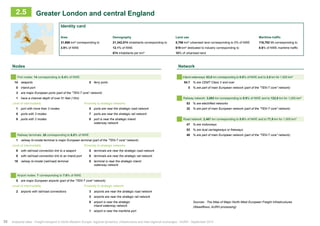
• North-Western Europe................................................................................................... p.4 
• Demographic dissymmetry.......................................................................................... p.10 
• Industrial dissymmetry.................................................................................................. p.11 
• European maritime facades........................................................................................ p.12 
• Maritime port traffic....................................................................................................... p.13 
• Port ranking: top 20..................................................................................................... p.14 
• Port ranking: top 5 per country................................................................................. p.15 
• Breakdown of import/export traffic.......................................................................... p.16 
• Port ranking per type of goods................................................................................. p.17 
• Inland waterway network: grid analysis method.................................................. p.18 
• Road network: grid analysis method....................................................................... p.19 
• Railway network: grid analysis method.................................................................. p.20 
• Transport hubs: grid analysis method..................................................................... p.21 
• Cross analysis of densities......................................................................................... p.22 
• Cross analysis of infrastructure concentrations.................................................... p.23 
• Remarkable regional areas......................................................................................... p.27 
• Strengths and opportunities of the infrastructure network................................ p.52 
• Division of North-Western Europe into 61 geozones (SEStran)..................... p.55 
• Total volume of interactions....................................................................................... p.56 
• Share of internal interactions in North-Western Europe................................... p.57 
• Main interactions .......................................................................................................... p.58 
• Main maritime interactions ......................................................................................... p.59 
• Main interactions between geozones broken down by transport modes..... p.60 
• Modal interaction breakdown per geozone............................................................ p.61 
• Inbound dominant interactions................................................................................... p.62 
• Outbound dominant interactions................................................................................ p.63 
• Dominant transnational inbound interactions and key outreach hubs........... p.64 
• Dominant transnational outbound interactions 
and key convergence hubs......................................................................................... p.65 
• Transport corridors and new European dynamics............................................... p.69
AURH - Town P lanning Agency 
of Le Havre and Seine Estuary Area 
76063 Le Havre cedex FRANCE 
Tel: +33 (0)2 35 42 17 88 
aurh@aurh.fr 
www.aurh.fr - www.aurhinweastflows.com 
Document created with the support of the European INTERREG IV B programme 
and in the framework of the European Weastflows project 
This assessment report is the second contribution of AURH for action 1 
ʺAssessment of sustainable transport capacityʺ 
www.weastflows.eu 
Published by AURH - September 2014 - P rinted by Snag & Centrale France +33 (0)2 32 74 06 90 
Registration of copyright: September 2014 
ISBN: 979-10-93006-04-8 
Not for sale 
With the kind financial support of:

AURH - Analytical Atlas of freigth transport in NWE

  • 1.
    ANALYTICAL ATLAS Freighttransport in North-Western Europe: regional dynamics, infrastructure and inter-regional exchanges Weastflows project - Action 1 - Deliverable 2 - September 2014
  • 3.
    CONTENT Executive summary....................................................................................................p.5 Part 1: geographical analysis of North-Western Europe.....p.7 About geographical analysis....................................................................................................p.8 1.1 European territorial organisation ...............................................................................p.10 1.2 Maritime organisation.....................................................................................................p.12 1.3 Organisation of transport infrastructure networks..................................................p.18 Part 2: focus on each of the eleven remarkable areas in North-Western Europe.............................................................................................p.25 About quantitative and qualitative analysis.........................................................................p.26 2.1 Ireland..................................................................................................................................p.30 2.2 Shannon-Limerick Gateway..........................................................................................p.32 2.3 Scotland...............................................................................................................................p.34 2.4 Liverpool and the west coast........................................................................................p.36 2.5 Greater London and central England.........................................................................p.38 2.6 Southern England.............................................................................................................p.40 2.7 Southern Netherlands......................................................................................................p.42 2.8 Benelux and Eastern France........................................................................................p.44 2.9 Western Germany............................................................................................................p.46 2.10 Northern France................................................................................................................p.48 2.11 Seine Gateway®................................................................................................................p.50 Part 3: analysis of interactions.......................................................................p.53 About the analysis of interactions..........................................................................................p.54 3.1 General analysis of interactions broken down by geozone..................................p.56 3.2 Key interactions between geozones.............................................................................p.58 3.3 Modal analysis of interactions........................................................................................p.60 3.4 Dominant interactions by individual geozones..........................................................p.62 3.5 Transnational dominant interactions.............................................................................p.64 Conclusion Rolling out new European dynamics........................................................p.68 Map index.............................................................................................................................p.71
  • 4.
    North-Western Europe NORWAY Münster DENMARK Dortmund NETERLANDS Antwerp Dusseldorf Köln Den Haag Lille Shetland, Scotland Shetland Dundee UNITED KINGDOM Edinburgh Newcastle upon Tyne Sheffield Cambridge Chelmsford Canterbury Dunkerque Amiens Paris Glasgow Belfast Aberdeen Sunderland Armagh Carlisle Lancaster Dublin Leeds Salford Birmingham Wolverhampton Hereford Bristol London Amsterdam Brussel Kassel GERMANY Frankfurt am Main SWEDEN Nürnberg Mannheim Stuttgart Gent BELGIUM Charleroi LUXEMBOURG Dijon Reims Liège Portsmouth Caen Angers Southampton Rennes Nantes Swansea Augsburg Le Havre Cardiff Plymouth Luxembourg Saarbrücken Strasbourg Freiburg im Breisgau Metz Galway Limerick Cork Rouen Le Mans Tours Brest Nancy Orléans Mulhouse Besançon IRELAND FRANCE Cities between 45,038 and 145,000 inhabitants between 145,001 and 450,000 inhabitants between 450,001 and 1,000,000 inhabitants over 1 million inhabitants Contextual information North-Western Europe Other European countries $ Data source powered by AURH Boudaries ©MBR and EuroGeographics,©ESRI Km Map data © OpenStreetMap contributors, ODbl ®AURH -2013/06 4 Analytical atlas - Freight transport in North-Western Europe: regional dynamics, infrastructure and inter-regional exchanges - AURH - September 2014 AUSTRIA ITALY UNITED KINGDOM SWITZERLAND NORTH SEA ATLANTIC OCEAN ENGLISH CHANNEL ATLANTIC OCEAN 0 25 50 100 GeoWeastflows platform November 2013 - The interactive cartography tool developed by the Henri Tudor Public Research Centre in Luxembourg and AURH can be accessed free of charge through a simple registration at: http://geo.weastflows.eu ATLAS Major North-West European freight infrastructures Weastflows project - Action 1 - Deliverable 1 - June 2013 The Atlas of North-Western Europe freight transport infrastructures June 2013 - 47 maps bringing together context maps, maps by transport mode and regional maps. It can be downloaded on www.aurh.fr and www.aurhinweastflows.com
  • 5.
    Development of portsand freight flow management have a strong correlation with the infrastructure network and its capacity to propose a panel of multimodal services that decrease the environmental impact of goods transport. Knowing the characteristics, strengths and weaknesses, opportunities and threats of this network is thus crucial, as well as deep knowledge of the main inter-regional goods exchanges. This is the goal of the work carried out by AURH in this report with a quantitative, qualitative and cartographical analysis of the transport infrastructures and regional dynamics. This publication is a part of the European Weastflows project (INTERREG IV B for North- Western Europe). This four-year project (2011-2014) is aimed at improving North-Western Europe logistics and freight transport as well as identifying alternative solutions to mitigate congestion in the Northern Range ports and traditional North-South roads. The scope of the study includes seven European countries (cf. map). It does not include the southern part of France, the northern part of the Netherlands, the eastern part of Germany and because of this, a part of the Northern Range, including Hamburg. This Analytical Atlas is the second stage of work AURH has carried out for Weastflows. It follows The Atlas of Major North-West European Freight Infrastructures published in June, 2013. This atlas listed an inventory of transport infrastructures, including all types of goods and modes, whether they already existed or were planned. This second opus goes even further and readers will be invited to comprehend stakes concerning transport of goods in North-Western Europe, taking into account the infrastructures and looking at this from a sustainable development point of view. It raises the question of the massification of exchanges, of modal changes as well as the environmental impact freight transport has. This deliverable uses data from the Geographical Information System (GIS) designed by AURH. This GIS data base, drawn up with the assistance of all partners in this project, is today considered as a reference work. It is a free of charge source of information on North-Western Europe freight transport infrastructures. OpenStreetMap is the main reference document and has been laid out and enriched to comply with Weastflows’ requirements. This data can be consulted, after registration, on the GeoWeastflows interactive cartography platform developed by AURH and the Henri Tudor Public Research Centre, a Weastflows partner, based in Luxembourg at the following link: http://geo.weastflows.eu For this deliverable, AURH designed a method that uses GIS spatial analysis tools applied to the infrastructure network, and including, in particular: • development of a grid analysis for a geographical study of the network which points out its concentrations; • definition of indicators to highlight strengths and weaknesses; • cartography of goods exchanged between North-Western Europe regions for a preliminary matching with infrastructures. This document is organised in three parts, each preceded by a methodological introduction. The first part proposes a geographical analysis of North-Western Europe. It focuses on regional characteristics: demography, land use, the port network and transport infrastructures. The second part presents a quantitative and qualitative analysis on the network of infrastructures. It concerns eleven remarkable strategic regional areas for freight transport. These areas were defined, in a collusive manner, at the beginning of the project. The Atlas had already included a series of maps at this scale. Lastly, the third part focuses on the analysis and qualification of the main goods exchanged between regions in North-Western Europe. These interactions were analysed using a theoretical goods flow matrix structure. This matrix structure was designed by the Scottish partner, SEStran in the framework of Action 4 of the project on the analysis of freight demand. AURH integrated the data into the GIS. Analytical atlas - Freight transport in North-Western Europe: regional dynamics, infrastructure and inter-regional exchanges - AURH - September 2014 5 EXECUTIVE SUMMARY
  • 7.
    Part 1 Geographicalanalysis of North-Western Europe
  • 8.
    About geographical analysis This geographical analysis provides keys allowing readers to better understand territorial and maritime stakes of freight transport. It includes three parts: • demographic and industrial densities; • port organisation; • transport infrastructures using the grid analysis method. Why use grid analysis? The European Union statistical system is based on a territorial division shared by the entire European Union called NUTS (Nomenclature of Territorial Units for Statistics). This reference system has three stages of division from NUTS 1 to NUTS 3. It is based on administrative divisions of member States correlated to population weight. Because of this, there are large divergences from one country to another, in particular in terms of area, which generates disequilibrium when comparing two zones between themselves. How does it work? Knowing this, AURH has designed a specific grid variation that divides the North-West European area into 1,290 squares of 800 km2 each. This division is more precise than the NUTS reference system which divides the same area into 485 NUTS 3, with an average area of 1,650 km2. The size chosen corresponds to the area of the smallest German administration division, which is equivalent to districts or city districts. Each square then brings information stemming from crossing it with network infrastructures. The grid analysis method was developed for roads, railways and inland waterways as well as for nodal elements such as ports, railway terminals and airports: • the infrastructure density was measured for networks by including each square in the total length of the network ; • for nodal infrastructures (ports, railways terminal and airports), the density of infrastructures was measure by the total number of nodes in each square. By cross referencing this data, each square gives information indications on the accumulated lengths of intersected networks or the total number of nodal infrastrutures. In order to make the grid variation easier to read, a discretization of data into three classes was made, using the standard discretization method. Each class was qualified according to the following categorization: strong, average and weak for the infrastructure concentration level. Some squares can belong to no class at all, and thus give “absence of data” information. This can mean two things: • either there are no infrastructures at all, • or there are no infrastructures adapted to mass freight transport. Methodological interest of grid analysis With grid analysis, you can: • exceed limitations of administrative divisions or traditional statistics, • supply a homogeneous data repository in which each area can be compared objectively to the others, • cross reference data. What grid analysis shows Grid analysis methods, when applied to the analysis of transport infrastructures for each of the three modes inland waterways, and the associated nodal infrastructures (ports, railways terminal and airports) give a geographical analysis of freight transport infrastructures: • it highlights concentrated infrastructures, • it pre-identifies congested zones as well as sectors conducive to the development of intermodality, • it highlights the continuities and discontinuities of the network. The grid analysis method focuses on territorial divergences by highlighting network densities. 8 Analytical atlas - Freight transport in North-Western Europe: regional dynamics, infrastructure and inter-regional exchanges - AURH - September 2014
  • 9.
    Commentaires Fromto NgUridTSd i3vi sdioivnision infraVsetrnutciltautrioen n oeft wthoerk in the squares of the grid (Sources : Weastflows project, AURH processing) Analytical atlas - Freight transport in North-Western Europe: regional dynamics, infrastructure and inter-regional exchanges - AURH - September 2014 9
  • 10.
    " " " " " " " " " Warszawa " " " European territorial organisation $ Data source ©CorineLandCover2006; ©Powered by AURH Boudaries ©MBR and EuroGeographics,©ESRI Km Map data © OpenStreetMap contributors, ODbl ®AURH -2013/06 0 50 100 200 Areas with the highest densities Areas with the lowest densities " " " " " " " " Rome Paris Madrid Berlin London Brussels Wien Oslo Praha Zagreb Dublin Budapest Sarajevo Stockholm Kobenhavn Ljubljana Amsterdam Bratislava Luxembourg en nombre d’habitants par km² 150 250 500 1 500 5 000 21 100 2 50 densités les plus faibles densités les plus fortes Capitales et villes européennes Dissymétrie Capitale européenne Ville de plus de 1 million d'habitants Éléments de contexte number of inhabitants per square kilometre lowest density highest density 2 50 European capitals and main cities Dissymmetry Capital city 150 250 500 1 500 5 000 21 100 City over 1 million of inhabitants Perimeter 10 Analytical atlas - Freight transport in North-Western Europe: regional dynamics, infrastructure and inter-regional exchanges - AURH - September 2014 Demographic dissymmetry In 2013, the European Union had 505.7 million inhabitants of which 35% live in North-Western Europe (sources Eurostat). Germany, France and the United Kingdom come in first as the most heavily populated Member States with respectively 80, 65 and 63 million inhabitants. North-Western Europe has the most cities with a dense population: 216 inhabitants per square kilometre as compared with 117 inhabitants per square kilometre for the European Union as a whole. Population breakdown has strong spacial divergences which seem like a fracture line dividing Europe into two distinct parts: • in the East, the highest densities are found in five cities with over a million inhabitants in the scope of our study: London, Birmingham, Paris, Brussels and Cologne; • in the West, countries with the lowest population densities include Spain, Portugal, as well as the Western sides of Ireland and France. Ligne de fracture Densité de population Ville entre 450 000 et 1 million d'habitants Europe du Nord-Ouest Dividing line Population density City between 450,000 and 1 million inhabitants North-West Europe 1.1
  • 11.
    !( !( !( !( !( !( !( !( !( !( !( !( !( !( !( !( !( !( !( !( !( !( !(!( !( !( !( !( !( !( !( !( !( !( !( !( !( !( !( !( !( !( !( !( !( !( !( !( !( !( !( !( !( !( !( !( !( !( !( !( !( !( !( !( !( !( !( !( !( !( !( !( !( !( !( !( !( !( !( !( !( !( !( !( !( !( !( !( !( !( !( !( !( !( !( !( $ !( Data source ©CorineLandCover2006; ©Powered by AURH Boudaries ©MBR and EuroGeographics,©ESRI Map data © OpenStreetMap contributors, ODbl ®AURH -2013/06 !( !( !( !( !( !( Warszawa !( !( " " " " " " " " " " " " " " " " " " " " Rome Paris Madrid Berlin London Brussels Wien Oslo Praha Zagreb Dublin Budapest Sarajevo Stockholm Kobenhavn Ljubljana Amsterdam Bratislava Luxembourg Km 0 50 100 200 Areas with the highest densities Areas with the lowest densities Densité industrielle surface en m² / 1 000m² dédiée à l’industrie 5 7 12 20 43 175 densités les plus faibles densités les plus fortes Volume total de marchandises chargées et déchargées Dissymétrie 0 2 Ligne de fracture Europe du Nord-Ouest NUTS 2 maritimes en milliers de tonnes, par NUTS 2 203 000 !(!(!(!( Éléments de contexte Industrial density area in m² dedicated to industry 5 7 12 20 43 175 lowest density highest density Total volume of goods loaded and unloaded Dissymmetry 0 2 in thousands of tonnes per NUTS 2 area Perimeter Dividing line North-Western Europe !(!(!(!( Coastal NUTS 2 area 100 000 60 000 20 000 11 000 203,000 100,000 60,000 20,000 11,000 Analytical atlas - Freight transport in North-Western Europe: regional dynamics, infrastructure and inter-regional exchanges - AURH - September 2014 11 Industrial dissymmetry Industrial density measures the space dedicated to industrial infrastructures in square metres in a 1,000 square metre area. This ratio allows us to visualise the area’s largest industrial basins. The average North-Western Europe industrial density is 101 m2 per 1,000 m2. North-Western Europe’s largest industrial infrastructure densities are thus concentrated in the German Ruhr River Basin, the Parisian Basin in France and in the Manchester-Liverpool industrial basin in the United Kingdom. Like the population, industry is not spread smoothly throughout the territory. It is located around a type of fault line that cuts Europe into two parts. Industrial infrastructures starting with Dublin, Paris and Northern Italy are completely concentrated along the European backbone to the East, with Poland and Austria, thus excluding Western Ireland and France as well as Spain. The heaviest maritime traffics are concentrated in the regions located to the East of this fault line, where demographic and industrial densities are the highest.
  • 12.
    " Coastline of the British and Irish Isles $ Data source ©Eurostat 2010; ©Powered by AURH Boudaries ©MBR and EuroGeographics,©ESRI Km Map data © OpenStreetMap contributors, ODbl ®AURH -2014/05 0 50 100 200 Baltic Arc Mediterranean Arc Atlantic Coastline North Range Rome Paris Madrid Berlin London Brussels Wien Oslo Praha Zagreb Dublin Warszawa Budapest Sarajevo Stockholm Kobenhavn Ljubljana Amsterdam Bratislava Luxembourg " " " " " " " " " " " " " " " " " " " Maritime organisation 1.2 Range Nord Arc Baltique Arc Méditerranée Façade des Iles Britanniques Façade Atlantique North Range Baltic Arc Mediterranean Arc 12 Analytical atlas - Freight transport in North-Western Europe: regional dynamics, infrastructure and inter-regional exchanges - AURH - September 2014 European maritime facades North-Western Europe is an area facing the sea. Its littoral is 26,000 km long. A third of the population, amounting to 61 million persons, lives near the coast and generates over 40% of the GDP. This littoral is composed of three maritime facades : • the British and Irish Isles facade with Ireland, England, Scotland and Wales, • the Atlantic facade on the Western French coast which begins in Brittany and goes until the South of Portugal border, • the Northern Range which goes from Le Havre to Hamburg. Please note the North-West European division does not include the Atlantic facade Façades or maritimes the Northern Range facade. Éléments de contexte NUTS 2 maritimes Europe du Nord-Ouest North-Western Europe European coastlines Perimeters Coastline of the British and Irish Isles Atlantic Coastline Coastal NUTS 2 area
  • 13.
    $ Data sourceEurostat - 2012 Km Boudaries ©MBR and EuroGeographics,©ESRI ®AURH -2014/05 0 25 50 100 Amsterdam North Range 900 Mt Atlantic Coastline 29,8 Mt Coastline of the British and Irish Isles 500 Mt Paris London Dublin Brussels Luxembourg Shetland, Scotland Shetland Trafic total de marchandises par principaux ports* en milliers de tonnes, en 2012 Range Nord Façades maritimes 400 000 100 000 50 000 10 000 1 000 Façade des Îles Britanniques Façade Atlantique Façade maritime 500 Mt Trafic total en millions de tonnes par façade maritime *sélection des ports ayant un trafic supérieur à 1 million de tonnes Éléments de contexte Europe du Nord-Ouest Capitale Total freight traffic by main ports* per thousand tonnes, in 2012 North Range Maritime coastlines 400,000 100,000 50,000 10,000 1,000 Coastline of the British and Irish Isles Atlantic coastline Maritime coastline 500 Mt Total trafic in millions of tonnes per maritime coastline *selection of ports with a freight traffic over 1,000 thousand tonnes Contextual information North-Western Europe Capital city Analytical atlas - Freight transport in North-Western Europe: regional dynamics, infrastructure and inter-regional exchanges - AURH - September 2014 13 Maritime port traffic North-Western Europe has 65 maritime ports with a freight traffic of over one million tonnes (sources Weastflows). They generate a total traffic density of over 1.5 billion tonnes annually. Nevertheless, the three North-Western Europe maritime coastlines have a heterogeneous number of ports and different traffic intensities. The British and Irish Isles coastline has 43 ports generating a total amount of traffic of nearly 500 million tonnes of goods. Because the United Kingdom and Ireland are islands, the strong port grid on their coastlines is easily comprehensible. The Atlantic coastline, with its main entrance port of Nantes-St Nazaire, has lesser traffic with 29.8 million tonnes of goods. Lastly, most of North-Western Europe’s freight traffic is concentrated on the Northern Range coastline with ports generating heavy traffic of over 900 million tonnes. Rotterdam and Antwerp are the main ports. It must be noted that : • All traffic on the Atlantic coastline as well as in the Northern Range is not taken into account here, because of the scope of our study. • All freight traffic is taken into account in this analysis whatever the product may be.
  • 14.
    16th Edinburg (Leith) 10th Tees and Hartlepool Total 1.2 billion tonnes = 62% of NWE traffic 4th : Grimsby and Immingham ! ! ! ! ! ! ! ! ! ! ! ! ! ! ! $ Data source : Eurostat - 2012 Km Boudaries ©MBR and EuroGeographics,©ESRI ®AURH -2014/05 0 25 50 100 3rd : Amsterdam 1st : Rotterdam 2nd : Antwerpen 5th : Le Havre 20th Dublin 11th Liverpool 8th Milford Haven 14th Felixstowe 6th London 9th Southampton 19th Rouen 15th Ghent 16thDover 13th Zeebrugge 7th Dunkerque 12th Nantes-St Nazaire 17th Ijmuiden Shetland, Scotland Shetland In 2012, 20 North-Western Europe maritime ports had mass freight traffic exceeding 20 million tonnes (source: Eurostat). These top 20 ports generate a total traffic of 1.2 billion tonnes. The five top ports in this ranking have 62% of total traffic. Excepting Grimsby- Immingham, located in the United Kingdom, four of these ports are located on the Northern Range coastline. • Rotterdam comes in first place in North-Western European ports with the highest amount of freight traffic: 400 million tonnes in 2012; • Antwerp comes in second with 165 million tonnes; • Amsterdam comes in third with 71 million tonnes; • Grimsby-Immingham comes in fourth in this ranking with 60 million tonnes; • Le Havre is the fifth North-Western European port with 59 million tonnes. London comes in sixth place. It must be noted that all freight traffic is taken into account in this analysis whatever the product may be. Ranking of main seaports in terms of freight traffic in 2012 ! 20 first seaports 5 first seaports Élément de contexte Contextual information North-Western Europe Classement des ports maritimes d’après leur trafic de marchandises en 2012 ! 20 premiers ports 5 premiers ports Europe du Nord-Ouest 14 Analytical atlas - Freight transport in North-Western Europe: regional dynamics, infrastructure and inter-regional exchanges - AURH - September 2014 Port ranking: top 20
  • 15.
    Port ranking: top5 per country 2nd :Shannon Foynes Total 44 Mt = 89% of national traffic 3rd : Milford Haven Southampton $ Data source Eurostat - 2012 Km Boudaries ©MBR and EuroGeographics,©ESRI ®AURH -2014/05 0 25 50 100 5th: Tees and Hartlepool Total 216 Mt = 43% of national traffic 1st : Grimsby and Immingham 2nd : Port of London 2nd :Dunkerque 5th : Calais 1st : Le Havre Total 167 Mt = 55% of national traffic 1st : Rotterdam 2nd : Amsterdam 4th : Vlissigen Total 520 Mt = 96% of national traffic Total 1 Mt Total 223 Mt = 99% of national traffic 4th : Rouen 4th : 3rd : Nantes Saint-Nazaire 3rd : Cork 1st : Dublin 4th : Bantry Bay 5th : Rosslare 1st : Duisburg 2nd : Krefeld 4th : Andernach 1st : Antwerpen 2nd : Zeebrugge 3rd : Ghent 4th : Ostend 5th : Liège 3rd : Ijmuiden 5th : Terneuzen 3rd : Koeln 5th :Wesel Shetland, Scotland Shetland This map presents the five largest maritime or interior ports in each country of North-Western Europe in terms of freight traffic. The total amount of freight traffic, in millions of tonnes, of the five highest ranked ports in each country is given and compared to the total maritime freight traffic of the country, except for Germany, as it only has interior ports on the North-West European perimeter. The ranking of the five most important ports per country indicates the main North-Western Europe maritime entrance ports. The top five Belgian and Dutch maritime ports respectively concentrate 96% and 99% of their domestic freight maritime traffic. In Ireland, the top five ports share 89% of domestic traffic. The top five ports of Northern France, which is split into two parts by the North-Western Europe perimeter, generate a bit over one half of the French maritime freight traffic. Le Havre is the maritime entrance port of this Northern half of France, as well as being a complement to the Rouen sea port. Lastly, in the United Kingdom, the top five ports concentrate less than half of the total of domestic freight traffic. The Grimsby-Immingham port, England’s main maritime entrance port, is located north of London. Classement portuaire, top 5 par pays d’après leur trafic de marchandises en 2012 1er port 2ème au 5ème port Pays concernés par le classement Élément de contexte Europe du Nord-Ouest Irlande Royaume-Uni France Pays-Bas Belgique Allemagne It must be noted that all freight traffic is taken into account in this analysis whatever the product may be. Port ranking, top 5 by country Contextual information in terms of freight traffic in 2012 North-Western Europe 1st seaport 2nd to 5th port Country Ireland United-Kingdom France The Netherlands Belgium Germany Analytical atlas - Freight transport in North-Western Europe: regional dynamics, infrastructure and inter-regional exchanges - AURH - September 2014 15
  • 16.
    Shetland, Scotland Breakdownof import/export traffic 1st : Edinburg (Leith) 2nd : Tees and Hartlepool 5th : Rouen 4th : Glensanda 1st : Rotterdam 3rd :Amsterdam 2nd :Antwerpen 5th :Le Havre 3rd : Sullom Voe 4th : Londres $ Data source ©Ports Authority; ©Powered by AURH Boudaries ©MBR and EuroGeographics,©ESRI Km Map data © OpenStreetMap contributors, ODbl ®AURH -2013/06 0 25 50 100 Shetland Each port’s freight traffic is broken down between the share of imported and exported traffic. Here, we want to differentiate profiles that import or export more as ports in order to locate the main entrance and exit freight ports in North-Western Europe. The majority of Northern Range ports are import ports. The Rotterdam, Amsterdam, Antwerp and Le Havre ports all have the same proportional profile: nearly three quarters of traffic volume is imported as compared with a bit over a quarter that is exported. These are the main European freight entrance ports serving the hinterlands. On the United Kingdom scale, London is the main importing port, coming in fourth place in North-Western Europe. Trafic total The en millions four leading de tonnes, exporting en 2011 ports in North-Western Europe are located in the United Kingdom: • 1 in England, Tees and Hartlepool, • 3 in Scotland: Edinburgh, Glensanda (sand and gravel for United 430 276 70 30 Kingdom and European construction industries) and Sullom Voe (crude oil). They show goods production and distribution sites with regional, national or European markets. Part du trafic dédié à l’import Part du trafic dédié à l’export Classification import/export Port majoritairement importateur Top 5 des ports ayant la balance commerciale à l’import la plus excédentaire Port majoritairement exportateur Top 5 des ports ayant la balance commerciale à l’export la plus excédentaire Élément de contexte It must be noted that all freight traffic is taken into account in this analysis whatever the product may be. Europe du Nord-Ouest Total traffic in millions of tonnes, in 2011 Import/export classification 430 276 70 30 Share of import traffic Share of export traffic Port that mainly imports Top 5 ports with the highest balance of trade when importing Port that mainly exports Top 5 ports with the highest balance of trade when exporting Contextual information North-Western Europe 16 Analytical atlas - Freight transport in North-Western Europe: regional dynamics, infrastructure and inter-regional exchanges - AURH - September 2014
  • 17.
    Port ranking pertype of goods Milford Haven Amsterdam $ Data source ©ESPO, ©Autorités Portuaires Km Boudaries ©MBR and EuroGeographics,©ESRI ®AURH -2014/05 0 25 50 100 2 1 1 1 3 5 2 3 5 5 4 2 1 5 3 4 3 2 London Le Havre 4 4 Immingham Felixstowe Dover Rotterdam Zeebrugge Dunkerque Calais Antwerpen Shetland, Scotland Shetland In order to pinpoint the specificities of the main maritime ports in our study, we ranked the ports according to the volume of traffic by type of goods transported: containers, liquid bulk, solid bulk, and roll-on/roll-off shipping (RoRo). The map presents port rankings per type of goods with the top five in each category. On the 12 ports in this ranking, seven are located in the Northern Range and five in England. Rotterdam and Antwerp stand out as being in the top five for three types of goods: freight containers, liquid bulk and solid bulk. Rotterdam is the leading liquid and solid bulk port as well as the leading freight container port. Antwerp comes in second for freight containers, and in third and fifth place for liquid and solid bulk. Located on the same maritime facade, Le Havre and Zeebrugge are both in the top five for two types of goods. Le Havre comes in fourth for freight containers, just in front of Zeebrugge. Ports in the United Kingdom mainly deal with RoRo and bulk traffic. Other ports, Calais and Dunkirk on the Northern Range and Dover, London, Felixstowe, Immingham and Milford Haven on the Atlantic façade, are in the top five of the North-West European thanks to just one type of traffic volume. Élément de contexte Contextual information North-Western Europe Top 5 des trafics portuaires d’après ESPO, 2010 Port dans le Top 5 pour 2 types de marchandises ou plus Top 5 in port traffic according to ESPO, 2010 Type of freight Container Liquid Bulk Dry Bulk RoRo 5 leading ports 1 for one or several types of freight Port with two or more types of traffic in the ranking Other port with a freight traffic over 1,000 tonnes Catégories de marchandises Conteneur Vrac liquide Vrac solide RoRo 5 premiers ports 1 pour un ou plusieurs types de marchandises Autre port ayant un trafic supérieur à 1 million de tonnes Europe du Nord-Ouest Analytical atlas - Freight transport in North-Western Europe: regional dynamics, infrastructure and inter-regional exchanges - AURH - September 2014 17
  • 18.
    1.3 Organisation oftransport infrastructure networks Inland waterway network: grid analysis method $ Data sources: Weastflows project, Km powered by AURH ®AURH - 2014/06 0 25 50 100 Manchester ship canal Thames Seine Valley Netherlands, Belgium and Rhine basin Loire Saône Valley This map represents concentrations of inland waterways whose ECMT classification exceeds or equals V*, the relevant threshold value for mass freight transport. This highlights the unequal breakdown of the large clearance inland waterway network, stemming from both natural and human factors. Ireland and Scotland have none, thus limiting the potentialities of modal changes to this mode, whereas Benelux and Germany have stronger network concentrations as well as longer continuities. France’s network is also much less developed, and characterised by the absence of continuity and connection with Belgian, Dutch and German networks. England has a nearly non-existing network which, nonetheless, does link country’s two main production and consumption basins to the sea: London to the North Sea with the Thames River and the Liverpool/Manchester region to the Atlantic Ocean via the Manchester Canal. We can identify two complementary networks: the Loire region on the Atlantic facade and the Saone Valley region with interconnections to inland waterways in the South of France. Inland waterways concentration Type of inland waterway concentration* Total length of network per square based on inland waterways with a CEMT class V and over High Medium Low No data** Inland waterway regions Perimeter North-West Europe area *only are considered the relevant infrastructure for high level of freight transportation **no data can mean no infrastructures or no infrastructures relevant for high level of freight transportation Data sources: Weastflows project, powered by AURH Shetland, Scotland Shetland * The ECMT classification indicates the seaworthiness level of the European network of inland waterways. It has seven classes, from I to VII. Type of inland waterway concentration* based on inland waterways with a CEMT class V and over High Medium Low No data** Inland waterway region Contextual information North-Western Europe * only relevant freight transport infrastructures have been considered ** no data can means no infrastructure or no infrastructure relevant for freight transport Concentration de voies navigables* 18 Analytical atlas - Freight transport in North-Western Europe: regional dynamics, infrastructure and inter-regional exchanges - AURH - September 2014
  • 19.
    Road network: gridanalysis method $ Data sources: Weastflows project, Km ®AURH 0 25 50 100 powered by AURH - 2014/06 North East of United Kingdom South of United Kingdom Seine Valley Benelux and Rhine basin South of Ireland Saône Valley Karlsruhe / Nuremberg axis Rhine Valley Belfast area square No data** infrastructure transportation infrastructures or level of Shetland, Scotland Shetland Contrary to the inland waterway network, the road network is characterised by quite a homogeneous distribution in the area we studied. This maps shows that nearly all of North-Western Europe is equipped with a road network that is adapted to mass freight transport. Urban centres with dense population levels thus logically have the densest road networks. This is the case, amongst others, of the Rhine River Basin, the Seine River Valley, the central and Southern parts of the United Kingdom, including Greater London, as well as the South of Ireland, with Cork and Waterford. For France, the Seine River Valley stands out as being the axis with the highest number of road infrastructures both in intensity and continuity. At a European level, the South of the United Kingdom is the region with the strongest network densities. Benelux and the Rhine River Basin are characterised by a more homogeneous and regular distribution, well covering their areas. Four complementary areas were also identified: the Belfast region, the Saone River Valley, the Rhine River Valley in its French part as well as the Karlsruhe/Nuremberg axis. The last three allow Southern and Eastern Europe to be interconnected. Type of road concentration* High Medium Low No data** Road region Contextual information North-Western Europe * only relevant freight transport infrastructures have been considered ** no data can means no infrastructure or no infrastructure relevant for freight transportation Concentration de réseau routier* Analytical atlas - Freight transport in North-Western Europe: regional dynamics, infrastructure and inter-regional exchanges - AURH - September 2014 19
  • 20.
    $ Data sources:Weastflows project, Km ®AURH - 2014/06 0 25 50 100 powered by AURH Railway network: grid analysis method Centre of United Kingdom London area Paris area Belgium Netherlands Duisburg and Rhine corridor As is the case with the road network, the railway network is broken down in a quite homogeneous manner throughout the North-West European area, though some disequilibrium does exist. Ireland and Scotland has the smallest concentrations as does Western France, where several zones have no railway Railways infrastructures concentration whatsoever. These regions, from this point of view, are in peripheral positions. It can quite logically be seen that the highest Type concentrations of railway concentration* are found in densely populated urban centres. Areas identified Total length are: of network Belgium per square and the Rhine River axis, Paris and its surrounding region, Greater London and the centre of the United Kingdom. They can differ from those identified for the road networks, which shows the absence of a systematic correlation between the ways in which these two networks were rolled out. Luxembourg and the region around Metz also have a dense concentration of networks. This area holds a central position in the continental part of the area we studied. Last but not least, we must not forget that the English, German and Belgian railway networks are among the densest in North-Western Europe. High Medium Low No data** Railway regions Perimeter North-West Europe area *only are considered the relevant infrastructure for high level of freight transportation **no data can mean no infrastructures or no infrastructures relevant for high level of freight transportation Data sources: Weastflows project, powered by AURH Luxembourg and Metz area Mannheim and Ludwigshafen Shetland, Scotland Shetland Type of railway concentration* High Medium Low No data** Contextual information North-Western Europe * only relevant freight transport infrastructures have been considered ** no data can means no infrastructure or no infrastructure relevant for freight transportation Concentration de réseau ferroviaire* Railway region 20 Analytical atlas - Freight transport in North-Western Europe: regional dynamics, infrastructure and inter-regional exchanges - AURH - September 2014
  • 21.
    Transport hubs: gridanalysis method Bristol - Cardiff $ Km ®AURH - 2014/06 0 25 50 100 Data sources: Weastflows project, powered by AURH Newcastle and Durham Manchester - Liverpool - Leeds axis London area Seine Valley Belgium, Netherlands and Rhine basin Luxembourg and Metz area Rhine Valley Glasgow - Edinburgh axis Shannon, Limerick and Cork Portsmouth and Southampton terminals No data** infrastructure transportation infrastructures or level of Shetland, Scotland Shetland A geographical readout of the cumulated concentrations of port, railway and airport hubs highlights the regions of connection where the passage from one mode of transport to another could possibly be facilitated by the presence of infrastructures allowing load splitting. Eleven areas have been identified. The Netherlands, Belgium and the Northern part of the Rhine River Basin are the first sub-assembly, both in continuity and in regularity, highlighting a dense concentration. The Seine River Valley and Rhine River Valley make up two similar areas, which can be explained by the presence of two large rivers. The longitudinal breakdown of transport hubs highlights a predisposition to value a multimodal transport corridor, such as those found in the most Northern part of the United Kingdom: the Glasgow-Edinburgh axis and the Liverpool-Manchester-Leeds axis. It also must be noted that the Liverpool-Manchester-Leeds axis acts as an interface between the North and South of the country. The four remaining areas, (London, Portsmouth, Luxembourg and Shannon- Cork), are the most compact but not the least dense, which brings us back to our hub logic. The position of the Luxembourg-Metz area must also be highlighted, as it is used as a central subsystem, as is the Rhine River Valley. Type of node concentration* High No data** Contextual information North-Western Europe Concentration de noeuds* basée sur les ports et les terminaux ferroviaires Nodes region based on port nodes and railway terminals Medium Low * only relevant freight transport infrastructures have been considered ** no data can means no infrastructure or no infrastructure relevant for freight transportation Analytical atlas - Freight transport in North-Western Europe: regional dynamics, infrastructure and inter-regional exchanges - AURH - September 2014 21
  • 22.
    The cross analysisof industrial densities and population densities shows: • in grey: the large European urban and industrial hubs, that are very dense and dynamic and are located near capital cities (Paris, Brussels, Amsterdam); • in pink: the large North-West European industrial basins: in England, Manchester and Birmingham and in Germany, Manheim, Frankfurt, Karlsruhe and the Ruhr River basin; • in purple: large population basins with little industry surrounding capital cities or large North-West European cities: the outskirts of Paris and the South of England; • in hachuring: peripheral regions with a strong disequilibrium between densities, especially in Western France and in the West of the Seine River Valley where industry, usually food-processing, is strong though the population is weak. The position of maritime entrance/exits allow us to relate industrial characteristics and population basins with dynamic exchanges of goods. Paris London Dublin Amsterdam Brussels Luxembourg Cross analysis of densities Km 0 25 50 100 Data source ©CorineLandCover 2006/AURH Boudaries ©MBR and EuroGeographics,©ESRI Map data © OpenStreetMap contributors, ODbl ®AURH -2013/06 Crossing of industrial density and population density The data crossing was made using an above average selection of industrial and population densities. The aim was to cross the two types of densities to highlight areas where there is a correlation / balance between the two densities and the areas where there is an over-representa-tion balance betwen industrial density of one over the other. highest level of population density lowest level of industrial density population > industry +++ ++ - ++ - lowest level of population density industry > population +++ Inbound/outbound of maritime freight Main entrance and exit way and population density highest level of industrial density Secondary entrance and exit way Contextual information North-Western Europe 22 Analytical atlas - Freight transport in North-Western Europe: regional dynamics, infrastructure and inter-regional exchanges - AURH - September 2014
  • 23.
    Cross analysis ofinfrastructure concentrations The accumulation of strong infrastructures allows us to identify several regional hubs. The Benelux / Rhine River Basin area is the most concentrated. It is characterised by a strong continuity of multimodal networks, leading it to be seen as a very connected region with heavy flows. The Seine River Valley is one of the few regions, with Benelux and the Rhine River Basin, where modal changes could take place massively towards rivers and railways. The map however, highlights an insular region, poorly connected to the rest of Europe. In the United Kingdom, three regions show strong road/railway concentrations. The Greater London region is connected to the continent by the Channel Tunnel, thus creating continuity with Benelux and the Rhine River Basin. Glasgow-Edinburgh holds a peripheral position, whilst the Centre of the United Kingdom region holds a central place for the United Kingdom, though a secondary one at the North- Western European scale. Lastly, peripheral regions characterised by weak concentration have been identified: Western France, Ireland and the North of the United Kingdom. d’infrastructures* Shetland, Scotland Shetland $ Data sources: Weastflows project, Km ®AURH 0 25 50 100 powered by AURH - 2014/06 Centre of United Kingdom London area Seine Valley Benelux and Rhine basin Glasgow - Edinburgh axis Saône Valley concentrations noeuds routier, routier fluvial routier d’infrastructures transport transport pour cette n’y a pas d’infrastructure Infrastructure concentrations* from crossing the highest network and nodal concentrations Multimodal concentrations High concentration of ports and railway terminals High concentration of road, railway and inland waterway networks Bimodal concentrations High concentration of road and railway networks High concentration of railway and inland waterway networks Single mode concentrations High concentration of inland waterway networks High concentration of road networks Cumulated infrastructure concentrations Infrastructure region Contextual information North-Western Europe No data** * only relevant freight transport infrastructures have been considered ** no data can mean no infrastructures or no infrastructure relevant for freight transportation Analytical atlas - Freight transport in North-Western Europe: regional dynamics, infrastructure and inter-regional exchanges - AURH - September 2014 23
  • 25.
    Part 2 Focuson each of the eleven remarkable areas in North-Western Europe
  • 26.
    About quantitative andqualitative analysis Why use quantitative and qualitative analysis? Quantitative and qualitative analysis completes The Atlas of Major North-West European Freight Infrastructures which presented the state of the existing and upcoming freight transport network. It is based on a series of indicators that highlight: • strengths and weaknesses of the infrastructure network; • the potential the network has to be sustainable; • under-used potentials that could identify alternative routes instead of the traditional North/South routes. What geographical areas are concerned by this analysis? This analysis concerns eleven remarkable areas in North-Western Europe (NWE). They correspond to areas interesting Weastflows’ partners and highlight regions that are intense and/or strategic in the organisation of freight transport. For these reasons, some zones are not identified and thus are not included in a regional analysis (cf. map). What data was used? The analysis was carried out using data from the Geographical Information System built by AURH. Data included: road, railway and inland waterway networks, ferry routes, as well as remarkable hubs such as ports, railway terminals and airports. This basic data was then enriched with qualitative information such as population density, land use, port traffic, intermodality levels, projects of infrastructures and whether or not the network belonged to the strategic European network (TEN-T), thus allowing crossed analyses. How were the indicators defined? The indicators were defined through a dialogue with project partners in compliance with the following criteria: • their relevance in showing sustainability of the existing infrastructure network; • their capacity to ensure continuity with The Atlas of Major North-West European Freight Infrastructures; • the availability and accessibility of data in the Geographical Information System. What were the results? A series of 57 indicators was drawn up. With these indicators, the key characteristics of the remarkable regional infrastructure network in each area can be described. Each of these areas has a specific sheet including: • a table with all the associated indicators and data, • a map with the main transport infrastructures, • and a comment on the characteristics of the area, the infrastructure network, remarkable hubs as well as its strengths and weaknesses. The table below show in a synthetic manner the finality of the analysis and the type of indicators that correspond. A precise description of these indicators is presented pages 28 and 29. Category Goal of the analysis Indicators Regional characteristics Key regional characteristics 26 Analytical atlas - Freight transport in North-Western Europe: regional dynamics, infrastructure and inter-regional exchanges - AURH - September 2014 • Area • Number of inhabitants • Density • Land use • Maritime port traffic Networks (inland waterways, railways and roads) Accessibility and connection Continuities and discontinuities Size of infrastructures • Belonging to the central European network (TEN-T) • Network density • Electrification of railway network • Share of motorways or dual carriageways • ECMT classification (inland waterways) Hubs (Airports, ports, railway terminals) Accessibility and connection Intermodality • Level of intermodality • Proximity of strategic European networks (TEN-T) • Number of hubs registered in the central TEN-T core network • Ferry connections
  • 27.
    Commentaires Remarkable regionalareas NETHERLANDS Amsterdam NORWAY Oostende Brugge Dortmund Köln Karlsruhe Peterhead Londonderry Southampton Analytical atlas - Freight transport in North-Western Europe: regional dynamics, infrastructure and inter-regional exchanges - AURH - September 2014 27 l’Angleterre Main regions Ireland Shannon-Limerick Gateway Scotland Liverpool and the west coast Greater London and central England Southern England Southern Netherlands Benelux and Eastern France Western Germany Northern France Seine Gateway® Contextual information Main city or port city Capital North-Western Europe Km 0 25 50 100 Data source powered by AURH Boudaries ©MBR and EuroGeographics,©ESRI Map data © OpenStreetMap contributors, ODbl ®AURH -2013/06 Paris London Dublin Brussel Luxembourg Metz Caen Cork Mainz Rouen Brest Nancy Leeds Dover Perth Essen Nantes Calais Dieppe Galway Lorient Glasgow Belfast Cardiff Bristol Grimsby Mannheim Nüremberg Duisburg Plymouth Kirkwall Limerick Aberdeen Stuttgart Edinburgh Sheffield Waterford Tynemouth Lancaster Liverpool Rotterdam Strasbourg Hartlepool Birmingham Portsmouth Felixstowe Manchester Rosslare Cherbourg Saint-Nazaire Le Havre Dunkerque Lille Charleroi Namur Liège Dusseldorf Gent Antwerp IRELAND FRANCE GERMANY BELGIUM UNITED KINGDOM LUXEMBOURG DENMARK SWEDEN AUSTRIA ITALY UNITED KINGDOM SWITZERLAND Shetland, Scotland ShetSlahnedtland
  • 28.
    Lists and descriptionsof indicators 1 Indicator Description ID card Acreage Area Area of geographical right-of-way % of the region Share of the geographical zone as compared with the total in NWE Demography Number of inhabitants Number of inhabitants in the geographical area % of inhabitants Share of inhabitants in the geographical zone as compared with the total in NWE Population density Number of inhabitants per square kilometre Land use Urbanised land Total urbanised land including land used for industry and transport % of urbanised land Share of the urbanised land of the geographical zone as compared with the total in NWE, including land used for industry and transport Dedicated industrial land Total area of dedicated industrial land % of dedicated industrial land Share of the dedicated industrial land in the geographical zone as compared with the total in NWE Maritime traffic Maritime traffic Total maritime traffic in thousands of tonnes % of maritime traffic Share of the maritime traffic in the geographical zone as compared with the total in NWE Hubs Ports Ports Total number of ports (maritime ports and inland ports) Only main sites are considered % of ports Share of ports in the geographical zone as compared with the total in NWE Maritime ports Number of maritime ports Ferry ports Number of ports with ferry links Inland ports Number of inland ports Ports in the central TEN-T core network Number of maritime and inland ports in the central TEN-T core network Ports with a channel that is over 15 m deep Number of ports with a channel that is over 15 m deep Level of intermodality of ports Ports with over three modal connections Number of ports with over three modal connections (river, rail, road, pipeline) Ports with three modal connections Number of ports with three modal connections (river, rail, road) Ports with two modal connections Number of ports with two modal connections (rail and road) Proximity of ports to the central RTE-T network Proximity of the European road network Number of ports near a European level road network (central TEN-T core network) Proximity to a strategic network is calculated as being in a 10 km radius around the port Proximity of the European railway network Number of ports near a European level railway network (central TEN-T core network) Proximity to a strategic network is calculated as being in a 10 km radius around the port Proximity of the European inland waterway network Number of ports near a European level inland waterway network (central TEN-T core network) Proximity to a strategic network is calculated as being in a 10 km radius around the port Airports Airports Number of airports with freight traffic % of airports Share of airports in the geographical zone as compared with the total in NWE Airports in the central TEN-T core network Number of airports in the central TEN-T core network Level of intermodality of Airports Airports with a rail/road connection Number of airports with a rail/road connection 28 Analytical atlas - Freight transport in North-Western Europe: regional dynamics, infrastructure and inter-regional exchanges - AURH - September 2014
  • 29.
    Indicator Description Analyticalatlas - Freight transport in North-Western Europe: regional dynamics, infrastructure and inter-regional exchanges - AURH - September 2014 29 Hubs Proximity of airports to the central RTE-T network Proximity of the European road network Number of airports near a European level road network (central TEN-T core network) Proximity to a strategic network is calculated as being in a 20 km radius around the airport Proximity of the European railway network Number of airports near a European level railway network (central TEN-T core network) Proximity to a strategic network is calculated as being in a 20 km radius around the airport Proximity of the European inland waterway network Number of airports near a European level inland waterway network (central TEN-T core network) Proximity to a strategic network is calculated as being in a 20 km radius around the airport Proximity to a maritime port Number of airports near a maritime port Proximity to a maritime port is calculated as being in a 20 km radius around the airport Railway terminals Railway terminals Number of railway terminals Maritime and inland waterway ports with a railway terminal are taken into account % of railway terminals Number of railway terminals integrated into the central TEN-T core network Railway terminals in the central TEN-T core network Number of railway terminals integrated into the central TEN-T core network Level of intermodality of railway terminals Railway terminals with a sea/road connection Number of railway terminals connected to a maritime port and to the road network Railway terminals with an inland waterway/road connection Number of railway terminals connected to a river port and to the road network Railway terminals with a railway/road connection Number of railway terminals with a railway/road connection Proximity of railway terminals to the central RTE-T network Proximity of the European road network Number of railway terminals near a European level road network (central TEN-T core network) Proximity to a strategic network is calculated as being in a 20 km radius around a railway terminal Proximity of the European railway network Number of railway terminals near a European level railway network (central TEN-T core network) Proximity to a strategic network is calculated as being in a 20 km radius around a railway terminal Proximity of the European inland waterway network Number of railway terminals near a European level inland waterway network (central TEN-T core network) Proximity to a strategic network is calculated as being in a 20 km radius around a railway terminal Networks Inland waterway network Navigable length of network Total length in km of the inland waterway network % of navigable inland waterways Share of the inland waterway network in the geographical zone as compared with the total in NWE Density of navigable inland waterways Number of km of inland waterway network for a 1,000 km2 area % of navigable inland waterways with a large clearance (ECMT class equal or exceeding V) Share of inland waterway network with a ECMT classification exceeding or equalling V % of navigable inland waterways registered in the central TEN-T core network Share of navigable inland waterways registered in the central TEN-T core network Railway network Length of railway network Total length of railway network in km Unused railways are not taken into account % of railway network Share of the railway network in the geographical zone as compared with the total in NWE Density of the railway network Number of km of railway network for a 1,000 km2 area % of electrified railway network Share of electrified railway network % of railway network registered in the central TEN-T core network Share of railway network registered in the central TEN-T core network Road network Length of the road network Total length in km of the road network Only main roads that can be used to transport freight, are taken into account % of road network Share of the road network in the geographical zone as compared with the total in NWE Density of the road network Number of km of road network for a 1,000 km2 area % of motorways Share of motorways in the road network The motorway network corresponds to high-speed roads, including toll ways, that are accessed by a motorway junction % of dual carriageway network Share of the road network that is a dual carriageway or motorway The motorway network corresponds to high-speed roads, which are accessed by a motorway junction, but are not toll ways. The dual carriageway network corresponds to roads with 2 lanes, with no tolls and with no motorway junction. % of the road network registered in the central TEN-T core network Share of road network registered in the central TEN-T core network
  • 30.
    Identity card AreaDemography Land use Maritime traffic 69,884 km² corresponding to 4,076,557 inhabitants corresponding to 1,594 km² urbanised land corresponding to 2.5% of NWE 42,325 Mt corresponding to 8.6% of NWE 2.3% of NWE 183 km² dedicated to industry corresponding to 3.1% of NWE maritime traffic 58 inhabitants per km² 11.5% of urbanised land 2.1 Ireland Nodes Network P ort nodes: 18 corresponding to 7% of NWE Inland waterways: 0 km corresponding to 0% of NWE and to 0 km for 1,000 km² 18 seaports 4 ferry ports 0 % are CEMT Class V and over 0 inland port 0 % are part of main European network (part of the ʺTEN-T coreʺ network) 2 are major European ports (part of the ʺTEN-T coreʺ network) 2 have a channel depth of over 51 feet (15m) Railway network: 1,762 km corresponding to 4.5% of NWE and to 25,2 km for 1,000 km² Level of intermodality Proximity to strategic networks 7.9 % are electrified networks 0 port with more than 3 modes 3 ports are near the strategic road network 23.5 % are part of main European network (part of the ʺTEN-T coreʺ network) 6 ports with 3 modes 1 port is near the strategic rail network 12 ports with 2 modes 0 port is near the strategic inland Road network: 1,450 km corresponding to 10.6% of NWE and to 20,7 km for 1,000 km² waterway network 68 % are motorway 32 % are dual carriageways or freeways Railway terminals: 21 corresponding to 4.8% of NWE 42 % are part of main European network (part of the ʺTEN-T coreʺ network) 0 railway bi-modal terminal is major European terminal (part of the ʺTEN-T coreʺ network) Level of intermodality Proximity to strategic network 20 with rail/road connection link to a seaport 0 terminal is near the strategic road network 0 with rail/road connection link to an inland port 0 terminal is near the strategic rail network 1 railway bi-modal (rail/road) terminal 0 terminal is near the strategic inland waterway network Airport nodes: 8 corresponding to 8.7% of NWE 2 are major European airports (part of the ʺTEN-T coreʺ network) Level of intermodality Proximity to strategic networks 0 airport with rail/road connection 2 airports are near the strategic road network 2 airports are near the strategic rail network 0 airport is near the strategic inland waterway network Sources : The Atlas of Major North-West European Freight Infrastructures (Weastflows, AURH processing) 2 airports are near the maritime port 30 Analytical atlas - Freight transport in North-Western Europe: regional dynamics, infrastructure and inter-regional exchanges - AURH - September 2014
  • 31.
    ! ! ! ! ! ! " ! Larne Galway Limerick Waterford Rosslare Harbour Londonderry Dublin Cork SShhaannnnoonn $0 10 20 40 Km Data source powered by AURH & ©Voies Navigables de France; ©European Commission, DG Move, TEN-Tec Information System; ©2012 National Geospatial Intelligence Agency ©OpenStreetMap contributors, ODbl;Boudaries ©MBR and EuroGeographics,©ESRI Map data ©OpenStreetMap contributors, ODbl/ ®AURH -2014/05 Key characteristics Located at the top of Western Europe, Ireland is characterised by population density and maritime traffic that are amongst the lowest in North-Western Europe. Networks The network of infrastructures is organised in a star shape from Dublin, the capital and largest city in the country. Only two types of transport are represented: road and railways. Network densities are amongst the weakest in North-Western Europe, approximately the same as in Scotland. Nevertheless, 42% of the road network is registered as a central European network which indicates that Ireland is well connected to the TEN-T network (only for this mode). The Irish railway network is poorly developed and the least electrified in North-Western Europe, with only 7.9%. Hubs Because it is an island, Ireland has a dense network of 18 maritime ports. Four of these ports have ferry connections; Three are registered in the TEN-T network and connected to the road network at a European level. However, only 1 of these ports is linked to the strategic railway network as identified by Europe. This is the Port of Dublin where the main railway terminal in this country is also located. Two ports have a channel that is over 15 m deep: Shannon and New Ross. This is a remarkable characteristic that Ireland shares only with the Southern part of the Netherlands. Weaknesses Ireland’s main shortcomings stem from the weakness of its road and railway networks. The railway network is poorly electrified and developed. There are discontinuities in the motorway network, in particular between Cork and Shannon and between Cork and Rosslare, showing a lack of connections between secondary urban centres. Strengths The proximity between ports and airports is the main strength in the Irish network as it facilitates connections between maritime and airport flows. This is the case in the ports of Dublin, Cork, and Shannon. These three ports have a European level. It must also be noted that container traffic could potentially be developed in the ports of Dublin, Waterford and Cork as well as short-distance maritime traffic, which would encourage modal changes. Analytical atlas - Freight transport in North-Western Europe: regional dynamics, infrastructure and inter-regional exchanges - AURH - September 2014 31
  • 32.
    2.2 Shannon-Limerick Gateway Identity card Area Demography Land use Maritime traffic 7,968 km² corresponding to 373,473 inhabitants corresponding to 146 km² urbanised land corresponding to 0.2% of NWE 9,134 Mt corresponding to 1.0% of NWE 0.2% of NWE 20 km² dedicated to industry corresponding to 0.7% of NWE maritime traffic 47 inhabitants per km² 32.2% of urbanised land Nodes Network P ort nodes: 1 corresponding to 0.4% of NWE Inland waterways: 0 km corresponding to 0% of NWE and to 0 km for 1,000 km² 1 seaport 0 ferry port 0 % are CEMT Class V and over 0 inland port 0 % are part of main European network (part of the ʺTEN-T coreʺ network) 1 is major European port (part of the ʺTEN-T coreʺ network) 1 have a channel depth of over 51 feet (15m) Railway network: 362 km corresponding to 0.9% of NWE and to 45,4 km for 1,000 km² Level of intermodality Proximity to strategic networks 26 % are electrified networks 0 port with more than 3 modes 1 port is near the strategic road network 50 % are part of main European network (part of the ʺTEN-T coreʺ network) 0 port with 3 modes 0 port is near the strategic rail network 1 port with 2 modes 0 port is near the strategic inland Road network: 384 km corresponding to 0.9% of NWE and to 48,2km for 1,000 km² waterway network 80 % are motorways 20 % are dual carriageways or freeways Railway terminals: 2 corresponding to 0.5% of NWE 69 % are part of main European network (part of the ʺTEN-T coreʺ network) 0 railway bi-modal terminal is major European terminal (part of the ʺTEN-T coreʺ network) Level of intermodality Proximity to strategic networks 1 with rail/road connection link to a seaport 0 terminal is near the strategic road network 0 with rail/road connection link to an inland port 0 terminal is near the strategic rail network 1 railway bi-modal (rail/road) terminal 0 terminal is near the strategic inland waterway network Airport nodes: 1 corresponding to 1.1% of NWE 0 is major European airport (part of the ʺTEN-T coreʺ network) Level of intermodality Proximity to strategic networks 1 airport with rail/road connections 1 airport is near the strategic road network 0 airport is near the strategic rail network 0 airport is near the strategic inland waterway network Sources : The Atlas of Major North-West European Freight Infrastructures (Weastflows, AURH processing) 1 airport is near the maritime port 32 Analytical atlas - Freight transport in North-Western Europe: regional dynamics, infrastructure and inter-regional exchanges - AURH - September 2014
  • 33.
    ! ! ! Galway Limerick Cork Shannon $0 10 20 40 Km Data source powered by AURH & ©Voies Navigables de France; ©European Commission, DG Move, TEN-Tec Information System; ©2012 National Geospatial Intelligence Agency ©OpenStreetMap contributors, ODbl;Boudaries ©MBR and EuroGeographics,©ESRI Map data ©OpenStreetMap contributors, ODbl/ ®AURH -2014/05 Key characteristics Shannon-Limerick Gateway corresponds to a sub-assembly in Ireland located on the West, on the Atlantic coast. This zone has a weak population density and a strong share of industrial dedicated land, with 30% of urban space, which puts it at the top of the 11 geographical areas studied. Networks Railway network and road network densities in this part of the country are up to two times more than the national average. These two networks are well linked to the central TEN-T network: 50% of the railway network and 69% of the road network, which shows a good connection level, in spite of a secondary location. Hubs Shannon-Limerick Gateway has 1 major maritime port whose depth exceeds 15 m, Shannon Foynes*, and is a part of the central TEN-T network. This port is connected to a European level road network and linked to an airport that is thriving, though it is not registered in the TEN-T network. Nonetheless, this part of Ireland is lacking in multiple mode connections, in particular towards the railway mode. * It counts six terminals including the Limerick port terminal. Weaknesses This region suffers from a lack of connections, both by road and by rail with the South of Ireland (Cork, Waterford and Rosslare). The weak population density is a handicap, as the fewer the people, the fewer the needs in freight transport. The Shannon Airport is also not registered in the central European TEN-T network, though the gateway project is based on this. Strengths One of the main strengths in this region is the gateway project between the two cities Shannon and Limerick which aims to encourage port and airport development. With a channel depth of over 15 m, the nautical qualities of the Shannon Port are definitely an asset, especially so as its western position makes it the first deep-water port on the Atlantic coastline of North-Western Europe. The large share of industrial dedicated land is also an asset for the gateway project. Analytical atlas - Freight transport in North-Western Europe: regional dynamics, infrastructure and inter-regional exchanges - AURH - September 2014 33
  • 34.
    2.3 Scotland Identitycard Area Demography Land use Maritime traffic 77,395 km² corresponding to 5,159,128 inhabitants corresponding to 2,067 km² urbanised land corresponding to 3.3% of NWE 30,295 Mt corresponding to 9.5% of NWE 2.9% of NWE 328 km² dedicated to industry corresponding to 2.2% of NWE maritime traffic 67 inhabitants per km² 15.8% of urbanised land Nodes Network P ort nodes: 35 corresponding to 13.6% of NWE Inland waterways: 0 km corresponding to 0% of NWE and to 0 km for 1,000 km² 35 seaports 9 ferry ports 0 % are CEMT Class V and over 0 inland port 0 % are part of main European network (part of the ʺTEN-T coreʺ network) 2 are major European ports (part of the ʺTEN-T coreʺ network) 1 have a channel depth of over 51 feet (15m) Railway network: 2,216 km corresponding to 5.6% of NWE and to 28,6 km for 1,000 km² Level of intermodality Proximity to strategic networks 20 % are electrified networks 0 port with more than 3 modes 3 ports are near the strategic road network 25 % are part of main European network (part of the ʺTEN-T coreʺ network) 7 ports with 3 modes 4 ports are near the strategic rail network 28 ports with 2 modes 0 port is near the strategic inland Road network: 1,042 km corresponding to 2.5% of NWE and to 13,4 km for 1,000 km² waterway network 39 % are motorways 61 % are dual carriageways or freeways Railway terminals: 52 corresponding to 11.9% of NWE 33 % are part of main European network (part of the ʺTEN-T coreʺ network) 0 railway bi-modal terminal is major European terminal (part of the ʺTEN-T coreʺ network) Level of intermodality Proximity to strategic networks 45 with rail/road connection link to a seaport 3 terminals are near the strategic road network 0 with rail/road connection link to an inland port 5 terminals are near the strategic rail network 7 railway bi-modal (rail/road) terminal 0 terminal is near the strategic inland waterway network Airport nodes: 14 corresponding to 15.2% of NWE 2 are major European airports (part of the ʺTEN-T coreʺ network) Level of intermodality Proximity to strategic networks 0 airport with rail/road connections 3 airports are near the strategic road network 3 airports are near the strategic rail network 0 airport is near the strategic inland waterway network Sources : The Atlas of Major North-West European Freight Infrastructures (Weastflows, AURH processing) 2 airports are near the maritime port 34 Analytical atlas - Freight transport in North-Western Europe: regional dynamics, infrastructure and inter-regional exchanges - AURH - September 2014
  • 35.
    ! ! ! ! ! ! ! ! ! ! Larne Perth Glasgow Aberdeen Edinburgh Peterhead Tynemouth Hartlepool Belfast Kirkwall $0 10 20 40 Km Data source powered by AURH & ©Voies Navigables de France; ©European Commission, DG Move, TEN-Tec Information System; ©2012 National Geospatial Intelligence Agency ©OpenStreetMap contributors, ODbl;Boudaries ©MBR and EuroGeographics,©ESRI Map data ©OpenStreetMap contributors, ODbl/ ®AURH -2014/05 Key characteristics Scotland, like Ireland, is located in the Northern part of North-Western Europe, and has a weak population density. Its population and industrial density are concentrated in the Glasgow-Edinburgh axis and on the East coast. Networks As is the case for the population, road and railway infrastructure networks are located on the Glasgow-Edinburgh East/West axis. Its road and railway networks are among the weakest in North-Western Europe. A mere 20% of the railway network is electrified. Nevertheless, this network offers good connections toward the United Kingdom’s economic centres of London, Birmingham, Manchester and Leeds. Hubs As is the case with Ireland, because it is an island, Scotland has a strong port network with 35 ports identified. Many of them however, are small fishing ports or local ferry ports. Nine ports have European level ferry links. Scotland has a remarkable number of railway hubs, most of which are located in ports, which shows a potential for intermodality development in the railway mode. Glasgow and Edinburgh have the only port and airport infrastructures of the central European network. Weaknesses The network of infrastructures in the Northern part of the zone is the least developed. Consequently, it has not been identified in the TEN-T, even though there is heavy freight movement. For the railway network, Scotland suffers from capacity limited to the South of the United Kingdom, which impacts its connectivity with the rest of North-Western Europe. Lastly, in spite of a relatively large number of ports with ferry links, Scotland has very few connections of this type with other countries in the NWE zone. Strengths Strengths of the Scottish region include the existence of a relatively calm road network, as well as a large electrification programme on-going in strategic railway itineraries. There is a potential to expand short distance maritime links and encourage the development of intermodality both on railway and maritime modes. Analytical atlas - Freight transport in North-Western Europe: regional dynamics, infrastructure and inter-regional exchanges - AURH - September 2014 35
  • 36.
    2.4 Liverpool andthe west coast Identity card Area Demography Land use Maritime traffic 14,180 km² corresponding to 6,886,010 inhabitants corresponding to 2,053 km² urbanised land corresponding to 9.1% of NWE 34,618 Mt corresponding to 1.7% of NWE 3.9% of NWE 277 km² dedicated to industry corresponding to 2.6% of NWE maritime traffic 486 inhabitants per km² 13% of urbanised land Nodes Network P ort nodes: 7 corresponding to 2.7% of NWE Inland waterways: 53 km corresponding to 0.5% of NWE and to 3,7 km for 1,000 km² 7 seaports 2 ferry ports 100 % are CEMT Class V and over 0 inland port 0 % are part of main European network (part of the ʺTEN-T coreʺ network) 1 is major European port (part of the ʺTEN-T coreʺ network) 0 have a channel depth of over 51 feet (15m) Railway network: 1 162 km corresponding to 3.0% of NWE and to 81,9 km for 1,000 km² Level of intermodality Proximity to strategic networks 39 % are electrified networks 0 port with more than 3 modes 1 port is near the strategic road network 40 % are part of main European network (part of the ʺTEN-T coreʺ network) 4 ports with 3 modes 2 ports are near the strategic rail network 3 ports with 2 modes 0 port is near the strategic inland Road network: 863 km corresponding to 2.0% of NWE and to 60,8 km for 1,000 km² waterway network 78 % are motorways 22 % are dual carriageways or freeways Railway terminals: 26 corresponding to 6.0% of NWE 49 % are part of main European network (part of the ʺTEN-T coreʺ network) 0 railway bi-modal terminal is major European terminals (part of the ʺTEN-T coreʺ network) Level of intermodality Proximity to strategic network 8 with rail/road connection link to a seaport 17 terminals are near the strategic road network 0 with rail/road connection link to an inland port 17 terminals are near the strategic rail network 18 railway bi-modal (rail/road) terminal 0 terminal is near the strategic inland waterway network Airport nodes: 4 corresponding to 4.3% of NWE 1 is major European airport (part of the ʺTEN-T coreʺ network) Level of intermodality Proximity to strategic networks 1 airport with rail/road connections 3 airports are near the strategic road network 3 airports are near the strategic rail network 0 airport is near the strategic inland waterway network Sources : The Atlas of Major North-West European Freight Infrastructures (Weastflows, AURH processing) 1 airport is near the maritime port 36 Analytical atlas - Freight transport in North-Western Europe: regional dynamics, infrastructure and inter-regional exchanges - AURH - September 2014
  • 37.
    ! ! BradfordLeeds ! ! ! ! ! Sheffield Lancaster Fleetwood Liverpool Manchester $0 10 20 40 Km Data source powered by AURH & ©Voies Navigables de France; ©European Commission, DG Move, TEN-Tec Information System; ©2012 National Geospatial Intelligence Agency ©OpenStreetMap contributors, ODbl;Boudaries ©MBR and EuroGeographics,©ESRI Map data ©OpenStreetMap contributors, ODbl/ ®AURH -2014/05 Key characteristics Located on the North-Western coast of England, the Liverpool/Manchester region is one of the most densely populated and most industrialised regions in North-Western Europe. It, however, has relatively weak maritime traffic density. This sector is concerned by a gateway project. Networks The transport infrastructure network has all 3 modes of land transport: roads, railways and inland waterways. At the scale of the British Isles, this is a remarkable achievement. The largest part of the infrastructure network is concentrated on a West/East axis between Liverpool and Manchester. A major railway axis linking Scotland to the South of England also goes through this region. Railway network densities are relatively high nonetheless and paradoxically, only a small part of the network is electrified. Hubs Four out of the 7 identified ports propose a tri-modal connection. Nevertheless, only 2 of them are located near a European level railway and road network: Liverpool and Lancaster. The ports propose many ferry connections with Ireland. The many ferry terminals are located near road and railways in the central TEN-T network. Weaknesses As like Scotland, the infrastructure network is limited because of the railway network which requires heavy investments to increase its capacity. Moreover, the small number of itineraries that link Liverpool and Manchester to Birmingham and London, the other English economic hubs, leads to congestion, also hampering the development of this zone. Strengths The main asset of these region is its gateway project, which aims to encourage use of the inland waterway mode for freight transport using the Manchester Ship Canal, which is currently underused. This project is justified by the zone’s western location, linked to the presence of the very large Liverpool Port and a dense population. This region can also count on a dense railway network which well serves the other urban centres in the country, leading to a potential in the development of multi-modal transport for freight. Analytical atlas - Freight transport in North-Western Europe: regional dynamics, infrastructure and inter-regional exchanges - AURH - September 2014 37
  • 38.
    2.5 Greater Londonand central England Identity card Area Demography Land use Maritime traffic 31,666 km² corresponding to 21,342,074 inhabitants corresponding to 5,766 km² urbanised land corresponding to 0% of NWE 116,762 Mt corresponding to 3.9% of NWE 12.1% of NWE 619 km² dedicated to industry corresponding to 8.6% of NWE maritime traffic 674 inhabitants per km² 10% of urbanised land Nodes Network P ort nodes: 14 corresponding to 5.4% of NWE Inland waterways: 63,6 km corresponding to 0.6% of NWE and to 2,0 km for 1,000 km² 14 seaports 5 ferry ports 54.7 % are CEMT Class V and over 0 inland port 0 % are part of main European network (part of the ʺTEN-T coreʺ network) 3 are major European ports (part of the ʺTEN-T coreʺ network) 1 have a channel depth of over 51 feet (15m) Railway network: 3,893 km corresponding to 9.9% of NWE and to 122,9 km for 1,000 km² Level of intermodality Proximity to strategic networks 53 % are electrified networks 1 port with more than 3 modes 5 ports are near the strategic road network 32 % are part of main European network (part of the ʺTEN-T coreʺ network) 5 ports with 3 modes 7 ports are near the strategic rail network 8 ports with 2 modes 0 port is near the strategic inland Road network: 2,467 km corresponding to 5.8% of NWE and to 77,9 km for 1,000 km² waterway network 47 % are motorways 53 % are dual carriageways or freeways Railway terminals: 26 corresponding to 6.0% of NWE 40 % are part of main European network (part of the ʺTEN-T coreʺ network) 1 railway bi-modal terminal is major European terminal (part of the ʺTEN-T coreʺ network) Level of intermodality Proximity to strategic networks 9 with rail/road connection link to a seaport 5 terminals are near the strategic road network 0 with rail/road connection link to an inland port 8 terminals are near the strategic rail network 18 railway bi-modal (rail/road) terminal 0 terminal is near the strategic inland waterway network Airport nodes: 7 corresponding to 7.6% of NWE 5 are major European airports (part of the ʺTEN-T coreʺ network) Level of intermodality Proximity to strategic network 2 airports with rail/road connections 3 airports are near the strategic road network 3 airports are near the strategic rail network 0 airport is near the strategic inland waterway network Sources : The Atlas of Major North-West European Freight Infrastructures (Weastflows, AURH processing) 1 airport is near the maritime port 38 Analytical atlas - Freight transport in North-Western Europe: regional dynamics, infrastructure and inter-regional exchanges - AURH - September 2014
  • 39.
    ! ! ! ! ! ! ! ! ! ! ! " Manchester ! ! ! ! Southampton ! ! ! Leeds Goole Barnet Ipswich Bristol Croydon Bradford Sheffield Birmingham Bournemouth Kingston upon Hull London Dover Newport Grimsby Liverpool Portsmouth $0 10 20 40 Km Data source powered by AURH & ©Voies Navigables de France; ©European Commission, DG Move, TEN-Tec Information System; ©2012 National Geospatial Intelligence Agency ©OpenStreetMap contributors, ODbl;Boudaries ©MBR and EuroGeographics,©ESRI Map data ©OpenStreetMap contributors, ODbl/ ®AURH -2014/05 Key characteristics Located in the South-Western part of the United Kingdom, this geographical area including Greater London and Central England up until Birmingham, is the country’s economic pulse. It concentrates the strongest population densities and comes in third place in North-Western Europe for maritime traffic. This region has an advanced gateway project: Thames Gateway. Networks Concerning transport infrastructures, this area is similar to that of Liverpool/Manchester in terms of density and characteristics of the network, with, for example, a navigable waterway. The Greater London and Central England railway network is nonetheless more compact and well developed, with over 50% of the network electrified. Hubs The Greater London and Central England region has a dense port network, with 14 ports, and 5 of them offer ferry links. Three ports are a part of the central TEN-T network: London, Felixtowe and Dover. These ports globally have a good level of intermodality with at least 3 types of modal connections. Five of the 7 regional airports are a part of the central TEN-T network. This is quite high as compared to other regions we have studied. One airport, the London City Airport, is located near a strategic port. There is also a European level railway terminal located in Birmingham. Weaknesses The main weakness this zone has stems from the longitudinal organisation of its infrastructure network on only one axis linking London to Manchester/Liverpool, which goes through Birmingham. Moreover, the road network seems to be less developed than that of other regions, with a mere 47% of motorways. Strengths This part of England is well connected to the continent by the English Channel, which helps mitigate the effects of insularity by offering a regional continuity with Europe, numerous ferry connections, in particular with France, Germany and the Netherlands. The Thames Gateway project is also an asset to promote intermodality. Analytical atlas - Freight transport in North-Western Europe: regional dynamics, infrastructure and inter-regional exchanges - AURH - September 2014 39
  • 40.
    2.6 Southern England Identity card Area Demography Land use Maritime traffic 9,623 km² corresponding to 4,527,877 inhabitants corresponding to 1,500 km² urbanised land corresponding to 2.4% of NWE 44,934 Mt corresponding to 1.2% of NWE 2.6% of NWE 83 km² dedicated to industry corresponding to 3.3% of NWE maritime traffic 471 inhabitants per km² 5.3% of urbanised land Nodes Network P ort nodes: 11 corresponding to 4.3% of NWE Inland waterways: 0 km corresponding to 0% of NWE and to 0 km for 1,000 km² 11 seaports 8 ferry ports 0 % are CEMT Class V and over 0 inland port 0 % are part of main European network (part of the ʺTEN-T coreʺ network) 2 are major European ports (part of the ʺTEN-T coreʺ network) 0 have a channel depth of over 51 feet (15m) Railway network: 794 km corresponding to 2.0% of NWE and to 82,4 km for 1,000 km² Level of intermodality Proximity to strategic networks 72 % are electrified networks 0 port with more than 3 modes 3 ports are near the strategic road network 10 % are part of main European network (part of the ʺTEN-T coreʺ network) 3 ports with 3 modes 1 port is near the strategic rail network 8 ports with 2 modes 0 port is near the strategic inland Road network: 707 km corresponding to 1.7% of NWE and to 73,4 km for 1,000 km² waterway network 32 % are motorways 68 % are dual carriageways or freeways Railway terminals: 10 corresponding to 2.3% of NWE 25 % are part of main European network (part of the ʺTEN-T coreʺ network) 0 railway bi-modal terminal is major European terminal (part of the ʺTEN-T coreʺ network) Level of intermodality Proximity to strategic networks 3 with rail/road connection link to a seaport 1 terminal is near the strategic road network 0 with rail/road connection link to an inland port 1 terminal is near the strategic rail network 1 railway bi-modal (rail/road) terminal 0 terminal is near the strategic inland waterway network Airport nodes: 3 corresponding to 3.3% of NWE 1 is major European airport (part of the ʺTEN-T coreʺ network) Level of intermodality Proximity to strategic networks 0 airport with rail/road connections 2 airports are near the strategic road network 2 airports are near the strategic rail network 0 airport is near the strategic inland waterway network Sources : The Atlas of Major North-West European Freight Infrastructures (Weastflows, AURH processing) 1 airport is near the maritime port 40 Analytical atlas - Freight transport in North-Western Europe: regional dynamics, infrastructure and inter-regional exchanges - AURH - September 2014
  • 41.
    Barnet ! ! " ! Southampton ! ! London Croydon Bournemouth Portsmouth $0 10 20 40 Km Data source powered by AURH & ©Voies Navigables de France; ©European Commission, DG Move, TEN-Tec Information System; ©2012 National Geospatial Intelligence Agency ©OpenStreetMap contributors, ODbl;Boudaries ©MBR and EuroGeographics,©ESRI Map data ©OpenStreetMap contributors, ODbl/ ®AURH -2014/05 Key characteristics Southern England, which includes the Portsmouth and Southampton ports, is located on the English Channel. This region can be characterised as under-represented in dedicated industrial zones, though its population density is one of the highest in North-Western Europe. Networks Its road and railway infrastructure network is one of the densest in North-Western Europe. It is organised in a star shape coming to and from London, which must be crossed when traveling to the North of the country. They railway network, with a 71% electrification rate, is the most developed one in the United Kingdom. Nevertheless, a mere 10% of it is connected to the central European network (25% of the road network). Hubs As is the case in other regions in the United Kingdom and Ireland, Southern England has many ports and 11 of them have been identified. Eight of them offer ferry links only to France. The intermodality level of these ports however, remains limited. Thus, 3 of them offer a railway connection but only one of them, Southampton, belongs to the TEN-T network. Three airports have been identified and 2 of them are near a strategic railway network. Weaknesses The main weakness of this regional network concerns the poor integration of its infrastructure network into the central TEN-T network. Transport infrastructures, which all lead to London, are also a weakness, especially when traveling to the North of the country. Strengths Southern England has an interesting geostrategic position: near London, across from the Le Havre Port, one of the largest ports in North-Western Europe, and upstream from the Pas-de-Calais strait. This location allows it to play an important role in sourcing for the English capital, by developing in particular, short sea shipping. The railway network is well equipped and has a good potential for further development, especially as 3 ferry ports have a railway terminal: Portsmouth, Southampton and Newhaven. Analytical atlas - Freight transport in North-Western Europe: regional dynamics, infrastructure and inter-regional exchanges - AURH - September 2014 41
  • 42.
    2.7 Southern Netherlands Identity card Area Demography Land use Maritime traffic 26,899 km² corresponding to 14,776,966 inhabitants corresponding to 4,390 km² urbanised land corresponding to 6.9% of NWE 485,661 Mt corresponding to 3.3% of NWE 8.4% of NWE 672 km² dedicated to industry corresponding to 36.0% of NWE maritime traffic 549 inhabitants per km² 14.1% of urbanised land Nodes Network P ort nodes: 20 corresponding to 7.8% of NWE Inland waterways: 1,347 km corresponding to 12.0% of NWE and to 50,0 km for 1,000 km² 12 seaports 3 ferry ports 81 % are CEMT Class V and over 8 inland ports 75 % are part of main European network (part of the ʺTEN-T coreʺ network) 7 are major European ports (part of the ʺTEN-T coreʺ network) 2 have a channel depth of over 51 feet (15m) Railway network: 2,210 km corresponding to 5.6% of NWE and to 82,1 km for 1,000 km² Level of intermodality Proximity to strategic networks 83 % are electrified networks 2 ports with more than 3 modes 8 ports are near the strategic road network 42 % are part of main European network (part of the ʺTEN-T coreʺ network) 9 ports with 3 modes 7 ports are near the strategic rail network 9 ports with 2 modes 15 ports are near the strategic inland Road network: 2,208 km corresponding to 5.2% of NWE and to 82,0 km for 1,000 km² waterway network 99 % are motorways 1 % are dual carriageways or freeways Railway terminals: 25 corresponding to 5.7% of NWE 35 % are part of main European network (part of the ʺTEN-T coreʺ network) 0 railway bi-modal terminal is major European terminal (part of the ʺTEN-T coreʺ network) Level of intermodality Proximity to strategic network 14 with rail/road connection link to a seaport 2 terminals are near the strategic road network 9 with rail/road connection link to an inland port 1 terminal is near the strategic rail network 2 railway bi-modal (rail/road) terminal 0 terminal is near the strategic inland waterway network Airport nodes: 5 corresponding to 5.4% of NWE 2 are major European airports (part of the ʺTEN-T coreʺ network) Level of intermodality Proximity to strategic networks 2 airports with rail/road connections 4 airports are near the strategic road network 3 airports are near the strategic rail network 2 airports are near the strategic inland waterway network Sources : The Atlas of Major North-West European Freight Infrastructures (Weastflows, AURH processing) 1 airport is near the maritime port 42 Analytical atlas - Freight transport in North-Western Europe: regional dynamics, infrastructure and inter-regional exchanges - AURH - September 2014
  • 43.
    Den Haag ! " ! ! Antwerpen ! ! ! ! " ! ! ! ! ! ! Essen Liège Essen Brussel Amsterdam Köln Gent Namur Duisburg Rotterdam Terneuzen Charleroi Düsseldorf $0 10 20 40 Km Data source powered by AURH & ©Voies Navigables de France; ©European Commission, DG Move, TEN-Tec Information System; ©2012 National Geospatial Intelligence Agency ©OpenStreetMap contributors, ODbl;Boudaries ©MBR and EuroGeographics,©ESRI Map data ©OpenStreetMap contributors, ODbl/ ®AURH -2014/05 Key characteristics The Southern part of the Netherlands has an extremely dense population and intense maritime traffic corresponding to one third of the total North-Western Europe traffic. Networks Consequently, the infrastructure network, including railways, roads and inland waterways is one of the densest and most developed in all of North-Western Europe. Some remarkable characteristics include: 81% of the inland waterway network is adapted for mass freight transport, with an ECMT class equal to or exceeding V; 75% of this network is a part of the TEN-T central network. Over 80% of the railway network is electrified and the road network adapted to freight transport is exclusively a motorway network. Hubs The Southern part of the Netherlands has 12 maritime ports and 8 inland waterway ports. A third of these ports are in the central TEN-T network and 2 maritime ports have channels that are over 15 m deep: Rotterdam and Amsterdam. The majority of these ports proposes advanced intermodality solutions. Two of them have over 3 types of modal connections: Amsterdam and Rotterdam. 9 of them have 3. Weaknesses The risk of congestion, due to the intensity of maritime traffic correlated with a very dense population, with ever increasing needs in travellers and freight mobility, are potential weaknesses. There is also little leeway for further development of existing infrastructures. Moreover, ports in this region are located downstream from the Pas-de-Calais strait, a high-risk sector for maritime traffic because of the intensity of its traffic volume. Strengths Because of its multimodal transport infrastructures which are the most developed in North-Western Europe, the Southern Netherlands is the most favourable and most operational region in North- Western Europe for the development of intermodality. This region benefits from efficient connections with all of North-Western Europe, including the United Kingdom, through intense short distance maritime links. Analytical atlas - Freight transport in North-Western Europe: regional dynamics, infrastructure and inter-regional exchanges - AURH - September 2014 43
  • 44.
    2.8 Benelux andEastern France Identity card Area Demography Land use Maritime traffic 105,747 km² corresponding to 17,562,943 inhabitants corresponding to 9,768 km² urbanised land corresponding to 15.4% of NWE 198,783 Mt corresponding to 12.9% of NWE 10.0% of NWE 1,212 km² dedicated to industry corresponding to 14.7% of NWE maritime traffic 166 inhabitants per km² 12.4% of urbanised land Nodes Network P ort nodes: 21 corresponding to 8.1% of NWE Inland waterways: 3,966 km corresponding to 36.0% of NWE and to 37,5 km for 1,000 km² 3 seaports 2 ferry ports 39 % are CEMT Class V and over 18 inland ports 55 % are part of main European network (part of the ʺTEN-T coreʺ network) 11 are major European ports (part of the ʺTEN-T coreʺ network) 0 have a channel depth of over 51 feet (15m) Railway network: 7,019 km corresponding to 17.8% of NWE and to 66,3 km for 1,000 km² Level of intermodality Proximity to strategic networks 72 % are electrified networks 4 ports with more than 3 modes 17 ports are near the strategic road network 48 % are part of main European network (part of the ʺTEN-T coreʺ network) 17 ports with 3 modes 17 ports are near the strategic rail network 0 port with 2 modes 21 ports are near the strategic inland Road network: 4,503 km corresponding to 10.6% of NWE and to 45,5 km for 1,000 km² waterway network 82 % are motorways 17 % are dual carriageways or freeways Railway terminals: 40 corresponding to 9.2% of NWE 44 % are part of main European network (part of the ʺTEN-T coreʺ network) 1 railway bi-modal terminal is major European terminal (part of the ʺTEN-T coreʺ network) Level of intermodality Proximity to strategic networks 3 with rail/road connection link to a seaport 7 terminals are near the strategic road network 26 with rail/road connection link to an inland port 9 terminals are near the strategic rail network 11 railway bi-modal (rail/road) terminal 7 terminals are near the strategic inland waterway network Airport nodes: 9 corresponding to 9.8% of NWE 2 are major European airports (part of the ʺTEN-T coreʺ network) Level of intermodality Proximity to strategic network 3 airports with rail/road connections 9 airports are near the strategic road network 8 airports are near the strategic rail network 5 airports are near the strategic inland waterway network Sources : The Atlas of Major North-West European Freight Infrastructures (Weastflows, AURH processing) 2 airports are near the maritime port 44 Analytical atlas - Freight transport in North-Western Europe: regional dynamics, infrastructure and inter-regional exchanges - AURH - September 2014
  • 45.
    Duisburg Dortmund Oostende Dunkerque " ! ! " ! ! ! ! ! ! ! ! ! ! " ! ! ! ! ! ! ! ! ! ! ! ! Luxembourg Nancy Liège Essen Zürich Paris Brussel Köln Metz Gent Mainz Lille Namur Calais Brugge Terneuzen Charleroi Antwerpen Düsseldorf Strasbourg $0 10 20 40 Km Data source powered by AURH & ©Voies Navigables de France; ©European Commission, DG Move, TEN-Tec Information System; ©2012 National Geospatial Intelligence Agency ©OpenStreetMap contributors, ODbl;Boudaries ©MBR and EuroGeographics,©ESRI Map data ©OpenStreetMap contributors, ODbl/ ®AURH -2014/05 Key characteristics The largest area studied, the region including Benelux and Eastern France has 10% of Western Europe’s population and 14.7% of its maritime traffic. Networks In the organisation of its infrastructure network, this region is similar to Western Germany combined with the Southern Netherlands (Rhine River axis), thus making up a parallel system. This region has a high level of inland waterways; nonetheless, only a third of this network is adapted to mass freight transport with an ECMT class equalling or exceeding V. Seventy % of the railway network is electrified and 48% of it is registered in the central TEN-T network, the largest share in all of North- Western Europe. The road network is, in its vast majority, made up of motorways. Hubs Like the Southern Netherlands, Benelux and Eastern France have a network of maritime and inland waterway ports that are amongst the highest in North-Western Europe. Twenty one ports have been identified, and over half of them are a part of the central TEN-T network. They have a good level of intermodality, as 17 of them have 3 intermodal connections. Four of the have more than 3. These ports are also very well connected to the road, railway and inland waterway networks on a European scale. Only 2 of the 3 airports in this zone are a part of the central European network. Moreover, a railway terminal has been identified in the central TEN-T network: the Bettembourg terminal in Luxembourg. Weaknesses The Benelux and Eastern France region has a large clearance inland waterway network that is one of the best developed in North-Western Europe. It however, is connected to a network and to hubs with a much lower capacity in the South-Western part of the zone we studied, compared with the Rhine River-Alps corridor, thus limiting possibilities of long distance mass freight transport. Strengths Strengths of this geographical area stem from its central position in North-Western Europe, where flow routes cross, as well as its good infrastructure network connection to the central European network. This area has a very high potential for development of intermodality. Analytical atlas - Freight transport in North-Western Europe: regional dynamics, infrastructure and inter-regional exchanges - AURH - September 2014 45
  • 46.
    2.9 Western Germany Identity card Area Demography Land use Maritime traffic 110,877 km² corresponding to 38,775,874 inhabitants corresponding to 11,949 km² urbanised land corresponding to 18.8% of NWE 0 Mt corresponding to 13.6% of NWE 22% of NWE 1,745 km² dedicated to industry corresponding to 0% of NWE maritime traffic 350 inhabitants per km² 14.6% of urbanised land Nodes Network P ort nodes: 27 corresponding to 10.5% of NWE Inland waterways: 1,948 km corresponding to 18.0% of NWE and to 17,5 km for 1,000 km² 0 seaport 0 ferry port 80 % are CEMT Class V and over 27 inland ports 90 % are part of main European network (part of the ʺTEN-T coreʺ network) 10 are major European ports (part of the ʺTEN-T coreʺ network) 0 have a channel depth of over 51 feet (15m) Railway network: 7,364 km corresponding to 18.7% of NWE and to 66,4 km for 1,000 km² Level of intermodality Proximity to strategic networks 70 % are electrified networks 1 port with more than 3 modes 13 ports are near the strategic road network 37 % are part of main European network (part of the ʺTEN-T coreʺ network) 23 ports with 3 modes 24 ports are near the strategic rail network 3 ports with 2 modes 27 ports are near the strategic inland Road network: 5,814 km corresponding to 13.7% of NWE and to 52,4 km for 1,000 km² waterway network 98 % are motorways 2 % are dual carriageways or freeways Railway terminals: 53 corresponding to 12.2% of NWE 39 % are part of main European network (part of the ʺTEN-T coreʺ network) 0 railway bi-modal terminal is major European terminal (part of the ʺTEN-T coreʺ network) Level of intermodality Proximity to strategic networks 0 with rail/road connection link to a seaport 14 terminals are near the strategic road network 31 with rail/road connection link to an inland port 18 terminals are near the strategic rail network 22 railway bi-modal (rail/road) terminal 16 terminals are near the strategic inland waterway network Airport nodes: 15 corresponding to 16.3% of NWE 4 are major European airports (part of the ʺTEN-T coreʺ network) Level of intermodality Proximity to strategic networks 2 airports with rail/road connections 10 airports are near the strategic road network 8 airports are near the strategic rail network 5 airports are near the strategic inland waterway network Sources : The Atlas of Major North-West European Freight Infrastructures (Weastflows, AURH processing) 0 airport is near the maritime port 46 Analytical atlas - Freight transport in North-Western Europe: regional dynamics, infrastructure and inter-regional exchanges - AURH - September 2014
  • 47.
    " ! ! ! ! ! ! ! ! ! ! ! ! ! ! ! ! ! ! Mainz Nancy Liège Zürich Hannover Luxembourg Köln Metz EsseBnochDuomrtmund Mannheim Nürnberg Duisburg Stuttgart Karlsruhe Düsseldorf Strasbourg Frankfurt am Main $0 10 20 40 Km Data source powered by AURH & ©Voies Navigables de France; ©European Commission, DG Move, TEN-Tec Information System; ©2012 National Geospatial Intelligence Agency ©OpenStreetMap contributors, ODbl;Boudaries ©MBR and EuroGeographics,©ESRI Map data ©OpenStreetMap contributors, ODbl/ ®AURH -2014/05 Key characteristics The Western part of Germany corresponds to the most western area in North-Western Europe, without any coastlines, though it does have major hubs connected to the ports of Antwerp and Rotterdam: Duisburg and Mannheim. This zone is very industrial and has a dense population, making it the main hinterland for the ports of Antwerp and Rotterdam. Networks The network of infrastructures follows a North-South axis corresponding to the Rhine River Valley and making up an important link in the largest European multimodal transport corridor: the Rhine River Valley-Alps corridor which links Rotterdam to Genoa. The 3 modes of terrestrial transport are present with average network densities when compared with the rest of North-Western Europe. 80% of the inland waterway network is adapted for mass freight transport, with an ECMT class equal to or exceeding V; 90% of this network is a part of the TEN-T central network. These are remarkable statistics. Hubs Hubs, meaning ports, airports and railway terminals for this geographical area, are registered in and connected to the central TEN-T network. All of the ports and a third of the airports are near a strategic inland waterway network, a remarkable characteristic. Eight airports are near a strategic railway network. The vast majority of inland waterway ports propose intermodal connections, in particular between rail and waterways, with 31 railway terminals connected to the inland waterway mode. Moreover, the high number of 53 railway terminals proves the importance of this mode for freight transport in this geographical area. Weaknesses The main weakness of this geographical area is the intensity of freight traffic on the Rhine River axis in its North-South direction, with the associated risk of congestion, in particular, for the railway network. Strengths The Western part of Germany is an intersection between the North/South and West/East flows. The Rhine River axis is the junction between the West and East of Europe. Moreover, the high level of intermodality of inland waterway ports, coupled with high service levels found in waterway and railway infrastructures, bode well for the development of intermodality. Analytical atlas - Freight transport in North-Western Europe: regional dynamics, infrastructure and inter-regional exchanges - AURH - September 2014 47
  • 48.
    2.10 Northern France Identity card Area Demography Land use Maritime traffic 36,859 km² corresponding to 7,624,435 inhabitants corresponding to 4,019 km² urbanised land corresponding to 6.3% of NWE 54,270 Mt corresponding to 4.5% of NWE 4.3% of NWE 481 km² dedicated to industry corresponding to 4.0% of NWE maritime traffic 207 inhabitants per km² 11.9% of urbanised land Nodes Network P ort nodes: 9 corresponding to 3.5% of NWE Inland waterways: 1,571 km corresponding to 14.0% of NWE and to 42,6 km for 1,000 km² 3 seaports 2 ferry ports 17 % are CEMT Class V and over 6 inland ports 40 % are part of main European network (part of the ʺTEN-T coreʺ network) 3 are major European ports (part of the ʺTEN-T coreʺ network) 3 have a channel depth of over 51 feet (15m) Railway network: 2,931 km corresponding to 7.4% of NWE and to 79,5 km for 1,000 km² Level of intermodality Proximity to strategic networks 77 % are electrified networks 0 port with more than 3 modes 5 ports are near the strategic road network 38 % are part of main European network (part of the ʺTEN-T coreʺ network) 6 ports with 3 modes 5 ports are near the strategic rail network 3 ports with 2 modes 7 ports are near the strategic inland Road network: 1,810 km corresponding to 4.3% of NWE and to 49.1 km for 1,000 km² waterway network 89 % are motorways 11 % are dual carriageways or freeways Railway terminals: 19 corresponding to 4.4% of NWE 33 % are part of main European network (part of the ʺTEN-T coreʺ network) 0 railway bi-modal terminal is major European terminal (part of the ʺTEN-T coreʺ network) Level of intermodality Proximity to strategic networks 5 with rail/road connection link to a seaport 2 terminals are near the strategic road network 12 with rail/road connection link to an inland port 2 terminals are near the strategic rail network 2 railway bi-modal (rail/road) terminal 1 terminal is near the strategic inland waterway network Airport nodes: 2 corresponding to 2.2% of NWE 1 is major European airport (part of the ʺTEN-T coreʺ network) Level of intermodality Proximity to strategic networks 0 airport with rail/road connections 1 airport is near the strategic road network 2 airports are near the strategic rail network 2 airports are near the strategic inland waterway network Sources : The Atlas of Major North-West European Freight Infrastructures (Weastflows, AURH processing) 0 airport is near the maritime port 48 Analytical atlas - Freight transport in North-Western Europe: regional dynamics, infrastructure and inter-regional exchanges - AURH - September 2014
  • 49.
    ! " ! ! ! ! ! ! ! ! ! ! ! " ! Essen Dunkerque Paris Gent Brussel Lille Dover Namur Calais Brugge Oostende Rotterdam Terneuzen Charleroi Antwerpen $0 10 20 40 Km Data source powered by AURH & ©Voies Navigables de France; ©European Commission, DG Move, TEN-Tec Information System; ©2012 National Geospatial Intelligence Agency ©OpenStreetMap contributors, ODbl;Boudaries ©MBR and EuroGeographics,©ESRI Map data ©OpenStreetMap contributors, ODbl/ ®AURH -2014/05 Key characteristics Located at the intersection between the United Kingdom, Benelux and Seine Gateway®, this geographical area, which includes the North-Pas-de-Calais and Picardy regions, totals 4.3% of the North-Western European population. It is one of the regions where maritime traffic is the weakest, totalling a mere 4%. Networks Its networks are part of the densest networks in North-Western Europe. This region totals 14% of inland waterways, a share that is almost identical to that of the Southern Netherlands. Nevertheless, only 17% of this network is adapted to mass freight transport, with an ECMT class that equals or exceeds V, as compared with 81% of the Southern Netherlands network. Northern France is well connected to the United Kingdom with the Channel as well as intense ferry links between Dover and Calais. This region is the starting point for an under-used border railway line between Dunkirk and Strasbourg, which allows transport to Europe’s economic heartland, without going through the congested capital city of Paris. Hubs Northern France has 3 maritime ports and 1 of them, Dunkirk, has a channel depth of over 15 metres. The analysis of railway hubs shows good interconnections between railways and inland waterways, with 12 railway terminals out of 19 offering this type of connection. This region has 2 railway terminals identified as being a part of the central TEN-T network: Calais, with the Eurotunnel and Dourges, which shows the importance of the railway mode for freight traffic. Weaknesses The main weakness of this region is its geographical proximity with the ports of Antwerp and Rotterdam, which polarises European maritime traffic. Though it has a large inland waterway network, it is poorly adapted to mass freight transport. Strengths The strength of the Northern France region stems from its position as an interface between the 3 largest regions for maritime traffic in North-Western Europe: Seine Gateway®, the Greater London region and Benelux. Its infrastructure network, and in particular its railway network, also supports the development of multimodal transport for goods. Analytical atlas - Freight transport in North-Western Europe: regional dynamics, infrastructure and inter-regional exchanges - AURH - September 2014 49
  • 50.
    2.11 Seine Gateway® Identity card Area Demography Land use Maritime traffic 54,008 km² corresponding to 15,457,564 inhabitants corresponding to 4,836 km² urbanised land corresponding to 7.6% of NWE 96,825 Mt corresponding to 6.6% of NWE 8.8% of NWE 738 km² dedicated to industry corresponding to 7.2% of NWE maritime traffic 286 inhabitants per km² 15.2% of urbanised land Nodes Network P ort nodes: 21 corresponding to 8.1% of NWE Inland waterways: 1,020 km corresponding to 9.3% of NWE and to 18,9 km for 1,000 km² 11 seaports 4 ferry ports 56 % are CEMT Class V and over 10 inland ports 64 % are part of main European network (part of the ʺTEN-T coreʺ network) 3 are major European ports (part of the ʺTEN-T coreʺ network) 1 have a channel depth of over 51 feet (15m) Railway network: 3,602 km corresponding to 9.1% of NWE and to 66,7 km for 1,000 km² Level of intermodality Proximity to strategic networks 72 % are electrified networks 2 ports with more than 3 modes 9 ports are near the strategic road network 40 % are part of main European network (part of the ʺTEN-T coreʺ network) 10 ports with 3 modes 13 ports are near the strategic rail network 9 ports with 2 modes 13 ports are near the strategic inland Road network: 2,887 km corresponding to 6.8% of NWE and to 53,4 km for 1,000 km² waterway network 63 % are motorways 37 % are dual carriageways or freeways Railway terminals: 26 corresponding to 6.0% of NWE 29 % are part of main European network (part of the ʺTEN-T coreʺ network) 0 railway bi-modal terminal is major European terminal (part of the ʺTEN-T coreʺ network) Level of intermodality Proximity to strategic networks 12 with rail/road connection link to a seaport 4 terminals are near the strategic road network 10 with rail/road connection link to an inland port 4 terminals are near the strategic rail network 4 railway bi-modal (rail/road) terminal 4 terminals are near the strategic inland waterway network Airport nodes: 4 corresponding to 4.3% of NWE 2 are major European airports (part of ʺTEN-T coreʺ network) Level of intermodality Proximity to strategic networks 2 airports with rail/road connections 2 airports are near the strategic road network 2 airports are near the strategic rail network 1 airport is near the strategic inland waterway network Sources : The Atlas of Major North-West European Freight Infrastructures (Weastflows, AURH processing) 0 airport is near the maritime port 50 Analytical atlas - Freight transport in North-Western Europe: regional dynamics, infrastructure and inter-regional exchanges - AURH - September 2014
  • 51.
    ! ! ! ! ! ! ! Felixstowe Harwich ! " ! Southampton ! ! ! ! ! ! ! " ! ! ! ! ! Caen Nantes Dieppe Barnet Ipswich Bristol Croydon Bournemouth Cherbourg-Octeville Paris London Rouen Lille Dover Calais Le Havre Oostende Portsmouth Dunkerque $0 10 20 40 Km Data source powered by AURH & ©Voies Navigables de France; ©European Commission, DG Move, TEN-Tec Information System; ©2012 National Geospatial Intelligence Agency ©OpenStreetMap contributors, ODbl;Boudaries ©MBR and EuroGeographics,©ESRI Map data ©OpenStreetMap contributors, ODbl/ ®AURH -2014/05 Key characteristics The regional Seine Gateway® area occupies a privileged geostrategic position upstream from the Pas-de-Calais strait. In Europe, this is the only region that has a major hub for maritime traffic: the Le Havre port. This region totals 7.2% of maritime traffic. Paris and its outskirts have the strongest population densities, whereas industrial activity is spread all along the Seine River Valley. Networks The transport infrastructure network is structured around a tri-modal axis linking Paris to a coastline. For all 3 modes, it can be compared to the Western part of Germany, both in terms of density and in terms of size. Figures in this table show a well-developed network, which is adapted to mass freight transport and well linked to the strategic TEN-T European network. Hubs Seine Gateway® stands out with 3 ports registered in the central TEN-T network: 2 maritime ports, Le Havre with a channel depth of over 15 m and Rouen, as well as an inland waterway port, Paris. This central network is completed with many multiple mode ports and platforms. Four ports have ferry connections with the South of England, which is a remarkable characteristic. With 26 identified railway terminals, Seine Gateway® finds itself at the same level as the Southern part of the Netherlands. Only 4 of them, however, are near a strategic railway, road or inland waterway network. Weaknesses The main weakness Seine Gateway® has is its peripheral location compared with Europe’s economic pulse, suffering from lack of efficient connections towards this region in general, and towards Eastern Europe in particular. Concerning infrastructures, the absence of a direct inland waterway connection between the main freight container Le Havre port and the Seine River, is also a handicap. Strengths We would like to point out two key strengths. The first one stems from its advantageous geographical position upstream from the Pas-de-Calais strait, as well as having a deep water port. The second one concerns the existence of a multimodal transport corridor from its coastline up to Paris. This region is also actively rolling out many structuring projects, including Paris-Normandy New Line, which will boost the offer of railway services for freight transport. Analytical atlas - Freight transport in North-Western Europe: regional dynamics, infrastructure and inter-regional exchanges - AURH - September 2014 51
  • 52.
    Strengths and opportunitiesof the infrastructure network Le Havre Amsterdam Rotterdam Antwerpen Grimsby Km 0 25 50 100 Data sources: Boudaries ©MBR and EuroGeographics,©ESRI Map data © OpenStreetMap contributors, ODbl ®AURH -2013/06 T chenal maritimes modes) Infrastructures in the TEN-T core network Port Port with a railway terminal Railway terminal Airport Infrastructure network (rail, road and inland waterway) Maritime features Port with a channel depth over 15 m Main ferry routes (more than 6 rotations per day) Main maritime access route Territorial features Sector with high terrestrial infrastructure density (all modes) - Ideal locations to develop intermodality High stakes sector in the development of intermodality Infrastructure crossing zone Contextual information North-Western Europe 52 Analytical atlas - Freight transport in North-Western Europe: regional dynamics, infrastructure and inter-regional exchanges - AURH - September 2014 The analysis of transport infrastructures and regional characteristics in each of our remarkable regional structures allows us to highlight qualities that the map on the left side of the page will try to synthesize. It gives three types of information: • the entire RTE-T central European network, including all modes of transport; • remarkable maritime characteristics; • regional characteristics. Five lessons can be learnt from this: • Benelux and the Rhine River axis are privileged sectors to implement multimodal transport; • outside of these zones, there are very few places in North-Western Europe where mass freight transport other than by roads can be rolled out; these are regions with existing or planned gateways; • there is only one major maritime entrance port upstream from the Pas-de- Calais strait: the Le Havre Port; • Benelux and the Rhine River Valley must both be crossed to implement West/East corridors as they have a North-South alignment and many existing connection points; • modal changes, in particular with the British Isles, can be envisaged towards the maritime mode thanks to the extensive network of coastline ports.
  • 53.
    Part 3 Analysisof interactions
  • 54.
    About the analysisof interactions Concerning the analysis of interactions The analysis of interactions investigate the global volumes of freight exchanged from region to region in North-Western Europe. These movements are called “interactions” rather than flows, as it is impossible to trace the complete itinerary of the goods in question. The study however can: • show interactions between the various regions; • qualify and quantify exchanges of all types of goods by transport mode: railway, maritime, inland waterway or roads; • identify the main zones that send and receive goods. Interactions take place from geozone A towards geozone B. Itineraries that combine one or several transport modes are considered as being that many interactions. For example, an Antwerp-Paris flow with break bulk or intermediate reloading in Dourges will be counted firstly as an Antwerp-Dourges interaction and then as a Dourges-Paris interaction, without being able to know the zone in which the goods initially came from. What is the analysis of interactions based on? The analysis of interactions is based on the database gathered by SEStran, which can be seen in the “ Task 1 ” report: Freight Supply and Demand Analysis,” written by SEStran in June, 2014, in the framework of Action 4. Readers who would like further information on the methodology used to produce this information can refer to this report. This is a theoretical gravitational model that estimates movements of goods from one region to another, according to the dominant mode; these movements are called “interactions.” The goal of this method, in a nutshell, is to supply a “freight transport request” matrix from an origin to a destination, for each transport mode, (road, maritime, railway, inland waterway) in order to estimate the global amount of goods exchanged between two regions. All goods are considered according to their tonnage exchanged between geographical zones with no distinction whatsoever between products. These interactions are firstly expressed in tonnes. They are also expressed in tonnes-kilometre, by multiplying them by the theoretical distances from zone centre to zone centre. This unit of measure is especially useful for heavy goods. The data produced corresponds to 3,721 dominant movements of goods from one region to another, or interactions. The SEStran model For this model, North-Western Europe was divided into 61 geographical zones, called “geozones.” This crosscutting was based, in some cases, on the aggregate NUTS 3. Data produced has coherent totals and constraints in lines and columns when compared with the Eurostat source, which studies goods sent and received per NUTS zone. The reference year changes depending on the transport mode, and can be 2010, 2011 or 2012. For the Northern part of France, AURH has also assisted in fine-tuning this model for the road mode by comparing it with the SITRAM (interregional transport tables) data base. Freight data from the UK Department of Transport, the Scottish Government and the Northern Ireland Office were also used to calculate the final data set. From the SEStran matrix structures to the AURH map The goal is to use this information with a geographical analysis to complete SEStran’s approach, to confer added value to it as well as comparing it to the infrastructures and corridors. AURH has included the matrix structure produced by SEStran in the GIS by transforming the cells into geographical links. AURH’s added value to this was to translate this data into a cartographical report in this matrix structure. AURH, in its work, only used a part of the data produced by SEStran, and based its work on internal interactions in North-Western Europe. Complementary analyses will allow us to study freight flows between individual Weastflows zones and individual countries (or parts of or groups of countries) out with the Weastflows area. 54 Analytical atlas - Freight transport in North-Western Europe: regional dynamics, infrastructure and inter-regional exchanges - AURH - September 2014
  • 55.
    Division of North-WesternEurope into 61 geozones (SEStran) Inverness Perth, Dundee ! ! Glasgow ! ! Liverpool, Manchester, Preston Birmingham, Coventry Oxford, Southampton, Portsmouth Le Mans, Nantes, Angers ! Aberdeen Newcastle, Middlesbrough Leeds, Sheffield, York, Hull Nottingham, Derby, Leicester ! Brighton, Dover Le Havre, Rouen Peterborough, Norwich, Ipswich Colchester, Cambridge Calais, Lille Tours, Orleans ! London Gent, Brugge Amiens Paris Reims Dijon ! ! Liège ! ! ! ! Luxembourg Metz, Nancy ! ! Besancon ! Dumfries ! ! Belfast ! ! Dublin ! ! Edinburgh ! ! Wrexham, Holyhead ! ! ! Shetland, Scotland ! Lerwick, Shetland Donegal, Dundalk Galway ! ! Waterford ! Londonderry, Antrim Cork ! ! ! ! ! ! ! ! ! ! ! ! ! Rotterdam Amsterdam, Utrecht Brussels, Antwerp Eindhoven, Maastricht Enschede, Arnhem ! ! Caen ! Cardiff, Swansea Bristol, Exeter Rennes, Brest ! ! ! ! ! ! Dusseldorf, Essen, Duisburg Koln, Bonn, Achen ! ! Dortmund, Bochum, Munster ! Koblenz, Mainz Kassel Frankfurt, Wiesbaden Ausburg ! Freiburg Nurnberg ! ! ! ! Athlone, Mullingar Limerick, Shannon Saarbrucken Strasbourg, Mulhouse Saarbrucken Strasbourg, Mulhouse Karlsruhe, Stuttgart, Mannheim Contextual information North-Western Europe Other European countries $ Data source powered by AURH Boudaries ©MBR and EuroGeographics,©ESRI Km Map data © OpenStreetMap contributors, ODbl ®AURH -2013/06 0 25 50 100 Analytical atlas - Freight transport in North-Western Europe: regional dynamics, infrastructure and inter-regional exchanges - AURH - September 2014 55 Zone SEStran zone Geometric centre of SEStran zone Zone including a capital Shetland From matrix structures... ...to maps Each line represents an interaction mentioned in a SEStran matrix structure cell. Internal NWE interactions are in red.
  • 56.
    General analysis ofinteractions broken down by geozone Shetland, Scotland Shetland Leeds Le Havre Km 100 000 50 000 Éléments de contexte Géozone 100,000 50,000 Contextual information SEStran maritime geozone centre SEStran geozone 56 Analytical atlas - Freight transport in North-Western Europe: regional dynamics, infrastructure and inter-regional exchanges - AURH - September 2014 Total volume of interactions Liege London Paris Dusseldorf Freiburg Nurnberg Rotterdam Brugge Rennes Lille Koblenz Tours Bristol Arnhem Koln Brussels Amsterdam Frankfurt Birmingham Eindhoven Cambridge Nantes Dortmund Nottingham Stuttgart Norwich Liverpool Oxford 0 25 50 100 Data source: SEStran Boudaries AURH (d’après ESRI) ®AURH -2014/06 The total volumes of goods sent and received, by the 61 North-Western European geozones, allows us to identify the weight of goods exchanged, including all products and all types of transport modes. Exchanges with the rest of the world are taken into account here. North-Western Europe totals 6.8 billion tonnes of goods exchanged. From Shetland in Scotland with 5.8 tonnes on an annual basis, up to Rotterdam, with over 423 tonnes exchanged, a 1 to 70 ratio is shown, represented by the size of circles on the map. The average hovers between 100 and 110 million tonnes exchanged per region Volume per total annum. des interactions Metz and Tours are in this segment, as well as London and par its géozone, neighbouring en kilo-tonnes cities: Oxford, annuelles Peterborough and Cambridge. The “top five” is made 400 000 up by the following regions: 1/ Rotterdam (423 million tonnes), 2/ Dortmund (368 million tonnes), 5 000 Europe du Nord-Ouest 3/ Brussels (259 million tonnes), 4/ Karlsruhe (241 million tonnes), 5/ Dusseldorf (240 million tonnes). Nom de la géozone Géozones ayant un volume d’interactions supérieures à Two large regions 100 in 000 the kt United Kingdom also exceed 200 million tonnes in goods exchanged: Liverpool and Leeds. Total volume of interactions by geozone, kilo-tonnes per annum 400,000 5,000 Geozone name Geozone with a volume of interactions over 100,000 kt North-Western Europe 3.1
  • 57.
    Share of internalinteractions in North-Western Europe Paris Amsterdam This analysis qualifies interactions by calculating the share of exchanges that take place in North-Western Europe as compared with the total number of exchanges. The goal is to qualify the nature of the main exchanges: are the interactions international or regional? Two types of regions can be identified: those which mainly exchange with the rest of the world and those which exchange mainly with NWE regions. Rotterdam is the only region that has more external exchanges than those inside the North-Western Europe region. With Brussels, Amsterdam and Le Havre, they make up a group of “connecting” regions to the rest of the world, with over a third of exchanges taking place with regions outside of North- Western Europe. Bruges/Ghent, Cardiff/Swansea, Limerick and so-called “frontier” regions in North-Western Europe such as Dortmund, Nuremberg and Dijon correspond to secondary portals, with 65 to 80% of internal North-Western Europe exchanges. The United Kingdom, Ireland and Eastern France are characterised by a heavy volume of exchanges within North-Western Europe. 100,000 50,000 Half of the interactions take place in North-Western Europe Region with an international port or European transhipment region Region with few interactions outside of North-Western Europe Insular or continental region Geozone Capital Analytical atlas - Freight transport in North-Western Europe: regional dynamics, infrastructure and inter-regional exchanges - AURH - September 2014 57 London Dublin Brussels Luxemburg Shetland, Scotland Shetland Total volume of interactions per geozone in kilo-tonnes per annum 400,000 5,000 Percentage of interactions in North-Western Europe Contextual information 49,4 - 65,0 65,1 - 80,0 80,1 - 90,0 90,1 - 99,9 Almost all actions take place inside of North-Western Europe North-Western Europe per zone in % of total interactions in the zone Pourcentage des interactions ayant lieu
  • 58.
    Key interactions betweengeozones 3.2 The goal of this map is to highlight the dominant interactions inside North- Western Europe, including all types of goods and modes. The threshold value we used is five million tonnes per annum. One hundred and seventeen major interactions have been identified amounting to a total of 1.2 billion tonnes, which is 20% of goods exchanged inside NWE. These exchanges are only terrestrial. These interactions can be described as belonging to three main sets: • the first set is a multinational one with 59 interactions totalling 662 million tonnes, portraying a West-East Rotterdam-Dortmund backbone, surrounding Duisburg, extremely dense in Belgium and in the Netherlands and linking Dortmund to Karlsruhe in its Southern part; • the second set is a British one with 42 interactions totalling 375 million tonnes, on both sides of the Nottingham-Birmingham axis; • the last set is a smaller French one, with 13 interactions totalling 107 Geometrical centre of Geozone in thousands of tonnes per annum Geozones receiving or emitting one or several interactions exceeding 18 mT Contextual information 58 Analytical atlas - Freight transport in North-Western Europe: regional dynamics, infrastructure and inter-regional exchanges - AURH - September 2014 Main interactions Major interactions* between geozones 18 652 - 40 470 6 848 - 18 652 5,039 - 6,847 * Main interactions represent interactions exceeding 5 million tonnes Geozone North-Western Europe 18,652 40,470 6,848 18,652 All interactions inside North-Western Europe million tonnes. Gaps in major interactions are also visible on the map: • between France and the Rhine River system; • between the United Kingdom and the continent; • in the United Kingdom, between Newcastle and Edinburgh. This representation shows three bordering areas: Ireland, Scotland and the Centre-Eastern part of France.
  • 59.
    This map focuseson maritime interactions. These interactions were not visible on the previous analysis as they did not reach the threshold value of five million tonnes per annum, which we chose for dominant interactions. Here, we have retained an annual threshold of 1.2 million tonnes per annum to indicate a relevant number of maritime interactions. Thirty-three interactions were selected giving a total of 66 million tonnes. They concern the dominant exchanges between the United Kingdom and the European continent as well as a few intra-European transhipments: • Edinburgh-Rotterdam, with 4.6 million tonnes, is the leading maritime Major maritime interactions* between geozones in North-Western Europe exceeds 2,500 between 1,200 and 2,500 Geozone receiving or emitting one or several maritime interactions exceeding 2,500 kT Contextual information Geometrical centre of Geozone Geozone Capital Analytical atlas - Freight transport in North-Western Europe: regional dynamics, infrastructure and inter-regional exchanges - AURH - September 2014 59 Main maritime interactions in thousands of tonnes *Main interactions representing interactions exceeding 500 kT All maritime interactions in North-Western Europe North-Western Europe interaction; • Le Havre-Rotterdam comes in second place with 3.7 million tonnes; • Leeds can be considered as a maritime hub, as it is connected to Rotterdam, Calais and Zeebrugge. Connections between the Eastern facade of the United Kingdom and the Northern Range ports look like a set of parallel beams going North-West/ South-East. Short maritime distances also exist, in particular between Newcastle and Leeds, Antwerp and Rotterdam, Brighton and Calais. From a lesser point of view, there are also interactions between Ireland and the United Kingdom. Cardiff, in the West, can be seen as a secondary hub, in front of Liverpool. It must be noted that France has no major maritime interactions with Ireland and the West of the United Kingdom.
  • 60.
    Main interactions betweengeozones broken down 3.3 The two following maps consolidate the dominant interactions using transport modes. To facilitate long distance interactions, the volume of goods exchanged is compared to the distance covered and is measured in million tonne-kilometres (t-km). The map on the right shows 15 to 20 major relations per mode and defines a significant threshold for each of them. This selection makes up a set of 68 relationships when interactions in both directions are added up. Rotterdam, with a third of interactions alone, impacts the map just like a symmetrical centre, with maritime interactions on one side and continental interactions on the other. The link between Rotterdam and the Karlsruhe region is the strongest intra North-West European relation, with 8.5 billion t-km in the inland waterways mode. Six other relationships with Rotterdam exceed 1.4 billion t-km. Three railway links that stand out are: Dusseldorf-Dortmund, nearly two billion t-km, a significant road movement, with 4.4 billion t-km, Saarbrucken- Rotterdam and Metz/Lille as two parallel links. The centre of the United Kingdom stands out with very significant road mode interactions between Manchester, Leeds, Nottingham and Birmingham. Main interactions per mode* inside North-Western Europe in million tonnes-km 2,053 - 3,500 3,501 - 4,389 985 - 1,815 1,816 - 3,141 Contextual information Geometrical centre of Geozone All interactions inside North-Western Europe Geozone Capital North-Western Europe ROAD MARITIME RAILWAY INLAND WATERWAY 60 Analytical atlas - Freight transport in North-Western Europe: regional dynamics, infrastructure and inter-regional exchanges - AURH - September 2014 by transport modes Modal analysis of interactions 300 - 1 000 1,001 - 1,996 872 - 1,500 1,501 - 8,586 * Main interactions per mode were selected after having determined a significant threshold that is specific to each interaction mode in million tonnes per km
  • 61.
    Modal interaction breakdownper geozone Amsterdam The map on the side represents, in tonnes-kilometre, the dominant modes per geozone. At a constant size, the sectional diagram highlights the angular modal shares. Additional information is given by colours to isolate some regions if the modal shares exceed remarkable threshold values. Road transport, in terms of gross tonnage, dominates in 80% of exchanges. If tonnes-kilometre are taken into account with the base of 2.9 million units, without local exchanges, roads represent merely 17% on average, whereas the maritime mode becomes the dominant one, with 78%, as it covers longer distances. The two alternative transport modes, waterways and railways, both have very weak shares, close to 2%. Strong inter-regional variations nonetheless do exist. Road transport is still dominant in the centre of France, England, Ireland and in Germany, except for the Rhine River basin. Nonetheless, there is an interesting type of co-modality in railways and inland waterways in Rhine River regions: Dusseldorf is the only zone where alternative transport modes equal road transport. Strasbourg stands out with 20% of the modal share for waterways, and Saarbrucken with 34% in the railway mode. Contextual information Geozone Analytical atlas - Freight transport in North-Western Europe: regional dynamics, infrastructure and inter-regional exchanges - AURH - September 2014 61 Shetland, Scotland Shetland Km 0 25 50 100 Dublin Data source: SEStran Boudaries AURH (d’après ESRI) ®AURH -2014/06 Brussels Luxemburg Paris London railway road inland maritime waterway Geozone exceeding a significant threshold for each mode Share of each mode North-Western Europe ROAD: geozone where road interaction > 80% MARITIME: geozone where maritime intractions > 85% RAILWAY: geozone where railway interactions > 15% INLAND WATERWAYS: geozone where inland waterway interactions > 8% Capital in % of total volume of interactions in million tonnes-km per geozone, in % of total volume of interactions in million tonnes-km
  • 62.
    Inbound dominant interactions Dominant interactions by individual geozones Km 3.4 European interactions have previously been highlighted through quantitative analysis however do not mention geozones with weaker interactions. In the following analysis, all geozones have the same weight. For each geozone, only the largest entering or exiting interaction, in terms of tonnage, is listed. On the preferential entering interactions maps, there are eight main hubs that stand out in terms of outreach: • firstly Karlsruhe, but also Rotterdam and Dublin which are the preferred suppliers of at least four neighbouring regions; • Dortmund, Brussels, London, Nottingham and Leeds are the preferred A few points can be noted on dominant interactions: • rarely transnational; only three cases out of 61: Rotterdam-Dusseldorf, Luxembourg-Brussels, and the Shetland Islands-Rotterdam; • in addition to the above, four take place between non-adjoining regions: Luxembourg towards Brussels, Enschede towards Rotterdam, Galway towards Dublin, and Cardiff towards Liverpool; • they can be relatively strong (40% of interactions in all): Edinburgh towards Dundee, Londonderry towards Belfast, Donegal and Athlone towards Dublin. Contextual information Geometrical centre of Geozone suppliers for three regions. Main concentrations of interactions by geozone, number North-Western Europe 62 Analytical atlas - Freight transport in North-Western Europe: regional dynamics, infrastructure and inter-regional exchanges - AURH - September 2014 Toward Shetland Isles 0 25 50 100 Data source: SEStran Boudaries AURH (d'après ESRI) ®AURH -2014/06 London Dublin Glasgow Waterford Edinburgh Rotterdam Metz Le Havre Brussels Strasbourg Nantes Dortmund Leeds Nottingham Stuttgart Shetland, Scotland Dominant inbound interactions* by geozone 2 3-4 5-6 Geozone Dominant interaction direction from the emission geozone to the reception geozone * Interactions shown on the map highlight the direction of the dominant inbound interaction from a departure geozone of to an arrival geozone. In the case of the concentration of the inbound interactions, interactions point out geozones which emit the goods toward multiple regions.
  • 63.
    Outbound dominant interactions Dusseldorf Seven main convergence hubs stand out on this map of preferential exiting interactions. Both analyses support each other: • the Karlsruhe region dominates its five neighbouring zones, both in its • in Ireland, Dublin tops the network though it does not enjoy any preferential connections with Northern Ireland; • Brussels, Rotterdam, Dortmund and London are key hubs. There is one difference with the previous map: Paris is a unique case, as its geozone brings in goods rather than sending them out. A dozen of regional systems stand out when both maps are combined: • the Rotterdam-Dortmund axis, turning around Dusseldorf, is the only • Karlsruhe; with five branches, Dublin with four entering and three exiting branches, and London with three branches, are all “star-shaped.” • ten strong axes stand out including Edinburgh-Glasgow, Paris-Le Havre, Calais-Amiens, as well as Leeds-Liverpool and Birmingham- Nottingham. Scotland and Ireland share one characteristic: both have symmetrical, thus reciprocal interactions. However Scotland is not linked to the rest of the United Kingdom. Contextual information Geometrical centre of geozone outreach as well as polarisation; transnational network; Main concentration of interactions by geozone, number North-Western Europe Analytical atlas - Freight transport in North-Western Europe: regional dynamics, infrastructure and inter-regional exchanges - AURH - September 2014 63 Km 0 25 50 100 Data source: SEStran Boudaries AURH (d'après ESRI) ®AURH -2014/06 Paris London Dublin Glasgow Edinburgh Rotterdam Le Havre Brussels Dortmund Leeds Liverpool Stuttgart Towards Shetland Isles Shetland, Scotland Dominant outbound interactions* by geozone 2 3 4-5 Geozone direction of dominant interaction from the emission geozone to the reception geozone * Interactions shown on the map highlight the direction of the dominant inbound interaction from a departure geozone of to an arrival geozone. In the case of the concentration of the inbound interactions, interactions point out geozones which emit the goods toward multiple regions.
  • 64.
    Dominant transnational inboundinteractions Km Transnational dominant interactions 3.5 On this double page, once again we are highlighting the largest inbound and outbound interactions for each geozone, in tonnage and for all transport modes. Two additional constraints have been applied: interactions must be transnational and between two non-neighbouring regions. From a quantitative point of view, the largest inbound transnational interaction is that of Rotterdam towards Saarbrucken, because of its large railway mode share. Three major goods distribution hubs have been identified: • Rotterdam which distributes 15 dominant transnational long-distance • Brussels with 14; • Calais, which distributes 17 dominant interactions, though on a much smaller scale, between 1 and 3.5%, except with the Shetland Islands, where this interaction soars to 13%. Each of these three dominant interaction systems can be explained by its geographical position: • Rotterdam mainly interacts with the Rhine River area in Europe, • Brussels towards France, Belgium and Luxembourg; • Calais towards the United Kingdom, except for Birmingham, Nottingham Ireland has distinct two sourcing zones a part from the United Kingdom: Belfast in the North and Liverpool in the South. Contextual information Geometrical centre of geozone Geozone interactions; including Strasbourg and Metz; and Peterborough. Dominant transnational inbound interactions* by geozone geozone emitting one or several transnational interactions direction of dominant interaction from the emission geozone to the reception geozone (out of the country and not adjacent) ROTTERDAM: 15 Belfast: 3 Main load-splitting hub with highest number of interactions stemming from the geozone Secondary load-splitting hub with highest number of interactions stemming from the geozone 64 Analytical atlas - Freight transport in North-Western Europe: regional dynamics, infrastructure and inter-regional exchanges - AURH - September 2014 and key outreach hubs ROTTERDAM : 15 BRUSSELS 14 Belfast : 3 CALAIS : 17 Liverpool : 3 0 25 50 100 Data source: SEStran Boudaries AURH (d'après ESRI) ®AURH -2014/06 Toward Shetland Isles Shetland, Scotland North-Western Europe * interactions shown on the map highlight the direction of the inbound dominant interaction, in NWE, from a departure geozone to an arrival geozone.
  • 65.
    Dominant transnational outboundinteractions and key convergence hubs Brugge : 7 ROTTERDAM : 22 Eindhoven : 5 BRUSSELS: 13 Outbound dominant interactions determine six convergence hubs: • firstly, Rotterdam, which draws in 22 dominant long-distance • Brussels, which draws in 13 others; • and from a lesser point of view, Ghent, Belfast, Eindhoven and Dublin. On average, these dominant transnational interactions represent 5% of freight transport from the various geozones. Areas with over 10% of outbound interactions include: Donegal-Belfast, which stands out in both directions, with 30% of interactions received by Donegal, the Shetland Islands towards Rotterdam, Inverness and Edinburgh towards Rotterdam, which were previously identified in the key maritime flows. We can also note several key interactions such as Rotterdam-Dusseldorf, both ways, as well as Brussels towards Dusseldorf, reinforcing these hubs at all levels of analysis. Dusseldorf is the dominant transnational freight origin for Rotterdam and Brussels. The Brussels towards Amsterdam interaction stands out because of its quantity (7Mt annually). Contextual information Geometrical centre of geozone Geozone transnational interactions; Dominant transnational outbound interactions* by geozone geozone receiving one or several transnational interactions direction of dominant interaction from the emission geozone to the reception geozone (out of the country and not adjacent) ROTTERDAM: 22 Brugge: 7 Main freight convergence hub with highest number of interactions received from the geozone Secondary freight convergence hub with highest number of interactions received by the geozone Analytical atlas - Freight transport in North-Western Europe: regional dynamics, infrastructure and inter-regional exchanges - AURH - September 2014 65 Belfast : 5 Km 0 25 50 100 Data source: SEStran Boudaries AURH (d'après ESRI) ®AURH -2014/06 Toward Shetland Isles Shetland, Scotland North-Western Europe * Interactions shown on the map highlight the direction of the outbound dominant interaction, in NWE, from a departure geozone to an arrival geozone.
  • 67.
  • 68.
    Rolling out newEuropean dynamics The Analytical Atlas, the second stage in work carried out by AURH for Weastflows, proposes, with a cartographical approach, a regional diagnostic for North-Western Europe. It accomplishes this using an innovative and exploratory analysis highlighting AURH’s geographical and geomathematical capacities. This work points out out four key issues related to freight: • massification of exchanges; • traffic congestion; • sustainable development; • regional development. Rolling out West/East multimodal high service level transport corridors on underused areas which bypass congested zones and connect secondary areas is one answer addressing these stakes. Europe has already partially given a response to this issue when it published, in October, 2013, its TEN-T corridor map. Four West/East corridors impacting the NWE territory thus were identified: • the “Atlantic Corridor” in its Le Havre-Mannheim and Le Havre-Strasbourg section; • the “North Sea-Mediterranean Corridor” in its “Cork-Dublin/Brussels” section; • the “North Sea-Baltic Corridor” • the “Rhine River-Danube Corridor,” which is a continuation of the “Atlantic Corridor.” This European cartography is a preliminary result that must be studied and completed regarding work carried out in the Weastflows project. AURH’s next steps will include work on the analysis of bottle-necks in the infrastructure network, deeper knowledge on the aforementioned TEN-T corridors, identification of secondary corridors within NWE connecting peripheral areas, and connection points towards Eastern Europe. Stakes involving freight transport at the North-Western European scale must be considered in a European context of contradictory dynamics (cf. map on the side): on one hand, the “Blue Banana” with its structuring North-South dynamics, and on the other, the emergence of a second upcoming and potential economic force, the “Orange Pumpkin.” Ever since the Berlin Wall fell and borders were opened, the European backbone has gradually been shifting towards Eastern Europe. The global value stream and transfer of many industrial activities towards the East, in particular towards Poland or the Czech Republic, today have led to the highest GDP growth in Europe. Corridors and entrance and exit-ways from Central Europe will no longer be sufficient to accompany the economic development of countries in Eastern Europe. This raises the question of the strategic positioning the West has, in regards to its Eastern neighbours. Though the “Blue Banana” or European backbone and now the “Orange Pumpkin” have become tangible realities, the connection of North-Western Europe to these driving and thriving regions is crucial to respond to the growing demand these countries have in raw material and consumer goods, to help balance the economics of these regions at the very Western side of European with those in the Centre and the East. Setting up a network of sustainable gateways linked by corridors is thus a solution with high stakes. Here it is a question of etching the premises of a system of North-West European gateways now heading towards the East but including the West, which will boost global exchanges. From a local point of view, peripheral areas will be connected to global hubs with booming economies. From a global point of view, a new European freight traffic will be formulated, reinforcing the place North-West European ports hold as a necessary pivot which harnesses and organises the flows of global goods on this continent. To learn more about the above map, consult the AURH note on stage n°2. 68 Analytical atlas - Freight transport in North-Western Europe: regional dynamics, infrastructure and inter-regional exchanges - AURH - September 2014
  • 69.
    Transport corridors andnew European dynamics Glasgow Edinburg Dublin Bilbao $ Data source powered by AURH Boudaries ©MBR and EuroGeographics,©ESRI Km Map data © OpenStreetMap contributors, ODbl Commission européenne, TENtec, ®AURH -2013/06 Amsterdam Berlin Dusseldorf Francfurt Manheim Stuttgart Zeebrugge Rotterdam Gent London Brussels Paris to Warsaw (Poland) and Belarus To Ostava (Bulgaria) and Ukraine Analytical atlas - Freight transport in North-Western Europe: regional dynamics, infrastructure and inter-regional exchanges - AURH - September 2014 69 Ouest-Est Nord-Sud corridor concentrations industrielles européenne) Européenne) densités maritime supérieur annuel TEN-T corridors connecting North-Western Europe West-East direction corridor section North-South direction corridor section City connected to a corridor Capital connected to a corridor Territorial dynamics Dividing line of population and industrial concentrations Blue Banana (European backbone) “Orange Pumpkin” (East european dynamic) West/East axis of high density (population and industrial) Contextual information Main maritime route access Port with a total traffic up to 50 million annual tonnes North-Western Europe Rest of Europe 0 100 Highest densities area Lowest densities area Cork Le Havre Lille Metz Dijon Bordeaux Lyon Dover Liverpool/ Manchester Birmingham Felixstowe Southampton Strasbourg Basel Gênes Köln Hanover Antwerp Liège Utrecht Osnabrück Calais Belfast Vitoria Marseille Praha Wien Luxembourg Budapest Bratislava Bern Hamburg To Bucharest (Romania) and the Black Sea To Madrid Lisbon Algeciras Bremerhaven Immingham
  • 71.
    MAP INDEX •North-Western Europe................................................................................................... p.4 • Demographic dissymmetry.......................................................................................... p.10 • Industrial dissymmetry.................................................................................................. p.11 • European maritime facades........................................................................................ p.12 • Maritime port traffic....................................................................................................... p.13 • Port ranking: top 20..................................................................................................... p.14 • Port ranking: top 5 per country................................................................................. p.15 • Breakdown of import/export traffic.......................................................................... p.16 • Port ranking per type of goods................................................................................. p.17 • Inland waterway network: grid analysis method.................................................. p.18 • Road network: grid analysis method....................................................................... p.19 • Railway network: grid analysis method.................................................................. p.20 • Transport hubs: grid analysis method..................................................................... p.21 • Cross analysis of densities......................................................................................... p.22 • Cross analysis of infrastructure concentrations.................................................... p.23 • Remarkable regional areas......................................................................................... p.27 • Strengths and opportunities of the infrastructure network................................ p.52 • Division of North-Western Europe into 61 geozones (SEStran)..................... p.55 • Total volume of interactions....................................................................................... p.56 • Share of internal interactions in North-Western Europe................................... p.57 • Main interactions .......................................................................................................... p.58 • Main maritime interactions ......................................................................................... p.59 • Main interactions between geozones broken down by transport modes..... p.60 • Modal interaction breakdown per geozone............................................................ p.61 • Inbound dominant interactions................................................................................... p.62 • Outbound dominant interactions................................................................................ p.63 • Dominant transnational inbound interactions and key outreach hubs........... p.64 • Dominant transnational outbound interactions and key convergence hubs......................................................................................... p.65 • Transport corridors and new European dynamics............................................... p.69
  • 72.
    AURH - TownP lanning Agency of Le Havre and Seine Estuary Area 76063 Le Havre cedex FRANCE Tel: +33 (0)2 35 42 17 88 aurh@aurh.fr www.aurh.fr - www.aurhinweastflows.com Document created with the support of the European INTERREG IV B programme and in the framework of the European Weastflows project This assessment report is the second contribution of AURH for action 1 ʺAssessment of sustainable transport capacityʺ www.weastflows.eu Published by AURH - September 2014 - P rinted by Snag & Centrale France +33 (0)2 32 74 06 90 Registration of copyright: September 2014 ISBN: 979-10-93006-04-8 Not for sale With the kind financial support of: