Introduction to
Augustus2015
Seminar/ Webinar
Series
Moderator =
Ed Merrick – TVA, APTECH
Panelists =
Peter Hunt – Engen, Shell,
Sunoco, Dupont
Frank Simpton – Amoco,
Saudi Aramco, Hovensa,
Acuren, Jacobs
THE AUGUSTUS GROUP, LLC
(AUGUSTUS) – WHO ARE WE?
 Founded in Houston Texas in 2004
 Privately Owned Small Business Registered in SAM
Program
 Engineering and Consulting Services to Refining and
Chemicals and Aerospace Industry for >10 Years
 Focus is on Materials Technology, Asset Integrity Problem
Solving, and Risk Management On and Off Shore
 Collective Experience in……
 Bolting Technology and Leak Management
 Materials Technology, Failure Analysis, Non-
Destructive Examination, Suitability for Service
 Fitness for Service and Risk Based Inspection
 Aerospace, Petroleum and Chemical, Fossil/Nuclear
Power Consulting Upstream and Downstream
 Wrote Chemical Manufacturer’s Association’s
Mechanical Integrity Supplement used to Train
Over 300 Member Companies
 >20 RBI Implementations Since 1995,
 First Known Refinery Program at BHP Hawaii,
 NASA Johnson and Stennis AFB
 Developed APTECH’s (Now Intertek) RBI
Program and Software
 Experience with Most Major Software Packages
& Programs – Tichuk, Meridium, PCMS, The
Welding Institute, Capstone, Reliasoft
 Full Scope RBI Implementations
 Using Capstone and PCMS Software
 Management Systems, Procedures, Audits, Training
EXPERIENCE - MECHANICAL
INTEGRITY AND RBI
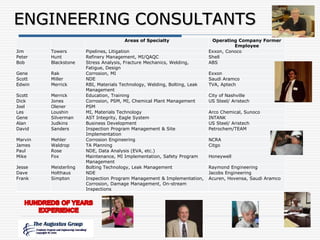
Areas of Specialty Operating Company Former
Employee
Jim Towers Pipelines, Litigation Exxon, Conoco
Peter Hunt Refinery Management, MI/QAQC Shell
Bob Blackstone Stress Analysis, Fracture Mechanics, Welding,
Fatigue, Design
ABS
Gene Rak Corrosion, MI Exxon
Scott Miller NDE Saudi Aramco
Edwin Merrick RBI, Materials Technology, Welding, Bolting, Leak
Management
TVA, Aptech
Scott Merrick Education, Training City of Nashville
Dick Jones Corrosion, PSM, MI, Chemical Plant Management US Steel/ Aristech
Joel Olener PSM
Les Loushin MI, Materials Technology Arco Chemical, Sunoco
Gene Silverman AST Integrity, Eagle System INTANK
Alan Judkins Business Development US Steel/ Aristech
David Sanders Inspection Program Management & Site
Implementation
Petrochem/TEAM
Marvin Mehler Corrosion Engineering NCRA
James Waldrop TA Planning Citgo
Paul Rose NDE, Data Analysis (EVA, etc.)
Mike Fox Maintenance, MI Implementation, Safety Program
Management
Honeywell
Jesse Meisterling Bolting Technology, Leak Management Raymond Engineering
Dave Holthaus NDE Jacobs Engineering
Frank Simpton Inspection Program Management & Implementation,
Corrosion, Damage Management, On-stream
Inspections
Acuren, Hovensa, Saudi Aramco
ENGINEERING CONSULTANTS
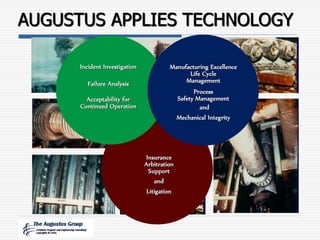
AUGUSTUS APPLIES TECHNOLOGY
Manufacturing Excellence
Life Cycle
Management
Process
Safety Management
and
Mechanical Integrity
Incident Investigation
Failure Analysis
Acceptability for
Continued Operation
Insurance
Arbitration
Support
and
Litigation
 2/19 - Improving your Turnaround
Performance by Managing for Leak Free
Startup – Webinar
 2/26 11am CST, Use Risk Based Inspection
Tools for Optimizing Performance – Webinar
 3/5, 11am CST, Managing Your On-Stream
Inspection Program and External Versus
Internal Inspections - Webinar
 3/12, 11am CST, Managing Corrosion Under
Insulation - Webinar
 3/17 & 3/18 – MI for PSM Compliance
SEMINAR
 MORE TO BE SCHEDULED, CHECK
WWW.THEAUGUSTUSGROUP.NET
WEBINAR/SEMINAR SERIES – HELPING OUR
CUSTOMERS ALIGN WITH BUSINESS OBJECTIVES
Managing Corrosion Under
Insulation
Moderator = Ed Merrick – TVA, APTECH
Panelists = Peter Hunt – Engen, Shell, Sunoco, Dupont
Frank Simpton – Amoco, Saudi Aramco, Hovensa,
Acuren, Jacobs
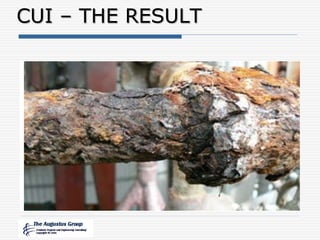
CORROSION UNDER INSULATION (CUI)
 Well known phenomena
 Cost wise is the worst type of corrosion
 Gulf coast represents over 70% of
corrosion issues, elsewhere averages
between 40-60% of piping costs
 Corrosion can be galvanic, chloride,
acidic or alkaline
 Potential for a major Process Safety
Incident
CUI – THE RESULT
CUI – HISTORY
 If you insulate metal, you have a potential for CUI
 ASTM STP 880 “Corrosion of Metals Under Thermal Insulation” in
1985
 Recommended use of multiple NDE techniques
 NACE RP 0198-98 “The Control of Corrosion Under
Thermal Insulation and Fireproofing Materials - A
Systems Approach”
 Recommended use of protective coatings
 Experience in 2003
 Trying a number of techniques
 Indicated 100% stripping of insulation only certain method
 Better techniques and processes now used
CUI - CAUSES
 Temperature Range – +25F to 300F, but can
occur at higher temperatures, worse in cyclic
conditions
 Coating – breakdown of the coating barrier
Average Coating life is 5-12 years
 Insulation – wicks and retains moisture
Worst insulations are Mineral wool and CalSil
 Lagging – penetrations and poor maintenance
Choice between AL or SS
CUI – TYPES
 Galvanic - wet insulation with an electrolyte
present which allows a current to flow between
metals of different corrosion potential
 Chloride - a combination of insulation
containing leachable chlorides with the 300
series austenitic stainless steel surfaces
 Acidic/Alkaline - either an alkali or an acid are
present in certain fibrous or granular
insulations, which is inadvertently mixed with
moisture in the environment
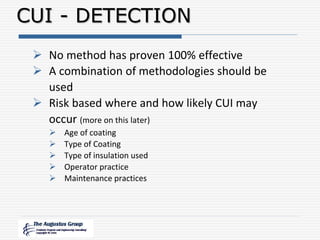
 No method has proven 100% effective
 A combination of methodologies should be
used
 Risk based where and how likely CUI may
occur (more on this later)
 Age of coating
 Type of Coating
 Type of insulation used
 Operator practice
 Maintenance practices
CUI - DETECTION
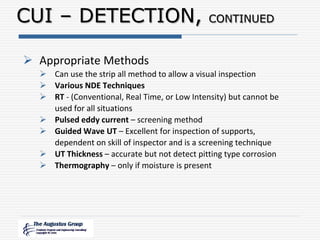
 Appropriate Methods
 Can use the strip all method to allow a visual inspection
 Various NDE Techniques
 RT - (Conventional, Real Time, or Low Intensity) but cannot be
used for all situations
 Pulsed eddy current – screening method
 Guided Wave UT – Excellent for inspection of supports,
dependent on skill of inspector and is a screening technique
 UT Thickness – accurate but not detect pitting type corrosion
 Thermography – only if moisture is present
CUI – DETECTION, CONTINUED
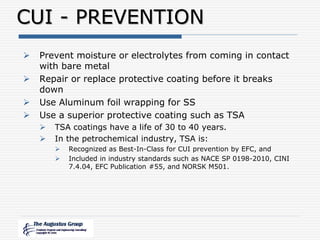
CUI - PREVENTION
 Prevent moisture or electrolytes from coming in contact
with bare metal
 Repair or replace protective coating before it breaks
down
 Use Aluminum foil wrapping for SS
 Use a superior protective coating such as TSA
 TSA coatings have a life of 30 to 40 years.
 In the petrochemical industry, TSA is:
 Recognized as Best-In-Class for CUI prevention by EFC, and
 Included in industry standards such as NACE SP 0198-2010, CINI
7.4.04, EFC Publication #55, and NORSK M501.
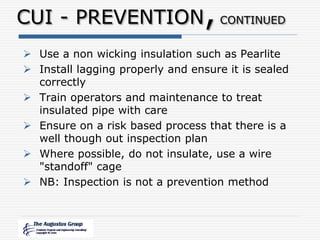
CUI - PREVENTION,CONTINUED
 Use a non wicking insulation such as Pearlite
 Install lagging properly and ensure it is sealed
correctly
 Train operators and maintenance to treat
insulated pipe with care
 Ensure on a risk based process that there is a
well though out inspection plan
 Where possible, do not insulate, use a wire
"standoff" cage
 NB: Inspection is not a prevention method
CUI – INFORMATION SOURCES
 API – 510/570
 API RP 583, Corrosion Under
Insulation and Fireproofing
 NACE SP0198-2010, Control of
Corrosion Under Thermal Insulation
and Fireproofing Materials – A
Systems Approach
WHERE TO INSPECT
 Highest priority to equipment and
piping where:
 Water can be trapped
 Equipment operates near cooling
towers, sea breeze or steam
condensate
 Surface condensation is a factor
 Previous history of
weatherproofing deterioration
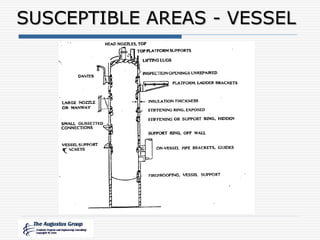
VESSEL INSPECTIONS
 Typical areas most vulnerable
include:
 Top platform supports
 Ladder supports
 Exposed stiffing or support
rings
 Small gusset supports
 Nozzles and manways
SUSCEPTIBLE AREAS - VESSEL
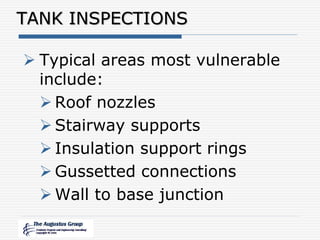
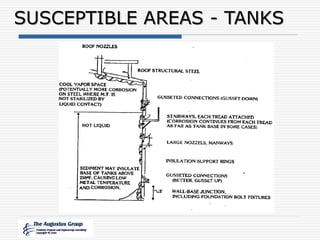
TANK INSPECTIONS
 Typical areas most vulnerable
include:
 Roof nozzles
 Stairway supports
 Insulation support rings
 Gussetted connections
 Wall to base junction
SUSCEPTIBLE AREAS - TANKS
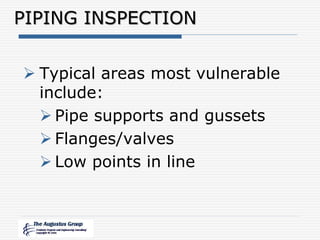
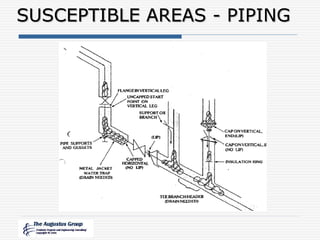
PIPING INSPECTION
 Typical areas most vulnerable
include:
 Pipe supports and gussets
 Flanges/valves
 Low points in line
SUSCEPTIBLE AREAS - PIPING
EVALUATION OF CUI CORROSION
 Baseline CUI Inspections to Find
and Mitigate Problems in Piping and
Fixed Equipment
 RBI or Classification of Piping to
Prioritize Work
 VT Inspection of Insulated Piping with
IR Inspection of Insulated Piping to
Complement VT
26
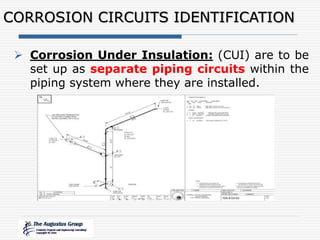
CORROSION CIRCUITS IDENTIFICATION
 Corrosion Under Insulation: (CUI) are to be
set up as separate piping circuits within the
piping system where they are installed.
AUGUSTUS CORROSION UNDER
INSULATION (CUI) DAMAGE
MANAGEMENT
QUALITY REVIEW/AUDIT OF INSPECTION
DOCUMENTATION
 ? Are You Actively Managing CUI
 ? Do You Have a Risk Based Approach
 Typical Augustus Review/Audit
 Assess Quality Of VT and UT Inspection
Documentation and Data
 Procedures
 Qualifications Of Inspectors
 Results
 Interviews with Management Engineers and
Inspectors
 Identifies Opportunities For
 External Vs Internal Inspections
 Input To RBI Program
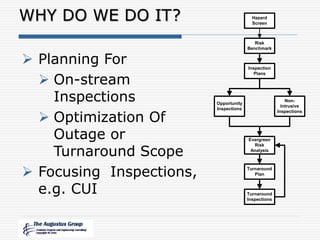
WHY DO WE DO IT?
 Planning For
 On-stream
Inspections
 Optimization Of
Outage or
Turnaround Scope
 Focusing Inspections,
e.g. CUI
Hazard
Screen
Risk
Benchmark
Inspection
Plans
Non-
Intrusive
Inspections
Opportunity
Inspections
Turnaround
Plan
Evergreen
Risk
Analysis
Turnaround
Inspections
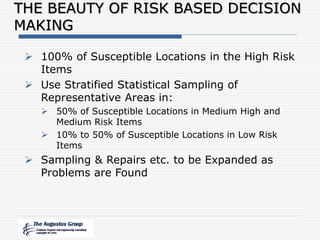
THE BEAUTY OF RISK BASED DECISION
MAKING
 100% of Susceptible Locations in the High Risk
Items
 Use Stratified Statistical Sampling of
Representative Areas in:
 50% of Susceptible Locations in Medium High and
Medium Risk Items
 10% to 50% of Susceptible Locations in Low Risk
Items
 Sampling & Repairs etc. to be Expanded as
Problems are Found
QUALITATIVE RB CUI MANAGEMENT
 Relies On Expert Judgment and Weighting
of Qualitative Factors
 Group Meeting To Review Procedures And
Agree On Scope, Approach, And Details Of
Review
 Maintenance
 Inspection
 Engineering
 Operations
 Contractors?
 We Recommend Integration with PHA
WHAT DOES THE QRA LOOK LIKE
 Qualitative Risk Analysis &
Prioritization
 Gut Level Sensibility Calibration for
 RBI Analysis of Items
 Inspection Data
 Add Financial Implications Aligned with
Business Case
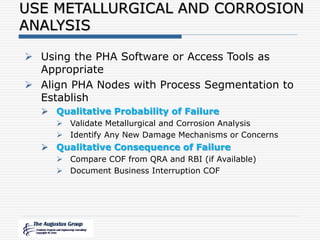
USE METALLURGICAL AND CORROSION
ANALYSIS
 Using the PHA Software or Access Tools as
Appropriate
 Align PHA Nodes with Process Segmentation to
Establish
 Qualitative Probability of Failure
 Validate Metallurgical and Corrosion Analysis
 Identify Any New Damage Mechanisms or Concerns
 Qualitative Consequence of Failure
 Compare COF from QRA and RBI (if Available)
 Document Business Interruption COF
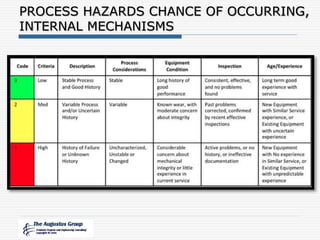
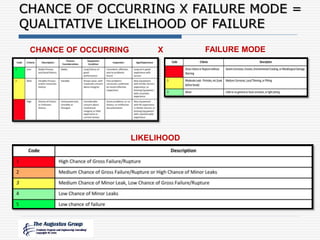
PROCESS HAZARDS CHANCE OF OCCURRING,
INTERNAL MECHANISMS
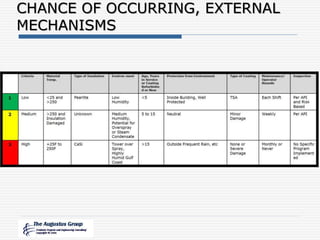
CHANCE OF OCCURRING, EXTERNAL
MECHANISMS
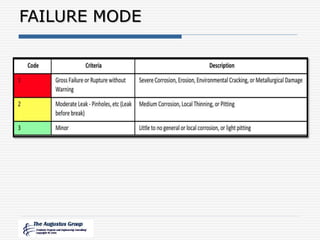
FAILURE MODE
CHANCE OF OCCURRING X FAILURE MODE =
QUALITATIVE LIKELIHOOD OF FAILURE
CHANCE OF OCCURRING X FAILURE MODE
LIKELIHOOD
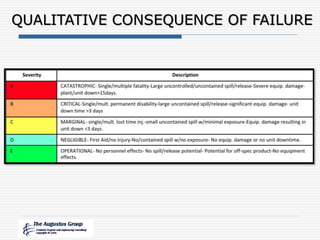
QUALITATIVE CONSEQUENCE OF FAILURE
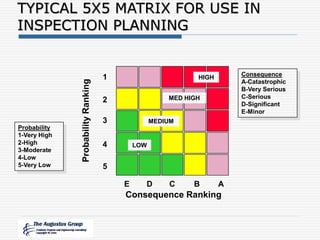
TYPICAL 5X5 MATRIX FOR USE IN
INSPECTION PLANNING
Consequence Ranking
ABCDE
HIGH
MED HIGH
MEDIUM
LOW
1
2
3
4
5
ProbabilityRanking
Consequence
A-Catastrophic
B-Very Serious
C-Serious
D-Significant
E-Minor
Probability
1-Very High
2-High
3-Moderate
4-Low
5-Very Low
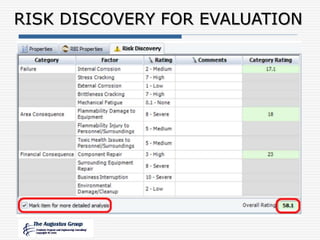
RISK DISCOVERY FOR EVALUATION
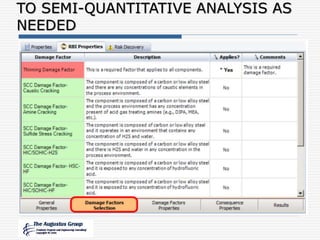
TO SEMI-QUANTITATIVE ANALYSIS AS
NEEDED
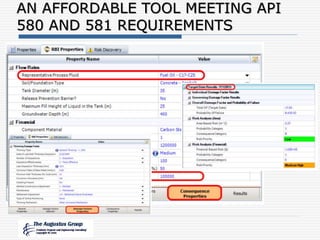
AN AFFORDABLE TOOL MEETING API
580 AND 581 REQUIREMENTS
SUMMARY
 Wet insulation is primary cause
of CUI
 Good design is a necessity
 Proper repairs of damaged
weatherproofing
 Good inspection program
concentrated or areas of
vulnerability
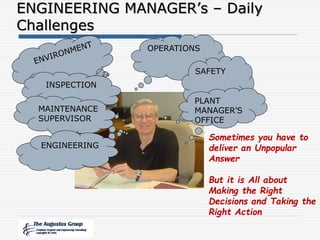
Sometimes you have to
deliver an Unpopular
Answer
But it is All about
Making the Right
Decisions and Taking the
Right Action
OPERATIONS
SAFETY
INSPECTION
MAINTENANCE
SUPERVISOR
ENGINEERING
PLANT
MANAGER’S
OFFICE
ENGINEERING MANAGER’s – Daily
Challenges
RISK MANAGEMENT – Consider
Augustus’ MI Seminar in March

Augustus Managing Corrosion Under Insulation Webinar

  • 1.
    Introduction to Augustus2015 Seminar/ Webinar Series Moderator= Ed Merrick – TVA, APTECH Panelists = Peter Hunt – Engen, Shell, Sunoco, Dupont Frank Simpton – Amoco, Saudi Aramco, Hovensa, Acuren, Jacobs
  • 2.
    THE AUGUSTUS GROUP,LLC (AUGUSTUS) – WHO ARE WE?  Founded in Houston Texas in 2004  Privately Owned Small Business Registered in SAM Program  Engineering and Consulting Services to Refining and Chemicals and Aerospace Industry for >10 Years  Focus is on Materials Technology, Asset Integrity Problem Solving, and Risk Management On and Off Shore  Collective Experience in……  Bolting Technology and Leak Management  Materials Technology, Failure Analysis, Non- Destructive Examination, Suitability for Service  Fitness for Service and Risk Based Inspection  Aerospace, Petroleum and Chemical, Fossil/Nuclear Power Consulting Upstream and Downstream
  • 3.
     Wrote ChemicalManufacturer’s Association’s Mechanical Integrity Supplement used to Train Over 300 Member Companies  >20 RBI Implementations Since 1995,  First Known Refinery Program at BHP Hawaii,  NASA Johnson and Stennis AFB  Developed APTECH’s (Now Intertek) RBI Program and Software  Experience with Most Major Software Packages & Programs – Tichuk, Meridium, PCMS, The Welding Institute, Capstone, Reliasoft  Full Scope RBI Implementations  Using Capstone and PCMS Software  Management Systems, Procedures, Audits, Training EXPERIENCE - MECHANICAL INTEGRITY AND RBI
  • 4.
    Areas of SpecialtyOperating Company Former Employee Jim Towers Pipelines, Litigation Exxon, Conoco Peter Hunt Refinery Management, MI/QAQC Shell Bob Blackstone Stress Analysis, Fracture Mechanics, Welding, Fatigue, Design ABS Gene Rak Corrosion, MI Exxon Scott Miller NDE Saudi Aramco Edwin Merrick RBI, Materials Technology, Welding, Bolting, Leak Management TVA, Aptech Scott Merrick Education, Training City of Nashville Dick Jones Corrosion, PSM, MI, Chemical Plant Management US Steel/ Aristech Joel Olener PSM Les Loushin MI, Materials Technology Arco Chemical, Sunoco Gene Silverman AST Integrity, Eagle System INTANK Alan Judkins Business Development US Steel/ Aristech David Sanders Inspection Program Management & Site Implementation Petrochem/TEAM Marvin Mehler Corrosion Engineering NCRA James Waldrop TA Planning Citgo Paul Rose NDE, Data Analysis (EVA, etc.) Mike Fox Maintenance, MI Implementation, Safety Program Management Honeywell Jesse Meisterling Bolting Technology, Leak Management Raymond Engineering Dave Holthaus NDE Jacobs Engineering Frank Simpton Inspection Program Management & Implementation, Corrosion, Damage Management, On-stream Inspections Acuren, Hovensa, Saudi Aramco ENGINEERING CONSULTANTS
  • 5.
    AUGUSTUS APPLIES TECHNOLOGY ManufacturingExcellence Life Cycle Management Process Safety Management and Mechanical Integrity Incident Investigation Failure Analysis Acceptability for Continued Operation Insurance Arbitration Support and Litigation
  • 6.
     2/19 -Improving your Turnaround Performance by Managing for Leak Free Startup – Webinar  2/26 11am CST, Use Risk Based Inspection Tools for Optimizing Performance – Webinar  3/5, 11am CST, Managing Your On-Stream Inspection Program and External Versus Internal Inspections - Webinar  3/12, 11am CST, Managing Corrosion Under Insulation - Webinar  3/17 & 3/18 – MI for PSM Compliance SEMINAR  MORE TO BE SCHEDULED, CHECK WWW.THEAUGUSTUSGROUP.NET WEBINAR/SEMINAR SERIES – HELPING OUR CUSTOMERS ALIGN WITH BUSINESS OBJECTIVES
  • 7.
    Managing Corrosion Under Insulation Moderator= Ed Merrick – TVA, APTECH Panelists = Peter Hunt – Engen, Shell, Sunoco, Dupont Frank Simpton – Amoco, Saudi Aramco, Hovensa, Acuren, Jacobs
  • 8.
    CORROSION UNDER INSULATION(CUI)  Well known phenomena  Cost wise is the worst type of corrosion  Gulf coast represents over 70% of corrosion issues, elsewhere averages between 40-60% of piping costs  Corrosion can be galvanic, chloride, acidic or alkaline  Potential for a major Process Safety Incident
  • 9.
  • 10.
    CUI – HISTORY If you insulate metal, you have a potential for CUI  ASTM STP 880 “Corrosion of Metals Under Thermal Insulation” in 1985  Recommended use of multiple NDE techniques  NACE RP 0198-98 “The Control of Corrosion Under Thermal Insulation and Fireproofing Materials - A Systems Approach”  Recommended use of protective coatings  Experience in 2003  Trying a number of techniques  Indicated 100% stripping of insulation only certain method  Better techniques and processes now used
  • 11.
    CUI - CAUSES Temperature Range – +25F to 300F, but can occur at higher temperatures, worse in cyclic conditions  Coating – breakdown of the coating barrier Average Coating life is 5-12 years  Insulation – wicks and retains moisture Worst insulations are Mineral wool and CalSil  Lagging – penetrations and poor maintenance Choice between AL or SS
  • 12.
    CUI – TYPES Galvanic - wet insulation with an electrolyte present which allows a current to flow between metals of different corrosion potential  Chloride - a combination of insulation containing leachable chlorides with the 300 series austenitic stainless steel surfaces  Acidic/Alkaline - either an alkali or an acid are present in certain fibrous or granular insulations, which is inadvertently mixed with moisture in the environment
  • 13.
     No methodhas proven 100% effective  A combination of methodologies should be used  Risk based where and how likely CUI may occur (more on this later)  Age of coating  Type of Coating  Type of insulation used  Operator practice  Maintenance practices CUI - DETECTION
  • 14.
     Appropriate Methods Can use the strip all method to allow a visual inspection  Various NDE Techniques  RT - (Conventional, Real Time, or Low Intensity) but cannot be used for all situations  Pulsed eddy current – screening method  Guided Wave UT – Excellent for inspection of supports, dependent on skill of inspector and is a screening technique  UT Thickness – accurate but not detect pitting type corrosion  Thermography – only if moisture is present CUI – DETECTION, CONTINUED
  • 15.
    CUI - PREVENTION Prevent moisture or electrolytes from coming in contact with bare metal  Repair or replace protective coating before it breaks down  Use Aluminum foil wrapping for SS  Use a superior protective coating such as TSA  TSA coatings have a life of 30 to 40 years.  In the petrochemical industry, TSA is:  Recognized as Best-In-Class for CUI prevention by EFC, and  Included in industry standards such as NACE SP 0198-2010, CINI 7.4.04, EFC Publication #55, and NORSK M501.
  • 16.
    CUI - PREVENTION,CONTINUED Use a non wicking insulation such as Pearlite  Install lagging properly and ensure it is sealed correctly  Train operators and maintenance to treat insulated pipe with care  Ensure on a risk based process that there is a well though out inspection plan  Where possible, do not insulate, use a wire "standoff" cage  NB: Inspection is not a prevention method
  • 17.
    CUI – INFORMATIONSOURCES  API – 510/570  API RP 583, Corrosion Under Insulation and Fireproofing  NACE SP0198-2010, Control of Corrosion Under Thermal Insulation and Fireproofing Materials – A Systems Approach
  • 18.
    WHERE TO INSPECT Highest priority to equipment and piping where:  Water can be trapped  Equipment operates near cooling towers, sea breeze or steam condensate  Surface condensation is a factor  Previous history of weatherproofing deterioration
  • 19.
    VESSEL INSPECTIONS  Typicalareas most vulnerable include:  Top platform supports  Ladder supports  Exposed stiffing or support rings  Small gusset supports  Nozzles and manways
  • 20.
  • 21.
    TANK INSPECTIONS  Typicalareas most vulnerable include:  Roof nozzles  Stairway supports  Insulation support rings  Gussetted connections  Wall to base junction
  • 22.
  • 23.
    PIPING INSPECTION  Typicalareas most vulnerable include:  Pipe supports and gussets  Flanges/valves  Low points in line
  • 24.
  • 25.
    EVALUATION OF CUICORROSION  Baseline CUI Inspections to Find and Mitigate Problems in Piping and Fixed Equipment  RBI or Classification of Piping to Prioritize Work  VT Inspection of Insulated Piping with IR Inspection of Insulated Piping to Complement VT
  • 26.
    26 CORROSION CIRCUITS IDENTIFICATION Corrosion Under Insulation: (CUI) are to be set up as separate piping circuits within the piping system where they are installed.
  • 27.
    AUGUSTUS CORROSION UNDER INSULATION(CUI) DAMAGE MANAGEMENT
  • 28.
    QUALITY REVIEW/AUDIT OFINSPECTION DOCUMENTATION  ? Are You Actively Managing CUI  ? Do You Have a Risk Based Approach  Typical Augustus Review/Audit  Assess Quality Of VT and UT Inspection Documentation and Data  Procedures  Qualifications Of Inspectors  Results  Interviews with Management Engineers and Inspectors  Identifies Opportunities For  External Vs Internal Inspections  Input To RBI Program
  • 29.
    WHY DO WEDO IT?  Planning For  On-stream Inspections  Optimization Of Outage or Turnaround Scope  Focusing Inspections, e.g. CUI Hazard Screen Risk Benchmark Inspection Plans Non- Intrusive Inspections Opportunity Inspections Turnaround Plan Evergreen Risk Analysis Turnaround Inspections
  • 30.
    THE BEAUTY OFRISK BASED DECISION MAKING  100% of Susceptible Locations in the High Risk Items  Use Stratified Statistical Sampling of Representative Areas in:  50% of Susceptible Locations in Medium High and Medium Risk Items  10% to 50% of Susceptible Locations in Low Risk Items  Sampling & Repairs etc. to be Expanded as Problems are Found
  • 31.
    QUALITATIVE RB CUIMANAGEMENT  Relies On Expert Judgment and Weighting of Qualitative Factors  Group Meeting To Review Procedures And Agree On Scope, Approach, And Details Of Review  Maintenance  Inspection  Engineering  Operations  Contractors?  We Recommend Integration with PHA
  • 32.
    WHAT DOES THEQRA LOOK LIKE  Qualitative Risk Analysis & Prioritization  Gut Level Sensibility Calibration for  RBI Analysis of Items  Inspection Data  Add Financial Implications Aligned with Business Case
  • 33.
    USE METALLURGICAL ANDCORROSION ANALYSIS  Using the PHA Software or Access Tools as Appropriate  Align PHA Nodes with Process Segmentation to Establish  Qualitative Probability of Failure  Validate Metallurgical and Corrosion Analysis  Identify Any New Damage Mechanisms or Concerns  Qualitative Consequence of Failure  Compare COF from QRA and RBI (if Available)  Document Business Interruption COF
  • 34.
    PROCESS HAZARDS CHANCEOF OCCURRING, INTERNAL MECHANISMS
  • 35.
    CHANCE OF OCCURRING,EXTERNAL MECHANISMS
  • 36.
  • 37.
    CHANCE OF OCCURRINGX FAILURE MODE = QUALITATIVE LIKELIHOOD OF FAILURE CHANCE OF OCCURRING X FAILURE MODE LIKELIHOOD
  • 38.
  • 39.
    TYPICAL 5X5 MATRIXFOR USE IN INSPECTION PLANNING Consequence Ranking ABCDE HIGH MED HIGH MEDIUM LOW 1 2 3 4 5 ProbabilityRanking Consequence A-Catastrophic B-Very Serious C-Serious D-Significant E-Minor Probability 1-Very High 2-High 3-Moderate 4-Low 5-Very Low
  • 40.
  • 41.
  • 42.
    AN AFFORDABLE TOOLMEETING API 580 AND 581 REQUIREMENTS
  • 43.
    SUMMARY  Wet insulationis primary cause of CUI  Good design is a necessity  Proper repairs of damaged weatherproofing  Good inspection program concentrated or areas of vulnerability
  • 44.
    Sometimes you haveto deliver an Unpopular Answer But it is All about Making the Right Decisions and Taking the Right Action OPERATIONS SAFETY INSPECTION MAINTENANCE SUPERVISOR ENGINEERING PLANT MANAGER’S OFFICE ENGINEERING MANAGER’s – Daily Challenges
  • 45.
    RISK MANAGEMENT –Consider Augustus’ MI Seminar in March