SCHOOL OF ENGINEERING & TECHNOLOGY
BABA GHULAM SHAH BADSHAH UNIVERSITY RAJOURI
J&K INDIA
SEMINAR
ON
AUDITING AND CONSERVATION OF RENEWABLE ENERGY
RESOURCES
Presented By:
TABASUM ZAHID
20-EE-2018
Department of Electrical Engineering
Contents
• Introduction to Audit and its types
• Introduction to preliminary and detailed audit
• Introduction to pre audit ,audit phase and post audit phase
• Need of Audit
• Benchmarking
• Energy and Types of energy
• Introduction to Renewable energy and its types
• Introduction to Wind energy , Hydro energy
• Introduction to Solar energy
• Introduction to biomass energy
• Introduction to Non-Renewable energy and its types
• Introduction to coal and uranium
• Difference between Renewable and Non-Renewable source of energy
• Energy conservation and why to conserve?
• Energy conservation in INDIA and data related to energy consumption in INDIA
• How and what we can do to conserve the energy
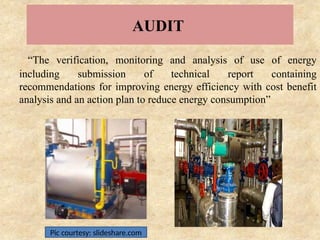
AUDIT
“The verification, monitoring and analysis of use of energy
including submission of technical report containing
recommendations for improving energy efficiency with cost benefit
analysis and an action plan to reduce energy consumption”
Pic courtesy: slideshare.com
TYPE OF AUDIT
The type of Energy Audit to be performed depends on:
• Function and type of industry
• Depth to which final audit is needed, and
• Potential and magnitude of cost reduction desired
Thus Energy Audit can be classified into the following two types:
i) Preliminary Audit
ii) Detailed Audit
INTRODUCTION TO PRELIMINARY AUDIT
 Preliminary energy audit is relatively quick exercise to:-
1. Establish energy consumption in organization Estimate scope
of saving.
2. Identify the easiest areas of attention.
3. Identify immediate improvement/savings.
4. Set a reference point.
5. Identify areas for more detailed study.
6. It uses existing or easily obtained data.
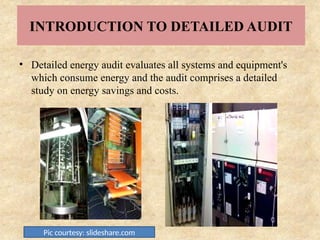
INTRODUCTION TO DETAILED AUDIT
• Detailed energy audit evaluates all systems and equipment's
which consume energy and the audit comprises a detailed
study on energy savings and costs.
Pic courtesy: slideshare.com
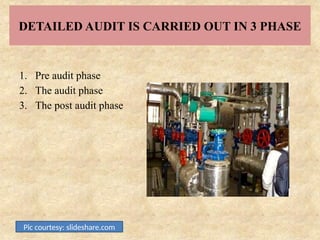
DETAILED AUDIT IS CARRIED OUT IN 3 PHASE
1. Pre audit phase
2. The audit phase
3. The post audit phase
Pic courtesy: slideshare.com
INTRODUCTION TO PRE AUDIT AND POST AUDIT
PHASE
 Step1-plan and organize
1. Walk through audit.
2. Interview with energy manager.
 Step2-conduct brief meeting
1. Building cooperation.
2. Issue questionnaire.
POST AUDIT PHASE :
• Step 1 - implementation and follow – up
1. Assist and implement energy conservation recommendation
measures and monitor the performance
INTRODUCTION TO AUDIT PHASE
 Step 1 - primary data gathering , pfc , energy utility diagram
1. Historic data.
2. Process flow charts.
3. Design operating data schedule.
4. Annual energy bill.
 Step2 - conduct survey monitoring
1. Motor lighting insulation survey with portable instruments.
 Step3 - conduct detailed trials
1. 24 hr power monitoring.
 Step4 - analysis of energy use
 Step5 - identification and development of energy conservation
opportunities
• Step 6 - cost benefit analysis
• Step 7 - reporting and presentation
NEED FOR AUDIT
 To minimize costs for energy.
 To minimize operational costs.
 To minimize costs for repairs and reconstruction.
 Increase quality of environment that contributes to
increased work productivity.
BENCHMARKING
 It can be a useful tool for understanding energy
consumption patterns in the industrial sector and also to
take requisite measures for improving energy efficiency.
 Factors involved.
1. Scale of operation.
2. Vintage of technology.
3. Raw material specification and quality.
4. Product specification and quality.
BENCHMARKING FOR ENERGY PERFORMANCE
• Internal benchmarking
Historical and trend analysis
• External benchmarking
Across familiar industries
BENCHMARKING ENERGY PERFORMANCE
• Quantification of fixed and variable energy consumption trends
• Comparison of industry energy performance w.r.t various production levels
• identification of best practices
• Scope and margin available for energy consumption and cost reduction
• Basis for monitoring and target setting exercises
ENERGY AND TYPES OF ENERGY
• Energy can neither be created nor it can be destroyed. But it can
only be converted into from one form to another form.
or
• Energy is a property of matter that can be converted into work, heat,
or radiation.
• Energy can be broadly divided into two categories:-
 Renewable energy E.g. Solar, wind, hydro etc.
 Non- Renewable energy E.g. Petroleum products ( kerosene,
petrol, diesel, etc), coal etc.
INTRODUCTION TO RENEWABLE ENERGY
AND ITS TYPES
• Renewable energy can be generated continuously practically
without decay of source.
Or
Renewable energy resources are those resources which can be
used to produce energy again and again.
• Example :
– Solar
– Wind
– Geothermal
– Hydro
– Biomass
– Tidal
INTRODUCTION TO WIND ENERGY , HYDRO
ENERGY
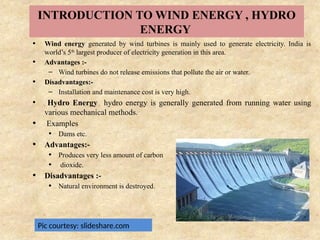
• Wind energy generated by wind turbines is mainly used to generate electricity. India is
world’s 5th
largest producer of electricity generation in this area.
• Advantages :-
– Wind turbines do not release emissions that pollute the air or water.
• Disadvantages:-
– Installation and maintenance cost is very high.
• Hydro Energy hydro energy is generally generated from running water using
various mechanical methods.
• Examples
• Dams etc.
• Advantages:-
• Produces very less amount of carbon
• dioxide.
• Disadvantages :-
• Natural environment is destroyed.
Pic courtesy: slideshare.com
INTRODUCTION TO SOLAR
ENERGY
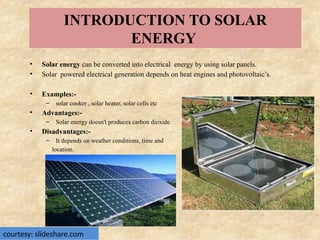
• Solar energy can be converted into electrical energy by using solar panels.
• Solar powered electrical generation depends on heat engines and photovoltaic’s.
• Examples:-
– solar cooker , solar heater, solar cells etc
• Advantages:-
– Solar energy doesn't produces carbon dioxide
• Disadvantages:-
– It depends on weather conditions, time and
location.
courtesy: slideshare.com
INTRODUCTION TO BIOMASS
ENERGY
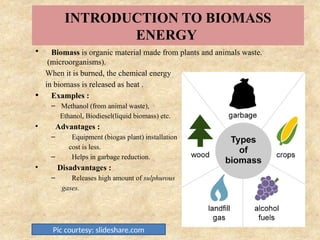
• Biomass is organic material made from plants and animals waste.
(microorganisms).
When it is burned, the chemical energy
in biomass is released as heat .
• Examples :
– Methanol (from animal waste),
Ethanol, Biodiesel(liquid biomass) etc.
• Advantages :
– Equipment (biogas plant) installation
cost is less.
– Helps in garbage reduction.
• Disadvantages :
– Releases high amount of sulphurous
gases.
Pic courtesy: slideshare.com
INTRODUCTION TO NON-RENEWABLE ENERGY AND
ITS TYPES
• Non- renewable energy resources are those resources which cannot be replaced once they are
used. These resources are known as non-renewable resources.
Or
• Non renewable energy can’t be generated again and again form the same source.
• Examples:
– Gases
– Uranium
– Petroleum products ( kerosene, petrol, diesel, etc )
– Coal
• The Non renewable energy ( gases, coal, uranium etc.) are limited and would be exhausted
within prescribed period of time. Greater usage of such fuels would result in energy crisis and
supply cannot be adjusted according to demand.
INTRODUCTION TO COALAND
URANIUM
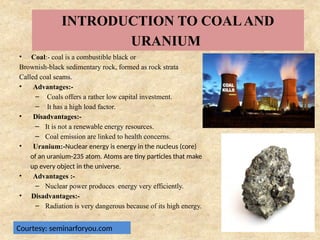
• Coal:- coal is a combustible black or
Brownish-black sedimentary rock, formed as rock strata
Called coal seams.
• Advantages:-
– Coals offers a rather low capital investment.
– It has a high load factor.
• Disadvantages:-
– It is not a renewable energy resources.
– Coal emission are linked to health concerns.
• Uranium:-Nuclear energy is energy in the nucleus (core)
of an uranium-235 atom. Atoms are tiny particles that make
up every object in the universe.
• Advantages :-
– Nuclear power produces energy very efficiently.
• Disadvantages:-
– Radiation is very dangerous because of its high energy.
Courtesy: seminarforyou.com
Difference between Renewable and Non-
renewable sources of energy
Renewable energy
• Definition : Renewable energy
resources are those resources which
can be used to produce energy again
and again.
• These are eco friendly resources.
• Not a reason behind global warming,
acid rain, emission of carbon dioxide
etc.
• Examples solar energy, hydro energy.
Wind energy etc.
Non-Renewable energy
• Definition: Non- renewable
energy resources are those resources
which cannot be replaced once they
are used.
• These are harmful for environment.
• Main reason behind global warming,
acid rain, emission of carbon dioxide
and carbon monoxide.
• Examples coal, oil, natural gases etc.
ENERGY CONSERVATION
• Energy conservation is the key element in energy
management.
• Energy conservation refers to efforts made to reduce energy
consumption.
• Energy conservation can be achieved through increased
efficient energy use or reduced consumption from
conventional energy sources.
• Electrical energy conservation is an important element of
energy policy.
ENERGY CONSERVATION IN INDIAAND DATA
RELATED TO ENERGY CONSUMPTION IN INDIA
• In India , government has passed “ energy conservation bill, 2001 ” for better utilization of energy and
conservation of the same.
• By this act, it is mandatory for energy intensive sectors to get their “energy audit ” conducted by
energy auditor.
• Bureau of energy efficiency : this body keeps watch on energy consumption patterns,
develops norm for appliances etc.
• Star ratings : BEE has also initiated “star rating system” for electrical appliances e.g. - CFL’S ,
geysers, refrigerator, etc.
• Data related to energy consumption in INDIA
• About 70% of India's energy generation capacity is from fossil fuels, with coal accounting for 40% of
India's total energy consumption followed by crude oil and natural gas at 24% and 6% respectively.
• By 2030, India's dependence on energy imports is expected to exceed 53% of the country's total energy
consumption. In 2009-10, the country imported 159.26 million tonnes of crude oil which amount to
80% of its domestic crude oil consumption .
• In India 31% of the country's total imports are oil imports.
HOW AND WHAT WE CAN DO TO CONSERVE THE
ENERGY
• Always switch off light and fans while going out of room.
• We should not open fridge frequently.
• While going to purchase new products eg. Geysers, television,CFL , other electronic
gadgets etc. insist for ratings ranging from 4-5 .
• Increase everyone's understanding of the benefits of energy efficiency.
• RECYCLE waste materials into new products to prevent waste of potentially useful
materials.
• REPLACE old light bulbs with energy saving fluorescent bulbs. They may cost more,
but will save you much more in the long run.
• Replace old equipments with new technology and also check their efficiency and
maintenance also.
• THREE R’s
• The slogan reduce, reuse, recycle is widely used to raise awareness against the use of
non-renewable source of energy.
• • Reduce consumption
• • Reuse manufactured products
• • Recycle raw materials
REFRENCES
1. WIKIPEDIA
2. NON.CONVENTIONAL ENERGY RESOURSES BY HASAN
SAYED
3. ENERGY AUDIT AND CONSERVATION BY UMESH RATHORE
4. SLIDESHARE.COM
5. SEMINARFORYOU.COM
THANK YOU

AUDITIG and renewable energy engineering.pptx

  • 1.
    SCHOOL OF ENGINEERING& TECHNOLOGY BABA GHULAM SHAH BADSHAH UNIVERSITY RAJOURI J&K INDIA SEMINAR ON AUDITING AND CONSERVATION OF RENEWABLE ENERGY RESOURCES Presented By: TABASUM ZAHID 20-EE-2018 Department of Electrical Engineering
  • 2.
    Contents • Introduction toAudit and its types • Introduction to preliminary and detailed audit • Introduction to pre audit ,audit phase and post audit phase • Need of Audit • Benchmarking • Energy and Types of energy • Introduction to Renewable energy and its types • Introduction to Wind energy , Hydro energy • Introduction to Solar energy • Introduction to biomass energy • Introduction to Non-Renewable energy and its types • Introduction to coal and uranium • Difference between Renewable and Non-Renewable source of energy • Energy conservation and why to conserve? • Energy conservation in INDIA and data related to energy consumption in INDIA • How and what we can do to conserve the energy
  • 3.
    AUDIT “The verification, monitoringand analysis of use of energy including submission of technical report containing recommendations for improving energy efficiency with cost benefit analysis and an action plan to reduce energy consumption” Pic courtesy: slideshare.com
  • 4.
    TYPE OF AUDIT Thetype of Energy Audit to be performed depends on: • Function and type of industry • Depth to which final audit is needed, and • Potential and magnitude of cost reduction desired Thus Energy Audit can be classified into the following two types: i) Preliminary Audit ii) Detailed Audit
  • 5.
    INTRODUCTION TO PRELIMINARYAUDIT  Preliminary energy audit is relatively quick exercise to:- 1. Establish energy consumption in organization Estimate scope of saving. 2. Identify the easiest areas of attention. 3. Identify immediate improvement/savings. 4. Set a reference point. 5. Identify areas for more detailed study. 6. It uses existing or easily obtained data.
  • 6.
    INTRODUCTION TO DETAILEDAUDIT • Detailed energy audit evaluates all systems and equipment's which consume energy and the audit comprises a detailed study on energy savings and costs. Pic courtesy: slideshare.com
  • 7.
    DETAILED AUDIT ISCARRIED OUT IN 3 PHASE 1. Pre audit phase 2. The audit phase 3. The post audit phase Pic courtesy: slideshare.com
  • 8.
    INTRODUCTION TO PREAUDIT AND POST AUDIT PHASE  Step1-plan and organize 1. Walk through audit. 2. Interview with energy manager.  Step2-conduct brief meeting 1. Building cooperation. 2. Issue questionnaire. POST AUDIT PHASE : • Step 1 - implementation and follow – up 1. Assist and implement energy conservation recommendation measures and monitor the performance
  • 9.
    INTRODUCTION TO AUDITPHASE  Step 1 - primary data gathering , pfc , energy utility diagram 1. Historic data. 2. Process flow charts. 3. Design operating data schedule. 4. Annual energy bill.  Step2 - conduct survey monitoring 1. Motor lighting insulation survey with portable instruments.  Step3 - conduct detailed trials 1. 24 hr power monitoring.  Step4 - analysis of energy use  Step5 - identification and development of energy conservation opportunities • Step 6 - cost benefit analysis • Step 7 - reporting and presentation
  • 10.
    NEED FOR AUDIT To minimize costs for energy.  To minimize operational costs.  To minimize costs for repairs and reconstruction.  Increase quality of environment that contributes to increased work productivity.
  • 11.
    BENCHMARKING  It canbe a useful tool for understanding energy consumption patterns in the industrial sector and also to take requisite measures for improving energy efficiency.  Factors involved. 1. Scale of operation. 2. Vintage of technology. 3. Raw material specification and quality. 4. Product specification and quality.
  • 12.
    BENCHMARKING FOR ENERGYPERFORMANCE • Internal benchmarking Historical and trend analysis • External benchmarking Across familiar industries BENCHMARKING ENERGY PERFORMANCE • Quantification of fixed and variable energy consumption trends • Comparison of industry energy performance w.r.t various production levels • identification of best practices • Scope and margin available for energy consumption and cost reduction • Basis for monitoring and target setting exercises
  • 13.
    ENERGY AND TYPESOF ENERGY • Energy can neither be created nor it can be destroyed. But it can only be converted into from one form to another form. or • Energy is a property of matter that can be converted into work, heat, or radiation. • Energy can be broadly divided into two categories:-  Renewable energy E.g. Solar, wind, hydro etc.  Non- Renewable energy E.g. Petroleum products ( kerosene, petrol, diesel, etc), coal etc.
  • 14.
    INTRODUCTION TO RENEWABLEENERGY AND ITS TYPES • Renewable energy can be generated continuously practically without decay of source. Or Renewable energy resources are those resources which can be used to produce energy again and again. • Example : – Solar – Wind – Geothermal – Hydro – Biomass – Tidal
  • 15.
    INTRODUCTION TO WINDENERGY , HYDRO ENERGY • Wind energy generated by wind turbines is mainly used to generate electricity. India is world’s 5th largest producer of electricity generation in this area. • Advantages :- – Wind turbines do not release emissions that pollute the air or water. • Disadvantages:- – Installation and maintenance cost is very high. • Hydro Energy hydro energy is generally generated from running water using various mechanical methods. • Examples • Dams etc. • Advantages:- • Produces very less amount of carbon • dioxide. • Disadvantages :- • Natural environment is destroyed. Pic courtesy: slideshare.com
  • 16.
    INTRODUCTION TO SOLAR ENERGY •Solar energy can be converted into electrical energy by using solar panels. • Solar powered electrical generation depends on heat engines and photovoltaic’s. • Examples:- – solar cooker , solar heater, solar cells etc • Advantages:- – Solar energy doesn't produces carbon dioxide • Disadvantages:- – It depends on weather conditions, time and location. courtesy: slideshare.com
  • 17.
    INTRODUCTION TO BIOMASS ENERGY •Biomass is organic material made from plants and animals waste. (microorganisms). When it is burned, the chemical energy in biomass is released as heat . • Examples : – Methanol (from animal waste), Ethanol, Biodiesel(liquid biomass) etc. • Advantages : – Equipment (biogas plant) installation cost is less. – Helps in garbage reduction. • Disadvantages : – Releases high amount of sulphurous gases. Pic courtesy: slideshare.com
  • 18.
    INTRODUCTION TO NON-RENEWABLEENERGY AND ITS TYPES • Non- renewable energy resources are those resources which cannot be replaced once they are used. These resources are known as non-renewable resources. Or • Non renewable energy can’t be generated again and again form the same source. • Examples: – Gases – Uranium – Petroleum products ( kerosene, petrol, diesel, etc ) – Coal • The Non renewable energy ( gases, coal, uranium etc.) are limited and would be exhausted within prescribed period of time. Greater usage of such fuels would result in energy crisis and supply cannot be adjusted according to demand.
  • 19.
    INTRODUCTION TO COALAND URANIUM •Coal:- coal is a combustible black or Brownish-black sedimentary rock, formed as rock strata Called coal seams. • Advantages:- – Coals offers a rather low capital investment. – It has a high load factor. • Disadvantages:- – It is not a renewable energy resources. – Coal emission are linked to health concerns. • Uranium:-Nuclear energy is energy in the nucleus (core) of an uranium-235 atom. Atoms are tiny particles that make up every object in the universe. • Advantages :- – Nuclear power produces energy very efficiently. • Disadvantages:- – Radiation is very dangerous because of its high energy. Courtesy: seminarforyou.com
  • 20.
    Difference between Renewableand Non- renewable sources of energy Renewable energy • Definition : Renewable energy resources are those resources which can be used to produce energy again and again. • These are eco friendly resources. • Not a reason behind global warming, acid rain, emission of carbon dioxide etc. • Examples solar energy, hydro energy. Wind energy etc. Non-Renewable energy • Definition: Non- renewable energy resources are those resources which cannot be replaced once they are used. • These are harmful for environment. • Main reason behind global warming, acid rain, emission of carbon dioxide and carbon monoxide. • Examples coal, oil, natural gases etc.
  • 21.
    ENERGY CONSERVATION • Energyconservation is the key element in energy management. • Energy conservation refers to efforts made to reduce energy consumption. • Energy conservation can be achieved through increased efficient energy use or reduced consumption from conventional energy sources. • Electrical energy conservation is an important element of energy policy.
  • 22.
    ENERGY CONSERVATION ININDIAAND DATA RELATED TO ENERGY CONSUMPTION IN INDIA • In India , government has passed “ energy conservation bill, 2001 ” for better utilization of energy and conservation of the same. • By this act, it is mandatory for energy intensive sectors to get their “energy audit ” conducted by energy auditor. • Bureau of energy efficiency : this body keeps watch on energy consumption patterns, develops norm for appliances etc. • Star ratings : BEE has also initiated “star rating system” for electrical appliances e.g. - CFL’S , geysers, refrigerator, etc. • Data related to energy consumption in INDIA • About 70% of India's energy generation capacity is from fossil fuels, with coal accounting for 40% of India's total energy consumption followed by crude oil and natural gas at 24% and 6% respectively. • By 2030, India's dependence on energy imports is expected to exceed 53% of the country's total energy consumption. In 2009-10, the country imported 159.26 million tonnes of crude oil which amount to 80% of its domestic crude oil consumption . • In India 31% of the country's total imports are oil imports.
  • 23.
    HOW AND WHATWE CAN DO TO CONSERVE THE ENERGY • Always switch off light and fans while going out of room. • We should not open fridge frequently. • While going to purchase new products eg. Geysers, television,CFL , other electronic gadgets etc. insist for ratings ranging from 4-5 . • Increase everyone's understanding of the benefits of energy efficiency. • RECYCLE waste materials into new products to prevent waste of potentially useful materials. • REPLACE old light bulbs with energy saving fluorescent bulbs. They may cost more, but will save you much more in the long run. • Replace old equipments with new technology and also check their efficiency and maintenance also. • THREE R’s • The slogan reduce, reuse, recycle is widely used to raise awareness against the use of non-renewable source of energy. • • Reduce consumption • • Reuse manufactured products • • Recycle raw materials
  • 24.
    REFRENCES 1. WIKIPEDIA 2. NON.CONVENTIONALENERGY RESOURSES BY HASAN SAYED 3. ENERGY AUDIT AND CONSERVATION BY UMESH RATHORE 4. SLIDESHARE.COM 5. SEMINARFORYOU.COM
  • 25.

Editor's Notes