Unit 5 Assignment
Jennifer, I know you spent many hours on this assignment. Your hard work paid off. This is by far the best
assignment I have had submitted and I've been teaching this course using this case for several years. You did a
fantastic job! You exceed expectations on properly indexing your workpapers, cross referencing and footing.
You should be very proud.
I have made comments on the file itself. Please let me know if youhave any questions.
Julie
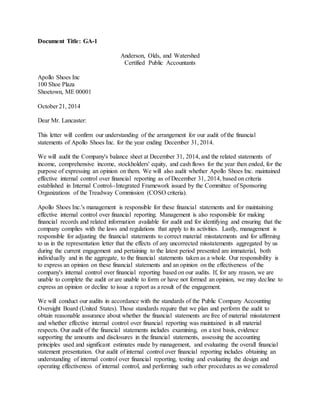
Document Title: GA-1
Anderson, Olds, and Watershed
Certified Public Accountants
Apollo Shoes Inc
100 Shoe Plaza
Shoetown, ME 00001
October 21, 2014
Dear Mr. Lancaster:
This letter will confirm our understanding of the arrangement for our audit of the financial
statements of Apollo Shoes Inc. for the year ending December 31, 2014.
We will audit the Company's balance sheet at December 31, 2014, and the related statements of
income, comprehensive income, stockholders' equity, and cash flows for the year then ended, for the
purpose of expressing an opinion on them. We will also audit whether Apollo Shoes Inc. maintained
effective internal control over financial reporting as of December 31, 2014, based on criteria
established in Internal Control--Integrated Framework issued by the Committee of Sponsoring
Organizations of the Treadway Commission (COSO criteria).
Apollo Shoes Inc.'s management is responsible for these financial statements and for maintaining
effective internal control over financial reporting. Management is also responsible for making
financial records and related information available for audit and for identifying and ensuring that the
company complies with the laws and regulations that apply to its activities. Lastly, management is
responsible for adjusting the financial statements to correct material misstatements and for affirming
to us in the representation letter that the effects of any uncorrected misstatements aggregated by us
during the current engagement and pertaining to the latest period presented are immaterial, both
individually and in the aggregate, to the financial statements taken as a whole. Our responsibility is
to express an opinion on these financial statements and an opinion on the effectiveness of the
company's internal control over financial reporting based on our audits. If, for any reason, we are
unable to complete the audit or are unable to form or have not formed an opinion, we may decline to
express an opinion or decline to issue a report as a result of the engagement.
We will conduct our audits in accordance with the standards of the Public Company Accounting
Oversight Board (United States). Those standards require that we plan and perform the audit to
obtain reasonable assurance about whether the financial statements are free of material misstatement
and whether effective internal control over financial reporting was maintained in all material
respects. Our audit of the financial statements includes examining, on a test basis, evidence
supporting the amounts and disclosures in the financial statements, assessing the accounting
principles used and significant estimates made by management, and evaluating the overall financial
statement presentation. Our audit of internal control over financial reporting includes obtaining an
understanding of internal control over financial reporting, testing and evaluating the design and
operating effectiveness of internal control, and performing such other procedures as we considered
necessary in the circumstances. We believe that our audits provide a reasonable basis for our
opinion.
A company's internal control over financial reporting is a process designed to provide reasonable
assurance regarding the reliability of financial reporting and the preparation of financial statements
for external purposes in accordance with generally accepted accounting principles. A company's
internal control over financial reporting includes those policies and procedures that (1) pertain to the
maintenance of records that, in reasonable detail, accurately and fairly reflect the significant
transactions and dispositions of the assets of the company; (2) provide reasonable assurance that
significant transactions are recorded as necessary to permit preparation of financial statements in
accordance with generally accepted accounting principles, and that receipts and expenditures of the
company are being made only in accordance with authorizations of management and directors of
the company; and (3) provide reasonable assurance regarding prevention or timely detection of
unauthorized acquisition, use, or disposition of the company's assets that could have a material
effect on the financial statements. Because of its inherent limitations, internal control over financial
reporting may not prevent or detect misstatements. Also, projections of any evaluation of the
effectiveness to future periods are subject to the risk that controls may become inadequate because
of changes in conditions, or that the degree of compliance with the policies or procedures may
deteriorate.
As part of our engagement for the year ending December 31, 2014, we will prepare the federal tax
and state franchise tax returns for Apollo Shoes Inc.
Our fees will be billed as work progresses and are based on the amount of time required plus
travel and other out-of-pocket expenses. Invoices are payable upon presentation. We will notify
you immediately of any circumstances we encounter that could significantly affect our initial
estimate of $750,000. If this letter correctly expresses your understanding, please sign the enclosed
copy where indicated and return it to us.
Sincerely,
Anderson, Olds, and Watershed, CPAs
______________________________
[Engagement Partner's Signature]
Accepted and agreed to:
______________________________
[Client Representative's Signature]
Apollo Shoes Inc.
______________________________
[Title]
______________________________
[Date]
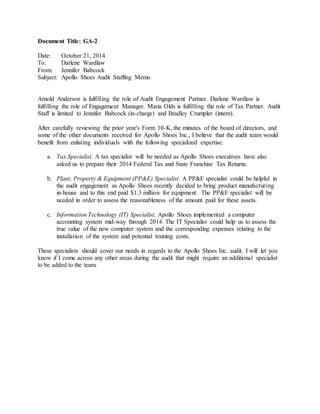
Document Title: GA-2
Date: October 21, 2014
To: Darlene Wardlaw
From: Jennifer Babcock
Subject: Apollo Shoes Audit Staffing Memo
Arnold Anderson is fulfilling the role of Audit Engagement Partner. Darlene Wardlaw is
fulfilling the role of Engagement Manager. Maria Olds is fulfilling the role of Tax Partner. Audit
Staff is limited to Jennifer Babcock (in-charge) and Bradley Crumpler (intern).
After carefully reviewing the prior year's Form 10-K, the minutes of the board of directors, and
some of the other documents received for Apollo Shoes Inc., I believe that the audit team would
benefit from enlisting individuals with the following specialized expertise:
a. Tax Specialist. A tax specialist will be needed as Apollo Shoes executives have also
asked us to prepare their 2014 Federal Tax and State Franchise Tax Returns.
b. Plant, Property & Equipment (PP&E) Specialist. A PP&E specialist could be helpful in
the audit engagement as Apollo Shoes recently decided to bring product manufacturing
in-house and to this end paid $1.3 million for equipment. The PP&E specialist will be
needed in order to assess the reasonableness of the amount paid for these assets.
c. Information Technology (IT) Specialist. Apollo Shoes implemented a computer
accounting system mid-way through 2014. The IT Specialist could help us to assess the
true value of the new computer system and the corresponding expenses relating to the
installation of the system and potential training costs.
These specialists should cover our needs in regards to the Apollo Shoes Inc. audit. I will let you
know if I come across any other areas during the audit that might require an additional specialist
to be added to the team.
Document Title: GA-4
Date: January 6, 2015
To: Darlene Wardlaw
From: Jennifer Babcock
Subject: Apollo Shoes Analytical Review Memo
After conducting an analytical review of the financial information presented by Apollo Shoes,
Inc. the following changes and potential misstatements have been identified:
 Net Sales decreased by 4.21%, but Gross Profit increased by 1.27%. In the June 30, 2014
Board of Directors meeting, Mr. Unum stated that sales were down due to decreased
customer willingness to pay $300 for a pair of shoes. In response, the company decided
to increase prices by 10% in order match the increase in production costs. Because the
company experienced a period of declining sales. One possible explanation for the
increase in gross profit could be the recording of fake sales.
 Selling, General, and Administrative Expenses decreased by 46.05%, however this
appears to be due to the reduced amount of Research and Development that took place
during 2014 in response to poor economic conditions.
 Interest Expense increased by 196.02%, which is likely due to the $46,403,000 increase
in debt from the previous year.
 Miscellaneous Income also increased from $0 in 2013 to $2,166,000 in 2014. There is no
detail indicating the source of this income.
 Net Accounts Receivable increased by 231.9% from 2013 to 2014. This is concerning,
especially when taking into consideration that net sales decreased by 4.21% and that the
allowance for doubtful accounts decreased by 1.89%.
 Other Receivables increased from $0 in 2013 to $1,250,000 in 2014 due to a personal
loan the was supposedly given to Mr. Lancaster’s personal secretary This load should
have been recorded as an employee advance, but was not due to the desire to "not worry”
their shareholders with such details. The board approved the personal loan, but only on
the contingency that the loan option be made available to the other members of the board.
 Inventory increased by 322.93% from 2013 to 2014. This is concerning, especially when
considering the company's admission in the June 30, 2014 Board of Directors meeting
that sales were not meeting expectations.
 Prepaid insurance increased 360.67% and could be misstated if Apollo Shoes did not
make the necessary amortization journal entry.
 Between 2013 and 2014, Employee and Employer Medicare Withholdings increased
1855%, Employee and Employer FICA Withholdings increased 540%, and Federal and
State Payroll Taxes increased 1857%.
Throughout the analytic review, it was apparent that Apollo Shoes has several accounts with
either concerning or suspicious activity. Further investigation may either prove their legitimacy
of these accounts or lead to the determination that fraudulent accounting is occurring.
Document Title: GA-5
Date: January 15, 2015
To: Darlene Wardlaw
From: Jennifer Babcock
Subject: Apollo Shoes Materiality Memo
After having analyzed the data found in the financial statement of Apollo Shoes Inc., I found a
number of areas that may contain possible material misstatement.
1. Independent auditors’ concept of materiality
The concept of materiality states that an auditor's attention should be focused primarily on
matters that are important to the financial statement users. The goal of an independent auditor is
to obtain the reasonable assurance about whether or not the financial statements as a whole are
free of material misstatement. This assurances is in consideration of the fact that the outside
user's may be negatively impacted if decisions are made based off of any material misstatements
that may exist in a company's financial information. As materiality is often a matter of
professional judgment the auditor must make materiality decisions based on the specifics of each
audit engagement. Additionally, when auditing the financial statements, the auditor's judgment
regarding matters that are considered to be material to users of financial statements is based on
the consideration of the needs of user group as a whole.
2. Common measures of materiality
The most common way of viewing materiality is by the dollar amount that would influence the
decision making of financial users. Materiality is commonly assessed as a percentage of a key
financial statement component. Choosing an appropriate benchmark, such as total revenue, total
net assets, or profits before tax, is key as these measurements can relate directly back to the
financial statement. By utilizing calculations such as percentages, ratios, and the methods used to
round to zero as these figures could detect abnormalities or materiality issues. The typical rule of
thumb is that anything less than 5% is generally not considered to be material, while anything
over 10% is generally considered to be material. However, the relative size of the misstatement,
the nature of the item or issue, the engagement circumstances, and the possible cumulative
effects all must be considered when determining materiality.
3. Estimate of Apollo Shoes' minimum material misstatement
Based on the lack of being able to communicate with Apollo's prior auditors and some of the
concerning information that has been provided in some of the documentation that we have
currently received from Apollo, such as the Board of Directors meeting minutes, I would like to
use some calculations that are on the lower end of the spectrum in order to ensure that fraud and
material misstatements are not occurring. To begin with, I will start with 5% of Apollo's net
profit. According to the trial balance information that we received, Apollo's Net Income for 2014
appears to be $50,549,082.03. If we use 5% of this amount, our minimum material misstatement
amount will be $2,527,454.10.
Document Title: GA-6
Date: January 16, 2015
To: Darlene Wardlaw
From: Jennifer Babcock
Subject: Considerations of Potential Fraud Memo
This memo is meant to address the possibilities of fraud within Apollo Shoes Inc. After careful review
of the Board of Directors meeting minutes and the analytic procedures that have been performed so
far, there are a number of things that may be considered “red flags” for the company. The generally
accepted auditing standard, SAS 99 "Consideration of Fraud in a Financial Statement Audit,"
discusses the relevancy of finding and correcting possibly fraudulent statements and the need to
provide reasonable assurance that the financial statements are free of material misstatements.
The following red flags in regards to the Apollo engagement have been identified:
 In the October 17, 2014 Audit Committee meeting minutes, Eric Unum, Apollo's VP of
Finance, stated that the company's former auditor, Smith & Smith, CPAs, unexpectedly
withdrew from the engagement due to "mutually incongruent goals." Mr. Unum declined
any further discussion of the matter due to possible litigation. The fact that the previous
auditors withdrew combined with the Apollo's request that the prior auditors not be
contacted is highly suspicious.
 One potential issue is that Larry Lancaster is Chairman of the Board, and is also Apollo's
President & CEO, causing a potential conflict of interest. The fact that Mr. Unum is both
a member of the board and Apollo's VP of Finance further complicates this conflict of
interest.
 In both the January 6, 2014 and the June 30, 2014 Board of Director meeting minutes,
Mr. Lancaster, responds with "or heads will roll!". This suggests that Mr. Lancaster may
have an aggressive management style that may encourage or force employees to take
inappropriate risks or make poor business decisions in an attempt to meet company goals.
 In the June 30, 2014 Board of Director meeting minutes, the board members unanimously
approved a $1,250,000 personal loan that was supposed to be for Mr. Lancaster's
secretary. This loan was approved on the contingency that personal loan options be made
available to all members of the board if requested. There are multiple issues going on
here. First, Mr. Lancaster requested that the check for the loan be made out him
personally and that he would supposedly cash it and give it to his secretary. It seems
unlikely that a check for such a large amount would need to be cash and even more
unreasonable that the check wouldn't be made out to the secretary directly. Secondly, Mr.
Unum suggests that the loan be coded as an "Other Receivable" rather than "Employee
Advance" as would be appropriate. Lastly, the board members are treating this situation
and the company as if it is a personal bank rather than a legitimate company in the
business of making a profit. This suggests a complete disregard for the company's
shareholders.
 In the June 30, 2014 Board of Director meeting minutes, Mr. Unum requests that the
Board approve a $44,403,000 draw from the company's line of credit. Other than for the
purchase of the new software system costing $1.2 million, there is no specific mentioning
as to why the large draw is needed. They only state that the funds are needed to pay for
the computer system and "other expenses." This is highly concerning, especially since the
2013 draw of $10,000,000 was not paid off but merely rolled into a short-term
$12,000,000 loan through a local bank, per the January 6, 2014 minutes.
 It is also concerning that the board approves executive 10% raises, executive bonuses,
and $90,000 stipends per board member even though the company's sales dropped by
4.21% and the current economy suggests the likelihood of continuing decreased sales.
Apollo's audit risk appears to be high due to some of the suspicious activities occurring within
the company and the seemingly high potential for fraud. It is difficult to tell at this point how
pervasive the potential fraud might be, but if it is occurring, top management would be most
likely to be involved. If collusion is taking place within the company, it would be even more
difficult to detect the possible fraud that may be occurring.
In order to ensure our best chances of being able to detect any existing fraudulent schemes, we
should insure that the client does not know which areas will be audited at which times or how,
and the personnel used to assist with document review should be limited in order to prevent
internal employees who are engaging in fraudulent behavior from being able to alter existing
documentation or the audit "findings."
Document Title: GA-6-1
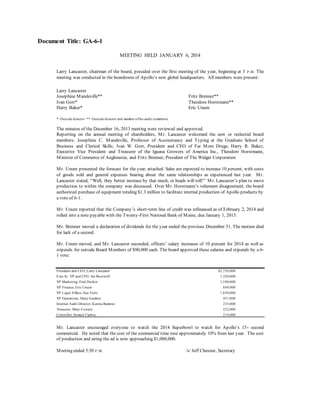
MEETING HELD JANUARY 6, 2014
Larry Lancaster, chairman of the board, presided over the first meeting of the year, beginning at 3 P.M. The
meeting was conducted in the boardroom of Apollo’s new global headquarters. All members were present:
Larry Lancaster
Josephine Mandeville** Fritz Brenner**
Ivan Gorr* Theodore Horstmann**
Harry Baker* Eric Unum
* Outside director ** Outside director and member ofthe audit committee.
The minutes of the December 16, 2013 meeting were reviewed and approved.
Reporting on the annual meeting of shareholders, Mr. Lancaster welcomed the new or reelected board
members: Josephine C. Mandeville, Professor of Accountancy and Typing at the Graduate School of
Business and Clerical Skills; Ivan W. Gorr, President and CEO of Far More Drugs; Harry R. Baker,
Executive Vice President and Treasurer of the Iguana Growers of America Inc., Theodore Horstmann,
Minister of Commerce of Anglonesia; and Fritz Brenner, President of The Widget Corporation
Mr. Unum presented the forecast for the year, attached. Sales are expected to increase 10 percent, with costs
of goods sold and general expenses bearing about the same relationships as experienced last year. Mr.
Lancaster stated, “Well, they better increase by that much, or heads will roll!” Mr. Lancaster’s plan to move
production to within the company was discussed. Over Mr. Horstmann’s vehement disagreement, the board
authorized purchase of equipment totaling $1.3 million to facilitate internal production of Apollo products by
a vote of 6-1.
Mr. Unum reported that the Company’s short-term line of credit was refinanced as of February 2, 2014 and
rolled into a note payable with the Twenty-First National Bank of Maine, due January 1, 2015.
Mr. Brenner moved a declaration of dividends for the year ended the previous December 31. The motion died
for lack of a second.
Mr. Unum moved, and Mr. Lancaster seconded, officers’ salary increases of 10 percent for 2014 as well as
stipends for outside Board Members of $90,000 each. The board approved these salaries and stipends by a 6-
1 vote:
President and CEO, Larry Lancaster $2,750,000
Exec Sr. VP and CFO, Joe Bootwell 1,320,000
VP Marketing, Fred Durkin 1,100,000
VP Finance, Eric Unum 649,000
VP Legal Affairs, Sue Fultz 1,650,000
VP Operations, Daisy Gardner 451,000
Internal Audit Director, Karina Ramirez 235,000
Treasurer, Mary Costain 222,000
Controller, Samuel Carboy 214,000
Mr. Lancaster encouraged everyone to watch the 2014 Superbowl to watch for Apollo’s 15- second
commercial. He noted that the cost of the commercial time rose approximately 10% from last year. The cost
of production and airing the ad is now approaching $1,000,000.
Meeting ended 5:30 P.M. /s/ Jeff Chesnut, Secretary
Document Title: GA-6-2
MEETING HELD JUNE 30, 2014
Larry Lancaster, chairman of the board, presided over the second meeting of the year, beginning at 3 P.M. All
members were present:
Larry Lancaster
Josephine Mandeville** Fritz Brenner**
Ivan Gorr* Theodore Horstmann**
Harry Baker* Eric Unum
* Outside director ** Outside director and member of the audit committee.
The minutes of the January 6 meeting were reviewed and approved.
Mr. Lancaster reported on damage caused by a “Nor’easter” storm that hit Shoetown in April. Damages
amounted to approximately $50,000, just under the insurance deductible.
Mr. Unum reported that sales revenues are not meeting expectations, primarily because of parents’ growing
disenchantment with spoiling their children; parents were no longer willing to buy $300 premium shoes for
their kids as they did in previous years. Mr. Gorr concurred and mentioned something about “not sparing the
rod.” In order to compensate for decreased sales, the Company has raised prices by about 10% with respect
to product costs.
Mr. Lancaster lamented that the quality of Apollo products was too high—the shoes were just not wearing
out fast enough. Mr. Lancaster also stated that because of the strength of current product lines and as a cost-
cutting measure, he decided to stop research and development efforts on the Phoneshoe, thereby eliminating
Research and Development expense for the current year. The development lab will be modified in 2015 to
house a personal gym for corporate executives. Scientists working in the lab have been reassigned to
maintenance duties elsewhere in the company. The Company has also saved postage and telephone expense
through increased use of e-mail.
In other business, the board authorized the write-off of one account receivable for $23,810.13 for an account
that had been outstanding for over a year. Mr. Lancaster noted that he did not anticipate any other write-offs
during the year, or that “heads would roll!”
Mr. Unum moved that Apollo advance $1,250,000 to Mr. Lancaster’s personal secretary as a personal loan to
cover personal legal expenses related to her previous employer. Mr. Unum further suggested that the
promissory note plus accrued interest of 1% per year be due on June 30, 2051. Mr. Lancaster suggested that
it be recorded in “other receivables,” rather than “employee advances” so as to not trouble shareholders with
needless details. After general agreement among the board that similar options be made available to other
board members in the future on an as needed basis, the advance was approved unanimously. Mr. Lancaster
asked Mr. Unum to have the check drawn to him immediately at the conclusion of the board meeting; he
would cash it and give it to his secretary.
The board unanimously supported Ernst Hathaway’s promotion from Director of MIS to VP-Information
Systems. He reported on the plans for the purchase and installation of a new information system. The board
authorized up to $1.2 million for the purchase of the new computer system. Ms. Mandeville offered to
consult on the purchase and installation. To fund the purchase and pay other expenses, Mr. Unum requested
that the board authorize a draw of $44,403,000 on the Company’s line of credit on July 1. This proposal was
unanimously approved.
Meeting ended 7:30 P.M. /s/ Jeff Chesnut, Secretary
AudComMins—063002.doc
Document Title: GA-6-3
MEETING HELD JANUARY 6, 2015
Larry Lancaster, chairman of the board, presided over the regular meeting, beginning at 2 P.M. All members
were present:
Larry Lancaster
Josephine Mandeville** Fritz Brenner**
Ivan Gorr* Theodore Horstmann**
Harry Baker* EricUnum
* Outside director ** Outside director and member of the audit committee.
The minutes of the June 30 meeting were reviewed and approved.
The selection by the audit committee of Anderson, Olds & Watershed as auditors was ratified. The $750,000
fee was approved for the 2014 audit.
Ms. Mandeville moved, and Mr. Gorr seconded, a proposal to declare retroactively a cash dividend of
$860,000 payable March 1 to stockholders of record on December 31. Approved by a vote of 5–2.
Ms. Fultz, VP-Legal affairs, stated that on January 5, 2015 (yesterday), a class action suit alleging gross
negligence and violation of warranty of merchantability was brought against Apollo for $12,000,000. The
action stems from the use of one of the Company's products in an aquatic environment, which may have
caused severe electrical shock to the wearer(s). She is working closely with Apollo’s legal counsel, Perley
Stebbins, to vigorously defend Apollo’s good name. Ms.Fultz stated that the company’s current insurance
does not cover these types of actions.
Mr. Baker inquired as to the status of the machinery purchased in early 2014. Mr. Lancaster replied that the
machinery would be set up “soon.”
Mr. Lancaster moved and Mr. Unum seconded the approval of officers’ bonuses for the year just ended
December 31. Approved by a 4–3 vote.
President, Larry Lancaster $200,000
VP Marketing, Fred Durkin 50,000
VP Finance, Eric Unum 50,000
VP Information Systems, Ernst Hathaway 50,000
VP Legal Affairs, Sue Fultz 50,000
VP Operations, Daisy Gardner 50,000
The Board approved the Company’s contribution to the Employee Benefits program. Mr. Unum stated that
the contribution was increased by $300,000 for 2014, up 10% over the past several years to appease growing
employee dissatisfaction. Given the company’s plans to automate the distribution process, Mr. Unum stated
that employee benefits will decrease significantly in future years.
Mr. Unum noted also that the company decided not to air a Superbowl ad this year.
Meeting ended 8:30 P.M. /s/ Jeff Chesnut, Secretary
Document Title: GA-7
Date: January 16, 2015
To: Arnold Anderson
From: Jennifer Babcock
Subject: Apollo Shoes Computer Processing of Transactions Memo
Apollo's Mid-Year Conversion to Computer System
After having reviewed the documentation that was provided by Karina Ramirez in relation to
Apollo's decision to implement a computer processing system for the accounting of transactions,
the following is of concern:
 Since the conversion took place mid-year, it may make the collection of data more
difficult unless the company was effectively able to enter the full year's worth of
transactions and detail into the new accounting software. If not, the audit process will be
made more difficult by having a portion of the accounting transactions and associated
documentation existing in a manual form and the other half existing in a computerized
form.
 Since this is the company's first year using the new accounting software, due diligence
must be used in order to ensure that the software is working as expected and that staff
members understand how to appropriately use the system.
AOW's Use of the PC as an Audit Tool
Our own firm can benefit from the use for computers and software in several ways, even though
we do not have any audit-specific programs at this time.
Word Processing
Most of the documents that will need to be created by us throughout an audit, such as the
engagement letter, audit memos, the audit report, and a variety of other documents can be created
with the use of a word processing software. We could use a word processing software to create
various official documents that could be saved to client files on a server. This process would all
us to go back and review documents specific to a given client much quicker, and possibly from a
remote location, without having to pull a physical file.
Electronic Spreadsheets
Electronic spreadsheets can be utilized to calculate common-size and comparative financial data
to be used for analytical review, along with the computation of ratios. The working trial balance
could also be put into a spreadsheet, allowing us an easier time of putting in adjusting journal
entries. The columnar set-up of an electronic spreadsheets allows us to use this type of software
to efficiently create and save working papers and other support documentation necessary to the
audit. Spreadsheets would also allow us to quickly calculate totals and a variety of other
mathematical functions in order to save time, ensure accuracy, and quickly make changes to
data.
Spreadsheets can also be of great use internally for purposes such as putting together a budgets,
which would them be compared with actual activity data for analysis.
Computer Auditing
A computer audit specialist could use a one of the laptops as a terminal to perform data base
inquiries and enter test data. We would need to coordinate such applications with the Apollo
personnel, as we would be entering their system through a communications software. This would
allow us the ability to remotely review some of the client's data without having to be onsite.
Statistical Software
We could also greatly benefit from purchasing some statistical software that could be used to
generate random numbers and make statistical calculations. Some packages can perform
regressions as well as calculate variances and standard deviations. Software can also be used to
quickly test for a number of issues, such as missing or duplicate numbers (purchase orders,
invoices, bills of lading, checks, etc.) and to look for certain dollar amounts, such as those that
fall just below a given threshold. Having a good audit software package could not only improve
the effectiveness of our audit review, but would also help us to save time by allowing the
computer to do some of the work for us.
Document Title: ICQ
Internal Control Questionnaire—Sales Transaction Processing
Assertions and Questions
Yes,
No,
N/A
Comments
Occurrence assertion:
1. Is thecredit department independent of the sales
department?
Yes
The credit manager is in thetreasury's office, not
the sales department
2. Are sales of the following types controlled by thesame
procedures described below? Sales to employees, COD sales,
disposals of property, cash sales, and scrap sales.
N/A
Not enough information provided in order to
determine whether or not these types of sales are
all controlled by thesame set of procedures
3. Is access to sales invoice blanks restricted?
Yes
Blank sales invoices are kept in a locked closet
4. Are pre-numbered bills of lading or other shipping
documents prepared or completed in the shippingdepartment? Yes
Pre-numbered 2-copy bills of lading are completed
in shipping department and one is sent with a copy
of the invoice to the A/R department
Completeness assertion:
5. Are sales invoice blanks pre-numbered?
Yes
Billing clerks create 4-copy invoices on
prenumbered sales invoice forms
6. Is thesequence checked for missing invoices?
Yes
When sales invoices are recorded, numerical
sequence is check by A/R clerk - missing invoices
must be found and explained
7. Is theshipping document numerical sequence checked for
missing bills of lading numbers?
N/A
No enough information in the in the report to be
able to determine if this control is being performed
Accuracy assertion:
8. Are all credit sales approved by thecredit department prior
to shipment? Yes
Credit managers approves all sales orders before
they can be sent to the billing department and then
on to the shippingdepartment
9. Are sales prices and terms based on approved standards? Yes Unit prices are verified from an approved pricelist
10. Are returned sales credits and other credits supported by
documentation as to receipt, condition, and quantity, and
approved by a responsible officer?
N/A Not enough information available to verify
11. Are shipped quantities compared to invoice quantities?
Yes
Invoice copies 3 & 4 are used by theshipping
employees to verify quantities
12. Are sales invoices checked for error in quantities, prices,
extensions and footing, and freight allowances, and checked with
customers’ orders?
Yes Accounts receivable clerk performs this function
13. Is there an overall check on arithmetic accuracy of period
sales data by a statisticalor product-line analysis?
Yes
The Marketing Vice President is in charge of this
function
14. Are periodic sales data reported directly to general ledger
accounting independent of accounts receivable accounting?
No
Information comes from the accounts receivable
department
Classificationobjective:
15. Does theaccounting manual contain instructions for
classifying sales?
Yes Marketing Vice President / Marketing Department
Cutoff objective:
16. Does theaccounting manual contain instructions to date
sales invoices on the shipment date?
Yes
General Ledger Supervisor / General Ledger
Control Account
<<RevenueICQ.doc>>
Document Title: ICC-1-1
Apollo Revenue Cycle Flowchart
Document Title: C-1
Date: January 17, 2015
To: Darlene Wardlaw
From: Jennifer Babcock
Subject: Apollo Shoes Revenue Cycle Problems Memo
This memo is intended to summarize the qualitative features and deviations discovered during
the revenue cycle test of controls performed by Bradley. Apollo's control procedures were tested
to (1) obtain control evidence about the validity, authorization, accuracy, and proper period
recording of recorded sales, and to (2) obtain control evidence regarding the accuracy and
classification of sales postings to individual customer accounts receivable.
Objective: To perform enough in-depth auditing to provide assurance against errors and fraud in
the sales and accounts receivable accounts. The internal controls were tested for effectiveness
using samples of transactions in accordance with audit standards.
Results: The revenue cycle test of controls for year end 2014 resulted in 51 deviations out of 180
sample transactions. Fifteen samples were chosen from each calendar month, however, 41 of the
51 deviations occurred during the 2nd half of the year. This is highly suspicious as typically
deviations should be relatively uniform throughout the year. Of the 51 deviations, 12 were due to
incorrect pricing, three had incorrect quantities, and two had arithmetic errors. In all cases, these
errors results in overcharges, which seemly highly unlikely unless intentional. These overcharges
resulted in 16 credit memos having been issued in order to correct the amounts and quantities
billed. As was that case with the percentage of deviations themselves, a vast majority of the
credit memos processed occurred during the third quarter, with none having been processed in
the first half of the year. Alarmingly, 31 of the 180 transactions sampled had no credit approval
notations, 10 of which are still outstanding at the date of this audit. The outstanding invoices
without credit approval for just those that were sampled in this audit total $38,714,200. All of
these unpaid orders with missing credit approvals were placed between the months of August
and December. The few transactions that were found to be missing bills of lading have all been
paid in full and on time, but will need to be verified to make sure that these sales were recorded.
Of further concern are the invoices that appear to be fictitious in nature, with two in particular
that caught my attention. The first is Invoice 39578 that was billed to Company B. This order
received no credit approval and is still outstanding. This is the only occurrence among the
deviations of Company B having been billed, but the company name itself is suspicious and
seems unlikely to be legitimate. The second invoice of concern is Invoice 41976, which was
billed to Mall-Warts on December 28, 2014 in the amount of $5,765,082, the exact same amount
that was billed to Sassy Shoes on Invoice 40686 dated October 28, 2014. Both invoices are
currently outstanding and neither received credit approval. However, unlike the Sassy Shoes
invoice, we were unable to locate a purchase order in association with the Mall-Warts invoice.
Where one or both of these invoices is fictitious will have to confirmed.
Response: Due to the unreliability of Apollo's sales and accounts receivable controls, the audit
team has been forced to do more extensive testing. Positive and/or negative confirmations are
needed to verify most of Apollo's customer accounts, except for those with currently zero
balances. Positive confirmations were sent to customers with account balance that were greater
than $1,000,000 and negative confirmations were sent to customers with account balances of
$1,000,000 or less. Customers have also been asked to verify their total sales for the year.
Recommendations: These findings indicate that either control procedures are not uniform
throughout the year, or deliberately fraudulent activity is taking place. Additionally, December
deviations are potential cause of misstatements in the financial statements. Management is
advised to implement and follow control procedures throughout the year and to ensure that sales
are not being inflated, especially at year-end.
The lack of appropriate credit approval has resulted in collection issues. Enforcing appropriate
credit approval requirements will improve the collection time of accounts receivable, resulting in
a reduction of financial problems, as were seen in the fourth quarter of 2014.
Missing bills of lading, substantial arithmetic errors with delay in correction, and deviations
resulting in the need for credit memos due to overcharges are red flags for potentially fraudulent
transactions. The missing bills of lading suggests the possibility of improperly recorded sales,
and the lack of mixture between over and under charges and the lag time between errors and
corrections are indicative of misstatement and possible fraud. Apollo's internal control should be
catching these types of issues. Improvements will need to be made in order to ensure that such
misstatements and errors do not continue to go unnoticed for so long.
STANDARD FORM TO CONFIRM ACCOUNT
BALANCE INFORMATION WITH FINANCIAL INSTITUTIONS
Document Title: B-3 Apollo Shoes, Inc
CUSTOMER NAME
FINANCIAL INSTITUTION'S NAME AND ADDRESS
Twenty First National Bank
Post Office Box 1
Shoetown, ME 00002
We have provided to our accountants the follow ing information as of the close of
business on 12/31/2014, regarding our deposit and loan balances.
Please confirmthe accuracy of the information, noting any exceptions to the
information provided. If the balances have been left blank, please complete this
formby furnishing the balance in the appropriate space below .* Although we do
not request nor expect you to conduct a comprehensive, detailed search of your
records, if during the process of completing this confirmation additional
information about other deposit and loan accounts we may have w ith you comes
to your attention, please include such information below . Please use the
enclosed envelope to return the form directly to our accountants.
1. At the close of business on the date listed above, our records indicated the follow ing deposit balance(s):
ACCOUNT NAME ACCOUNT NO. INTEREST RATE BALANCE*
General Cash Account
Payroll Account
Savings Account
604-17-526-5
604-29-016-3
604-03-739-8
n/a
n/a
3.2%
3,309,192.03
0
3,645,599.152. We w ere directly liable to the financialinstitution for loans at the close of business on the date listed above as follow s:
ACCOUNT
NO./
DESCRIPTION BALANCE* DATE DUE
INTEREST
RATE
DATE THROUGH
WHICH INTEREST IS
PAID
DESCRIPTION OF
COLLATERAL
Note#106316
Line of
Credit,
Acct#7500438
12,000,000
44,403,000
1/1/2015
2015
(revolving)
8.15%
9.16%
11/30/2014
11/30/2014
Inventory
Inventory
E.P Unum 1/9/2015
(Customer's Authorized Signature (Date)
The informationpresentedaboveby the customer is in agreementwith ourrecords. Although we have not conducted
a comprehensive, detailedsearch of ourrecords,no otherdepositor loan accountshavecome to our attention except
as noted below .
I.M.Rich 1/13/2015
(Financial Institution Authorized Signature) (Date)
EXCEPTIONS AND OR COMMENTS
No exceptions noted.
Please return this formdirectly to our accountants: Andersen, Olds, and Watershed, LLP
32nd Financial Avenue
Shoetown, ME 00002
* Ordinarily, balances are intentionally left blank if they are not available at the time this formis prepared.
Approved 1990 by American Bankers Association, American Institute of Certified Public Accounts, and BankAdministration Institute.
Additional forms available from: AICPA - Order Department, P.O. Box 1003 NY, NY 10108-1003
Document Title: C-2-1
Date: January 28, 2015
To: Darlene Wardlaw
From: Jennifer Babcock
Subject: Apollo Shoes Audit of Accounts Receivable Memo
In regards to our audit of Accounts Receivable, we decided to use both positive and negative
confirmations to verify customer balances as we determined that we could not rely on Apollo's
controls over these accounts. Positive confirmations merely ask the customer to respond to us
stating whether or not their account balance listed is correct. We used this type of confirmation
for all customers who had account balances that were greater than $1,000,000. Negative
confirmations ask the customer to respond only if there is an issue with the account balance
listed. We used this type of confirmation for all customers who had account balances that were
$1,000,000 or less. We also asked customers to confirm their total sales for the year as there
were relatively few transactions for each customer to look at. This process resulted in 6 positive
confirmations and 25 negative confirmations having been sent out.
If we do not receive responses from any of the positive confirmation customers, we will follow
up with a second positive confirmation request. If this second attempt results in no reply from the
customer(s) as well, we will take steps to contract the customers through other means, such as by
telephone. We may also research these customers to make sure that billing and contact
information is complete and accurate.
Of the confirmations that were sent out, we received all six positive confirmations back, along
with one negative confirmation. The findings of each are listed below:
 Neutralizer - Customer's records showed that $1,388.75 more was owed to Apollo than
what was indicated on the positive confirmation. Neutralizer had made out a check to
Apollo on 12/28/14 in the amount of $3,053,144.23 for the 10 pallets of shoes that were
received.
 Mall-Warts - Customer stated that they had entered into an involuntary bankruptcy on
11/03/14, which Apollo was made aware of at that time. Against Mall-Warts' wishes,
Apollo sent a large shipment of shoes to Mall-Wart in late December (including over
1600 pairs of size 23 shoes). While Mall-Warts believes that the balance listed on the
positive confirmation is correct, they did not place an order for the most recent
shipment and cannot currently afford to ship the goods back to Apollo.
 Run for Your Life Shoes - Customer stated that they had made one purchase from Apollo
during 2014, but that they had paid the entire balance on 01/08/15.
 Tread - Customer stated that they had returned five pairs of defective shoes and had
been told that their account had been credited for the return, which was supposed to
be in the amount of $1,388.75, the current balance listed. Otherwise, total purchases
for the year agreed with the customer's records.
 Paul Bunion Footwear - Customer did not note any problems in regards to the positive
confirmation that they had received.
 Sassy Shoes - Customer stated that they did own the balance listed on the positive
confirmation that was received, but that they had been having some financial difficulties
during the year causing payment to be slowed. They also claimed that payment had
been sent on 01/10/15.
 International Soccer Federation - Customer confirmed that the balance listed on their
positive confirmation was correct, but due to issues with the product, did not intent to
purchase any more merchandise from Apollo.
After examining these results, it appears as though there are a couple of issues. The first is that it
appears Neutralizer was (probably) accidentally credited the $1,388.75 that should have been
credited to Tread's customer account. Correcting this error would clear up both of these accounts.
Our audit process has confirmed that a payment was received from Run for Your Life Shoes that
paid off their balance and a payment was also received from Sassy Shoes, however records
indicate that they still have an outstanding balance of $634,000.00. Of larger concern in the fact
that Apollo shipped an order to Mall-Warts in the amount of $5,765,082 on December 28, 2014
after having already been informed of Mall-Warts' involuntary bankruptcy. As we have been
unable to locate a purchase order in relation to this order, combined with the fact that Mall-Warts
states that this is not an order that they place, raises extreme suspicion. Even more suspicious is
the fact that Apollo shipped over 1600 pairs of the size 23 shoes that they had been having
difficulty getting rid of due to the odd size. This large inventory of size 23 shoes in 2013 resulted
in Apollo having to add the balance of this portion of inventory into their Reserve for Inventory
Obsolescence account. Making a large shipment of these odd sized shoes to Mall-Warts resulted
in Apollo reducing this reserve account from $3,012,000 to a balance of just $846,000. This
decision on Apollo's part had a double impact on the financials by allowing the company to
record a full-price sale for this particular inventory and allowed them to greatly reduced their
Obsolescence account, increasing the total value of the inventory account. It appears that this
was an authorized shipment that never should have been recorded as a sale and the transaction
should be voided and the merchandise recovered from Mall-Warts.
Document Title: C-2-2
Apollo Shoes, Inc.
Shoetown, ME
Neutralizer
1359 Central Boulevard
Derma,MS 39530
Attn: Accounts Payable Dept.
Our auditors, Anderson, Olds, and Watershed,are making their regular audit of our financial statements.
Part of this audit includes direct verification of customer balances.
PLEASE EXAMINE THE DATA BELOW CAREFULLY AND EITHER CONFIRM ITS ACCURACY
OR REPORT ANY DIFFERENCES DIRECTLY TO OUR AUDITORS USING THE ENCLOSED
REPLY ENVELOPE.
This is not a request for payment. Please do not send your remittance to our auditors.
Your prompt attention to this request will be appreciated.
Samuel Carboy
______________________
Samuel Carboy, Controller
The balance due Apollo Shoes as of December 31, 2014, is
$3,051,755.48
Purchases from Apollo Shoes during the year 2014 totaled
$3,051,755.48
This balance is correct except as noted below:
Our recordsindicatethatwe owe $1388.75 morethanindicatedabove. We wrote acheck toApolloon12/28 for
$3,053,144.23for 10 palletsofshoes.
Date: 1/20/2015 By: __RudyRobinson______________________
Title: _AccountsPayable ______________
Document Title: C-2-3
Apollo Shoes, Inc.
Shoetown, ME
Mall-Warts
146 Boardwalk Drive
Atlantic City, NJ 08401
Attn: Accounts Payable Dept.
Our auditors, Anderson, Olds, and Watershed,are making their regular audit of our financial statements.
Part of this audit includes direct verification of customer balances.
PLEASE EXAMINE THE DATA BELOW CAREFULLY AND EITHER CONFIRM ITS ACCURACY
OR REPORT ANY DIFFERENCES DIRECTLY TO OUR AUDITORS USINGTHE ENCLOSED
REPLY ENVELOPE.
This is not a request for payment. Please do not send your remittance to our auditors.
Your prompt attention to this request will be appreciated.
Samuel Carboy
______________________
Samuel Carboy, Controller
The balance due Apollo Shoes as of December 31, 2014, is
$20,549,225.88
Purchases from Apollo Shoes during the year 2014 totaled
$122,826,158.60
These amounts are correct except as noted below:
The amounts appear right, but we entered intoinvoluntary bankruptcy on November 3. We told Apollo about
this back at that time. We don’t know why they shipped us somany pairs inlate December (including over 1600
pairs of size 23’s that we can’t evengive away!)! We didn’t order them andwe can’t afford tosend them back!
Date: 1/14/2015 By: __Action
Jackson____________
Title: _Liquidation
Coordinator______
Document Title: C-2-4
Apollo Shoes, Inc.
Shoetown, ME
Run for Your Life Shoes
Attn: Accounts Payable Dept.
5110 Speedway Drive
Los Angeles, CA 90035
Our auditors, Anderson, Olds, and Watershed,are making their regular audit of our financial statements.
Part of this audit includes direct verification of customer balances.
PLEASE EXAMINE THE DATA BELOW CAREFULLY AND EITHER CONFIRM ITS ACCURACY
OR REPORT ANY DIFFERENCES DIRECTLY TO OUR AUDITORS USINGTHE ENCLOSED
REPLY ENVELOPE.
This is not a request for payment. Please do not send your remittance to our auditors.
Your prompt attention to this request will be appreciated.
Samuel Carboy
______________________
Samuel Carboy, Controller
The balance due Apollo Shoes as of December 31, 2014, is
$2,165,500.55
Purchases from Apollo Shoes during the year 2014 totaled
$2,165,500.55
This balance is correct except as noted below:
Yes,we made one purchasefromApolloduringthe year,butwe paid the entireamounton1/8/2015.
Date: 1/14/2015 By: __JustinThompson_____________________
Title: _AccountsPayable Coordinator___________
Document Title: C-2-5
Apollo Shoes, Inc.
Shoetown, ME
Tread
Attn: Accounts Payable Dept.
Highway 67
French Lick, IN 47432
Our auditors, Anderson, Olds, and Watershed,are making their regular audit of our financial statements.
Part of this audit includes direct verification of customer balances.
PLEASE EXAMINE THE DATA BELOW CAREFULLY AND COMPARE THEM TO YOUR
RECORDS OF YOUR ACCOUNT WITH US. IF THE INFORMATION IS NOT IN AGREEMENT
WITH YOUR RECORDS,PLEASE STATE ANY DIFFERENCES BELOW AND RETURN
DIRECTLY TO OUR AUDITORS IN THE RETURN ENVELOPE PROVIDED. IF THE
INFORMATIONIS CORRECT,NO REPLYIS NECESSARY.
This is not a request for payment. Please do not send your remittance to our auditors.
Your prompt attention to this request will be appreciated.
Samuel Carboy
______________________
Samuel Carboy, Controller
The balance due Apollo Shoes as of December 31, 2014, is
$1,388.75
Purchases from Apollo Shoes during the year 2014 totaled
$3,091,017.74
This balance is correct except as noted below:
We were told inNovember that our account had already beencreditedfor the amount listed above for a return of
5 pairs ofdefective shoes. Total purchases agree with our records though.
Date:__1/14/2015 By: __ShoelessJoe Johanson____
Title: _President,TreadShoes
Document Title: C-2-6
Apollo Shoes, Inc.
Shoetown, ME
Paul Bunion Footwear
Attn: Accounts Payable Dept.
Lone Mountain Trail
P.O. Box 10558
Big Sky, MT 59717
Our auditors, Anderson, Olds, and Watershed,are making their regular audit of our financial statements.
Part of this audit includes direct verification of customer balances.
PLEASE EXAMINE THE DATA BELOW CAREFULLY AND EITHER CONFIRM ITS ACCURACY
OR REPORT ANY DIFFERENCES DIRECTLY TO OUR AUDITORS USINGTHE ENCLOSED
REPLY ENVELOPE.
This is not a request for payment. Please do not send your remittance to our auditors.
Your prompt attention to this request will be appreciated.
Samuel Carboy
______________________
Samuel Carboy, Controller
The balance due Apollo Shoes as of December 31, 2014, is
$11,558,847.58
Purchases from Apollo Shoes during the year 2014 totaled
$29,270,632.63
This balance is correct except as noted below:
Noproblemsnoted.
Date: 1/21/2015 By: __KevinBunion_______________________
Title: _VP-Finance,PBS ______________
Document Title: C-2-7
Apollo Shoes, Inc.
Shoetown, ME
Sassy Shoes
Attn: Accounts Payable Dept.
440 W. 53rd
Street
New York, NY 10018
Our auditors, Anderson, Olds, and Watershed,are making their regular audit of our financial statements.
Part of this audit includes direct verification of customer balances.
PLEASE EXAMINE THE DATA BELOW CAREFULLY AND EITHER CONFIRM ITS ACCURACY
OR REPORT ANY DIFFERENCES DIRECTLY TO OUR AUDITORS USINGTHE ENCLOSED
REPLY ENVELOPE.
This is not a request for payment. Please do not send your remittance to our auditors.
Your prompt attention to this request will be appreciated.
Samuel Carboy
______________________
Samuel Carboy, Controller
The balance due Apollo Shoes as of December 31, 2014, is
$6,400,081.85
Purchases from Apollo Shoes during the year 2014 totaled
$15,178,041.85
This balance is correct except as noted below:
Yes, we owed it. This is the third letter that we’ve receivedfrom you people!!! Our sales are just running a little
slowly this year, but we paidon the tenth, so quit hassling us!
Date:__1/22/2015_______________ By: __SassySpinelli______________
Title: _Founder, Sassy
Shoes_________
Document Title: C-2-8
Apollo Shoes, Inc.
Shoetown, ME
International Soccer Federation
Attn: Accounts Payable Dept.
Birmingham Road
Stratford-upon-Avon
Warwickshire CV34 6LT
England
Our auditors, Anderson, Olds, and Watershed,are making their regular audit of our financial statements.
Part of this audit includes direct verification of customer balances.
PLEASE EXAMINE THE DATA BELOW CAREFULLY AND EITHER CONFIRM ITS ACCURACY
OR REPORT ANY DIFFERENCES DIRECTLY TO OUR AUDITORS USINGTHE ENCLOSED
REPLY ENVELOPE.
This is not a request for payment. Please do not send your remittance to our auditors.
Your prompt attention to this request will be appreciated.
Samuel Carboy
______________________
Samuel Carboy, Controller
The balance due Apollo Shoes as of December 31, 2014, is
$1,222,359.56
Purchases from Apollo Shoes during the year 2014 totaled
$3,228,779.92
This balance is correct except as noted below:
The amounts are correct asstated. Idon’t thinkwe are going tobuy any more though. The sirens keep going off
prematurely and it’scausingour fans toriot.
Date: 1/21/2015 By: __FootsMcKinney____________________
Title: _EquipmentManager,ISF _____________
Document Title: C-3
Date: January 28, 2015
To: Darlene Wardlaw
From: Jennifer Babcock
Subject: Apollo Shoes Allowance for Doubtful Accounts Memo
This memo is intended to address the reasonableness of the Allowance for Doubtful Accounts
for Apollo Shoes Inc. Typically the reasonableness of this account is not assessed by the external
auditors, however, in this case we have reason to doubt the appropriateness of the value placed
on this account for the year ended December 31, 2014.
Bad debt and Allowance for Doubtful Accounts are typically determined based on a percentage
of either sales or total receivables. This percentage should stay relatively consistent from year to
year unless has changed products, credit policies, or its customer base. Since none of these kinds
of changes took place for Apollo, 2014 estimates should be relatively close to what was used in
2013, unless there are other outside factors that would influences these accounts. If we determine
the Allowance for Doubtful Accounts based on a percentage of Total Receivables and Bad Debt
Expense as a percentage of Total Sales, the percentages and ratios for 2013 were as follows:
Allowance for Doubtful Accounts = $1,262,819.88 / $16,410,902.71 = 7.70%
Bad Debt Expense = $1,622,425.99 / $246,172,918.44 = 0.66%
A/R Turnover = $246,172,918.44 / $15,148,082.83 = 16.25 times
Days' Sales in A/R = $15,148,082.83 / ($246,172,918.44 / 360) = 22.15 days
For 2014, Apollo's percentages and ratios were as follows:
Allowance for Doubtful Accounts = $1,239,009.75 / $51,515,259.98 = 2.41%
Bad Debt Expense = This account had a zero balance at the end of 2014
A/R Turnover = $242,713,452.88 / $50,276,250.23 = 4.83 times
Days' Sales in A/R = $50,276,250.23 / ($242,713,452.88 / 360) = 74.57 days
These results are indicative of a serious accounts receivable collections issue for Apollo Shoes. If
the Allowance for Doubtful Accounts percentage had remained similar to what was used in
2013, the estimated used for 2014 would have been around $3,966,675 ($51,515,259.98 x 7.7%).
This amount is over three times greater than what was actually used by Apollo. Additionally,
Bad Debt Expense for 2014 could be calculated by using 2013's percentage to get $1,601,909
($242,713,452.88 x 0.66%). Apollo's accounts receivable turnover ratio in 2013 was three times
faster than in 2014, and the days' sales in accounts receivable ratio shows that customers were
taking three times as long to pay in 2014 as they were in 2013. This may be partially due to
Apollo's lack of enforcing credit checks on all sales, but could also be due to the economic
slowdown that seems to be occurring.
In addition, Apollo's largest customer, Mall-Warts, has entered into involuntary bankruptcy,
resulting in a large outstanding balance that likely won't be paid. Mall-Warts' outstanding
balance consists of $14,784,144.03 that is over 90 days old and the $5,765,081.85 illegitimate
shipment that Apollo sent to Mall-Warts on December 28, 2014, totaling $20,549,225.88 in all.
In order for Apollo to be accurately reflecting their Allowance for Doubtful Accounts, the
account needs to be adjusted to the base value of $3,966,675 that was calculated using the same
percentage rate of accounts receivable that was used in 2013, plus the $20,549,225.88 balance
for Mall-Warts that is currently outstanding. This would result in the 2014 Allowance for
Doubtful Accounts total being $24,515,900.88.
My recommendation is that Apollo Shoes should make an adjustment to their 2014 Allowance
for Doubtful Accounts to reflect these assumptions. If this is done, the Allowance for Doubtful
Accounts can be reduced to $18,750,819.03. In addition, I would like to look a little deeper in the
Company B customer as they have an outstanding balance of $63,258.65 that is over 90 days old.
While this balance might be small in comparison to some of the other accounts, I would like to
ensure that this customer is a legitimate company. There has been other sales recorded on this
account earlier in the year that have been paid, so the company could be legitimate and just
operating under a very generic name.
Document Title: ICP-1
Date: February 7, 2015
To: Darlene Wardlaw
From: Jennifer Babcock
Subject: Apollo Shoes Payroll Memo
This memo addresses the SSAE 16 report that was provided by the payroll processing company
and whether or not this independent report serves to fulfill our audit obligations under Section
404 of the Sarbanes-Oxley Act of 2002 (SOX).
There are two kinds of SOC 1 (SSAE 16) reports that can be used by the user entity's financial
auditors, known as Type 1 and Type 2. Both types enable a user auditor to perform risk
assessment procedures and a Type 2 report additionally allows a user auditor to also assess the
risk of material misstatements of the financial statement assertions that would be effected by the
service organization's processing procedures.
The Independent Service Auditor's Report that was provided to us for the audit of Roll Pay
Payroll Services, Inc. appears to be a Type 2 report. We can therefore use this SSAE 16 report in
order to fulfill our audit obligations.
Document Title: ICP-1-1
Independent Service Auditor’s Report on a Description of a Service Organization’s System
and the Suitability of the Design and Operating Effectiveness of Controls
To the Board of Directors of Roll Pay Payroll Services, Inc.:
Scope
We have examined Roll Pay Payroll Services, Inc.’s description of its systemfor processing userentities' payroll
transactions throughout the period January 1, 2014 through December 31, 2014 and the suitability of the design and
operating effectiveness of controls to achieve the related control objectives stated in the description.
Service organization's responsibilities
On page 11 of the description, Roll Pay Payroll Services, Inc. has provided an assertion about the fairness of the
presentation of the description and suitability of the design and operating effectiveness of the controls to achieve the
related control objectives stated in the description. Roll Pay Payroll Services, Inc. is responsible for preparing the
description and for the assertion,including the completeness, accuracy, and method of presentation of the
description and the assertion,providing the services covered by the description, specifying the control objectives and
stating them in the description, identifying the risks that threaten the achievement of the control objectives, selecting
the criteria, and designing,implementing, and documenting controls to achieve the related control objectives stated
in the description.
Service auditor's responsibilities
Our responsibility is to express an opinion on the fairness of the presentation of the description and on the suitability
of the design and operating effectiveness of the controls to achieve the related control objectives stated in the
description, based on our examination. We conducted our examination in accordance with attestation standards
established by the American Institute of Certified Public Accountants.Those standards require that we plan and
perform our examination to obtain reasonable assurance about whether, in all material respects,the description is
fairly presented and the controls were suitably designed and operating effectively to achieve the related control
objectives stated in the description throughout the period January 1, 2014 through December 31, 2014.
An examination of a description of a service organization's systemand the suitability of the design and operating
effectiveness of the service organization's controls to achieve the related control objectives stated in the description
involves performing procedures to obtain evidence about the fairness of the presentation of the description and the
suitability of the design and operating effectiveness of those controls to achieve the related control objectives stated
in the description. Our procedures included assessing the risks that the description is not fairly presented and that the
controls were not suitably designed or operating effectively to achieve the related control objectives stated in the
description. Our procedures also included testing the operating effectiveness of those controls that we consider
necessary to provide reasonable assurance that the related control objectives stated in the description were achieved.
An examination engagement of this type also includes evaluating the overall presentation of the description and the
suitability of the control objectives stated therein, and the suitability of the criteria specified by the service
organization and described at page 12. We believe that the evidence we obtained is sufficient and appropriate to
provide a reasonable basis for our opinion.
Inherent limitations
Because of their nature, controls at a service organization may not prevent, or detect and correct, all errors or
omissions in processing or reporting transactions. Also, the projection to the future of any evaluation of the fairness
of the presentation of the description, or conclusions about the suitability of the design or operating effectiveness of
the controls to achieve the related control objectives is subject to the risk that controls at a service organization may
become inadequate or fail.
Opinion
In our opinion, in all material respects,based on the criteria described in Roll Pay Payroll Services, Inc.’s assertion
on page 11,
a. the description fairly presents the systemfor processing userentities' payroll transactions throughout the
period January 1, 2014 through December 31, 2014.
b. the controls related to the control objectives stated in the description were suitably designed to provide
reasonable assurance that the control objectives would be achieved if the controls operated effectively
throughout the period January 1, 2014 through December 31, 2014.
c. the controls tested,which were those necessary to provide reasonable assurance that the control
objectives stated in the description were achieved, operated effectively throughout the period January 1,
2014 through December 31, 2014.
Description of tests of controls
The specific controls tested and the nature, timing, and results of those tests are listed on pages 15–18.
Restricted use
This report, including the description of tests ofcontrols and results thereof on pages 15-18, is intended solely for
the information and use of Roll Pay Payroll Services, Inc., userentities of Roll Pay Payroll Services, Inc.’s system
for processing userentities' payroll transactions during some or all of the period January 1, 2014 through December
31, 2014, and the independent auditors of such userentities, who have a sufficient understanding to considerit,
along with other information including information about controls implemented by user entities themselves, when
assessing the risks of material misstatements of user entities' financial statements.This report is not intended to be
and should not be used by anyone other than these specified parties.
MichaelScarn,CPA
January 25, 2015
Scranton, PA
Document Title: L-4
Date: February 7, 2015
To: Darlene Wardlaw
From: Jennifer Babcock
Subject: Apollo Shoes Substantive Payroll Procedures Memo
This memo is meant to address the substantive payroll procedures necessary to fulfill our
obligation as auditors for Apollo Shoes Inc. As there has been little turnover and Apollo's
internal auditors watch payroll closely, we did not have to do any detailed testing on payroll.
Instead, we used analytic procedures to get to the comfort level needed.
I was able to tie Apollo's wage expenses and withholding amounts from the payroll register (L-5)
to the balances listed on the company's year-end trail balance (GA-4-4). Warehouse salaries
increased 1.88% and administrative wages decreased 4.02% from 2013 totals. These figures
were calculated before the adjusting journal entries needed to record wages accrued between the
last payroll date and the end of the calendar year have been made. If the adjusting journal entries
are made, warehouse salaries would increase by 3.06% and administrative wages would only
decrease by 0.30%. Payroll tax expenses had increased 1.73%, before adjusting journal entries,
and would increase to 5.74% once the adjusting journal entries have been made (X-1). Executive
salaries and Board member stipends that were approved in the January 6, 2014 meeting minutes
were also confirmed with the payroll register (GA-6-1).
Wages payable that had accrued for the last few days of December are estimated to be
$682,097.99, which estimated payroll tax expenses being $62,219.14. In addition, approved
bonuses for the year ending 2014 that were approved during the January 6, 2015 board meeting
were not reflected in the trial balance (GA-6-3). An adjusting entry will need to made to add the
$450,000 in bonuses to the Bonuses Payable and corresponding expense accounts.
Document Title: R-1 & X-1
Date: February 9, 2015
To: Darlene Wardlaw
From: Jennifer Babcock
Subject: Apollo Shoes Revenue & Expenses Memo
We have now completed our audit of the revenue and expense accounts for Apollo Shoes Inc.
This memo is intended to discuss our finding regarding these accounts. These findings are based
on the information that was provided to us in the trial balances, board or directors meeting
minutes, and other relevant documentation.
We used analytic procedures to evaluate all of the revenue and expense accounts. We discovered
that while Apollo's sales had decreased by 1.41%, sales returns and warranties had both
increased by 146.8% and 5.06% respectively. This is either the result of erroneous postings to the
sales returns and warranties accounts, or may be due to Apollo over-shipping inventory or
possibly sending a higher number of defective merchandise. If the adjusting entry is made to
reverse the illegitimate sale that was made to Mall-Warts on December 28, 2014, then sales will
show a decrease of 3.75% from the previous year.
The Income from Investments and Miscellaneous Income accounts are both new in 2014 and
neither account has been explained to us regarding the sources of the income. Income from
Investments could be from dividends received from Apollo's Investments, but this amount seems
far too high. An adjustment was made to this account in the amount of the $330,375.80 that was
transferred over from the Controller's Clearing Account. This amount was the result of check
#3582 having supposedly been cancelled, although it doesn't appear that the amount was ever
actually removed from Apollo's banking records since they had to add the amount back in order
to get their records to balance since they didn't include the check in with the rest of the check still
outstanding as of December 31, 2014. Miscellaneous income will need to be investigate further
as the amount of $2,166,000 is too high to be considered "miscellaneous" and should at the very
least be moved into an appropriate income account, assuming that the income is even legitimate.
There is also a possibility that Interest Income has not yet been accrued for a portion of the year
based on the decrease of 35.45% from 2013. This could also be due to Apollo having maintained
a smaller balance in the company's savings account throughout the year.
Advertising expenses had increase by 15.57% from the prior year and this was likely due to the
increase in cost associated with purchasing an advertisement spot during the 2014 Superbowl.
Research and Development expenses dropped 98.31%, which is not concerning since Mr.
Lancaster had stated at the June 30, 2014 board meeting that research and development costs
were being cut due to the decrease in demand for Apollo merchandise. Depreciation Expense
increased 235.34% from 2013, which is due to the company having purchased $1.3 million in
equipment and $1.2 million in computer software and hardware. Property tax expense increased
23.40%, which will need to be researched further in order to insure that the increase in this
account is correct. In addition, Legal and Professional Expense increased by 36.28%, which is
due to the increased need for legal expertise due to various ligations. However, since Apollo has
not yet recorded the $750,000 that was approved in the January 6, 2015 meeting minutes for
auditing fees, the percentage increase will actually be 57.09% after the adjusting entry has been
made. Bad Debt Expense had a zero balance at the end of 2014 due to Apollo's failure to
calculate an appropriate value for the Allowance for Doubtful Accounts account. If Apollo goes
ahead with making our suggested adjusting entry, the Bad Debt Expense account will show an
increase of 979.36%. Insurance Expense decreased by 95.77%, which may be due to the fact that
Apollo is no longer leasing an additional building and decided to move all operations to their
headquarters. Maintenance Expense decreased 41.93%, which may need to be researched. While
Apollo has a smaller operating space to maintain, they also had additional equipment. Apollo's
comparison trial balance showed an increase of only 1.25% for their Utilities account, however,
they had missed an invoice for December electricity that will need to be entered for 2014. Once
this adjustment has been made, Utilities shows an increase of 12.46%, which may be due to
Apollo's increased use of computers in 2014. Telephone Expense and Postage Expense are both
down 31.13% and 39.23% respectively, which is primarily due to Apollo's increased use of email
correspondence. Office Supplies Expense increased by 46.22%, which will need to inquired
about to verify the reason for the increase in supplies. Contributions to the Employee Benefit
plan increased by 10%, in an attempt to appease growing employee dissatisfaction. Interest
Expense increased by 244.25%, which resulted from a substantial increase in the use of short-
term loans. The $10,000,000 that had been advanced from Apollo's Line of Credit in 2013 was
rolled over into a short-term, $12,000,000 loan through Twenty-First National Bank of Maine on
February 2, 2014. The company then chose to advance another $44,403,000 of their $50 million
Line of Credit on July 1, 2014. Federal and State Income Taxes also increased 276.32% and
622.61% respectively, largely due to the lack of the tax credit that Apollo was able to use in
2013.
Document Title: A-1
Date: February 11, 2015
To: Darlene Wardlaw
From: Jennifer Babcock
Subject: Apollo Shoes Subsequent Events Memo
This memo addresses the subsequent events that were revealed in the February 9, 2015 Board of
Directors meeting minutes.
Subsequent events are those that are occur after the financial statements date, but before the date
of the auditor's report. There are two types of subsequent events, those that provide additional
evidence of conditions that existed at the date of the financial statements (Type I) and those that
provide additional evidence of conditions that came into existence after the date of the financial
statements (Type II).
Our primary concern with subsequent events is ensuring that any material events that could
affect the fairness of the financial statements and disclosures are properly identified and
disclosed with the rest of the client's financial statement information. Once a subsequent event
has been identified, the auditors should: (1) obtain an understanding of the procedures that
management performed in order to identify material subsequent events, (2) inquire of
management and those charged with governance as to the existence of subsequent events
(corroborated through written representations), (3) read the meeting minutes of managers,
owners, and those charged with governance that are held after the date of the financial
statements, and (4) review the client's latest interim financial statements, if applicable.
In Apollo's Board of Directors meeting that was held on February 9, 2015, management
discussed their ongoing litigations and Mall-Warts bankruptcy. As we were already aware of
Mall-Warts bankruptcy during our initial audit, we will continue to advocate that Apollo should
consider including Mall-Warts' substantial outstanding balance in their Allowance for Doubtful
Accounts estimations. Apollo needs to disclose the fact that the company's remaining workers
have all gone on strike as of February 8, 2015. We do not have enough information at this time
to be able to get a feel for how long this strike might last, but the strike could last for some time,
effectively shutting down Apollo's operations. In regards to the three 2014 litigations that were
brought against Apollo, two of them were dropped, resulting in no legal liability for Apollo. The
third litigation is still ongoing, and while Apollo's lawyers believe that the suit has only a low
chance of being successful, the amount that would be due if the suit is to succeed could be
substantial. As a result, while I don't think we should require Apollo to make a journal entry to
record this possible liability, it should be mentioned in the disclosure notes to the financial
statements. In addition, it appears that there is another $3,000,000 in legal fees for 2014 that
Apollo's lawyers have not yet sent an invoice for. Knowing this, I would highly recommend that
an adjusting journal entry be made to account for these fees (if Apollo has not already done so).
Document Title: A-2
Apollo Shoes, Inc.
Shoetown, ME
Anderson, Olds, and Watershed February 16,2015
This representation letter is provided in connection with your audit of the financial statements of
Apollo Shoes, Inc. for the year ended December 31, 2014 for the purpose of expressing an
opinion as to whether the financial statements give a true and fair view of (present fairly, in all
material respects) the financial position of Apollo Shoes, Inc. as of December 31, 2014 and of
the results of its operations and its cash flows for the year then ended in accordance with the
standards of the Public Company Accounting Oversight Board (United States).
Certain representations in this letter are described as being limited to matters that are material.
Items are considered material, regardless of size, if they involve an omission or misstatement of
accounting information that, in the light of surrounding circumstances, makes it probable that the
judgment of a reasonable person relying on the information would be changed or influenced by
the omission or misstatement.
We acknowledge our responsibility for the fair presentation of the financial statements in
conformity with generally accepted accounting principles.
We confirm, to the best of our knowledge and belief, the following representations:
1. The financial statements referred to above are fairly presented in conformity with
generally accepted accounting principles.
2. We have made available to you all--
a. Financial records and related data
b. Minutes of the meetings of stockholders, directors, and committees of directors, or
summaries of actions of recent meetings for which minutes have not yet been prepared.
3. There have been no communications from regulatory agencies concerning
noncompliance with or deficiencies in financial reporting practices.
4. There are no material transactions that have not been properly recorded in the accounting
records underlying the financial statements.
5. There has been no--
a. Fraud involving management or employees who have significant roles in internal
control.
b. Fraud involving others that could have a material effect on the financial statements.
6. The company has no plans or intentions that may materially affect the carrying value or
classification of assets and liabilities.
7. The following have been properly recorded or disclosed in the financial statements:
a. Related-party transactions, including sales, purchases, loans, transfers, leasing
arrangements, and guarantees, and amounts receivable from or payable to related parties.
b. Guarantees, whether written or oral, under which the company is contingently liable.
c. Significant estimates and material concentrations known to management that are
required to be disclosed in accordance with the AICPA’s Statement of Position 94-6,
‘‘Disclosure of Significant Risks and Uncertainties.’’
8. There are no—
a. Violations or possible violations of laws or regulations whose effects should be
considered for disclosure in the financial statements or as a basis for recording a loss
contingency.
b. Unasserted claims or assessments that our lawyer has advised us are probable of
assertion and must be disclosed in accordance with Financial Accounting Standards
Board (FASB) Statement No. 5, ‘‘Accounting for Contingencies.’’
c. Other liabilities or gain or loss contingencies that are required to be accrued or
disclosed by FASB Statement No. 5.
9. The company has satisfactory title to all owned assets, and there are no liens or
encumbrances on such assets nor has any asset been pledged as collateral.
10. The company has complied with all aspects of contractual agreements that would have a
material effect on the financial statements in the event of noncompliance.
11. To the best of our knowledge and belief, no events have occurred subsequent to the
balance-sheet date and through the date of this letter that would require adjustment to or
disclosure in the aforementioned financial statements.
(Senior Executive Officer)
(Senior Financial Officer)
Document Title: A-3
CERTIFICATIONS
We, Larry Lancaster and Joe Bootwell, certify that:
1. We have reviewed this annual report on Form 10-K of Apollo Shoes, Inc.;
2. Based on our knowledge, this report does not contain any untrue statement of a material fact or omit to
state a materialfact necessary to make the statements made, in light of the circumstances under which such
statements were made, not misleading with respect to the period covered by this report;
3. Based on our knowledge, the financial statements, and other financial information included in this report,
fairly present in all material respects the financial condition, results of operations and cash flows of the
registrant as of, and for, the periods presented in this report;
4. We are responsible for establishing and maintaining disclosure controls and procedures (as defined in
Exchange Act Rules 13a-15(e) and 15d-15(e)) for the registrant and have:
a) Designed such disclosure controls and procedures, or caused such disclosure controls and procedures to
be designed under our supervision, to ensure that material information relating to the registrant, including its
consolidated subsidiaries, is made known to us by others within those entities, particularly during the period
in which this report is being prepared;
b) Evaluated the effectiveness of the registrant’s disclosure controls and procedures and presented in this
report our conclusions about the effectiveness of the disclosure controls and procedures,as of the end of the
period covered by this report based on such evaluation; and
c) Disclosed in this report any change in the registrant’s internal control over financial reporting that
occurred during the registrant’s most recent fiscalquarter (the registrant’s fourth fiscalquarter in the case of
an annual report) that has materially affected, or is reasonably likely to materially affect, the registrant’s
internal control over financial reporting; and
5. We have disclosed, based on our most recent evaluation of internal control over financial reporting, to the
registrant’s auditors and the audit committee of registrant’s board of directors (or persons performing the
equivalent functions):
a) All significant deficiencies and material weaknesses in the design or operation of internal control over
financial reporting which are reasonably likely to adversely affect the registrant’s ability to record, process,
summarize and report financial information; and
b) Any fraud,whether or not material, that involves management or other employees who have a significant
role in the registrant’s internal control over financial reporting.
Date: February 16, 2015
Larry Lancaster Joe Bootwell
Chairman of the Board of Directors,
President and CEO
Executive Senior Vice-President and CFO
Document Title: A-6
Date: February 18, 2015
To: Darlene Wardlaw
From: Jennifer Babcock
Subject: Apollo Shoes Analysis of Accounting Estimates Memo
This memo addresses the material accounting estimates that are used by Apollo Shoes, Inc.
Typically accounting estimates are left up to the client's management to decide, however, if we
determine during the course of an audit that substantial bias is being exerted over a particular
estimate, we may suggest an adjustment in order to prevent material misstatements in the
financial statements and disclosures.
The following accounting estimates are calculated by Apollo Shoes:
 Allowance for Doubtful Accounts
 Depreciable Assets
 Inventory Obsolescence
 Warranty Expense
While Apollo's 2013 estimates for the Allowance for Doubtful Accounts appeared to be
reasonable, we have determined that their estimates for 2014 are far below what they should be,
especially considering the large increase in accounts receivable, the bankruptcy of one of
Apollo's largest customers, the current economic downturn, and Apollo's failure to appropriately
review customers for credit approval. A typical method for determining a base estimate for the
Allowance for Doubtful Accounts is by using a percentage of Total Accounts Receivables. To
begin with, 5% may be a reasonable percentage to use as a base, with higher percentages used
depending on any other circumstances that could have an effect on the collectability of
receivables. As Apollo's ending audited A/R balance was $45,750,178.13, anywhere from 5%-
10% of this balance could be considered reasonable, or between $2,287,508.91 - $4,575,017.83.
For 2014, we calculated a much higher amount due to the involuntary bankruptcy of Apollo's
largest customer and the customer's large outstanding balance. This bias is potentially inflating
Apollo's income and causing a material misstatement in the company's financial information.
Apollo's estimate useful life assumptions appear to be appropriate, apart from the building,
appears to have been purchased in 2013. The useful life should probably be 30 years rather than
15 years. The would make the useful life estimate for the capitalized expenses (repairs/repaint)
appropriate as they should match the life of the building. The salvage value for the building
should be higher than zero as it is unlikely that the building would not be worth anything if the
company were to sell it 15 - 30 years down the road. The rest of the fixed assets should be okay
having a salvage value of zero. The straight-line method of depreciation is reasonable for all of
Apollo's fixed assets.
Apollo currently has a large balance in their Reserve for Inventory Obsolescence account. This is
primarily due to a large shipment of Size 23 shoes that Apollo received from a vendor that the
company has been having difficulty selling. This inventory is likely to have little to no
marketable value due to the lack of demand for Size 23 shoes, combined with the large quantity
that Apollo currently has in stock. As it is highly unlikely that Apollo will be able to sell even a
small portion of this inventory before the merchandise becomes obsolete, management made the
decision to move the value of this inventory into their Reserve for Inventory Obsolescence
account. A typical method for determining a base estimate for the Reserve for Inventory
Obsolescence account is by using a percentage of Total Inventory. To start off with, a company
might use anywhere from 1%-5% as a reasonable percentage, with higher or lower percentages
being used depending on the life of the inventory and other circumstances that could have a
material effect on obsolescence of inventory. Apollo's ending audited Inventory balance was
$71,323,609.35, so a reasonable amount to use for the Reserve for Inventory Obsolescence might
be anywhere from $713,236.35 - $3,566,180.47. This is amount is pretty close to what Apollo is
using for this account.
While Apollo's 2013 estimates for their Warranty Expense account appeared to be reasonable,
the amount added to this account for 2014 seems a bit high, especially considering the fact that
Apollo's sales for 2014 decrease from the year before. A typical method for determining a base
estimate for the Warranty Expense is by using a percentage of Total Sales. To begin with, 5%
may be a reasonable percentage to use as a base, with higher percentages being used depending
on any other circumstances that could have an effect on the collectability of receivables. To start
off with, a company might use 0.5% as a reasonable starting percentage, with higher or lower
percentages being used depending on the inventory and other circumstances that could have a
material effect on the defectiveness of inventory. Apollo's ending audited Sales balance was
$236,948,371.03, so a reasonable amount to use for the Reserve for Inventory Obsolescence
might be $1,184,741.85. This is amount is pretty close to what Apollo is using for this account,
the increase in Warranty Expense compared to Total Sales may have been a result of Apollo
using a more relevant percentage amount for this account.

Audit II Apollo Case Final Project

  • 1.
    Unit 5 Assignment Jennifer,I know you spent many hours on this assignment. Your hard work paid off. This is by far the best assignment I have had submitted and I've been teaching this course using this case for several years. You did a fantastic job! You exceed expectations on properly indexing your workpapers, cross referencing and footing. You should be very proud. I have made comments on the file itself. Please let me know if youhave any questions. Julie
  • 2.
    Document Title: GA-1 Anderson,Olds, and Watershed Certified Public Accountants Apollo Shoes Inc 100 Shoe Plaza Shoetown, ME 00001 October 21, 2014 Dear Mr. Lancaster: This letter will confirm our understanding of the arrangement for our audit of the financial statements of Apollo Shoes Inc. for the year ending December 31, 2014. We will audit the Company's balance sheet at December 31, 2014, and the related statements of income, comprehensive income, stockholders' equity, and cash flows for the year then ended, for the purpose of expressing an opinion on them. We will also audit whether Apollo Shoes Inc. maintained effective internal control over financial reporting as of December 31, 2014, based on criteria established in Internal Control--Integrated Framework issued by the Committee of Sponsoring Organizations of the Treadway Commission (COSO criteria). Apollo Shoes Inc.'s management is responsible for these financial statements and for maintaining effective internal control over financial reporting. Management is also responsible for making financial records and related information available for audit and for identifying and ensuring that the company complies with the laws and regulations that apply to its activities. Lastly, management is responsible for adjusting the financial statements to correct material misstatements and for affirming to us in the representation letter that the effects of any uncorrected misstatements aggregated by us during the current engagement and pertaining to the latest period presented are immaterial, both individually and in the aggregate, to the financial statements taken as a whole. Our responsibility is to express an opinion on these financial statements and an opinion on the effectiveness of the company's internal control over financial reporting based on our audits. If, for any reason, we are unable to complete the audit or are unable to form or have not formed an opinion, we may decline to express an opinion or decline to issue a report as a result of the engagement. We will conduct our audits in accordance with the standards of the Public Company Accounting Oversight Board (United States). Those standards require that we plan and perform the audit to obtain reasonable assurance about whether the financial statements are free of material misstatement and whether effective internal control over financial reporting was maintained in all material respects. Our audit of the financial statements includes examining, on a test basis, evidence supporting the amounts and disclosures in the financial statements, assessing the accounting principles used and significant estimates made by management, and evaluating the overall financial statement presentation. Our audit of internal control over financial reporting includes obtaining an understanding of internal control over financial reporting, testing and evaluating the design and operating effectiveness of internal control, and performing such other procedures as we considered
  • 3.
    necessary in thecircumstances. We believe that our audits provide a reasonable basis for our opinion. A company's internal control over financial reporting is a process designed to provide reasonable assurance regarding the reliability of financial reporting and the preparation of financial statements for external purposes in accordance with generally accepted accounting principles. A company's internal control over financial reporting includes those policies and procedures that (1) pertain to the maintenance of records that, in reasonable detail, accurately and fairly reflect the significant transactions and dispositions of the assets of the company; (2) provide reasonable assurance that significant transactions are recorded as necessary to permit preparation of financial statements in accordance with generally accepted accounting principles, and that receipts and expenditures of the company are being made only in accordance with authorizations of management and directors of the company; and (3) provide reasonable assurance regarding prevention or timely detection of unauthorized acquisition, use, or disposition of the company's assets that could have a material effect on the financial statements. Because of its inherent limitations, internal control over financial reporting may not prevent or detect misstatements. Also, projections of any evaluation of the effectiveness to future periods are subject to the risk that controls may become inadequate because of changes in conditions, or that the degree of compliance with the policies or procedures may deteriorate. As part of our engagement for the year ending December 31, 2014, we will prepare the federal tax and state franchise tax returns for Apollo Shoes Inc. Our fees will be billed as work progresses and are based on the amount of time required plus travel and other out-of-pocket expenses. Invoices are payable upon presentation. We will notify you immediately of any circumstances we encounter that could significantly affect our initial estimate of $750,000. If this letter correctly expresses your understanding, please sign the enclosed copy where indicated and return it to us. Sincerely, Anderson, Olds, and Watershed, CPAs ______________________________ [Engagement Partner's Signature] Accepted and agreed to: ______________________________ [Client Representative's Signature] Apollo Shoes Inc. ______________________________ [Title] ______________________________ [Date]
  • 4.
    Document Title: GA-2 Date:October 21, 2014 To: Darlene Wardlaw From: Jennifer Babcock Subject: Apollo Shoes Audit Staffing Memo Arnold Anderson is fulfilling the role of Audit Engagement Partner. Darlene Wardlaw is fulfilling the role of Engagement Manager. Maria Olds is fulfilling the role of Tax Partner. Audit Staff is limited to Jennifer Babcock (in-charge) and Bradley Crumpler (intern). After carefully reviewing the prior year's Form 10-K, the minutes of the board of directors, and some of the other documents received for Apollo Shoes Inc., I believe that the audit team would benefit from enlisting individuals with the following specialized expertise: a. Tax Specialist. A tax specialist will be needed as Apollo Shoes executives have also asked us to prepare their 2014 Federal Tax and State Franchise Tax Returns. b. Plant, Property & Equipment (PP&E) Specialist. A PP&E specialist could be helpful in the audit engagement as Apollo Shoes recently decided to bring product manufacturing in-house and to this end paid $1.3 million for equipment. The PP&E specialist will be needed in order to assess the reasonableness of the amount paid for these assets. c. Information Technology (IT) Specialist. Apollo Shoes implemented a computer accounting system mid-way through 2014. The IT Specialist could help us to assess the true value of the new computer system and the corresponding expenses relating to the installation of the system and potential training costs. These specialists should cover our needs in regards to the Apollo Shoes Inc. audit. I will let you know if I come across any other areas during the audit that might require an additional specialist to be added to the team.
  • 5.
    Document Title: GA-4 Date:January 6, 2015 To: Darlene Wardlaw From: Jennifer Babcock Subject: Apollo Shoes Analytical Review Memo After conducting an analytical review of the financial information presented by Apollo Shoes, Inc. the following changes and potential misstatements have been identified:  Net Sales decreased by 4.21%, but Gross Profit increased by 1.27%. In the June 30, 2014 Board of Directors meeting, Mr. Unum stated that sales were down due to decreased customer willingness to pay $300 for a pair of shoes. In response, the company decided to increase prices by 10% in order match the increase in production costs. Because the company experienced a period of declining sales. One possible explanation for the increase in gross profit could be the recording of fake sales.  Selling, General, and Administrative Expenses decreased by 46.05%, however this appears to be due to the reduced amount of Research and Development that took place during 2014 in response to poor economic conditions.  Interest Expense increased by 196.02%, which is likely due to the $46,403,000 increase in debt from the previous year.  Miscellaneous Income also increased from $0 in 2013 to $2,166,000 in 2014. There is no detail indicating the source of this income.  Net Accounts Receivable increased by 231.9% from 2013 to 2014. This is concerning, especially when taking into consideration that net sales decreased by 4.21% and that the allowance for doubtful accounts decreased by 1.89%.  Other Receivables increased from $0 in 2013 to $1,250,000 in 2014 due to a personal loan the was supposedly given to Mr. Lancaster’s personal secretary This load should have been recorded as an employee advance, but was not due to the desire to "not worry” their shareholders with such details. The board approved the personal loan, but only on the contingency that the loan option be made available to the other members of the board.  Inventory increased by 322.93% from 2013 to 2014. This is concerning, especially when considering the company's admission in the June 30, 2014 Board of Directors meeting that sales were not meeting expectations.  Prepaid insurance increased 360.67% and could be misstated if Apollo Shoes did not make the necessary amortization journal entry.  Between 2013 and 2014, Employee and Employer Medicare Withholdings increased 1855%, Employee and Employer FICA Withholdings increased 540%, and Federal and State Payroll Taxes increased 1857%. Throughout the analytic review, it was apparent that Apollo Shoes has several accounts with either concerning or suspicious activity. Further investigation may either prove their legitimacy of these accounts or lead to the determination that fraudulent accounting is occurring.
  • 6.
    Document Title: GA-5 Date:January 15, 2015 To: Darlene Wardlaw From: Jennifer Babcock Subject: Apollo Shoes Materiality Memo After having analyzed the data found in the financial statement of Apollo Shoes Inc., I found a number of areas that may contain possible material misstatement. 1. Independent auditors’ concept of materiality The concept of materiality states that an auditor's attention should be focused primarily on matters that are important to the financial statement users. The goal of an independent auditor is to obtain the reasonable assurance about whether or not the financial statements as a whole are free of material misstatement. This assurances is in consideration of the fact that the outside user's may be negatively impacted if decisions are made based off of any material misstatements that may exist in a company's financial information. As materiality is often a matter of professional judgment the auditor must make materiality decisions based on the specifics of each audit engagement. Additionally, when auditing the financial statements, the auditor's judgment regarding matters that are considered to be material to users of financial statements is based on the consideration of the needs of user group as a whole. 2. Common measures of materiality The most common way of viewing materiality is by the dollar amount that would influence the decision making of financial users. Materiality is commonly assessed as a percentage of a key financial statement component. Choosing an appropriate benchmark, such as total revenue, total net assets, or profits before tax, is key as these measurements can relate directly back to the financial statement. By utilizing calculations such as percentages, ratios, and the methods used to round to zero as these figures could detect abnormalities or materiality issues. The typical rule of thumb is that anything less than 5% is generally not considered to be material, while anything over 10% is generally considered to be material. However, the relative size of the misstatement, the nature of the item or issue, the engagement circumstances, and the possible cumulative effects all must be considered when determining materiality. 3. Estimate of Apollo Shoes' minimum material misstatement Based on the lack of being able to communicate with Apollo's prior auditors and some of the concerning information that has been provided in some of the documentation that we have currently received from Apollo, such as the Board of Directors meeting minutes, I would like to use some calculations that are on the lower end of the spectrum in order to ensure that fraud and material misstatements are not occurring. To begin with, I will start with 5% of Apollo's net profit. According to the trial balance information that we received, Apollo's Net Income for 2014 appears to be $50,549,082.03. If we use 5% of this amount, our minimum material misstatement amount will be $2,527,454.10.
  • 7.
    Document Title: GA-6 Date:January 16, 2015 To: Darlene Wardlaw From: Jennifer Babcock Subject: Considerations of Potential Fraud Memo This memo is meant to address the possibilities of fraud within Apollo Shoes Inc. After careful review of the Board of Directors meeting minutes and the analytic procedures that have been performed so far, there are a number of things that may be considered “red flags” for the company. The generally accepted auditing standard, SAS 99 "Consideration of Fraud in a Financial Statement Audit," discusses the relevancy of finding and correcting possibly fraudulent statements and the need to provide reasonable assurance that the financial statements are free of material misstatements. The following red flags in regards to the Apollo engagement have been identified:  In the October 17, 2014 Audit Committee meeting minutes, Eric Unum, Apollo's VP of Finance, stated that the company's former auditor, Smith & Smith, CPAs, unexpectedly withdrew from the engagement due to "mutually incongruent goals." Mr. Unum declined any further discussion of the matter due to possible litigation. The fact that the previous auditors withdrew combined with the Apollo's request that the prior auditors not be contacted is highly suspicious.  One potential issue is that Larry Lancaster is Chairman of the Board, and is also Apollo's President & CEO, causing a potential conflict of interest. The fact that Mr. Unum is both a member of the board and Apollo's VP of Finance further complicates this conflict of interest.  In both the January 6, 2014 and the June 30, 2014 Board of Director meeting minutes, Mr. Lancaster, responds with "or heads will roll!". This suggests that Mr. Lancaster may have an aggressive management style that may encourage or force employees to take inappropriate risks or make poor business decisions in an attempt to meet company goals.  In the June 30, 2014 Board of Director meeting minutes, the board members unanimously approved a $1,250,000 personal loan that was supposed to be for Mr. Lancaster's secretary. This loan was approved on the contingency that personal loan options be made available to all members of the board if requested. There are multiple issues going on here. First, Mr. Lancaster requested that the check for the loan be made out him personally and that he would supposedly cash it and give it to his secretary. It seems unlikely that a check for such a large amount would need to be cash and even more unreasonable that the check wouldn't be made out to the secretary directly. Secondly, Mr. Unum suggests that the loan be coded as an "Other Receivable" rather than "Employee Advance" as would be appropriate. Lastly, the board members are treating this situation and the company as if it is a personal bank rather than a legitimate company in the business of making a profit. This suggests a complete disregard for the company's shareholders.  In the June 30, 2014 Board of Director meeting minutes, Mr. Unum requests that the Board approve a $44,403,000 draw from the company's line of credit. Other than for the
  • 8.
    purchase of thenew software system costing $1.2 million, there is no specific mentioning as to why the large draw is needed. They only state that the funds are needed to pay for the computer system and "other expenses." This is highly concerning, especially since the 2013 draw of $10,000,000 was not paid off but merely rolled into a short-term $12,000,000 loan through a local bank, per the January 6, 2014 minutes.  It is also concerning that the board approves executive 10% raises, executive bonuses, and $90,000 stipends per board member even though the company's sales dropped by 4.21% and the current economy suggests the likelihood of continuing decreased sales. Apollo's audit risk appears to be high due to some of the suspicious activities occurring within the company and the seemingly high potential for fraud. It is difficult to tell at this point how pervasive the potential fraud might be, but if it is occurring, top management would be most likely to be involved. If collusion is taking place within the company, it would be even more difficult to detect the possible fraud that may be occurring. In order to ensure our best chances of being able to detect any existing fraudulent schemes, we should insure that the client does not know which areas will be audited at which times or how, and the personnel used to assist with document review should be limited in order to prevent internal employees who are engaging in fraudulent behavior from being able to alter existing documentation or the audit "findings."
  • 9.
    Document Title: GA-6-1 MEETINGHELD JANUARY 6, 2014 Larry Lancaster, chairman of the board, presided over the first meeting of the year, beginning at 3 P.M. The meeting was conducted in the boardroom of Apollo’s new global headquarters. All members were present: Larry Lancaster Josephine Mandeville** Fritz Brenner** Ivan Gorr* Theodore Horstmann** Harry Baker* Eric Unum * Outside director ** Outside director and member ofthe audit committee. The minutes of the December 16, 2013 meeting were reviewed and approved. Reporting on the annual meeting of shareholders, Mr. Lancaster welcomed the new or reelected board members: Josephine C. Mandeville, Professor of Accountancy and Typing at the Graduate School of Business and Clerical Skills; Ivan W. Gorr, President and CEO of Far More Drugs; Harry R. Baker, Executive Vice President and Treasurer of the Iguana Growers of America Inc., Theodore Horstmann, Minister of Commerce of Anglonesia; and Fritz Brenner, President of The Widget Corporation Mr. Unum presented the forecast for the year, attached. Sales are expected to increase 10 percent, with costs of goods sold and general expenses bearing about the same relationships as experienced last year. Mr. Lancaster stated, “Well, they better increase by that much, or heads will roll!” Mr. Lancaster’s plan to move production to within the company was discussed. Over Mr. Horstmann’s vehement disagreement, the board authorized purchase of equipment totaling $1.3 million to facilitate internal production of Apollo products by a vote of 6-1. Mr. Unum reported that the Company’s short-term line of credit was refinanced as of February 2, 2014 and rolled into a note payable with the Twenty-First National Bank of Maine, due January 1, 2015. Mr. Brenner moved a declaration of dividends for the year ended the previous December 31. The motion died for lack of a second. Mr. Unum moved, and Mr. Lancaster seconded, officers’ salary increases of 10 percent for 2014 as well as stipends for outside Board Members of $90,000 each. The board approved these salaries and stipends by a 6- 1 vote: President and CEO, Larry Lancaster $2,750,000 Exec Sr. VP and CFO, Joe Bootwell 1,320,000 VP Marketing, Fred Durkin 1,100,000 VP Finance, Eric Unum 649,000 VP Legal Affairs, Sue Fultz 1,650,000 VP Operations, Daisy Gardner 451,000 Internal Audit Director, Karina Ramirez 235,000 Treasurer, Mary Costain 222,000 Controller, Samuel Carboy 214,000 Mr. Lancaster encouraged everyone to watch the 2014 Superbowl to watch for Apollo’s 15- second commercial. He noted that the cost of the commercial time rose approximately 10% from last year. The cost of production and airing the ad is now approaching $1,000,000. Meeting ended 5:30 P.M. /s/ Jeff Chesnut, Secretary
  • 10.
    Document Title: GA-6-2 MEETINGHELD JUNE 30, 2014 Larry Lancaster, chairman of the board, presided over the second meeting of the year, beginning at 3 P.M. All members were present: Larry Lancaster Josephine Mandeville** Fritz Brenner** Ivan Gorr* Theodore Horstmann** Harry Baker* Eric Unum * Outside director ** Outside director and member of the audit committee. The minutes of the January 6 meeting were reviewed and approved. Mr. Lancaster reported on damage caused by a “Nor’easter” storm that hit Shoetown in April. Damages amounted to approximately $50,000, just under the insurance deductible. Mr. Unum reported that sales revenues are not meeting expectations, primarily because of parents’ growing disenchantment with spoiling their children; parents were no longer willing to buy $300 premium shoes for their kids as they did in previous years. Mr. Gorr concurred and mentioned something about “not sparing the rod.” In order to compensate for decreased sales, the Company has raised prices by about 10% with respect to product costs. Mr. Lancaster lamented that the quality of Apollo products was too high—the shoes were just not wearing out fast enough. Mr. Lancaster also stated that because of the strength of current product lines and as a cost- cutting measure, he decided to stop research and development efforts on the Phoneshoe, thereby eliminating Research and Development expense for the current year. The development lab will be modified in 2015 to house a personal gym for corporate executives. Scientists working in the lab have been reassigned to maintenance duties elsewhere in the company. The Company has also saved postage and telephone expense through increased use of e-mail. In other business, the board authorized the write-off of one account receivable for $23,810.13 for an account that had been outstanding for over a year. Mr. Lancaster noted that he did not anticipate any other write-offs during the year, or that “heads would roll!” Mr. Unum moved that Apollo advance $1,250,000 to Mr. Lancaster’s personal secretary as a personal loan to cover personal legal expenses related to her previous employer. Mr. Unum further suggested that the promissory note plus accrued interest of 1% per year be due on June 30, 2051. Mr. Lancaster suggested that it be recorded in “other receivables,” rather than “employee advances” so as to not trouble shareholders with needless details. After general agreement among the board that similar options be made available to other board members in the future on an as needed basis, the advance was approved unanimously. Mr. Lancaster asked Mr. Unum to have the check drawn to him immediately at the conclusion of the board meeting; he would cash it and give it to his secretary. The board unanimously supported Ernst Hathaway’s promotion from Director of MIS to VP-Information Systems. He reported on the plans for the purchase and installation of a new information system. The board authorized up to $1.2 million for the purchase of the new computer system. Ms. Mandeville offered to consult on the purchase and installation. To fund the purchase and pay other expenses, Mr. Unum requested that the board authorize a draw of $44,403,000 on the Company’s line of credit on July 1. This proposal was unanimously approved. Meeting ended 7:30 P.M. /s/ Jeff Chesnut, Secretary AudComMins—063002.doc
  • 11.
    Document Title: GA-6-3 MEETINGHELD JANUARY 6, 2015 Larry Lancaster, chairman of the board, presided over the regular meeting, beginning at 2 P.M. All members were present: Larry Lancaster Josephine Mandeville** Fritz Brenner** Ivan Gorr* Theodore Horstmann** Harry Baker* EricUnum * Outside director ** Outside director and member of the audit committee. The minutes of the June 30 meeting were reviewed and approved. The selection by the audit committee of Anderson, Olds & Watershed as auditors was ratified. The $750,000 fee was approved for the 2014 audit. Ms. Mandeville moved, and Mr. Gorr seconded, a proposal to declare retroactively a cash dividend of $860,000 payable March 1 to stockholders of record on December 31. Approved by a vote of 5–2. Ms. Fultz, VP-Legal affairs, stated that on January 5, 2015 (yesterday), a class action suit alleging gross negligence and violation of warranty of merchantability was brought against Apollo for $12,000,000. The action stems from the use of one of the Company's products in an aquatic environment, which may have caused severe electrical shock to the wearer(s). She is working closely with Apollo’s legal counsel, Perley Stebbins, to vigorously defend Apollo’s good name. Ms.Fultz stated that the company’s current insurance does not cover these types of actions. Mr. Baker inquired as to the status of the machinery purchased in early 2014. Mr. Lancaster replied that the machinery would be set up “soon.” Mr. Lancaster moved and Mr. Unum seconded the approval of officers’ bonuses for the year just ended December 31. Approved by a 4–3 vote. President, Larry Lancaster $200,000 VP Marketing, Fred Durkin 50,000 VP Finance, Eric Unum 50,000 VP Information Systems, Ernst Hathaway 50,000 VP Legal Affairs, Sue Fultz 50,000 VP Operations, Daisy Gardner 50,000 The Board approved the Company’s contribution to the Employee Benefits program. Mr. Unum stated that the contribution was increased by $300,000 for 2014, up 10% over the past several years to appease growing employee dissatisfaction. Given the company’s plans to automate the distribution process, Mr. Unum stated that employee benefits will decrease significantly in future years. Mr. Unum noted also that the company decided not to air a Superbowl ad this year. Meeting ended 8:30 P.M. /s/ Jeff Chesnut, Secretary
  • 12.
    Document Title: GA-7 Date:January 16, 2015 To: Arnold Anderson From: Jennifer Babcock Subject: Apollo Shoes Computer Processing of Transactions Memo Apollo's Mid-Year Conversion to Computer System After having reviewed the documentation that was provided by Karina Ramirez in relation to Apollo's decision to implement a computer processing system for the accounting of transactions, the following is of concern:  Since the conversion took place mid-year, it may make the collection of data more difficult unless the company was effectively able to enter the full year's worth of transactions and detail into the new accounting software. If not, the audit process will be made more difficult by having a portion of the accounting transactions and associated documentation existing in a manual form and the other half existing in a computerized form.  Since this is the company's first year using the new accounting software, due diligence must be used in order to ensure that the software is working as expected and that staff members understand how to appropriately use the system. AOW's Use of the PC as an Audit Tool Our own firm can benefit from the use for computers and software in several ways, even though we do not have any audit-specific programs at this time. Word Processing Most of the documents that will need to be created by us throughout an audit, such as the engagement letter, audit memos, the audit report, and a variety of other documents can be created with the use of a word processing software. We could use a word processing software to create various official documents that could be saved to client files on a server. This process would all us to go back and review documents specific to a given client much quicker, and possibly from a remote location, without having to pull a physical file. Electronic Spreadsheets Electronic spreadsheets can be utilized to calculate common-size and comparative financial data to be used for analytical review, along with the computation of ratios. The working trial balance could also be put into a spreadsheet, allowing us an easier time of putting in adjusting journal entries. The columnar set-up of an electronic spreadsheets allows us to use this type of software to efficiently create and save working papers and other support documentation necessary to the audit. Spreadsheets would also allow us to quickly calculate totals and a variety of other mathematical functions in order to save time, ensure accuracy, and quickly make changes to data.
  • 13.
    Spreadsheets can alsobe of great use internally for purposes such as putting together a budgets, which would them be compared with actual activity data for analysis. Computer Auditing A computer audit specialist could use a one of the laptops as a terminal to perform data base inquiries and enter test data. We would need to coordinate such applications with the Apollo personnel, as we would be entering their system through a communications software. This would allow us the ability to remotely review some of the client's data without having to be onsite. Statistical Software We could also greatly benefit from purchasing some statistical software that could be used to generate random numbers and make statistical calculations. Some packages can perform regressions as well as calculate variances and standard deviations. Software can also be used to quickly test for a number of issues, such as missing or duplicate numbers (purchase orders, invoices, bills of lading, checks, etc.) and to look for certain dollar amounts, such as those that fall just below a given threshold. Having a good audit software package could not only improve the effectiveness of our audit review, but would also help us to save time by allowing the computer to do some of the work for us.
  • 14.
    Document Title: ICQ InternalControl Questionnaire—Sales Transaction Processing Assertions and Questions Yes, No, N/A Comments Occurrence assertion: 1. Is thecredit department independent of the sales department? Yes The credit manager is in thetreasury's office, not the sales department 2. Are sales of the following types controlled by thesame procedures described below? Sales to employees, COD sales, disposals of property, cash sales, and scrap sales. N/A Not enough information provided in order to determine whether or not these types of sales are all controlled by thesame set of procedures 3. Is access to sales invoice blanks restricted? Yes Blank sales invoices are kept in a locked closet 4. Are pre-numbered bills of lading or other shipping documents prepared or completed in the shippingdepartment? Yes Pre-numbered 2-copy bills of lading are completed in shipping department and one is sent with a copy of the invoice to the A/R department Completeness assertion: 5. Are sales invoice blanks pre-numbered? Yes Billing clerks create 4-copy invoices on prenumbered sales invoice forms 6. Is thesequence checked for missing invoices? Yes When sales invoices are recorded, numerical sequence is check by A/R clerk - missing invoices must be found and explained 7. Is theshipping document numerical sequence checked for missing bills of lading numbers? N/A No enough information in the in the report to be able to determine if this control is being performed Accuracy assertion: 8. Are all credit sales approved by thecredit department prior to shipment? Yes Credit managers approves all sales orders before they can be sent to the billing department and then on to the shippingdepartment 9. Are sales prices and terms based on approved standards? Yes Unit prices are verified from an approved pricelist 10. Are returned sales credits and other credits supported by documentation as to receipt, condition, and quantity, and approved by a responsible officer? N/A Not enough information available to verify 11. Are shipped quantities compared to invoice quantities? Yes Invoice copies 3 & 4 are used by theshipping employees to verify quantities 12. Are sales invoices checked for error in quantities, prices, extensions and footing, and freight allowances, and checked with customers’ orders? Yes Accounts receivable clerk performs this function 13. Is there an overall check on arithmetic accuracy of period sales data by a statisticalor product-line analysis? Yes The Marketing Vice President is in charge of this function 14. Are periodic sales data reported directly to general ledger accounting independent of accounts receivable accounting? No Information comes from the accounts receivable department Classificationobjective: 15. Does theaccounting manual contain instructions for classifying sales? Yes Marketing Vice President / Marketing Department Cutoff objective: 16. Does theaccounting manual contain instructions to date sales invoices on the shipment date? Yes General Ledger Supervisor / General Ledger Control Account <<RevenueICQ.doc>>
  • 15.
    Document Title: ICC-1-1 ApolloRevenue Cycle Flowchart
  • 16.
    Document Title: C-1 Date:January 17, 2015 To: Darlene Wardlaw From: Jennifer Babcock Subject: Apollo Shoes Revenue Cycle Problems Memo This memo is intended to summarize the qualitative features and deviations discovered during the revenue cycle test of controls performed by Bradley. Apollo's control procedures were tested to (1) obtain control evidence about the validity, authorization, accuracy, and proper period recording of recorded sales, and to (2) obtain control evidence regarding the accuracy and classification of sales postings to individual customer accounts receivable. Objective: To perform enough in-depth auditing to provide assurance against errors and fraud in the sales and accounts receivable accounts. The internal controls were tested for effectiveness using samples of transactions in accordance with audit standards. Results: The revenue cycle test of controls for year end 2014 resulted in 51 deviations out of 180 sample transactions. Fifteen samples were chosen from each calendar month, however, 41 of the 51 deviations occurred during the 2nd half of the year. This is highly suspicious as typically deviations should be relatively uniform throughout the year. Of the 51 deviations, 12 were due to incorrect pricing, three had incorrect quantities, and two had arithmetic errors. In all cases, these errors results in overcharges, which seemly highly unlikely unless intentional. These overcharges resulted in 16 credit memos having been issued in order to correct the amounts and quantities billed. As was that case with the percentage of deviations themselves, a vast majority of the credit memos processed occurred during the third quarter, with none having been processed in the first half of the year. Alarmingly, 31 of the 180 transactions sampled had no credit approval notations, 10 of which are still outstanding at the date of this audit. The outstanding invoices without credit approval for just those that were sampled in this audit total $38,714,200. All of these unpaid orders with missing credit approvals were placed between the months of August and December. The few transactions that were found to be missing bills of lading have all been paid in full and on time, but will need to be verified to make sure that these sales were recorded. Of further concern are the invoices that appear to be fictitious in nature, with two in particular that caught my attention. The first is Invoice 39578 that was billed to Company B. This order received no credit approval and is still outstanding. This is the only occurrence among the deviations of Company B having been billed, but the company name itself is suspicious and seems unlikely to be legitimate. The second invoice of concern is Invoice 41976, which was billed to Mall-Warts on December 28, 2014 in the amount of $5,765,082, the exact same amount that was billed to Sassy Shoes on Invoice 40686 dated October 28, 2014. Both invoices are currently outstanding and neither received credit approval. However, unlike the Sassy Shoes invoice, we were unable to locate a purchase order in association with the Mall-Warts invoice. Where one or both of these invoices is fictitious will have to confirmed.
  • 17.
    Response: Due tothe unreliability of Apollo's sales and accounts receivable controls, the audit team has been forced to do more extensive testing. Positive and/or negative confirmations are needed to verify most of Apollo's customer accounts, except for those with currently zero balances. Positive confirmations were sent to customers with account balance that were greater than $1,000,000 and negative confirmations were sent to customers with account balances of $1,000,000 or less. Customers have also been asked to verify their total sales for the year. Recommendations: These findings indicate that either control procedures are not uniform throughout the year, or deliberately fraudulent activity is taking place. Additionally, December deviations are potential cause of misstatements in the financial statements. Management is advised to implement and follow control procedures throughout the year and to ensure that sales are not being inflated, especially at year-end. The lack of appropriate credit approval has resulted in collection issues. Enforcing appropriate credit approval requirements will improve the collection time of accounts receivable, resulting in a reduction of financial problems, as were seen in the fourth quarter of 2014. Missing bills of lading, substantial arithmetic errors with delay in correction, and deviations resulting in the need for credit memos due to overcharges are red flags for potentially fraudulent transactions. The missing bills of lading suggests the possibility of improperly recorded sales, and the lack of mixture between over and under charges and the lag time between errors and corrections are indicative of misstatement and possible fraud. Apollo's internal control should be catching these types of issues. Improvements will need to be made in order to ensure that such misstatements and errors do not continue to go unnoticed for so long.
  • 18.
    STANDARD FORM TOCONFIRM ACCOUNT BALANCE INFORMATION WITH FINANCIAL INSTITUTIONS Document Title: B-3 Apollo Shoes, Inc CUSTOMER NAME FINANCIAL INSTITUTION'S NAME AND ADDRESS Twenty First National Bank Post Office Box 1 Shoetown, ME 00002 We have provided to our accountants the follow ing information as of the close of business on 12/31/2014, regarding our deposit and loan balances. Please confirmthe accuracy of the information, noting any exceptions to the information provided. If the balances have been left blank, please complete this formby furnishing the balance in the appropriate space below .* Although we do not request nor expect you to conduct a comprehensive, detailed search of your records, if during the process of completing this confirmation additional information about other deposit and loan accounts we may have w ith you comes to your attention, please include such information below . Please use the enclosed envelope to return the form directly to our accountants. 1. At the close of business on the date listed above, our records indicated the follow ing deposit balance(s): ACCOUNT NAME ACCOUNT NO. INTEREST RATE BALANCE* General Cash Account Payroll Account Savings Account 604-17-526-5 604-29-016-3 604-03-739-8 n/a n/a 3.2% 3,309,192.03 0 3,645,599.152. We w ere directly liable to the financialinstitution for loans at the close of business on the date listed above as follow s: ACCOUNT NO./ DESCRIPTION BALANCE* DATE DUE INTEREST RATE DATE THROUGH WHICH INTEREST IS PAID DESCRIPTION OF COLLATERAL Note#106316 Line of Credit, Acct#7500438 12,000,000 44,403,000 1/1/2015 2015 (revolving) 8.15% 9.16% 11/30/2014 11/30/2014 Inventory Inventory E.P Unum 1/9/2015 (Customer's Authorized Signature (Date) The informationpresentedaboveby the customer is in agreementwith ourrecords. Although we have not conducted a comprehensive, detailedsearch of ourrecords,no otherdepositor loan accountshavecome to our attention except as noted below . I.M.Rich 1/13/2015 (Financial Institution Authorized Signature) (Date) EXCEPTIONS AND OR COMMENTS No exceptions noted. Please return this formdirectly to our accountants: Andersen, Olds, and Watershed, LLP 32nd Financial Avenue Shoetown, ME 00002 * Ordinarily, balances are intentionally left blank if they are not available at the time this formis prepared.
  • 19.
    Approved 1990 byAmerican Bankers Association, American Institute of Certified Public Accounts, and BankAdministration Institute. Additional forms available from: AICPA - Order Department, P.O. Box 1003 NY, NY 10108-1003
  • 20.
    Document Title: C-2-1 Date:January 28, 2015 To: Darlene Wardlaw From: Jennifer Babcock Subject: Apollo Shoes Audit of Accounts Receivable Memo In regards to our audit of Accounts Receivable, we decided to use both positive and negative confirmations to verify customer balances as we determined that we could not rely on Apollo's controls over these accounts. Positive confirmations merely ask the customer to respond to us stating whether or not their account balance listed is correct. We used this type of confirmation for all customers who had account balances that were greater than $1,000,000. Negative confirmations ask the customer to respond only if there is an issue with the account balance listed. We used this type of confirmation for all customers who had account balances that were $1,000,000 or less. We also asked customers to confirm their total sales for the year as there were relatively few transactions for each customer to look at. This process resulted in 6 positive confirmations and 25 negative confirmations having been sent out. If we do not receive responses from any of the positive confirmation customers, we will follow up with a second positive confirmation request. If this second attempt results in no reply from the customer(s) as well, we will take steps to contract the customers through other means, such as by telephone. We may also research these customers to make sure that billing and contact information is complete and accurate. Of the confirmations that were sent out, we received all six positive confirmations back, along with one negative confirmation. The findings of each are listed below:  Neutralizer - Customer's records showed that $1,388.75 more was owed to Apollo than what was indicated on the positive confirmation. Neutralizer had made out a check to Apollo on 12/28/14 in the amount of $3,053,144.23 for the 10 pallets of shoes that were received.  Mall-Warts - Customer stated that they had entered into an involuntary bankruptcy on 11/03/14, which Apollo was made aware of at that time. Against Mall-Warts' wishes, Apollo sent a large shipment of shoes to Mall-Wart in late December (including over 1600 pairs of size 23 shoes). While Mall-Warts believes that the balance listed on the positive confirmation is correct, they did not place an order for the most recent shipment and cannot currently afford to ship the goods back to Apollo.  Run for Your Life Shoes - Customer stated that they had made one purchase from Apollo during 2014, but that they had paid the entire balance on 01/08/15.  Tread - Customer stated that they had returned five pairs of defective shoes and had been told that their account had been credited for the return, which was supposed to be in the amount of $1,388.75, the current balance listed. Otherwise, total purchases for the year agreed with the customer's records.
  • 21.
     Paul BunionFootwear - Customer did not note any problems in regards to the positive confirmation that they had received.  Sassy Shoes - Customer stated that they did own the balance listed on the positive confirmation that was received, but that they had been having some financial difficulties during the year causing payment to be slowed. They also claimed that payment had been sent on 01/10/15.  International Soccer Federation - Customer confirmed that the balance listed on their positive confirmation was correct, but due to issues with the product, did not intent to purchase any more merchandise from Apollo. After examining these results, it appears as though there are a couple of issues. The first is that it appears Neutralizer was (probably) accidentally credited the $1,388.75 that should have been credited to Tread's customer account. Correcting this error would clear up both of these accounts. Our audit process has confirmed that a payment was received from Run for Your Life Shoes that paid off their balance and a payment was also received from Sassy Shoes, however records indicate that they still have an outstanding balance of $634,000.00. Of larger concern in the fact that Apollo shipped an order to Mall-Warts in the amount of $5,765,082 on December 28, 2014 after having already been informed of Mall-Warts' involuntary bankruptcy. As we have been unable to locate a purchase order in relation to this order, combined with the fact that Mall-Warts states that this is not an order that they place, raises extreme suspicion. Even more suspicious is the fact that Apollo shipped over 1600 pairs of the size 23 shoes that they had been having difficulty getting rid of due to the odd size. This large inventory of size 23 shoes in 2013 resulted in Apollo having to add the balance of this portion of inventory into their Reserve for Inventory Obsolescence account. Making a large shipment of these odd sized shoes to Mall-Warts resulted in Apollo reducing this reserve account from $3,012,000 to a balance of just $846,000. This decision on Apollo's part had a double impact on the financials by allowing the company to record a full-price sale for this particular inventory and allowed them to greatly reduced their Obsolescence account, increasing the total value of the inventory account. It appears that this was an authorized shipment that never should have been recorded as a sale and the transaction should be voided and the merchandise recovered from Mall-Warts.
  • 22.
    Document Title: C-2-2 ApolloShoes, Inc. Shoetown, ME Neutralizer 1359 Central Boulevard Derma,MS 39530 Attn: Accounts Payable Dept. Our auditors, Anderson, Olds, and Watershed,are making their regular audit of our financial statements. Part of this audit includes direct verification of customer balances. PLEASE EXAMINE THE DATA BELOW CAREFULLY AND EITHER CONFIRM ITS ACCURACY OR REPORT ANY DIFFERENCES DIRECTLY TO OUR AUDITORS USING THE ENCLOSED REPLY ENVELOPE. This is not a request for payment. Please do not send your remittance to our auditors. Your prompt attention to this request will be appreciated. Samuel Carboy ______________________ Samuel Carboy, Controller The balance due Apollo Shoes as of December 31, 2014, is $3,051,755.48 Purchases from Apollo Shoes during the year 2014 totaled $3,051,755.48 This balance is correct except as noted below: Our recordsindicatethatwe owe $1388.75 morethanindicatedabove. We wrote acheck toApolloon12/28 for $3,053,144.23for 10 palletsofshoes. Date: 1/20/2015 By: __RudyRobinson______________________ Title: _AccountsPayable ______________
  • 23.
    Document Title: C-2-3 ApolloShoes, Inc. Shoetown, ME Mall-Warts 146 Boardwalk Drive Atlantic City, NJ 08401 Attn: Accounts Payable Dept. Our auditors, Anderson, Olds, and Watershed,are making their regular audit of our financial statements. Part of this audit includes direct verification of customer balances. PLEASE EXAMINE THE DATA BELOW CAREFULLY AND EITHER CONFIRM ITS ACCURACY OR REPORT ANY DIFFERENCES DIRECTLY TO OUR AUDITORS USINGTHE ENCLOSED REPLY ENVELOPE. This is not a request for payment. Please do not send your remittance to our auditors. Your prompt attention to this request will be appreciated. Samuel Carboy ______________________ Samuel Carboy, Controller The balance due Apollo Shoes as of December 31, 2014, is $20,549,225.88 Purchases from Apollo Shoes during the year 2014 totaled $122,826,158.60 These amounts are correct except as noted below: The amounts appear right, but we entered intoinvoluntary bankruptcy on November 3. We told Apollo about this back at that time. We don’t know why they shipped us somany pairs inlate December (including over 1600 pairs of size 23’s that we can’t evengive away!)! We didn’t order them andwe can’t afford tosend them back! Date: 1/14/2015 By: __Action Jackson____________
  • 24.
    Title: _Liquidation Coordinator______ Document Title:C-2-4 Apollo Shoes, Inc. Shoetown, ME Run for Your Life Shoes Attn: Accounts Payable Dept. 5110 Speedway Drive Los Angeles, CA 90035 Our auditors, Anderson, Olds, and Watershed,are making their regular audit of our financial statements. Part of this audit includes direct verification of customer balances. PLEASE EXAMINE THE DATA BELOW CAREFULLY AND EITHER CONFIRM ITS ACCURACY OR REPORT ANY DIFFERENCES DIRECTLY TO OUR AUDITORS USINGTHE ENCLOSED REPLY ENVELOPE. This is not a request for payment. Please do not send your remittance to our auditors. Your prompt attention to this request will be appreciated. Samuel Carboy ______________________ Samuel Carboy, Controller The balance due Apollo Shoes as of December 31, 2014, is $2,165,500.55 Purchases from Apollo Shoes during the year 2014 totaled $2,165,500.55 This balance is correct except as noted below: Yes,we made one purchasefromApolloduringthe year,butwe paid the entireamounton1/8/2015. Date: 1/14/2015 By: __JustinThompson_____________________ Title: _AccountsPayable Coordinator___________
  • 26.
    Document Title: C-2-5 ApolloShoes, Inc. Shoetown, ME Tread Attn: Accounts Payable Dept. Highway 67 French Lick, IN 47432 Our auditors, Anderson, Olds, and Watershed,are making their regular audit of our financial statements. Part of this audit includes direct verification of customer balances. PLEASE EXAMINE THE DATA BELOW CAREFULLY AND COMPARE THEM TO YOUR RECORDS OF YOUR ACCOUNT WITH US. IF THE INFORMATION IS NOT IN AGREEMENT WITH YOUR RECORDS,PLEASE STATE ANY DIFFERENCES BELOW AND RETURN DIRECTLY TO OUR AUDITORS IN THE RETURN ENVELOPE PROVIDED. IF THE INFORMATIONIS CORRECT,NO REPLYIS NECESSARY. This is not a request for payment. Please do not send your remittance to our auditors. Your prompt attention to this request will be appreciated. Samuel Carboy ______________________ Samuel Carboy, Controller The balance due Apollo Shoes as of December 31, 2014, is $1,388.75 Purchases from Apollo Shoes during the year 2014 totaled $3,091,017.74 This balance is correct except as noted below: We were told inNovember that our account had already beencreditedfor the amount listed above for a return of 5 pairs ofdefective shoes. Total purchases agree with our records though. Date:__1/14/2015 By: __ShoelessJoe Johanson____ Title: _President,TreadShoes
  • 27.
    Document Title: C-2-6 ApolloShoes, Inc. Shoetown, ME Paul Bunion Footwear Attn: Accounts Payable Dept. Lone Mountain Trail P.O. Box 10558 Big Sky, MT 59717 Our auditors, Anderson, Olds, and Watershed,are making their regular audit of our financial statements. Part of this audit includes direct verification of customer balances. PLEASE EXAMINE THE DATA BELOW CAREFULLY AND EITHER CONFIRM ITS ACCURACY OR REPORT ANY DIFFERENCES DIRECTLY TO OUR AUDITORS USINGTHE ENCLOSED REPLY ENVELOPE. This is not a request for payment. Please do not send your remittance to our auditors. Your prompt attention to this request will be appreciated. Samuel Carboy ______________________ Samuel Carboy, Controller The balance due Apollo Shoes as of December 31, 2014, is $11,558,847.58 Purchases from Apollo Shoes during the year 2014 totaled $29,270,632.63 This balance is correct except as noted below: Noproblemsnoted. Date: 1/21/2015 By: __KevinBunion_______________________ Title: _VP-Finance,PBS ______________
  • 28.
    Document Title: C-2-7 ApolloShoes, Inc. Shoetown, ME Sassy Shoes Attn: Accounts Payable Dept. 440 W. 53rd Street New York, NY 10018 Our auditors, Anderson, Olds, and Watershed,are making their regular audit of our financial statements. Part of this audit includes direct verification of customer balances. PLEASE EXAMINE THE DATA BELOW CAREFULLY AND EITHER CONFIRM ITS ACCURACY OR REPORT ANY DIFFERENCES DIRECTLY TO OUR AUDITORS USINGTHE ENCLOSED REPLY ENVELOPE. This is not a request for payment. Please do not send your remittance to our auditors. Your prompt attention to this request will be appreciated. Samuel Carboy ______________________ Samuel Carboy, Controller The balance due Apollo Shoes as of December 31, 2014, is $6,400,081.85 Purchases from Apollo Shoes during the year 2014 totaled $15,178,041.85 This balance is correct except as noted below: Yes, we owed it. This is the third letter that we’ve receivedfrom you people!!! Our sales are just running a little slowly this year, but we paidon the tenth, so quit hassling us! Date:__1/22/2015_______________ By: __SassySpinelli______________ Title: _Founder, Sassy Shoes_________
  • 29.
    Document Title: C-2-8 ApolloShoes, Inc. Shoetown, ME International Soccer Federation Attn: Accounts Payable Dept. Birmingham Road Stratford-upon-Avon Warwickshire CV34 6LT England Our auditors, Anderson, Olds, and Watershed,are making their regular audit of our financial statements. Part of this audit includes direct verification of customer balances. PLEASE EXAMINE THE DATA BELOW CAREFULLY AND EITHER CONFIRM ITS ACCURACY OR REPORT ANY DIFFERENCES DIRECTLY TO OUR AUDITORS USINGTHE ENCLOSED REPLY ENVELOPE. This is not a request for payment. Please do not send your remittance to our auditors. Your prompt attention to this request will be appreciated. Samuel Carboy ______________________ Samuel Carboy, Controller The balance due Apollo Shoes as of December 31, 2014, is $1,222,359.56 Purchases from Apollo Shoes during the year 2014 totaled $3,228,779.92 This balance is correct except as noted below: The amounts are correct asstated. Idon’t thinkwe are going tobuy any more though. The sirens keep going off prematurely and it’scausingour fans toriot. Date: 1/21/2015 By: __FootsMcKinney____________________ Title: _EquipmentManager,ISF _____________
  • 30.
    Document Title: C-3 Date:January 28, 2015 To: Darlene Wardlaw From: Jennifer Babcock Subject: Apollo Shoes Allowance for Doubtful Accounts Memo This memo is intended to address the reasonableness of the Allowance for Doubtful Accounts for Apollo Shoes Inc. Typically the reasonableness of this account is not assessed by the external auditors, however, in this case we have reason to doubt the appropriateness of the value placed on this account for the year ended December 31, 2014. Bad debt and Allowance for Doubtful Accounts are typically determined based on a percentage of either sales or total receivables. This percentage should stay relatively consistent from year to year unless has changed products, credit policies, or its customer base. Since none of these kinds of changes took place for Apollo, 2014 estimates should be relatively close to what was used in 2013, unless there are other outside factors that would influences these accounts. If we determine the Allowance for Doubtful Accounts based on a percentage of Total Receivables and Bad Debt Expense as a percentage of Total Sales, the percentages and ratios for 2013 were as follows: Allowance for Doubtful Accounts = $1,262,819.88 / $16,410,902.71 = 7.70% Bad Debt Expense = $1,622,425.99 / $246,172,918.44 = 0.66% A/R Turnover = $246,172,918.44 / $15,148,082.83 = 16.25 times Days' Sales in A/R = $15,148,082.83 / ($246,172,918.44 / 360) = 22.15 days For 2014, Apollo's percentages and ratios were as follows: Allowance for Doubtful Accounts = $1,239,009.75 / $51,515,259.98 = 2.41% Bad Debt Expense = This account had a zero balance at the end of 2014 A/R Turnover = $242,713,452.88 / $50,276,250.23 = 4.83 times Days' Sales in A/R = $50,276,250.23 / ($242,713,452.88 / 360) = 74.57 days These results are indicative of a serious accounts receivable collections issue for Apollo Shoes. If the Allowance for Doubtful Accounts percentage had remained similar to what was used in 2013, the estimated used for 2014 would have been around $3,966,675 ($51,515,259.98 x 7.7%). This amount is over three times greater than what was actually used by Apollo. Additionally, Bad Debt Expense for 2014 could be calculated by using 2013's percentage to get $1,601,909 ($242,713,452.88 x 0.66%). Apollo's accounts receivable turnover ratio in 2013 was three times faster than in 2014, and the days' sales in accounts receivable ratio shows that customers were taking three times as long to pay in 2014 as they were in 2013. This may be partially due to Apollo's lack of enforcing credit checks on all sales, but could also be due to the economic slowdown that seems to be occurring.
  • 31.
    In addition, Apollo'slargest customer, Mall-Warts, has entered into involuntary bankruptcy, resulting in a large outstanding balance that likely won't be paid. Mall-Warts' outstanding balance consists of $14,784,144.03 that is over 90 days old and the $5,765,081.85 illegitimate shipment that Apollo sent to Mall-Warts on December 28, 2014, totaling $20,549,225.88 in all. In order for Apollo to be accurately reflecting their Allowance for Doubtful Accounts, the account needs to be adjusted to the base value of $3,966,675 that was calculated using the same percentage rate of accounts receivable that was used in 2013, plus the $20,549,225.88 balance for Mall-Warts that is currently outstanding. This would result in the 2014 Allowance for Doubtful Accounts total being $24,515,900.88. My recommendation is that Apollo Shoes should make an adjustment to their 2014 Allowance for Doubtful Accounts to reflect these assumptions. If this is done, the Allowance for Doubtful Accounts can be reduced to $18,750,819.03. In addition, I would like to look a little deeper in the Company B customer as they have an outstanding balance of $63,258.65 that is over 90 days old. While this balance might be small in comparison to some of the other accounts, I would like to ensure that this customer is a legitimate company. There has been other sales recorded on this account earlier in the year that have been paid, so the company could be legitimate and just operating under a very generic name.
  • 32.
    Document Title: ICP-1 Date:February 7, 2015 To: Darlene Wardlaw From: Jennifer Babcock Subject: Apollo Shoes Payroll Memo This memo addresses the SSAE 16 report that was provided by the payroll processing company and whether or not this independent report serves to fulfill our audit obligations under Section 404 of the Sarbanes-Oxley Act of 2002 (SOX). There are two kinds of SOC 1 (SSAE 16) reports that can be used by the user entity's financial auditors, known as Type 1 and Type 2. Both types enable a user auditor to perform risk assessment procedures and a Type 2 report additionally allows a user auditor to also assess the risk of material misstatements of the financial statement assertions that would be effected by the service organization's processing procedures. The Independent Service Auditor's Report that was provided to us for the audit of Roll Pay Payroll Services, Inc. appears to be a Type 2 report. We can therefore use this SSAE 16 report in order to fulfill our audit obligations.
  • 33.
    Document Title: ICP-1-1 IndependentService Auditor’s Report on a Description of a Service Organization’s System and the Suitability of the Design and Operating Effectiveness of Controls To the Board of Directors of Roll Pay Payroll Services, Inc.: Scope We have examined Roll Pay Payroll Services, Inc.’s description of its systemfor processing userentities' payroll transactions throughout the period January 1, 2014 through December 31, 2014 and the suitability of the design and operating effectiveness of controls to achieve the related control objectives stated in the description. Service organization's responsibilities On page 11 of the description, Roll Pay Payroll Services, Inc. has provided an assertion about the fairness of the presentation of the description and suitability of the design and operating effectiveness of the controls to achieve the related control objectives stated in the description. Roll Pay Payroll Services, Inc. is responsible for preparing the description and for the assertion,including the completeness, accuracy, and method of presentation of the description and the assertion,providing the services covered by the description, specifying the control objectives and stating them in the description, identifying the risks that threaten the achievement of the control objectives, selecting the criteria, and designing,implementing, and documenting controls to achieve the related control objectives stated in the description. Service auditor's responsibilities Our responsibility is to express an opinion on the fairness of the presentation of the description and on the suitability of the design and operating effectiveness of the controls to achieve the related control objectives stated in the description, based on our examination. We conducted our examination in accordance with attestation standards established by the American Institute of Certified Public Accountants.Those standards require that we plan and perform our examination to obtain reasonable assurance about whether, in all material respects,the description is fairly presented and the controls were suitably designed and operating effectively to achieve the related control objectives stated in the description throughout the period January 1, 2014 through December 31, 2014. An examination of a description of a service organization's systemand the suitability of the design and operating effectiveness of the service organization's controls to achieve the related control objectives stated in the description involves performing procedures to obtain evidence about the fairness of the presentation of the description and the suitability of the design and operating effectiveness of those controls to achieve the related control objectives stated in the description. Our procedures included assessing the risks that the description is not fairly presented and that the controls were not suitably designed or operating effectively to achieve the related control objectives stated in the description. Our procedures also included testing the operating effectiveness of those controls that we consider necessary to provide reasonable assurance that the related control objectives stated in the description were achieved. An examination engagement of this type also includes evaluating the overall presentation of the description and the suitability of the control objectives stated therein, and the suitability of the criteria specified by the service organization and described at page 12. We believe that the evidence we obtained is sufficient and appropriate to provide a reasonable basis for our opinion. Inherent limitations Because of their nature, controls at a service organization may not prevent, or detect and correct, all errors or omissions in processing or reporting transactions. Also, the projection to the future of any evaluation of the fairness of the presentation of the description, or conclusions about the suitability of the design or operating effectiveness of the controls to achieve the related control objectives is subject to the risk that controls at a service organization may become inadequate or fail.
  • 34.
    Opinion In our opinion,in all material respects,based on the criteria described in Roll Pay Payroll Services, Inc.’s assertion on page 11, a. the description fairly presents the systemfor processing userentities' payroll transactions throughout the period January 1, 2014 through December 31, 2014. b. the controls related to the control objectives stated in the description were suitably designed to provide reasonable assurance that the control objectives would be achieved if the controls operated effectively throughout the period January 1, 2014 through December 31, 2014. c. the controls tested,which were those necessary to provide reasonable assurance that the control objectives stated in the description were achieved, operated effectively throughout the period January 1, 2014 through December 31, 2014. Description of tests of controls The specific controls tested and the nature, timing, and results of those tests are listed on pages 15–18. Restricted use This report, including the description of tests ofcontrols and results thereof on pages 15-18, is intended solely for the information and use of Roll Pay Payroll Services, Inc., userentities of Roll Pay Payroll Services, Inc.’s system for processing userentities' payroll transactions during some or all of the period January 1, 2014 through December 31, 2014, and the independent auditors of such userentities, who have a sufficient understanding to considerit, along with other information including information about controls implemented by user entities themselves, when assessing the risks of material misstatements of user entities' financial statements.This report is not intended to be and should not be used by anyone other than these specified parties. MichaelScarn,CPA January 25, 2015 Scranton, PA
  • 35.
    Document Title: L-4 Date:February 7, 2015 To: Darlene Wardlaw From: Jennifer Babcock Subject: Apollo Shoes Substantive Payroll Procedures Memo This memo is meant to address the substantive payroll procedures necessary to fulfill our obligation as auditors for Apollo Shoes Inc. As there has been little turnover and Apollo's internal auditors watch payroll closely, we did not have to do any detailed testing on payroll. Instead, we used analytic procedures to get to the comfort level needed. I was able to tie Apollo's wage expenses and withholding amounts from the payroll register (L-5) to the balances listed on the company's year-end trail balance (GA-4-4). Warehouse salaries increased 1.88% and administrative wages decreased 4.02% from 2013 totals. These figures were calculated before the adjusting journal entries needed to record wages accrued between the last payroll date and the end of the calendar year have been made. If the adjusting journal entries are made, warehouse salaries would increase by 3.06% and administrative wages would only decrease by 0.30%. Payroll tax expenses had increased 1.73%, before adjusting journal entries, and would increase to 5.74% once the adjusting journal entries have been made (X-1). Executive salaries and Board member stipends that were approved in the January 6, 2014 meeting minutes were also confirmed with the payroll register (GA-6-1). Wages payable that had accrued for the last few days of December are estimated to be $682,097.99, which estimated payroll tax expenses being $62,219.14. In addition, approved bonuses for the year ending 2014 that were approved during the January 6, 2015 board meeting were not reflected in the trial balance (GA-6-3). An adjusting entry will need to made to add the $450,000 in bonuses to the Bonuses Payable and corresponding expense accounts.
  • 36.
    Document Title: R-1& X-1 Date: February 9, 2015 To: Darlene Wardlaw From: Jennifer Babcock Subject: Apollo Shoes Revenue & Expenses Memo We have now completed our audit of the revenue and expense accounts for Apollo Shoes Inc. This memo is intended to discuss our finding regarding these accounts. These findings are based on the information that was provided to us in the trial balances, board or directors meeting minutes, and other relevant documentation. We used analytic procedures to evaluate all of the revenue and expense accounts. We discovered that while Apollo's sales had decreased by 1.41%, sales returns and warranties had both increased by 146.8% and 5.06% respectively. This is either the result of erroneous postings to the sales returns and warranties accounts, or may be due to Apollo over-shipping inventory or possibly sending a higher number of defective merchandise. If the adjusting entry is made to reverse the illegitimate sale that was made to Mall-Warts on December 28, 2014, then sales will show a decrease of 3.75% from the previous year. The Income from Investments and Miscellaneous Income accounts are both new in 2014 and neither account has been explained to us regarding the sources of the income. Income from Investments could be from dividends received from Apollo's Investments, but this amount seems far too high. An adjustment was made to this account in the amount of the $330,375.80 that was transferred over from the Controller's Clearing Account. This amount was the result of check #3582 having supposedly been cancelled, although it doesn't appear that the amount was ever actually removed from Apollo's banking records since they had to add the amount back in order to get their records to balance since they didn't include the check in with the rest of the check still outstanding as of December 31, 2014. Miscellaneous income will need to be investigate further as the amount of $2,166,000 is too high to be considered "miscellaneous" and should at the very least be moved into an appropriate income account, assuming that the income is even legitimate. There is also a possibility that Interest Income has not yet been accrued for a portion of the year based on the decrease of 35.45% from 2013. This could also be due to Apollo having maintained a smaller balance in the company's savings account throughout the year. Advertising expenses had increase by 15.57% from the prior year and this was likely due to the increase in cost associated with purchasing an advertisement spot during the 2014 Superbowl. Research and Development expenses dropped 98.31%, which is not concerning since Mr. Lancaster had stated at the June 30, 2014 board meeting that research and development costs were being cut due to the decrease in demand for Apollo merchandise. Depreciation Expense increased 235.34% from 2013, which is due to the company having purchased $1.3 million in equipment and $1.2 million in computer software and hardware. Property tax expense increased 23.40%, which will need to be researched further in order to insure that the increase in this account is correct. In addition, Legal and Professional Expense increased by 36.28%, which is due to the increased need for legal expertise due to various ligations. However, since Apollo has not yet recorded the $750,000 that was approved in the January 6, 2015 meeting minutes for
  • 37.
    auditing fees, thepercentage increase will actually be 57.09% after the adjusting entry has been made. Bad Debt Expense had a zero balance at the end of 2014 due to Apollo's failure to calculate an appropriate value for the Allowance for Doubtful Accounts account. If Apollo goes ahead with making our suggested adjusting entry, the Bad Debt Expense account will show an increase of 979.36%. Insurance Expense decreased by 95.77%, which may be due to the fact that Apollo is no longer leasing an additional building and decided to move all operations to their headquarters. Maintenance Expense decreased 41.93%, which may need to be researched. While Apollo has a smaller operating space to maintain, they also had additional equipment. Apollo's comparison trial balance showed an increase of only 1.25% for their Utilities account, however, they had missed an invoice for December electricity that will need to be entered for 2014. Once this adjustment has been made, Utilities shows an increase of 12.46%, which may be due to Apollo's increased use of computers in 2014. Telephone Expense and Postage Expense are both down 31.13% and 39.23% respectively, which is primarily due to Apollo's increased use of email correspondence. Office Supplies Expense increased by 46.22%, which will need to inquired about to verify the reason for the increase in supplies. Contributions to the Employee Benefit plan increased by 10%, in an attempt to appease growing employee dissatisfaction. Interest Expense increased by 244.25%, which resulted from a substantial increase in the use of short- term loans. The $10,000,000 that had been advanced from Apollo's Line of Credit in 2013 was rolled over into a short-term, $12,000,000 loan through Twenty-First National Bank of Maine on February 2, 2014. The company then chose to advance another $44,403,000 of their $50 million Line of Credit on July 1, 2014. Federal and State Income Taxes also increased 276.32% and 622.61% respectively, largely due to the lack of the tax credit that Apollo was able to use in 2013.
  • 38.
    Document Title: A-1 Date:February 11, 2015 To: Darlene Wardlaw From: Jennifer Babcock Subject: Apollo Shoes Subsequent Events Memo This memo addresses the subsequent events that were revealed in the February 9, 2015 Board of Directors meeting minutes. Subsequent events are those that are occur after the financial statements date, but before the date of the auditor's report. There are two types of subsequent events, those that provide additional evidence of conditions that existed at the date of the financial statements (Type I) and those that provide additional evidence of conditions that came into existence after the date of the financial statements (Type II). Our primary concern with subsequent events is ensuring that any material events that could affect the fairness of the financial statements and disclosures are properly identified and disclosed with the rest of the client's financial statement information. Once a subsequent event has been identified, the auditors should: (1) obtain an understanding of the procedures that management performed in order to identify material subsequent events, (2) inquire of management and those charged with governance as to the existence of subsequent events (corroborated through written representations), (3) read the meeting minutes of managers, owners, and those charged with governance that are held after the date of the financial statements, and (4) review the client's latest interim financial statements, if applicable. In Apollo's Board of Directors meeting that was held on February 9, 2015, management discussed their ongoing litigations and Mall-Warts bankruptcy. As we were already aware of Mall-Warts bankruptcy during our initial audit, we will continue to advocate that Apollo should consider including Mall-Warts' substantial outstanding balance in their Allowance for Doubtful Accounts estimations. Apollo needs to disclose the fact that the company's remaining workers have all gone on strike as of February 8, 2015. We do not have enough information at this time to be able to get a feel for how long this strike might last, but the strike could last for some time, effectively shutting down Apollo's operations. In regards to the three 2014 litigations that were brought against Apollo, two of them were dropped, resulting in no legal liability for Apollo. The third litigation is still ongoing, and while Apollo's lawyers believe that the suit has only a low chance of being successful, the amount that would be due if the suit is to succeed could be substantial. As a result, while I don't think we should require Apollo to make a journal entry to record this possible liability, it should be mentioned in the disclosure notes to the financial statements. In addition, it appears that there is another $3,000,000 in legal fees for 2014 that Apollo's lawyers have not yet sent an invoice for. Knowing this, I would highly recommend that an adjusting journal entry be made to account for these fees (if Apollo has not already done so).
  • 39.
    Document Title: A-2 ApolloShoes, Inc. Shoetown, ME Anderson, Olds, and Watershed February 16,2015 This representation letter is provided in connection with your audit of the financial statements of Apollo Shoes, Inc. for the year ended December 31, 2014 for the purpose of expressing an opinion as to whether the financial statements give a true and fair view of (present fairly, in all material respects) the financial position of Apollo Shoes, Inc. as of December 31, 2014 and of the results of its operations and its cash flows for the year then ended in accordance with the standards of the Public Company Accounting Oversight Board (United States). Certain representations in this letter are described as being limited to matters that are material. Items are considered material, regardless of size, if they involve an omission or misstatement of accounting information that, in the light of surrounding circumstances, makes it probable that the judgment of a reasonable person relying on the information would be changed or influenced by the omission or misstatement. We acknowledge our responsibility for the fair presentation of the financial statements in conformity with generally accepted accounting principles. We confirm, to the best of our knowledge and belief, the following representations: 1. The financial statements referred to above are fairly presented in conformity with generally accepted accounting principles. 2. We have made available to you all-- a. Financial records and related data b. Minutes of the meetings of stockholders, directors, and committees of directors, or summaries of actions of recent meetings for which minutes have not yet been prepared. 3. There have been no communications from regulatory agencies concerning noncompliance with or deficiencies in financial reporting practices. 4. There are no material transactions that have not been properly recorded in the accounting records underlying the financial statements. 5. There has been no-- a. Fraud involving management or employees who have significant roles in internal control. b. Fraud involving others that could have a material effect on the financial statements.
  • 40.
    6. The companyhas no plans or intentions that may materially affect the carrying value or classification of assets and liabilities. 7. The following have been properly recorded or disclosed in the financial statements: a. Related-party transactions, including sales, purchases, loans, transfers, leasing arrangements, and guarantees, and amounts receivable from or payable to related parties. b. Guarantees, whether written or oral, under which the company is contingently liable. c. Significant estimates and material concentrations known to management that are required to be disclosed in accordance with the AICPA’s Statement of Position 94-6, ‘‘Disclosure of Significant Risks and Uncertainties.’’ 8. There are no— a. Violations or possible violations of laws or regulations whose effects should be considered for disclosure in the financial statements or as a basis for recording a loss contingency. b. Unasserted claims or assessments that our lawyer has advised us are probable of assertion and must be disclosed in accordance with Financial Accounting Standards Board (FASB) Statement No. 5, ‘‘Accounting for Contingencies.’’ c. Other liabilities or gain or loss contingencies that are required to be accrued or disclosed by FASB Statement No. 5. 9. The company has satisfactory title to all owned assets, and there are no liens or encumbrances on such assets nor has any asset been pledged as collateral. 10. The company has complied with all aspects of contractual agreements that would have a material effect on the financial statements in the event of noncompliance. 11. To the best of our knowledge and belief, no events have occurred subsequent to the balance-sheet date and through the date of this letter that would require adjustment to or disclosure in the aforementioned financial statements. (Senior Executive Officer) (Senior Financial Officer)
  • 41.
    Document Title: A-3 CERTIFICATIONS We,Larry Lancaster and Joe Bootwell, certify that: 1. We have reviewed this annual report on Form 10-K of Apollo Shoes, Inc.; 2. Based on our knowledge, this report does not contain any untrue statement of a material fact or omit to state a materialfact necessary to make the statements made, in light of the circumstances under which such statements were made, not misleading with respect to the period covered by this report; 3. Based on our knowledge, the financial statements, and other financial information included in this report, fairly present in all material respects the financial condition, results of operations and cash flows of the registrant as of, and for, the periods presented in this report; 4. We are responsible for establishing and maintaining disclosure controls and procedures (as defined in Exchange Act Rules 13a-15(e) and 15d-15(e)) for the registrant and have: a) Designed such disclosure controls and procedures, or caused such disclosure controls and procedures to be designed under our supervision, to ensure that material information relating to the registrant, including its consolidated subsidiaries, is made known to us by others within those entities, particularly during the period in which this report is being prepared; b) Evaluated the effectiveness of the registrant’s disclosure controls and procedures and presented in this report our conclusions about the effectiveness of the disclosure controls and procedures,as of the end of the period covered by this report based on such evaluation; and c) Disclosed in this report any change in the registrant’s internal control over financial reporting that occurred during the registrant’s most recent fiscalquarter (the registrant’s fourth fiscalquarter in the case of an annual report) that has materially affected, or is reasonably likely to materially affect, the registrant’s internal control over financial reporting; and 5. We have disclosed, based on our most recent evaluation of internal control over financial reporting, to the registrant’s auditors and the audit committee of registrant’s board of directors (or persons performing the equivalent functions): a) All significant deficiencies and material weaknesses in the design or operation of internal control over financial reporting which are reasonably likely to adversely affect the registrant’s ability to record, process, summarize and report financial information; and b) Any fraud,whether or not material, that involves management or other employees who have a significant role in the registrant’s internal control over financial reporting. Date: February 16, 2015 Larry Lancaster Joe Bootwell Larry Lancaster Joe Bootwell Chairman of the Board of Directors, President and CEO Executive Senior Vice-President and CFO
  • 42.
    Document Title: A-6 Date:February 18, 2015 To: Darlene Wardlaw From: Jennifer Babcock Subject: Apollo Shoes Analysis of Accounting Estimates Memo This memo addresses the material accounting estimates that are used by Apollo Shoes, Inc. Typically accounting estimates are left up to the client's management to decide, however, if we determine during the course of an audit that substantial bias is being exerted over a particular estimate, we may suggest an adjustment in order to prevent material misstatements in the financial statements and disclosures. The following accounting estimates are calculated by Apollo Shoes:  Allowance for Doubtful Accounts  Depreciable Assets  Inventory Obsolescence  Warranty Expense While Apollo's 2013 estimates for the Allowance for Doubtful Accounts appeared to be reasonable, we have determined that their estimates for 2014 are far below what they should be, especially considering the large increase in accounts receivable, the bankruptcy of one of Apollo's largest customers, the current economic downturn, and Apollo's failure to appropriately review customers for credit approval. A typical method for determining a base estimate for the Allowance for Doubtful Accounts is by using a percentage of Total Accounts Receivables. To begin with, 5% may be a reasonable percentage to use as a base, with higher percentages used depending on any other circumstances that could have an effect on the collectability of receivables. As Apollo's ending audited A/R balance was $45,750,178.13, anywhere from 5%- 10% of this balance could be considered reasonable, or between $2,287,508.91 - $4,575,017.83. For 2014, we calculated a much higher amount due to the involuntary bankruptcy of Apollo's largest customer and the customer's large outstanding balance. This bias is potentially inflating Apollo's income and causing a material misstatement in the company's financial information. Apollo's estimate useful life assumptions appear to be appropriate, apart from the building, appears to have been purchased in 2013. The useful life should probably be 30 years rather than 15 years. The would make the useful life estimate for the capitalized expenses (repairs/repaint) appropriate as they should match the life of the building. The salvage value for the building should be higher than zero as it is unlikely that the building would not be worth anything if the company were to sell it 15 - 30 years down the road. The rest of the fixed assets should be okay having a salvage value of zero. The straight-line method of depreciation is reasonable for all of Apollo's fixed assets. Apollo currently has a large balance in their Reserve for Inventory Obsolescence account. This is primarily due to a large shipment of Size 23 shoes that Apollo received from a vendor that the
  • 43.
    company has beenhaving difficulty selling. This inventory is likely to have little to no marketable value due to the lack of demand for Size 23 shoes, combined with the large quantity that Apollo currently has in stock. As it is highly unlikely that Apollo will be able to sell even a small portion of this inventory before the merchandise becomes obsolete, management made the decision to move the value of this inventory into their Reserve for Inventory Obsolescence account. A typical method for determining a base estimate for the Reserve for Inventory Obsolescence account is by using a percentage of Total Inventory. To start off with, a company might use anywhere from 1%-5% as a reasonable percentage, with higher or lower percentages being used depending on the life of the inventory and other circumstances that could have a material effect on obsolescence of inventory. Apollo's ending audited Inventory balance was $71,323,609.35, so a reasonable amount to use for the Reserve for Inventory Obsolescence might be anywhere from $713,236.35 - $3,566,180.47. This is amount is pretty close to what Apollo is using for this account. While Apollo's 2013 estimates for their Warranty Expense account appeared to be reasonable, the amount added to this account for 2014 seems a bit high, especially considering the fact that Apollo's sales for 2014 decrease from the year before. A typical method for determining a base estimate for the Warranty Expense is by using a percentage of Total Sales. To begin with, 5% may be a reasonable percentage to use as a base, with higher percentages being used depending on any other circumstances that could have an effect on the collectability of receivables. To start off with, a company might use 0.5% as a reasonable starting percentage, with higher or lower percentages being used depending on the inventory and other circumstances that could have a material effect on the defectiveness of inventory. Apollo's ending audited Sales balance was $236,948,371.03, so a reasonable amount to use for the Reserve for Inventory Obsolescence might be $1,184,741.85. This is amount is pretty close to what Apollo is using for this account, the increase in Warranty Expense compared to Total Sales may have been a result of Apollo using a more relevant percentage amount for this account.