International Research Journal of Engineering and Technology (IRJET) e-ISSN: 2395-0056
Volume: 09 Issue: 01 | Jan 2022 www.irjet.net p-ISSN: 2395-0072
Audio Transmission with Li-Fi Technology
Dr.Sanjana Prasad1, Prof. Syeda Husna Mohammadi 2, Ms. Sowmya P3, Mr. Sumith Mandolkar4,
Dr. Arun S5
1Associate Professor, Department of ECE, HKBK College of Engineering, Bengaluru-45, India
2Assistant Professor, Department of ECE, HKBK College of Engineering, Bengaluru-45, India
3UG Student, Department of ECE, HKBK College of Engineering, Bengaluru-45, India
4UG Student, Department of ECE, HKBK College of Engineering, Bengaluru-45, India
5Assistant Professor, Department of ECE, CMR Institute of Technology, Bengaluru-37, India
----------------------------------------------------------------------***---------------------------------------------------------------------
Abstract - Light may be used to communicate any type of information. This work focuses on constructing a system for delivering
audio signals utilizing the LI-FI technology, in which Visible LightCommunication(VLC)isamethodoftransmittingdatausinglight
(VLC). LI- FIisabrand-new light-basedtechnology. Ittransmits data usinglightratherthan regularradio waves. Wi-Fiiscurrently
the most effective method for transmitting data over radio waves in the electromagnetic spectrum. Wi-Fi employs radio waves,
which are extremely damaging to humans, and radio waves have the power to penetrate through medical instruments, causing
harm to patients. The conceptof LI-FI is gaining traction asa novel kind of data transfer that employslightwavesratherthanradio
wavesto deliver data. When it comes to data transmission, choosing a light source is crucial. The LightEmittingDiode(LED)canbe
used as a light source, but it has a number of disadvantages, such as overheating, shorter lamp life, less distance coverage, non-
directionality, low intensity, and so on, so we are using Laser in replacement with LED. Because, when compared to LED, laser
providesgreaterbenefits.Highintensity,singlewavelength,applicationoptimized,directionality,monochromaticity,constantoutput,
greater value, high intensity, focuses on a specific spot. As a result,the suggested system uses "LASER" as a lightsource.Sothatdata
transmission is as efficient aspossible. Low latency, high efficiency, accessible spectrum, and highdatatransmissionareallfeatures
of LI-FI. The data can't be hacked because it's well-protected. Thistechnology provides asecureinterfacetransmissionandwillplay
a critical role in the future of communication.
Key Words: Visible Light Communication, Li-Fi, Wi-Fi, Radio-waves, Light Emitting Diodes (LED), LASER
1.INTRODUCTION
Arepresentation ofsound isan audiosignal.Frequencies intheaudio range of 20 to20000 Hz are used in audio signals. The
mechanism by which audio signals are routed and processed is known as an audio transmission system. The audio signal was
transmitted via microphones, and the signal was routed to a single output channel. Microphones will send and process audio
signals, but the light in this article will function as a transmitter, transporting data.
The acronym LI-FI refers for ‘Light-Fidelity’. Harald Hass, a German physicist, invented the phrase LI-FI. This is the next
generation of the internet, in which data issent usinglightasa medium. LI-FIisanovelandefficientkindofwirelessLight-based
communication. LI-FI isa newand efficient wirelesscommunication technologythatsendsdatausinglight.It'sthesamelightwe
use in our homes and offices, but with a few changes, it can convey data to all of our internet-connected devices. To transfer
audio data, VISIBLE LIGHT COMMUNICATION(VLC)isemployed,andLI-FI(LightFidelity)technologyhasbeendeveloped.LI-FI
is aone- of-a-kind method ofsending dataacross small distancesinaquickandeffectivemanner.TheoperatingprincipleofLI-FI
is to communicate data in a standardized manner using the AMof thesunlightsource.Wecantransferdata atspeedsmorethan
10Gbps with this method, and its operational frequency ranges from 400THz to 800THz.
It is a part of the IEEE standard IEEE 802.15.7. Wireless LI-FI technology in the future might attain data speed of up to
100Gbps. WI-FI is now used around the world; but, because of its speed and security, LI-FI will supplant WI-FI in the future
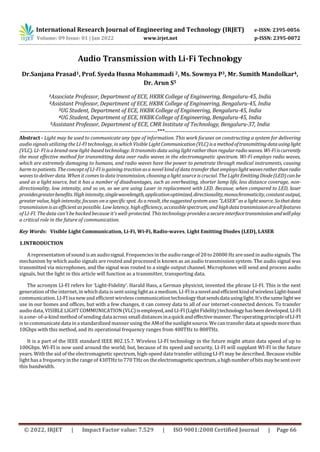
years. With the aid of the electromagnetic spectrum, high-speed data transfer utilizing LI-FI may be described. Because visible
light hasa frequency in the range of 430THz to 770 THz on theelectromagneticspectrum,ahighnumberofbitsmaybesentover
this bandwidth.
© 2022, IRJET | Impact Factor value: 7.529 | ISO 9001:2008 Certified Journal | Page 66
International Research Journal of Engineering and Technology (IRJET) e-ISSN: 2395-0056
Volume: 09 Issue: 01 | Jan 2022 www.irjet.net p-ISSN: 2395-0072
Figure 1.1. Electromagnetic spectrum showing visible light portion
As a result, the rate inside the LI-FI will be greater, and faster speeds will be obtained more frequently. We can send many
sorts of data over a Wi-Fi network utilizing LI-FI. The main goal is to design a transmitter and receiver for audio using a LI-FI
configuration.LI-FI isn't only aboutlight and LEDs; it's a platformwithawiderangeofbenefitsandfeatures.ThisLI-FIsubjectis
about pulling the fiber out of fiber optics and transmitting data through an LED.
ThisstudyprovidesanobjectiveoverviewofLI-FI'soperation,benefits,andapplications.Thegoalofthisarticleistoprovidea
method for data transfer that is both quicker and more secure.
The major goals of this project are to develop and build a LI-FI-based wireless data transmitter and receiver. VLC is used to
convert audio files. The use of light as a carrier to send and receive audio data. The goal of this project is to create a data
transmission system that is bothquickerandmoresecure.LI-FItechnologyoffersthefollowingbenefits:fasterdatatransmission
than WI-FI, easier and less expensive to implement, faster data transfer due to greater speed of light emitted by the laser, high
security due to light restrictions, safe from electromagnetic interferences, cheap cost, portability. The data throughput for
internet applications is higher, there is a large lot of energyreduction in industry that utilizesLI-FIbasedequipment,anditruns
on optical bands that are not hazardous like RF spectrum. As a result, the LI-FI-based technology poses no health risks. This
method has a wide range of uses Because operating rooms do not allow WI-FI because it emits dangerous signals,LI-FImay be
utilizedinavariety of sectors,including hospital automation. Wheretheusageofradiospectrumishighlyhazardous,LI-FIaudio
transmission is commonly used in petrochemical industry automation. Because WI-FI and many other forms of radiation are
harmful to such vital places, LI-FI can be utilized in power plants. Localized advertising isfrequently done by broadcastingover
the LI-FI channel into smallerdistances, and it may also be utilized in underwater systemsforvoicecommunicationsanddevice
management. Secure networked medical equipment,patient accounts, and other information can all benefit from LI-FI. This
system may be utilized in placessuchasworkplaces,hotels,andotherplacesthatdemandstrongillumination.Asaresult, lasers
and high-intensity LED lights may both be employed.
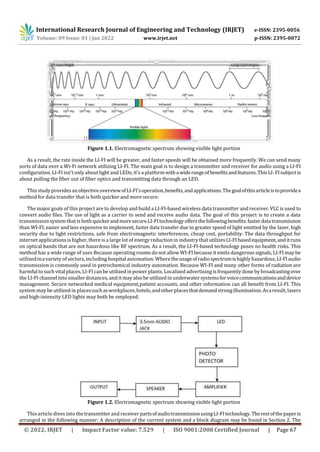
Figure 1.2. Electromagnetic spectrum showing visible light portion
Thisarticle dives into the transmitter and receiver partsofaudiotransmissionusingLI-FItechnology.Therestofthepaperis
arranged in the following manner: A description of the current system and a block diagram may be found in Section 2. The
© 2022, IRJET | Impact Factor value: 7.529 | ISO 9001:2008 Certified Journal | Page 67
International Research Journal of Engineering and Technology (IRJET) e-ISSN: 2395-0056
Volume: 09 Issue: 01 | Jan 2022 www.irjet.net p-ISSN: 2395-0072
Smart phone Audio jack Laser Solar panel Amplifier Speaker
suggestedsystemisshown inSection3as ablock diagram.Section4iswhereyou'll findtheconclusionandfuturescope.Section
5 contains a list of sources.
2. EXISTING SYSTEM
The LED on the transmitter will flash whenever a 3.5mmaudio jack isattachedtoanaudiosource,suchasasmartphone,but
the intensity of the light will not change when the phone is switched off. As soon as we start listening to the audio, we'll notice
that the intensity of the light changes frequently. When weturn upthevolumeonourphone,TheintensityoftheLEDlightvaries
at a pace that is quicker than the human eye can process. LEDs have a wavelength range of 275 to 950nm, hence they will only
reachasmalldistance.Atthereceiverend,asolar panelisinstalledthatissosensitivethatitcandetectslightchangesinintensity
and, as a result, the voltages at the solar panel's output vary. As a result, when the LED hits the panel, the voltage varies
depending on how bright the light is. The voltage from the solar panel is then routed into anamplifier,whichamplifiestheaudio
signal and outputs it through the speaker. The audio signal is amplified using the IC LM386 audio amplifier. As long as the solar
panel is in contact with the LEDs, output will be achieved.
To get clear audio output, we can keep the LED at a maximum distance of 15-20 cm from the solar panel.. Because LEDs are
inexpensive and widely available,thissystemcanbeimplemented;nevertheless,themaindisadvantage/drawbackofemploying
LEDs is that their range is limited, which necessitates a large solar panel area and greater wattage power. Data transmission
requires a near or perfect line-of-sight, which can be affected by LED, naturallight, sunlight, and conventional electriclight.Asa
result, in the suggested system of this research, laser light is used instead of LEDs.
3. PROPOSED SYSTEM
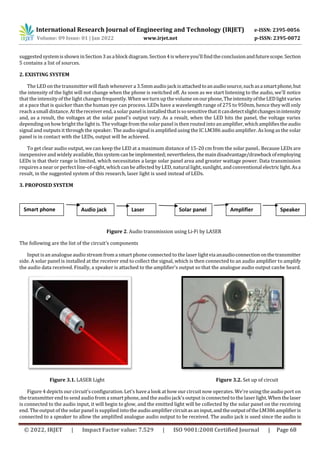
Figure 2. Audio transmission using Li-Fi by LASER
The following are the list of the circuit's components
Input isan analogue audio stream from a smart phone connected to the laser lightviaanaudioconnectiononthetransmitter
side. A solar panel is installed at the receiver end to collect the signal, which is then connected to an audio amplifier to amplify
the audio data received. Finally, a speaker is attached to the amplifier's output so that the analogue audio output canbe heard.
Figure 3.1. LASER Light Figure 3.2. Set up of circuit
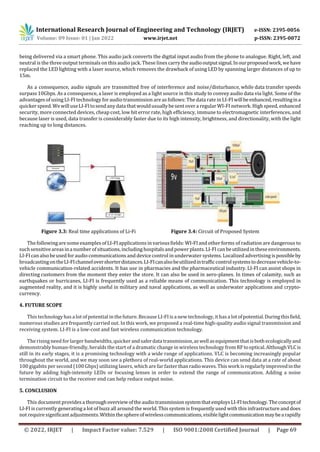
Figure 4 depicts our circuit's configuration. Let's have a look at how our circuit now operates. We're using the audio port on
the transmitter end to send audio from a smart phone, andthe audio jack's output is connected to the laser light.Whenthelaser
is connected to the audio input, it will begin to glow, and the emitted light will be collected by the solar panel on the receiving
end. The output of the solar panel is supplied into the audio amplifiercircuitasaninput,andtheoutputoftheLM386amplifieris
connected to a speaker to allow the amplified analogue audio output to be received. The audio jack is used since the audio is
© 2022, IRJET | Impact Factor value: 7.529 | ISO 9001:2008 Certified Journal | Page 68
International Research Journal of Engineering and Technology (IRJET) e-ISSN: 2395-0056
Volume: 09 Issue: 01 | Jan 2022 www.irjet.net p-ISSN: 2395-0072
being delivered via a smart phone. This audio jack converts the digital input audio from the phone to analogue. Right, left, and
neutral is the three output terminals on this audio jack. These lines carry the audiooutputsignal.Inourproposedwork,wehave
replaced the LED lighting with a laser source, which removes the drawback of using LED by spanning larger distances of up to
15m.
As a consequence, audio signals are transmitted free of interference and noise/disturbance, while data transfer speeds
surpass 10Gbps. As a consequence, a laser is employed as a light source in this study to convey audio data via light. Some of the
advantages of usingLI-FI technology for audio transmission are as follows: The data ratein LI-FI willbeenhanced,resultingina
quickerspeed.WewilluseLI-FItosendanydatathatwouldusuallybesentover a regularWI-FI network. High speed, enhanced
security, more connected devices, cheap cost, low bit error rate, high efficiency, immune to electromagnetic interferences, and
because laser is used, data transfer is considerably faster due to its high intensity, brightness, and directionality, with the light
reaching up to long distances.
Figure 3.3: Real time applications of Li-Fi Figure 3.4: Circuit of Proposed System
Thefollowingaresomeexamples ofLI-FIapplications invariousfields: WI-FIandother forms of radiation are dangerous to
suchsensitiveareasina numberofsituations,includinghospitalsandpowerplants.LI-FIcanbeutilizedintheseenvironments.
LI-FIcanalsobeusedforaudio communications and device control in underwater systems. Localizedadvertising ispossibleby
broadcastingontheLI-FIchannelovershorterdistances.LI-FIcanalsobeutilizedintrafficcontrolsystemstodecreasevehicle-to-
vehicle communication-related accidents. It has use in pharmacies and the pharmaceutical industry. LI-FI can assist shops in
directing customers from the moment they enter the store. It can also be used in aero-planes. In times of calamity, such as
earthquakes or hurricanes, LI-FI is frequently used as a reliable means of communication. This technology is employed in
augmented reality, and it is highly useful in military and naval applications, as well as underwater applications and crypto-
currency.
4. FUTURE SCOPE
Thistechnologyhasalot ofpotential inthefuture. BecauseLI-FIisa new technology, ithasa lotofpotential.Duringthisfield,
numerous studies are frequently carried out. In this work, we proposed a real-time high-quality audio signal transmission and
receiving system. LI-FI is a low-cost and fast wireless communication technology.
The rising need for larger bandwidths, quickerandsaferdatatransmission,aswellasequipmentthatisbothecologicallyand
demonstrably human-friendly, heralds the start of a dramatic change in wireless technology fromRFtooptical.AlthoughVLCis
still in its early stages, it is a promising technology with a wide range of applications. VLC is becoming increasingly popular
throughout the world, and we may soon see a plethora of real-world applications. This device can send data at a rate of about
100 gigabits per second (100 Gbps) utilizing lasers, which are far faster thanradiowaves.Thisworkisregularlyimprovedinthe
future by adding high-intensity LEDs or focusing lenses in order to extend the range of communication. Adding a noise
termination circuit to the receiver end can help reduce output noise.
5. CONCLUSION
This document providesa thoroughoverviewoftheaudiotransmissionsystemthatemploysLI-FItechnology.Theconceptof
LI-FI is currently generating a lot of buzz all around the world. This system is frequently used with this infrastructure and does
not require significant adjustments.Withinthesphereofwirelesscommunications,visiblelightcommunicationmaybearapidly
© 2022, IRJET | Impact Factor value: 7.529 | ISO 9001:2008 Certified Journal | Page 69
International Research Journal of Engineering and Technology (IRJET) e-ISSN: 2395-0056
Volume: 09 Issue: 01 | Jan 2022 www.irjet.net p-ISSN: 2395-0072
emerging technology. The VLC is still in its early phases, but with the great advances in technology being made step by stage, it
will soon be integrated into our daily life. LI-FI is a quick and low-cost wireless data transport technology. The rising need for
higher bandwidths, quicker and safer data transfer, as well as technology that is both ecologically and demonstrably human-
friendly, heralds the start of a huge wireless revolution. This type of recent invention is frequently promoted as a safe and
environmentally friendly technology. It can also be used inhazardous environments,such as thermal and atomicpower plants,
without creating electromagnetic interference. As a result, LI-FI can take the place of Wi-Fi.
REFERENCES
1. Jagadeeswari, B., Anusha, C.S., Monisa, D. and Preethi, M., (2019) Audio Transmission usingLi-FiTechnology.IntJ
of Trend in Scientific Research and Development 3(3):1008- 1011
2. Rekha, R., Priyadarshini, C., Pooja, R., Prashanth, R. and Shetty, S.V., (2019) Li-Fi based Data and Audio
Communication, International Journal of Engineering Research & Technology, 8(5):558-561
3. Gayathiri, Dr. S. Mohanapriya., (2020) A Starter to the FutureCommunicationThrough IlluminationTransmission
along with the Wireless Transmission, International Journal of Engineering Research & Technology, 8(3):1-4.
4. Nandwana S, Dixit S, Audeechaya N, (2018) Li-Fi (Light Fidelity), NCETECE-14: National conference on Emerging
trends in Electronics and Communication, p.241-244.
5. GMadhuri,KAnjaliandRSakthiPrabha,(2020)Transmissionofdata,audioandtextsignal using LI-FI technology.
IOP conf. Series: materials science and Engineering, 872(1):1-7
6. SameerBinAli(2018),ImplementationissuesofLI-FI,IJRET,6(9)SETS-2018Conference preceeding , p.1-3
7. Shweta Sagar, Mukti Rawal, Yukti Mutreja, Sushil Kumar(2018), Comparison of Analog and Digital based Voice
Transmission System for Visible Light Communication, IJRET, 5(10):1-3 ICCCS-2017: Int Conf On Computational
Intelligence, Cyber Security And Smart Grid
8. Vinnarasi, S. T Aarthy , (2017),Transmission of data, audio signal andtextusingLI-FI,ICMSMT,872(2020):1-7,IOP
conf. series: material
9. Revathi S, Aiswarya NJ , (2018),Audio transmissionusingLI-FI,international journal ofadvanceresearch,ideasand
innovations in technology, 4(2):2599-2603
10. Nischay, (2017),A review paper on LI-FI technology, IJRERT, VIMPACT-17, conference preceeding, 5(23):1-5.
11. Lamya I. Albraheem, Lamia. Alhudaithy, Afnan A. Aliaser, MuneerahR.Aldhafian,andGhada M.Bahliwah,(2018),
Toward designing a LI-FI based hierarchical IOT architecture, IEEE ACCESS , 6(2018):40811-40825.
12. Saranya S, Ragavi B, Pavithra L, Susheel S, Srivarsha M, Vishal V, (2021), Audio transmission using visible light
communication and LI-FI technology. 6TH International ConferenceonInventiveComputationTechnology(ICICT)
(IEEE):19-24.
13. A Maideen Abdhulkaderjeylani, B Achuthan, B Arunkumar, M Boobalan and R L Chiragsun , (2021), Underwater
visible light communication using LI-FI, Easy chair preprint no.5080.
14. P.M Benson Mansingh, G. Sekar and T. JobyTitus,(2021),VehiclecollisionavoidancesystemusingLI-FI,Intechopen
Ubiquitious computing 1-15.
15. D. Kusuma, K. Nikitha, P. Naga Sai, S. Mahesh babu, K. Manoj Kumar and J. Jhansi , (2021),Transmission ofdata and
audio signal using LI-FI technology, Int journal of innovative Research in Science Engineering Technology, 10(7):
9527-9530.
© 2022, IRJET | Impact Factor value: 7.529 | ISO 9001:2008 Certified Journal | Page 70
International Research Journal of Engineering and Technology (IRJET) e-ISSN: 2395-0056
Volume: 09 Issue: 01 | Jan 2022 www.irjet.net p-ISSN: 2395-0072
BIOGRAPHIES
Ms Sowmya P is currently a Final year B.E Electronics and Communication Engineering student in
HKBK College of Engineering, Nagawara, Bengaluru. She has completed herInternshipinEmbedded
systems domain from Emertxe Information Technologies. Her internship project was based on
Washing machine simulator using MPLAB XIDE and Picsimlab. She has completed her internship
based on Embedded systems and IoRT from EdGate technologies Pvt Ltd, Bengaluru. Sheisanactive
student co-ordinator in Centre for Research and Development- Student Club (CORD-SC)atHKBKCE.
Her technical skills includes MATLAB, Keil, Cadence, Xilinx,Nctuns,EmbeddedC,Python,Verilogand
Digital System Design. Her research interests include Wireless Communications, Signal Processing,
Optimization techniques, Embedded systems and VLSI Design.
Dr. Sanjana Prasad is currently working as Associate Professor in the Department of ECE at HKBK
College of Engineering, Nagawara, Bengaluru She completed her B.E in Electronics and Communication
Engineering from NGP Institute of Technology in the year 2013. She graduated M.E in Communication
systems from Bannari Amman Institute of Technology, Sathyamangalam, Erode in the year 2015. She
completed her Ph.D. (Full time) in Information and Communication Engineering, Anna University,
Chennai in the year 2020. She has research experience in the field of Wireless Communications and
teaching experience at PSG College of Technology, Coimbatore. Her research interests include Wireless
Communications, Beyond 5G Networks, Signal Processing, Optimizationtechniques,5GTechnologyand
Artificial Intelligence.
Ms. Syeda Husna Mohammadi is currently working as Assistant Professor at HKBK College of
Engineering, Bengaluru. She has completed her M. Tech in Digital Electronics and Communication
from M S Ramaiah Institute of Technology. She has16 years of teaching experience. Her research
interests include Digital Electronics, Communication, Embedded systems , VLSI Design, and Image
Processing .
Mr. Sumith Mandolkar is currently a Final year B.E Electronics and Communication Engineering
student in HKBK College of Engineering, Nagawara,Bengaluru.HehascompletedhisInternshipin
Embedded systems domain from Emertxe Information Technologies and completed project on
Microwave oven simulator using MPLAB XIDE and Picsimlab. He has completed his internship
based on Embedded systems and IoRT from EdGate technologies Pvt Ltd, Bengaluru. He is an
active student co-ordinator in Centre for Research and Development- Student Club (CORD-SC)at
HKBKCE. His technical skills such as MATLAB, Keil, Cadence, Xilinx, Nctuns, Embedded C,Python,
Verilog and DSD. His research interests include Wireless Communications, Signal Processing,
Optimization techniques, Embedded systems and VLSI Design.
Dr. Arun. S is currently working as Assistant Professor in the Department of Electronics and
Communication, CMR Institute of Technology, Bangalore. He completed his B.E Electronics and
Communication from VLB Janakiammal College of Engineering and Technology under Anna
University. His M.E Communication Systems was completed from Sri Krishna College of
Engineering and Technology under Anna University. He pursued his Ph.D Full Time from PSG
College of Technology under Anna University in 2020. His research interests include Wireless
Communication, Network Security, Cognitive Radio Networks etc. He has also served as
Assistant Professor in Sri Krishna College of Technology, Coimbatore.
© 2022, IRJET | Impact Factor value: 7.529 | ISO 9001:2008 Certified Journal | Page 71