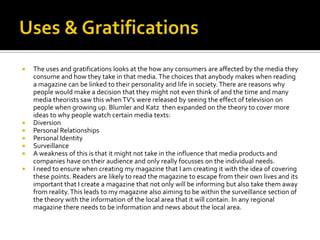
   The uses and gratifications looks at the how any consumers are affected by the media they
    consume and how they take in that media. The choices that anybody makes when reading
    a magazine can be linked to their personality and life in society. There are reasons why
    people would make a decision that they might not even think of and the time and many
    media theorists saw this when TV’s were released by seeing the effect of television on
    people when growing up. Blumler and Katz then expanded on the theory to cover more
    ideas to why people watch certain media texts:
   Diversion
   Personal Relationships
   Personal Identity
   Surveillance
   A weakness of this is that it might not take in the influence that media products and
    companies have on their audience and only really focusses on the individual needs.
   I need to ensure when creating my magazine that I am creating it with the idea of covering
    these points. Readers are likely to read the magazine to escape from their own lives and its
    important that I create a magazine that not only will be informing but also take them away
    from reality. This leads to my magazine also aiming to be within the surveillance section of
    the theory with the information of the local area that it will contain. In any regional
    magazine there needs to be information and news about the local area.
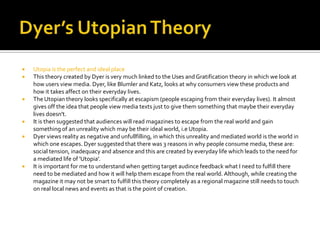
   Utopia is the perfect and ideal place
   This theory created by Dyer is very much linked to the Uses and Gratification theory in which we look at
    how users view media. Dyer, like Blumler and Katz, looks at why consumers view these products and
    how it takes affect on their everyday lives.
   The Utopian theory looks specifically at escapism (people escaping from their everyday lives). It almost
    gives off the idea that people view media texts just to give them something that maybe their everyday
    lives doesn't.
   It is then suggested that audiences will read magazines to escape from the real world and gain
    something of an unreality which may be their ideal world, i.e Utopia.
   Dyer views reality as negative and unfullfilling, in which this unreality and mediated world is the world in
    which one escapes. Dyer suggested that there was 3 reasons in why people consume media, these are:
    social tension, inadequacy and absence and this are created by everyday life which leads to the need for
    a mediated life of 'Utopia'.
   It is important for me to understand when getting target audince feedback what I need to fulfill there
    need to be mediated and how it will help them escape from the real world. Although, while creating the
    magazine it may not be smart to fulfill this theory completely as a regional magazine still needs to touch
    on real local news and events as that is the point of creation.
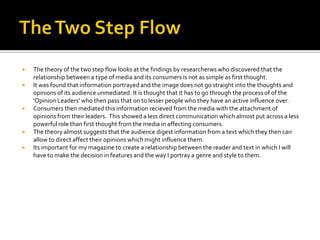
   The theory of the two step flow looks at the findings by researcherws who discovered that the
    relationship between a type of media and its consumers is not as simple as first thought.
   It was found that information portrayed and the image does not go straight into the thoughts and
    opinions of its audience unmediated. It is thought that it has to go through the process of of the
    'Opinion Leaders' who then pass that on to lesser people who they have an active influence over.
   Consumers then mediated this information recieved from the media with the attachment of
    opinions from their leaders. This showed a less direct communication which almost put across a less
    powerful role than first thought from the media in affecting consumers.
   The theory almost suggests that the audience digest information from a text which they then can
    allow to direct affect their opinions which might influence them.
   Its important for my magazine to create a relationship between the reader and text in which I will
    have to make the decision in features and the way I portray a genre and style to them.
   The hypodermic needle theory analyses how consumers react to media off all different kinds. It
    explains the idea of an audience being immediately affected by opinion or personality by the ways a
    media text may portray an image, text, or video.
   Its also important to understand that this theory suggests that this information goes in without
    being thought of and challenged by an individual. This results in an audience being thought to be
    manipulated by a media text and that an opinion of some sort can be influencing someones
    thoughts.
   Though it does seem to have major problems surfacing with the theory especially now in modern
    day where audiences are well aware of media made opinions and stories. People are more carefl
    about what to believe and everyone has certain media they do and dont trust. Though it is not
    completely flawed with people creating opinions and personal interests on an ever growing media
    platform.
   When looking at a magazine it is important when trying to put across a certain style or genre then
    you use mise-en-scene and imagery to do so. This then interprets a style to the audience which then
    may influence them.
   When creating any media text its important to remember that although thinking an audience as a
    group that there is also individuals as well.
   Circumstances such as gender, region, hobbies class, age and ethnicity all need to be taken into
    account when aiming for a specific audience. These things will only affect their opinion of the text
    and it is important for these to be though of when trying to link a product to its audience for it to be
    successful.
   Stuart Hall's work on encoding and decoding which looked at how a text and its consumer were
    linked and how these two different groups were looking at the same codes and connotations but
    reading them differently. Though using expected and stereotypical conventions when attracting an
    audience for any media text then it is likely to be more favourable and easier to understand and
    there is likely to be a better understanding between the relationship of the creator and the
    consumer.
   When I create my magazine its important that i recognise all the expectations of my audience. I have
    to be able to recognise these and create a magazine which shows codes and conventions that my
    audience are able to then understand and be preferable to or else my products are likely to be
    unsuccessful.

Audience theories

  • 2.
    The uses and gratifications looks at the how any consumers are affected by the media they consume and how they take in that media. The choices that anybody makes when reading a magazine can be linked to their personality and life in society. There are reasons why people would make a decision that they might not even think of and the time and many media theorists saw this when TV’s were released by seeing the effect of television on people when growing up. Blumler and Katz then expanded on the theory to cover more ideas to why people watch certain media texts:  Diversion  Personal Relationships  Personal Identity  Surveillance  A weakness of this is that it might not take in the influence that media products and companies have on their audience and only really focusses on the individual needs.  I need to ensure when creating my magazine that I am creating it with the idea of covering these points. Readers are likely to read the magazine to escape from their own lives and its important that I create a magazine that not only will be informing but also take them away from reality. This leads to my magazine also aiming to be within the surveillance section of the theory with the information of the local area that it will contain. In any regional magazine there needs to be information and news about the local area.
  • 3.
    Utopia is the perfect and ideal place  This theory created by Dyer is very much linked to the Uses and Gratification theory in which we look at how users view media. Dyer, like Blumler and Katz, looks at why consumers view these products and how it takes affect on their everyday lives.  The Utopian theory looks specifically at escapism (people escaping from their everyday lives). It almost gives off the idea that people view media texts just to give them something that maybe their everyday lives doesn't.  It is then suggested that audiences will read magazines to escape from the real world and gain something of an unreality which may be their ideal world, i.e Utopia.  Dyer views reality as negative and unfullfilling, in which this unreality and mediated world is the world in which one escapes. Dyer suggested that there was 3 reasons in why people consume media, these are: social tension, inadequacy and absence and this are created by everyday life which leads to the need for a mediated life of 'Utopia'.  It is important for me to understand when getting target audince feedback what I need to fulfill there need to be mediated and how it will help them escape from the real world. Although, while creating the magazine it may not be smart to fulfill this theory completely as a regional magazine still needs to touch on real local news and events as that is the point of creation.
  • 4.
    The theory of the two step flow looks at the findings by researcherws who discovered that the relationship between a type of media and its consumers is not as simple as first thought.  It was found that information portrayed and the image does not go straight into the thoughts and opinions of its audience unmediated. It is thought that it has to go through the process of of the 'Opinion Leaders' who then pass that on to lesser people who they have an active influence over.  Consumers then mediated this information recieved from the media with the attachment of opinions from their leaders. This showed a less direct communication which almost put across a less powerful role than first thought from the media in affecting consumers.  The theory almost suggests that the audience digest information from a text which they then can allow to direct affect their opinions which might influence them.  Its important for my magazine to create a relationship between the reader and text in which I will have to make the decision in features and the way I portray a genre and style to them.
  • 5.
    The hypodermic needle theory analyses how consumers react to media off all different kinds. It explains the idea of an audience being immediately affected by opinion or personality by the ways a media text may portray an image, text, or video.  Its also important to understand that this theory suggests that this information goes in without being thought of and challenged by an individual. This results in an audience being thought to be manipulated by a media text and that an opinion of some sort can be influencing someones thoughts.  Though it does seem to have major problems surfacing with the theory especially now in modern day where audiences are well aware of media made opinions and stories. People are more carefl about what to believe and everyone has certain media they do and dont trust. Though it is not completely flawed with people creating opinions and personal interests on an ever growing media platform.  When looking at a magazine it is important when trying to put across a certain style or genre then you use mise-en-scene and imagery to do so. This then interprets a style to the audience which then may influence them.
  • 6.
    When creating any media text its important to remember that although thinking an audience as a group that there is also individuals as well.  Circumstances such as gender, region, hobbies class, age and ethnicity all need to be taken into account when aiming for a specific audience. These things will only affect their opinion of the text and it is important for these to be though of when trying to link a product to its audience for it to be successful.  Stuart Hall's work on encoding and decoding which looked at how a text and its consumer were linked and how these two different groups were looking at the same codes and connotations but reading them differently. Though using expected and stereotypical conventions when attracting an audience for any media text then it is likely to be more favourable and easier to understand and there is likely to be a better understanding between the relationship of the creator and the consumer.  When I create my magazine its important that i recognise all the expectations of my audience. I have to be able to recognise these and create a magazine which shows codes and conventions that my audience are able to then understand and be preferable to or else my products are likely to be unsuccessful.