Download free for 30 days
Sign in
Upload
Language (EN)
Support
Business
Mobile
Social Media
Marketing
Technology
Art & Photos
Career
Design
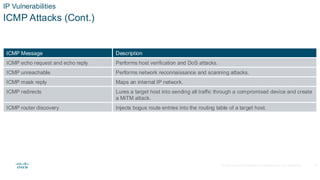
Education
Presentations & Public Speaking
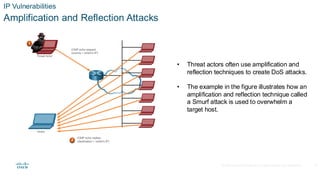
Government & Nonprofit
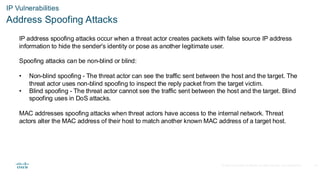
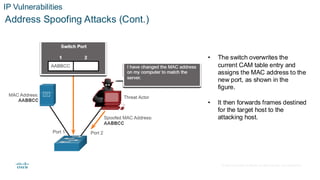
Healthcare
Internet
Law
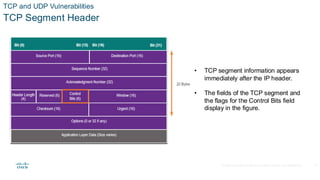
Leadership & Management
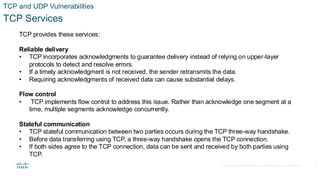
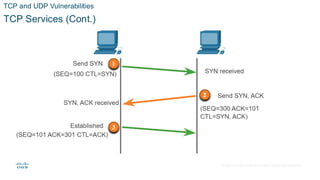
Automotive
Engineering
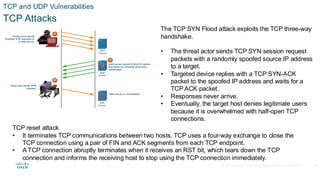
Software
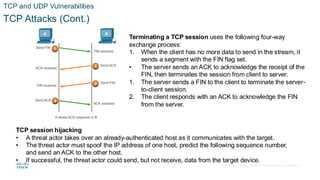
Recruiting & HR
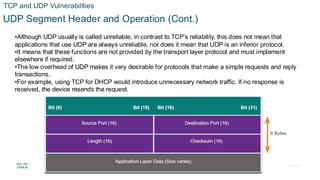
Retail
Sales
Services
Science
Small Business & Entrepreneurship
Food
Environment
Economy & Finance
Data & Analytics
Investor Relations
Sports
Spiritual
News & Politics
Travel
Self Improvement
Real Estate
Entertainment & Humor
Health & Medicine
Devices & Hardware
Lifestyle
Change Language
Language
English
Español
Português
Français
Deutsche
Cancel
Save
EN
Uploaded by
phon02772
3 views
Attacking the Foundation. .pdf.
The foundation of Attack
Technology
◦
Read more
0
Save
Share
Embed
Embed presentation
Download
Download to read offline
1
/ 30
2
/ 30
3
/ 30
4
/ 30
5
/ 30
6
/ 30
7
/ 30
8
/ 30
9
/ 30
10
/ 30
11
/ 30
12
/ 30
13
/ 30
14
/ 30
15
/ 30
16
/ 30
17
/ 30
18
/ 30
19
/ 30
20
/ 30
21
/ 30
22
/ 30
23
/ 30
24
/ 30
25
/ 30
26
/ 30
27
/ 30
28
/ 30
29
/ 30
30
/ 30
More Related Content
PPTX
ITN_Module_8.pptx
by
AliJrboy
PPTX
CCNA v6.0 ITN - Chapter 06
by
Irsandi Hasan
PDF
7.1 Network Layer.pdf1234567891011121314
by
MinaMolky
PPTX
Subject NETWORK LAYER for under graduates.pptx
by
nuruddinrazali
PPTX
IPV6-HD how ro lubricate oil the jumps over layz
by
JinjaxJacobi
PPTX
Lecture Notes- Network Services - Copy.pptx
by
SaqibAhmedKhan4
PPTX
Chp4 Network Layer.pptxdata communication and networking
by
eliasaraya142
PPTX
ITN_Module_13-Internet-control-message-protocol-Slides-Ins.pptx
by
saadiweh
ITN_Module_8.pptx
by
AliJrboy
CCNA v6.0 ITN - Chapter 06
by
Irsandi Hasan
7.1 Network Layer.pdf1234567891011121314
by
MinaMolky
Subject NETWORK LAYER for under graduates.pptx
by
nuruddinrazali
IPV6-HD how ro lubricate oil the jumps over layz
by
JinjaxJacobi
Lecture Notes- Network Services - Copy.pptx
by
SaqibAhmedKhan4
Chp4 Network Layer.pptxdata communication and networking
by
eliasaraya142
ITN_Module_13-Internet-control-message-protocol-Slides-Ins.pptx
by
saadiweh
Similar to Attacking the Foundation. .pdf.
PPTX
Network Layer and its protocols mod .pptx
by
cossykin19
PPTX
ITN_Module_9.pptx
by
FhKh5
PPTX
Ccna v5-S1-Chapter 5
by
Hamza Malik
PPTX
ITN_Module_9.pptx
by
SomEducationonline
PDF
Network security
by
Sri Manakula Vinayagar Engineering College
PPTX
CCNA (R & S) Module 01 - Introduction to Networks - Chapter 5
by
Waqas Ahmed Nawaz
PDF
IPv6 Security - Myths and Reality
by
Swiss IPv6 Council
DOCX
Implementation of IPSec VPN on Cisco routers and Configuring it on ISP. (1)
by
Vanitha Joshi
PDF
ITN_Module_7.pdf jnnnnnnnnnnnnnnnnnnmnnm
by
mweenemweemba88
PPTX
Chapter 5 : Ethernet
by
teknetir
PPTX
CCNA RS_NB - Chapter 10
by
Irsandi Hasan
PPTX
Packet Analysis - Course Technology Computing Conference
by
Cengage Learning
PPTX
CCNA RS_ITN - Chapter 5
by
Irsandi Hasan
PPTX
Lecture 7 Attacker and there tools.pptx
by
AsmaaLafi1
PPTX
Eric Vyncke - IPv6 Security Vendor Point of View
by
IPv6 Conference
PPTX
CCNA 1 Routing and Switching v5.0 Chapter 5
by
Nil Menon
PDF
CISSP Week 5
by
jemtallon
PDF
Using packet-tracer, capture and other Cisco ASA tools for network troublesho...
by
Cisco Russia
PPTX
Endpoint Security - Network Security Infrastructure
by
abigailjudith8
PDF
02- Common TCP-IP Attacks securit .pdf
by
morabi921
Network Layer and its protocols mod .pptx
by
cossykin19
ITN_Module_9.pptx
by
FhKh5
Ccna v5-S1-Chapter 5
by
Hamza Malik
ITN_Module_9.pptx
by
SomEducationonline
Network security
by
Sri Manakula Vinayagar Engineering College
CCNA (R & S) Module 01 - Introduction to Networks - Chapter 5
by
Waqas Ahmed Nawaz
IPv6 Security - Myths and Reality
by
Swiss IPv6 Council
Implementation of IPSec VPN on Cisco routers and Configuring it on ISP. (1)
by
Vanitha Joshi
ITN_Module_7.pdf jnnnnnnnnnnnnnnnnnnmnnm
by
mweenemweemba88
Chapter 5 : Ethernet
by
teknetir
CCNA RS_NB - Chapter 10
by
Irsandi Hasan
Packet Analysis - Course Technology Computing Conference
by
Cengage Learning
CCNA RS_ITN - Chapter 5
by
Irsandi Hasan
Lecture 7 Attacker and there tools.pptx
by
AsmaaLafi1
Eric Vyncke - IPv6 Security Vendor Point of View
by
IPv6 Conference
CCNA 1 Routing and Switching v5.0 Chapter 5
by
Nil Menon
CISSP Week 5
by
jemtallon
Using packet-tracer, capture and other Cisco ASA tools for network troublesho...
by
Cisco Russia
Endpoint Security - Network Security Infrastructure
by
abigailjudith8
02- Common TCP-IP Attacks securit .pdf
by
morabi921
Recently uploaded
PPTX
Real-Time KPI Dashboard Playbook: What to Track Live and What Not To
by
victorworkvebo
PDF
GenerationAI_Paris_2025_Architecting_Intelligence.pdf
by
apidays
PPTX
CTO Strategy OS 2026: The Tech, AI & Cloud Playbook Boards Want
by
ridwansassman
PDF
Agent Factory -AIOUG Multicloud - Feb 2026
by
Sandesh Rao
PDF
Digital Twin in IBM for Accelerated Discovery of Climate & Sustainability, K...
by
Michiaki Tatsubori
PDF
Escape from the Forbidden Zone: Smuggling green and inclusive tech past the g...
by
BookNet Canada
PDF
Odoo Implementation Checklist: A Strategic ERP Blueprint for Business-Ready D...
by
BANIBRO IT SOLUTION
PDF
From Artificial Intelligence to African Intelligence: Transforming Research &...
by
Moses Kemibaro
PDF
Empower your IT team with cloud-based PC management using Dell Management Por...
by
Principled Technologies
PDF
Founder & Tech Lead | Web Development & Digital Growth Consultant | Helping B...
by
Shyamal Das
PDF
AI TOOLS FOR PRODUCTIVITY IN MODERN TIMES.pdf
by
Santunu
PDF
apidays New York 2025 | AI in Application Security
by
apidays
PDF
HOW TO OVERCOME THE THREATS OF ARTIFICIAL INTELLIGENCE AGAINST HUMANITY.pdf
by
Faga1939
PDF
GTM-and-Sales-Plan for a cyber security product
by
Ashish Jangir
PDF
GDG Cloud Southlake #49: Pradeep R Kumar: Implications of Agentic AI for Iden...
by
James Anderson
PDF
Transcript: Escape from the Forbidden Zone: Smuggling green and inclusive tec...
by
BookNet Canada
PDF
Bringing AI into R&D, Taking a Human-Centric Approach / Haim Yadid
by
Haim Yadid
PDF
apidays Paris 2025 | Zero Trust By Design
by
apidays
PDF
final.pdf
by
omarbishtawi04
PPTX
The Transformative Technology in Contemporary Businesses
by
greyaudrina
Real-Time KPI Dashboard Playbook: What to Track Live and What Not To
by
victorworkvebo
GenerationAI_Paris_2025_Architecting_Intelligence.pdf
by
apidays
CTO Strategy OS 2026: The Tech, AI & Cloud Playbook Boards Want
by
ridwansassman
Agent Factory -AIOUG Multicloud - Feb 2026
by
Sandesh Rao
Digital Twin in IBM for Accelerated Discovery of Climate & Sustainability, K...
by
Michiaki Tatsubori
Escape from the Forbidden Zone: Smuggling green and inclusive tech past the g...
by
BookNet Canada
Odoo Implementation Checklist: A Strategic ERP Blueprint for Business-Ready D...
by
BANIBRO IT SOLUTION
From Artificial Intelligence to African Intelligence: Transforming Research &...
by
Moses Kemibaro
Empower your IT team with cloud-based PC management using Dell Management Por...
by
Principled Technologies
Founder & Tech Lead | Web Development & Digital Growth Consultant | Helping B...
by
Shyamal Das
AI TOOLS FOR PRODUCTIVITY IN MODERN TIMES.pdf
by
Santunu
apidays New York 2025 | AI in Application Security
by
apidays
HOW TO OVERCOME THE THREATS OF ARTIFICIAL INTELLIGENCE AGAINST HUMANITY.pdf
by
Faga1939
GTM-and-Sales-Plan for a cyber security product
by
Ashish Jangir
GDG Cloud Southlake #49: Pradeep R Kumar: Implications of Agentic AI for Iden...
by
James Anderson
Transcript: Escape from the Forbidden Zone: Smuggling green and inclusive tec...
by
BookNet Canada
Bringing AI into R&D, Taking a Human-Centric Approach / Haim Yadid
by
Haim Yadid
apidays Paris 2025 | Zero Trust By Design
by
apidays
final.pdf
by
omarbishtawi04
The Transformative Technology in Contemporary Businesses
by
greyaudrina
Attacking the Foundation. .pdf.
1.
Module 3: Attacking
the Foundation Cybersecurity Essentials 3.0
2.
© 2020 Cisco
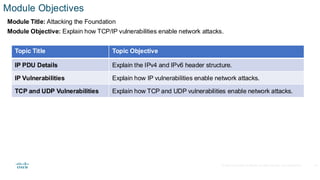
and/or its affiliates.All rights reserved. Cisco Confidential Module Objectives Module Title: Attacking the Foundation Module Objective: Explain how TCP/IP vulnerabilities enable network attacks. Topic Title Topic Objective IP PDU Details Explain the IPv4 and IPv6 header structure. IP Vulnerabilities Explain how IP vulnerabilities enable network attacks. TCP and UDP Vulnerabilities Explain how TCP and UDP vulnerabilities enable network attacks. 10
3.
© 2020 Cisco
and/or its affiliates.All rights reserved. Cisco Confidential 3.1 IP PDU Details 11
4.
© 2020 Cisco
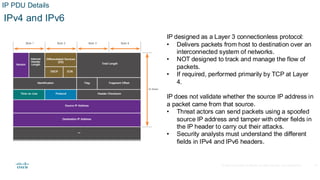
and/or its affiliates.All rights reserved. Cisco Confidential IP PDU Details IPv4 and IPv6 IP designed as a Layer 3 connectionless protocol: • Delivers packets from host to destination over an interconnected system of networks. • NOT designed to track and manage the flow of packets. • If required, performed primarily by TCP at Layer 4. IP does not validate whether the source IP address in a packet came from that source. • Threat actors can send packets using a spoofed source IP address and tamper with other fields in the IP header to carry out their attacks. • Security analysts must understand the different fields in IPv4 and IPv6 headers. 12
5.
© 2020 Cisco
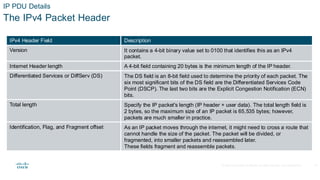
and/or its affiliates.All rights reserved. Cisco Confidential IP PDU Details The IPv4 Packet Header IPv4 Header Field Description Version It contains a 4-bit binary value set to 0100 that identifies this as an IPv4 packet. Internet Header length A 4-bit field containing 20 bytes is the minimum length of the IP header. Differentiated Services or DiffServ (DS) The DS field is an 8-bit field used to determine the priority of each packet. The six most significant bits of the DS field are the Differentiated Services Code Point (DSCP). The last two bits are the Explicit Congestion Notification (ECN) bits. Total length Specify the IP packet's length (IP header + user data). The total length field is 2 bytes, so the maximum size of an IP packet is 65,535 bytes; however, packets are much smaller in practice. Identification, Flag, and Fragment offset As an IP packet moves through the internet, it might need to cross a route that cannot handle the size of the packet. The packet will be divided, or fragmented, into smaller packets and reassembled later. These fields fragment and reassemble packets. 13
6.
© 2020 Cisco
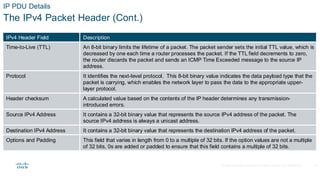
and/or its affiliates.All rights reserved. Cisco Confidential IP PDU Details The IPv4 Packet Header (Cont.) IPv4 Header Field Description Time-to-Live (TTL) An 8-bit binary limits the lifetime of a packet. The packet sender sets the initial TTL value, which is decreased by one each time a router processes the packet. If the TTL field decrements to zero, the router discards the packet and sends an ICMP Time Exceeded message to the source IP address. Protocol It identifies the next-level protocol. This 8-bit binary value indicates the data payload type that the packet is carrying, which enables the network layer to pass the data to the appropriate upper- layer protocol. Header checksum A calculated value based on the contents of the IP header determines any transmission- introduced errors. Source IPv4 Address It contains a 32-bit binary value that represents the source IPv4 address of the packet. The source IPv4 address is always a unicast address. Destination IPv4 Address It contains a 32-bit binary value that represents the destination IPv4 address of the packet. Options and Padding This field that varies in length from 0 to a multiple of 32 bits. If the option values are not a multiple of 32 bits, 0s are added or padded to ensure that this field contains a multiple of 32 bits. 14
7.
© 2020 Cisco
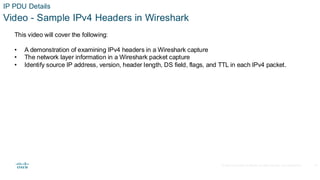
and/or its affiliates.All rights reserved. Cisco Confidential IP PDU Details Video - Sample IPv4 Headers in Wireshark This video will cover the following: • A demonstration of examining IPv4 headers in a Wireshark capture • The network layer information in a Wireshark packet capture • Identify source IP address, version, header length, DS field, flags, and TTL in each IPv4 packet. 15
8.
© 2020 Cisco
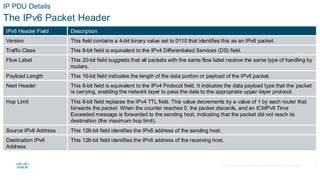
and/or its affiliates.All rights reserved. Cisco Confidential IP PDU Details The IPv6 Packet Header IPv6 Header Field Description Version This field contains a 4-bit binary value set to 0110 that identifies this as an IPv6 packet. Traffic Class This 8-bit field is equivalent to the IPv4 Differentiated Services (DS) field. Flow Label This 20-bit field suggests that all packets with the same flow label receive the same type of handling by routers. Payload Length This 16-bit field indicates the length of the data portion or payload of the IPv6 packet. Next Header This 8-bit field is equivalent to the IPv4 Protocol field. It indicates the data payload type that the packet is carrying, enabling the network layer to pass the data to the appropriate upper-layer protocol. Hop Limit This 8-bit field replaces the IPv4 TTL field. This value decrements by a value of 1 by each router that forwards the packet. When the counter reaches 0, the packet discards, and an ICMPv6 Time Exceeded message is forwarded to the sending host, indicating that the packet did not reach its destination (the maximum hop limit). Source IPv6 Address This 128-bit field identifies the IPv6 address of the sending host. Destination IPv6 Address This 128-bit field identifies the IPv6 address of the receiving host. 16
9.
© 2020 Cisco
and/or its affiliates.All rights reserved. Cisco Confidential IP PDU Details Video - Sample IPv6 Headers in Wireshark This video will cover the following: • Investigate a threat landscape and 3 vulnerabilities that can be exploited by threat actors • Explore a vulnerability that results from a device that is not properly configured with security best practices 17
10.
© 2020 Cisco
and/or its affiliates.All rights reserved. Cisco Confidential 3.2 IP Vulnerabilities 18
11.
© 2020 Cisco
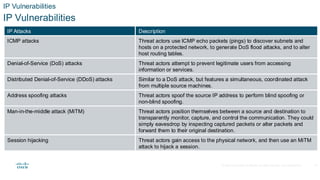
and/or its affiliates.All rights reserved. Cisco Confidential IP Vulnerabilities IP Vulnerabilities IP Attacks Description ICMP attacks Threat actors use ICMP echo packets (pings) to discover subnets and hosts on a protected network, to generate DoS flood attacks, and to alter host routing tables. Denial-of-Service (DoS) attacks Threat actors attempt to prevent legitimate users from accessing information or services. Distributed Denial-of-Service (DDoS) attacks Similar to a DoS attack, but features a simultaneous, coordinated attack from multiple source machines. Address spoofing attacks Threat actors spoof the source IP address to perform blind spoofing or non-blind spoofing. Man-in-the-middle attack (MiTM) Threat actors position themselves between a source and destination to transparently monitor, capture, and control the communication. They could simply eavesdrop by inspecting captured packets or alter packets and forward them to their original destination. Session hijacking Threat actors gain access to the physical network, and then use an MiTM attack to hijack a session. 19
12.
© 2020 Cisco
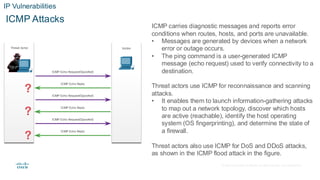
and/or its affiliates.All rights reserved. Cisco Confidential ICMP Attacks ICMP carries diagnostic messages and reports error conditions when routes, hosts, and ports are unavailable. • Messages are generated by devices when a network error or outage occurs. • The ping command is a user-generated ICMP message (echo request) used to verify connectivity to a destination. Threat actors use ICMP for reconnaissance and scanning attacks. • It enables them to launch information-gathering attacks to map out a network topology, discover which hosts are active (reachable), identify the host operating system (OS fingerprinting), and determine the state of a firewall. Threat actors also use ICMP for DoS and DDoS attacks, as shown in the ICMP flood attack in the figure. IP Vulnerabilities
13.
© 2020 Cisco
and/or its affiliates.All rights reserved. Cisco Confidential IP Vulnerabilities ICMP Attacks (Cont.) ICMP Message Description ICMP echo request and echo reply Performs host verification and DoS attacks. ICMP unreachable Performs network reconnaissance and scanning attacks. ICMP mask reply Maps an internal IP network. ICMP redirects Lures a target host into sending all traffic through a compromised device and create a MiTM attack. ICMP router discovery Injects bogus route entries into the routing table of a target host. 21
14.
© 2020 Cisco
and/or its affiliates.All rights reserved. Cisco Confidential IP Vulnerabilities Video - Amplification, Reflection, and Spoofing Attacks This video will cover the following: • Explain the amplification, reflection, and spoofing attack • Identify and address the difference between non-blind spoofing and blind spoofing attacks 22
15.
© 2020 Cisco
and/or its affiliates.All rights reserved. Cisco Confidential IP Vulnerabilities Amplification and Reflection Attacks • Threat actors often use amplification and reflection techniques to create DoS attacks. • The example in the figure illustrates how an amplification and reflection technique called a Smurf attack is used to overwhelm a target host. 23
16.
© 2020 Cisco
and/or its affiliates.All rights reserved. Cisco Confidential IP Vulnerabilities Address Spoofing Attacks IP address spoofing attacks occur when a threat actor creates packets with false source IP address information to hide the sender's identity or pose as another legitimate user. Spoofing attacks can be non-blind or blind: • Non-blind spoofing - The threat actor can see the traffic sent between the host and the target. The threat actor uses non-blind spoofing to inspect the reply packet from the target victim. • Blind spoofing - The threat actor cannot see the traffic sent between the host and the target. Blind spoofing uses in DoS attacks. MAC addresses spoofing attacks when threat actors have access to the internal network. Threat actors alter the MAC address of their host to match another known MAC address of a target host. 24
17.
© 2020 Cisco
and/or its affiliates.All rights reserved. Cisco Confidential Address Spoofing Attacks (Cont.) • The switch overwrites the current CAM table entry and assigns the MAC address to the new port, as shown in the figure. • It then forwards frames destined for the target host to the attacking host. IP Vulnerabilities
18.
© 2020 Cisco
and/or its affiliates.All rights reserved. Cisco Confidential 3.3 TCP and UDP Vulnerabilities 26
19.
© 2020 Cisco
and/or its affiliates.All rights reserved. Cisco Confidential TCP and UDP Vulnerabilities TCP Segment Header • TCP segment information appears immediately after the IP header. • The fields of the TCP segment and the flags for the Control Bits field display in the figure. 27
20.
© 2020 Cisco
and/or its affiliates.All rights reserved. Cisco Confidential TCP and UDP Vulnerabilities TCP Services TCP provides these services: Reliable delivery • TCP incorporates acknowledgments to guarantee delivery instead of relying on upper-layer protocols to detect and resolve errors. • If a timely acknowledgment is not received, the sender retransmits the data. • Requiring acknowledgments of received data can cause substantial delays. Flow control • TCP implements flow control to address this issue. Rather than acknowledge one segment at a time, multiple segments acknowledge concurrently. Stateful communication • TCP stateful communication between two parties occurs during the TCP three-way handshake. • Before data transferring using TCP, a three-way handshake opens the TCP connection. • If both sides agree to the TCP connection, data can be sent and received by both parties using TCP. 28
21.
© 2020 Cisco
and/or its affiliates.All rights reserved. Cisco Confidential TCP and UDP Vulnerabilities TCP Services (Cont.)
22.
© 2020 Cisco
and/or its affiliates.All rights reserved. Cisco Confidential TCP and UDP Vulnerabilities TCP Attacks The TCP SYN Flood attack exploits the TCP three-way handshake. • The threat actor sends TCP SYN session request packets with a randomly spoofed source IP address to a target. • Targeted device replies with a TCP SYN-ACK packet to the spoofed IP address and waits for a TCP ACK packet. • Responses never arrive. • Eventually, the target host denies legitimate users because it is overwhelmed with half-open TCP connections. TCP reset attack • It terminates TCP communications between two hosts. TCP uses a four-way exchange to close the TCP connection using a pair of FIN and ACK segments from each TCP endpoint. • A TCP connection abruptly terminates when it receives an RST bit, which tears down the TCP connection and informs the receiving host to stop using the TCP connection immediately. 30
23.
© 2020 Cisco
and/or its affiliates.All rights reserved. Cisco Confidential TCP and UDP Vulnerabilities TCP Attacks (Cont.) Terminating a TCP session uses the following four-way exchange process: 1. When the client has no more data to send in the stream, it sends a segment with the FIN flag set. • The server sends an ACK to acknowledge the receipt of the FIN, then terminates the session from client to server. 1. The server sends a FIN to the client to terminate the server- to-client session. 2. The client responds with an ACK to acknowledge the FIN from the server. TCP session hijacking • A threat actor takes over an already-authenticated host as it communicates with the target. • The threat actor must spoof the IP address of one host, predict the following sequence number, and send an ACK to the other host. • If successful, the threat actor could send, but not receive, data from the target device.
24.
© 2020 Cisco
and/or its affiliates.All rights reserved. Cisco Confidential TCP and UDP Vulnerabilities UDP Segment Header and Operation • UDP commonly uses DNS, DHCP, TFTP, NFS, and SNMP. • It uses real-time applications such as media streaming or VoIP. • UDP is a connectionless transport layer protocol. • It has a much lower overhead than TCP because it is not connection-oriented and does not offer the sophisticated retransmission, sequencing, and flow control mechanisms that provide reliability. • The UDP segment structure is much smaller than TCP's segment structure. • Note: UDP divides data into datagrams. However, the generic term "segment" is commonly used. 32
25.
© 2020 Cisco
and/or its affiliates.All rights reserved. Cisco Confidential TCP and UDP Vulnerabilities UDP Segment Header and Operation (Cont.) •Although UDP usually is called unreliable, in contrast to TCP’s reliability, this does not mean that applications that use UDP are always unreliable, nor does it mean that UDP is an inferior protocol. •It means that these functions are not provided by the transport layer protocol and must implement elsewhere if required. •The low overhead of UDP makes it very desirable for protocols that make a simple requests and reply transactions. •For example, using TCP for DHCP would introduce unnecessary network traffic. If no response is received, the device resends the request.
26.
© 2020 Cisco
and/or its affiliates.All rights reserved. Cisco Confidential TCP and UDP Vulnerabilities UDP Attacks Any encryption does not protect UDP. Encryption can be added to UDP but is not available by default. • Lack of encryption means anyone can see the traffic, change it, and send it on to its destination. • Changing the data in the traffic will alter the 16-bit checksum, but the checksum is optional and not always used. • When the checksum uses, the threat actor can create a new checksum based on the new data payload and then record it in the header as a new checksum. • The destination device will find that the checksum matches the data without realizing it is altered data. This type of attack is not widely used. 34
27.
© 2020 Cisco
and/or its affiliates.All rights reserved. Cisco Confidential TCP and UDP Vulnerabilities UDP Attacks (Cont.) UDP Flood Attacks • A UDP flood attack consumes all the resources on a network. • The threat actor must use a tool like UDP Unicorn or Low Orbit Ion Cannon. • These tools send a flood of UDP packets, often from a spoofed host, to a server on the subnet. • The program will sweep through all the known ports to find closed ports, causing the server to reply with an unreachable ICMP port message. • Because there are many closed ports on the server, this creates traffic on the segment, which uses up most of the bandwidth. The result is very similar to a DoS attack. 35
28.
© 2020 Cisco
and/or its affiliates.All rights reserved. Cisco Confidential 3.4 Attacking the Foundation Summary 36
29.
© 2020 Cisco
and/or its affiliates.All rights reserved. Cisco Confidential Attacking the Foundation Summary What did I Learn in this Module? • IP is a Layer 3 connectionless protocol. The IPv4 header consists of several fields, and the IPv6 header contains fewer fields. • Different types of attacks target IP, like ICMP attacks, DoS attacks, DDoS attacks, Address spoofing attacks, Man-in-the-middle attacks (MiTM), and Session hijacking. • ICMP carries diagnostic messages and reports error conditions when routes, hosts, and ports are unavailable. • Threat actors use ICMP for reconnaissance and scanning attacks and DoS and DDoS attacks. • Threat actors often use amplification and reflection techniques to create DoS attacks. • They also use resource exhaustion attacks to consume the resources of a target host to crash or consume the network's resources. • IP address spoofing attacks occur when a threat actor creates packets with false source IP address information to either hide the sender's identity or pose as another legitimate user. • Address spoofing attacks can be non-blind spoofing to hijack a session or blind spoofing to create a DoS attack. MAC address spoofing attacks deploy when threat actors have access to the internal network. 37
30.
© 2020 Cisco
and/or its affiliates.All rights reserved. Cisco Confidential Attacking the Foundation Summary What did I Learn in this Module? (Cont.) • TCP segment and UDP datagram information appear immediately after the IP header. • TCP provides reliable delivery, flow control, and stateful communication. • TCP stateful communication between two parties occurs during the TCP three-way handshake. • Threat actors can conduct TCP-related attacks like TCP port scans, TCP SYN Flood attacks, TCP Reset Attacks, and TCP Session Hijacking attacks. • The UDP segment (i.e., datagram) is much smaller than the TCP segment, making it desirable for use by protocols that make simple request and reply transactions, such as DNS, DHCP, SNMP, and others. • Threat actors can conduct UDP flood attacks which sweep through all the known UDP ports on a server trying to find closed ports. Threat actor actions can create a DoS situation. 38
Download