Atomic Structure: The Orbitals
In chemistry, we learn that electrons in an atom don't just move around randomly. Instead, their behavior is described by a math formula called a wave equation. When scientists solve this equation, they get a wave function, also called an orbital (written as the Greek letter psi, or ψ).
If you square this wave function (ψ²) and plot it in 3D, it shows the area around the nucleus where the electron is most likely to be. You can think of an orbital like a blurry photo of the electron taken with a slow camera—it shows a fuzzy cloud where the electron spends most of its time. This cloud doesn’t have a clear edge, but scientists usually say it covers the space where the electron is found about 90% to 95% of the time.
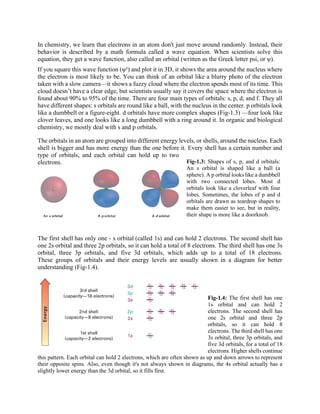
There are four main types of orbitals: s, p, d, and f. They all have different shapes: s orbitals are round like a ball, with the nucleus in the center. p orbitals look like a dumbbell or a figure-eight. d orbitals have more complex shapes (Fig-1.3) —four look like clover leaves, and one looks like a long dumbbell with a ring around it. In organic and biological chemistry, we mostly deal with s and p orbitals.
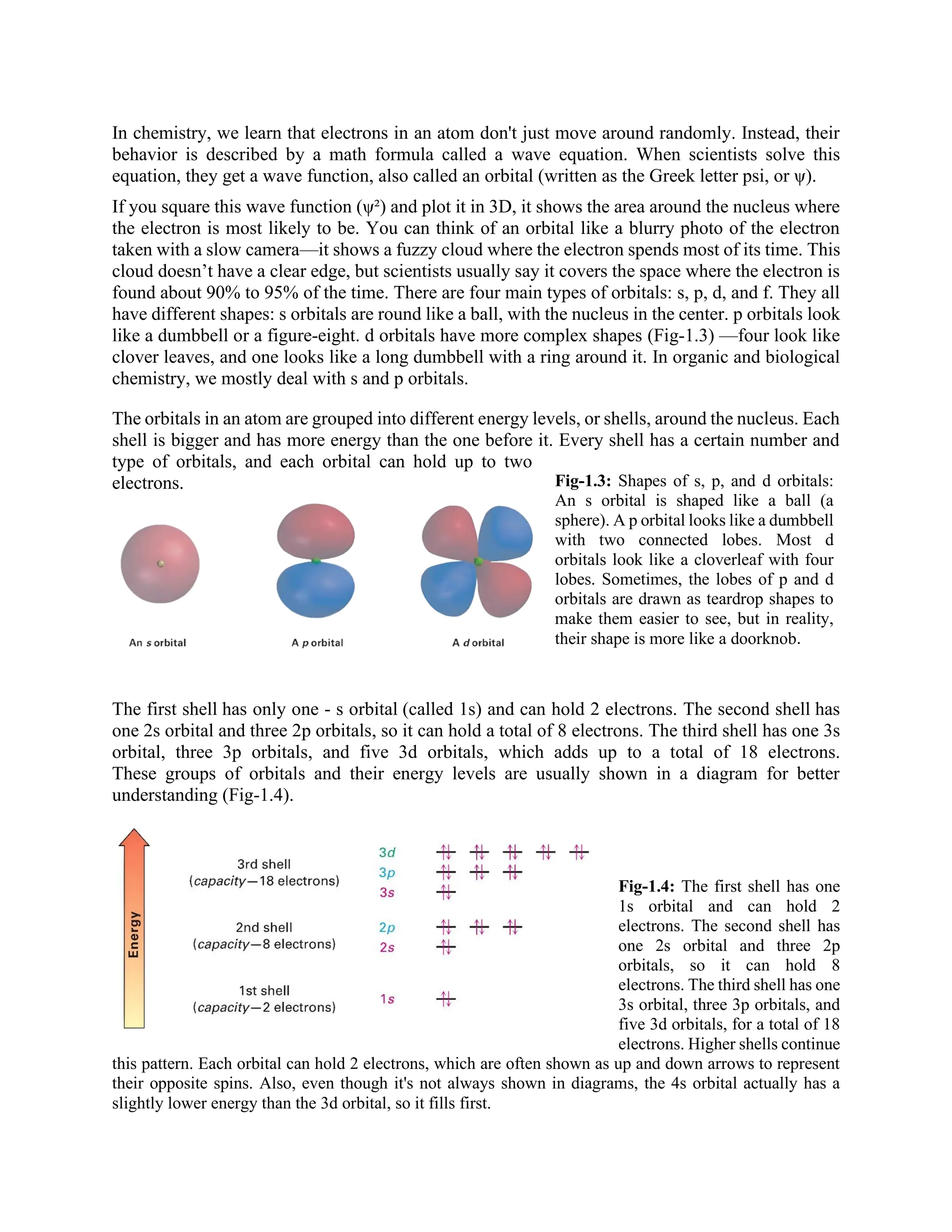
The orbitals in an atom are grouped into different energy levels, or shells, around the nucleus. Each shell is bigger and has more energy than the one before it. Every shell has a certain number and type of orbitals, and each orbital can hold up to two electrons.
The first shell has only one - s orbital (called 1s) and can hold 2 electrons. The second shell has one 2s orbital and three 2p orbitals, so it can hold a total of 8 electrons. The third shell has one 3s orbital, three 3p orbitals, and five 3d orbitals, which adds up to a total of 18 electrons. These groups of orbitals and their energy levels are usually shown in a diagram for better understanding (Fig-1.4).
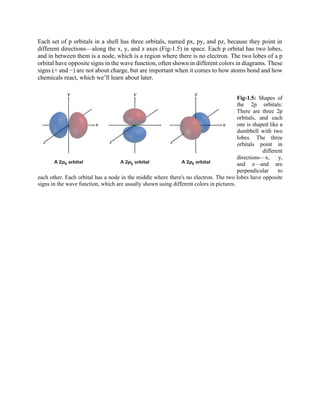
Each set of p orbitals in a shell has three orbitals, named px, py, and pz, because they point in different directions—along the x, y, and z axes (Fig-1.5) in space. Each p orbital has two lobes, and in between them is a node, which is a region where there is no electron. The two lobes of a p orbital have opposite signs in the wave function, often shown in different colors in diagrams. These signs (+ and −) are not about charge, but are important when it comes to how atoms bond and how chemicals react, which we’ll learn about later.
#Organic_Chemistry
#Pharmacy_Education
# # # # # # # # # # # # # # # # # # # #