Impact of Atal Innovation Mission
on Entrepreneurial Growth
Ketan Vira, Associate Professor, GNVS
Institute of Management, Mumbai
Introduction
In Union Budget 2015-16 Government of India
proposed to establish the Atal Innovation
Mission (AIM) in NITI Aayog and stated that a
initially a sum of Rs.150 crores would be
earmarked for this purpose. The overarching
purpose of the mission is to promote a culture
of entrepreneurship and innovation in India
Objectives of AIM
• To create umbrella structure to oversee innovation eco-
system of the country
• To provide platform and collaboration opportunities for
different stakeholders
• To study and suggest best and novel practices to be
adopted by different stakeholders in the innovation chain
• To provide policy inputs to NITI Aayog and various
Government departments and organizations
• To create awareness and provide knowledge inputs in
creating innovation challenges and funding mechanism to
government and
• To develop new programmes and policies for fostering
innovation in different sector of economy.
Atal Incubation Centers
Establishment of the Atal Incubation Centers is
one of the major parts of Atal Innovation
Mission. AIM is going to establish many
incubation centers across the country in near
future to support the start ups. AIC are the
support system for the start ups (in suggested
areas or sector). According to the guidelines of
the AIM, the centers will provide proper
infrastructure that are necessary to support a
start ups.
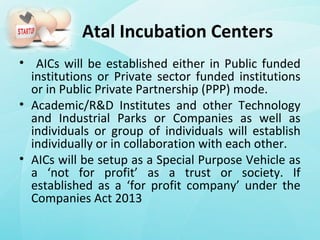
Atal Incubation Centers
• AICs will be established either in Public funded
institutions or Private sector funded institutions
or in Public Private Partnership (PPP) mode.
• Academic/R&D Institutes and other Technology
and Industrial Parks or Companies as well as
individuals or group of individuals will establish
individually or in collaboration with each other.
• AICs will be setup as a Special Purpose Vehicle as
a ‘not for profit’ as a trust or society. If
established as a ‘for profit company’ under the
Companies Act 2013
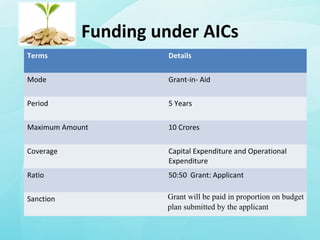
Funding under AICs
Terms Details
Mode Grant-in- Aid
Period 5 Years
Maximum Amount 10 Crores
Coverage Capital Expenditure and Operational
Expenditure
Ratio 50:50 Grant: Applicant
Sanction Grant will be paid in proportion on budget
plan submitted by the applicant
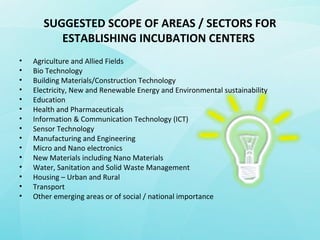
SUGGESTED SCOPE OF AREAS / SECTORS FOR
ESTABLISHING INCUBATION CENTERS
• Agriculture and Allied Fields
• Bio Technology
• Building Materials/Construction Technology
• Electricity, New and Renewable Energy and Environmental sustainability
• Education
• Health and Pharmaceuticals
• Information & Communication Technology (ICT)
• Sensor Technology
• Manufacturing and Engineering
• Micro and Nano electronics
• New Materials including Nano Materials
• Water, Sanitation and Solid Waste Management
• Housing – Urban and Rural
• Transport
• Other emerging areas or of social / national importance
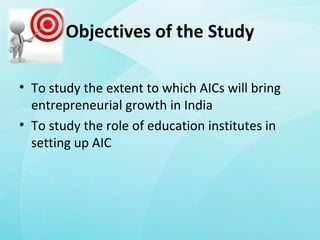
Objectives of the Study
• To study the extent to which AICs will bring
entrepreneurial growth in India
• To study the role of education institutes in
setting up AIC
Analysis
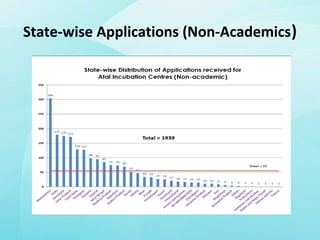
The Statistics shows the total applications
received from Academics and Non-Academics
with the details in terms of aided and unaided
for Academics and Corporate and Individuals
and Corporate in Non-Academic. Further state
wise detail are also analyzed
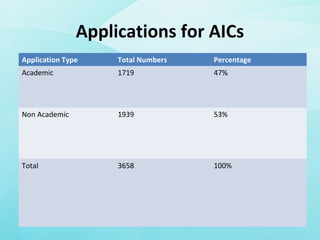
Applications for AICs
Application Type Total Numbers Percentage
Academic 1719 47%
Non Academic 1939 53%
Total 3658 100%
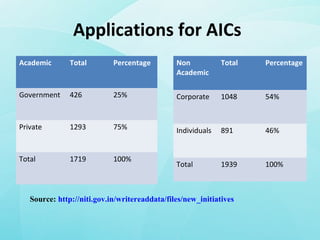
Applications for AICs
Academic Total Percentage
Government 426 25%
Private 1293 75%
Total 1719 100%
Non
Academic
Total Percentage
Corporate 1048 54%
Individuals 891 46%
Total 1939 100%
Source: http://niti.gov.in/writereaddata/files/new_initiatives
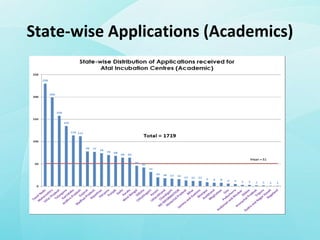
State-wise Applications (Academics)
State-wise Applications (Non-Academics)
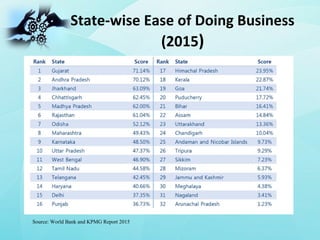
State-wise Ease of Doing Business
(2015)
Source: World Bank and KPMG Report 2015
Analysis
The above given data when compared with the
Ease of doing business to applications received
by AIC can trace that there is positive chance of
growth of entrepreneurship in the states like
Gujarat, Andhra Pradesh, Madhya Pradesh,
Rajasthan, Maharashtra, Karnataka and UP as
they stand in top 10 list of ease of doing business
as well as the list of applications received for AICs
which will make these incubators to make their
businesses workable due to conducive
environment leading to growth of entrepreneurs.
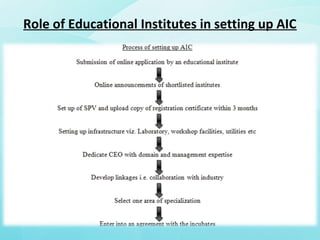
Role of Educational Institutes in setting up AIC
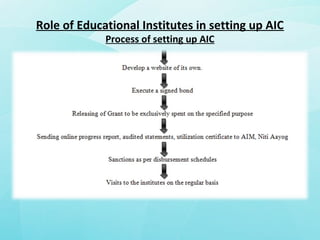
Process of setting up AIC
Role of Educational Institutes in setting up
AIC
Role of educational institute includes to
provide at least 10,000 sq.ft of built up space
with a lease period of 15 years, Setting up
SPV, Appointment of CEO, Dedicated and
dynamic website for incubator, Industry
linkages, Preparing progress reports on
regular basis for grant to be released as per
schedule, Getting statements of accounts
audited on the regular basis and Investment
commitment.
Conclusion
Of the different initiatives by the present
government one of the prime objectives is to
create entrepreneurs. It also calls for the
educational institutes to come forwards and
contribute to the entrepreneurial growth by
setting up incubators and innovation centers.
Such required infrastructure and investments
may not be possible for all the educational
institutes. But, there can be some initiatives on
the same grounds which may lead to creating a
culture of entrepreneurship and innovation.
Thank You !!!

Atal innovation mission

  • 1.
    Impact of AtalInnovation Mission on Entrepreneurial Growth Ketan Vira, Associate Professor, GNVS Institute of Management, Mumbai
  • 2.
    Introduction In Union Budget2015-16 Government of India proposed to establish the Atal Innovation Mission (AIM) in NITI Aayog and stated that a initially a sum of Rs.150 crores would be earmarked for this purpose. The overarching purpose of the mission is to promote a culture of entrepreneurship and innovation in India
  • 3.
    Objectives of AIM •To create umbrella structure to oversee innovation eco- system of the country • To provide platform and collaboration opportunities for different stakeholders • To study and suggest best and novel practices to be adopted by different stakeholders in the innovation chain • To provide policy inputs to NITI Aayog and various Government departments and organizations • To create awareness and provide knowledge inputs in creating innovation challenges and funding mechanism to government and • To develop new programmes and policies for fostering innovation in different sector of economy.
  • 4.
    Atal Incubation Centers Establishmentof the Atal Incubation Centers is one of the major parts of Atal Innovation Mission. AIM is going to establish many incubation centers across the country in near future to support the start ups. AIC are the support system for the start ups (in suggested areas or sector). According to the guidelines of the AIM, the centers will provide proper infrastructure that are necessary to support a start ups.
  • 5.
    Atal Incubation Centers •AICs will be established either in Public funded institutions or Private sector funded institutions or in Public Private Partnership (PPP) mode. • Academic/R&D Institutes and other Technology and Industrial Parks or Companies as well as individuals or group of individuals will establish individually or in collaboration with each other. • AICs will be setup as a Special Purpose Vehicle as a ‘not for profit’ as a trust or society. If established as a ‘for profit company’ under the Companies Act 2013
  • 6.
    Funding under AICs TermsDetails Mode Grant-in- Aid Period 5 Years Maximum Amount 10 Crores Coverage Capital Expenditure and Operational Expenditure Ratio 50:50 Grant: Applicant Sanction Grant will be paid in proportion on budget plan submitted by the applicant
  • 7.
    SUGGESTED SCOPE OFAREAS / SECTORS FOR ESTABLISHING INCUBATION CENTERS • Agriculture and Allied Fields • Bio Technology • Building Materials/Construction Technology • Electricity, New and Renewable Energy and Environmental sustainability • Education • Health and Pharmaceuticals • Information & Communication Technology (ICT) • Sensor Technology • Manufacturing and Engineering • Micro and Nano electronics • New Materials including Nano Materials • Water, Sanitation and Solid Waste Management • Housing – Urban and Rural • Transport • Other emerging areas or of social / national importance
  • 8.
    Objectives of theStudy • To study the extent to which AICs will bring entrepreneurial growth in India • To study the role of education institutes in setting up AIC
  • 9.
    Analysis The Statistics showsthe total applications received from Academics and Non-Academics with the details in terms of aided and unaided for Academics and Corporate and Individuals and Corporate in Non-Academic. Further state wise detail are also analyzed
  • 10.
    Applications for AICs ApplicationType Total Numbers Percentage Academic 1719 47% Non Academic 1939 53% Total 3658 100%
  • 11.
    Applications for AICs AcademicTotal Percentage Government 426 25% Private 1293 75% Total 1719 100% Non Academic Total Percentage Corporate 1048 54% Individuals 891 46% Total 1939 100% Source: http://niti.gov.in/writereaddata/files/new_initiatives
  • 12.
  • 13.
  • 14.
    State-wise Ease ofDoing Business (2015) Source: World Bank and KPMG Report 2015
  • 15.
    Analysis The above givendata when compared with the Ease of doing business to applications received by AIC can trace that there is positive chance of growth of entrepreneurship in the states like Gujarat, Andhra Pradesh, Madhya Pradesh, Rajasthan, Maharashtra, Karnataka and UP as they stand in top 10 list of ease of doing business as well as the list of applications received for AICs which will make these incubators to make their businesses workable due to conducive environment leading to growth of entrepreneurs.
  • 16.
    Role of EducationalInstitutes in setting up AIC
  • 17.
    Role of EducationalInstitutes in setting up AIC Process of setting up AIC
  • 18.
    Role of EducationalInstitutes in setting up AIC Role of educational institute includes to provide at least 10,000 sq.ft of built up space with a lease period of 15 years, Setting up SPV, Appointment of CEO, Dedicated and dynamic website for incubator, Industry linkages, Preparing progress reports on regular basis for grant to be released as per schedule, Getting statements of accounts audited on the regular basis and Investment commitment.
  • 19.
    Conclusion Of the differentinitiatives by the present government one of the prime objectives is to create entrepreneurs. It also calls for the educational institutes to come forwards and contribute to the entrepreneurial growth by setting up incubators and innovation centers. Such required infrastructure and investments may not be possible for all the educational institutes. But, there can be some initiatives on the same grounds which may lead to creating a culture of entrepreneurship and innovation.
  • 20.