Danielle Anderson 
Sodexo Dietetic Intern
 Most children require more than a snack to sustain 
them throughout the afternoon and early evening. 
 Early lunch times – Several schools in the 
district offer lunches at 10:30 AM. 
 Working parents- Afterschool meals are 
increasingly important because more and more 
children are spending long hours in afterschool 
programs while their parents are working. 
 Food insecure – The food a child receives at an 
afterschool program may be their last meal of 
the day. 
 Providing afterschool meals is a win for students, 
parents, the community, our clients and Sodexo. 
An estimated 440,000 kids in 
Washington state—one-quarter of all 
children—are food insecure, meaning 
they don’t have adequate, nutritious 
food on a regular basis. 
—Hungry in Washington 2012, 
Children’s Alliance
 The Child and Adult Care Food Program (CACFP) offers 
cash payments and USDA foods to afterschool programs 
that serve a meal and/or snack to children in low-income 
areas, during the school year. 
 The program can be operated by: 
 Public or private nonprofit schools 
 Local government agencies: rec center, county health 
departments, etc. 
 Private nonprofit organizations: YMCAs, Boys and Girls Club, 
community athletic leagues, food banks, etc.
*1 in 4 children in Washington live in 
a household that struggles to put food 
on the table. 
 Support Afterschool Programs - Provides a steady source of 
funding that frees up resources for additional activities 
 Fight Hunger – Provides an additional balanced meal to make 
sure children and teens receive the nutrition they need, but may 
not have access to at home 
 Counter Childhood Obesity – Serves healthy food at appropriate 
serving sizes 
 Foster Student Improvement – Ensures children are more alert 
and fully benefit from the educational and enrichment activities 
provided 
 Increase Attendance - Food attracts students to positive 
afterschool activities that keep them safe and engaged 
 Increase Revenue - Provides higher reimbursement rates and 
increases meal counts from 3:1 for snacks to 1:1 for meals in 
addition to offering higher reimbursement rates
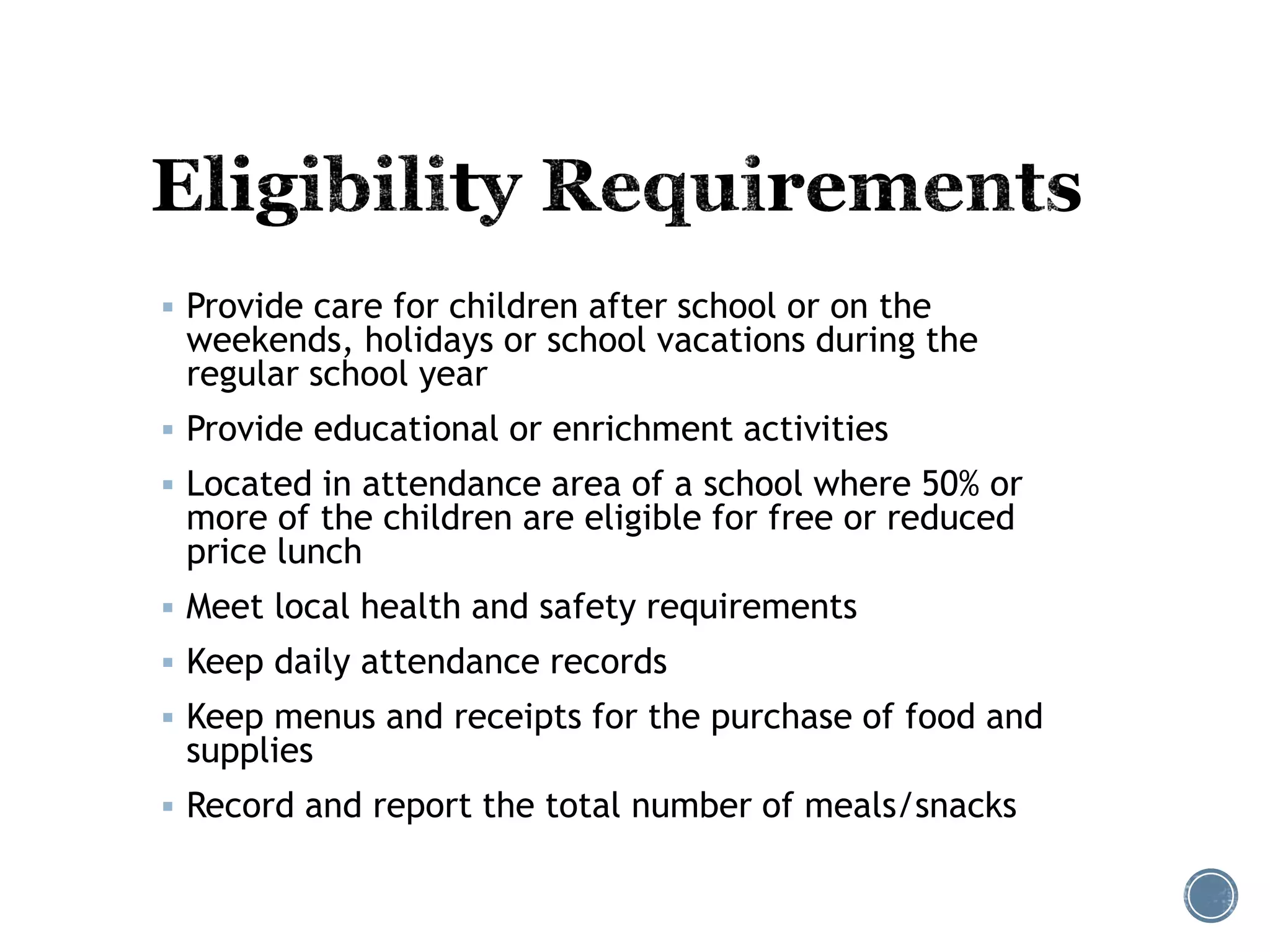
 Provide care for children after school or on the 
weekends, holidays or school vacations during the 
regular school year 
 Provide educational or enrichment activities 
 Located in attendance area of a school where 50% or 
more of the children are eligible for free or reduced 
price lunch 
 Meet local health and safety requirements 
 Keep daily attendance records 
 Keep menus and receipts for the purchase of food and 
supplies 
 Record and report the total number of meals/snacks
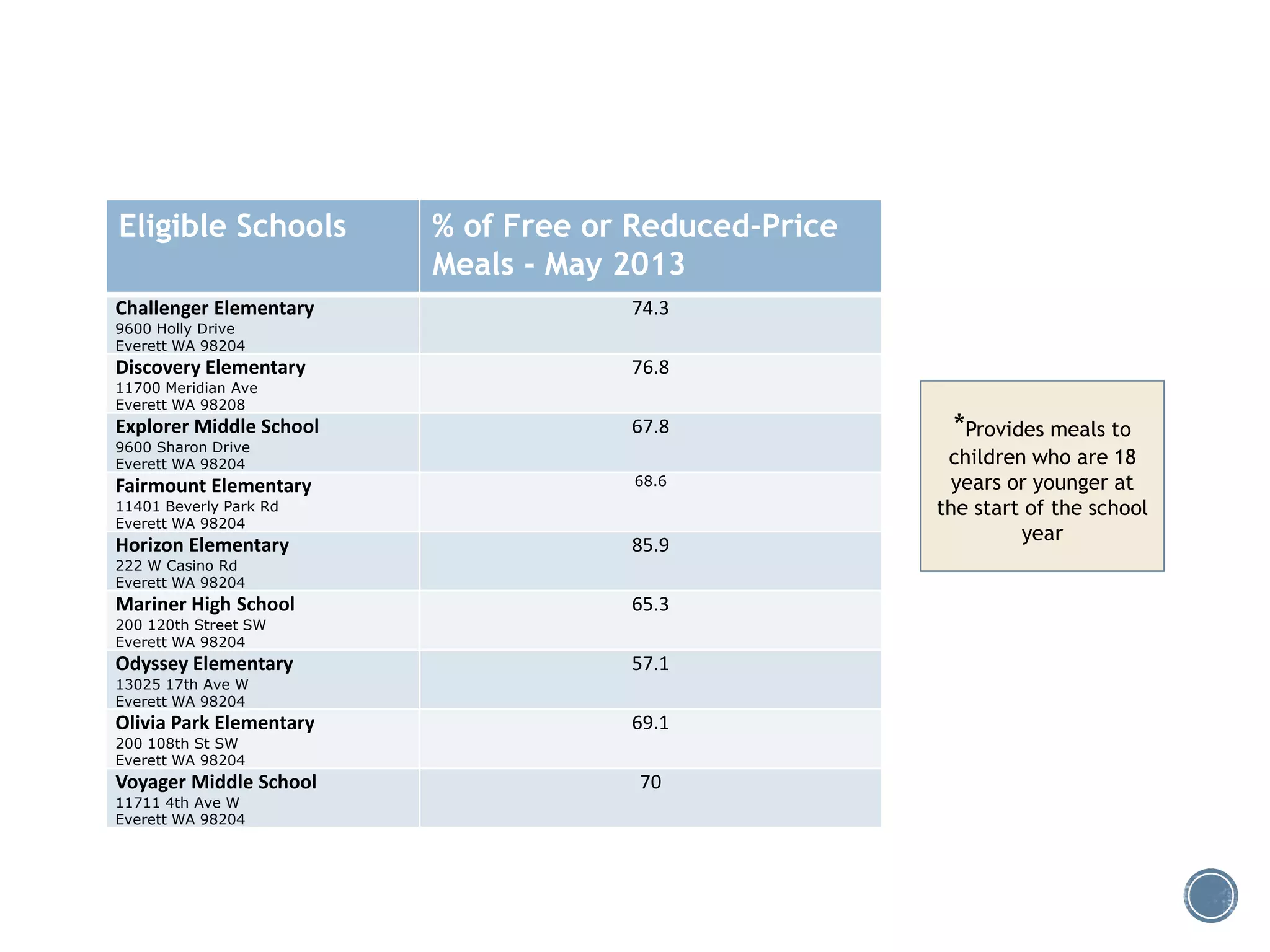
Eligible Schools % of Free or Reduced-Price 
Meals - May 2013 
Challenger Elementary 
9600 Holly Drive 
Everett WA 98204 
74.3 
Discovery Elementary 
11700 Meridian Ave 
Everett WA 98208 
76.8 
Explorer Middle School 
9600 Sharon Drive 
Everett WA 98204 
67.8 
Fairmount Elementary 
11401 Beverly Park Rd 
Everett WA 98204 
68.6 
Horizon Elementary 
222 W Casino Rd 
Everett WA 98204 
85.9 
Mariner High School 
200 120th Street SW 
Everett WA 98204 
65.3 
Odyssey Elementary 
13025 17th Ave W 
Everett WA 98204 
57.1 
Olivia Park Elementary 
200 108th St SW 
Everett WA 98204 
69.1 
Voyager Middle School 
11711 4th Ave W 
Everett WA 98204 
70 
*Provides meals to 
children who are 18 
years or younger at 
the start of the school 
year
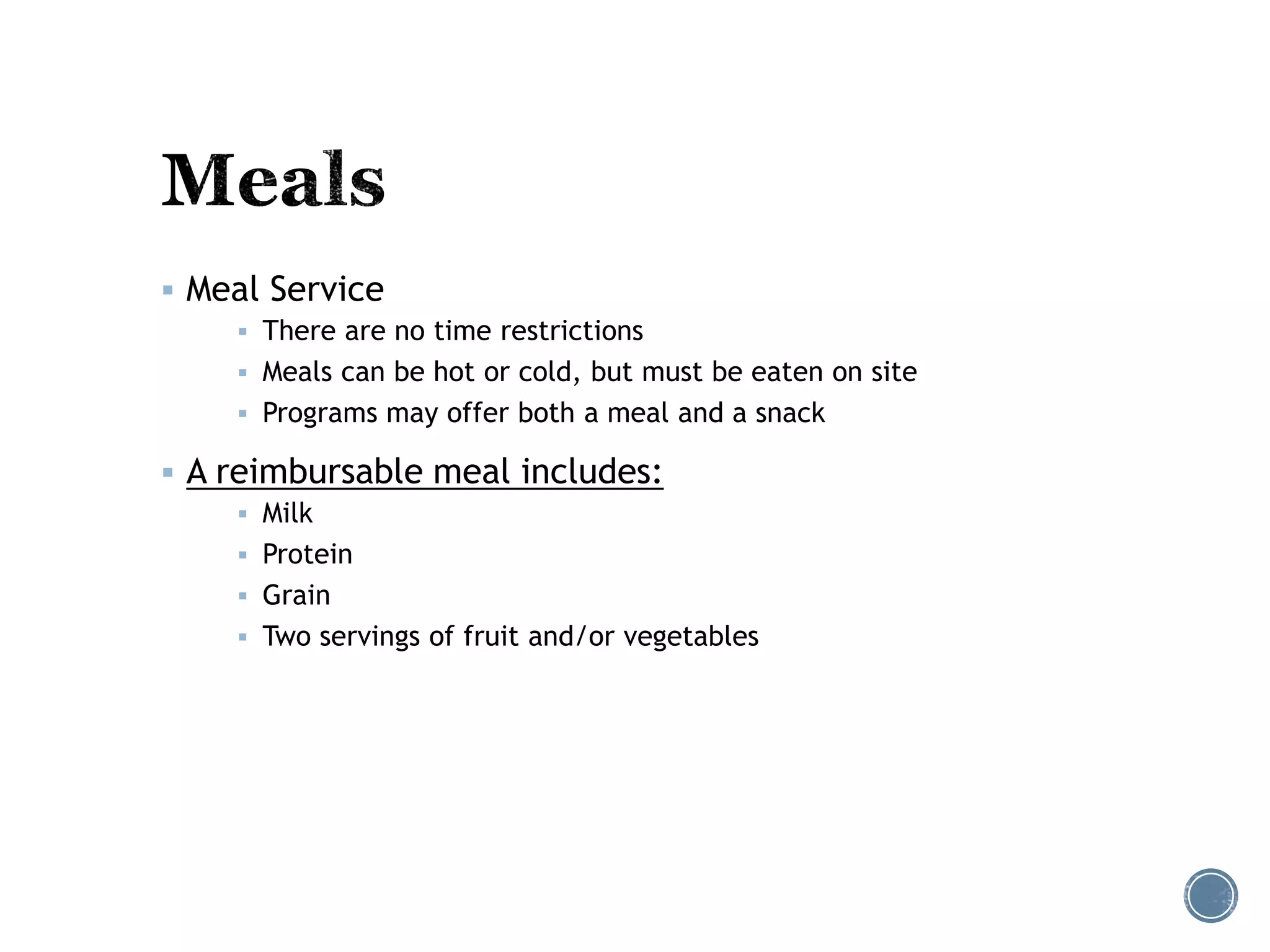
 Meal Service 
 There are no time restrictions 
 Meals can be hot or cold, but must be eaten on site 
 Programs may offer both a meal and a snack 
 A reimbursable meal includes: 
 Milk 
 Protein 
 Grain 
 Two servings of fruit and/or vegetables
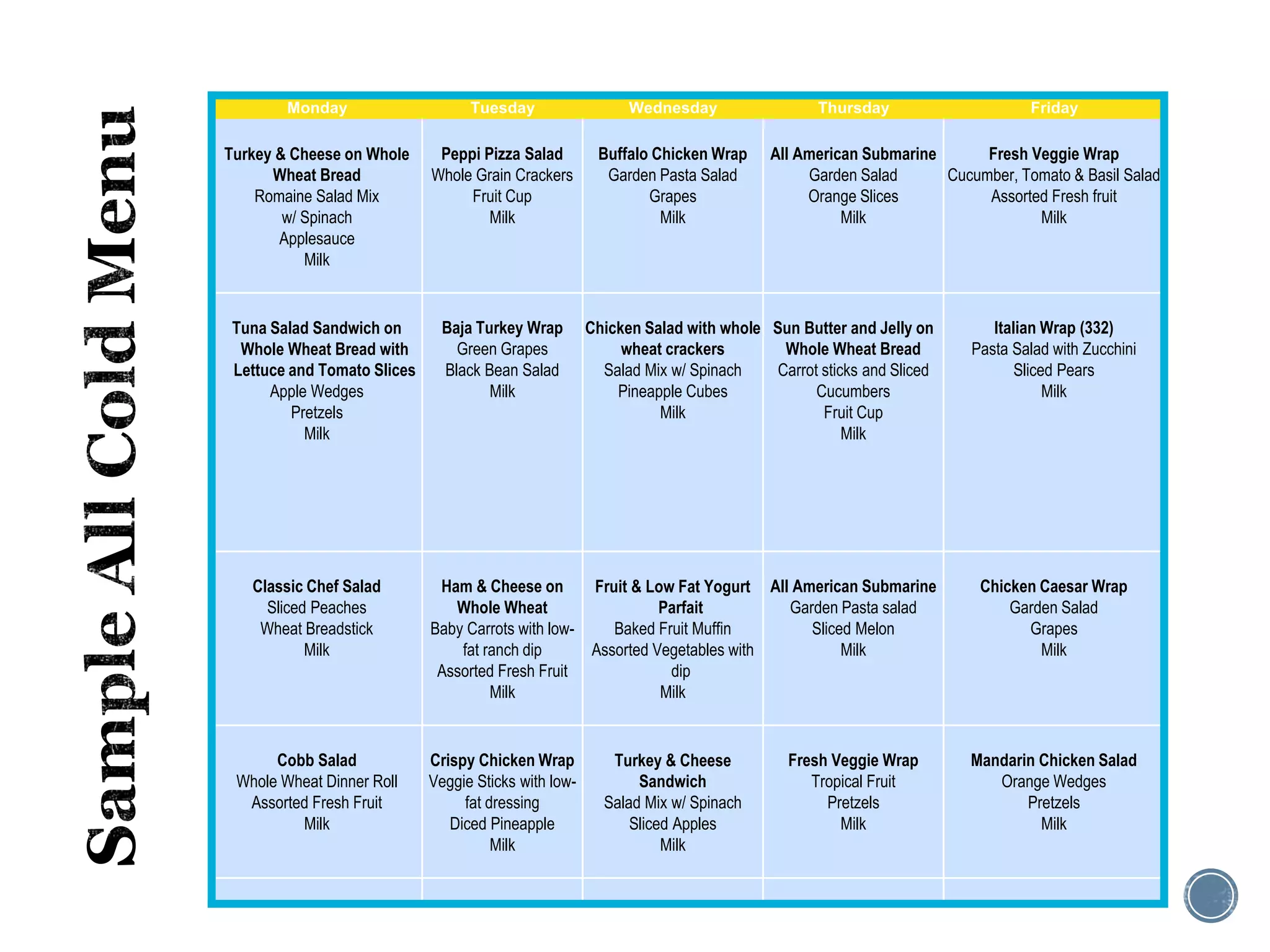
Monday Tuesday Wednesday Thursday Friday 
Turkey & Cheese on Whole 
Wheat Bread 
Romaine Salad Mix 
w/ Spinach 
Applesauce 
Milk 
Peppi Pizza Salad 
Whole Grain Crackers 
Fruit Cup 
Milk 
Buffalo Chicken Wrap 
Garden Pasta Salad 
Grapes 
Milk 
All American Submarine 
Garden Salad 
Orange Slices 
Milk 
Fresh Veggie Wrap 
Cucumber, Tomato & Basil Salad 
Assorted Fresh fruit 
Milk 
Tuna Salad Sandwich on 
Whole Wheat Bread with 
Lettuce and Tomato Slices 
Apple Wedges 
Pretzels 
Milk 
Baja Turkey Wrap 
Green Grapes 
Black Bean Salad 
Milk 
Chicken Salad with whole 
wheat crackers 
Salad Mix w/ Spinach 
Pineapple Cubes 
Milk 
Sun Butter and Jelly on 
Whole Wheat Bread 
Carrot sticks and Sliced 
Cucumbers 
Fruit Cup 
Milk 
Italian Wrap (332) 
Pasta Salad with Zucchini 
Sliced Pears 
Milk 
Classic Chef Salad 
Sliced Peaches 
Wheat Breadstick 
Milk 
Ham & Cheese on 
Whole Wheat 
Baby Carrots with low-fat 
ranch dip 
Assorted Fresh Fruit 
Milk 
Fruit & Low Fat Yogurt 
Parfait 
Baked Fruit Muffin 
Assorted Vegetables with 
dip 
Milk 
All American Submarine 
Garden Pasta salad 
Sliced Melon 
Milk 
Chicken Caesar Wrap 
Garden Salad 
Grapes 
Milk 
Cobb Salad 
Whole Wheat Dinner Roll 
Assorted Fresh Fruit 
Milk 
Crispy Chicken Wrap 
Veggie Sticks with low-fat 
dressing 
Diced Pineapple 
Milk 
Turkey & Cheese 
Sandwich 
Salad Mix w/ Spinach 
Sliced Apples 
Milk 
Fresh Veggie Wrap 
Tropical Fruit 
Pretzels 
Milk 
Mandarin Chicken Salad 
Orange Wedges 
Pretzels 
Milk
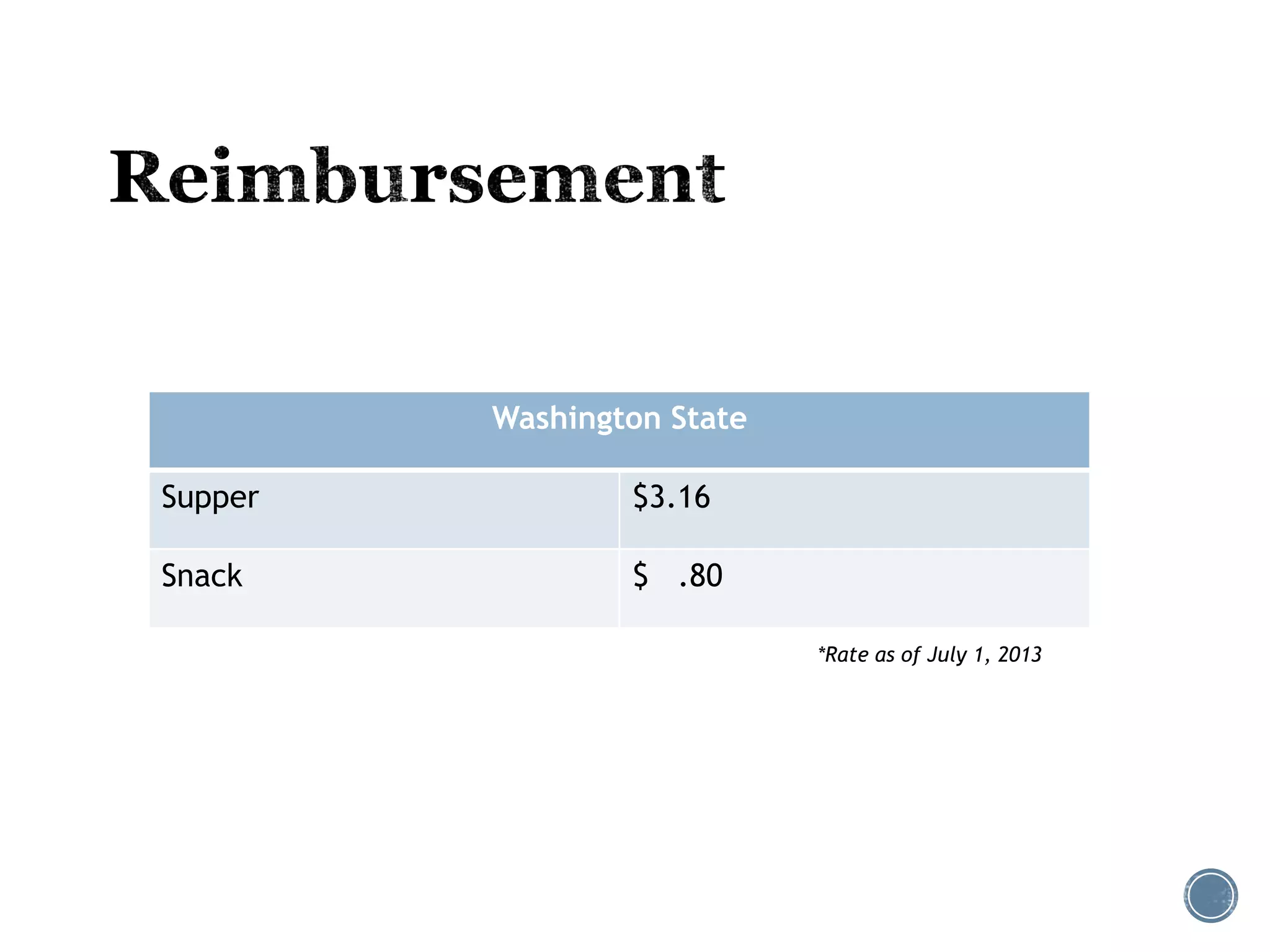
Washington State 
Supper $3.16 
Snack $ .80 
*Rate as of July 1, 2013
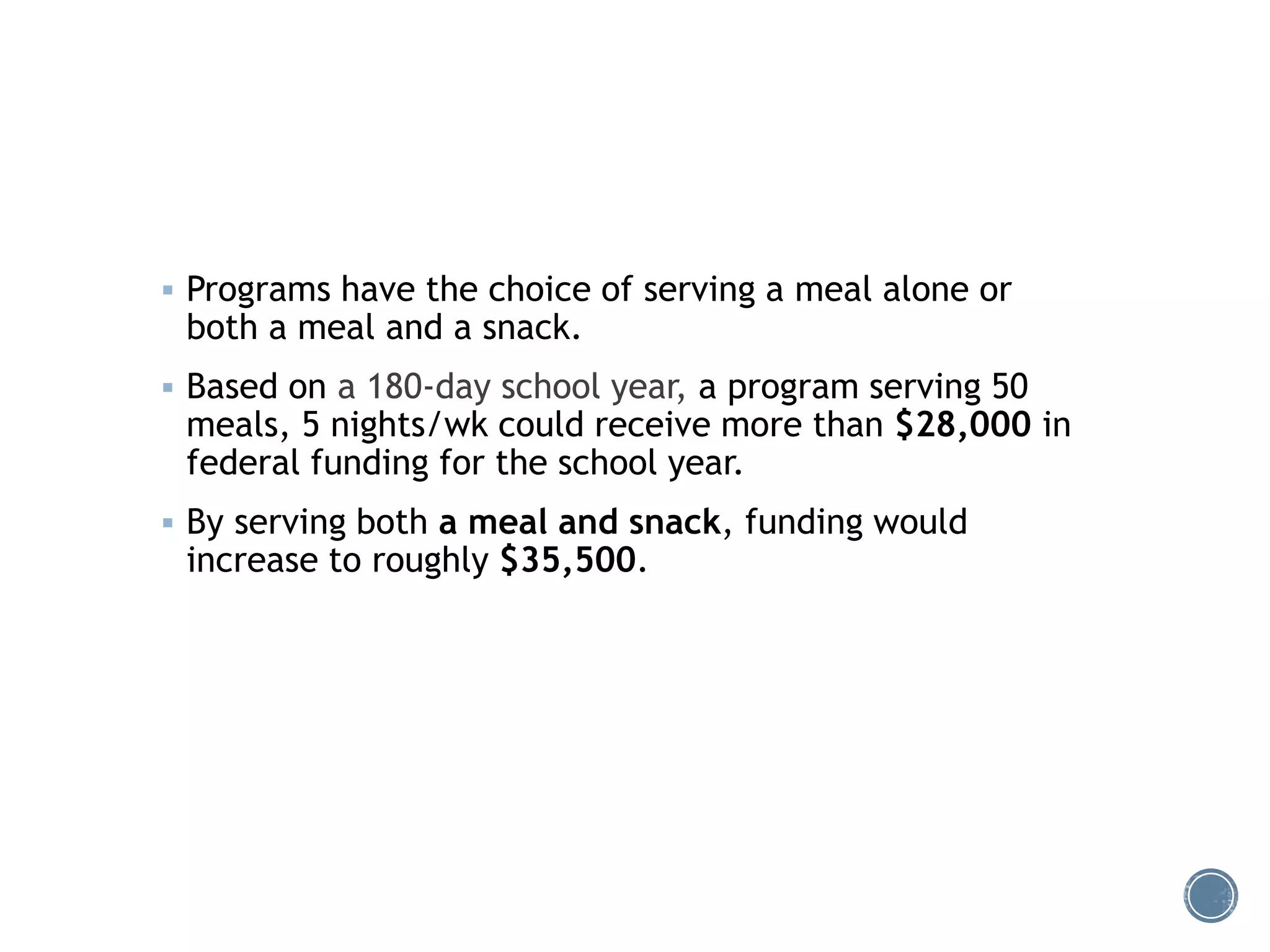
 Programs have the choice of serving a meal alone or 
both a meal and a snack. 
 Based on a 180-day school year, a program serving 50 
meals, 5 nights/wk could receive more than $28,000 in 
federal funding for the school year. 
 By serving both a meal and snack, funding would 
increase to roughly $35,500.
“The funding grows as your 
 Letters to parents/guardians of students 
program grows.” 
 Information about program in district newsletter 
 Presentation at PTA meeting for school programs 
 Flyers/brochures at participating YMCA locations
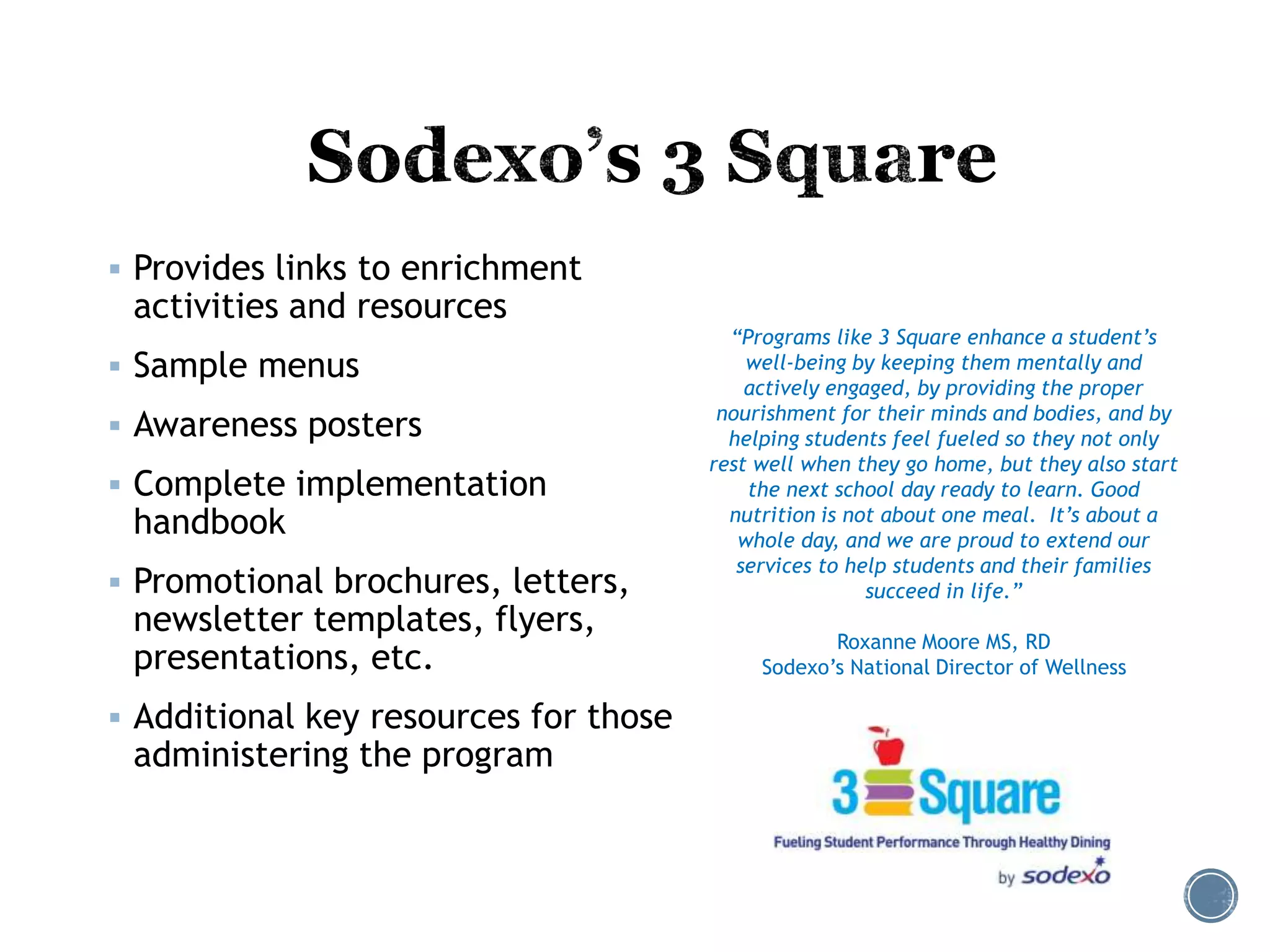
 Provides links to enrichment 
activities and resources 
 Sample menus 
 Awareness posters 
 Complete implementation 
handbook 
 Promotional brochures, letters, 
newsletter templates, flyers, 
presentations, etc. 
 Additional key resources for those 
administering the program 
“Programs like 3 Square enhance a student’s 
well-being by keeping them mentally and 
actively engaged, by providing the proper 
nourishment for their minds and bodies, and by 
helping students feel fueled so they not only 
rest well when they go home, but they also start 
the next school day ready to learn. Good 
nutrition is not about one meal. It’s about a 
whole day, and we are proud to extend our 
services to help students and their families 
succeed in life.” 
Roxanne Moore MS, RD 
Sodexo’s National Director of Wellness
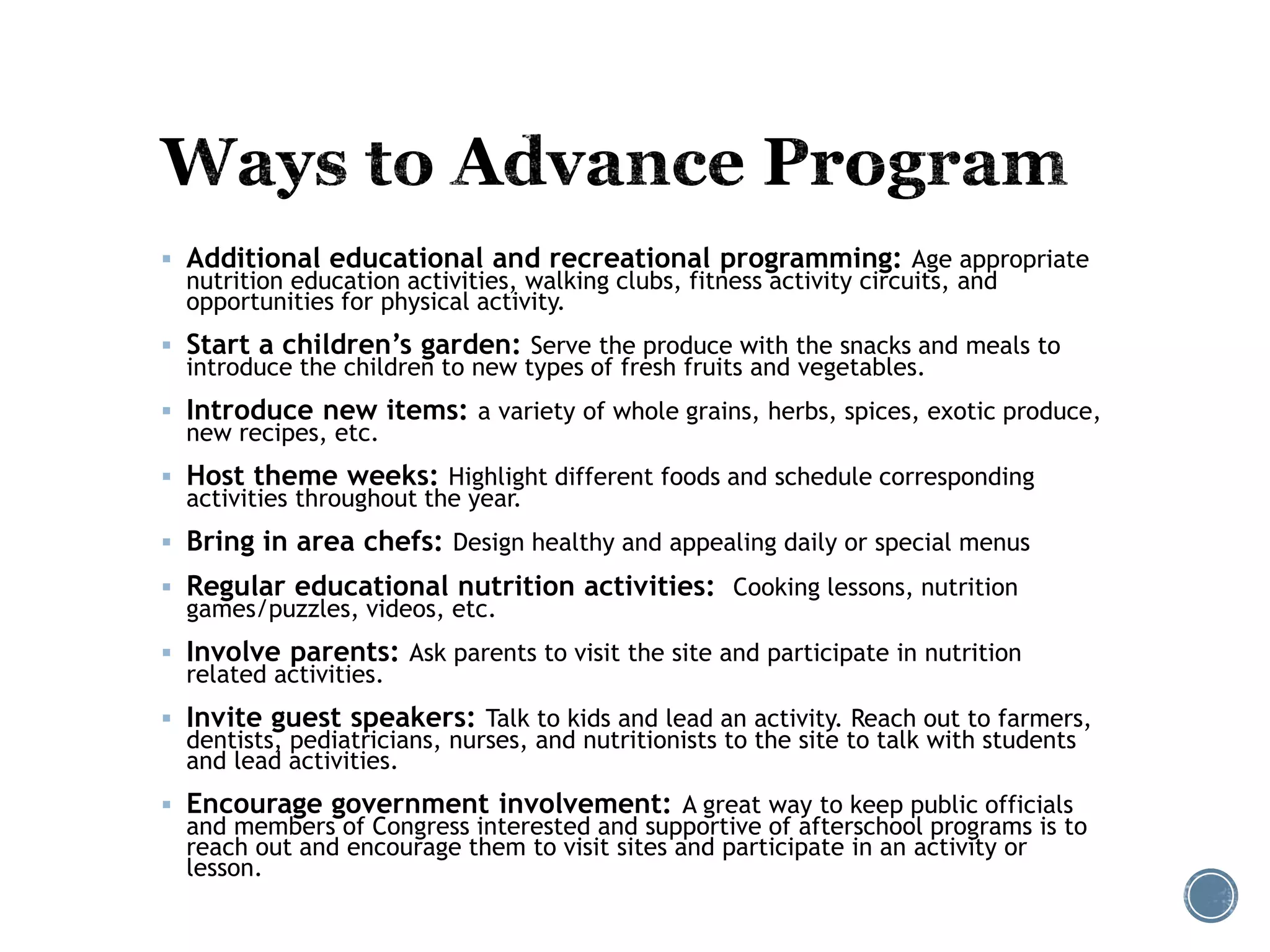
 Additional educational and recreational programming: Age appropriate 
nutrition education activities, walking clubs, fitness activity circuits, and 
opportunities for physical activity. 
 Start a children’s garden: Serve the produce with the snacks and meals to 
introduce the children to new types of fresh fruits and vegetables. 
 Introduce new items: a variety of whole grains, herbs, spices, exotic produce, 
new recipes, etc. 
 Host theme weeks: Highlight different foods and schedule corresponding 
activities throughout the year. 
 Bring in area chefs: Design healthy and appealing daily or special menus 
 Regular educational nutrition activities: Cooking lessons, nutrition 
games/puzzles, videos, etc. 
 Involve parents: Ask parents to visit the site and participate in nutrition 
related activities. 
 Invite guest speakers: Talk to kids and lead an activity. Reach out to farmers, 
dentists, pediatricians, nurses, and nutritionists to the site to talk with students 
and lead activities. 
 Encourage government involvement: A great way to keep public officials 
and members of Congress interested and supportive of afterschool programs is to 
reach out and encourage them to visit sites and participate in an activity or 
lesson.
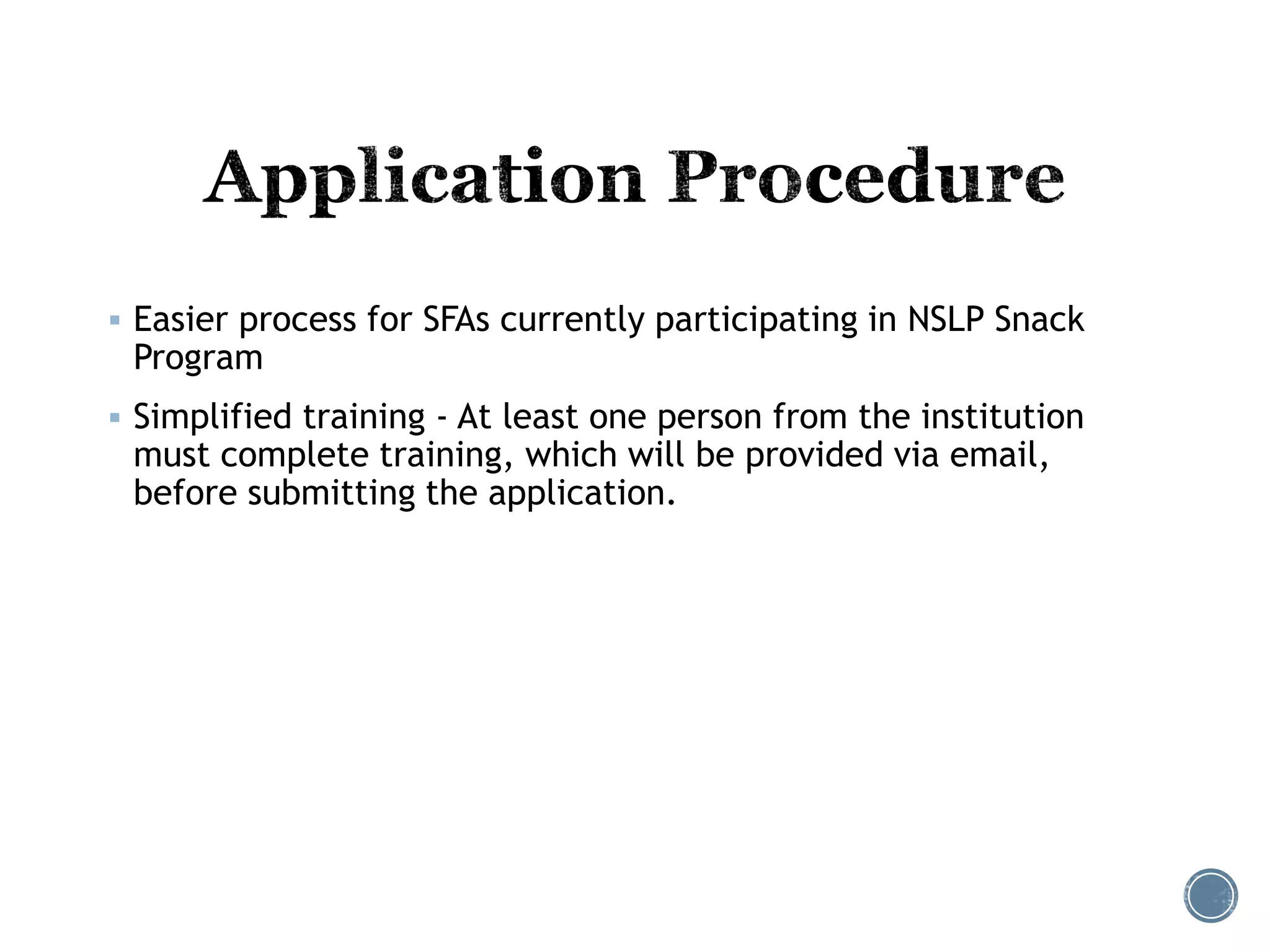
 Easier process for SFAs currently participating in NSLP Snack 
Program 
 Simplified training - At least one person from the institution 
must complete training, which will be provided via email, 
before submitting the application.
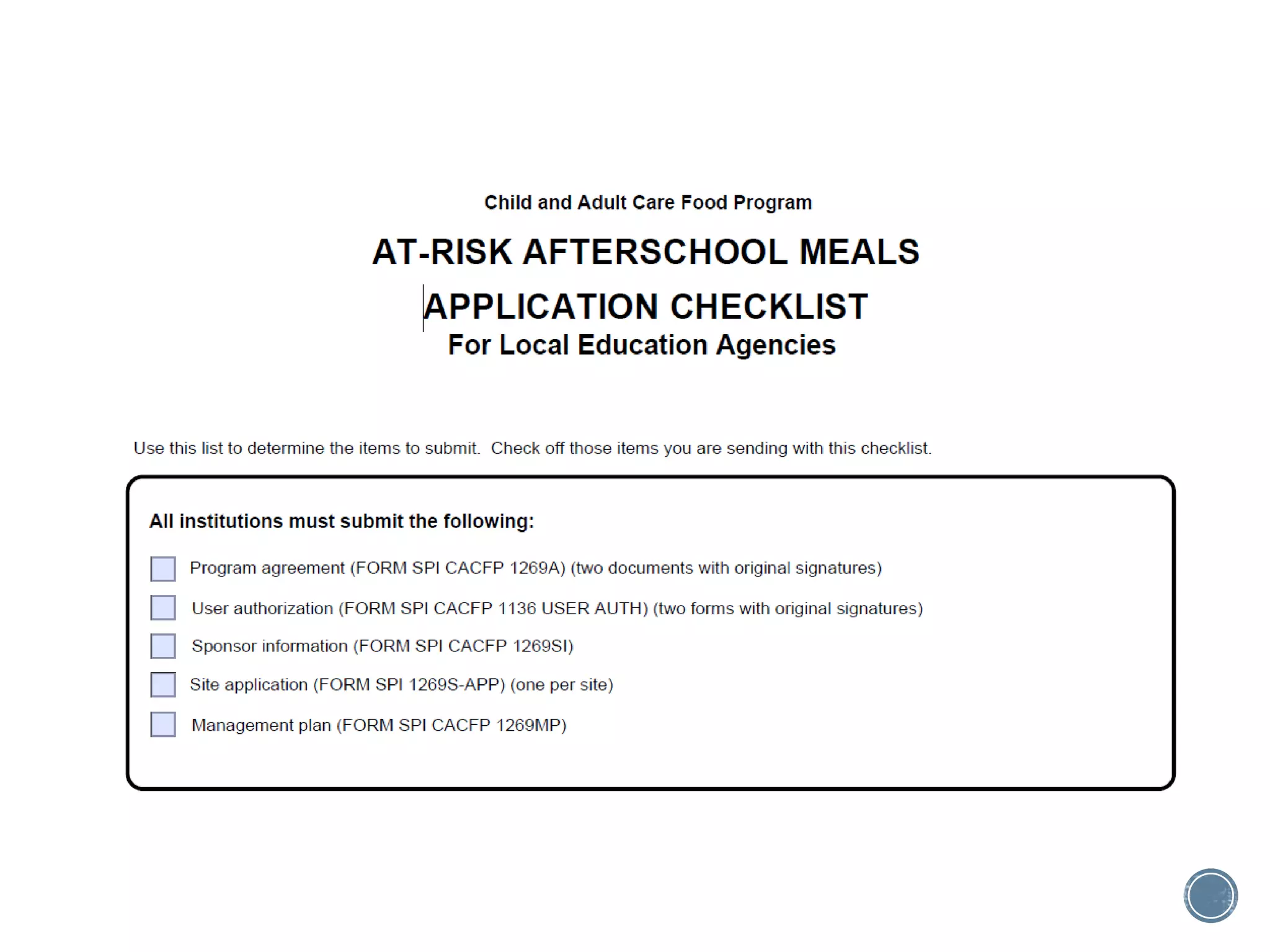
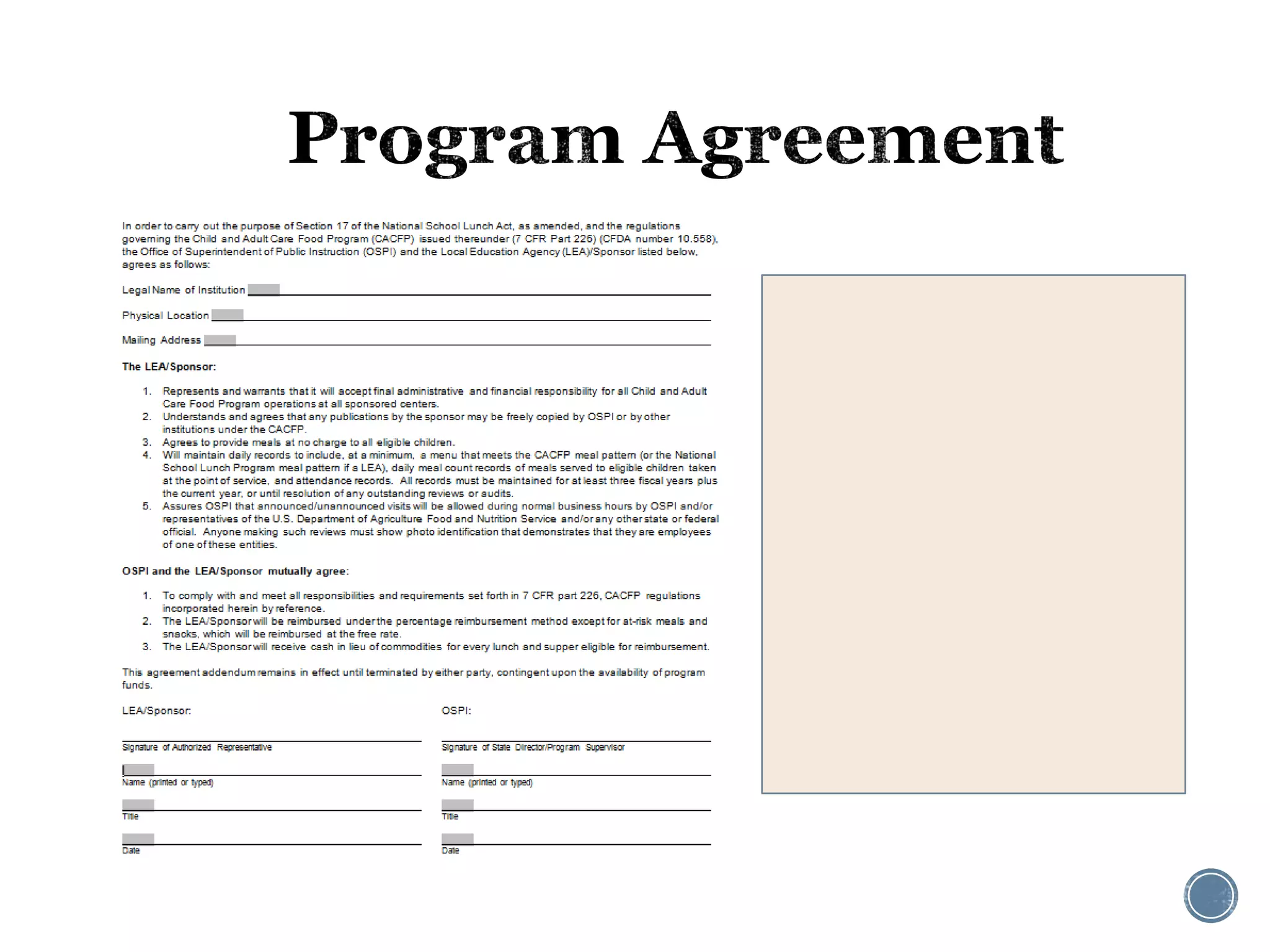
 State agencies that 
administer the NSLP 
and the CACFP are 
required to enter into a 
single agreement with 
the SFAs. An addendum 
to the existing 
agreement is sufficient 
for the SFAs interested 
in participating in the 
at-risk afterschool 
meals component of 
the CACFP.
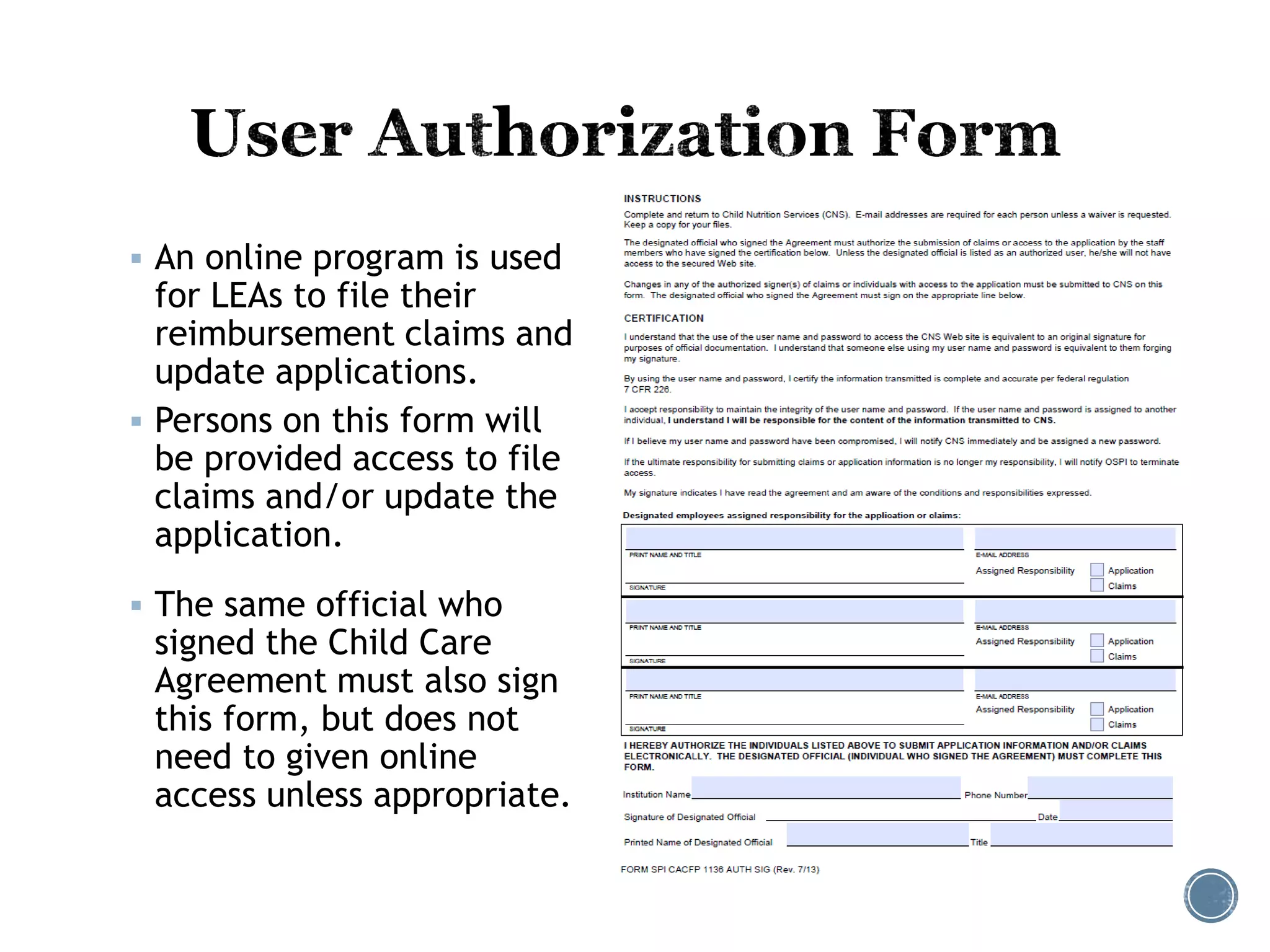
 An online program is used 
for LEAs to file their 
reimbursement claims and 
update applications. 
 Persons on this form will 
be provided access to file 
claims and/or update the 
application. 
 The same official who 
signed the Child Care 
Agreement must also sign 
this form, but does not 
need to given online 
access unless appropriate.
 A 3-page plan that includes details on staffing, preferred meal 
plan (CACFP vs NSLP), training, monitoring, and record keeping. 
 SFAs that are already successfully operating the NSLP do not 
need to submit a separate CACFP management plan
 Use the sample letter to collect information about the past 
performance and criminal records of all principals within your 
organization (for internal use only) 
For additional questions or assistance please contact: 
Adele Roberts, Supervisor 
Child and Adult Care Program 
360-725-6200 
Adele.Roberts@k12.wa.us

At risk afterschool meal program

  • 1.
    Danielle Anderson SodexoDietetic Intern
  • 2.
     Most childrenrequire more than a snack to sustain them throughout the afternoon and early evening.  Early lunch times – Several schools in the district offer lunches at 10:30 AM.  Working parents- Afterschool meals are increasingly important because more and more children are spending long hours in afterschool programs while their parents are working.  Food insecure – The food a child receives at an afterschool program may be their last meal of the day.  Providing afterschool meals is a win for students, parents, the community, our clients and Sodexo. An estimated 440,000 kids in Washington state—one-quarter of all children—are food insecure, meaning they don’t have adequate, nutritious food on a regular basis. —Hungry in Washington 2012, Children’s Alliance
  • 3.
     The Childand Adult Care Food Program (CACFP) offers cash payments and USDA foods to afterschool programs that serve a meal and/or snack to children in low-income areas, during the school year.  The program can be operated by:  Public or private nonprofit schools  Local government agencies: rec center, county health departments, etc.  Private nonprofit organizations: YMCAs, Boys and Girls Club, community athletic leagues, food banks, etc.
  • 4.
    *1 in 4children in Washington live in a household that struggles to put food on the table.  Support Afterschool Programs - Provides a steady source of funding that frees up resources for additional activities  Fight Hunger – Provides an additional balanced meal to make sure children and teens receive the nutrition they need, but may not have access to at home  Counter Childhood Obesity – Serves healthy food at appropriate serving sizes  Foster Student Improvement – Ensures children are more alert and fully benefit from the educational and enrichment activities provided  Increase Attendance - Food attracts students to positive afterschool activities that keep them safe and engaged  Increase Revenue - Provides higher reimbursement rates and increases meal counts from 3:1 for snacks to 1:1 for meals in addition to offering higher reimbursement rates
  • 5.
     Provide carefor children after school or on the weekends, holidays or school vacations during the regular school year  Provide educational or enrichment activities  Located in attendance area of a school where 50% or more of the children are eligible for free or reduced price lunch  Meet local health and safety requirements  Keep daily attendance records  Keep menus and receipts for the purchase of food and supplies  Record and report the total number of meals/snacks
  • 6.
    Eligible Schools %of Free or Reduced-Price Meals - May 2013 Challenger Elementary 9600 Holly Drive Everett WA 98204 74.3 Discovery Elementary 11700 Meridian Ave Everett WA 98208 76.8 Explorer Middle School 9600 Sharon Drive Everett WA 98204 67.8 Fairmount Elementary 11401 Beverly Park Rd Everett WA 98204 68.6 Horizon Elementary 222 W Casino Rd Everett WA 98204 85.9 Mariner High School 200 120th Street SW Everett WA 98204 65.3 Odyssey Elementary 13025 17th Ave W Everett WA 98204 57.1 Olivia Park Elementary 200 108th St SW Everett WA 98204 69.1 Voyager Middle School 11711 4th Ave W Everett WA 98204 70 *Provides meals to children who are 18 years or younger at the start of the school year
  • 7.
     Meal Service  There are no time restrictions  Meals can be hot or cold, but must be eaten on site  Programs may offer both a meal and a snack  A reimbursable meal includes:  Milk  Protein  Grain  Two servings of fruit and/or vegetables
  • 8.
    Monday Tuesday WednesdayThursday Friday Turkey & Cheese on Whole Wheat Bread Romaine Salad Mix w/ Spinach Applesauce Milk Peppi Pizza Salad Whole Grain Crackers Fruit Cup Milk Buffalo Chicken Wrap Garden Pasta Salad Grapes Milk All American Submarine Garden Salad Orange Slices Milk Fresh Veggie Wrap Cucumber, Tomato & Basil Salad Assorted Fresh fruit Milk Tuna Salad Sandwich on Whole Wheat Bread with Lettuce and Tomato Slices Apple Wedges Pretzels Milk Baja Turkey Wrap Green Grapes Black Bean Salad Milk Chicken Salad with whole wheat crackers Salad Mix w/ Spinach Pineapple Cubes Milk Sun Butter and Jelly on Whole Wheat Bread Carrot sticks and Sliced Cucumbers Fruit Cup Milk Italian Wrap (332) Pasta Salad with Zucchini Sliced Pears Milk Classic Chef Salad Sliced Peaches Wheat Breadstick Milk Ham & Cheese on Whole Wheat Baby Carrots with low-fat ranch dip Assorted Fresh Fruit Milk Fruit & Low Fat Yogurt Parfait Baked Fruit Muffin Assorted Vegetables with dip Milk All American Submarine Garden Pasta salad Sliced Melon Milk Chicken Caesar Wrap Garden Salad Grapes Milk Cobb Salad Whole Wheat Dinner Roll Assorted Fresh Fruit Milk Crispy Chicken Wrap Veggie Sticks with low-fat dressing Diced Pineapple Milk Turkey & Cheese Sandwich Salad Mix w/ Spinach Sliced Apples Milk Fresh Veggie Wrap Tropical Fruit Pretzels Milk Mandarin Chicken Salad Orange Wedges Pretzels Milk
  • 9.
    Washington State Supper$3.16 Snack $ .80 *Rate as of July 1, 2013
  • 10.
     Programs havethe choice of serving a meal alone or both a meal and a snack.  Based on a 180-day school year, a program serving 50 meals, 5 nights/wk could receive more than $28,000 in federal funding for the school year.  By serving both a meal and snack, funding would increase to roughly $35,500.
  • 11.
    “The funding growsas your  Letters to parents/guardians of students program grows.”  Information about program in district newsletter  Presentation at PTA meeting for school programs  Flyers/brochures at participating YMCA locations
  • 12.
     Provides linksto enrichment activities and resources  Sample menus  Awareness posters  Complete implementation handbook  Promotional brochures, letters, newsletter templates, flyers, presentations, etc.  Additional key resources for those administering the program “Programs like 3 Square enhance a student’s well-being by keeping them mentally and actively engaged, by providing the proper nourishment for their minds and bodies, and by helping students feel fueled so they not only rest well when they go home, but they also start the next school day ready to learn. Good nutrition is not about one meal. It’s about a whole day, and we are proud to extend our services to help students and their families succeed in life.” Roxanne Moore MS, RD Sodexo’s National Director of Wellness
  • 13.
     Additional educationaland recreational programming: Age appropriate nutrition education activities, walking clubs, fitness activity circuits, and opportunities for physical activity.  Start a children’s garden: Serve the produce with the snacks and meals to introduce the children to new types of fresh fruits and vegetables.  Introduce new items: a variety of whole grains, herbs, spices, exotic produce, new recipes, etc.  Host theme weeks: Highlight different foods and schedule corresponding activities throughout the year.  Bring in area chefs: Design healthy and appealing daily or special menus  Regular educational nutrition activities: Cooking lessons, nutrition games/puzzles, videos, etc.  Involve parents: Ask parents to visit the site and participate in nutrition related activities.  Invite guest speakers: Talk to kids and lead an activity. Reach out to farmers, dentists, pediatricians, nurses, and nutritionists to the site to talk with students and lead activities.  Encourage government involvement: A great way to keep public officials and members of Congress interested and supportive of afterschool programs is to reach out and encourage them to visit sites and participate in an activity or lesson.
  • 14.
     Easier processfor SFAs currently participating in NSLP Snack Program  Simplified training - At least one person from the institution must complete training, which will be provided via email, before submitting the application.
  • 16.
     State agenciesthat administer the NSLP and the CACFP are required to enter into a single agreement with the SFAs. An addendum to the existing agreement is sufficient for the SFAs interested in participating in the at-risk afterschool meals component of the CACFP.
  • 17.
     An onlineprogram is used for LEAs to file their reimbursement claims and update applications.  Persons on this form will be provided access to file claims and/or update the application.  The same official who signed the Child Care Agreement must also sign this form, but does not need to given online access unless appropriate.
  • 18.
     A 3-pageplan that includes details on staffing, preferred meal plan (CACFP vs NSLP), training, monitoring, and record keeping.  SFAs that are already successfully operating the NSLP do not need to submit a separate CACFP management plan
  • 19.
     Use thesample letter to collect information about the past performance and criminal records of all principals within your organization (for internal use only) For additional questions or assistance please contact: Adele Roberts, Supervisor Child and Adult Care Program 360-725-6200 Adele.Roberts@k12.wa.us

Editor's Notes

  • #3 Programs can be either drop-in or enrolled.
  • #4 The Healthy, Hunger-Free Kids Act of 2010 expanded the availability for at-risk afterschool meals to all states!
  • #6 Educational/Enrichment activities could include: Arts and crafts Homework assistance Life skills Computers Corrective education Competitive sports teams are NOT eligible, but afterschool programs that include a sports activity as part of their enrichment program may be eligible. Children who are attending classes of pre-primary grade in a school (Ex – Head Start or ECEAP) and who are participating in an eligible afterschool program after their regularly scheduled school program may be claimed for reimbursement. For example, serving lunch and an afternoon snack to children after half-day kindergarten or a half-day Head Start Program is allowable because their school day has ended.
  • #8 Anytime after the school day or on weekend and school vacations There are no time restrictions for meal or snack service. A certain amount of time does not need to lapse between meal services nor between the end of school and service of the meal/snack. OVS is available only to schools or facilities sponsored by or receiving meals from schools, but may not be used for snacks. However, family style meal service is an option available to all CACFP institutions. Afterschool programs may use the USDA commodity foods. The amount of food will continue to be based solely upon the number of lunches or suppers served to children. Snacks must include two of the four components
  • #11 Programs can claim the snack through NSLP or claim both the meal and snack through CACFP. – Confirmed by Adele Roberts, WA CACFP Supervisor Try 3 Square’s Revenue Assessment Tool: https://noram.sodexonet.com/sdxnet/usen/usa/resources/guidelinesandstandards/offers_and_menus/offers_and_menus-offers/3Square/3SquarePrice.aspx There are currently 6 off-site locations that we provide snacks through the NSLP
  • #13 Sodexo provides numerous educational and enrichment resources for their partners. (i.e. School Gardens, Fine Dining, kid’s cooking lessons, and nutrition lesson plans) Students can get more individualized attention afterschool from Sodexo’s partners at Tutor.com.
  • #19 State agencies may consider requests to align the monitoring requirements of the CACFP at-risk afterschool meal sites with those of the NSLP. SFAs may choose to use the NSLP and the SBP meal pattern or the CACFP meal pattern. Schools that participate as at-risk afterschool care centers in the CACFP do not have to meet any additional health and safety requirements. Participation in the NSLP or the SBP requires a health and safety inspection. Therefore, participation in the NSLP or the SBP is proof of meeting health and safety requirements for the CACFP Sponsors of sites must review their sites at least three times each year. At least two of the three reviews must be unannounced; and one of the unannounced reviews must include observation of a meal service. Timings must be varied so they remain unpredictable. Also at least one of the reviews must be made during each site’s first four weeks of program operations, and not more than six moths may elapse between reviews.