ASTHMA
2010 NEW GINA
 GUIDELINES


         Dr.Pradeep.G.C
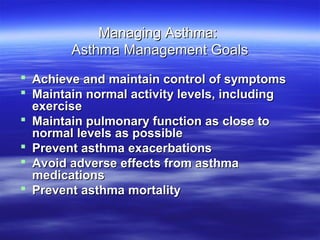
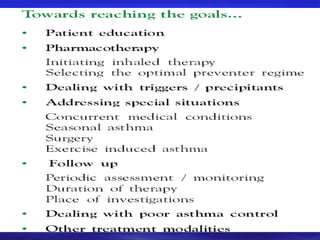
Managing Asthma:
        Asthma Management Goals
 Achieve and maintain control of symptoms
 Maintain normal activity levels, including
  exercise
 Maintain pulmonary function as close to
  normal levels as possible
 Prevent asthma exacerbations
 Avoid adverse effects from asthma
  medications
 Prevent asthma mortality
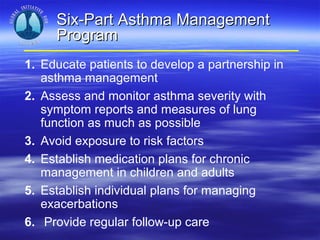
Six-Part Asthma Management
     Program
1. Educate patients to develop a partnership in
   asthma management
2. Assess and monitor asthma severity with
   symptom reports and measures of lung
   function as much as possible
3. Avoid exposure to risk factors
4. Establish medication plans for chronic
   management in children and adults
5. Establish individual plans for managing
   exacerbations
6. Provide regular follow-up care
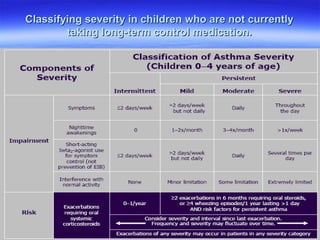
Classifying severity in children who are not currently
        taking long-term control medication.
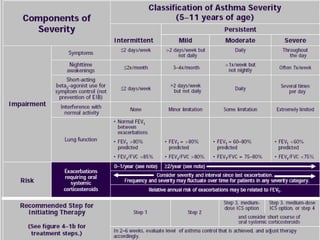
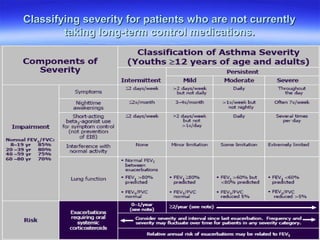
Classifying severity for patients who are not currently
        taking long-term control medications.
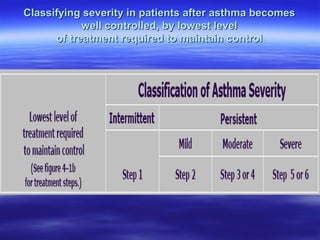
Classifying severity in patients after asthma becomes
            well controlled, by lowest level
      of treatment required to maintain control
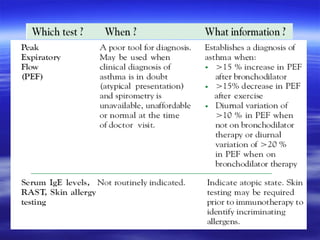
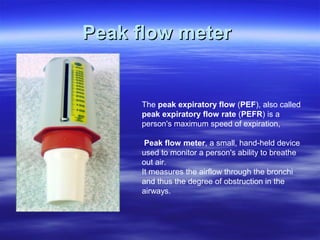
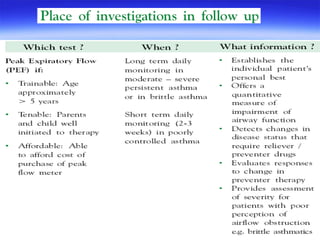
Peak flow meter


     The peak expiratory flow (PEF), also called
     peak expiratory flow rate (PEFR) is a
     person's maximum speed of expiration,

      Peak flow meter, a small, hand-held device
     used to monitor a person's ability to breathe
     out air.
     It measures the airflow through the bronchi
     and thus the degree of obstruction in the
     airways.
An easy to remember approximation is: PEFR (L/min) = [Height (cm) - 80] x 5
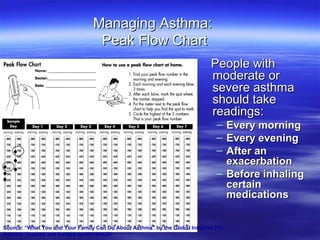
Managing Asthma:
                                  Peak Flow Chart
                                                                              People with
                                                                              moderate or
                                                                              severe asthma
                                                                              should take
                                                                              readings:
                                                                                – Every morning
                                                                                – Every evening
                                                                                – After an
                                                                                  exacerbation
                                                                                – Before inhaling
                                                                                  certain
                                                                                  medications

Source: “What You and Your Family Can Do About Asthma” by the Global Initiative For
Asthma Created and funded by NIH/NHLBI
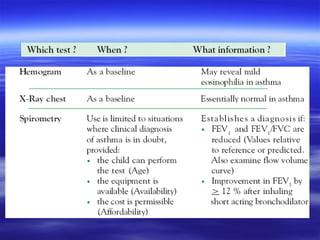
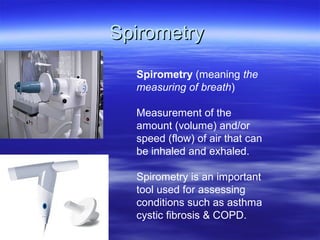
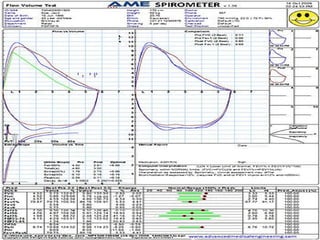
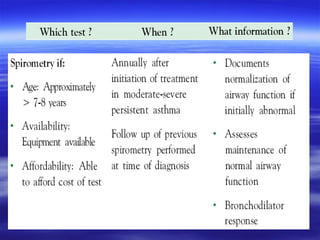
Spirometry
  Spirometry (meaning the
  measuring of breath)

  Measurement of the
  amount (volume) and/or
  speed (flow) of air that can
  be inhaled and exhaled.

  Spirometry is an important
  tool used for assessing
  conditions such as asthma
  cystic fibrosis & COPD.
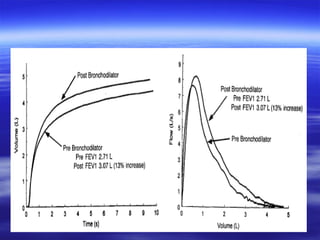
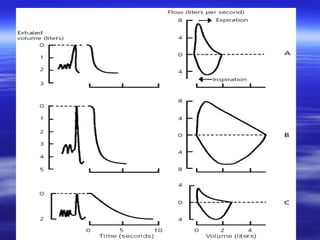
 A volume-time curve, showing volume
  (liters) along the Y-axis and time (seconds)
  along the X-axis
 A flow-volume loop, which graphically
  depicts the rate of airflow on the Y-axis and
  the total volume inspired or expired on the
  X-axis
 Procedure
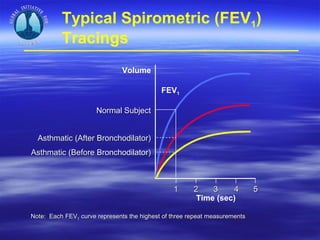
Typical Spirometric (FEV1)
          Tracings
                               Volume

                                            FEV1

                      Normal Subject


  Asthmatic (After Bronchodilator)
Asthmatic (Before Bronchodilator)


                                                1      2    3     4         5
                                                        Time (sec)

Note: Each FEV1 curve represents the highest of three repeat measurements
Limitations of test
 Spirometry can only be used on children old enough to
  comprehend and follow the instructions given (6 years old
  or more), and only on patients who are able to understand
  and follow instructions
 Many intermittent or mild asthmatics have normal
  spirometry between acute exacerbation, limiting
  spirometry's usefulness as a diagnostic.
 It is more useful as a monitoring tool.
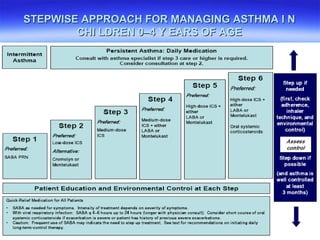
STEPWISE APPROACH FOR MANAGING ASTHMA I N
        CHI LDREN 0–4 Y EARS OF AGE
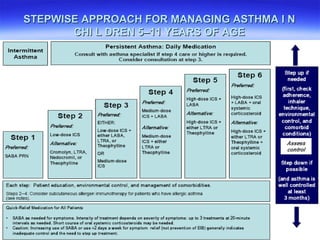
STEPWISE APPROACH FOR MANAGING ASTHMA I N
       CHI L DREN 5–11 YEARS OF AGE
Tool Kit for Achieving
         Management Goals
   Relievers
   Preventers
   Peak Flow meter
   Patient education
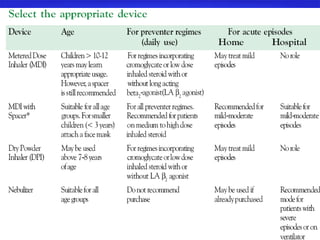
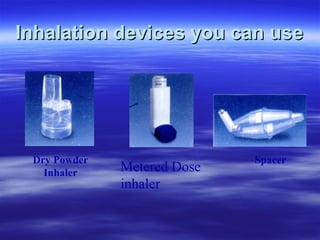
Inhalation devices you can use


 Dry Powder                  Spacer
   Inhaler    Metered Dose
              inhaler
Advantages of Spacer

 No co-ordination required

 No cold - freon effect

 Reduced oropharyngeal deposition

 Increased drug deposition in the
lungs
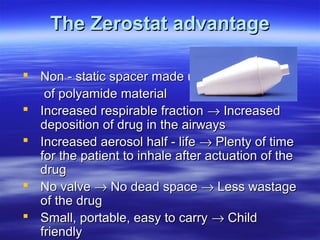
The Zerostat advantage

 Non - static spacer made up
   of polyamide material
 Increased respirable fraction → Increased
  deposition of drug in the airways
 Increased aerosol half - life → Plenty of time
  for the patient to inhale after actuation of the
  drug
 No valve → No dead space → Less wastage
  of the drug
 Small, portable, easy to carry → Child
  friendly
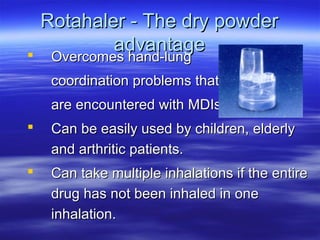
Rotahaler - The dry powder
             advantage
    Overcomes hand-lung
     Overcomes hand-lung
     coordination problems that
     are encountered with MDIs.
    Can be easily used by children, elderly
     and arthritic patients.
    Can take multiple inhalations if the entire
     drug has not been inhaled in one
     inhalation.
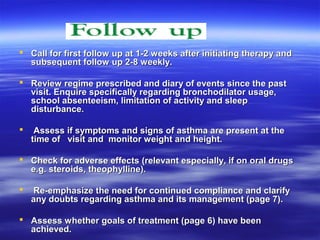
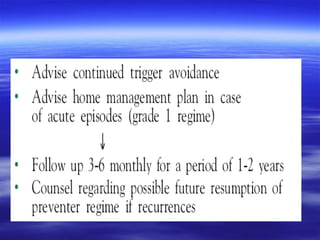
 Call for first follow up at 1-2 weeks after initiating therapy and
  subsequent follow up 2-8 weekly.

 Review regime prescribed and diary of events since the past
  visit. Enquire specifically regarding bronchodilator usage,
  school absenteeism, limitation of activity and sleep
  disturbance.

    Assess if symptoms and signs of asthma are present at the
    time of visit and monitor weight and height.

 Check for adverse effects (relevant especially, if on oral drugs
  e.g. steroids, theophylline).

   Re-emphasize the need for continued compliance and clarify
    any doubts regarding asthma and its management (page 7).

 Assess whether goals of treatment (page 6) have been
  achieved.
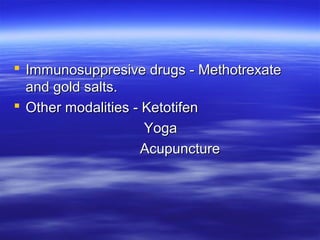
 Immunosuppresive drugs - Methotrexate
  and gold salts.
 Other modalities - Ketotifen
                     Yoga
                     Acupuncture
THANK YOU

Asthma 2010 new gina guidelines[pediatric]

  • 1.
    ASTHMA 2010 NEW GINA GUIDELINES Dr.Pradeep.G.C
  • 2.
    Managing Asthma: Asthma Management Goals  Achieve and maintain control of symptoms  Maintain normal activity levels, including exercise  Maintain pulmonary function as close to normal levels as possible  Prevent asthma exacerbations  Avoid adverse effects from asthma medications  Prevent asthma mortality
  • 3.
    Six-Part Asthma Management Program 1. Educate patients to develop a partnership in asthma management 2. Assess and monitor asthma severity with symptom reports and measures of lung function as much as possible 3. Avoid exposure to risk factors 4. Establish medication plans for chronic management in children and adults 5. Establish individual plans for managing exacerbations 6. Provide regular follow-up care
  • 6.
    Classifying severity inchildren who are not currently taking long-term control medication.
  • 8.
    Classifying severity forpatients who are not currently taking long-term control medications.
  • 9.
    Classifying severity inpatients after asthma becomes well controlled, by lowest level of treatment required to maintain control
  • 12.
    Peak flow meter The peak expiratory flow (PEF), also called peak expiratory flow rate (PEFR) is a person's maximum speed of expiration, Peak flow meter, a small, hand-held device used to monitor a person's ability to breathe out air. It measures the airflow through the bronchi and thus the degree of obstruction in the airways.
  • 13.
    An easy toremember approximation is: PEFR (L/min) = [Height (cm) - 80] x 5
  • 14.
    Managing Asthma: Peak Flow Chart People with moderate or severe asthma should take readings: – Every morning – Every evening – After an exacerbation – Before inhaling certain medications Source: “What You and Your Family Can Do About Asthma” by the Global Initiative For Asthma Created and funded by NIH/NHLBI
  • 15.
    Spirometry Spirometry(meaning the measuring of breath) Measurement of the amount (volume) and/or speed (flow) of air that can be inhaled and exhaled. Spirometry is an important tool used for assessing conditions such as asthma cystic fibrosis & COPD.
  • 16.
     A volume-timecurve, showing volume (liters) along the Y-axis and time (seconds) along the X-axis  A flow-volume loop, which graphically depicts the rate of airflow on the Y-axis and the total volume inspired or expired on the X-axis  Procedure
  • 17.
    Typical Spirometric (FEV1) Tracings Volume FEV1 Normal Subject Asthmatic (After Bronchodilator) Asthmatic (Before Bronchodilator) 1 2 3 4 5 Time (sec) Note: Each FEV1 curve represents the highest of three repeat measurements
  • 22.
    Limitations of test Spirometry can only be used on children old enough to comprehend and follow the instructions given (6 years old or more), and only on patients who are able to understand and follow instructions  Many intermittent or mild asthmatics have normal spirometry between acute exacerbation, limiting spirometry's usefulness as a diagnostic.  It is more useful as a monitoring tool.
  • 23.
    STEPWISE APPROACH FORMANAGING ASTHMA I N CHI LDREN 0–4 Y EARS OF AGE
  • 24.
    STEPWISE APPROACH FORMANAGING ASTHMA I N CHI L DREN 5–11 YEARS OF AGE
  • 26.
    Tool Kit forAchieving Management Goals  Relievers  Preventers  Peak Flow meter  Patient education
  • 27.
    Inhalation devices youcan use Dry Powder Spacer Inhaler Metered Dose inhaler
  • 28.
    Advantages of Spacer No co-ordination required  No cold - freon effect  Reduced oropharyngeal deposition  Increased drug deposition in the lungs
  • 29.
    The Zerostat advantage Non - static spacer made up of polyamide material  Increased respirable fraction → Increased deposition of drug in the airways  Increased aerosol half - life → Plenty of time for the patient to inhale after actuation of the drug  No valve → No dead space → Less wastage of the drug  Small, portable, easy to carry → Child friendly
  • 30.
    Rotahaler - Thedry powder advantage  Overcomes hand-lung Overcomes hand-lung coordination problems that are encountered with MDIs.  Can be easily used by children, elderly and arthritic patients.  Can take multiple inhalations if the entire drug has not been inhaled in one inhalation.
  • 35.
     Call forfirst follow up at 1-2 weeks after initiating therapy and subsequent follow up 2-8 weekly.  Review regime prescribed and diary of events since the past visit. Enquire specifically regarding bronchodilator usage, school absenteeism, limitation of activity and sleep disturbance.  Assess if symptoms and signs of asthma are present at the time of visit and monitor weight and height.  Check for adverse effects (relevant especially, if on oral drugs e.g. steroids, theophylline).  Re-emphasize the need for continued compliance and clarify any doubts regarding asthma and its management (page 7).  Assess whether goals of treatment (page 6) have been achieved.
  • 44.
     Immunosuppresive drugs- Methotrexate and gold salts.  Other modalities - Ketotifen Yoga Acupuncture
  • 45.

Editor's Notes

  • #3 Managing Asthma: Asthma Management Goals
  • #15 Managing Asthma: Peak Flow Chart