Assist and Assure – Frontline Awareness Training
1
Welcome to Country – Perth
Assist and Assure – Frontline Awareness Training
3
I would like to begin by acknowledging the
Whadjuk people of Noongar country, Traditional
Custodians of the land on which we meet today,
and pay my respects to their Elders past, present
and emerging.
Assist and Assure – Frontline Awareness Training
5
At the end of this course, you will be able to:
• Describe the key elements of Assist and Assure
• Describe how to contribute at an engaging transition to work meeting
• Demonstrate how to have effective ‘Step 7’ conversations
• Describe proactive Effective Supervision
• Describe our role in Assure
• Any other expectations
Learning Objectives
Assist and Assure – Frontline Awareness Training
6
Step 1 – Plan
Topic
01 Overview
02 Assist and Assure Fundamentals
03 Transition to Work
04 Step 7
05 Effective Supervision
06 Assure
06 Summary
07 Implementation / Q&A
Step 1: Plan
• Step 2 Communicate – Location of first aid, AED, fire
extinguishers, toilets, smoking area is outside, emergency
response - not expecting a drill today, muster point and evacuation
route, sign on to attendance sheet
• Step 3 Check Equipment – Laptop & microphone, leads are
secured, chairs are stable, enough water, coffee, resources –
paper, pens, handouts
• Step 4 Prepare Area – COVID requirements, group activities
• Step 5 Control Energy – Please ensure phones are on silent,
Anything else?
• Step 6 Final Check – Have we completed all of our checks from
above?​
• Step 7 Start work – Are we convinced it is safe to start?
Assist and Assure – Frontline Awareness Training
7
Assist and Assure – Frontline Awareness Training
9
In pairs, present your next
door neighbour:
Name
Company
Role
Something unique?
Questions:
What
Where
When
Who
Why
How
Open Questions
Introductions
Assist and Assure – Frontline Awareness Training
10
In the context of living, what is important to YOU?
• Make a list of everything or anyone that is important to YOU –
Think of as many as you can!
• Now choose your TOP 4
Now ask yourself, if I am injured how will this affect my TOP 4?
Switching On
Video – Work Safe, Home Safe - Family watching TV waiting for
their dad to come home
This video is available at:
https://vimeo.com/814785053/be1f64c8aa?share=copy
Assist and Assure – Frontline Awareness Training
11
What’s Important?
Assist & Assure Training Pack
12
Overview 1
What is A&A?
A way of working to proactively identify
and mitigate risk in work preparation
and execution.
Assist and Assure – Frontline Awareness Training
13
What is Assist and Assure?
Collaboration
We work together, share ideas and grow
awareness.
Learning
We are all learning, every day.
Proactive Leadership
Visible, engaging, where we can influence
best.
Psychological Safety
A safe place to speak up.
Line-led
Leadership ownership and commitment.
Consistent
Setting and holding of expectations.
Intended to becoming self-sustaining
Ownership is where it belongs at the
frontline.
Culture of Care
About demonstrating care rather than
driving results.
Assist and Assure – Frontline Awareness Training
14
What is Assist and Assure?
How many decisions do we make in a day? How many mistakes?
We all make mistakes
When incidents occur, how often do you think they are the result of malicious behaviours?
Actions are rarely malicious, but well-meaning behaviours intended to get the job done, the
context drives behaviours
Have you ever had a manager react badly to a mistake or failure? How did it make you feel?
How leaders respond to failure matters: we need to learn from mistakes
When are you most engaged at work?
People who feel valued are more engaged
Who is most likely to produce solutions to pain points in the workplace?
Our people are masters of their job and key to solutions
Assist and Assure – Frontline Awareness Training
15
Human Performance Challenges?
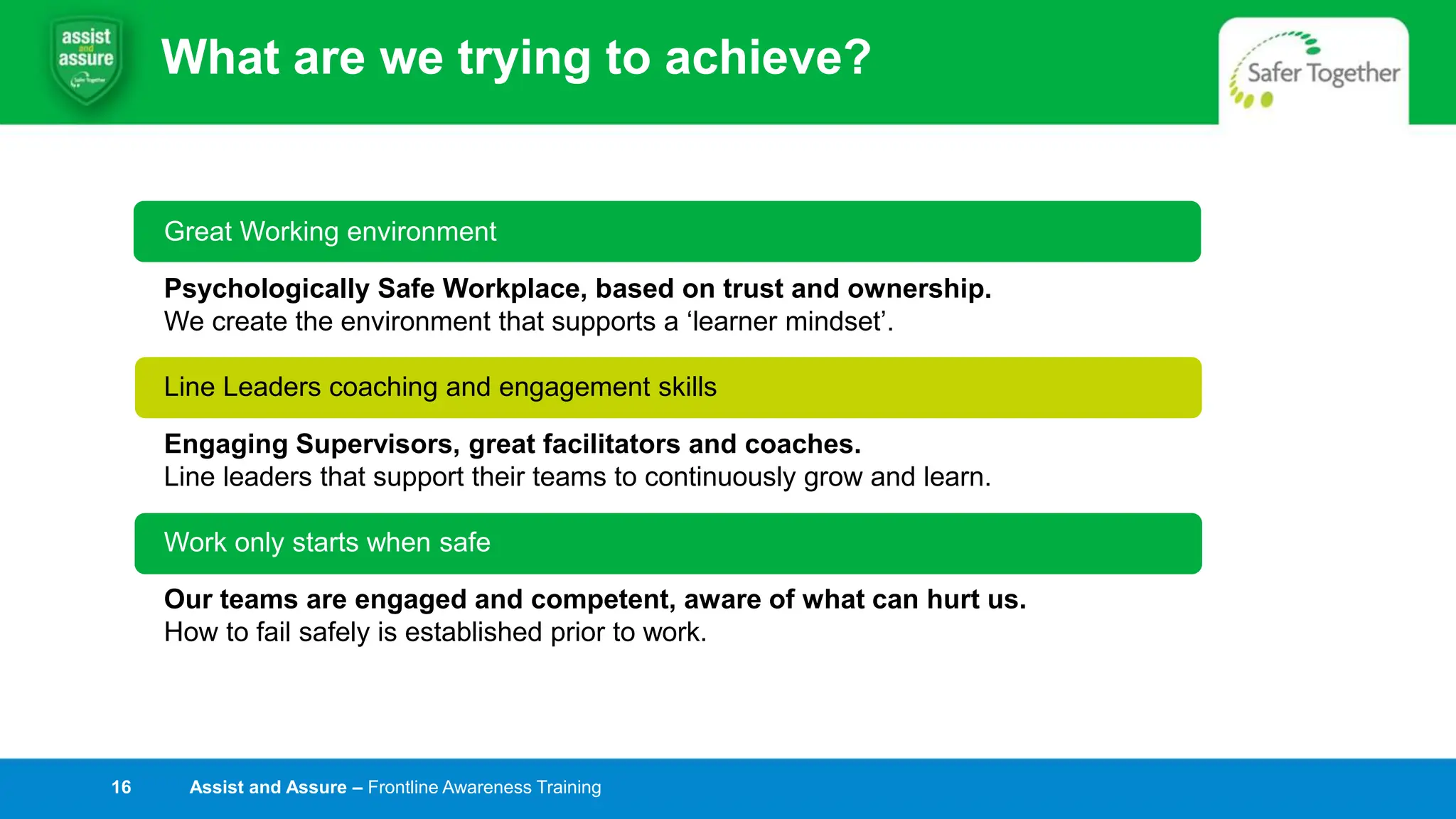
Great Working environment
Psychologically Safe Workplace, based on trust and ownership.
We create the environment that supports a ‘learner mindset’.
Line Leaders coaching and engagement skills
Engaging Supervisors, great facilitators and coaches.
Line leaders that support their teams to continuously grow and learn.
Work only starts when safe
Our teams are engaged and competent, aware of what can hurt us.
How to fail safely is established prior to work.
Assist and Assure – Frontline Awareness Training
16
What are we trying to achieve?
Video - Video of the captain in the submarine
This video is available here:
https://vimeo.com/814788225/888cc41719?share=copy
Assist and Assure – Frontline Awareness Training
17
Lead by Intent
Great Working environment
 Psychologically safe workplace, based on trust and ownership.
 We create the environment that supports a ‘learner mindset’.
Engaging Supervisors
 Great facilitators, supportive, grow and learn.
 Line leaders that support their teams to continuously grow and learn
Work only starts when safe
 Our teams are engaged and competent, aware of what can hurt us.
 How to fail safely is established prior to work
Assist and Assure – Frontline Awareness Training
18
Where are we now?
Assist & Assure Training Pack
20
Assist and Assure Fundamentals 2
Senior Leadership Message
Senior Leader video
This video is available at: https://vimeo.com/852261295?share=copy
Assist and Assure – Frontline Awareness Training
21
Assist and Assure – Frontline Awareness Training
22
1. Transition to Work
2. Step 7
3. Effective Supervision
4. Assure
Engaging, switch on, open questions.
We are convinced it is safe to start work.
Proactive (lead by example), curious, engaging,
focus on continuous improvement.
Self-assurance – build capacity & ownership.
4 Elements of Assist & Assure
Assist & Assure Training Pack
23
Transition to Work 3
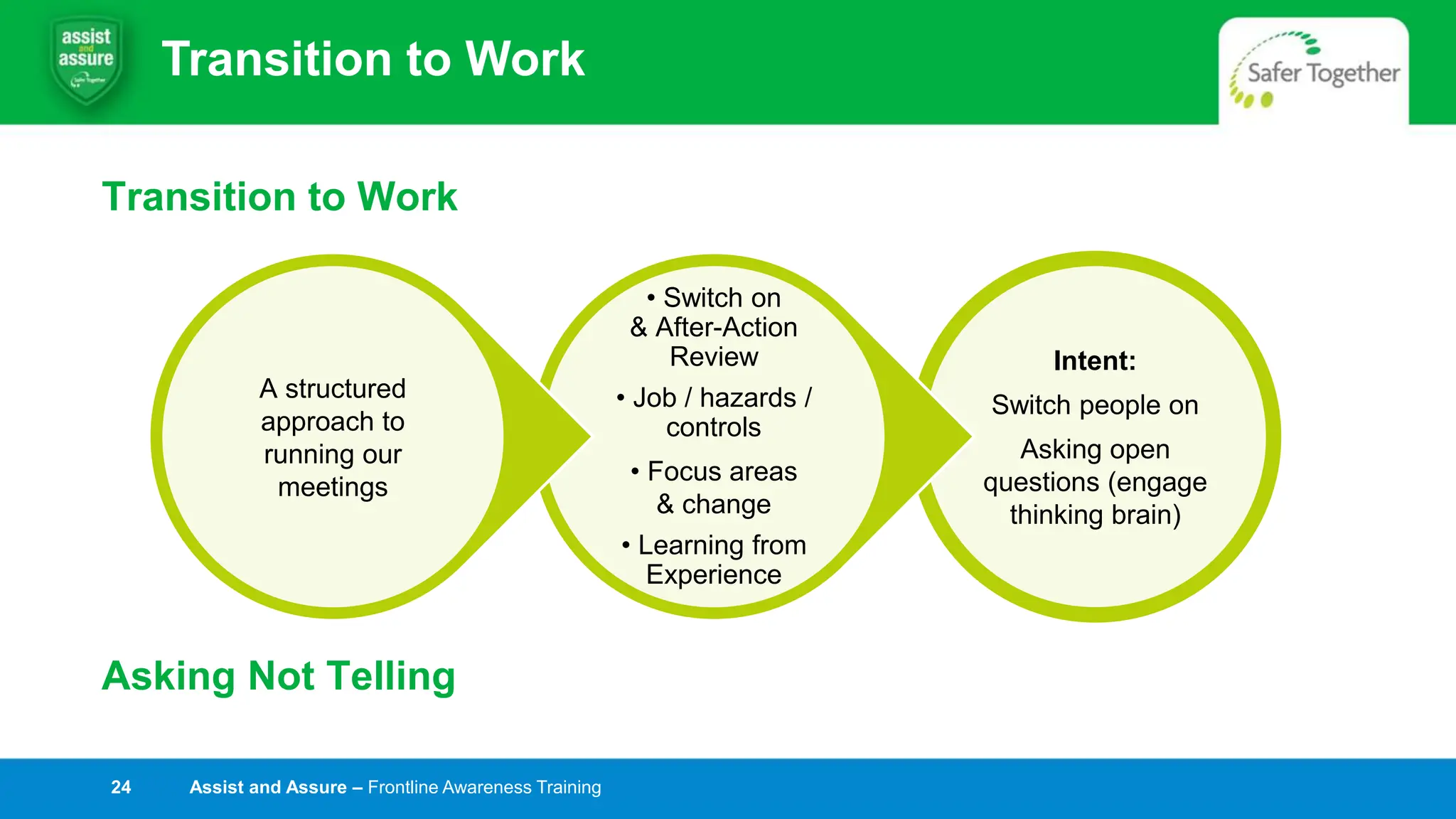
Transition to Work
Asking Not Telling
Intent:
Switch people on
Asking open
questions (engage
thinking brain)
• Switch on
& After-Action
Review
• Job / hazards /
controls
• Focus areas
& change
• Learning from
Experience
A structured
approach to
running our
meetings
Assist and Assure – Frontline Awareness Training
24
Transition to Work
Assist and Assure – Frontline Awareness Training
25
Open questions to get people thinking? Quizwise.com
What went well yesterday, what didn’t, anyone stop the job?
What are we doing today? Roles, responsibilities (Circle 1)
What can hurt us? (Circle 1)
What can we do about it? (Circle 1)
What is your key focus today? (Circle 2)
What is different about today? (Circle 2)
Learning from experience – Can this happen to us? How will we respond? (Story)
Ask Questions
Ask
Everyone
Transition to Work
Quizwise.com | Daily
General Knowledge Quiz
Assist and Assure – Frontline Awareness Training
26
Quiz Wise
Assist and Assure – Frontline Awareness Training
27
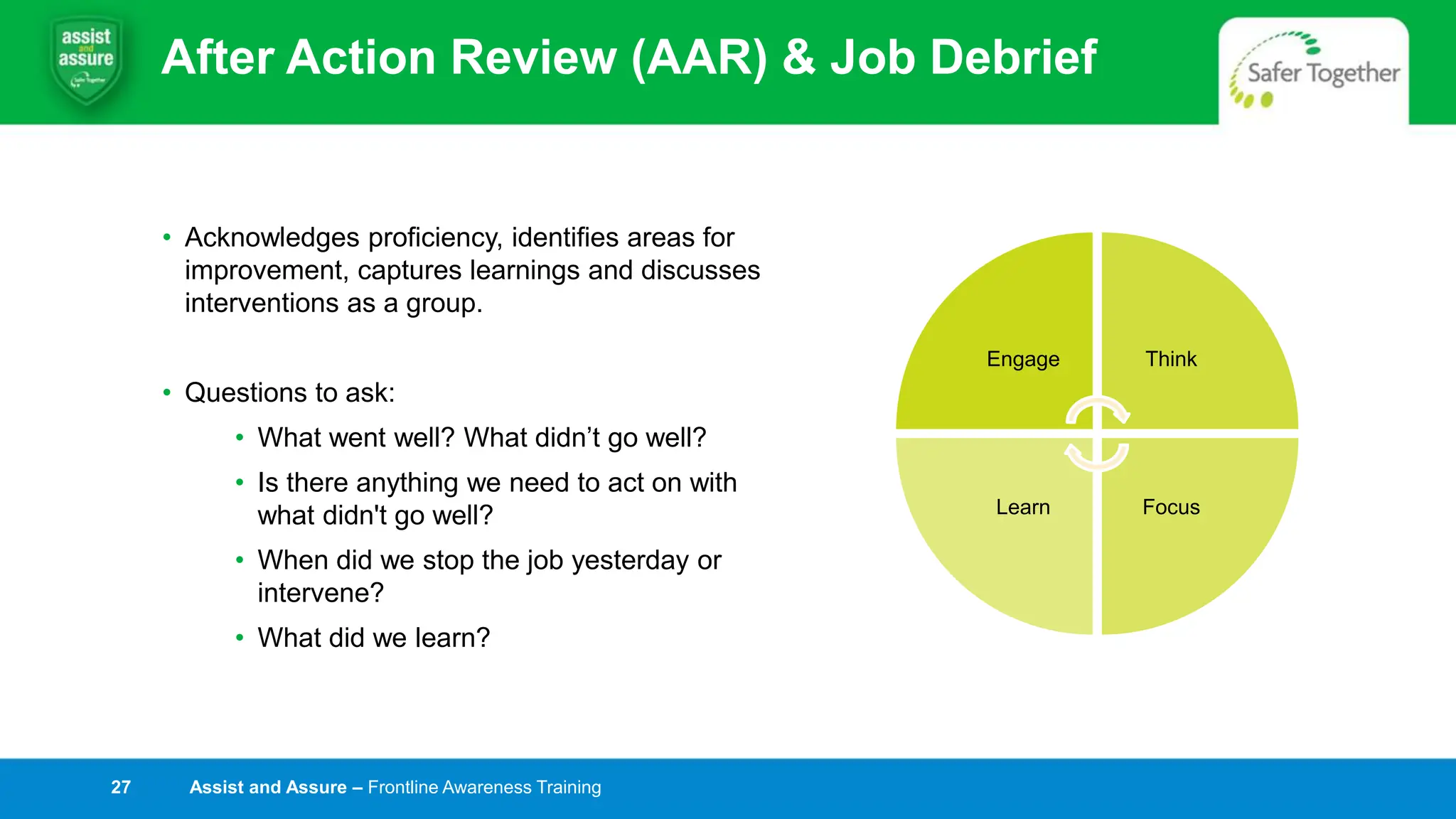
• Acknowledges proficiency, identifies areas for
improvement, captures learnings and discusses
interventions as a group.
• Questions to ask:
• What went well? What didn’t go well?
• Is there anything we need to act on with
what didn't go well?
• When did we stop the job yesterday or
intervene?
• What did we learn?
Engage Think
Focus
Learn
After Action Review (AAR) & Job Debrief
Assist and Assure – Frontline Awareness Training
28
• What are we doing today?
• Roles and responsibilities
• What can hurt us?
• What can we do about it?
Engaging Open Questions
Focus Areas
What is your key risk for today that
could hurt you or others?
What can go wrong?
What can we do about it now? Hand
injuries
Slips, trips,
falls
Process
safety
Drops
Vehicle /
forklift
interaction
Pressure
Stored
energy
Manual
handling
SIMOPS
Fatigue
Fit for work
Assist and Assure – Frontline Awareness Training
29
Focus Areas
WHAT CAN CHANGE?
New arrivals
Equipment
Scope
Weather
Road conditions
Attitudes
Key risks Pressures
Assist and Assure – Frontline Awareness Training
30
Change
Assist and Assure – Frontline Awareness Training
31
What relevant stories can we share?
• Could this happen to us?
• What do we do if it does?
• When was the last time something like this has happened?
• What do we have to stop this happening? What is our plan?
• How will we respond?
We are hardwired to be influenced by stories.
Learning From Experience
Assist & Assure Training Pack
32
Step 7 4
Assist and Assure – Frontline Awareness Training
33
Ask the question at the conversation, not an investigation!
They are the same questions, where would you rather ask them?
Verify all controls /
barriers, Convince
us all it is safe to
start work
Structured
conversation using
the card visibly to
verify it is safe to
start work
Step 7
Assist and Assure – Frontline Awareness Training
34
At the start of every job – immediately prior to starting work
Resuming work to convince us it is safe
Re-confirm we are convinced it is safe when things change
Permit to Work discussion (to guide the Toolbox talk)
If anyone has concerns for the safeguards during the task
If there is a change in personnel doing the job
As a structured Leadership engagement tool
When do we use it?
Every line every time video
This video is available at: https://vimeo.com/814785602/8f50c38280?share=copy
Assist and Assure – Frontline Awareness Training
35
Video
For example:
• Moving a desk from one room to another
• Unloading a truck
• Simultaneous operations on a wellsite
• Anything that requires a group of people.
Activity
Assist and Assure – Frontline Awareness Training
36
Step 7
Assist & Assure Training Pack
37
Effective Supervision 5
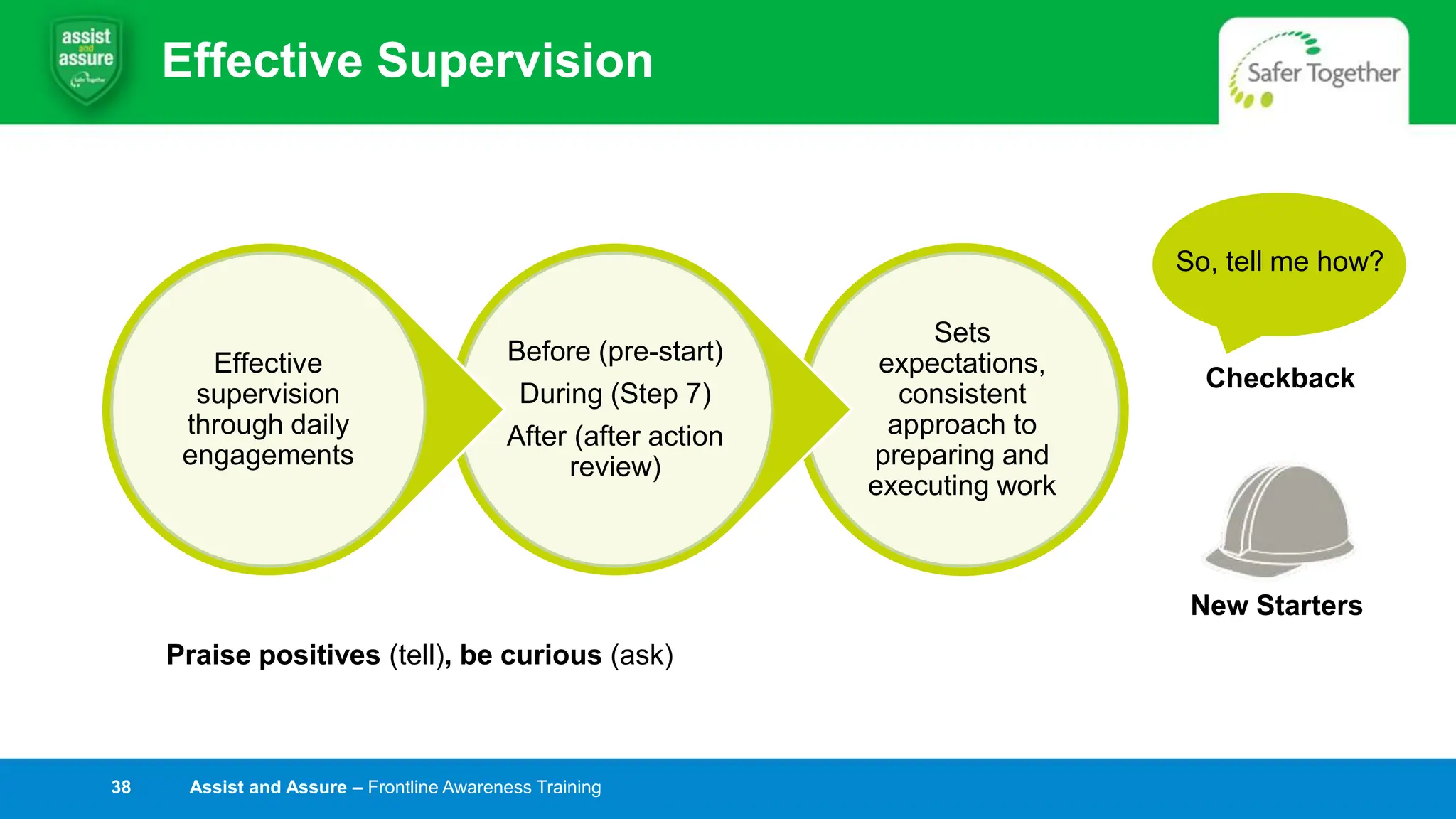
Sets
expectations,
consistent
approach to
preparing and
executing work
Before (pre-start)
During (Step 7)
After (after action
review)
Effective
supervision
through daily
engagements
Praise positives (tell), be curious (ask)
New Starters
Checkback
So, tell me how?
Assist and Assure – Frontline Awareness Training
38
Effective Supervision
Assist & Assure Training Pack
39
Assure 6
Assist and Assure – Frontline Awareness Training
40
• Who has a smoke detector at home?
• Who has a fire extinguisher OR fire blanket at home?
• Who has done any training with the extinguisher or blanket?
• Who has run any Emergency Response drills with the family at home?
• Who has a first aid kit in your car?
Score /5
Home Safety Quiz
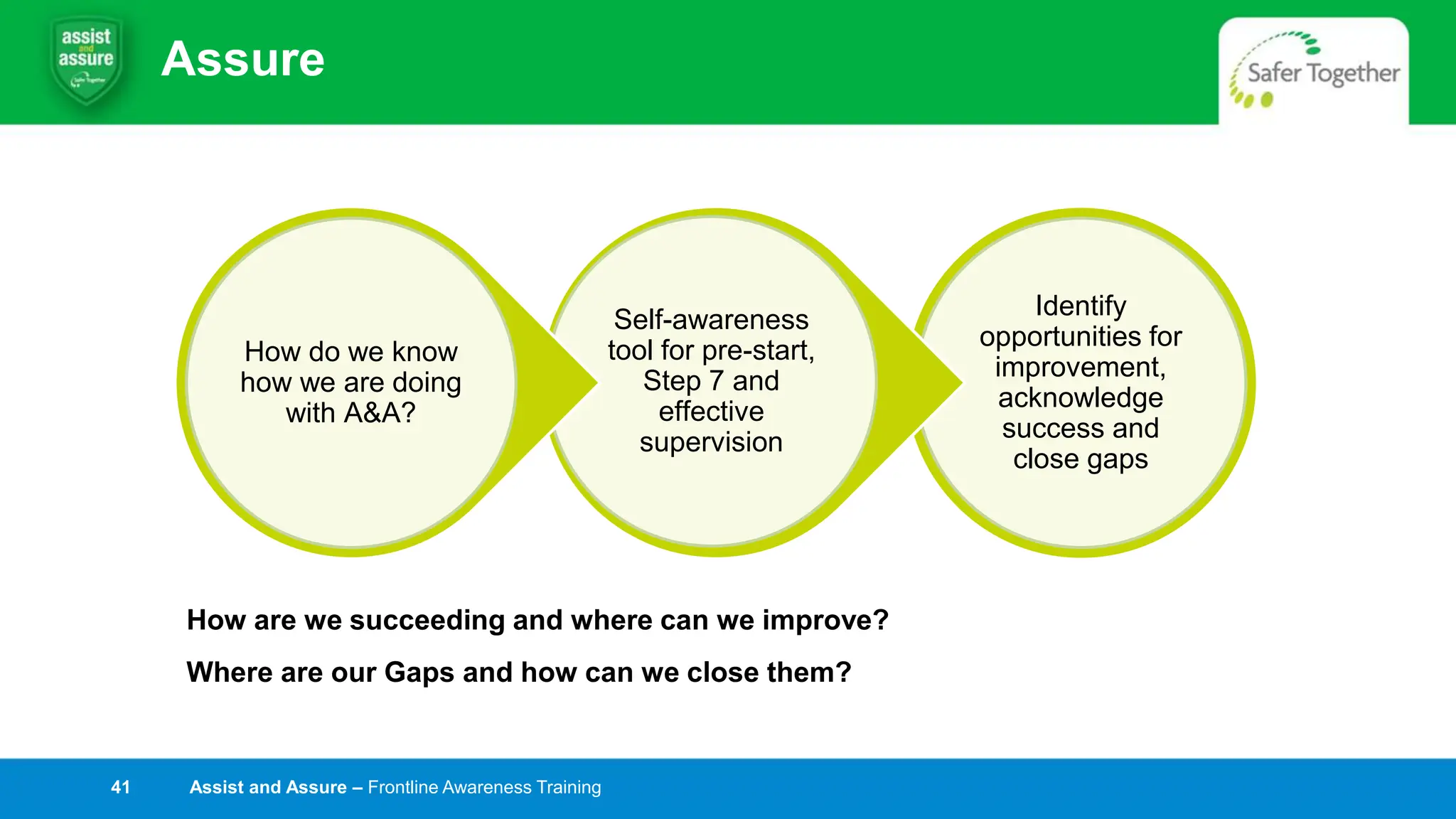
How are we succeeding and where can we improve?
Where are our Gaps and how can we close them?
Identify
opportunities for
improvement,
acknowledge
success and
close gaps
Self-awareness
tool for pre-start,
Step 7 and
effective
supervision
How do we know
how we are doing
with A&A?
Assist and Assure – Frontline Awareness Training
41
Assure
Assist and Assure – Frontline Awareness Training
42
Assure – Self-awareness tool
Assist & Assure Training Pack
43
Summary 7
Assist and Assure – Frontline Awareness Training
44
1. Transition to Work
2. Step 7
3. Effective Supervision
4. Assure
Engaging, switch on, open questions.
We are convinced it is safe to start work.
Proactive (lead by example), curious, engaging,
focus on continuous improvement.
Self-assurance – build capacity & ownership.
4 Elements of Assist & Assure
• What went well today?
• What didn’t go so well?
• Has anything changed or needs to change as a result
of today? Beliefs, attitudes, enthusiasm, motivation?
• What did we learn?
Assist and Assure – Frontline Awareness Training
45
After Action Review
Assist and Assure – Frontline Awareness Training
46
Assist & Assure
Questions
Thanks
Assist and Assure – Supervisors Safety Leadership Training
47
Thank You

Assist&Assure.Frontline.Awareness.Training.pptx

  • 1.
    Assist and Assure– Frontline Awareness Training 1
  • 2.
    Welcome to Country– Perth Assist and Assure – Frontline Awareness Training 3 I would like to begin by acknowledging the Whadjuk people of Noongar country, Traditional Custodians of the land on which we meet today, and pay my respects to their Elders past, present and emerging.
  • 3.
    Assist and Assure– Frontline Awareness Training 5 At the end of this course, you will be able to: • Describe the key elements of Assist and Assure • Describe how to contribute at an engaging transition to work meeting • Demonstrate how to have effective ‘Step 7’ conversations • Describe proactive Effective Supervision • Describe our role in Assure • Any other expectations Learning Objectives
  • 4.
    Assist and Assure– Frontline Awareness Training 6 Step 1 – Plan Topic 01 Overview 02 Assist and Assure Fundamentals 03 Transition to Work 04 Step 7 05 Effective Supervision 06 Assure 06 Summary 07 Implementation / Q&A Step 1: Plan
  • 5.
    • Step 2Communicate – Location of first aid, AED, fire extinguishers, toilets, smoking area is outside, emergency response - not expecting a drill today, muster point and evacuation route, sign on to attendance sheet • Step 3 Check Equipment – Laptop & microphone, leads are secured, chairs are stable, enough water, coffee, resources – paper, pens, handouts • Step 4 Prepare Area – COVID requirements, group activities • Step 5 Control Energy – Please ensure phones are on silent, Anything else? • Step 6 Final Check – Have we completed all of our checks from above?​ • Step 7 Start work – Are we convinced it is safe to start? Assist and Assure – Frontline Awareness Training 7
  • 6.
    Assist and Assure– Frontline Awareness Training 9 In pairs, present your next door neighbour: Name Company Role Something unique? Questions: What Where When Who Why How Open Questions Introductions
  • 7.
    Assist and Assure– Frontline Awareness Training 10 In the context of living, what is important to YOU? • Make a list of everything or anyone that is important to YOU – Think of as many as you can! • Now choose your TOP 4 Now ask yourself, if I am injured how will this affect my TOP 4? Switching On
  • 8.
    Video – WorkSafe, Home Safe - Family watching TV waiting for their dad to come home This video is available at: https://vimeo.com/814785053/be1f64c8aa?share=copy Assist and Assure – Frontline Awareness Training 11 What’s Important?
  • 9.
    Assist & AssureTraining Pack 12 Overview 1
  • 10.
    What is A&A? Away of working to proactively identify and mitigate risk in work preparation and execution. Assist and Assure – Frontline Awareness Training 13 What is Assist and Assure?
  • 11.
    Collaboration We work together,share ideas and grow awareness. Learning We are all learning, every day. Proactive Leadership Visible, engaging, where we can influence best. Psychological Safety A safe place to speak up. Line-led Leadership ownership and commitment. Consistent Setting and holding of expectations. Intended to becoming self-sustaining Ownership is where it belongs at the frontline. Culture of Care About demonstrating care rather than driving results. Assist and Assure – Frontline Awareness Training 14 What is Assist and Assure?
  • 12.
    How many decisionsdo we make in a day? How many mistakes? We all make mistakes When incidents occur, how often do you think they are the result of malicious behaviours? Actions are rarely malicious, but well-meaning behaviours intended to get the job done, the context drives behaviours Have you ever had a manager react badly to a mistake or failure? How did it make you feel? How leaders respond to failure matters: we need to learn from mistakes When are you most engaged at work? People who feel valued are more engaged Who is most likely to produce solutions to pain points in the workplace? Our people are masters of their job and key to solutions Assist and Assure – Frontline Awareness Training 15 Human Performance Challenges?
  • 13.
    Great Working environment PsychologicallySafe Workplace, based on trust and ownership. We create the environment that supports a ‘learner mindset’. Line Leaders coaching and engagement skills Engaging Supervisors, great facilitators and coaches. Line leaders that support their teams to continuously grow and learn. Work only starts when safe Our teams are engaged and competent, aware of what can hurt us. How to fail safely is established prior to work. Assist and Assure – Frontline Awareness Training 16 What are we trying to achieve?
  • 14.
    Video - Videoof the captain in the submarine This video is available here: https://vimeo.com/814788225/888cc41719?share=copy Assist and Assure – Frontline Awareness Training 17 Lead by Intent
  • 15.
    Great Working environment Psychologically safe workplace, based on trust and ownership.  We create the environment that supports a ‘learner mindset’. Engaging Supervisors  Great facilitators, supportive, grow and learn.  Line leaders that support their teams to continuously grow and learn Work only starts when safe  Our teams are engaged and competent, aware of what can hurt us.  How to fail safely is established prior to work Assist and Assure – Frontline Awareness Training 18 Where are we now?
  • 16.
    Assist & AssureTraining Pack 20 Assist and Assure Fundamentals 2
  • 17.
    Senior Leadership Message SeniorLeader video This video is available at: https://vimeo.com/852261295?share=copy Assist and Assure – Frontline Awareness Training 21
  • 18.
    Assist and Assure– Frontline Awareness Training 22 1. Transition to Work 2. Step 7 3. Effective Supervision 4. Assure Engaging, switch on, open questions. We are convinced it is safe to start work. Proactive (lead by example), curious, engaging, focus on continuous improvement. Self-assurance – build capacity & ownership. 4 Elements of Assist & Assure
  • 19.
    Assist & AssureTraining Pack 23 Transition to Work 3
  • 20.
    Transition to Work AskingNot Telling Intent: Switch people on Asking open questions (engage thinking brain) • Switch on & After-Action Review • Job / hazards / controls • Focus areas & change • Learning from Experience A structured approach to running our meetings Assist and Assure – Frontline Awareness Training 24 Transition to Work
  • 21.
    Assist and Assure– Frontline Awareness Training 25 Open questions to get people thinking? Quizwise.com What went well yesterday, what didn’t, anyone stop the job? What are we doing today? Roles, responsibilities (Circle 1) What can hurt us? (Circle 1) What can we do about it? (Circle 1) What is your key focus today? (Circle 2) What is different about today? (Circle 2) Learning from experience – Can this happen to us? How will we respond? (Story) Ask Questions Ask Everyone Transition to Work
  • 22.
    Quizwise.com | Daily GeneralKnowledge Quiz Assist and Assure – Frontline Awareness Training 26 Quiz Wise
  • 23.
    Assist and Assure– Frontline Awareness Training 27 • Acknowledges proficiency, identifies areas for improvement, captures learnings and discusses interventions as a group. • Questions to ask: • What went well? What didn’t go well? • Is there anything we need to act on with what didn't go well? • When did we stop the job yesterday or intervene? • What did we learn? Engage Think Focus Learn After Action Review (AAR) & Job Debrief
  • 24.
    Assist and Assure– Frontline Awareness Training 28 • What are we doing today? • Roles and responsibilities • What can hurt us? • What can we do about it? Engaging Open Questions
  • 25.
    Focus Areas What isyour key risk for today that could hurt you or others? What can go wrong? What can we do about it now? Hand injuries Slips, trips, falls Process safety Drops Vehicle / forklift interaction Pressure Stored energy Manual handling SIMOPS Fatigue Fit for work Assist and Assure – Frontline Awareness Training 29 Focus Areas
  • 26.
    WHAT CAN CHANGE? Newarrivals Equipment Scope Weather Road conditions Attitudes Key risks Pressures Assist and Assure – Frontline Awareness Training 30 Change
  • 27.
    Assist and Assure– Frontline Awareness Training 31 What relevant stories can we share? • Could this happen to us? • What do we do if it does? • When was the last time something like this has happened? • What do we have to stop this happening? What is our plan? • How will we respond? We are hardwired to be influenced by stories. Learning From Experience
  • 28.
    Assist & AssureTraining Pack 32 Step 7 4
  • 29.
    Assist and Assure– Frontline Awareness Training 33 Ask the question at the conversation, not an investigation! They are the same questions, where would you rather ask them? Verify all controls / barriers, Convince us all it is safe to start work Structured conversation using the card visibly to verify it is safe to start work Step 7
  • 30.
    Assist and Assure– Frontline Awareness Training 34 At the start of every job – immediately prior to starting work Resuming work to convince us it is safe Re-confirm we are convinced it is safe when things change Permit to Work discussion (to guide the Toolbox talk) If anyone has concerns for the safeguards during the task If there is a change in personnel doing the job As a structured Leadership engagement tool When do we use it?
  • 31.
    Every line everytime video This video is available at: https://vimeo.com/814785602/8f50c38280?share=copy Assist and Assure – Frontline Awareness Training 35 Video
  • 32.
    For example: • Movinga desk from one room to another • Unloading a truck • Simultaneous operations on a wellsite • Anything that requires a group of people. Activity Assist and Assure – Frontline Awareness Training 36 Step 7
  • 33.
    Assist & AssureTraining Pack 37 Effective Supervision 5
  • 34.
    Sets expectations, consistent approach to preparing and executingwork Before (pre-start) During (Step 7) After (after action review) Effective supervision through daily engagements Praise positives (tell), be curious (ask) New Starters Checkback So, tell me how? Assist and Assure – Frontline Awareness Training 38 Effective Supervision
  • 35.
    Assist & AssureTraining Pack 39 Assure 6
  • 36.
    Assist and Assure– Frontline Awareness Training 40 • Who has a smoke detector at home? • Who has a fire extinguisher OR fire blanket at home? • Who has done any training with the extinguisher or blanket? • Who has run any Emergency Response drills with the family at home? • Who has a first aid kit in your car? Score /5 Home Safety Quiz
  • 37.
    How are wesucceeding and where can we improve? Where are our Gaps and how can we close them? Identify opportunities for improvement, acknowledge success and close gaps Self-awareness tool for pre-start, Step 7 and effective supervision How do we know how we are doing with A&A? Assist and Assure – Frontline Awareness Training 41 Assure
  • 38.
    Assist and Assure– Frontline Awareness Training 42 Assure – Self-awareness tool
  • 39.
    Assist & AssureTraining Pack 43 Summary 7
  • 40.
    Assist and Assure– Frontline Awareness Training 44 1. Transition to Work 2. Step 7 3. Effective Supervision 4. Assure Engaging, switch on, open questions. We are convinced it is safe to start work. Proactive (lead by example), curious, engaging, focus on continuous improvement. Self-assurance – build capacity & ownership. 4 Elements of Assist & Assure
  • 41.
    • What wentwell today? • What didn’t go so well? • Has anything changed or needs to change as a result of today? Beliefs, attitudes, enthusiasm, motivation? • What did we learn? Assist and Assure – Frontline Awareness Training 45 After Action Review
  • 42.
    Assist and Assure– Frontline Awareness Training 46 Assist & Assure Questions
  • 43.
    Thanks Assist and Assure– Supervisors Safety Leadership Training 47 Thank You

Editor's Notes

  • #2 I will always introduce myself first. Give a brief history of my working life to break the ice a little and help build some rapport initially then ask each participant in the course to talk about themselves, their life history briefly and how they have come to be here on site. This always leads to information that you can draw on as a facilitator to relate information to them, their roles, industry and ask targeted questions to them based on their experience. Key program considerations: Senior management need to embrace and lead the programme in the organisation Adequate training and coaching resources are essential to success. Initial coaching deployment for 1-2 weeks, then 2-3 days/week The program is most successful when owned at the local level This training pack has been made so the organisations can enter some of their own data/stories/pictures if desired. Ultimately A&A is about building capability not dependence so focus on upskilling the teams is paramount Resist the temptation to use A&A as a corporate statistics generating machine. All facilitator instructions are in the speaker notes for each slide Products Available on https://www.safertogether.com.au/resources/products
  • #3 In the spirit of Assist & Assure, the course leader should ask the course participants to describe the alarms, emergency exits, etc. Explain that phones should be on silent, but that it is ok to take a call if needed.
  • #4 Talk through the acknowledgement of country and its importance in recognising the Traditional Owners of the region we are in.
  • #5 Talk through the acknowledgement of country and its importance in recognising the Traditional Owners of the region we are in.
  • #6 These are the learning objectives for the course Tun through the list and ask if there are any other expectations.
  • #7 Step 1 – Plan, run through the high level plan for the day. Will have breaks as required Please ask questions at any time throughout the session to help clarify concepts that may be tricky We will try to give as many examples as possible
  • #8 Complete the Step 7, confirming what we already know from the previous slide. Ask if everyone feels convinced it is safe to start?
  • #9 Acknowledge that Assist and Assure came from Shell Wells prior to being offered to industry through Safer Together
  • #10 Get to know you – in pairs – present your next door neighbour Name Company Role Something unique? Begin to use open questions when talking to each other. See how the conversation develops and where curiosity can take you.
  • #11 In the previous activity, we found out about each other. Maybe discovering what is important to people, what we do for fun, where we would rather be than at work potentially. If we link what people are doing, or not doing, to their “Top 4” we have a better chance of influencing their behavior. How do we find out their Top 4? – By having conversations and LISTENING to what is important to them. This is an important reminder to us of what could be affected if we are injured either at work or at home. Our awareness of this can related directly to how safe we are and how we are influencing others around us. Our awareness of this can be related directly to how safe we are and how we are influencing others around us
  • #12 Play the video and see how the people in the room have been affected. Discuss how quickly lives can change and the people who care about us can be affected dramatically. Provide a story from either home or the workplace where an injury has affected the people around us or someone’s safety attitude. Relate back to Top 4!
  • #14 This is the first part of a definition of what A&A is This comes from the A&A mission statement. The next slide demonstrates how we do this. Sometimes I ask, ‘what is the key word in the sentence?, the word ‘proactive’ is pivotal for the rest of the day and one of the ‘results’ of A&A if done well
  • #15 Work through each click, explaining what these look like in practice and what we will be practicing today Will be practicing engagement and see how it feels to line-led practices within the transition to work and Step 7’s Talk about how to be consistent with setting expectations and what that looks like Taking ownership of the process Demonstration of care, rather than results. This leads to better results anyway and an increase in positive morale. Sharing ideas through after-action reviews and raising our collective awareness Having a learner mindset to continually learn from situations and others Leadership should be visible and tangible. This is where we can influence the best Having a safe place to speak up builds a better team, workplace and surfaces ideas or issues that could cause accidents.
  • #17 Work through each click, explaining what these look like in practice and what we will be practicing today. Will be practicing engagement and see how it feels to line-led practices within the transition to work and Step 7’s Talk about how to be consistent with setting expectations and what that looks like Taking ownership of the process Demonstration of care, rather than results. This leads to better results anyway and an increase in positive morale. Sharing ideas through after-action reviews and raising our collective awareness Having a learner mindset to continually learn from situations and others Leadership should be visible and tangible. This is where we can influence the best Having a safe place to speak up builds a better team, workplace and surfaces ideas or issues that could cause accidents.
  • #18 Video ~ 9 Minutes Discuss: Similarity to A&A? Prove to me it’s safe… Step 7? Is it the right thing to do… Safety Leadership? Creating a Leader - Leader environment! L. David Marquet’s book – “Turn the Ship Around!” is an excellent resource for those looking into how to initiate and run with a leader-leader work environment. It is transformational.
  • #19 Also for discussion is how psychological safety features within the ‘great working environment’ and how this is characterised by a ‘learner mindset’. If everyone is out to learn honestly then this will contribute to psychological safety – the two go hand in hand. We will also see this supported by a human performance approach and we will talk about this soon. Work through each click, explaining what these look like in practice and what we will be practicing today Will be practicing engagement and see how it feels to line-led practices within the transition to work and Step 7’s Talk about how to be consistent with setting expectations and what that looks like Taking ownership of the process Demonstration of care, rather than results. This leads to better results anyway and an increase in positive morale. Sharing ideas through after-action reviews and raising our collective awareness Having a learner mindset to continually learn from situations and others Leadership should be visible and tangible. This is where we can influence the best Having a safe place to speak up builds a better team, workplace and surfaces ideas or issues that could cause accidents.
  • #20 Click through and discuss each question. These questions are an initial assurance activity to develop a baseline and direct the training focus for the day.
  • #23 Notes next to each one, brief summary to start with, overall intents. Click through animation at the end and talk about 1-3 being the Assist element while 4 is just about Assure.
  • #25 Pre-Tour = Pre-Start = Toolbox Talk = what you do at the start of the day before work commences. The focus is on facilitating rather than presenting, ask more questions throughout, starting with a quiz can help ensure workers are paying attention and ready to receive the rest of the information and engage. If the engagement is low, then you must work extra hard as a facilitator to bring it to a place where people are engaging and not falling asleep. WHAT? – consistent (not stale) meetings are key in developing a safe place for people to speak up and contribute. HOW? – talk about what can hurt people today, where is our awareness focused? What is the riskiest theme for the day? What has changed? A story to help us remember how people can be hurt, nearly or actually or how situations can generate undesired outcomes. WHY? – Switch crews on (engage thinking brain), create unease The TTW may be larger group (10-20) meetings and / or smaller work group (3-6) meeting. The principle remains the same. In a larger group, you may ask questions randomly of people changing daily who gets asked. This engages people to ‘listen and think’. In a smaller work group everybody gets asked questions of the role, hazards, controls, why the controls are in place, focus areas, contingencies …”what if” questions. A supervisor must work to find out what people do not know (gaps) and bridge the gaps accordingly.
  • #26 This slide shows how simple a transition to work can be bringing in all the elements we have just spoken about. Simple questions, engaging, getting people talking. If we don’t talk about it we don’t think about it. The ‘Recipe’ for an and engaging effective TTW is – 2 Circles, 1 Story
  • #27 Initial open questions help engage people, get them thinking and ready to use their ‘thinking brain’ to anticipate the day’s hazards and controls. Click on the link to show people how to use Quiz Wise. Other ideas include: Any open questions – general knowledge, An open question relating to safety – industry specific so relevant to people in the room, Videos on epic fails, industry injuries – relevant State Work Health Safety videos/case studies, Driving – Dash Cam Owners Australia on Facebook is a rich and always updated resource, Print out Where’s Wally and make it a competition, Show an image or video and get people to pick the hazards.
  • #28 Run through the slide and talk about what people are currently doing or asking in their meetings. Note that successful continuous improvement hinges on how safe people feel it is speak up and how likely the issues are to be resolved. When we focus on what went well and how we succeeded and talk more about how to replicate this, it sets a very important direction rather than focussing on how we failed. It is very good practice to share mistakes and learn collectively through this process but not dwell on the human error but rather making this normal as we all make mistakes.
  • #29 Go around the circle and ask the following questions in your meetings. I find that ‘safety’ talk can distract sometimes so it might be better to not use the words ‘hazards’ and ‘controls’. People may think of a lot more things also when we ask the question ‘what can hurt us?’. The collective experience of using the words ‘us’ and ‘we’ also creates a better team environment through the language we use.
  • #30 Ask about focus areas and how they are managed. These will be job site and industry specific related to your scope of work. These are key areas that hurt us every year. We talk about them so we think about them. Talk about forklifts if you are using forklifts for the day etc. and so on. What Life Saving Rules do I need to take responsibility for today as well as process safety fundamentals? If there are new people on site, how will their knowledge of these things affect the job? Also don’t forget to talk about the human factors involved in doing the work. Things like fatigue and being fit for work. What impact do these things have ? As well as distraction from home etc.
  • #31 Heraclitus (Ancient Greek philosopher) said “The only thing that is constant is change”. What makes change difficult? What is our normal temptation when we come to almost finishing a job as a group? What role does peer-pressure play in this? Are our workplace cultures open enough that we are okay to stop and re-assess? We need to be able to talk about change openly and open questions can be keys to unlocking these conversations. What can change during your day that may impact what you are doing? Reveal the things that can change after the previous question and talk about each one in the scope of work. We need to get better at managing change and talking about it. It is something that we don’t do well. There will be a story in 2 slides to demonstrate reaction to change.
  • #32 Learning from experiences are a story that we should be able to relate to help deepen our understanding of what could go wrong based on our experiences both within and outside of work. Stories are a fundamental building block of our understanding. We are hard-wired to be influenced by stories. Some cultures around the world subsist on stories to share history, cultural aspects - medicine, food, religion, caring for country, kinship etc. All first nation Australians had no written language and relied on stories and memory to pass information between generations. We can draw on many resources to keep these fresh everyday – Shell’s LFE library, people within our group with prior notice to provide experiences, LFI’s that are sent from within QGC, Contractor companies etc. Work Health Safety Queensland – worksafe.qld.gov.au and other state safety authorities. The time we spend finding a relevant learning from experience is time well spent to provide quality discussions and learnings.
  • #34 WHAT? – Step 7. HOW? – It is a structured conversation using the Step 7 card visibly to verify it is safe to start work. Ask – why do we use the card visibly? WHY? – to convince us all it is safe to start work before the work begins. How proactive can we really get? What can we do about the ‘what if’ situations before they have happened? What plans can we put in place to fail safely? Shell studied 200 incidents around the globe and each of the 6 steps were contributing factors in most serious incidents. No paperwork involved, a conversation starter. It is not a crystal ball; we still need to rely on our procedures to ensure we are working safely and if something doesn’t seem right. Don’t start.
  • #35 Talk through the slide one line at a time These are the key times when we expect the step 7 to be used and this will be backed by Leadership expectations It is a ‘human checker’ tool also, finding out what we have forgotten and starting at the best possible place we can
  • #36 Video ~ 5min 20 seconds. How would you describe the Step 7 process to someone who has never heard of it or seen it? In your opinion – what is the “Intent” of the Step 7 process? How can you use Step 7 in your daily activities? What did they say about pilots in the video? Should we demonstrate the same discipline? How often do we rely on luck and assumption?
  • #37 We have learnt about the elements that make up a quality Step 7. Now time to practice. Break into groups of at least 3 and have a practice. Try to convince yourselves that it is safe to start work.
  • #39 WHAT? – What does effective supervision mean to you? WHEN? – Meetings, Step 7 and during after action review. WHY? - Sets expectations, demonstrates care, curiosity and increases awareness of leadership expectations leading to increased morale overall. Check back, give an example, asking someone to pick up multi-grain bread, milk, tomato sauce, chicken breast, chocolate and beer on the way home, ask the question, what was it you were picking up again? Why should we focus on new starters? What don’t they know? What assumptions are we making?
  • #41 Tell people to run through the quiz individually. Have everyone score themselves. Make the point…the score doesn’t matter…it’s what you do about it that matters. This is the same as the scoring with A&A it’s not saying who’s good who’s bad it’s more about what are the gaps and what are you doing about them. The potential effects can be devastating. People with personal experiences with fire and first aid are more likely to have these things sorted. It is human nature to learn from mistakes and do something about them, it is next level to learn from other people’s mistakes and this reflects a good learner mindset.
  • #42 For the Site - by the Site! Important that ownership is where it belongs to manage their own A&A process. Click through the circles and talk to each of them. The first is just about Assurance providing us a snapshot into how we are going with A&A. The second is that we now have a Self-Awareness Tool to looking at our current practice through using the self-rating on key elements linked to human performance. The third circle is what it does. This is where we can see where we need to improve and celebrate where are doing well.
  • #43 This is what the Self-Awareness tool looks like. You’ll notice inclusive language as well as the star ratings. This is designed to help drive improvement through building capacity rather than self-auditing which isn’t a nice experience. This is a tool designed to be used by leaders and those running meetings but also for frontline staff to see how they can build capacity in running Step 7’s and contribute to meetings. Can be scanned and used by anyone with the data used to identify trends over time in how we are doing.
  • #45 Notes next to each one, brief summary to start with, overall intents. Click through animation at the end and talk about 1-3 being the Assist element while 4 is just about Assure.
  • #46 Complete the Step 7, confirming what we already know from the previous slide. Ask if everyone feels convinced it is safe to start?
  • #47 Any questions?   Common ones: When do I have to do a Step 7? What type of tasks? What do coaches do? What further support is available? What further training is available? Final verification of understanding