 The science of nano-medicine is currently among
the most fascinating areas of research.
 These are the engineered technologies that use
nano-particles for the targeted delivery.
 This is due to the large surface presence and large
affinity for drugs and small molecules such as
ligands, for targeting and control release purposes
of nano-particles.
 NNMs are the nano-particulate nano-medicines.
 These has the potential to have a major impact on
human health for the prevention, diagnosis, and
treatment of diseases.
 These are used for drug delivery in humans.
 NNMs are intended to deliver drugs via various
mechanisms:
1. Solubilization
2. Passive targeting
3. Active targeting
4. Triggered release
 The NNM approach aims to:
1. Increase therapeutic efficacy
2. Decrease the therapeutically effective dose
3. Reduce the risk of systemic side effects
 NNMs are often studied to improve drug targeting
to specific sites of disease and attenuate
localization in healthy non-target tissues.
 The vast majority of NNMs in preclinical and clinical
development are for targeting a wide variety of
cancers and tumors.
 Non-cancerous inflammatory diseases that have
been explored with NNM therapy include
rheumatoid arthritis, inflammatory bowel disease,
asthma, multiple sclerosis, diabetes, and
neurodegenerative diseases.
 The EPR(Enhanced Permeability and Retention)
effect refers to the preferential localization of
NNMs in pathological tissues due to the enhanced
permeability of the vasculature that supplies to
tumors.
 These pathological properties allow NNMs to
accumulate at pathological sites and is referred to
as passive targeting.
 NNMs with drug cargo circulate long enough in the
bloodstream.
 This can be achieved by conjugating polyethylene
glycol (PEG) to the surface of NNMs.
 For the development of NNMs for passive tumor
targeting, leading to NNMs with adequate
physicochemical properties and prolonged
circulation half-life that accumulate in tumors over
time.
 This is highly dependent on the tumor
pathophysiology.
 EPR is a very heterogeneous phenomenon as it
depends on the type of tumor and can vary
significantly within the same tumor type.
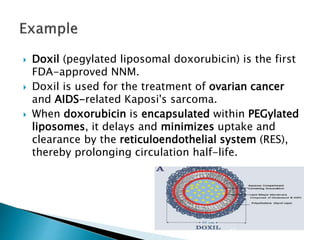
 Doxil (pegylated liposomal doxorubicin) is the first
FDA-approved NNM.
 Doxil is used for the treatment of ovarian cancer
and AIDS-related Kaposi's sarcoma.
 When doxorubicin is encapsulated within PEGylated
liposomes, it delays and minimizes uptake and
clearance by the reticuloendothelial system (RES),
thereby prolonging circulation half-life.
 Active targeting is also termed ligand-targeting or
receptor-mediated targeting.
 It involves the use of ligands (e.g., antibodies,
peptides or sugar moieties) which are physically or
chemically conjugated onto the surface of NNMs
for localization to target cells.
 There are three sets of cellular targets are generally
considered for active targeting in cancer;
1. Targeting of cancer cells, which present over
expression of receptors for transferrin, folate,
epidermal growth factor or glycoproteins.
2. Targeting of the tumor endothelium over
expressing vascular endothelial growth factors,
integrins, vascular cell adhesion molecule-1 or
matrix metalloproteinases.
3. Targeting of stroma cells (e.g., Macrophages,
fibroblasts) that can acquire a tumor survival-
promoting phenotype in response to cytokines in
the tumor microenvironment.
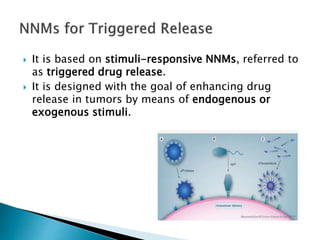
 It is based on stimuli-responsive NNMs, referred to
as triggered drug release.
 It is designed with the goal of enhancing drug
release in tumors by means of endogenous or
exogenous stimuli.
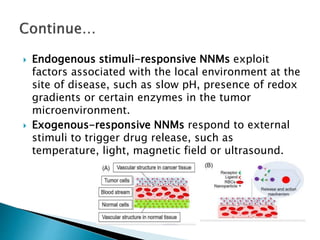
 Endogenous stimuli-responsive NNMs exploit
factors associated with the local environment at the
site of disease, such as slow pH, presence of redox
gradients or certain enzymes in the tumor
microenvironment.
 Exogenous-responsive NNMs respond to external
stimuli to trigger drug release, such as
temperature, light, magnetic field or ultrasound.
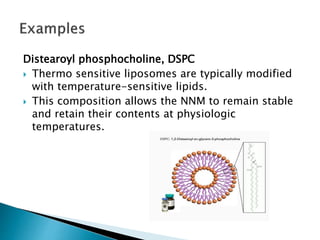
Distearoyl phosphocholine, DSPC
 Thermo sensitive liposomes are typically modified
with temperature-sensitive lipids.
 This composition allows the NNM to remain stable
and retain their contents at physiologic
temperatures.
 Key issues related to the clinical development of
NNMs will be covered, including:
1. Biological challenges
2. Large-scale manufacturing
3. Intellectual property (IP)
4. Government regulations
5. Overall cost-effectiveness
 It is applied a disease-driven approach by
designing and developing NNMs.
 it is essential to consider the relationship between
disease pathophysiology and the heterogeneity of
the disease in humans, and the importance of
physicochemical characteristics of different NNMs
to overcoming biological barriers.
 These biological challenges can be a significant
deterrent for pharmaceutical industry investment
into nano medicines.
 In order to reduce investment risk for NNMs, the
preclinical data sets need to evaluate therapeutic
efficacy, safety, bio-distribution, and pharmacokinetics
in appropriate animal models of the disease that are
relevant to human disease.
 Differences in the anatomy of the animal species
compared to humans should be taken into account
based on different routes of administration.
 Other considerations include designing preclinical
studies to optimize NNM performance in vivo, dosing
schedules, and treatment combinations based on the
specific clinical disease, as well as understanding the
influence of disease progression and severity on nano
medicine performance.
 Pharmaceutical manufacturing development is centered
on quality and cost because platforms require for
complex synthesis procedures on a large-scale.
 Quality includes the manufacturing process and stability
of the formulation, with NNM manufacturing being
challenged by potential issues related to:
 Poor quality control
 Scalability complexities
 Incomplete purification from contaminants
 High material and/or manufacturing costs
 Low production yield
 Insufficient batch-to-batch reproducibility,
consistency and storage stability of the final
product (e.g., Regarding size distribution,
porosity, charge and mass)
 Lack of infrastructure and/or in-house expertise
 Chemical instability or Denaturation of the
encapsulated compound during the manufacturing
process
 Scarcity of venture funds and pharmaceutical
industry investment.
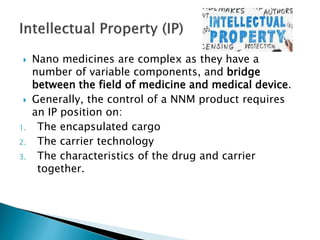
 Nano medicines are complex as they have a
number of variable components, and bridge
between the field of medicine and medical device.
 Generally, the control of a NNM product requires
an IP position on:
1. The encapsulated cargo
2. The carrier technology
3. The characteristics of the drug and carrier
together.
 Nano medicines have significant potential to
increase the growth of the pharmaceutical market
and improve health benefits.
 Commercialization of nano medicines is highly
dependent on a number of regulatory factors based
on government policies in the area of
manufacturing practice, quality control, safety, and
patent protection.
 The lack of clear regulatory and safety guidelines
has affected the development of NNM products
toward timely and effective clinical translation.
 Overall, the use of nanotechnology in medicine has
the potential to have a major impact on human
health. It has been suggested to facilitate the
development of personalized medicine for specific
patient sub-groups, in which therapy is tailored by
the patient's individual genetic and disease profile.
 The physicochemical properties (e.g., size and
structure) of the delivery system can also be
modified according to the severity of the disease
for optimal therapeutic benefits.
 Finally, researchers need to consider minimizing
the complexity of NNMs and take into account the
final dosage form for human use.

Assignment of NanoBiotechnology

  • 2.
     The scienceof nano-medicine is currently among the most fascinating areas of research.  These are the engineered technologies that use nano-particles for the targeted delivery.  This is due to the large surface presence and large affinity for drugs and small molecules such as ligands, for targeting and control release purposes of nano-particles.
  • 3.
     NNMs arethe nano-particulate nano-medicines.  These has the potential to have a major impact on human health for the prevention, diagnosis, and treatment of diseases.  These are used for drug delivery in humans.  NNMs are intended to deliver drugs via various mechanisms: 1. Solubilization 2. Passive targeting 3. Active targeting 4. Triggered release
  • 4.
     The NNMapproach aims to: 1. Increase therapeutic efficacy 2. Decrease the therapeutically effective dose 3. Reduce the risk of systemic side effects
  • 5.
     NNMs areoften studied to improve drug targeting to specific sites of disease and attenuate localization in healthy non-target tissues.  The vast majority of NNMs in preclinical and clinical development are for targeting a wide variety of cancers and tumors.  Non-cancerous inflammatory diseases that have been explored with NNM therapy include rheumatoid arthritis, inflammatory bowel disease, asthma, multiple sclerosis, diabetes, and neurodegenerative diseases.
  • 6.
     The EPR(EnhancedPermeability and Retention) effect refers to the preferential localization of NNMs in pathological tissues due to the enhanced permeability of the vasculature that supplies to tumors.  These pathological properties allow NNMs to accumulate at pathological sites and is referred to as passive targeting.  NNMs with drug cargo circulate long enough in the bloodstream.
  • 7.
     This canbe achieved by conjugating polyethylene glycol (PEG) to the surface of NNMs.  For the development of NNMs for passive tumor targeting, leading to NNMs with adequate physicochemical properties and prolonged circulation half-life that accumulate in tumors over time.  This is highly dependent on the tumor pathophysiology.  EPR is a very heterogeneous phenomenon as it depends on the type of tumor and can vary significantly within the same tumor type.
  • 8.
     Doxil (pegylatedliposomal doxorubicin) is the first FDA-approved NNM.  Doxil is used for the treatment of ovarian cancer and AIDS-related Kaposi's sarcoma.  When doxorubicin is encapsulated within PEGylated liposomes, it delays and minimizes uptake and clearance by the reticuloendothelial system (RES), thereby prolonging circulation half-life.
  • 9.
     Active targetingis also termed ligand-targeting or receptor-mediated targeting.  It involves the use of ligands (e.g., antibodies, peptides or sugar moieties) which are physically or chemically conjugated onto the surface of NNMs for localization to target cells.
  • 10.
     There arethree sets of cellular targets are generally considered for active targeting in cancer; 1. Targeting of cancer cells, which present over expression of receptors for transferrin, folate, epidermal growth factor or glycoproteins. 2. Targeting of the tumor endothelium over expressing vascular endothelial growth factors, integrins, vascular cell adhesion molecule-1 or matrix metalloproteinases. 3. Targeting of stroma cells (e.g., Macrophages, fibroblasts) that can acquire a tumor survival- promoting phenotype in response to cytokines in the tumor microenvironment.
  • 11.
     It isbased on stimuli-responsive NNMs, referred to as triggered drug release.  It is designed with the goal of enhancing drug release in tumors by means of endogenous or exogenous stimuli.
  • 12.
     Endogenous stimuli-responsiveNNMs exploit factors associated with the local environment at the site of disease, such as slow pH, presence of redox gradients or certain enzymes in the tumor microenvironment.  Exogenous-responsive NNMs respond to external stimuli to trigger drug release, such as temperature, light, magnetic field or ultrasound.
  • 13.
    Distearoyl phosphocholine, DSPC Thermo sensitive liposomes are typically modified with temperature-sensitive lipids.  This composition allows the NNM to remain stable and retain their contents at physiologic temperatures.
  • 14.
     Key issuesrelated to the clinical development of NNMs will be covered, including: 1. Biological challenges 2. Large-scale manufacturing 3. Intellectual property (IP) 4. Government regulations 5. Overall cost-effectiveness
  • 15.
     It isapplied a disease-driven approach by designing and developing NNMs.  it is essential to consider the relationship between disease pathophysiology and the heterogeneity of the disease in humans, and the importance of physicochemical characteristics of different NNMs to overcoming biological barriers.  These biological challenges can be a significant deterrent for pharmaceutical industry investment into nano medicines.
  • 16.
     In orderto reduce investment risk for NNMs, the preclinical data sets need to evaluate therapeutic efficacy, safety, bio-distribution, and pharmacokinetics in appropriate animal models of the disease that are relevant to human disease.  Differences in the anatomy of the animal species compared to humans should be taken into account based on different routes of administration.  Other considerations include designing preclinical studies to optimize NNM performance in vivo, dosing schedules, and treatment combinations based on the specific clinical disease, as well as understanding the influence of disease progression and severity on nano medicine performance.
  • 17.
     Pharmaceutical manufacturingdevelopment is centered on quality and cost because platforms require for complex synthesis procedures on a large-scale.  Quality includes the manufacturing process and stability of the formulation, with NNM manufacturing being challenged by potential issues related to:  Poor quality control  Scalability complexities  Incomplete purification from contaminants  High material and/or manufacturing costs  Low production yield
  • 18.
     Insufficient batch-to-batchreproducibility, consistency and storage stability of the final product (e.g., Regarding size distribution, porosity, charge and mass)  Lack of infrastructure and/or in-house expertise  Chemical instability or Denaturation of the encapsulated compound during the manufacturing process  Scarcity of venture funds and pharmaceutical industry investment.
  • 19.
     Nano medicinesare complex as they have a number of variable components, and bridge between the field of medicine and medical device.  Generally, the control of a NNM product requires an IP position on: 1. The encapsulated cargo 2. The carrier technology 3. The characteristics of the drug and carrier together.
  • 20.
     Nano medicineshave significant potential to increase the growth of the pharmaceutical market and improve health benefits.  Commercialization of nano medicines is highly dependent on a number of regulatory factors based on government policies in the area of manufacturing practice, quality control, safety, and patent protection.  The lack of clear regulatory and safety guidelines has affected the development of NNM products toward timely and effective clinical translation.
  • 21.
     Overall, theuse of nanotechnology in medicine has the potential to have a major impact on human health. It has been suggested to facilitate the development of personalized medicine for specific patient sub-groups, in which therapy is tailored by the patient's individual genetic and disease profile.  The physicochemical properties (e.g., size and structure) of the delivery system can also be modified according to the severity of the disease for optimal therapeutic benefits.  Finally, researchers need to consider minimizing the complexity of NNMs and take into account the final dosage form for human use.