Name: LIEZL JEANE T. ANDO
Program: Philo – Ed 603
Class Schedule: Saturday (8:00-12:00 )
ASSIGNMENT
1.Describe the feature of social change.
Answer:
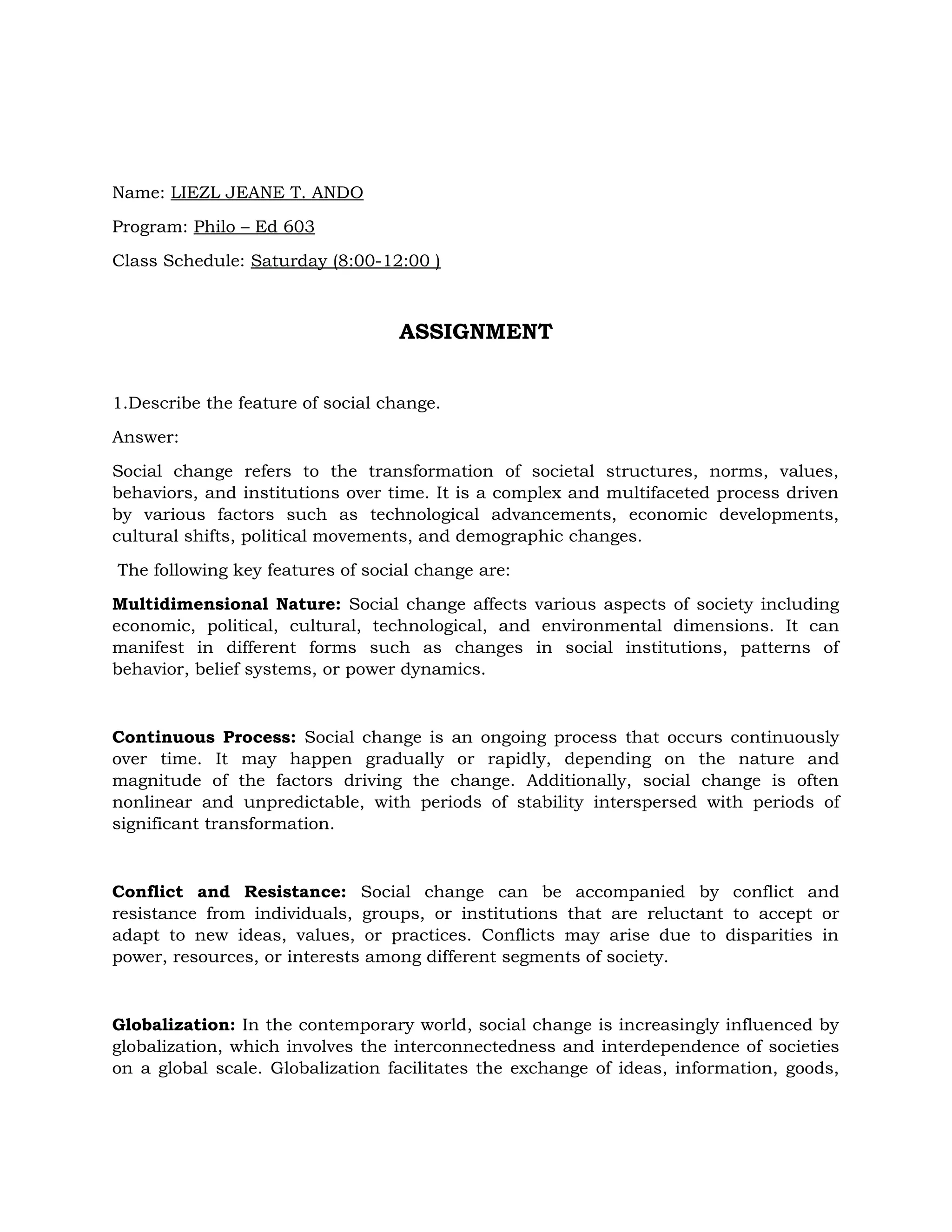
Social change refers to the transformation of societal structures, norms, values,
behaviors, and institutions over time. It is a complex and multifaceted process driven
by various factors such as technological advancements, economic developments,
cultural shifts, political movements, and demographic changes.
The following key features of social change are:
Multidimensional Nature: Social change affects various aspects of society including
economic, political, cultural, technological, and environmental dimensions. It can
manifest in different forms such as changes in social institutions, patterns of
behavior, belief systems, or power dynamics.
Continuous Process: Social change is an ongoing process that occurs continuously
over time. It may happen gradually or rapidly, depending on the nature and
magnitude of the factors driving the change. Additionally, social change is often
nonlinear and unpredictable, with periods of stability interspersed with periods of
significant transformation.
Conflict and Resistance: Social change can be accompanied by conflict and
resistance from individuals, groups, or institutions that are reluctant to accept or
adapt to new ideas, values, or practices. Conflicts may arise due to disparities in
power, resources, or interests among different segments of society.
Globalization: In the contemporary world, social change is increasingly influenced by
globalization, which involves the interconnectedness and interdependence of societies
on a global scale. Globalization facilitates the exchange of ideas, information, goods,
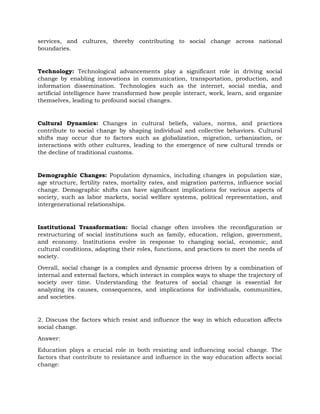
services, and cultures, thereby contributing to social change across national
boundaries.
Technology: Technological advancements play a significant role in driving social
change by enabling innovations in communication, transportation, production, and
information dissemination. Technologies such as the internet, social media, and
artificial intelligence have transformed how people interact, work, learn, and organize
themselves, leading to profound social changes.
Cultural Dynamics: Changes in cultural beliefs, values, norms, and practices
contribute to social change by shaping individual and collective behaviors. Cultural
shifts may occur due to factors such as globalization, migration, urbanization, or
interactions with other cultures, leading to the emergence of new cultural trends or
the decline of traditional customs.
Demographic Changes: Population dynamics, including changes in population size,
age structure, fertility rates, mortality rates, and migration patterns, influence social
change. Demographic shifts can have significant implications for various aspects of
society, such as labor markets, social welfare systems, political representation, and
intergenerational relationships.
Institutional Transformation: Social change often involves the reconfiguration or
restructuring of social institutions such as family, education, religion, government,
and economy. Institutions evolve in response to changing social, economic, and
cultural conditions, adapting their roles, functions, and practices to meet the needs of
society.
Overall, social change is a complex and dynamic process driven by a combination of
internal and external factors, which interact in complex ways to shape the trajectory of
society over time. Understanding the features of social change is essential for
analyzing its causes, consequences, and implications for individuals, communities,
and societies.
2. Discuss the factors which resist and influence the way in which education affects
social change.
Answer:
Education plays a crucial role in both resisting and influencing social change. The
factors that contribute to resistance and influence in the way education affects social
change:
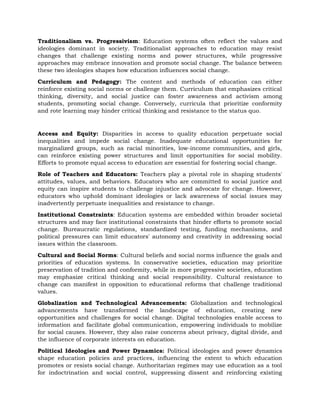
Traditionalism vs. Progressivism: Education systems often reflect the values and
ideologies dominant in society. Traditionalist approaches to education may resist
changes that challenge existing norms and power structures, while progressive
approaches may embrace innovation and promote social change. The balance between
these two ideologies shapes how education influences social change.
Curriculum and Pedagogy: The content and methods of education can either
reinforce existing social norms or challenge them. Curriculum that emphasizes critical
thinking, diversity, and social justice can foster awareness and activism among
students, promoting social change. Conversely, curricula that prioritize conformity
and rote learning may hinder critical thinking and resistance to the status quo.
Access and Equity: Disparities in access to quality education perpetuate social
inequalities and impede social change. Inadequate educational opportunities for
marginalized groups, such as racial minorities, low-income communities, and girls,
can reinforce existing power structures and limit opportunities for social mobility.
Efforts to promote equal access to education are essential for fostering social change.
Role of Teachers and Educators: Teachers play a pivotal role in shaping students'
attitudes, values, and behaviors. Educators who are committed to social justice and
equity can inspire students to challenge injustice and advocate for change. However,
educators who uphold dominant ideologies or lack awareness of social issues may
inadvertently perpetuate inequalities and resistance to change.
Institutional Constraints: Education systems are embedded within broader societal
structures and may face institutional constraints that hinder efforts to promote social
change. Bureaucratic regulations, standardized testing, funding mechanisms, and
political pressures can limit educators' autonomy and creativity in addressing social
issues within the classroom.
Cultural and Social Norms: Cultural beliefs and social norms influence the goals and
priorities of education systems. In conservative societies, education may prioritize
preservation of tradition and conformity, while in more progressive societies, education
may emphasize critical thinking and social responsibility. Cultural resistance to
change can manifest in opposition to educational reforms that challenge traditional
values.
Globalization and Technological Advancements: Globalization and technological
advancements have transformed the landscape of education, creating new
opportunities and challenges for social change. Digital technologies enable access to
information and facilitate global communication, empowering individuals to mobilize
for social causes. However, they also raise concerns about privacy, digital divide, and
the influence of corporate interests on education.
Political Ideologies and Power Dynamics: Political ideologies and power dynamics
shape education policies and practices, influencing the extent to which education
promotes or resists social change. Authoritarian regimes may use education as a tool
for indoctrination and social control, suppressing dissent and reinforcing existing
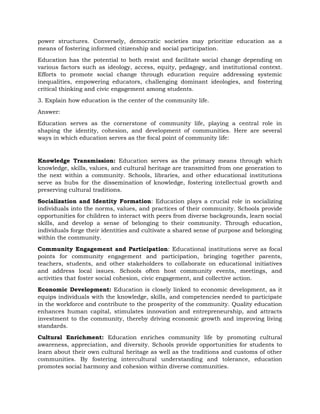
power structures. Conversely, democratic societies may prioritize education as a
means of fostering informed citizenship and social participation.
Education has the potential to both resist and facilitate social change depending on
various factors such as ideology, access, equity, pedagogy, and institutional context.
Efforts to promote social change through education require addressing systemic
inequalities, empowering educators, challenging dominant ideologies, and fostering
critical thinking and civic engagement among students.
3. Explain how education is the center of the community life.
Answer:
Education serves as the cornerstone of community life, playing a central role in
shaping the identity, cohesion, and development of communities. Here are several
ways in which education serves as the focal point of community life:
Knowledge Transmission: Education serves as the primary means through which
knowledge, skills, values, and cultural heritage are transmitted from one generation to
the next within a community. Schools, libraries, and other educational institutions
serve as hubs for the dissemination of knowledge, fostering intellectual growth and
preserving cultural traditions.
Socialization and Identity Formation: Education plays a crucial role in socializing
individuals into the norms, values, and practices of their community. Schools provide
opportunities for children to interact with peers from diverse backgrounds, learn social
skills, and develop a sense of belonging to their community. Through education,
individuals forge their identities and cultivate a shared sense of purpose and belonging
within the community.
Community Engagement and Participation: Educational institutions serve as focal
points for community engagement and participation, bringing together parents,
teachers, students, and other stakeholders to collaborate on educational initiatives
and address local issues. Schools often host community events, meetings, and
activities that foster social cohesion, civic engagement, and collective action.
Economic Development: Education is closely linked to economic development, as it
equips individuals with the knowledge, skills, and competencies needed to participate
in the workforce and contribute to the prosperity of the community. Quality education
enhances human capital, stimulates innovation and entrepreneurship, and attracts
investment to the community, thereby driving economic growth and improving living
standards.
Cultural Enrichment: Education enriches community life by promoting cultural
awareness, appreciation, and diversity. Schools provide opportunities for students to
learn about their own cultural heritage as well as the traditions and customs of other
communities. By fostering intercultural understanding and tolerance, education
promotes social harmony and cohesion within diverse communities.
Community Empowerment: Education empowers individuals and communities by
providing them with the knowledge, skills, and resources needed to advocate for their
rights, address social issues, and effect positive change. Educated communities are
better equipped to tackle challenges such as poverty, inequality, and environmental
degradation, and to mobilize resources and support for community development
initiatives.
Lifelong Learning and Social Mobility: Education is a lifelong process that empowers
individuals to continuously learn, adapt, and grow throughout their lives. By providing
opportunities for lifelong learning and skill development, educational institutions
enable individuals to enhance their employability, pursue higher education, and
achieve social mobility, thereby enriching the fabric of the community.
Since education serves as the beating heart of community life, fostering social
cohesion, economic vitality, cultural enrichment, and individual empowerment. By
investing in education and promoting equitable access to quality educational
opportunities, communities can build a brighter future for their residents and create a
more inclusive and resilient society.
4. Describe the role of education in modernization.
Answer:
Education plays a pivotal role in the process of modernization, which involves the
transformation of traditional societies into modern industrialized societies
characterized by economic development, technological advancement, urbanization,
and social change. Here's how education contributes to modernization:
Human Capital Development: Education is essential for developing the human
capital necessary for modern economies. By providing individuals with knowledge,
skills, and competencies, education enhances productivity, innovation, and
adaptability in the workforce. A well-educated population is better equipped to
participate in and contribute to modern economic sectors such as technology, finance,
and healthcare.
Technological Advancement: Education fosters technological literacy and
innovation, driving technological advancement and industrialization. Through science,
technology, engineering, and mathematics (STEM) education, individuals acquire the
skills and knowledge needed to develop and utilize new technologies, leading to
improvements in productivity, efficiency, and quality of life.
Industrialization and Urbanization: Education facilitates the transition from
agrarian-based economies to industrialized urban economies. By providing individuals
with the skills and knowledge needed for employment in manufacturing, services, and
knowledge-based industries, education accelerates urbanization and the growth of
modern cities. Education also promotes social mobility, enabling individuals to move
from rural areas to urban centers in search of economic opportunities.
Social Change and Modern Values: Education promotes social change by
disseminating modern values such as individualism, rationality, equality, and
democracy. Through formal education, individuals are exposed to new ideas,
perspectives, and ways of thinking that challenge traditional beliefs and practices.
Education fosters critical thinking, tolerance, and civic engagement, laying the
foundation for democratic governance and social progress.
Health and Welfare: Education is closely linked to improvements in health and
welfare, which are key indicators of modernization. Education enhances public health
by promoting hygiene, preventive healthcare, and disease awareness. Educated
individuals are more likely to adopt healthy behaviors, seek medical care, and make
informed decisions about their health and well-being, leading to reductions in
mortality rates and improvements in overall quality of life.
Globalization and Cultural Exchange: Education facilitates globalization and
cultural exchange by fostering intercultural understanding, communication, and
cooperation. Through international education programs, exchanges, and partnerships,
individuals gain exposure to diverse cultures, languages, and perspectives, fostering
cross-cultural collaboration and mutual enrichment. Education also promotes global
citizenship and awareness of global issues such as environmental sustainability,
human rights, and social justice.
Poverty Reduction and Social Mobility: Education is a powerful tool for reducing
poverty and promoting social mobility. By providing individuals with access to quality
education and skills training, education empowers them to escape poverty, achieve
economic independence, and improve their social status. Education enhances
opportunities for upward mobility, enabling individuals to secure better jobs, higher
incomes, and improved living standards for themselves and their families.
To sum up, education is indispensable for modernization, playing a crucial role in
economic development, technological advancement, social change, health promotion,
cultural exchange, poverty reduction, and social mobility. By investing in education
and promoting equitable access to quality educational opportunities, societies can
accelerate the process of modernization and build a more prosperous, equitable, and
sustainable future for all.

Assignment in Philosophy, psychosocial teaching

  • 1.
    Name: LIEZL JEANET. ANDO Program: Philo – Ed 603 Class Schedule: Saturday (8:00-12:00 ) ASSIGNMENT 1.Describe the feature of social change. Answer: Social change refers to the transformation of societal structures, norms, values, behaviors, and institutions over time. It is a complex and multifaceted process driven by various factors such as technological advancements, economic developments, cultural shifts, political movements, and demographic changes. The following key features of social change are: Multidimensional Nature: Social change affects various aspects of society including economic, political, cultural, technological, and environmental dimensions. It can manifest in different forms such as changes in social institutions, patterns of behavior, belief systems, or power dynamics. Continuous Process: Social change is an ongoing process that occurs continuously over time. It may happen gradually or rapidly, depending on the nature and magnitude of the factors driving the change. Additionally, social change is often nonlinear and unpredictable, with periods of stability interspersed with periods of significant transformation. Conflict and Resistance: Social change can be accompanied by conflict and resistance from individuals, groups, or institutions that are reluctant to accept or adapt to new ideas, values, or practices. Conflicts may arise due to disparities in power, resources, or interests among different segments of society. Globalization: In the contemporary world, social change is increasingly influenced by globalization, which involves the interconnectedness and interdependence of societies on a global scale. Globalization facilitates the exchange of ideas, information, goods,
  • 2.
    services, and cultures,thereby contributing to social change across national boundaries. Technology: Technological advancements play a significant role in driving social change by enabling innovations in communication, transportation, production, and information dissemination. Technologies such as the internet, social media, and artificial intelligence have transformed how people interact, work, learn, and organize themselves, leading to profound social changes. Cultural Dynamics: Changes in cultural beliefs, values, norms, and practices contribute to social change by shaping individual and collective behaviors. Cultural shifts may occur due to factors such as globalization, migration, urbanization, or interactions with other cultures, leading to the emergence of new cultural trends or the decline of traditional customs. Demographic Changes: Population dynamics, including changes in population size, age structure, fertility rates, mortality rates, and migration patterns, influence social change. Demographic shifts can have significant implications for various aspects of society, such as labor markets, social welfare systems, political representation, and intergenerational relationships. Institutional Transformation: Social change often involves the reconfiguration or restructuring of social institutions such as family, education, religion, government, and economy. Institutions evolve in response to changing social, economic, and cultural conditions, adapting their roles, functions, and practices to meet the needs of society. Overall, social change is a complex and dynamic process driven by a combination of internal and external factors, which interact in complex ways to shape the trajectory of society over time. Understanding the features of social change is essential for analyzing its causes, consequences, and implications for individuals, communities, and societies. 2. Discuss the factors which resist and influence the way in which education affects social change. Answer: Education plays a crucial role in both resisting and influencing social change. The factors that contribute to resistance and influence in the way education affects social change:
  • 3.
    Traditionalism vs. Progressivism:Education systems often reflect the values and ideologies dominant in society. Traditionalist approaches to education may resist changes that challenge existing norms and power structures, while progressive approaches may embrace innovation and promote social change. The balance between these two ideologies shapes how education influences social change. Curriculum and Pedagogy: The content and methods of education can either reinforce existing social norms or challenge them. Curriculum that emphasizes critical thinking, diversity, and social justice can foster awareness and activism among students, promoting social change. Conversely, curricula that prioritize conformity and rote learning may hinder critical thinking and resistance to the status quo. Access and Equity: Disparities in access to quality education perpetuate social inequalities and impede social change. Inadequate educational opportunities for marginalized groups, such as racial minorities, low-income communities, and girls, can reinforce existing power structures and limit opportunities for social mobility. Efforts to promote equal access to education are essential for fostering social change. Role of Teachers and Educators: Teachers play a pivotal role in shaping students' attitudes, values, and behaviors. Educators who are committed to social justice and equity can inspire students to challenge injustice and advocate for change. However, educators who uphold dominant ideologies or lack awareness of social issues may inadvertently perpetuate inequalities and resistance to change. Institutional Constraints: Education systems are embedded within broader societal structures and may face institutional constraints that hinder efforts to promote social change. Bureaucratic regulations, standardized testing, funding mechanisms, and political pressures can limit educators' autonomy and creativity in addressing social issues within the classroom. Cultural and Social Norms: Cultural beliefs and social norms influence the goals and priorities of education systems. In conservative societies, education may prioritize preservation of tradition and conformity, while in more progressive societies, education may emphasize critical thinking and social responsibility. Cultural resistance to change can manifest in opposition to educational reforms that challenge traditional values. Globalization and Technological Advancements: Globalization and technological advancements have transformed the landscape of education, creating new opportunities and challenges for social change. Digital technologies enable access to information and facilitate global communication, empowering individuals to mobilize for social causes. However, they also raise concerns about privacy, digital divide, and the influence of corporate interests on education. Political Ideologies and Power Dynamics: Political ideologies and power dynamics shape education policies and practices, influencing the extent to which education promotes or resists social change. Authoritarian regimes may use education as a tool for indoctrination and social control, suppressing dissent and reinforcing existing
  • 4.
    power structures. Conversely,democratic societies may prioritize education as a means of fostering informed citizenship and social participation. Education has the potential to both resist and facilitate social change depending on various factors such as ideology, access, equity, pedagogy, and institutional context. Efforts to promote social change through education require addressing systemic inequalities, empowering educators, challenging dominant ideologies, and fostering critical thinking and civic engagement among students. 3. Explain how education is the center of the community life. Answer: Education serves as the cornerstone of community life, playing a central role in shaping the identity, cohesion, and development of communities. Here are several ways in which education serves as the focal point of community life: Knowledge Transmission: Education serves as the primary means through which knowledge, skills, values, and cultural heritage are transmitted from one generation to the next within a community. Schools, libraries, and other educational institutions serve as hubs for the dissemination of knowledge, fostering intellectual growth and preserving cultural traditions. Socialization and Identity Formation: Education plays a crucial role in socializing individuals into the norms, values, and practices of their community. Schools provide opportunities for children to interact with peers from diverse backgrounds, learn social skills, and develop a sense of belonging to their community. Through education, individuals forge their identities and cultivate a shared sense of purpose and belonging within the community. Community Engagement and Participation: Educational institutions serve as focal points for community engagement and participation, bringing together parents, teachers, students, and other stakeholders to collaborate on educational initiatives and address local issues. Schools often host community events, meetings, and activities that foster social cohesion, civic engagement, and collective action. Economic Development: Education is closely linked to economic development, as it equips individuals with the knowledge, skills, and competencies needed to participate in the workforce and contribute to the prosperity of the community. Quality education enhances human capital, stimulates innovation and entrepreneurship, and attracts investment to the community, thereby driving economic growth and improving living standards. Cultural Enrichment: Education enriches community life by promoting cultural awareness, appreciation, and diversity. Schools provide opportunities for students to learn about their own cultural heritage as well as the traditions and customs of other communities. By fostering intercultural understanding and tolerance, education promotes social harmony and cohesion within diverse communities.
  • 5.
    Community Empowerment: Educationempowers individuals and communities by providing them with the knowledge, skills, and resources needed to advocate for their rights, address social issues, and effect positive change. Educated communities are better equipped to tackle challenges such as poverty, inequality, and environmental degradation, and to mobilize resources and support for community development initiatives. Lifelong Learning and Social Mobility: Education is a lifelong process that empowers individuals to continuously learn, adapt, and grow throughout their lives. By providing opportunities for lifelong learning and skill development, educational institutions enable individuals to enhance their employability, pursue higher education, and achieve social mobility, thereby enriching the fabric of the community. Since education serves as the beating heart of community life, fostering social cohesion, economic vitality, cultural enrichment, and individual empowerment. By investing in education and promoting equitable access to quality educational opportunities, communities can build a brighter future for their residents and create a more inclusive and resilient society. 4. Describe the role of education in modernization. Answer: Education plays a pivotal role in the process of modernization, which involves the transformation of traditional societies into modern industrialized societies characterized by economic development, technological advancement, urbanization, and social change. Here's how education contributes to modernization: Human Capital Development: Education is essential for developing the human capital necessary for modern economies. By providing individuals with knowledge, skills, and competencies, education enhances productivity, innovation, and adaptability in the workforce. A well-educated population is better equipped to participate in and contribute to modern economic sectors such as technology, finance, and healthcare. Technological Advancement: Education fosters technological literacy and innovation, driving technological advancement and industrialization. Through science, technology, engineering, and mathematics (STEM) education, individuals acquire the skills and knowledge needed to develop and utilize new technologies, leading to improvements in productivity, efficiency, and quality of life. Industrialization and Urbanization: Education facilitates the transition from agrarian-based economies to industrialized urban economies. By providing individuals with the skills and knowledge needed for employment in manufacturing, services, and knowledge-based industries, education accelerates urbanization and the growth of
  • 6.
    modern cities. Educationalso promotes social mobility, enabling individuals to move from rural areas to urban centers in search of economic opportunities. Social Change and Modern Values: Education promotes social change by disseminating modern values such as individualism, rationality, equality, and democracy. Through formal education, individuals are exposed to new ideas, perspectives, and ways of thinking that challenge traditional beliefs and practices. Education fosters critical thinking, tolerance, and civic engagement, laying the foundation for democratic governance and social progress. Health and Welfare: Education is closely linked to improvements in health and welfare, which are key indicators of modernization. Education enhances public health by promoting hygiene, preventive healthcare, and disease awareness. Educated individuals are more likely to adopt healthy behaviors, seek medical care, and make informed decisions about their health and well-being, leading to reductions in mortality rates and improvements in overall quality of life. Globalization and Cultural Exchange: Education facilitates globalization and cultural exchange by fostering intercultural understanding, communication, and cooperation. Through international education programs, exchanges, and partnerships, individuals gain exposure to diverse cultures, languages, and perspectives, fostering cross-cultural collaboration and mutual enrichment. Education also promotes global citizenship and awareness of global issues such as environmental sustainability, human rights, and social justice. Poverty Reduction and Social Mobility: Education is a powerful tool for reducing poverty and promoting social mobility. By providing individuals with access to quality education and skills training, education empowers them to escape poverty, achieve economic independence, and improve their social status. Education enhances opportunities for upward mobility, enabling individuals to secure better jobs, higher incomes, and improved living standards for themselves and their families. To sum up, education is indispensable for modernization, playing a crucial role in economic development, technological advancement, social change, health promotion, cultural exchange, poverty reduction, and social mobility. By investing in education and promoting equitable access to quality educational opportunities, societies can accelerate the process of modernization and build a more prosperous, equitable, and sustainable future for all.