ASSIGNMENT
GAYATHRI PAVITHRAN
ROLL NO : 16
OPTION : COMMERCE
TOPIC
COMPETITIVE EXAMS
IN
COMMERCE
INTRODUCTON
There are many competitive exams in India which anyone can
appear after 12th or after graduation. However if you are from the
Commerce stream, you will have to choose which competitive exam to
appear for. Also you need to decide whether you wish to go for
government job or a private sector job? Based on this also it will depend
which competitive exam to appear for.
Basically, every ones thinking is not in the right direction, since
they wish to appear for competitive exams not considering what career
they wish to go in and what are those aspects which will make them
successful in the career. It is important, to analyze ones own capabilities,
emotional quotient, interests, likings, strengths, weaknesses, etc. Any
career choice should be determined based on these aspects only and not
by randomly choosing.
Since in commerce, can appear for the exams like CA, CS,
ICWA, MAT, etc. These are professional courses which lead you
to a professional career as a professional expert in the respective
domain area.
1.CHARTERED ACCOUNTANCY COURSE
(CA COURSE)
The CA courseis designed to combine theoretical study with practical
training. The Chartered Accountancy courseis considered to be the rigorous
professionalcourses both in India and Worldwidewith only 3-8 % of the students
passing in every attempt in Inter and Final Level. At Present, pass ratein
Foundation is Approx15%, Inter 4-8 %, Final3-7 %, that means students who take
admission in CA Course, only 0.0225% to 0.096%actually pass CA. For instance, in
the November 2013 CA Final exam, the pass percentage was merely 3.11% (Both
Groups) As of April 2010, Theprestigious institute has 874,694 students, studying
various levels of the Chartered Accountancy Course.[4]
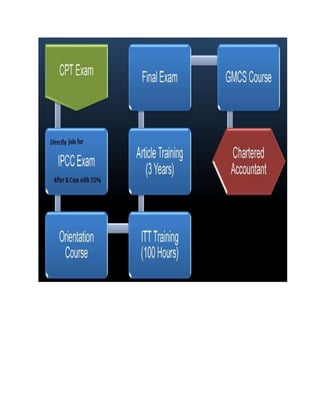
The Chartered Accountancy
examinations are divided into three levels. They are
. Common Proficiency Test (CPT)
 Integrated Professional Competence Course (IPCC)
 Final Examination
CPT covers four basic subjects viz.
Fundamentals of Accounting, Mercantile Laws, Economics and
Quantitative Aptitude. Fundamentals of Accounting carries 60 marks,
Mercantile Laws carries 40 marks and Economics & Quantitative
Aptitude carries 50 marks each. A person can register for CPT after
completing Grade 10 and take the exam after completing High School
(Grade 12). Every incorrect answer on the CPT exam carries a 0.25
negative mark. A candidate is considered to have cleared CPT if he/she
obtains in a sitting 30% in each of the 4 sections and a 50.00%
aggregate in the entire examination.
IPCC or Integrated ProfessionalCompetenceCourseis the
second level of Chartered Accountancy examinations. A person can take the IPCC
Examination after passing CPT and nine months of study. IPCChas two groups of
seven subjects. Group – I consists of four subjects and Group – II of threesubjects.
Group I:
 Paper 1 : Accounting
 Paper 2 : Business Laws, Ethics and Communication
 Paper 3 : Cost Accounting and Financial Management
 Paper 4 : Taxation
Group II:
 Paper 5 : Advanced Accounting
 Paper 6 : Auditing and Assurance
 Paper 7 : Information Technology and Strategic Management
A passing gradein IPCCis awarded if the candidate obtains 40% marks in each
subject(a subjectis attributed 100 marks) and an aggregate of 50% in the
aggregate in each group. Benefit of set-off is also available if the candidate
appears for both groups together and obtains 50% collectively in both groups,
even if he fails to obtain an individual aggregate of 50% in the each group
independently.
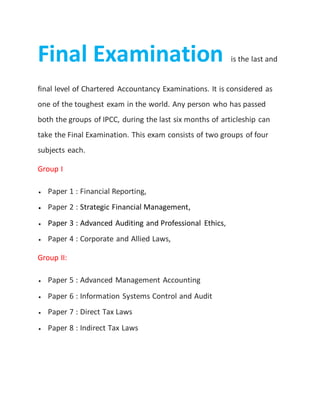
Final Examination is the last and
final level of Chartered Accountancy Examinations. It is considered as
one of the toughest exam in the world. Any person who has passed
both the groups of IPCC, during the last six months of articleship can
take the Final Examination. This exam consists of two groups of four
subjects each.
Group I
 Paper 1 : Financial Reporting,
 Paper 2 : Strategic Financial Management,
 Paper 3 : Advanced Auditing and Professional Ethics,
 Paper 4 : Corporate and Allied Laws,
Group II:
 Paper 5 : Advanced Management Accounting
 Paper 6 : Information Systems Control and Audit
 Paper 7 : Direct Tax Laws
 Paper 8 : Indirect Tax Laws
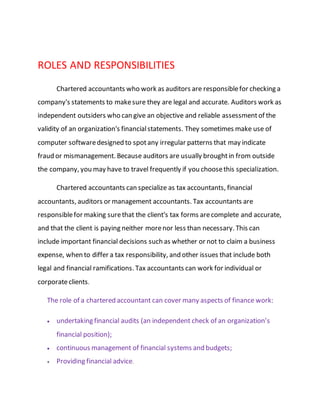
ROLES AND RESPONSIBILITIES
Chartered accountants who work as auditors are responsiblefor checking a
company's statements to makesure they are legal and accurate. Auditors work as
independent outsiders who can give an objective and reliable assessmentof the
validity of an organization's financialstatements. They sometimes make use of
computer softwaredesigned to spotany irregular patterns that may indicate
fraud or mismanagement. Because auditors are usually broughtin from outside
the company, you may have to travel frequently if you choosethis specialization.
Chartered accountants can specialize as tax accountants, financial
accountants, auditors or management accountants. Tax accountants are
responsiblefor making surethat the client's tax forms arecomplete and accurate,
and that the client is paying neither morenor less than necessary. This can
include important financial decisions such as whether or not to claim a business
expense, when to differ a tax responsibility, and other issues that include both
legal and financial ramifications. Tax accountants can work for individual or
corporateclients.
The role of a chartered accountant can cover many aspects of finance work:
 undertaking financial audits (an independent check of an organization’s
financial position);
 continuous management of financial systems and budgets;
 Providing financial advice.
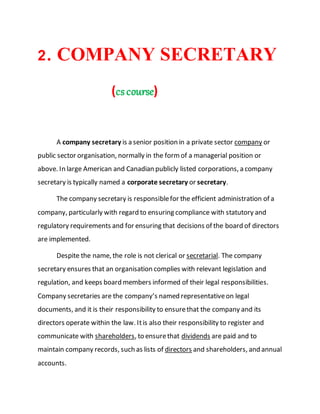
2. COMPANY SECRETARY
(cscourse)
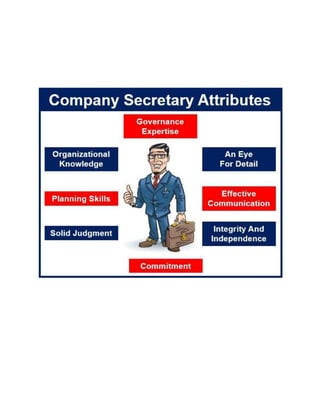
A company secretary is a senior position in a private sector company or
public sector organisation, normally in the formof a managerial position or
above. In large American and Canadian publicly listed corporations, a company
secretary is typically named a corporate secretary or secretary.
The company secretary is responsiblefor the efficient administration of a
company, particularly with regard to ensuring compliance with statutory and
regulatory requirements and for ensuring that decisions of the board of directors
are implemented.
Despite the name, the role is not clerical or secretarial. The company
secretary ensures that an organisation complies with relevant legislation and
regulation, and keeps board members informed of their legal responsibilities.
Company secretaries are the company’s named representativeon legal
documents, and it is their responsibility to ensurethat the company and its
directors operate within the law. Itis also their responsibility to register and
communicate with shareholders, to ensurethat dividends are paid and to
maintain company records, such as lists of directors and shareholders, and annual
accounts.
ROLES AND RESPONSIBILITIES
Company secretaries in all sectors havehigh level responsibilities including
governancestructures and mechanisms, corporateconductwithin an
organisation's regulatory environment, board, shareholder and trustee meetings,
compliance with legal, regulatory and listing requirements, the training and
induction of non-executives and trustees, contact with regulatory and external
bodies, reports and circulars to shareholders/trustees, managementof employee
benefits such as pensions and employee shareschemes, insuranceadministration
and organisation, the negotiation of contracts, risk management, property
administration and organisation and the interpretation of financial accounts.
Company secretaries are the primary sourceof advice on the conduct of
business and this can span everything fromlegal advice on conflicts of interest,
through accounting advice on financial reports, to the development of strategy
and corporateplanning.
In India, every listed company and other class of companies (i.e. non-listed
public companies with sharecapital of 50 million (5 Crore) & private Companies
with sharecapital of 50 million [5 crore]) are required to have a Qualified
Company Secretary be appointed as Key Managerial Personnelto performthe
Functions of Company Secretary under section 203 of the Companies Act, 2013
read with Rule 8 of Companies (Appointment and Remuneration of Key
Managerial Personnel) Rules, 2014.Butlater it is clarified by the Ministry of
CorporateAffairs company secretary would be appointed as earlier
3. INSTITUTE OF COST & WORKS ACCOUNTANTS OF INDIA
(ICWACOURSE)
The Institute of Cost Accountants of India
(ICAI) [previously known as the Instituteof Cost& Works Accountants of India
(ICWAI)] is a premier statutory professionalaccountancy body in India with the
objects of promoting, regulating and developing the profession of Cost
Accountancy. Itis the only licensing cum regulating body of Cost & Management
Accountancy profession in India. It recommends the Cost Accounting Standards to
be followed by companies in India to which statutory maintenance of costrecords
applicable. ICAI is solely responsiblefor setting the auditing and assurance
standards for statutory CostAudit to be followed in the Audit of Cost
statements in India. Italso issues other technical guidelines on severalaspects
like InternalAudit, Management Accounting etc. to be followed by practising Cost
Accountants while discharging their services. Itworks closely with the industries,
various departments of Governmentof India, State governments in India and
other Regulating Authorities in India e.g. Reserve Bank of India, Insurance
Regulatory and Development Authority, Securities and Exchange Board of
India etc. on severalaspects of performance, costoptimisation and reporting.
ROLES AND RESPONSIBILITIES
The regulating body is responsible for
preparing the financial reports of the organization, analyzing the
reports as well as presenting the reports to the management as well as
decision makers in the most lucid manner. The importance of the
responsibilities of the management accountants can be gauged by the
fact that almost all the decisions that the organization makes in order
to further their business or to increase the number of employees or any
other decision really depends on the financial reports prepared by him.
He is the person who performs the key role in determining whether a
particular project that the organization has undertaken would be
beneficial to the organization or not. In fact he can play a key role in
determining the projects that are worth taking up or not.
4. Management Aptitude Test
(MAT COURSE)
Management Aptitude Test (MAT) is a standard aptitude test
conducted in India since 1998 by the All India Management
Association (AIMA). MAT is used for admission to Master of Business
Administration (MBA) and allied programmes by over 600 business
schools across India. It was approved by the Ministry of Human
Resource Development in 2003.[1,
 Candidates can choose to take either a paper-based or a
computer-based test. It is conducted in either English or Hindi.
Eligibility is for graduates in any discipline, though final year
students of graduate courses can also apply.[1] The test is offered
four times in a year in February, May, September and
December.[2] The cost of admission was ₹1,400 (US$22) in 2017
and the test scores are valid for one year.[2]
 The tests includes 200 questions, 40 in each subject: language
comprehension, mathematical skills, data analysis and sufficiency,
intelligence and critical reasoning, and Indian and global
environment. Time allotted is 150 minutes
 The MAT exam generally comprises 200 questions with 4 marks for every
right answer and 1 mark deducted for every wrong answer. Thevarious
areas which generally have 40 questions each are as follows.
 Quantitative ability
 Data Interpretation
 Data Sufficiently
 Verbal Ability and Reading Comprehension
 General Awareness
 Analytical and Logical reasoning
CONCLUSION
 A competitive examination is
an examination where candidates are ranked according to their
grades. If the examination is open for n positions, then the
first n candidates in ranks pass, the others are rejected.
 Competitive examinations are
considered an egalitarian way of choosing worthy applicants
without risking influence peddling, bias or other concerns.
 It is important, to analyze one’s own capabilities, emotional
quotient, interests, likings, strengths, weaknesses, etc. Any career
choice should be determined based on these aspects only and not
by randomly choosing.
REFERENCE
 GOOGLE
 BOOK OF K.G.C NAIR
 Book of T.N MANOHARAN
Assignment

Assignment

  • 1.
  • 2.
    GAYATHRI PAVITHRAN ROLL NO: 16 OPTION : COMMERCE
  • 3.
  • 4.
    INTRODUCTON There are manycompetitive exams in India which anyone can appear after 12th or after graduation. However if you are from the Commerce stream, you will have to choose which competitive exam to appear for. Also you need to decide whether you wish to go for government job or a private sector job? Based on this also it will depend which competitive exam to appear for. Basically, every ones thinking is not in the right direction, since they wish to appear for competitive exams not considering what career they wish to go in and what are those aspects which will make them successful in the career. It is important, to analyze ones own capabilities, emotional quotient, interests, likings, strengths, weaknesses, etc. Any career choice should be determined based on these aspects only and not by randomly choosing. Since in commerce, can appear for the exams like CA, CS, ICWA, MAT, etc. These are professional courses which lead you to a professional career as a professional expert in the respective domain area.
  • 5.
    1.CHARTERED ACCOUNTANCY COURSE (CACOURSE) The CA courseis designed to combine theoretical study with practical training. The Chartered Accountancy courseis considered to be the rigorous professionalcourses both in India and Worldwidewith only 3-8 % of the students passing in every attempt in Inter and Final Level. At Present, pass ratein Foundation is Approx15%, Inter 4-8 %, Final3-7 %, that means students who take admission in CA Course, only 0.0225% to 0.096%actually pass CA. For instance, in the November 2013 CA Final exam, the pass percentage was merely 3.11% (Both Groups) As of April 2010, Theprestigious institute has 874,694 students, studying various levels of the Chartered Accountancy Course.[4] The Chartered Accountancy examinations are divided into three levels. They are . Common Proficiency Test (CPT)  Integrated Professional Competence Course (IPCC)  Final Examination
  • 6.
    CPT covers fourbasic subjects viz. Fundamentals of Accounting, Mercantile Laws, Economics and Quantitative Aptitude. Fundamentals of Accounting carries 60 marks, Mercantile Laws carries 40 marks and Economics & Quantitative Aptitude carries 50 marks each. A person can register for CPT after completing Grade 10 and take the exam after completing High School (Grade 12). Every incorrect answer on the CPT exam carries a 0.25 negative mark. A candidate is considered to have cleared CPT if he/she obtains in a sitting 30% in each of the 4 sections and a 50.00% aggregate in the entire examination.
  • 7.
    IPCC or IntegratedProfessionalCompetenceCourseis the second level of Chartered Accountancy examinations. A person can take the IPCC Examination after passing CPT and nine months of study. IPCChas two groups of seven subjects. Group – I consists of four subjects and Group – II of threesubjects. Group I:  Paper 1 : Accounting  Paper 2 : Business Laws, Ethics and Communication  Paper 3 : Cost Accounting and Financial Management  Paper 4 : Taxation Group II:  Paper 5 : Advanced Accounting  Paper 6 : Auditing and Assurance  Paper 7 : Information Technology and Strategic Management A passing gradein IPCCis awarded if the candidate obtains 40% marks in each subject(a subjectis attributed 100 marks) and an aggregate of 50% in the aggregate in each group. Benefit of set-off is also available if the candidate appears for both groups together and obtains 50% collectively in both groups, even if he fails to obtain an individual aggregate of 50% in the each group independently.
  • 8.
    Final Examination isthe last and final level of Chartered Accountancy Examinations. It is considered as one of the toughest exam in the world. Any person who has passed both the groups of IPCC, during the last six months of articleship can take the Final Examination. This exam consists of two groups of four subjects each. Group I  Paper 1 : Financial Reporting,  Paper 2 : Strategic Financial Management,  Paper 3 : Advanced Auditing and Professional Ethics,  Paper 4 : Corporate and Allied Laws, Group II:  Paper 5 : Advanced Management Accounting  Paper 6 : Information Systems Control and Audit  Paper 7 : Direct Tax Laws  Paper 8 : Indirect Tax Laws
  • 9.
    ROLES AND RESPONSIBILITIES Charteredaccountants who work as auditors are responsiblefor checking a company's statements to makesure they are legal and accurate. Auditors work as independent outsiders who can give an objective and reliable assessmentof the validity of an organization's financialstatements. They sometimes make use of computer softwaredesigned to spotany irregular patterns that may indicate fraud or mismanagement. Because auditors are usually broughtin from outside the company, you may have to travel frequently if you choosethis specialization. Chartered accountants can specialize as tax accountants, financial accountants, auditors or management accountants. Tax accountants are responsiblefor making surethat the client's tax forms arecomplete and accurate, and that the client is paying neither morenor less than necessary. This can include important financial decisions such as whether or not to claim a business expense, when to differ a tax responsibility, and other issues that include both legal and financial ramifications. Tax accountants can work for individual or corporateclients. The role of a chartered accountant can cover many aspects of finance work:  undertaking financial audits (an independent check of an organization’s financial position);  continuous management of financial systems and budgets;  Providing financial advice.
  • 11.
    2. COMPANY SECRETARY (cscourse) Acompany secretary is a senior position in a private sector company or public sector organisation, normally in the formof a managerial position or above. In large American and Canadian publicly listed corporations, a company secretary is typically named a corporate secretary or secretary. The company secretary is responsiblefor the efficient administration of a company, particularly with regard to ensuring compliance with statutory and regulatory requirements and for ensuring that decisions of the board of directors are implemented. Despite the name, the role is not clerical or secretarial. The company secretary ensures that an organisation complies with relevant legislation and regulation, and keeps board members informed of their legal responsibilities. Company secretaries are the company’s named representativeon legal documents, and it is their responsibility to ensurethat the company and its directors operate within the law. Itis also their responsibility to register and communicate with shareholders, to ensurethat dividends are paid and to maintain company records, such as lists of directors and shareholders, and annual accounts.
  • 12.
    ROLES AND RESPONSIBILITIES Companysecretaries in all sectors havehigh level responsibilities including governancestructures and mechanisms, corporateconductwithin an organisation's regulatory environment, board, shareholder and trustee meetings, compliance with legal, regulatory and listing requirements, the training and induction of non-executives and trustees, contact with regulatory and external bodies, reports and circulars to shareholders/trustees, managementof employee benefits such as pensions and employee shareschemes, insuranceadministration and organisation, the negotiation of contracts, risk management, property administration and organisation and the interpretation of financial accounts. Company secretaries are the primary sourceof advice on the conduct of business and this can span everything fromlegal advice on conflicts of interest, through accounting advice on financial reports, to the development of strategy and corporateplanning. In India, every listed company and other class of companies (i.e. non-listed public companies with sharecapital of 50 million (5 Crore) & private Companies with sharecapital of 50 million [5 crore]) are required to have a Qualified Company Secretary be appointed as Key Managerial Personnelto performthe Functions of Company Secretary under section 203 of the Companies Act, 2013 read with Rule 8 of Companies (Appointment and Remuneration of Key Managerial Personnel) Rules, 2014.Butlater it is clarified by the Ministry of CorporateAffairs company secretary would be appointed as earlier
  • 14.
    3. INSTITUTE OFCOST & WORKS ACCOUNTANTS OF INDIA (ICWACOURSE) The Institute of Cost Accountants of India (ICAI) [previously known as the Instituteof Cost& Works Accountants of India (ICWAI)] is a premier statutory professionalaccountancy body in India with the objects of promoting, regulating and developing the profession of Cost Accountancy. Itis the only licensing cum regulating body of Cost & Management Accountancy profession in India. It recommends the Cost Accounting Standards to be followed by companies in India to which statutory maintenance of costrecords applicable. ICAI is solely responsiblefor setting the auditing and assurance standards for statutory CostAudit to be followed in the Audit of Cost statements in India. Italso issues other technical guidelines on severalaspects like InternalAudit, Management Accounting etc. to be followed by practising Cost Accountants while discharging their services. Itworks closely with the industries, various departments of Governmentof India, State governments in India and other Regulating Authorities in India e.g. Reserve Bank of India, Insurance Regulatory and Development Authority, Securities and Exchange Board of India etc. on severalaspects of performance, costoptimisation and reporting.
  • 15.
    ROLES AND RESPONSIBILITIES Theregulating body is responsible for preparing the financial reports of the organization, analyzing the reports as well as presenting the reports to the management as well as decision makers in the most lucid manner. The importance of the responsibilities of the management accountants can be gauged by the fact that almost all the decisions that the organization makes in order to further their business or to increase the number of employees or any other decision really depends on the financial reports prepared by him. He is the person who performs the key role in determining whether a particular project that the organization has undertaken would be beneficial to the organization or not. In fact he can play a key role in determining the projects that are worth taking up or not.
  • 17.
    4. Management AptitudeTest (MAT COURSE) Management Aptitude Test (MAT) is a standard aptitude test conducted in India since 1998 by the All India Management Association (AIMA). MAT is used for admission to Master of Business Administration (MBA) and allied programmes by over 600 business schools across India. It was approved by the Ministry of Human Resource Development in 2003.[1,  Candidates can choose to take either a paper-based or a computer-based test. It is conducted in either English or Hindi.
  • 18.
    Eligibility is forgraduates in any discipline, though final year students of graduate courses can also apply.[1] The test is offered four times in a year in February, May, September and December.[2] The cost of admission was ₹1,400 (US$22) in 2017 and the test scores are valid for one year.[2]  The tests includes 200 questions, 40 in each subject: language comprehension, mathematical skills, data analysis and sufficiency, intelligence and critical reasoning, and Indian and global environment. Time allotted is 150 minutes  The MAT exam generally comprises 200 questions with 4 marks for every right answer and 1 mark deducted for every wrong answer. Thevarious areas which generally have 40 questions each are as follows.  Quantitative ability  Data Interpretation  Data Sufficiently  Verbal Ability and Reading Comprehension  General Awareness  Analytical and Logical reasoning
  • 20.
  • 21.
     A competitiveexamination is an examination where candidates are ranked according to their grades. If the examination is open for n positions, then the first n candidates in ranks pass, the others are rejected.  Competitive examinations are considered an egalitarian way of choosing worthy applicants without risking influence peddling, bias or other concerns.  It is important, to analyze one’s own capabilities, emotional quotient, interests, likings, strengths, weaknesses, etc. Any career choice should be determined based on these aspects only and not by randomly choosing.
  • 23.
    REFERENCE  GOOGLE  BOOKOF K.G.C NAIR  Book of T.N MANOHARAN