





08
To
Confused…!
about career
in commerce ?
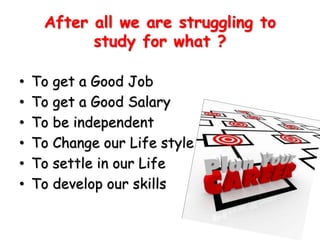
• To get a Good Job
• To get a Good Salary
• To be independent
• To Change our Life style
• To settle in our Life
• To develop our skills
After all we are struggling to
study for what ?
‘Learning is never ending
process’
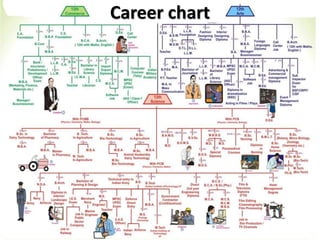
Career chart
Career- A big concern to whom?
• Students completing their school or college.
• Individuals just started with their jobs and
shaken with their choice of work.
• Individuals working over years and are
demotivated for some unknown reasons.
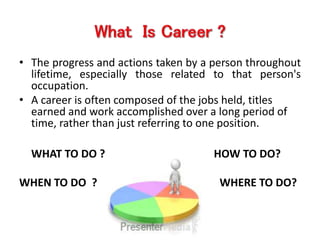
• The progress and actions taken by a person throughout
lifetime, especially those related to that person's
occupation.
• A career is often composed of the jobs held, titles
earned and work accomplished over a long period of
time, rather than just referring to one position.
WHAT TO DO ? HOW TO DO?
WHEN TO DO ? WHERE TO DO?
Factors to be considered while
choosing your career.
• What are you interested in?
• What are you good at?
• What kind of lifestyle do you want?
• Where your capabilities get utilized to the
maximum?
• Think about where you live and where you want to
live, and make sure there are jobs in your chosen
place available.
Factors to be considered while
choosing your career.
• Figure out how much time and money you can
devote to your education.
• Think about the salary you need and you get in that
particular area of interest.
• Analyse demand and supply factors of a career you
choose.
• Do your own SWOT analysis.
• Be realistic. Be honest. And do what's right for you.
Meaning of Commerce
• Commerce is the activity of buying and selling of goods
and services, especially on a large scale. The system
includes legal, economic, political, social, cultural and
technological factors that are in operation in any
country or internationally.
• In simple terms, Commerce can also be defined as a
component of business which includes all activities,
functions involved in transferring goods from
producers to consumers.
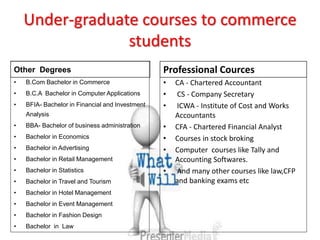
Under-graduate courses to commerce
students
Other Degrees
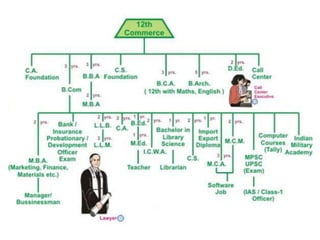
• B.Com Bachelor in Commerce
• B.C.A Bachelor in Computer Applications
• BFIA- Bachelor in Financial and Investment
Analysis
• BBA- Bachelor of business administration
• Bachelor in Economics
• Bachelor in Advertising
• Bachelor in Retail Management
• Bachelor in Statistics
• Bachelor in Travel and Tourism
• Bachelor in Hotel Management
• Bachelor in Event Management
• Bachelor in Fashion Design
• Bachelor in Law
Professional Cources
• CA - Chartered Accountant
• CS - Company Secretary
• ICWA - Institute of Cost and Works
Accountants
• CFA - Chartered Financial Analyst
• Courses in stock broking
• Computer courses like Tally and
Accounting Softwares.
• And many other courses like law,CFP
and banking exams etc
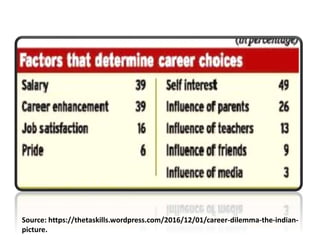
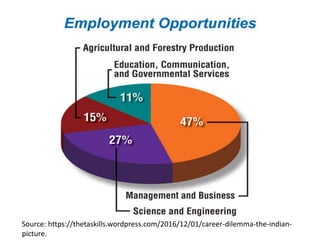
Source: https://thetaskills.wordpress.com/2016/12/01/career-dilemma-the-indian-
picture.
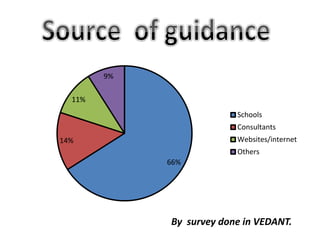
66%
14%
11%
9%
Schools
Consultants
Websites/internet
Others
By survey done in VEDANT.
Which course should you
choose?
Bachelor of commerce
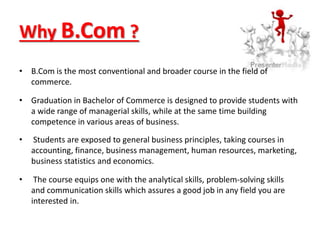
Why B.Com ?
• B.Com is the most conventional and broader course in the field of
commerce.
• Graduation in Bachelor of Commerce is designed to provide students with
a wide range of managerial skills, while at the same time building
competence in various areas of business.
• Students are exposed to general business principles, taking courses in
accounting, finance, business management, human resources, marketing,
business statistics and economics.
• The course equips one with the analytical skills, problem-solving skills
and communication skills which assures a good job in any field you are
interested in.
Why B.Com ?
 The skills not only help to fetch a good job, but also, the students remain at
an edge over others while studying MBA.
 After B.Com the students can avail exciting and diverse post graduate
opportunities like MBA, LAW, International studies
Designing/Merchandising, M.Com, Finance, Economics, Fashion etc
• The industry takes them at par with the students having professional degree
like BBA, Hotel Management etc and sometimes at higher platform
• The course equips an individual with confidence and risk taking abilities to
become an entrepreneur.
• ACCOUNTING
Financial Accounting
Corporate Accounting
Management Accounting
Cost Accounting
• FINANCE:
Financial Management
Banking
Investment Analysis
• BUSINESS ECONOMICS
Demand & Supply Law
Theories of
Pricing
Elasticity
Returns
Core Subjects in B.Com..!
• HUMAN RESOURCES
Managing the people
Leading & Guiding
Recruiting, selecting
Training & developing
• MARKETING:
Products & Services
Pricing
Promotional
Place
Distribution
Advertising
• AUDIT
Liquid Transactions
Assets & Liabilities
• BUSINESS LAW:
Laws
Code of Conduct
• BUSINESS COMMUNICATION
Oral Communication
Written Communication
Non Verbal Communication
Benefits of B.Com
• A career path in commerce.
• An understanding of management functions
within the business environment.
• A greater ability to communicate effectively,
manage human resources and handle labour
relations functions.
Benefits of B.Com
• A proficiency at interpreting and using numerical
and statistical knowledge.
• Knowledge that is relevant to the economic
context of the business environment.
• Skills that will boost our career and improve
performance.
Career opportunities after B.Com
• Plentiful job opportunities in India and abroad.
• Career in public and private undertakings.
• Attend various tests in public sector
like UPSC exams, Combined
defense services exam,
Air force Accounts exams and so on.
• Jobs in insurance sector.
• Entrepreneur.
Career opportunities after B.Com
• Banking sector jobs like clerical and
probationary Officers job.
• Jobs in industries, media and communication
and in multi national companies.
• Work in health care, educational
institutions and in
financial service sector.
• Jobs in accounting & auditing sector.
Source: https://thetaskills.wordpress.com/2016/12/01/career-dilemma-the-indian-
picture.
Paths After Pursuing B.Com
Post graduation in any of the following
streams:
 M.Com - Master of Commerce
 MBA - Master of Business
Administration
 Masters in Economics
 Masters in Statistics
 Masters in Law
 Masters in Insurance
 Masters in International Studies
Other Professional Courses
 CA - Chartered Accountant
 CS - Company Secretary
 ICWA - Institute of Cost and Works
Accountants
 CMA - Certified Management
Accountant
 CFA - Chartered Financial Analyst
 Courses in stock broking
 Computer courses like Tally and
Accounting Softwares.
 And many other courses like law,
CFP, MHRD and banking exams etc.
CONCLUSION
Finally….
• B.Com graduates rarely find themselves with less scope of opportunities
as there has always been a demand for them for the simple reason that
they are required by every business, private or public, big or small to run
their commercial activities.
• They can fill the shoes of Accountant, HR Manager, Finance Manager,
Banker, Auditor, Stock Broker, Sales Manager, EXIM Manager, BPO/KPO
officers, Administrative Officers, Purchase Managers, Travel Manager,
Event Manager, Entrepreneur, Economist and the list goes on.
No wonder,
B.Com is ever Reliable.
The helping hands
MR. Chetan Pujari &
Miss. Akshata Chitawadagi

Why commerce cource

  • 1.
  • 2.
  • 3.
    • To geta Good Job • To get a Good Salary • To be independent • To Change our Life style • To settle in our Life • To develop our skills After all we are struggling to study for what ?
  • 4.
    ‘Learning is neverending process’
  • 5.
  • 7.
    Career- A bigconcern to whom? • Students completing their school or college. • Individuals just started with their jobs and shaken with their choice of work. • Individuals working over years and are demotivated for some unknown reasons.
  • 8.
    • The progressand actions taken by a person throughout lifetime, especially those related to that person's occupation. • A career is often composed of the jobs held, titles earned and work accomplished over a long period of time, rather than just referring to one position. WHAT TO DO ? HOW TO DO? WHEN TO DO ? WHERE TO DO?
  • 9.
    Factors to beconsidered while choosing your career. • What are you interested in? • What are you good at? • What kind of lifestyle do you want? • Where your capabilities get utilized to the maximum? • Think about where you live and where you want to live, and make sure there are jobs in your chosen place available.
  • 10.
    Factors to beconsidered while choosing your career. • Figure out how much time and money you can devote to your education. • Think about the salary you need and you get in that particular area of interest. • Analyse demand and supply factors of a career you choose. • Do your own SWOT analysis. • Be realistic. Be honest. And do what's right for you.
  • 11.
    Meaning of Commerce •Commerce is the activity of buying and selling of goods and services, especially on a large scale. The system includes legal, economic, political, social, cultural and technological factors that are in operation in any country or internationally. • In simple terms, Commerce can also be defined as a component of business which includes all activities, functions involved in transferring goods from producers to consumers.
  • 12.
    Under-graduate courses tocommerce students Other Degrees • B.Com Bachelor in Commerce • B.C.A Bachelor in Computer Applications • BFIA- Bachelor in Financial and Investment Analysis • BBA- Bachelor of business administration • Bachelor in Economics • Bachelor in Advertising • Bachelor in Retail Management • Bachelor in Statistics • Bachelor in Travel and Tourism • Bachelor in Hotel Management • Bachelor in Event Management • Bachelor in Fashion Design • Bachelor in Law Professional Cources • CA - Chartered Accountant • CS - Company Secretary • ICWA - Institute of Cost and Works Accountants • CFA - Chartered Financial Analyst • Courses in stock broking • Computer courses like Tally and Accounting Softwares. • And many other courses like law,CFP and banking exams etc
  • 13.
  • 14.
  • 15.
    Which course shouldyou choose? Bachelor of commerce
  • 16.
    Why B.Com ? •B.Com is the most conventional and broader course in the field of commerce. • Graduation in Bachelor of Commerce is designed to provide students with a wide range of managerial skills, while at the same time building competence in various areas of business. • Students are exposed to general business principles, taking courses in accounting, finance, business management, human resources, marketing, business statistics and economics. • The course equips one with the analytical skills, problem-solving skills and communication skills which assures a good job in any field you are interested in.
  • 17.
    Why B.Com ? The skills not only help to fetch a good job, but also, the students remain at an edge over others while studying MBA.  After B.Com the students can avail exciting and diverse post graduate opportunities like MBA, LAW, International studies Designing/Merchandising, M.Com, Finance, Economics, Fashion etc • The industry takes them at par with the students having professional degree like BBA, Hotel Management etc and sometimes at higher platform • The course equips an individual with confidence and risk taking abilities to become an entrepreneur.
  • 18.
    • ACCOUNTING Financial Accounting CorporateAccounting Management Accounting Cost Accounting • FINANCE: Financial Management Banking Investment Analysis • BUSINESS ECONOMICS Demand & Supply Law Theories of Pricing Elasticity Returns Core Subjects in B.Com..! • HUMAN RESOURCES Managing the people Leading & Guiding Recruiting, selecting Training & developing • MARKETING: Products & Services Pricing Promotional Place Distribution Advertising • AUDIT Liquid Transactions Assets & Liabilities • BUSINESS LAW: Laws Code of Conduct • BUSINESS COMMUNICATION Oral Communication Written Communication Non Verbal Communication
  • 19.
    Benefits of B.Com •A career path in commerce. • An understanding of management functions within the business environment. • A greater ability to communicate effectively, manage human resources and handle labour relations functions.
  • 20.
    Benefits of B.Com •A proficiency at interpreting and using numerical and statistical knowledge. • Knowledge that is relevant to the economic context of the business environment. • Skills that will boost our career and improve performance.
  • 21.
    Career opportunities afterB.Com • Plentiful job opportunities in India and abroad. • Career in public and private undertakings. • Attend various tests in public sector like UPSC exams, Combined defense services exam, Air force Accounts exams and so on. • Jobs in insurance sector. • Entrepreneur.
  • 22.
    Career opportunities afterB.Com • Banking sector jobs like clerical and probationary Officers job. • Jobs in industries, media and communication and in multi national companies. • Work in health care, educational institutions and in financial service sector. • Jobs in accounting & auditing sector.
  • 23.
  • 24.
    Paths After PursuingB.Com Post graduation in any of the following streams:  M.Com - Master of Commerce  MBA - Master of Business Administration  Masters in Economics  Masters in Statistics  Masters in Law  Masters in Insurance  Masters in International Studies Other Professional Courses  CA - Chartered Accountant  CS - Company Secretary  ICWA - Institute of Cost and Works Accountants  CMA - Certified Management Accountant  CFA - Chartered Financial Analyst  Courses in stock broking  Computer courses like Tally and Accounting Softwares.  And many other courses like law, CFP, MHRD and banking exams etc.
  • 25.
    CONCLUSION Finally…. • B.Com graduatesrarely find themselves with less scope of opportunities as there has always been a demand for them for the simple reason that they are required by every business, private or public, big or small to run their commercial activities. • They can fill the shoes of Accountant, HR Manager, Finance Manager, Banker, Auditor, Stock Broker, Sales Manager, EXIM Manager, BPO/KPO officers, Administrative Officers, Purchase Managers, Travel Manager, Event Manager, Entrepreneur, Economist and the list goes on. No wonder, B.Com is ever Reliable.
  • 27.
    The helping hands MR.Chetan Pujari & Miss. Akshata Chitawadagi

Editor's Notes

  • #17 Graduation in Bachelor of Commerce is designed to provide students with a wide range of managerial skills, while at the same time building competence in various areas of business. Students are exposed to general business principles, taking courses in accounting, finance, business management, human resources, marketing, business statistics and economics.
  • #18 Graduation in Bachelor of Commerce is designed to provide students with a wide range of managerial skills, while at the same time building competence in various areas of business. Students are exposed to general business principles, taking courses in accounting, finance, business management, human resources, marketing, business statistics and economics.