ASSET BUILDING
Pulling yourself up by your bootstraps and a “hard
work” ethic are the hallmarks of America’s definition of
success. To achieve success and the economic
mobility of the American Dream, however, requires not
only the ability to generate income, but also the ability
to translate such income into assets. While income
may measure whether or not a person has enough to
get by, assets measure whether or not a person has
enough to get ahead.
An Assets Agenda for the States
New America Foundation
Asset-Building
Asset building refers to engaging in longterm saving and investment behavior as a
means to building household wealth and
increasing economic independence.
Asset building strategies empower
individuals to make economic choices that
provide long-term benefits for themselves,
their families and their communities.
Theory and Research Underlying
Asset Building Strategy
• Assets not only help households sustain themselves during

difficult economic times, they also orient people to the future
and provide a stake in society.
• As more low-income households have a stake in society,
families and neighborhoods stabilize and economic opportunity
and the economy expand.
• Low-income households want to and can save and, while
saving generally rises with income, they may actually save at a
higher rate (as a percentage of income) than higher-income
households.
• Evidence suggests that, while providing household stability and
expanding educational and entrepreneurial opportunity, asset
building also can:
• Decrease economic strain, marital dissolution, and risk of

intergenerational poverty;
• Increase property values, property maintenance, health and
satisfaction, and local civic involvement.
The Asset Gap
Asset poverty rates and wealth gaps are worse than
income poverty and distribution
• Racial disparities in asset ownership are widest
• 14% of all households and 24% of minority households live in

extreme asset poverty – meaning that they have zero or negative
net worth
• Helping people build assets has been a long-standing policy of the
U.S. government. Many opportunities to build assets exist, such as
the Homestead Act, the GI Bill, and the home mortgage interest
deduction. Unfortunately, low-income families do not benefit as
much from these policies because many of these incentives are
delivered through the tax code.
Individual Development Accounts
• Individual Development Accounts(IDAs) are special

savings accounts that match the deposits of low- and
moderate-income people.
• For every dollar saved in an IDA, savers receive a
corresponding match which serves as both a reward and
an incentive to further the saving habit.
• Savers agree to use their savings for an asset-building
purpose – typically for post-secondary education or job
training, home purchase, or to capitalize a small business.
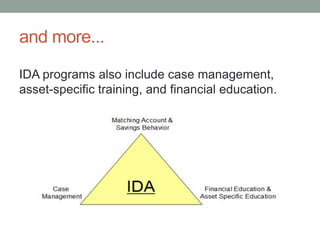
and more...
IDA programs also include case management,
asset-specific training, and financial education.
Assets for Independence (AFI)
Federal program authorized in 1998 that provides five-year
AFI grants that enable participants to use IDAs to acquire a
first home, capitalize a small business, and pursue
postsecondary education and training.
• AFI projects open nearly 1,000 new accounts each month
• Through FY 2010, participants in regular AFI projects had

opened a total of 68,421 IDAs.
• In the 68,421 IDAs opened in regular projects through FY
2010, account holders deposited a total of $64,665,564 in
earned income, or an average of $945 per account holder.
• 12,167 purchased a home; 8,738 financed a business; 10,986
financed education and/or training
• Participants had used $136.4 million to purchase long-term
economic assets, which includes the value of their own IDA
savings ($41.3 million) and matching funds ($95.1 million)
11th Annual report to Congress (2010)
Assets for Independence Program
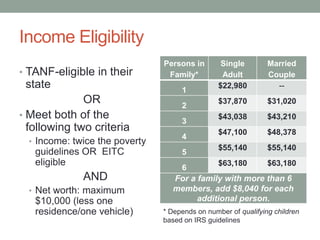
Income Eligibility
• TANF-eligible in their

state

Persons in
Family*
1

OR
• Meet both of the
following two criteria
• Income: twice the poverty

guidelines OR EITC
eligible

AND
• Net worth: maximum

$10,000 (less one
residence/one vehicle)

2

3
4
5
6

Single
Adult
$22,980

Married
Couple
--

$37,870

$31,020

$43,038

$43,210

$47,100

$48,378

$55,140

$55,140

$63,180

$63,180

For a family with more than 6
members, add $8,040 for each
additional person.
* Depends on number of qualifying children
based on IRS guidelines
The Funding Challenge
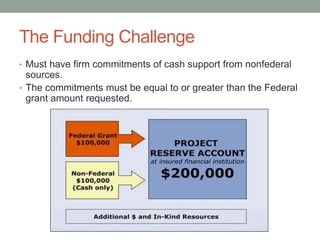
• Must have firm commitments of cash support from nonfederal

sources.
• The commitments must be equal to or greater than the Federal
grant amount requested.
Employer IDA Initiatives
• Employer IDA initiatives hold tremendous potential for reaching

millions of working poor individuals.
• Employers are attractive delivery channels for a number of reasons
including their:
• Access to low-income workers;
• Existing benefits systems;
• Effective outreach and communications venues; and
• Ability to provide matching funds.

• Benefits to employers include:
• Lowered absenteeism and improved employee retention;
• Increased recruitment of lower-income employees;
• Improved workplace productivity;
• Additional skills and improved career opportunities, particularly if the IDAs
are used for educational purposes; and
• Psychological benefits, such as improved expectations about the future and
a more positive outlook of the workplace.
Case Study 1
• Encourages low-wage employees to take advantage of

existing programs by increasing benefit available:
• Employer Assisted Housing Program ($5,000 + $2,000 Federal

match + $500 personal savings = $7,500)
• Scholars and Career Assistance Program ($3,000 + $2,000 Federal
match + $500 personal savings = $5,500)

• Corresponds with company’s goal of growing its own

employees, encouraging frontline staff to retrain for new
fields that often come with better pay and more
advancement opportunities.
Case Study 2

• Doubles investment of company foundation in carrying out

its efforts to provide educational opportunities, including
scholarships and education resources, for employees
($2,000 scholarship + $2,000 Federal match + $500
personal savings = $4,500)
• Adds a new tool to a suite of employee programs focused
on asset-building, including free tax preparation services.
What’s Unique?
• Approached by

employers
• 100 estimated
participants per
employer
• Multiple sites, multiple
shifts
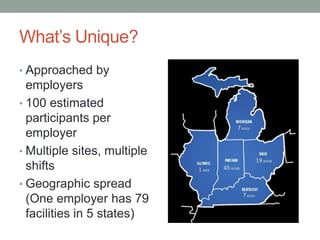
• Geographic spread
(One employer has 79
facilities in 5 states)

Asset Building

  • 1.
  • 2.
    Pulling yourself upby your bootstraps and a “hard work” ethic are the hallmarks of America’s definition of success. To achieve success and the economic mobility of the American Dream, however, requires not only the ability to generate income, but also the ability to translate such income into assets. While income may measure whether or not a person has enough to get by, assets measure whether or not a person has enough to get ahead. An Assets Agenda for the States New America Foundation
  • 3.
    Asset-Building Asset building refersto engaging in longterm saving and investment behavior as a means to building household wealth and increasing economic independence. Asset building strategies empower individuals to make economic choices that provide long-term benefits for themselves, their families and their communities.
  • 4.
    Theory and ResearchUnderlying Asset Building Strategy • Assets not only help households sustain themselves during difficult economic times, they also orient people to the future and provide a stake in society. • As more low-income households have a stake in society, families and neighborhoods stabilize and economic opportunity and the economy expand. • Low-income households want to and can save and, while saving generally rises with income, they may actually save at a higher rate (as a percentage of income) than higher-income households. • Evidence suggests that, while providing household stability and expanding educational and entrepreneurial opportunity, asset building also can: • Decrease economic strain, marital dissolution, and risk of intergenerational poverty; • Increase property values, property maintenance, health and satisfaction, and local civic involvement.
  • 5.
    The Asset Gap Assetpoverty rates and wealth gaps are worse than income poverty and distribution • Racial disparities in asset ownership are widest • 14% of all households and 24% of minority households live in extreme asset poverty – meaning that they have zero or negative net worth • Helping people build assets has been a long-standing policy of the U.S. government. Many opportunities to build assets exist, such as the Homestead Act, the GI Bill, and the home mortgage interest deduction. Unfortunately, low-income families do not benefit as much from these policies because many of these incentives are delivered through the tax code.
  • 6.
    Individual Development Accounts •Individual Development Accounts(IDAs) are special savings accounts that match the deposits of low- and moderate-income people. • For every dollar saved in an IDA, savers receive a corresponding match which serves as both a reward and an incentive to further the saving habit. • Savers agree to use their savings for an asset-building purpose – typically for post-secondary education or job training, home purchase, or to capitalize a small business.
  • 7.
    and more... IDA programsalso include case management, asset-specific training, and financial education.
  • 8.
    Assets for Independence(AFI) Federal program authorized in 1998 that provides five-year AFI grants that enable participants to use IDAs to acquire a first home, capitalize a small business, and pursue postsecondary education and training. • AFI projects open nearly 1,000 new accounts each month • Through FY 2010, participants in regular AFI projects had opened a total of 68,421 IDAs. • In the 68,421 IDAs opened in regular projects through FY 2010, account holders deposited a total of $64,665,564 in earned income, or an average of $945 per account holder. • 12,167 purchased a home; 8,738 financed a business; 10,986 financed education and/or training • Participants had used $136.4 million to purchase long-term economic assets, which includes the value of their own IDA savings ($41.3 million) and matching funds ($95.1 million) 11th Annual report to Congress (2010) Assets for Independence Program
  • 9.
    Income Eligibility • TANF-eligiblein their state Persons in Family* 1 OR • Meet both of the following two criteria • Income: twice the poverty guidelines OR EITC eligible AND • Net worth: maximum $10,000 (less one residence/one vehicle) 2 3 4 5 6 Single Adult $22,980 Married Couple -- $37,870 $31,020 $43,038 $43,210 $47,100 $48,378 $55,140 $55,140 $63,180 $63,180 For a family with more than 6 members, add $8,040 for each additional person. * Depends on number of qualifying children based on IRS guidelines
  • 10.
    The Funding Challenge •Must have firm commitments of cash support from nonfederal sources. • The commitments must be equal to or greater than the Federal grant amount requested.
  • 11.
    Employer IDA Initiatives •Employer IDA initiatives hold tremendous potential for reaching millions of working poor individuals. • Employers are attractive delivery channels for a number of reasons including their: • Access to low-income workers; • Existing benefits systems; • Effective outreach and communications venues; and • Ability to provide matching funds. • Benefits to employers include: • Lowered absenteeism and improved employee retention; • Increased recruitment of lower-income employees; • Improved workplace productivity; • Additional skills and improved career opportunities, particularly if the IDAs are used for educational purposes; and • Psychological benefits, such as improved expectations about the future and a more positive outlook of the workplace.
  • 12.
    Case Study 1 •Encourages low-wage employees to take advantage of existing programs by increasing benefit available: • Employer Assisted Housing Program ($5,000 + $2,000 Federal match + $500 personal savings = $7,500) • Scholars and Career Assistance Program ($3,000 + $2,000 Federal match + $500 personal savings = $5,500) • Corresponds with company’s goal of growing its own employees, encouraging frontline staff to retrain for new fields that often come with better pay and more advancement opportunities.
  • 13.
    Case Study 2 •Doubles investment of company foundation in carrying out its efforts to provide educational opportunities, including scholarships and education resources, for employees ($2,000 scholarship + $2,000 Federal match + $500 personal savings = $4,500) • Adds a new tool to a suite of employee programs focused on asset-building, including free tax preparation services.
  • 14.
    What’s Unique? • Approachedby employers • 100 estimated participants per employer • Multiple sites, multiple shifts • Geographic spread (One employer has 79 facilities in 5 states)

Editor's Notes

  • #4 In 1991, Michael Sherraden published the groundbreaking Assets and the Poor, arguing that poverty must be understood and solved in terms of assets, not just income. This seemingly simple idea has had a profound impact, offering a novel and consequential perspective on overcoming poverty. His ideas have heavily influenced policymakers, researchers, non-profits, foundations, and others worldwide. Dr. Sherraden writes, “Few people have ever spent their way out of poverty. Those who escape do so through saving and investing for the long term.”
  • #5 Research shows that financial assets matter.Talking Points1. Move past paycheck to paycheck, towards long term financial stabilityBecause of their participation in the IDA program, 59% of participants said they are more likely to work or stay employed and 41% said they are more likely to work more hours.From interviews, common themes stated by IDA participants were that they are “more able to save,” “look forward to saving,” and “plan to save in the future” as well as having a sense of security and a backup plan (knowing they have the financial means to take care of unplanned or planned things that happen).2. Stronger, Healthier FamiliesBecause of their participation in IDA programs, 54% of participants said they are more likely to have good relationships with family.3. Enhanced Self-EsteemBecause of their participation in the IDA program, 84% of participants said they are more likely to feel economically secure.From interviews, common themes stated by IDA participants were that they feel more self-confident and more able to accomplish things.4. Long-Term Thinking and PlanningBecause of their participation in the IDA program, 60% of participants said they are more likely to make educational plans for their children, 59% said they are more likely to make educational plans for themselves, and 57% said they are more likely to make plans for retirement.From interviews, common themes stated by IDA participants were that the IDA program “creates goals and purpose,” teaches participants to “see more clearly” and “visualize a future,” and provides participants with a “road map” and a “way to reach goals.” In summary the interviewed IDA participants identified the IDA program structure as changing both outlook and behavior related to saving and reaching life goals.5. More Community InvolvementBecause of their participation in the IDA program, 32% of participants said they are more likely to be involved in their neighborhood, and 35% said they are more likely to be respected in their communities.From interviews, common themes stated by IDA participants were that they felt more personal responsibility (spending money wisely), a greater desire to have the means to help others in their communities. Also it was commonly stated that being able own a home caused a feeling of being a part of the community.6. Hope for the FutureBecause of their participation in the IDA program, 93% of participants said they are more confident about the future, and 73% said they are more likely to buy or renovate a home.From interviews, common themes stated by IDA participants were that they were more likely to set goals and felt more hopefulness about the future.
  • #6 Racial disparities in asset ownership are widest, with minorities:Twice as likely to be asset poor (37.2% vs. 16.4%)Three times as likely to have a high-cost mortgage loan Much less likely to own a home or have a college degree
  • #12 only 10% of active AFI projects focus on serving employees of a particular organization.
  • #15 All research on this type of IDA – employer approached by service providerThe handful of employer IDA initiatives that are currently in operation have about 15 to 50 employees enrolled at each company. One employer at one siteImplications – Reliance on technologyOnline financial educationOnline application and enrollment procedures