Enhanced Climate Change Adaptation Capacity of Communities in Contiguous Fragile Ecosystems in the Cordilleras
Biophysical Characterization and Socio-Economic Profiling in Benguet 	Benguet State University (FG Calora, MR Parao, JF Malamug, RS Batani, MD Gapasin)
TopicsGeneral ObjectiveStudy SitesSources of DataMethodologyBiophysical CharacterizationSocio – Economic ProfilingThe ClimateBiophysical CharacterizationSoil CharacterizationBiodiversityWater SourcesLand Use and TopographyClimate Related Hazards
TopicsSocio-Economic ProfileDemographic ProfileSource of LivelihoodIncome StructureSource of Farm LaborGender and Climate ChangeGender DifferentialsAgri-based Livelihood and Climate ChangeMajor CropsCropping PatternsProduction InputsMarketing StrategiesFarm SizeLivestock Production
TopicsClimate Change Perception and AdaptationLocal TermsClimate Change Awareness and EffectsCommon Farming ProblemsPerceived Effects of Climate ChangeAdaptationIssues, Gaps and Constraints Key MessagesRecommendations
General ObjectiveTo conduct a biophysical characterization and agro-socio economic profiling of selected municipalities in Benguet Bayabas, SablanTaloy Sur, TubaLoo, BuguiasPaoay, Atok
Study SitesLow elevation (200-999 masl) Barangay Taloy Sur, TubaBarangay Bayabas, Sablan	Mid elevation (1000-2000 masl)Barangay Loo, BuguiasHigh elevation (>2000 masl)Barangay Paoay, Atok
Sources of DataCordillera Highland Agriculture Resource Management Project (CHARMP)Community Land Use Plans (CLUP)Barangay Natural Resources Management Plans (BNRMP)Philippine Atmospheric Geophysical and Astronomical Services Administration (PAGASA) – BSU, Baguio City and Dagupan City
Sources of DataNational Irrigation Administration (NIA)Local Government Units (LGUs)FAO-developed CLIMWAT ProgramPlant inventories, soil collection, field interviews and validation, household interviews, focus group discussions, and key informant interviews
Methodology
Biophysical CharacterizationField site reconnaissance and site selectionCoordination with LGUs for site reconnaissance and data collection
Biophysical CharacterizationSoil sampling and undergrowth vegetation analysis in Pan-ayawan, Loo, BuguiasGPS reading being undertaken by the team
Biophysical CharacterizationConsultation with barangay officials for hazard mappingValidation of identified hazard-prone areas
Socio-Economic ProfilingThe researchers conducting a fish bowl technique in randomly selecting the respondentsTrekking on foot to reach far-flung areas for survey (in Beckes, Paoay)
Socio-Economic ProfilingFGD with the Kayabang Organization members in BayabasA researcher conducting HH survey with one of the respondents
Socio-Economic ProfilingBarangay officials FGD participants doing resource mapping in Taloy Sur, TubaAn FGD participants dicussing the resource map in Bayabas, Sablan
The Climate
Climate CharacterizationLow elevation – based on data observed in Dagupan City Mid and High elevations – based on data recorded in Baguio City and La Trinidad, Benguet
Climate in BenguetBenguet falls under the Type I climate
Characterized by two distinct seasons
wet from May to October
dry during the rest of the year
It is frequented not only by the northeast and southwest monsoons but also by typhoons and other tropical disturbancesClimate in BenguetFor the mid and high elevations:
average temperature ranges : 15.3 - 22.8ºC;
average sunshine duration: 5.7 hours;
potential evapotranspiration rate:2.45 to 3.71 mm/day;
annual average rainfall: about 3878 mmClimate in BenguetFor the low elevation areas
Warmer, temperature range: 25.8 - 29.7ºC;
Higher average potential evapotranspiration rates: 3.88 - 6.36 mm/day;
average annual rainfall:  1338.8 mm
About 62 % of the total annual rainfall occurs during a three-month period (July - September)Comparison of average daily temperatures (C) between the periods 1979 – 2003 and 1999 – 2009 (PAGASA)
Average annual rainfall from 1976 to 2008, where the annual rainfall was beyond 7000 mm for 1978. The wettest years were from 1977-1982 while the driest years were from 1992-1996.
Average daily rainfall(mm) over monthly periods from  1999 until 2009 showing extreme rainfall events for 2001, 2004 and 2009 based on the agrometeorological data from PAGASA-BSU La Trinidad.
Average monthly daily total rainfall (mm) from 1999-2009 showing an increase in the rainfall events after January and peaking August then receding to start its annual cycle
Significant FindingsClimate can still be considered “normal” although some manifestations of climate change were noted
There is an increase of about 0.4ºC in temperature from average values computed from 1979-2003 and 1999-2009;
However, a decrease of 0.4ºC during the month of August over the same periods was also observedSignificant FindingsThe range in daily temperatures (difference between minimum and maximum) is becoming greater in the colder months (8.1ºC)
Water shortages may be attributed not to a decrease in rainfall amounts but perhaps to increasing demand Biophysical Characterization
Soil CharacterizationSoil series for the project sitesPaoay, Atok: : Paoay Clay loam Loo, Buguias: Umingan soil series Bayabas, Sablan: Burgos clay series Taloy Sur, Tuba: Bakakeng series
Soil CharacterizationPaoay,  Atok – High elevation
Paoay soil series.
The soil is deep with color from dark yellowish brown to brownish yellow.
The soil texture is loam to sandy loam, generally the soil is loose when moist, sticky and plastic when wet, and hard to extremely hard when dry.
This type of soil is moderately prone to erosion.Soil CharacterizationLoo,  Buguias (Mid elevation)Umingan soil series. The soil is from very dark grayish brown to dark yellowish brown, The soil texture is from soil clay to clay loam. Rock fragments are present in all horizons ranging from 10% to 20%. The soil structure is generally subangular blocky.   This type of soils is slightly prone to erosion.
Soil CharacterizationSablan
Burgos Clay series
The soil is moderate with color from brown .
The soil texture is from sandy loam to sandy clay.
The structure is granular to sub angular blocky,
There is presence of rock fragments increasing as depth of the profile increases.
These soils are prone to erosionSoil CharacterizationTubaBakakeng series for tuba., The soil is deep with color from dark reddish brown to red, The soil texture is from clay loam to silty slay, These soils are slight prone to erosion.
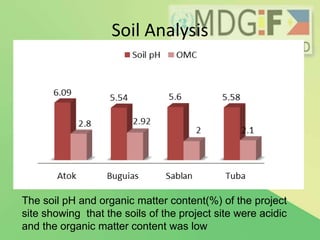
Soil AnalysisMacronutrient levels for NPK, where the N level (%) for all sites was low while the P(ppm) adequate except for  Atok and Buguias. , the  K(ppm) was sufficient for all sites.
Soil AnalysisThe soil pH and organic matter content(%) of the project site showing  that the soils of the project site were acidic and the organic matter content was low
BiodiversityThere are 28  plant species belonging 14 families which were identified to be endangered based on the conservation status classification of the IUCN, These ranged from vulnerable, threatened, endangered, critically endangered CITES, rare and nearly threatened
Conservation StatusConservation status of 28 species identified under the IUCN classification for the different municipalities collected from the established biodiversity plots
Plant FamiliesThe plant families of the identified endangered/threatened species based on the IUCN classification
Biodiversity IndicesThe biodiversity indices (Shanon and Pielou’s Similarity Index)  for trees and undergrowth per municipality
List of Endangered, Threatened and Vulnerable Species
Low ElevationMid ElevationHigh Elevation
Water SourcesThe sources of water mentioned by farmers used for agricultural purposes on the project site
Land Use and TopographyTopography strongly influences land-use patterns and resource utilization, especially crop in crop productionLand UseMajor land uses in the project sites
Atok, Sablan, and Tuba: Forest
Buguias: Agricultural
The forest areas are vulnerable to changes not only due to climatic factors but also due to encroachment by farmersMajor land uses in the four study sitesLand Use
TopographyTopography is not directly related to elevation
Atok and Tuba: moderate to steep slopes
Buguias, and Sablan: gently sloping and rolling to moderately steep slopes Slope distribution in the four study sitesTopography
Area covered by the four municipalitiesLand Area
Land Use and Topographic MapsLand use map : AtokTopographic Map : Atok
Land-use Map: BuguiasTopographic Map : Buguias
Topographic Map: SablanLand-use Map : Sablan
Topographic Map : TubaLand-use Map : Tuba
Climate Related HazardsClimate related hazards within the last 5 years of economic impacts in the area were mappedNote:All study sites were vulnerable to severe and moderate erosion due to heavy rainfall, loose soil and rugged topographyFlooding is only common near river banks except in PaoayAll study sites were vulnerable to fires as a result of hotter weather conditions
Community Hazard Map as  identified by the community  of PaoayThe hazards identified The were:Climate Induced HazardsSevere  and moderate Erosion was observed near road sideFloodFrost*Man induced HazardsForest Fires , these occurred due to thrown cigarette butts and camp firesInsufficient water supply*
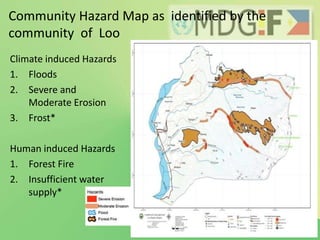
Community Hazard Map as  identified by the community  of  LooClimate induced HazardsFloodsSevere and Moderate ErosionFrost*Human induced HazardsForest FireInsufficient water supply*
Community Hazard Map as  identified by the community  of  BayabasClimate induced HazardsSevere and Moderate ErosionFloodHuman induced HazardsForest FireInsufficient water supply*
Community Hazard Map as  identified by the community  of  Taloy SurClimate induced hazardsSevere / Moderate ErosionHuman induced HazardsForest FireInsufficient water supply*
Socio Economic Profile
 Demographic ProfileGender 66.7% female33.3% maleCivil  StatusMarried – 81.5%EthnicityKankana-ey – 49%Ibaloi – 36.2 %EducationHigh School Graduate – 23%College level – 17.3 %Age
41-50 , 27.6%
31-40, 23.9%
Residency
21-30, 17.3%
31-50, 17.3%
Occupation
Farmer – 57.2%- others: business, employed, OFW, hired laborsAverage monthly income
< 5000 pesos ,34.2%
<10000 pesos, 25.9%
< 20000 pesos, 10.7%Source of LivelihoodMain Source of livelihood
Income StructureHouseholds with 10 members – highest average monthly income (P 20,240)
<4 household members and >10 ~ low income
Poverty line P 6,713/mo; many are poor but do not go hungry
Majority of farmers still have off-farm works in Bayabas and Taloy Sur unlike in Paoay and Loo
Sablan, higher dependence on natural forest for wood carving and furniture makingIncome BracketMonthly income bracket range (MIBR) per municipality
Source of Farm LaborThe potential source of labor from the municipalities.
Gender and Climate Change
Gender DifferentialsGender differentials of farming activities for Tuba and Sablan showing that women have added weeding, fertilizer application, harvesting and selling farm produce to their role. Gender differentials refer to the roles women assume. Positive “ +” GD means all males are performing the tasks, Negative “ – “ GD means  more women are engaged in this activity.
Agri-based Livelihood and Climate Change
Major CropsMajor crops in the project sites
Major CropsMajor crops by municipality
Cropping PatternsCropping patterns used in the project sites.
Production InputsSome production inputs for Atok, Buguias, Sablan and Tuba

BSU Assessments Study - Benguet