ORIENTATION
TRAINING
ASSESSMENT
By: Roatha Kong
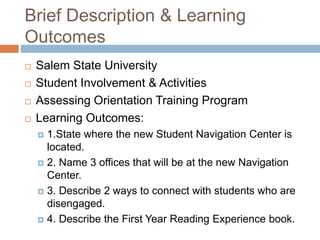
Brief Description & Learning
Outcomes
 Salem State University
 Student Involvement & Activities
 Assessing Orientation Training Program
 Learning Outcomes:
 1.State where the new Student Navigation Center is
located.
 2. Name 3 offices that will be at the new Navigation
Center.
 3. Describe 2 ways to connect with students who are
disengaged.
 4. Describe the First Year Reading Experience book.
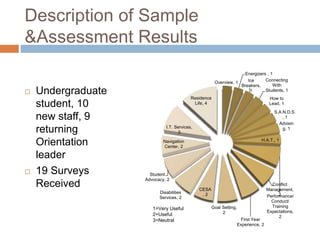
Description of Sample
&Assessment Results
 Undergraduate
student, 10
new staff, 9
returning
Orientation
leader
 19 Surveys
Received
Overview, 1
Energizers , 1
Ice
Breakers,
1
Connecting
With
Students, 1
How to
Lead, 1
S.A.N.D.S.
, 1
Advisin
g, 1
H.A.T., 1
Performance/
Conduct/
Training
Expectations,
2
Conflict
Management,
2
First Year
Experience, 2
Goal Setting,
2
CESA
, 2Disabilities
Services, 2
Student
Advocacy, 2
Navigation
Center, 2
I.T. Services,
3
Residence
Life, 4
1=Very Useful
2=Useful
3=Neutral
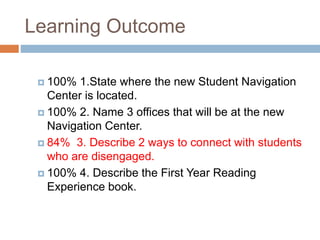
Learning Outcome
 100% 1.State where the new Student Navigation
Center is located.
 100% 2. Name 3 offices that will be at the new
Navigation Center.
 84% 3. Describe 2 ways to connect with students
who are disengaged.
 100% 4. Describe the First Year Reading
Experience book.
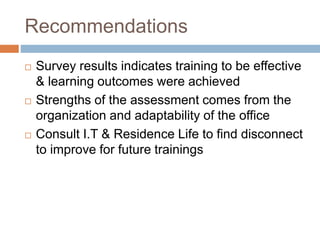
Recommendations
 Survey results indicates training to be effective
& learning outcomes were achieved
 Strengths of the assessment comes from the
organization and adaptability of the office
 Consult I.T & Residence Life to find disconnect
to improve for future trainings
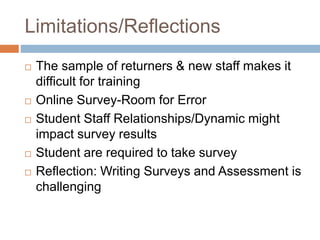
Limitations/Reflections
 The sample of returners & new staff makes it
difficult for training
 Online Survey-Room for Error
 Student Staff Relationships/Dynamic might
impact survey results
 Student are required to take survey
 Reflection: Writing Surveys and Assessment is
challenging

Assessment in Higher Education Final Project

  • 1.
  • 2.
    Brief Description &Learning Outcomes  Salem State University  Student Involvement & Activities  Assessing Orientation Training Program  Learning Outcomes:  1.State where the new Student Navigation Center is located.  2. Name 3 offices that will be at the new Navigation Center.  3. Describe 2 ways to connect with students who are disengaged.  4. Describe the First Year Reading Experience book.
  • 3.
    Description of Sample &AssessmentResults  Undergraduate student, 10 new staff, 9 returning Orientation leader  19 Surveys Received Overview, 1 Energizers , 1 Ice Breakers, 1 Connecting With Students, 1 How to Lead, 1 S.A.N.D.S. , 1 Advisin g, 1 H.A.T., 1 Performance/ Conduct/ Training Expectations, 2 Conflict Management, 2 First Year Experience, 2 Goal Setting, 2 CESA , 2Disabilities Services, 2 Student Advocacy, 2 Navigation Center, 2 I.T. Services, 3 Residence Life, 4 1=Very Useful 2=Useful 3=Neutral
  • 4.
    Learning Outcome  100%1.State where the new Student Navigation Center is located.  100% 2. Name 3 offices that will be at the new Navigation Center.  84% 3. Describe 2 ways to connect with students who are disengaged.  100% 4. Describe the First Year Reading Experience book.
  • 5.
    Recommendations  Survey resultsindicates training to be effective & learning outcomes were achieved  Strengths of the assessment comes from the organization and adaptability of the office  Consult I.T & Residence Life to find disconnect to improve for future trainings
  • 6.
    Limitations/Reflections  The sampleof returners & new staff makes it difficult for training  Online Survey-Room for Error  Student Staff Relationships/Dynamic might impact survey results  Student are required to take survey  Reflection: Writing Surveys and Assessment is challenging