Learning Outcomes:
Clarifyprogram outcomes for the teacher education
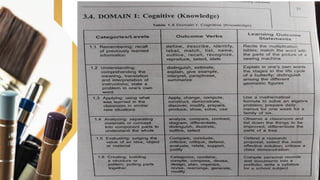
Distinguish the six levels of knowledge under the cognitive domain
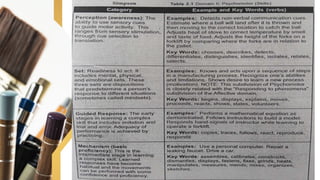
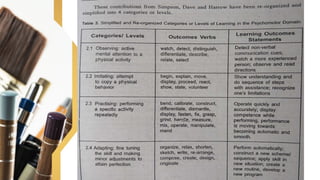
Discuss the psychomotor categories in psychomotor domain of objectives
contributed by Simpson, Dave and Harrow
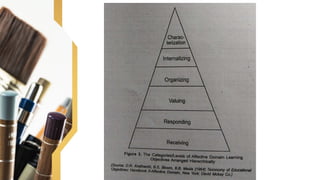
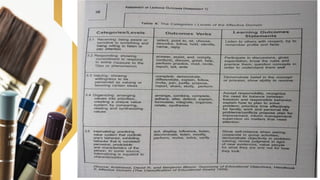
Discuss the six levels of learning objectives in the affective domain arranged
hierarchically
Discuss the Kendall’s and Manzano’s new Taxonomy
3.
Introduction
• In thischapter, you will distinguish program outcomes from learning
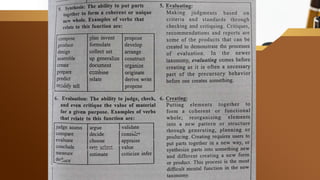
outcomes. Learning outcomes come in three(3) different domains- cognitive,
psychomotor, and affective. You will also be introduced to Kendall’s and
Manzano’s five levels of processing information, mental procedures and
psychomotor procedures.
4.
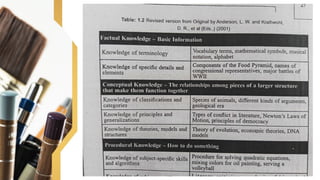
3.1. Program Outcomesand Student Learning
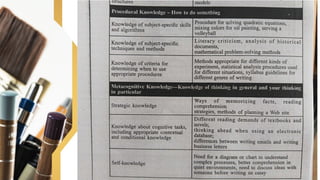
Outcomes
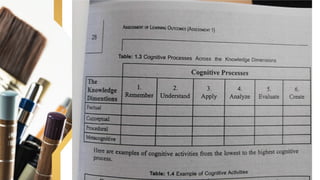
The shift of focus in education from content to student learning
outcomes has changed teachers' instructional perspective. In the past,
teachers were often heard about their concern to finish their subject
matter before the end of the term. Maybe because of the number of their
students or failure to clarify the desired learning outcomes, teacher's
concern for outcomes was secondary to the completion of the planned
content for the subject. In short, teachers were more content-centered
than outcomes-centered.
5.
The new educationalperspective requires teachers to visualize the
ideal graduates three or more years after graduation and right after
completion of the program, i.e., graduation time (as stated in
institutional outcomes and program outcomes. The Commission on
Higher Education, the body that regulates higher education in the
Philippines, in its Memorandum Order # 20, s. 2014 requires the
following program outcomes for all higher education institutions the
ability to:
6.
a) articulate anddiscuss the latest developments in the specific field of practice;
b) effectively communicate orally and in writing using both English and Filipino;
c) work effectively and independently in multi-disciplinary and multi-cultural
teams;
d) act in recognition of professional, social and ethical responsibility; and
e) preserve and promote "Filipino historical and cultural heritage."
7.
Some program outcomesare based on types of higher education institutional (HEI) because this
determines the focus and purpose of the HEI. For example:
• Graduates of professional institutions demonstrate a service orientation in one's profession.
• Graduates of colleges participate in various types of employment, development activities and public
discourses, particularly in response to the needs of the communities one serves.
• Graduates of universities participate in the generation of new knowledge or in research and
development projects.
• Graduates of State Universities and Colleges must, in addition, have the competencies to support
"national, regional and local development plans."
8.
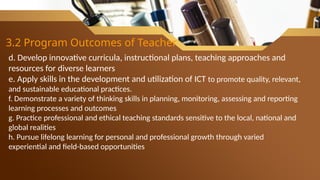
3.2 Program Outcomesof Teacher
The program outcomes specific to degrees are programs spelled out in the specific
Policies, Standards and Guidelines (PSG) per program or degree issued by the same
Commission. The following are the program outcomes for teacher education in 2017
Philippines,.
a. Articulate the rootedness of education in philosophical, socio-cultural, historical,
psychological and political contexts
b. Demonstrate mastery of subject matter/discipline
c. Facilitate learning using a wide range of teaching methodologies and delivery modes
appropriate to specific learners and their environments
9.
3.2 Program Outcomesof Teacher
d. Develop innovative curricula, instructional plans, teaching approaches and
resources for diverse learners
e. Apply skills in the development and utilization of ICT to promote quality, relevant,
and sustainable educational practices.
f. Demonstrate a variety of thinking skills in planning, monitoring, assessing and reporting
learning processes and outcomes
g. Practice professional and ethical teaching standards sensitive to the local, national and
global realities
h. Pursue lifelong learning for personal and professional growth through varied
experiential and field-based opportunities
10.
In addition tothe program outcomes of teacher education as a discipline,
there are program outcomes specific to Bachelor of Elementary Education,
(CMO No.74,S.2017); Bachelor of Secondary Education Major in English,
Filipino, Mathematics, Science, Social Studies (CMO No.75,S.2017); Bachelor
of Early Childhood Education (CMO No.76,S.2017); Bachelor of Special Needs
Education (CMO No.77,S.2017); Bachelor of Technology and Livelihood
Education (CMO No.78,S.2017); Bachelor of Technical-Vocational Teacher
Education (CMO No.79,S.2017); Bachelor of Physical Education (CMO
No.80,5.2017); Bachelor of Culture and Arts Education (CMO No.82,S.2017).
For details, refer to the given CMOs.
11.
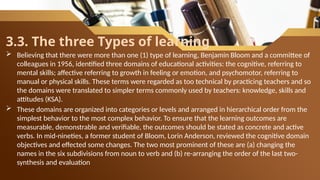
3.3. The threeTypes of learning
Believing that there were more than one (1) type of learning, Benjamin Bloom and a committee of
colleagues in 1956, identified three domains of educational activities: the cognitive, referring to
mental skills; affective referring to growth in feeling or emotion, and psychomotor, referring to
manual or physical skills. These terms were regarded as too technical by practicing teachers and so
the domains were translated to simpler terms commonly used by teachers: knowledge, skills and
attitudes (KSA).
These domains are organized into categories or levels and arranged in hierarchical order from the
simplest behavior to the most complex behavior. To ensure that the learning outcomes are
measurable, demonstrable and verifiable, the outcomes should be stated as concrete and active
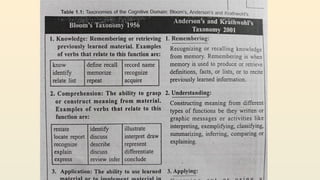
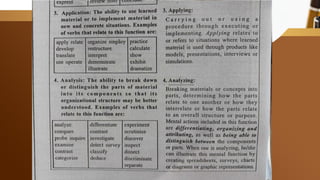
verbs. In mid-nineties, a former student of Bloom, Lorin Anderson, reviewed the cognitive domain
objectives and effected some changes. The two most prominent of these are (a) changing the
names in the six subdivisions from noun to verb and (b) re-arranging the order of the last two-
synthesis and evaluation
15.
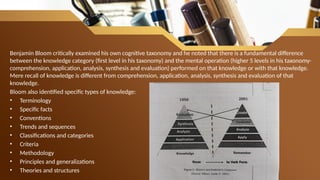
Benjamin Bloom criticallyexamined his own cognitive taxonomy and he noted that there is a fundamental difference
between the knowledge category (first level in his taxonomy) and the mental operation (higher 5 levels in his taxonomy-
comprehension, application, analysis, synthesis and evaluation) performed on that knowledge or with that knowledge.
Mere recall of knowledge is different from comprehension, application, analysis, synthesis and evaluation of that
knowledge.
Bloom also identified specific types of knowledge:
• Terminology
• Specific facts
• Conventions
• Trends and sequences
• Classifications and categories
• Criteria
• Methodology
• Principles and generalizations
• Theories and structures
16.
In the revisedcognitive taxonomy, Anderson and Krathwohl identified 4 levels of
knowledge: 1) factual knowledge 2) conceptual knowledge, 3) procedural knowledge
and 4) metacognitive knowledge If you compare the specific types of knowledge given
by Bloom, take note that the first 3 categories factual, conceptual and procedural
knowledge were cited by Bloom.
How do the 4 categories of knowledge differ from one another?
Factual Knowledge - As the name implies, this refers to facts. This refers to essential
facts, terminology, details or elements students must know or be familiar with in order
to understand a discipline or solve a problem in it.
17.
Conceptual Knowledge -This refers to the interrelationship of facts. It is facts put
together within a within a larger structure that enable them to function together. It is
knowledge of classifications, principles, generalizations, theories, models or structures
pertinent to a particular disciplinary area.
Procedural Knowledge - This is knowing how to do something. refers to information or
knowledge that helps students to do something specific to a discipline, subject or area
of study. It includes knowledge of methods of inquiry, criteria for using skills,
algorithms, techniques and methods.
18.
Metacognitive Knowledge -This is knowing that you know. This is thinking about your
own thinking in a purposeful way. It is awareness and knowledge of one's own
cognition. It is a reflective knowledge about how to go about solving problems and
cognitive task. It includes contextual and conditional knowledge and knowledge of self.
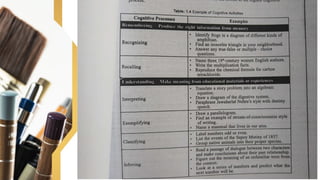
As shown in Table 1.1 in the revised cognitive taxonomy, the cognitive processes start
with remembering and end with creating knowledge along factual, conceptual,
procedural and metacognitive dimensions.
27.
3.5. DOMAIN II:Psychomotor(skills)
• In the early seventies, E Simpson, Dave and A.S. Harrow
recommended categories for the Psychomotor Domain which
included physical coordination, movement and use of the motor skills
body parts. Development of these skills requires constant practice in
accuracy and speed. Simpson contributed 7 categories, Dave 5
categories and Harrow 6 categories.
31.
3.6. DOMAIN III:Affective (attitude)
• The affective domain refers to the way in which we deal with
situations emotionally such as feelings, appreciation, enthusiasm,
motivation, values and attitude. The taxonomy is ordered into 5 levels
as the person progresses towards internalization in which the attitude
or feeling consistently guides or controls a person's behavior.
34.
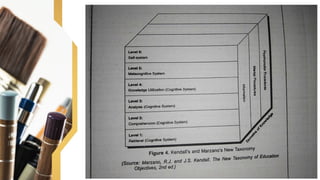
3.7. Kendall’s andMarzano’s New Taxonomy
• Instead of categorizing learning activities which Bloom and Anderson did, Kendall
and Marzano reframed the three domains of knowledge (information, mental
procedures and psychomotor procedures) by describing six levels of processing
knowledge. (Refer to Figure 5). The first four levels of processing are cognitive,
beginning with the lowest (retrieval) then moving upward with increasing cognitive
complexity comprehension, analysis and knowledge utilization. The fifth level of
processing, the metacognitive system, involves the learner's specification of
learning goals, monitoring of the learner's own learning process, clarity and
accuracy of the learner's learning. (See Figure 5)
35.
• The highestlevel of knowledge processing self-system,
involves the learner's examination of the importance
of the learning task and his/her self-efficacy. It also
involves the learner's examining his/her emotional
response and his/her motivation of learning.













![sir ben [Autosaved].pptx](https://cdn.slidesharecdn.com/ss_thumbnails/sirbenautosaved-220815044758-c86eced4-thumbnail.jpg?width=640&height=640&fit=bounds)


