LOGO
“ Add your company slogan ”
PIPING DESIGN BASIC
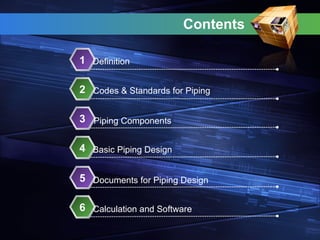
Contents
Definition
1
Codes & Standards for Piping
2
Piping Components
3
Basic Piping Design
4
Documents for Piping Design
5
Calculation and Software
6
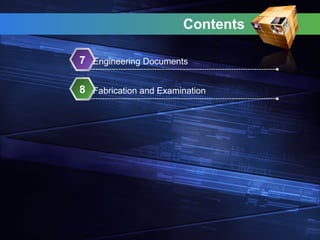
Contents
Engineering Documents
7
Fabrication and Examination
8
Definition
 Piping:
…assemblies of piping components used…[for] fluid flows. Piping also
includes pipe supporting elements, but does not include support structures…
or equipment…
 Piping system:
…interconnected piping subject to the same design conditions
 Piping components:
…mechanical elements suitable for joining or assembly into pressure tight
fluid-containing piping systems…pipes, fittings, flanges, gaskets, bolting,
valves and special devices such as expansion joints.
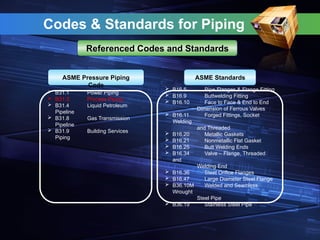
Codes & Standards for Piping
Referenced Codes and Standards
ASME Standards
 B16.5 Pipe Flanges & Flange Fitting
 B16.9 Buttwelding Fitting
 B16.10 Face to Face & End to End
Dimension of Ferrous Valves
 B16.11 Forged Fittings, Socket
Welding
and Threaded
 B16.20 Metallic Gaskets
 B16.21 Nonmetallic Flat Gasket
 B16.25 Butt Welding Ends
 B16.34 Valve – Flange, Threaded
and
Welding End
 B16.36 Steel Orifice Flanges
 B16.47 Large Diameter Steel Flange
 B36.10M Welded and Seamless
Wrought
Steel Pipe
 B36.19 Stainless Steel Pipe
 B31.1 Power Piping
 B31.3 Process Piping
 B31.4 Liquid Petroleum
Pipeline
 B31.8 Gas Transmission
Pipeline
 B31.9 Building Services
Piping
ASME Pressure Piping
Code
Codes & Standards for Piping
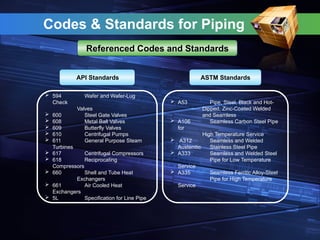
ASTM Standards
 A53 Pipe, Steel, Black and Hot-
Dipped, Zinc-Coated Welded
and Seamless
 A106 Seamless Carbon Steel Pipe
for
High Temperature Service
 A312 Seamless and Welded
Austenitic Stainless Steel Pipe
 A333 Seamless and Welded Steel
Pipe for Low Temperature
Service
 A335 Seamless Ferritic Alloy-Steel
Pipe for High Temperature
Service
 594 Wafer and Wafer-Lug
Check
Valves
 600 Steel Gate Valves
 608 Metal Ball Valves
 609 Butterfly Valves
 610 Centrifugal Pumps
 611 General Purpose Steam
Turbines
 617 Centrifugal Compressors
 618 Reciprocating
Compressors
 660 Shell and Tube Heat
Exchangers
 661 Air Cooled Heat
Exchangers
 5L Specification for Line Pipe
API Standards
Referenced Codes and Standards
Codes & Standards for Piping
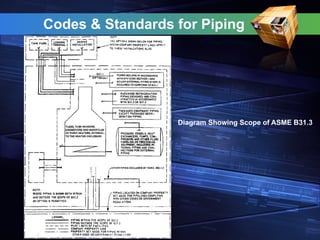
Diagram Showing Scope of ASME B31.3
Codes & Standards for Piping
Scope of ASME B31.3
Rules for the Process Piping Code Section B31.3 have been developed considering piping
typically found in petroleum refineries; chemical, pharmaceutical, textile, paper, semiconductor,
and cryogenic plants; and related processing plants and terminals. [300.1]
This Code applies for all fluids including:
 Row, intermediate and finished chemicals
 Petroleum products
 Gas, steam, air and water
 Fluidized solids
 Refrigerants
 Cryogenic fluids
This Code excludes the following:
 Piping systems designed for internal gage pressures at or above zero but less than 105
kPa (15 psi)
 Fluid handled is nonflammable, nontoxic, and not damaging to human tissues
 Power boilers in accordance with BPV Code Section I and boiler external piping which is
required to conform to B31.1
 Tube headers and manifolds of fired heaters
 Pressure vessels, heat exchangers, pumps, compressors and processing equipment,
including internal piping and connections for external piping
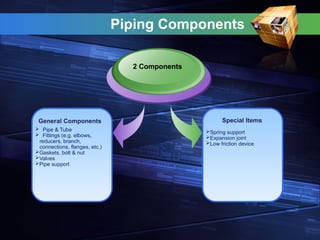
Piping Components
General Components
2 Components
Special Items
 Pipe & Tube
 Fittings (e.g. elbows,
reducers, branch,
connections, flanges, etc.)
Gaskets, bolt & nut
Valves
Pipe support
Spring support
Expansion joint
Low friction device
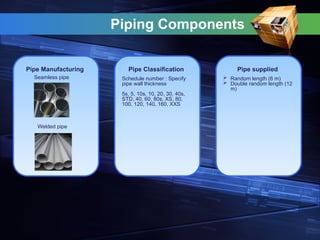
Piping Components
Pipe Manufacturing
Seamless pipe
Welded pipe
Pipe Classification Pipe supplied
Schedule number : Specify
pipe wall thickness
5s, 5, 10s, 10, 20, 30, 40s,
STD, 40, 60, 80s, XS, 80,
100, 120, 140, 160, XXS
 Random length (6 m)
 Double random length (12
m)
Piping Components
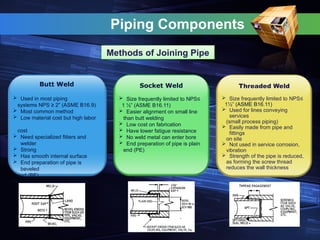
Butt Weld
 Used in most piping
systems NPS ≥ 2” (ASME B16.9)
 Most common method
 Low material cost but high labor
cost
 Need specialized fitters and
welder
 Strong
 Has smooth internal surface
 End preparation of pipe is
beveled
end (BE)
 Used generally not restricted
Threaded Weld
 Size frequently limited to NPS≤
1½” (ASME B16.11)
 Used for lines conveying
services
(small process piping)
 Easily made from pipe and
fittings
on site
 Not used in service corrosion,
vibration
 Strength of the pipe is reduced,
as forming the screw thread
reduces the wall thickness
Socket Weld
 Size frequently limited to NPS≤
1 ½” (ASME B16.11)
 Easier alignment on small line
than butt welding
 Low cost on fabrication
 Have lower fatigue resistance
 No weld metal can enter bore
 End preparation of pipe is plain
end (PE)
Methods of Joining Pipe
Piping Components
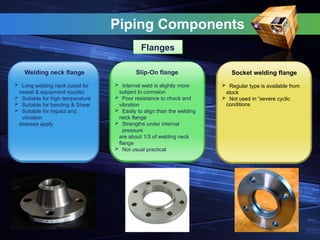
Welding neck flange
 Long welding neck (used for
vessel & equipment nozzle)
 Suitable for high temperature
 Suitable for bending & Shear
 Suitable for impact and
vibration
stresses apply
Socket welding flange
 Regular type is available from
stock
 Not used in “severe cyclic
conditions
Slip-On flange
 Internal weld is slightly more
subject to corrosion
 Poor resistance to chock and
vibration
 Easily to align than the welding
neck flange
 Strengths under internal
pressure
are about 1/3 of welding neck
flange
 Not usual practical
Flanges
Piping Components
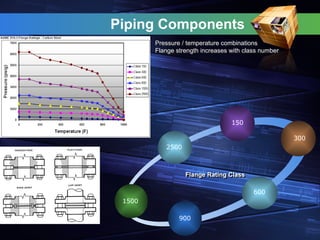
Pressure / temperature combinations
Flange strength increases with class number
150
300
600
900
Flange Rating Class
1500
2500
Piping Components
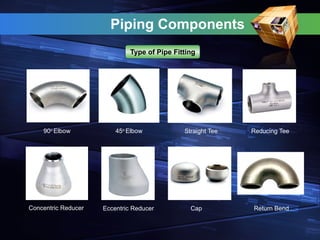
Type of Pipe Fitting
90o
Elbow 45o
Elbow Straight Tee Reducing Tee
Concentric Reducer Eccentric Reducer Cap Return Bend
Piping Components
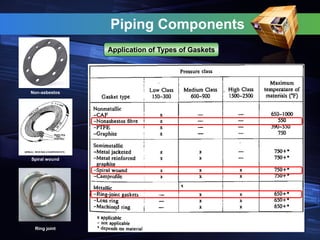
Application of Types of Gaskets
Non-asbestos
Spiral wound
Ring joint
Piping Components
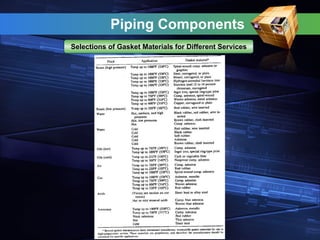
Selections of Gasket Materials for Different Services
Piping Components
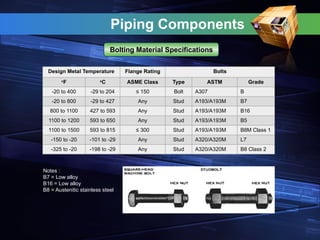
Bolting Material Specifications
Design Metal Temperature Flange Rating Bolts
o
F o
C ASME Class Type ASTM Grade
-20 to 400 -29 to 204 ≤ 150 Bolt A307 B
-20 to 800 -29 to 427 Any Stud A193/A193M B7
800 to 1100 427 to 593 Any Stud A193/A193M B16
1100 to 1200 593 to 650 Any Stud A193/A193M B5
1100 to 1500 593 to 815 ≤ 300 Stud A193/A193M B8M Class 1
-150 to -20 -101 to -29 Any Stud A320/A320M L7
-325 to -20 -198 to -29 Any Stud A320/A320M B8 Class 2
Notes :
B7 = Low alloy
B16 = Low alloy
B8 = Austenitic stainless steel
Piping Components
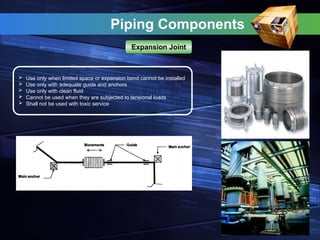
 Use only when limited space or expansion bend cannot be installed
 Use only with adequate guide and anchors
 Use only with clean fluid
 Cannot be used when they are subjected to tensional loads
 Shall not be used with toxic service
Expansion Joint
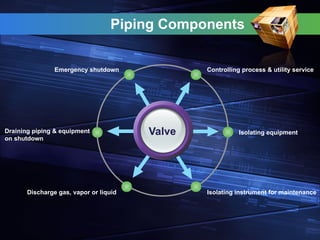
Controlling process & utility service
Emergency shutdown
Isolating equipment
Isolating instrument for maintenance
Draining piping & equipment
on shutdown
Discharge gas, vapor or liquid
Valve
Piping Components
Piping Components
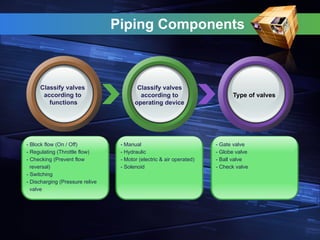
Classify valves
according to
functions
Classify valves
according to
operating device
Type of valves
- Block flow (On / Off)
- Regulating (Throttle flow)
- Checking (Prevent flow
reversal)
- Switching
- Discharging (Pressure relive
valve
- Manual
- Hydraulic
- Motor (electric & air operated)
- Solenoid
- Gate valve
- Globe valve
- Ball valve
- Check valve
Piping Components
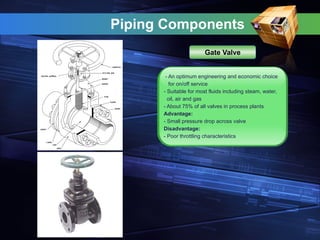
- An optimum engineering and economic choice
for on/off service
- Suitable for most fluids including steam, water,
oil, air and gas
- About 75% of all valves in process plants
Advantage:
- Small pressure drop across valve
Disadvantage:
- Poor throttling characteristics
Gate Valve
Piping Components
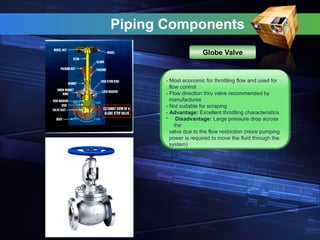
- Most economic for throttling flow and used for
flow control
- Flow direction thru valve recommended by
manufactures
- Not suitable for scraping
- Advantage: Excellent throttling characteristics
- Disadvantage: Large pressure drop across
the
valve due to the flow restriction (more pumping
power is required to move the fluid through the
system)
Globe Valve
Piping Components
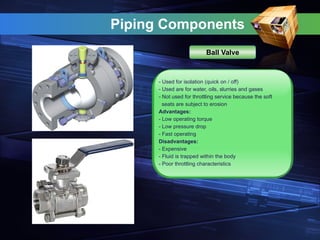
- Used for isolation (quick on / off)
- Used are for water, oils, slurries and gases
- Not used for throttling service because the soft
seats are subject to erosion
Advantages:
- Low operating torque
- Low pressure drop
- Fast operating
Disadvantages:
- Expensive
- Fluid is trapped within the body
- Poor throttling characteristics
Ball Valve
Piping Components
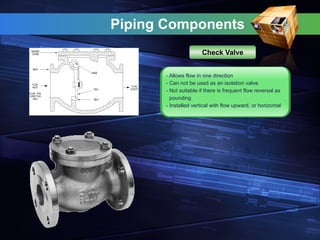
- Allows flow in one direction
- Can not be used as an isolation valve
- Not suitable if there is frequent flow reversal as
pounding
- Installed vertical with flow upward, or horizontal
Check Valve
Piping Components
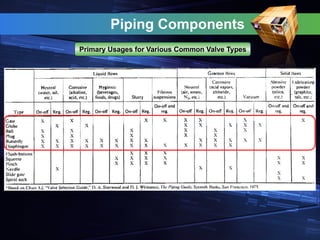
Primary Usages for Various Common Valve Types
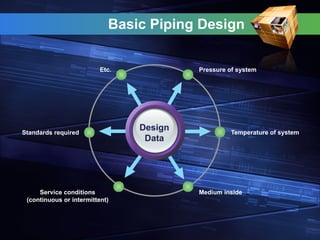
Pressure of system
Etc.
Temperature of system
Medium inside
Standards required
Service conditions
(continuous or intermittent)
Design
Data
Basic Piping Design
Basic Piping Design
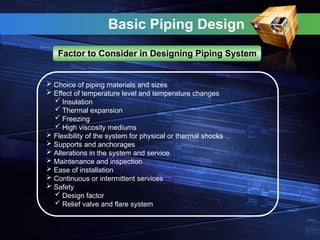
Factor to Consider in Designing Piping System
 Choice of piping materials and sizes
 Effect of temperature level and temperature changes
 Insulation
 Thermal expansion
 Freezing
 High viscosity mediums
 Flexibility of the system for physical or thermal shocks
 Supports and anchorages
 Alterations in the system and service
 Maintenance and inspection
 Ease of installation
 Continuous or intermittent services
 Safety
 Design factor
 Relief valve and flare system
Basic Piping Design
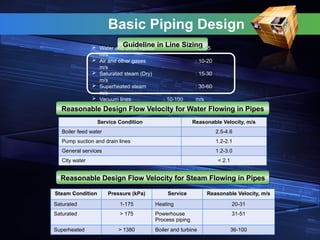
Guideline in Line Sizing
 Water and other liquids : 0.5-5
m/s
 Air and other gases : 10-20
m/s
 Saturated steam (Dry) : 15-30
m/s
 Superheated steam : 30-60
m/s
 Vacuum lines : 10-100 m/s
Reasonable Design Flow Velocity for Water Flowing in Pipes
Service Condition Reasonable Velocity, m/s
Boiler feed water 2.5-4.6
Pump suction and drain lines 1.2-2.1
General services 1.2-3.0
City water < 2.1
Reasonable Design Flow Velocity for Steam Flowing in Pipes
Steam Condition Pressure (kPa) Service Reasonable Velocity, m/s
Saturated 1-175 Heating 20-31
Saturated > 175 Powerhouse
Process piping
31-51
Superheated > 1380 Boiler and turbine 36-100
Basic Piping Design
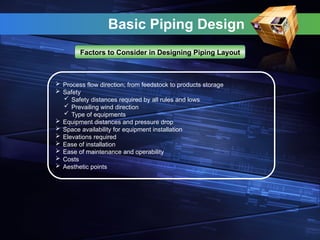
Factors to Consider in Designing Piping Layout
 Process flow direction; from feedstock to products storage
 Safety
 Safety distances required by all rules and lows
 Prevailing wind direction
 Type of equipments
 Equipment distances and pressure drop
 Space availability for equipment installation
 Elevations required
 Ease of installation
 Ease of maintenance and operability
 Costs
 Aesthetic points
Basic Piping Design
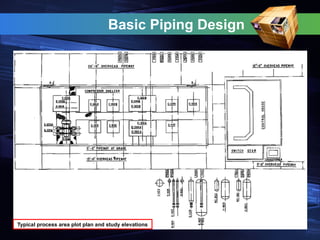
Typical process area plot plan and study elevations
Basic Piping Design
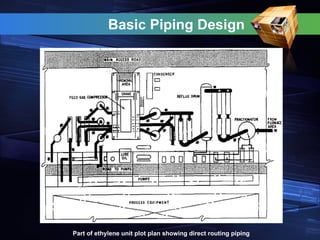
Part of ethylene unit plot plan showing direct routing piping
Basic Piping Design
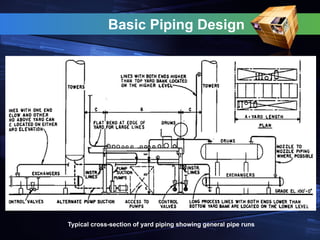
Typical cross-section of yard piping showing general pipe runs
Basic Piping Design
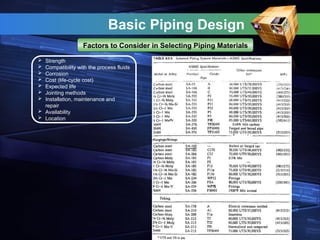
Factors to Consider in Selecting Piping Materials
 Strength
 Compatibility with the process fluids
 Corrosion
 Cost (life-cycle cost)
 Expected life
 Jointing methods
 Installation, maintenance and
repair
 Availability
 Location
Basic Piping Design
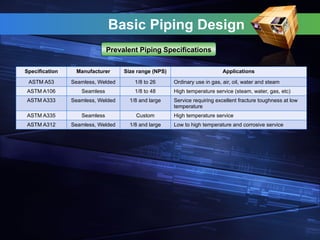
Specification Manufacturer Size range (NPS) Applications
ASTM A53 Seamless, Welded 1/8 to 26 Ordinary use in gas, air, oil, water and steam
ASTM A106 Seamless 1/8 to 48 High temperature service (steam, water, gas, etc)
ASTM A333 Seamless, Welded 1/8 and large Service requiring excellent fracture toughness at low
temperature
ASTM A335 Seamless Custom High temperature service
ASTM A312 Seamless, Welded 1/8 and large Low to high temperature and corrosive service
Prevalent Piping Specifications
Basic Piping Design
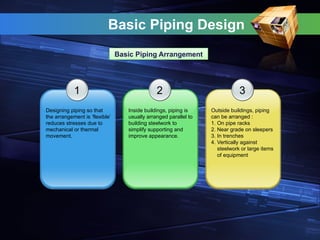
1
Designing piping so that
the arrangement is ‘flexible’
reduces stresses due to
mechanical or thermal
movement.
2
Inside buildings, piping is
usually arranged parallel to
building steelwork to
simplify supporting and
improve appearance.
3
Outside buildings, piping
can be arranged :
1. On pipe racks
2. Near grade on sleepers
3. In trenches
4. Vertically against
steelwork or large items
of equipment
Basic Piping Arrangement
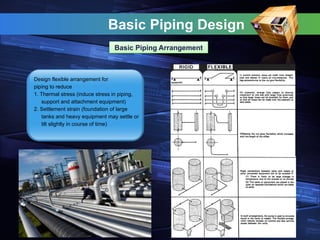
Design flexible arrangement for
piping to reduce
1. Thermal stress (induce stress in piping,
support and attachment equipment)
2. Settlement strain (foundation of large
tanks and heavy equipment may settle or
tilt slightly in course of time)
Basic Piping Design
Basic Piping Arrangement
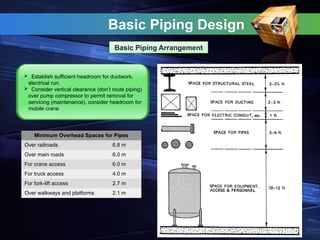
 Establish sufficient headroom for ductwork,
electrical run.
 Consider vertical clearance (don’t route piping)
over pump compressor to permit removal for
servicing (maintenance), consider headroom for
mobile crane
Basic Piping Design
Basic Piping Arrangement
Minimum Overhead Spaces for Pipes
Over railroads 6.8 m
Over main roads 6.0 m
For crane access 6.0 m
For truck access 4.0 m
For fork-lift access 2.7 m
Over walkways and platforms 2.1 m
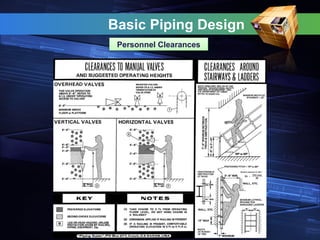
Personnel Clearances
Basic Piping Design
Basic Piping Design
Piping Adjacent to Equipment
General :
 Piping shall be routed to allow access for maintenance (e.g. cranes and truck).
Removal or replacement of equipment shall be possible with a minimum
dismantling of piping
 All equipment shall have a valve drains and vents provided
Basic Piping Design
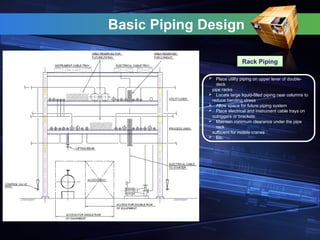
 Place utility piping on upper lever of double-
deck
pipe racks
 Locate large liquid-filled piping near columns to
reduce bending stress
 Allow space for future piping system
 Place electrical and instrument cable trays on
outriggers or brackets
 Maintain minimum clearance under the pipe
rack
sufficient for mobile cranes
 Etc.
Rack Piping
Basic Piping Design
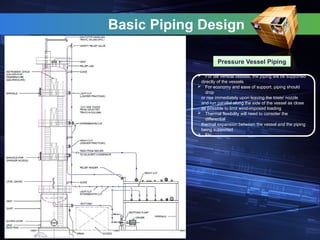
Pressure Vessel Piping
 For tall vertical vessels, the piping will be supported
directly of the vessels
 For economy and ease of support, piping should
drop
or rise immediately upon leaving the tower nozzle
and run parallel along the side of the vessel as close
as possible to limit wind-imposed loading
 Thermal flexibility will need to consider the
differential
thermal expansion between the vessel and the piping
being supported
 Etc.
Basic Piping Design
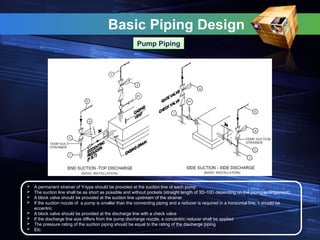
 A permanent strainer of Y-type should be provided at the suction line of each pump
 The suction line shall be as short as possible and without pockets (straight length of 3D-10D depending on the piping arrangement)
 A block valve should be provided at the suction line upstream of the strainer
 If the suction nozzle of a pump is smaller than the connecting piping and a reducer is required in a horizontal line, it should be
eccentric
 A block valve should be provided at the discharge line with a check valve
 If the discharge line size differs from the pump discharge nozzle, a concentric reducer shall be applied
 The pressure rating of the suction piping should be equal to the rating of the discharge piping
 Etc.
Pump Piping
Basic Piping Design
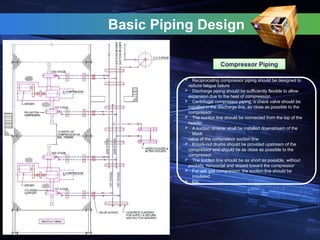
Compressor Piping
 Reciprocating compressor piping should be designed to
reduce fatigue failure
 Discharge piping should be sufficiently flexible to allow
expansion due to the heat of compression
 Centrifugal compressor piping, a check valve should be
installed in the discharge line, as close as possible to the
compressor
 The suction line should be connected from the top of the
header
 A suction strainer shall be installed downstream of the
block
valve of the compressor suction line
 Knock-out drums should be provided upstream of the
compressor and should be as close as possible to the
compressor
 The suction line should be as short as possible, without
pockets, horizontal and sloped toward the compressor
 For wet gas compressor, the suction line should be
insulated
 Etc.
Basic Piping Design
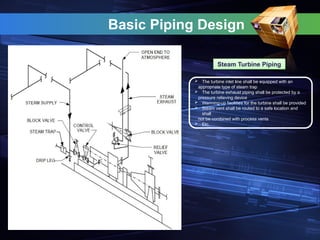
Steam Turbine Piping
 The turbine inlet line shall be equipped with an
appropriate type of steam trap
 The turbine exhaust piping shall be protected by a
pressure relieving device
 Warming-up facilities for the turbine shall be provided
 Steam vent shall be routed to a safe location and
shall
not be combined with process vents
 Etc.
Basic Piping Design
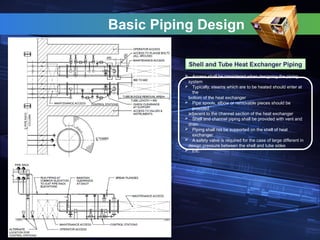
Shell and Tube Heat Exchanger Piping
 Access shall be considered when designing the piping
system
 Typically, steams which are to be heated should enter at
the
bottom of the heat exchanger
 Pipe spools, elbow or removable pieces should be
provided
adjacent to the channel section of the heat exchanger
 Shell and channel piping shall be provided with vent and
drain
 Piping shall not be supported on the shell of heat
exchanger
 A safety valve is required for the case of large different in
design pressure between the shell and tube sides
 Etc.
Basic Piping Design
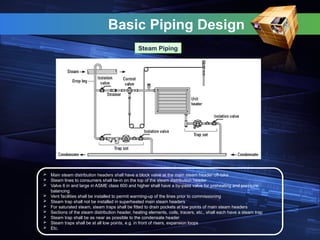
Steam Piping
 Main steam distribution headers shall have a block valve at the main steam header off-take
 Steam lines to consumers shall tie-in on the top of the steam distribution header
 Valve 6 in and large in ASME class 600 and higher shall have a by-pass valve for preheating and pressure
balancing
 Vent facilities shall be installed to permit warming-up of the lines prior to commissioning
 Steam trap shall not be installed in superheated main steam headers
 For saturated steam, steam traps shall be fitted to drain pockets at low points of main steam headers
 Sections of the steam distribution header, heating elements, coils, tracers, etc., shall each have a steam trap
 Steam trap shall be as near as possible to the condensate header
 Steam traps shall be at all low points, e.g. in front of risers, expansion loops
 Etc.
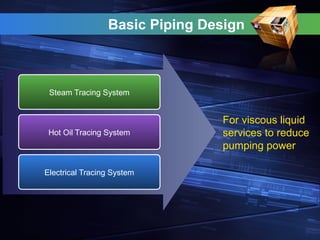
Steam Tracing System
Hot Oil Tracing System
Electrical Tracing System
For viscous liquid
services to reduce
pumping power
Basic Piping Design
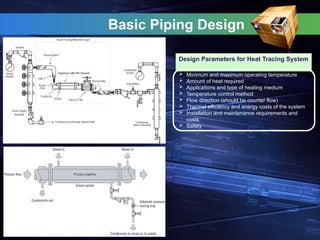
Design Parameters for Heat Tracing System
 Minimum and maximum operating temperature
 Amount of heat required
 Applications and type of heating medium
 Temperature control method
 Flow direction (should be counter flow)
 Thermal efficiency and energy costs of the system
 Installation and maintenance requirements and
costs
 Safety
Basic Piping Design
Basic Piping Design
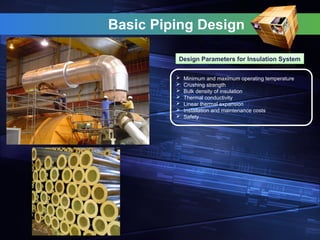
Design Parameters for Insulation System
 Minimum and maximum operating temperature
 Crushing strength
 Bulk density of insulation
 Thermal conductivity
 Linear thermal expansion
 Installation and maintenance costs
 Safety
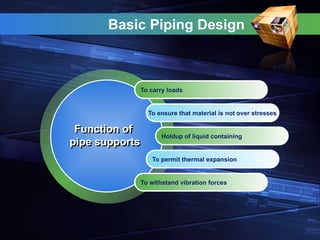
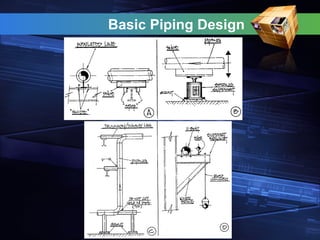
To carry loads
To ensure that material is not over stresses
Holdup of liquid containing
To permit thermal expansion
To withstand vibration forces
Function of
pipe supports
Basic Piping Design
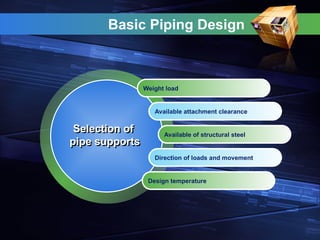
Weight load
Available attachment clearance
Available of structural steel
Direction of loads and movement
Design temperature
Selection of
pipe supports
Basic Piping Design
Basic Piping Design
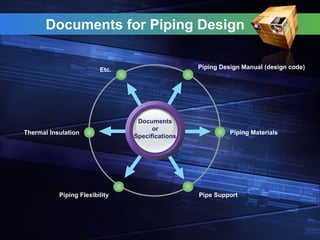
Piping Design Manual (design code)
Etc.
Piping Materials
Pipe Support
Thermal Insulation
Piping Flexibility
Documents
or
Specifications
Documents for Piping Design
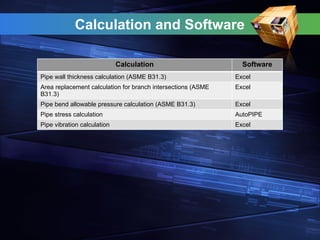
Calculation and Software
Calculation Software
Pipe wall thickness calculation (ASME B31.3) Excel
Area replacement calculation for branch intersections (ASME
B31.3)
Excel
Pipe bend allowable pressure calculation (ASME B31.3) Excel
Pipe stress calculation AutoPIPE
Pipe vibration calculation Excel
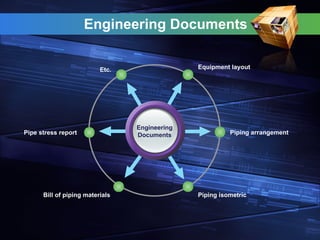
Engineering Documents
Equipment layout
Etc.
Piping arrangement
Piping isometric
Pipe stress report
Bill of piping materials
Engineering
Documents
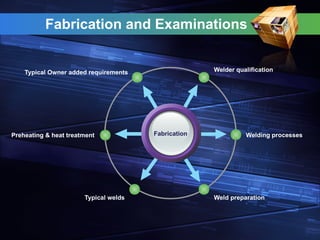
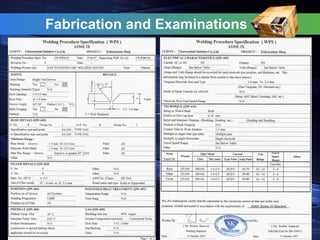
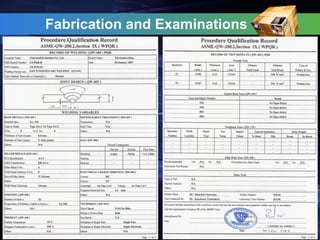
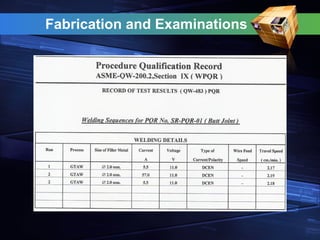
Welder qualification
Typical Owner added requirements
Welding processes
Weld preparation
Preheating & heat treatment
Typical welds
Fabrication
Fabrication and Examinations
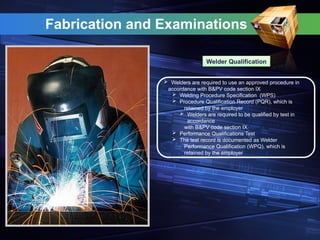
Welder Qualification
 Welders are required to use an approved procedure in
accordance with B&PV code section IX
 Welding Procedure Specification (WPS)
 Procedure Qualification Record (PQR), which is
retained by the employer
 Welders are required to be qualified by test in
accordance
with B&PV code section IX
 Performance Qualifications Test
 The test record is documented as Welder
Performance Qualification (WPQ), which is
retained by the employer
Fabrication and Examinations
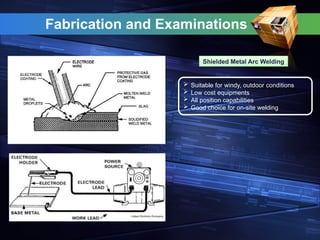
Shielded Metal Arc Welding
 Suitable for windy, outdoor conditions
 Low cost equipments
 All position capabilities
 Good choice for on-site welding
Fabrication and Examinations
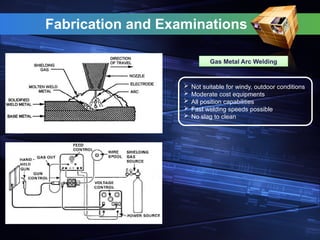
Gas Metal Arc Welding
 Not suitable for windy, outdoor conditions
 Moderate cost equipments
 All position capabilities
 Fast welding speeds possible
 No slag to clean
Fabrication and Examinations
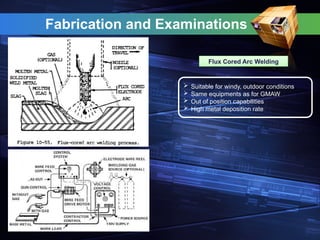
Flux Cored Arc Welding
 Suitable for windy, outdoor conditions
 Same equipments as for GMAW
 Out of position capabilities
 High metal deposition rate
Fabrication and Examinations
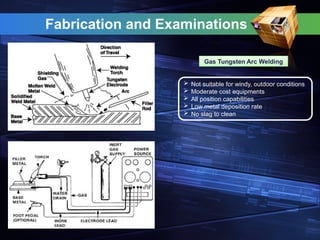
Gas Tungsten Arc Welding
 Not suitable for windy, outdoor conditions
 Moderate cost equipments
 All position capabilities
 Low metal deposition rate
 No slag to clean
Fabrication and Examinations
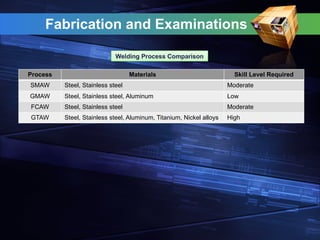
Welding Process Comparison
Process Materials Skill Level Required
SMAW Steel, Stainless steel Moderate
GMAW Steel, Stainless steel, Aluminum Low
FCAW Steel, Stainless steel Moderate
GTAW Steel, Stainless steel, Aluminum, Titanium, Nickel alloys High
Fabrication and Examinations
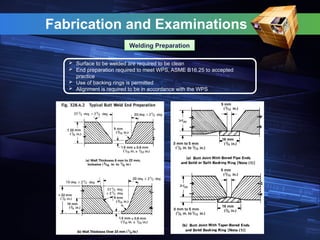
Welding Preparation
 Surface to be welded are required to be clean
 End preparation required to meet WPS, ASME B16.25 to accepted
practice
 Use of backing rings is permitted
 Alignment is required to be in accordance with the WPS
Fabrication and Examinations
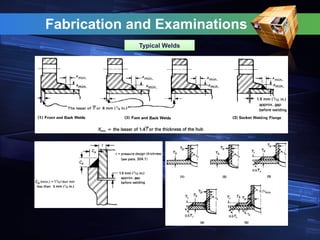
Typical Welds
Fabrication and Examinations
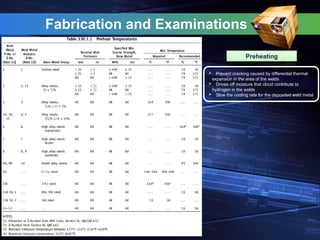
Preheating
 Prevent cracking caused by differential thermal
expansion in the area of the welds
 Drives off moisture that cloud contribute to
hydrogen in the welds
 Slow the cooling rate for the deposited weld metal
Fabrication and Examinations
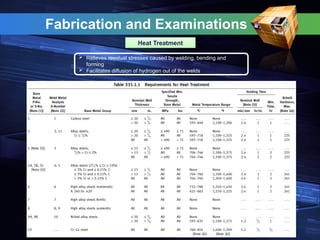
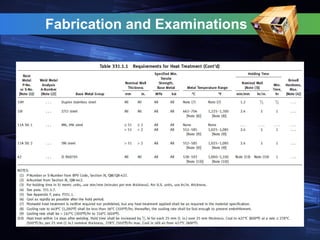
Heat Treatment
 Relieves residual stresses caused by welding, bending and
forming
 Facilitates diffusion of hydrogen out of the welds
Fabrication and Examinations
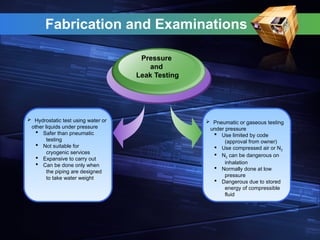
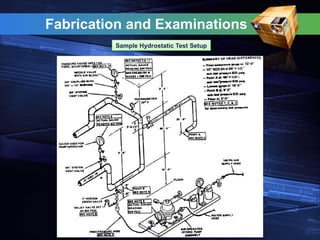
 Hydrostatic test using water or
other liquids under pressure
 Safer than pneumatic
testing
 Not suitable for
cryogenic services
 Expansive to carry out
 Can be done only when
the piping are designed
to take water weight
Pressure
and
Leak Testing
 Pneumatic or gaseous testing
under pressure
 Use limited by code
(approval from owner)
 Use compressed air or N2
 N2 can be dangerous on
inhalation
 Normally done at low
pressure
 Dangerous due to stored
energy of compressible
fluid
Fabrication and Examinations
Rules on Pressure Testing
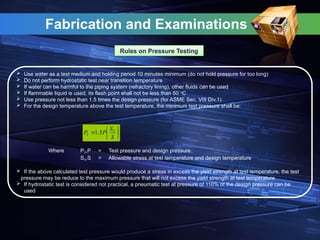
 Use water as a test medium and holding period 10 minutes minimum (do not hold pressure for too long)
 Do not perform hydrostatic test near transition temperature
 If water can be harmful to the piping system (refractory lining), other fluids can be used
 If flammable liquid is used, its flash point shall not be less than 50 o
C
 Use pressure not less than 1.5 times the design pressure (for ASME Sec. VIII Div.1)
 For the design temperature above the test temperature, the minimum test pressure shall be:
Where PT,P = Test pressure and design pressure
ST,S = Allowable stress at test temperature and design temperature
 If the above calculated test pressure would produce a stress in excess the yield strength at test temperature, the test
pressure may be reduce to the maximum pressure that will not excess the yield strength at test temperature
 If hydrostatic test is considered not practical, a pneumatic test at pressure of 110% of the design pressure can be
used







S
S
P
P T
T 5
.
1
Fabrication and Examinations
Sample Hydrostatic Test Setup
LOGO
“ Add your company slogan ”

Piping Design Basic course for engineer study

  • 1.
    LOGO “ Add yourcompany slogan ” PIPING DESIGN BASIC
  • 2.
    Contents Definition 1 Codes & Standardsfor Piping 2 Piping Components 3 Basic Piping Design 4 Documents for Piping Design 5 Calculation and Software 6
  • 3.
  • 4.
    Definition  Piping: …assemblies ofpiping components used…[for] fluid flows. Piping also includes pipe supporting elements, but does not include support structures… or equipment…  Piping system: …interconnected piping subject to the same design conditions  Piping components: …mechanical elements suitable for joining or assembly into pressure tight fluid-containing piping systems…pipes, fittings, flanges, gaskets, bolting, valves and special devices such as expansion joints.
  • 5.
    Codes & Standardsfor Piping Referenced Codes and Standards ASME Standards  B16.5 Pipe Flanges & Flange Fitting  B16.9 Buttwelding Fitting  B16.10 Face to Face & End to End Dimension of Ferrous Valves  B16.11 Forged Fittings, Socket Welding and Threaded  B16.20 Metallic Gaskets  B16.21 Nonmetallic Flat Gasket  B16.25 Butt Welding Ends  B16.34 Valve – Flange, Threaded and Welding End  B16.36 Steel Orifice Flanges  B16.47 Large Diameter Steel Flange  B36.10M Welded and Seamless Wrought Steel Pipe  B36.19 Stainless Steel Pipe  B31.1 Power Piping  B31.3 Process Piping  B31.4 Liquid Petroleum Pipeline  B31.8 Gas Transmission Pipeline  B31.9 Building Services Piping ASME Pressure Piping Code
  • 6.
    Codes & Standardsfor Piping ASTM Standards  A53 Pipe, Steel, Black and Hot- Dipped, Zinc-Coated Welded and Seamless  A106 Seamless Carbon Steel Pipe for High Temperature Service  A312 Seamless and Welded Austenitic Stainless Steel Pipe  A333 Seamless and Welded Steel Pipe for Low Temperature Service  A335 Seamless Ferritic Alloy-Steel Pipe for High Temperature Service  594 Wafer and Wafer-Lug Check Valves  600 Steel Gate Valves  608 Metal Ball Valves  609 Butterfly Valves  610 Centrifugal Pumps  611 General Purpose Steam Turbines  617 Centrifugal Compressors  618 Reciprocating Compressors  660 Shell and Tube Heat Exchangers  661 Air Cooled Heat Exchangers  5L Specification for Line Pipe API Standards Referenced Codes and Standards
  • 7.
    Codes & Standardsfor Piping Diagram Showing Scope of ASME B31.3
  • 8.
    Codes & Standardsfor Piping Scope of ASME B31.3 Rules for the Process Piping Code Section B31.3 have been developed considering piping typically found in petroleum refineries; chemical, pharmaceutical, textile, paper, semiconductor, and cryogenic plants; and related processing plants and terminals. [300.1] This Code applies for all fluids including:  Row, intermediate and finished chemicals  Petroleum products  Gas, steam, air and water  Fluidized solids  Refrigerants  Cryogenic fluids This Code excludes the following:  Piping systems designed for internal gage pressures at or above zero but less than 105 kPa (15 psi)  Fluid handled is nonflammable, nontoxic, and not damaging to human tissues  Power boilers in accordance with BPV Code Section I and boiler external piping which is required to conform to B31.1  Tube headers and manifolds of fired heaters  Pressure vessels, heat exchangers, pumps, compressors and processing equipment, including internal piping and connections for external piping
  • 9.
    Piping Components General Components 2Components Special Items  Pipe & Tube  Fittings (e.g. elbows, reducers, branch, connections, flanges, etc.) Gaskets, bolt & nut Valves Pipe support Spring support Expansion joint Low friction device
  • 10.
    Piping Components Pipe Manufacturing Seamlesspipe Welded pipe Pipe Classification Pipe supplied Schedule number : Specify pipe wall thickness 5s, 5, 10s, 10, 20, 30, 40s, STD, 40, 60, 80s, XS, 80, 100, 120, 140, 160, XXS  Random length (6 m)  Double random length (12 m)
  • 11.
    Piping Components Butt Weld Used in most piping systems NPS ≥ 2” (ASME B16.9)  Most common method  Low material cost but high labor cost  Need specialized fitters and welder  Strong  Has smooth internal surface  End preparation of pipe is beveled end (BE)  Used generally not restricted Threaded Weld  Size frequently limited to NPS≤ 1½” (ASME B16.11)  Used for lines conveying services (small process piping)  Easily made from pipe and fittings on site  Not used in service corrosion, vibration  Strength of the pipe is reduced, as forming the screw thread reduces the wall thickness Socket Weld  Size frequently limited to NPS≤ 1 ½” (ASME B16.11)  Easier alignment on small line than butt welding  Low cost on fabrication  Have lower fatigue resistance  No weld metal can enter bore  End preparation of pipe is plain end (PE) Methods of Joining Pipe
  • 12.
    Piping Components Welding neckflange  Long welding neck (used for vessel & equipment nozzle)  Suitable for high temperature  Suitable for bending & Shear  Suitable for impact and vibration stresses apply Socket welding flange  Regular type is available from stock  Not used in “severe cyclic conditions Slip-On flange  Internal weld is slightly more subject to corrosion  Poor resistance to chock and vibration  Easily to align than the welding neck flange  Strengths under internal pressure are about 1/3 of welding neck flange  Not usual practical Flanges
  • 13.
    Piping Components Pressure /temperature combinations Flange strength increases with class number 150 300 600 900 Flange Rating Class 1500 2500
  • 14.
    Piping Components Type ofPipe Fitting 90o Elbow 45o Elbow Straight Tee Reducing Tee Concentric Reducer Eccentric Reducer Cap Return Bend
  • 15.
    Piping Components Application ofTypes of Gaskets Non-asbestos Spiral wound Ring joint
  • 16.
    Piping Components Selections ofGasket Materials for Different Services
  • 17.
    Piping Components Bolting MaterialSpecifications Design Metal Temperature Flange Rating Bolts o F o C ASME Class Type ASTM Grade -20 to 400 -29 to 204 ≤ 150 Bolt A307 B -20 to 800 -29 to 427 Any Stud A193/A193M B7 800 to 1100 427 to 593 Any Stud A193/A193M B16 1100 to 1200 593 to 650 Any Stud A193/A193M B5 1100 to 1500 593 to 815 ≤ 300 Stud A193/A193M B8M Class 1 -150 to -20 -101 to -29 Any Stud A320/A320M L7 -325 to -20 -198 to -29 Any Stud A320/A320M B8 Class 2 Notes : B7 = Low alloy B16 = Low alloy B8 = Austenitic stainless steel
  • 18.
    Piping Components  Useonly when limited space or expansion bend cannot be installed  Use only with adequate guide and anchors  Use only with clean fluid  Cannot be used when they are subjected to tensional loads  Shall not be used with toxic service Expansion Joint
  • 19.
    Controlling process &utility service Emergency shutdown Isolating equipment Isolating instrument for maintenance Draining piping & equipment on shutdown Discharge gas, vapor or liquid Valve Piping Components
  • 20.
    Piping Components Classify valves accordingto functions Classify valves according to operating device Type of valves - Block flow (On / Off) - Regulating (Throttle flow) - Checking (Prevent flow reversal) - Switching - Discharging (Pressure relive valve - Manual - Hydraulic - Motor (electric & air operated) - Solenoid - Gate valve - Globe valve - Ball valve - Check valve
  • 21.
    Piping Components - Anoptimum engineering and economic choice for on/off service - Suitable for most fluids including steam, water, oil, air and gas - About 75% of all valves in process plants Advantage: - Small pressure drop across valve Disadvantage: - Poor throttling characteristics Gate Valve
  • 22.
    Piping Components - Mosteconomic for throttling flow and used for flow control - Flow direction thru valve recommended by manufactures - Not suitable for scraping - Advantage: Excellent throttling characteristics - Disadvantage: Large pressure drop across the valve due to the flow restriction (more pumping power is required to move the fluid through the system) Globe Valve
  • 23.
    Piping Components - Usedfor isolation (quick on / off) - Used are for water, oils, slurries and gases - Not used for throttling service because the soft seats are subject to erosion Advantages: - Low operating torque - Low pressure drop - Fast operating Disadvantages: - Expensive - Fluid is trapped within the body - Poor throttling characteristics Ball Valve
  • 24.
    Piping Components - Allowsflow in one direction - Can not be used as an isolation valve - Not suitable if there is frequent flow reversal as pounding - Installed vertical with flow upward, or horizontal Check Valve
  • 25.
    Piping Components Primary Usagesfor Various Common Valve Types
  • 26.
    Pressure of system Etc. Temperatureof system Medium inside Standards required Service conditions (continuous or intermittent) Design Data Basic Piping Design
  • 27.
    Basic Piping Design Factorto Consider in Designing Piping System  Choice of piping materials and sizes  Effect of temperature level and temperature changes  Insulation  Thermal expansion  Freezing  High viscosity mediums  Flexibility of the system for physical or thermal shocks  Supports and anchorages  Alterations in the system and service  Maintenance and inspection  Ease of installation  Continuous or intermittent services  Safety  Design factor  Relief valve and flare system
  • 28.
    Basic Piping Design Guidelinein Line Sizing  Water and other liquids : 0.5-5 m/s  Air and other gases : 10-20 m/s  Saturated steam (Dry) : 15-30 m/s  Superheated steam : 30-60 m/s  Vacuum lines : 10-100 m/s Reasonable Design Flow Velocity for Water Flowing in Pipes Service Condition Reasonable Velocity, m/s Boiler feed water 2.5-4.6 Pump suction and drain lines 1.2-2.1 General services 1.2-3.0 City water < 2.1 Reasonable Design Flow Velocity for Steam Flowing in Pipes Steam Condition Pressure (kPa) Service Reasonable Velocity, m/s Saturated 1-175 Heating 20-31 Saturated > 175 Powerhouse Process piping 31-51 Superheated > 1380 Boiler and turbine 36-100
  • 29.
    Basic Piping Design Factorsto Consider in Designing Piping Layout  Process flow direction; from feedstock to products storage  Safety  Safety distances required by all rules and lows  Prevailing wind direction  Type of equipments  Equipment distances and pressure drop  Space availability for equipment installation  Elevations required  Ease of installation  Ease of maintenance and operability  Costs  Aesthetic points
  • 30.
    Basic Piping Design Typicalprocess area plot plan and study elevations
  • 31.
    Basic Piping Design Partof ethylene unit plot plan showing direct routing piping
  • 32.
    Basic Piping Design Typicalcross-section of yard piping showing general pipe runs
  • 33.
    Basic Piping Design Factorsto Consider in Selecting Piping Materials  Strength  Compatibility with the process fluids  Corrosion  Cost (life-cycle cost)  Expected life  Jointing methods  Installation, maintenance and repair  Availability  Location
  • 34.
    Basic Piping Design SpecificationManufacturer Size range (NPS) Applications ASTM A53 Seamless, Welded 1/8 to 26 Ordinary use in gas, air, oil, water and steam ASTM A106 Seamless 1/8 to 48 High temperature service (steam, water, gas, etc) ASTM A333 Seamless, Welded 1/8 and large Service requiring excellent fracture toughness at low temperature ASTM A335 Seamless Custom High temperature service ASTM A312 Seamless, Welded 1/8 and large Low to high temperature and corrosive service Prevalent Piping Specifications
  • 35.
    Basic Piping Design 1 Designingpiping so that the arrangement is ‘flexible’ reduces stresses due to mechanical or thermal movement. 2 Inside buildings, piping is usually arranged parallel to building steelwork to simplify supporting and improve appearance. 3 Outside buildings, piping can be arranged : 1. On pipe racks 2. Near grade on sleepers 3. In trenches 4. Vertically against steelwork or large items of equipment Basic Piping Arrangement
  • 36.
    Design flexible arrangementfor piping to reduce 1. Thermal stress (induce stress in piping, support and attachment equipment) 2. Settlement strain (foundation of large tanks and heavy equipment may settle or tilt slightly in course of time) Basic Piping Design Basic Piping Arrangement
  • 37.
     Establish sufficientheadroom for ductwork, electrical run.  Consider vertical clearance (don’t route piping) over pump compressor to permit removal for servicing (maintenance), consider headroom for mobile crane Basic Piping Design Basic Piping Arrangement Minimum Overhead Spaces for Pipes Over railroads 6.8 m Over main roads 6.0 m For crane access 6.0 m For truck access 4.0 m For fork-lift access 2.7 m Over walkways and platforms 2.1 m
  • 38.
  • 39.
    Basic Piping Design PipingAdjacent to Equipment General :  Piping shall be routed to allow access for maintenance (e.g. cranes and truck). Removal or replacement of equipment shall be possible with a minimum dismantling of piping  All equipment shall have a valve drains and vents provided
  • 40.
    Basic Piping Design Place utility piping on upper lever of double- deck pipe racks  Locate large liquid-filled piping near columns to reduce bending stress  Allow space for future piping system  Place electrical and instrument cable trays on outriggers or brackets  Maintain minimum clearance under the pipe rack sufficient for mobile cranes  Etc. Rack Piping
  • 41.
    Basic Piping Design PressureVessel Piping  For tall vertical vessels, the piping will be supported directly of the vessels  For economy and ease of support, piping should drop or rise immediately upon leaving the tower nozzle and run parallel along the side of the vessel as close as possible to limit wind-imposed loading  Thermal flexibility will need to consider the differential thermal expansion between the vessel and the piping being supported  Etc.
  • 42.
    Basic Piping Design A permanent strainer of Y-type should be provided at the suction line of each pump  The suction line shall be as short as possible and without pockets (straight length of 3D-10D depending on the piping arrangement)  A block valve should be provided at the suction line upstream of the strainer  If the suction nozzle of a pump is smaller than the connecting piping and a reducer is required in a horizontal line, it should be eccentric  A block valve should be provided at the discharge line with a check valve  If the discharge line size differs from the pump discharge nozzle, a concentric reducer shall be applied  The pressure rating of the suction piping should be equal to the rating of the discharge piping  Etc. Pump Piping
  • 43.
    Basic Piping Design CompressorPiping  Reciprocating compressor piping should be designed to reduce fatigue failure  Discharge piping should be sufficiently flexible to allow expansion due to the heat of compression  Centrifugal compressor piping, a check valve should be installed in the discharge line, as close as possible to the compressor  The suction line should be connected from the top of the header  A suction strainer shall be installed downstream of the block valve of the compressor suction line  Knock-out drums should be provided upstream of the compressor and should be as close as possible to the compressor  The suction line should be as short as possible, without pockets, horizontal and sloped toward the compressor  For wet gas compressor, the suction line should be insulated  Etc.
  • 44.
    Basic Piping Design SteamTurbine Piping  The turbine inlet line shall be equipped with an appropriate type of steam trap  The turbine exhaust piping shall be protected by a pressure relieving device  Warming-up facilities for the turbine shall be provided  Steam vent shall be routed to a safe location and shall not be combined with process vents  Etc.
  • 45.
    Basic Piping Design Shelland Tube Heat Exchanger Piping  Access shall be considered when designing the piping system  Typically, steams which are to be heated should enter at the bottom of the heat exchanger  Pipe spools, elbow or removable pieces should be provided adjacent to the channel section of the heat exchanger  Shell and channel piping shall be provided with vent and drain  Piping shall not be supported on the shell of heat exchanger  A safety valve is required for the case of large different in design pressure between the shell and tube sides  Etc.
  • 46.
    Basic Piping Design SteamPiping  Main steam distribution headers shall have a block valve at the main steam header off-take  Steam lines to consumers shall tie-in on the top of the steam distribution header  Valve 6 in and large in ASME class 600 and higher shall have a by-pass valve for preheating and pressure balancing  Vent facilities shall be installed to permit warming-up of the lines prior to commissioning  Steam trap shall not be installed in superheated main steam headers  For saturated steam, steam traps shall be fitted to drain pockets at low points of main steam headers  Sections of the steam distribution header, heating elements, coils, tracers, etc., shall each have a steam trap  Steam trap shall be as near as possible to the condensate header  Steam traps shall be at all low points, e.g. in front of risers, expansion loops  Etc.
  • 47.
    Steam Tracing System HotOil Tracing System Electrical Tracing System For viscous liquid services to reduce pumping power Basic Piping Design
  • 48.
    Design Parameters forHeat Tracing System  Minimum and maximum operating temperature  Amount of heat required  Applications and type of heating medium  Temperature control method  Flow direction (should be counter flow)  Thermal efficiency and energy costs of the system  Installation and maintenance requirements and costs  Safety Basic Piping Design
  • 49.
    Basic Piping Design DesignParameters for Insulation System  Minimum and maximum operating temperature  Crushing strength  Bulk density of insulation  Thermal conductivity  Linear thermal expansion  Installation and maintenance costs  Safety
  • 50.
    To carry loads Toensure that material is not over stresses Holdup of liquid containing To permit thermal expansion To withstand vibration forces Function of pipe supports Basic Piping Design
  • 51.
    Weight load Available attachmentclearance Available of structural steel Direction of loads and movement Design temperature Selection of pipe supports Basic Piping Design
  • 52.
  • 53.
    Piping Design Manual(design code) Etc. Piping Materials Pipe Support Thermal Insulation Piping Flexibility Documents or Specifications Documents for Piping Design
  • 54.
    Calculation and Software CalculationSoftware Pipe wall thickness calculation (ASME B31.3) Excel Area replacement calculation for branch intersections (ASME B31.3) Excel Pipe bend allowable pressure calculation (ASME B31.3) Excel Pipe stress calculation AutoPIPE Pipe vibration calculation Excel
  • 55.
    Engineering Documents Equipment layout Etc. Pipingarrangement Piping isometric Pipe stress report Bill of piping materials Engineering Documents
  • 56.
    Welder qualification Typical Owneradded requirements Welding processes Weld preparation Preheating & heat treatment Typical welds Fabrication Fabrication and Examinations
  • 57.
    Fabrication and Examinations WelderQualification  Welders are required to use an approved procedure in accordance with B&PV code section IX  Welding Procedure Specification (WPS)  Procedure Qualification Record (PQR), which is retained by the employer  Welders are required to be qualified by test in accordance with B&PV code section IX  Performance Qualifications Test  The test record is documented as Welder Performance Qualification (WPQ), which is retained by the employer
  • 58.
    Fabrication and Examinations ShieldedMetal Arc Welding  Suitable for windy, outdoor conditions  Low cost equipments  All position capabilities  Good choice for on-site welding
  • 59.
    Fabrication and Examinations GasMetal Arc Welding  Not suitable for windy, outdoor conditions  Moderate cost equipments  All position capabilities  Fast welding speeds possible  No slag to clean
  • 60.
    Fabrication and Examinations FluxCored Arc Welding  Suitable for windy, outdoor conditions  Same equipments as for GMAW  Out of position capabilities  High metal deposition rate
  • 61.
    Fabrication and Examinations GasTungsten Arc Welding  Not suitable for windy, outdoor conditions  Moderate cost equipments  All position capabilities  Low metal deposition rate  No slag to clean
  • 62.
    Fabrication and Examinations WeldingProcess Comparison Process Materials Skill Level Required SMAW Steel, Stainless steel Moderate GMAW Steel, Stainless steel, Aluminum Low FCAW Steel, Stainless steel Moderate GTAW Steel, Stainless steel, Aluminum, Titanium, Nickel alloys High
  • 63.
    Fabrication and Examinations WeldingPreparation  Surface to be welded are required to be clean  End preparation required to meet WPS, ASME B16.25 to accepted practice  Use of backing rings is permitted  Alignment is required to be in accordance with the WPS
  • 64.
  • 65.
    Fabrication and Examinations Preheating Prevent cracking caused by differential thermal expansion in the area of the welds  Drives off moisture that cloud contribute to hydrogen in the welds  Slow the cooling rate for the deposited weld metal
  • 66.
    Fabrication and Examinations HeatTreatment  Relieves residual stresses caused by welding, bending and forming  Facilitates diffusion of hydrogen out of the welds
  • 67.
  • 68.
  • 69.
  • 70.
  • 71.
     Hydrostatic testusing water or other liquids under pressure  Safer than pneumatic testing  Not suitable for cryogenic services  Expansive to carry out  Can be done only when the piping are designed to take water weight Pressure and Leak Testing  Pneumatic or gaseous testing under pressure  Use limited by code (approval from owner)  Use compressed air or N2  N2 can be dangerous on inhalation  Normally done at low pressure  Dangerous due to stored energy of compressible fluid Fabrication and Examinations
  • 72.
    Fabrication and Examinations Ruleson Pressure Testing  Use water as a test medium and holding period 10 minutes minimum (do not hold pressure for too long)  Do not perform hydrostatic test near transition temperature  If water can be harmful to the piping system (refractory lining), other fluids can be used  If flammable liquid is used, its flash point shall not be less than 50 o C  Use pressure not less than 1.5 times the design pressure (for ASME Sec. VIII Div.1)  For the design temperature above the test temperature, the minimum test pressure shall be: Where PT,P = Test pressure and design pressure ST,S = Allowable stress at test temperature and design temperature  If the above calculated test pressure would produce a stress in excess the yield strength at test temperature, the test pressure may be reduce to the maximum pressure that will not excess the yield strength at test temperature  If hydrostatic test is considered not practical, a pneumatic test at pressure of 110% of the design pressure can be used        S S P P T T 5 . 1
  • 73.
  • 74.
    LOGO “ Add yourcompany slogan ”