Habitat Use by Bats in Montana Managed Forests: a Pilot Study
Western Small Footed Bat
 Background
 Forest bat roost and winter hibernacula habitat is poorly
understood in Montana-attention focused on caves.
 Unknown if bats hibernate in trees
 White Nose Syndrome (WNS) has caused dramatic population
declines >80%.
 WNS affects bats during hibernation- we have very little
information on what structures bats are using as hibernacula
in the west, let alone Montana, no idea how this may affect
westward of WNS.
 WNS is spreading south and west: this year detected in
Minnesota, Iowa and Mississippi in addition to 23 other states.
 11 hibernating bat species have been affected by WNS.
 Northern Long-eared Myotis (M. septentrionalis) proposed for
federal listing under ESA because of WNS
Montana Bat Investigations
 Employ advanced acoustic monitoring technology to remotely
inventory bat species using working forest habitats
 Follow up with telemetry investigations to identify species
specific seasonal roost habitat preferences
 Use acoustic and telemetry techniques to evaluate winter
hibernacula habitat within working forests
 Expand effort to provide credible data for future bat species
listing and habitat management processes
Findings/Discussion
 High diversity and high activity levels of bats documented in
managed forest using acoustic monitoring
 Managed forests seem to provide excellent foraging habitat,
and suitable roosting habitat in summer and fall
 Collection of important pre-hibernation behavior and roost site
selection for California myotis
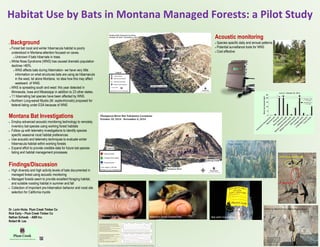
Acoustic monitoring
 Species specific daily and annual patterns
 Potential surveillance tools for WNS
 Cost effective
Bat with transmitterCalifornia Myotis
Tree Roost
California Myotis Diurnal Disturbance Event
Rock Roost
Bird Nest with Eggs
Bat roosted below bird nest
and attempted to crawl up
crevice to eat eggs. Nesting
bird forced bat out of roost
Dr. Lorin Hicks Plum Creek Timber Co
Rick Early – Plum Creek Timber Co
Nathan Schwab - ABR Inc.
Robert M. Lee
Shier, T.A., C.M. Hudson, and S.A. Scott. 2014. Acoustic surveillance to monitor the prevalence of White-nose Syndrome. Indiana Dept. Fish and Wildlife.

Bats

  • 1.
    Habitat Use byBats in Montana Managed Forests: a Pilot Study Western Small Footed Bat  Background  Forest bat roost and winter hibernacula habitat is poorly understood in Montana-attention focused on caves.  Unknown if bats hibernate in trees  White Nose Syndrome (WNS) has caused dramatic population declines >80%.  WNS affects bats during hibernation- we have very little information on what structures bats are using as hibernacula in the west, let alone Montana, no idea how this may affect westward of WNS.  WNS is spreading south and west: this year detected in Minnesota, Iowa and Mississippi in addition to 23 other states.  11 hibernating bat species have been affected by WNS.  Northern Long-eared Myotis (M. septentrionalis) proposed for federal listing under ESA because of WNS Montana Bat Investigations  Employ advanced acoustic monitoring technology to remotely inventory bat species using working forest habitats  Follow up with telemetry investigations to identify species specific seasonal roost habitat preferences  Use acoustic and telemetry techniques to evaluate winter hibernacula habitat within working forests  Expand effort to provide credible data for future bat species listing and habitat management processes Findings/Discussion  High diversity and high activity levels of bats documented in managed forest using acoustic monitoring  Managed forests seem to provide excellent foraging habitat, and suitable roosting habitat in summer and fall  Collection of important pre-hibernation behavior and roost site selection for California myotis Acoustic monitoring  Species specific daily and annual patterns  Potential surveillance tools for WNS  Cost effective Bat with transmitterCalifornia Myotis Tree Roost California Myotis Diurnal Disturbance Event Rock Roost Bird Nest with Eggs Bat roosted below bird nest and attempted to crawl up crevice to eat eggs. Nesting bird forced bat out of roost Dr. Lorin Hicks Plum Creek Timber Co Rick Early – Plum Creek Timber Co Nathan Schwab - ABR Inc. Robert M. Lee Shier, T.A., C.M. Hudson, and S.A. Scott. 2014. Acoustic surveillance to monitor the prevalence of White-nose Syndrome. Indiana Dept. Fish and Wildlife.