Asia’s Future Critical Thinking for a Changing Environment
60%  of the world’s population lives in Asia …this means that people standing side by side holding hands would reach around the world at the equator  more than  100 times.
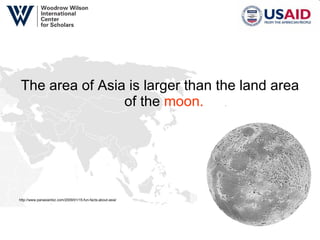
The area of Asia is larger than the land area of the  moon.   http://www.panasianbiz.com/2009/01/15-fun-facts-about-asia/
20%  of the world’s known terrestrial species and 75%  of the world’s known coral species live in Southeast Asia which occupies only  3%  of the world’s total land area.
The  highest  fish diversity on the planet is in Southeast Asia 
Over  200 million people  in the region depend on fish as their primary source of protein.
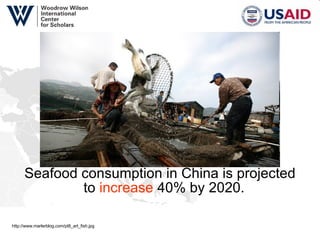
Seafood consumption in China is projected to  increase  40% by 2020.  http://www.marlerblog.com/pt8_art_fish.jpg
With Deforestation predicted to reach  74%  by 2100… More than  40%  of the animal and plant species in Southeast Asia could be  wiped out  this century. http://www.newscientist.com/article/dn3973
A few hundred years ago, at least  95%  of the Philippines was covered by rain forest... In 1992, old-growth rain forest had declined to  8.6%.  http://www.fieldmuseum.org/Vanishing_Treasures/Deforestation_1.htm
At present rates, natural forests in Indonesia would be logged out  in 10 years … Papua New Guinea  in 13 to 16 years http://www.asianews.it/index.php?l=en&art=5728
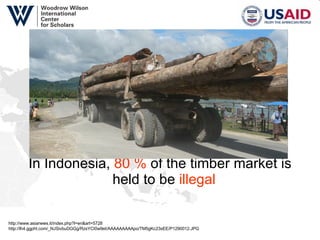
In Indonesia,  80 %  of the timber market is held to be  illegal   http://www.asianews.it/index.php?l=en&art=5728 http://lh4.ggpht.com/_NJSivbuDGGg/RzsYCI0w9eI/AAAAAAAAApo/TM5gKc23sEE/P1290012.JPG
9.4 million acres of forest have been planted with oil palm since 1996 in Indonesia A rate of  2,000 acres a day one football field a minute     http://e360.yale.edu/content/feature.msp?id=2112
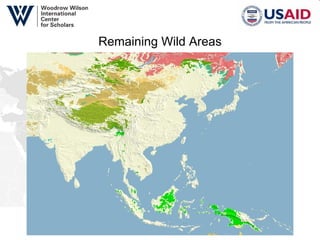
Remaining Wild Areas
Malaysia  is ranked among the top 10  illegal wildlife   smuggling  hubs in the world, together with Manila (the Philippines),  Medan (Indonesia),  Singapore  and the United States.
In Bangladesh, nearly 132 million people  roughly half the population of the U.S. live in an area the size of  New York State .
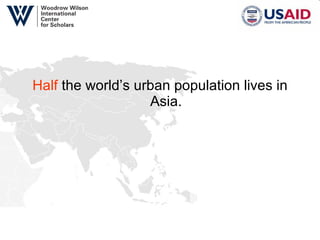
Half  the world’s urban population lives in Asia.
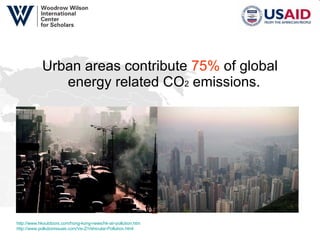
Urban areas contribute  75%  of global energy related CO 2  emissions.  http://www.hkoutdoors.com/hong-kong-news/hk-air-pollution.htm http://www.pollutionissues.com/Ve-Z/Vehicular-Pollution.html
In Asia Crop yields will  decrease  2.5% to 10% by 2020 http://www.ipcc.ch/pdf/assessment-report/ar4/syr/ar4_syr.pdf
A  2°C increase  in mean air temperature  could decrease rain-fed rice yields by 4 to 10% in South Asian countries, and by  5 to12%  in China.
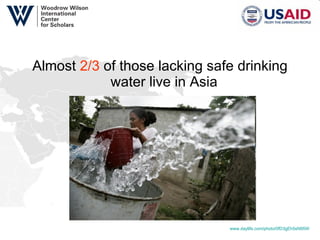
Almost  2/3  of those lacking safe drinking water live in Asia  www.daylife.com/photo/0fD3gEh5sN95W
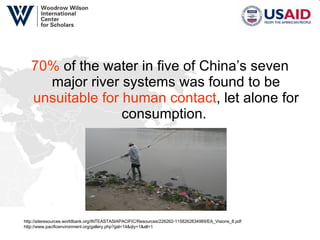
70%  of the water in five of China’s seven major river systems was found to be  unsuitable for human contact , let alone for consumption.  http://siteresources.worldbank.org/INTEASTASIAPACIFIC/Resources/226262-1158262834989/EA_Visions_8.pdf http://www.pacificenvironment.org/gallery.php?gal=14&qty=1&all=1
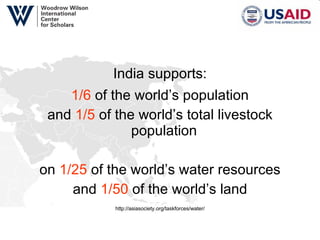
India supports: 1/6  of the world’s population and  1/5  of the world’s total livestock population  on  1/25  of the world’s water resources and  1/50  of the world’s land http://asiasociety.org/taskforces/water/
Per capita water storage in India is  200  cubic meters The lowest relative to comparable sized countries  ( 1960  for U.S. and  1100  for China) http://asiasociety.org/taskforces/water/
In India groundwater irrigation is responsible for Approximately  10%  of GDP  and almost  30%  of total electricity consumption http://asiasociety.org/taskforces/water/
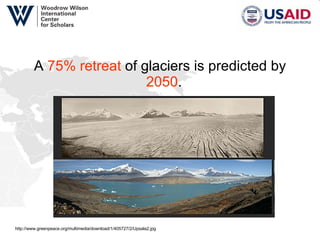
A  75% retreat  of glaciers is predicted by  2050 .  http://www.greenpeace.org/multimedia/download/1/405727/2/Upsala2.jpg
Glaciers in Himalayas  could  disappear by 2035 ,  if not sooner.
Some  40 million  people depend on the Himalayan glaciers for their water supply.
If sea levels rise  1m to 5m  in East Asia, 2% to 8.6%  of the population would be impacted,  2.09% to 10.2%  of GDP would be impacted.
Along with  Bangladesh , the country likely to be most adversely affected by rising sea levels is  Vietnam http://www-wds.worldbank.org/servlet/WDSContentServer/WDSP/IB/2007/02/09/000016406_20070209161430/Rendered/PDF/wps4136.pdf
In the event of a 90 cm rise in sea level,  Vietnam will lose 1/3 of its natural reserves and  1/4 of the known biodiversity  they contain.   In the event of a 5 m sea level rise 16% landmass  will be lost in Vietnam, Affecting  35% of its population  and  40% of its urban areas .  http://www-wds.worldbank.org/servlet/WDSContentServer/WDSP/IB/2007/02/09/000016406_20070209161430/Rendered/PDF/wps4136.pdf
In recent years, ASEAN economies have averaged a growth rate of  5-6%  per year, with China pushing  7-10%  per year.
In 2007, China vaulted past Germany to become the  world’s 3 rd  largest economy .  http://news.bbc.co.uk/chinese/simp/hi/newsid_7820000/newsid_7829700/7829714.stm
By 2015, some  42% of global GDP  is expected to be contributed by Asia.
In 2003, China spent  1.3%  of GDP on research and development Thailand spends only  0.26%  of GDP on research and development   http://www.uscc.gov/hearings/2005hearings/written_testimonies/05_21_22wrts/walsh_kathleen_wrts.pdf http://www.zdnetasia.com/news/business/0,39044229,62004185,00.htm
Indonesian companies  spend more money  on research and development than Chinese companies. http://www.insead.edu/v1/gitr/wef/main/analysis/showdatatable.cfm?vno=5.21&countryid=413
Indonesia and Thailand  rank higher than the United States  with respect to the quality of math and science  education . http://www.insead.edu/v1/gitr/wef/main/analysis/showdatatable.cfm?vno=4.19&countryid=413  
China  now has  as many  scientists and engineers as the  U.S.
Some  60%  of nano products are manufactured in Asia.
With  1,500,933,080 internet users , East Asia and the Pacific make up 18% of global web users.  http://ddp-ext.worldbank.org/ext/ddpreports/ViewSharedReport?REPORT_ID=9147&REQUEST_TYPE=VIEWADVANCED&WSP=N&HF=N/CPProfile.asp
In 2006, 69.10 per 100 Americans 10.35 per 100 Chinese and  0.31  per 100 Bangladeshis had access to and use of the Internet. http://www.insead.edu/v1/gitr/wef/main/analysis/showdatatable.cfm?vno=7.19&countryid=413
Mobile phone subscribers per 100 people: Thailand    63.02   China    34.83 Cambodia  7.94 http://www.insead.edu/v1/gitr/wef/main/analysis/showdatatable.cfm?vno=7.16&countryid=413
By 2020, greenhouse emissions from IT globally are expected to  equal those from aviation.
Energy demand in Asia is expected to increase by nearly  50% by 2020 , at a rate of more than 4% per year  Electricity demand alone is expected to  quadruple  from 2000 to 2020.  Over 40% of this growth in energy use is expected to come from  residential use .
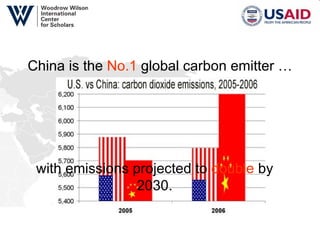
China is the  No.1  global carbon emitter … with emissions projected to  double  by 2030.
The  U.S.  is the No.2 carbon emitter … followed by  Indonesia , mostly due to deforestation activities.
Air pollution levels in the largest Asian cities are among the highest in the world … contributing more than  1.5 million premature deaths   per year.
China has  20  of the world's 30 most polluted cities  largely due to high coal use and motorization.
By 2015,  half  of the world’s poor will still be in Asia… 75% of them will be in rural areas
% of Population living on  less than $1  per day:   Indonesia  7.5%   China  9.9%   Philippines  14.8%   Laos  27.0%   Cambodia  34.1%    Bangladesh  41.3% UN Development Programme http://hdrstats.undp.org/indicators/23.html
Presentation compiled by:   Linden Ellis Tod Kaiser Elisa Lai Kexin Liu Rongkun Liu William Rogers Dorothy Zbicz

Asia's Future

  • 1.
    Asia’s Future CriticalThinking for a Changing Environment
  • 2.
    60% ofthe world’s population lives in Asia …this means that people standing side by side holding hands would reach around the world at the equator more than 100 times.
  • 3.
    The area ofAsia is larger than the land area of the moon. http://www.panasianbiz.com/2009/01/15-fun-facts-about-asia/
  • 4.
    20% ofthe world’s known terrestrial species and 75% of the world’s known coral species live in Southeast Asia which occupies only 3% of the world’s total land area.
  • 5.
    The highest fish diversity on the planet is in Southeast Asia 
  • 6.
    Over 200million people in the region depend on fish as their primary source of protein.
  • 7.
    Seafood consumption inChina is projected to increase 40% by 2020. http://www.marlerblog.com/pt8_art_fish.jpg
  • 8.
    With Deforestation predictedto reach 74% by 2100… More than 40% of the animal and plant species in Southeast Asia could be wiped out this century. http://www.newscientist.com/article/dn3973
  • 9.
    A few hundredyears ago, at least 95% of the Philippines was covered by rain forest... In 1992, old-growth rain forest had declined to 8.6%. http://www.fieldmuseum.org/Vanishing_Treasures/Deforestation_1.htm
  • 10.
    At present rates,natural forests in Indonesia would be logged out in 10 years … Papua New Guinea in 13 to 16 years http://www.asianews.it/index.php?l=en&art=5728
  • 11.
    In Indonesia, 80 % of the timber market is held to be illegal http://www.asianews.it/index.php?l=en&art=5728 http://lh4.ggpht.com/_NJSivbuDGGg/RzsYCI0w9eI/AAAAAAAAApo/TM5gKc23sEE/P1290012.JPG
  • 12.
    9.4 million acresof forest have been planted with oil palm since 1996 in Indonesia A rate of 2,000 acres a day one football field a minute   http://e360.yale.edu/content/feature.msp?id=2112
  • 13.
  • 14.
    Malaysia isranked among the top 10 illegal wildlife smuggling hubs in the world, together with Manila (the Philippines), Medan (Indonesia), Singapore and the United States.
  • 15.
    In Bangladesh, nearly132 million people roughly half the population of the U.S. live in an area the size of New York State .
  • 16.
    Half theworld’s urban population lives in Asia.
  • 17.
    Urban areas contribute 75% of global energy related CO 2 emissions. http://www.hkoutdoors.com/hong-kong-news/hk-air-pollution.htm http://www.pollutionissues.com/Ve-Z/Vehicular-Pollution.html
  • 18.
    In Asia Cropyields will decrease 2.5% to 10% by 2020 http://www.ipcc.ch/pdf/assessment-report/ar4/syr/ar4_syr.pdf
  • 19.
    A 2°Cincrease in mean air temperature could decrease rain-fed rice yields by 4 to 10% in South Asian countries, and by 5 to12% in China.
  • 20.
    Almost 2/3 of those lacking safe drinking water live in Asia  www.daylife.com/photo/0fD3gEh5sN95W
  • 21.
    70% ofthe water in five of China’s seven major river systems was found to be unsuitable for human contact , let alone for consumption.  http://siteresources.worldbank.org/INTEASTASIAPACIFIC/Resources/226262-1158262834989/EA_Visions_8.pdf http://www.pacificenvironment.org/gallery.php?gal=14&qty=1&all=1
  • 22.
    India supports: 1/6 of the world’s population and 1/5 of the world’s total livestock population on 1/25 of the world’s water resources and 1/50 of the world’s land http://asiasociety.org/taskforces/water/
  • 23.
    Per capita waterstorage in India is 200 cubic meters The lowest relative to comparable sized countries ( 1960 for U.S. and 1100 for China) http://asiasociety.org/taskforces/water/
  • 24.
    In India groundwaterirrigation is responsible for Approximately 10% of GDP and almost 30% of total electricity consumption http://asiasociety.org/taskforces/water/
  • 25.
    A 75%retreat of glaciers is predicted by 2050 . http://www.greenpeace.org/multimedia/download/1/405727/2/Upsala2.jpg
  • 26.
    Glaciers in Himalayas could disappear by 2035 , if not sooner.
  • 27.
    Some 40million people depend on the Himalayan glaciers for their water supply.
  • 28.
    If sea levelsrise 1m to 5m in East Asia, 2% to 8.6% of the population would be impacted, 2.09% to 10.2% of GDP would be impacted.
  • 29.
    Along with Bangladesh , the country likely to be most adversely affected by rising sea levels is Vietnam http://www-wds.worldbank.org/servlet/WDSContentServer/WDSP/IB/2007/02/09/000016406_20070209161430/Rendered/PDF/wps4136.pdf
  • 30.
    In the eventof a 90 cm rise in sea level, Vietnam will lose 1/3 of its natural reserves and 1/4 of the known biodiversity they contain. In the event of a 5 m sea level rise 16% landmass will be lost in Vietnam, Affecting 35% of its population and 40% of its urban areas . http://www-wds.worldbank.org/servlet/WDSContentServer/WDSP/IB/2007/02/09/000016406_20070209161430/Rendered/PDF/wps4136.pdf
  • 31.
    In recent years,ASEAN economies have averaged a growth rate of 5-6% per year, with China pushing 7-10% per year.
  • 32.
    In 2007, Chinavaulted past Germany to become the world’s 3 rd largest economy . http://news.bbc.co.uk/chinese/simp/hi/newsid_7820000/newsid_7829700/7829714.stm
  • 33.
    By 2015, some 42% of global GDP is expected to be contributed by Asia.
  • 34.
    In 2003, Chinaspent 1.3% of GDP on research and development Thailand spends only 0.26% of GDP on research and development http://www.uscc.gov/hearings/2005hearings/written_testimonies/05_21_22wrts/walsh_kathleen_wrts.pdf http://www.zdnetasia.com/news/business/0,39044229,62004185,00.htm
  • 35.
    Indonesian companies spend more money on research and development than Chinese companies. http://www.insead.edu/v1/gitr/wef/main/analysis/showdatatable.cfm?vno=5.21&countryid=413
  • 36.
    Indonesia and Thailand rank higher than the United States with respect to the quality of math and science education . http://www.insead.edu/v1/gitr/wef/main/analysis/showdatatable.cfm?vno=4.19&countryid=413  
  • 37.
    China nowhas as many scientists and engineers as the U.S.
  • 38.
    Some 60% of nano products are manufactured in Asia.
  • 39.
    With 1,500,933,080internet users , East Asia and the Pacific make up 18% of global web users. http://ddp-ext.worldbank.org/ext/ddpreports/ViewSharedReport?REPORT_ID=9147&REQUEST_TYPE=VIEWADVANCED&WSP=N&HF=N/CPProfile.asp
  • 40.
    In 2006, 69.10per 100 Americans 10.35 per 100 Chinese and 0.31 per 100 Bangladeshis had access to and use of the Internet. http://www.insead.edu/v1/gitr/wef/main/analysis/showdatatable.cfm?vno=7.19&countryid=413
  • 41.
    Mobile phone subscribersper 100 people: Thailand 63.02 China 34.83 Cambodia 7.94 http://www.insead.edu/v1/gitr/wef/main/analysis/showdatatable.cfm?vno=7.16&countryid=413
  • 42.
    By 2020, greenhouseemissions from IT globally are expected to equal those from aviation.
  • 43.
    Energy demand inAsia is expected to increase by nearly 50% by 2020 , at a rate of more than 4% per year Electricity demand alone is expected to quadruple from 2000 to 2020. Over 40% of this growth in energy use is expected to come from residential use .
  • 44.
    China is the No.1 global carbon emitter … with emissions projected to double by 2030.
  • 45.
    The U.S. is the No.2 carbon emitter … followed by Indonesia , mostly due to deforestation activities.
  • 46.
    Air pollution levelsin the largest Asian cities are among the highest in the world … contributing more than 1.5 million premature deaths per year.
  • 47.
    China has 20 of the world's 30 most polluted cities largely due to high coal use and motorization.
  • 48.
    By 2015, half of the world’s poor will still be in Asia… 75% of them will be in rural areas
  • 49.
    % of Populationliving on less than $1 per day: Indonesia 7.5% China 9.9% Philippines 14.8% Laos 27.0% Cambodia 34.1% Bangladesh 41.3% UN Development Programme http://hdrstats.undp.org/indicators/23.html
  • 50.
    Presentation compiled by: Linden Ellis Tod Kaiser Elisa Lai Kexin Liu Rongkun Liu William Rogers Dorothy Zbicz