Water Pollution in China:   Workshop at Nanjing
                            University
How Can Business Help?      January 15, 2010
Overview
1. How is BSR involved?
2. Why companies care about water pollution
3. Current approaches in China


                                              2
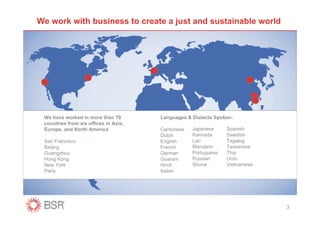
We work with business to create a just and sustainable world


 We have worked in more than 70        Languages & Dialects Spoken:
 countries from six offices in Asia,
 Europe, and North America             Cantonese   Japanese     Spanish
                                       Dutch       Kannada      Swedish
 San Francisco                         English     Lao          Tagalog
 Beijing                               French      Mandarin     Taiwanese
 Guangzhou                             German      Portuguese   Thai
 Hong Kong                             Guarani     Russian      Urdu
 New York                              Hindi       Shona        Vietnamese
 Paris                                 Italian


                                                                             3
Member Network: over 250 companies from a broad range of industries


Sample corporate members include:

Alcatel-Lucent            IKEA                     Pfizer
Aramex International      Kraft Foods              Royal Dutch Shell
Bank of New York Mellon   John Wiley & Sons        SAP
Cisco Systems             Levi Strauss & Co.       Sodexo Group
Citigroup                 Marks & Spencer          Sony Corporation
The Coca-Cola Company     McDonald’s Corporation   Starbucks Coffee Company
Duke Energy               McGraw-Hill              Time Warner
Ford Motor Company        Microsoft                Wal-Mart Stores
GE                        Nike                     The Walt Disney Company
IBM                       Novartis                 Wells Fargo & Company


                                                                              4
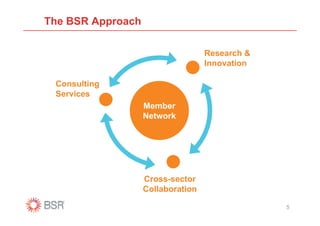
The BSR Approach

                                   Research &
                                   Innovation

 Consulting
 Services
                   Member
                   Network


                   Cross-sector
                   Collaboration

                                                5
Why Companies Care about
     Water Pollution


                           6
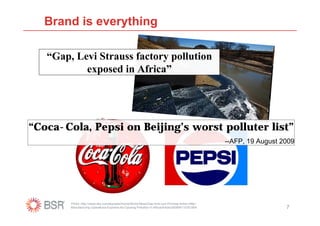
Brand is everything

   “Gap, Levi Strauss factory pollution
           exposed in Africa”


“Coca-Cola, Pepsi on Beijing’s worst polluter list”
                                                                                                  --AFP, 19 August 2009


        Photo: http://news.sky.com/skynews/Home/World-News/Gap-And-Levi-Promise-Action-After-
        Manufacturing-Operations-Exposed-As-Causing-Pollution-In-Africa/Article/200908115351904                     7
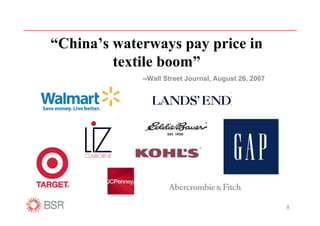
“China’s waterways pay price in
         textile boom”
             --Wall Street Journal, August 26, 2007


                                                      8
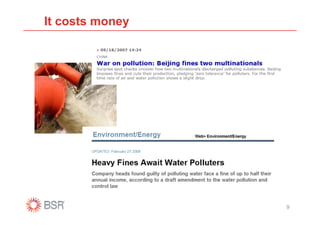
It costs money


                 9
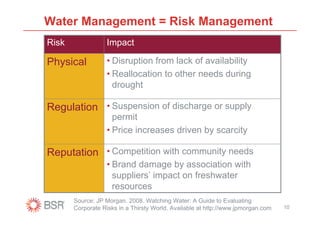
Water Management = Risk Management
Risk               Impact

Physical           • Disruption from lack of availability
                   • Reallocation to other needs during
                     drought

Regulation • Suspension of discharge or supply
                     permit
                   • Price increases driven by scarcity

Reputation • Competition with community needs
                   • Brand damage by association with
                     suppliers’ impact on freshwater
                     resources
       Source: JP Morgan. 2008. Watching Water: A Guide to Evaluating
       Corporate Risks in a Thirsty World. Available at http://www.jpmorgan.com   10
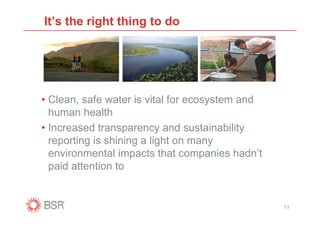
It’s the right thing to do


• Clean, safe water is vital for ecosystem and
  human health
• Increased transparency and sustainability
  reporting is shining a light on many
  environmental impacts that companies hadn’t
  paid attention to


                                                 11
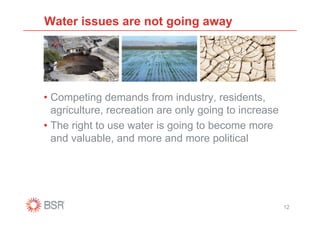
Water issues are not going away


• Competing demands from industry, residents,
  agriculture, recreation are only going to increase
• The right to use water is going to become more
  and valuable, and more and more political


                                                       12
What are Companies Doing in
          China?


                              13
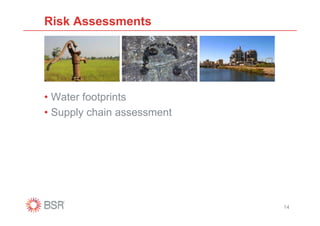
Risk Assessments


• Water footprints
• Supply chain assessment


                            14
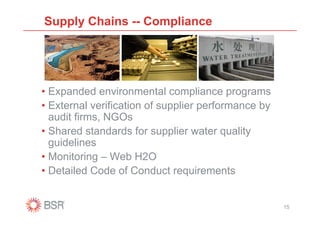
Supply Chains -- Compliance


• Expanded environmental compliance programs
• External verification of supplier performance by
  audit firms, NGOs
• Shared standards for supplier water quality
  guidelines
• Monitoring – Web H2O
• Detailed Code of Conduct requirements


                                                     15
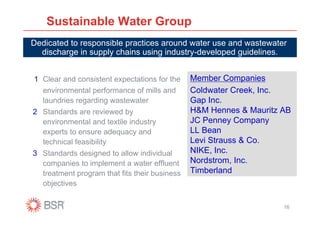
Sustainable Water Group
Dedicated to responsible practices around water use and wastewater
  discharge in supply chains using industry-developed guidelines.


1 Clear and consistent expectations for the    Member Companies
  environmental performance of mills and       Coldwater Creek, Inc.
  laundries regarding wastewater               Gap Inc.
2 Standards are reviewed by                    H&M Hennes & Mauritz AB
  environmental and textile industry           JC Penney Company
  experts to ensure adequacy and               LL Bean
  technical feasibility                        Levi Strauss & Co.
3 Standards designed to allow individual       NIKE, Inc.
  companies to implement a water effluent      Nordstrom, Inc.
  treatment program that fits their business   Timberland
  objectives


                                                                    16
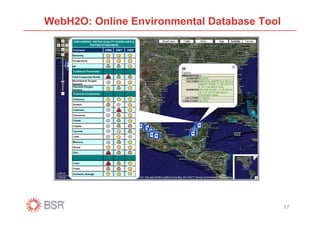
WebH2O: Online Environmental Database Tool
      BSR-AWQWG WATER QUALITY GUIDELINES &
              TESTING STANDARDS
     Parameter                 2006   2007   2008
     Sampling

     Temperature

     pH

     Traditional Parameters:

     Total Suspended Solids
     Biochemical Oxygen
     Demand
     Chemical Oxygen
     Demand
     Chemical Constituents:

     Antimony

     Arsenic

     Cadmium

     Chromium

     Cobalt

     Copper

     Cyanide

     Lead

     Mercury

     Nickel

     Zinc


     Color

     Foam:

     Domestic Sewage:


                                                    17
Supply Chains -- Support


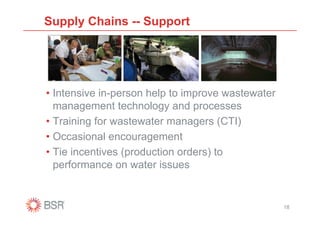
• Intensive in-person help to improve wastewater
  management technology and processes
• Training for wastewater managers (CTI)
• Occasional encouragement
• Tie incentives (production orders) to
  performance on water issues


                                                   18
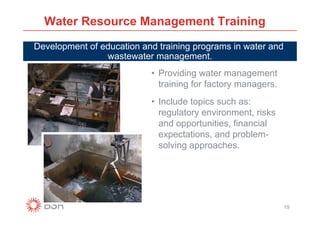
Water Resource Management Training
Development of education and training programs in water and
                wastewater management.
                           • Providing water management
                             training for factory managers.
                           • Include topics such as:
                             regulatory environment, risks
                             and opportunities, financial
                             expectations, and problem-
                             solving approaches.


                                                              19
Community Engagement
• Coca-Cola:
   – partnership with WWF to protect Yangtze River basin
   – rainwater harvesting in 12 villages in NW China
   – partnership with UNDP, MWR, MOFCOM, to improve
     water access and sanitation
• Pepsi:
   – grants on Safe Water and efficiency
   – partnership with All China Women’s Federation on
     safe drinking water
• Lots of interest (primarily from beverage
  companies), but not much experience

                                                           20
Main challenges to supply chain work


• Regulatory environment
• Limited NGO / civil society pressure
• Highly technical issue
• Long-term horizon often necessary for
  investment – in most industries, neither
  customer nor supplier have this
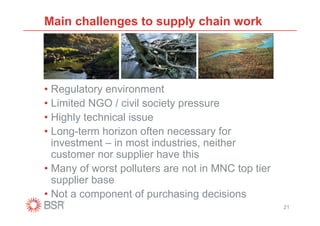
• Many of worst polluters are not in MNC top tier
  supplier base
• Not a component of purchasing decisions
                                                    21
Thank you!

Laura Ediger: lediger@bsr.org


                                22

Laura Ediger

  • 1.
    Water Pollution inChina: Workshop at Nanjing University How Can Business Help? January 15, 2010
  • 2.
    Overview 1. How isBSR involved? 2. Why companies care about water pollution 3. Current approaches in China 2
  • 3.
    We work withbusiness to create a just and sustainable world We have worked in more than 70 Languages & Dialects Spoken: countries from six offices in Asia, Europe, and North America Cantonese Japanese Spanish Dutch Kannada Swedish San Francisco English Lao Tagalog Beijing French Mandarin Taiwanese Guangzhou German Portuguese Thai Hong Kong Guarani Russian Urdu New York Hindi Shona Vietnamese Paris Italian 3
  • 4.
    Member Network: over250 companies from a broad range of industries Sample corporate members include: Alcatel-Lucent IKEA Pfizer Aramex International Kraft Foods Royal Dutch Shell Bank of New York Mellon John Wiley & Sons SAP Cisco Systems Levi Strauss & Co. Sodexo Group Citigroup Marks & Spencer Sony Corporation The Coca-Cola Company McDonald’s Corporation Starbucks Coffee Company Duke Energy McGraw-Hill Time Warner Ford Motor Company Microsoft Wal-Mart Stores GE Nike The Walt Disney Company IBM Novartis Wells Fargo & Company 4
  • 5.
    The BSR Approach Research & Innovation Consulting Services Member Network Cross-sector Collaboration 5
  • 6.
    Why Companies Careabout Water Pollution 6
  • 7.
    Brand is everything “Gap, Levi Strauss factory pollution exposed in Africa” “Coca-Cola, Pepsi on Beijing’s worst polluter list” --AFP, 19 August 2009 Photo: http://news.sky.com/skynews/Home/World-News/Gap-And-Levi-Promise-Action-After- Manufacturing-Operations-Exposed-As-Causing-Pollution-In-Africa/Article/200908115351904 7
  • 8.
    “China’s waterways payprice in textile boom” --Wall Street Journal, August 26, 2007 8
  • 9.
  • 10.
    Water Management =Risk Management Risk Impact Physical • Disruption from lack of availability • Reallocation to other needs during drought Regulation • Suspension of discharge or supply permit • Price increases driven by scarcity Reputation • Competition with community needs • Brand damage by association with suppliers’ impact on freshwater resources Source: JP Morgan. 2008. Watching Water: A Guide to Evaluating Corporate Risks in a Thirsty World. Available at http://www.jpmorgan.com 10
  • 11.
    It’s the rightthing to do • Clean, safe water is vital for ecosystem and human health • Increased transparency and sustainability reporting is shining a light on many environmental impacts that companies hadn’t paid attention to 11
  • 12.
    Water issues arenot going away • Competing demands from industry, residents, agriculture, recreation are only going to increase • The right to use water is going to become more and valuable, and more and more political 12
  • 13.
    What are CompaniesDoing in China? 13
  • 14.
    Risk Assessments • Waterfootprints • Supply chain assessment 14
  • 15.
    Supply Chains --Compliance • Expanded environmental compliance programs • External verification of supplier performance by audit firms, NGOs • Shared standards for supplier water quality guidelines • Monitoring – Web H2O • Detailed Code of Conduct requirements 15
  • 16.
    Sustainable Water Group Dedicatedto responsible practices around water use and wastewater discharge in supply chains using industry-developed guidelines. 1 Clear and consistent expectations for the Member Companies environmental performance of mills and Coldwater Creek, Inc. laundries regarding wastewater Gap Inc. 2 Standards are reviewed by H&M Hennes & Mauritz AB environmental and textile industry JC Penney Company experts to ensure adequacy and LL Bean technical feasibility Levi Strauss & Co. 3 Standards designed to allow individual NIKE, Inc. companies to implement a water effluent Nordstrom, Inc. treatment program that fits their business Timberland objectives 16
  • 17.
    WebH2O: Online EnvironmentalDatabase Tool BSR-AWQWG WATER QUALITY GUIDELINES & TESTING STANDARDS Parameter 2006 2007 2008 Sampling Temperature pH Traditional Parameters: Total Suspended Solids Biochemical Oxygen Demand Chemical Oxygen Demand Chemical Constituents: Antimony Arsenic Cadmium Chromium Cobalt Copper Cyanide Lead Mercury Nickel Zinc Color Foam: Domestic Sewage: 17
  • 18.
    Supply Chains --Support • Intensive in-person help to improve wastewater management technology and processes • Training for wastewater managers (CTI) • Occasional encouragement • Tie incentives (production orders) to performance on water issues 18
  • 19.
    Water Resource ManagementTraining Development of education and training programs in water and wastewater management. • Providing water management training for factory managers. • Include topics such as: regulatory environment, risks and opportunities, financial expectations, and problem- solving approaches. 19
  • 20.
    Community Engagement • Coca-Cola: – partnership with WWF to protect Yangtze River basin – rainwater harvesting in 12 villages in NW China – partnership with UNDP, MWR, MOFCOM, to improve water access and sanitation • Pepsi: – grants on Safe Water and efficiency – partnership with All China Women’s Federation on safe drinking water • Lots of interest (primarily from beverage companies), but not much experience 20
  • 21.
    Main challenges tosupply chain work • Regulatory environment • Limited NGO / civil society pressure • Highly technical issue • Long-term horizon often necessary for investment – in most industries, neither customer nor supplier have this • Many of worst polluters are not in MNC top tier supplier base • Not a component of purchasing decisions 21
  • 22.
    Thank you! Laura Ediger:lediger@bsr.org 22