Pr esent ed by:
Name :Qai ser Hussai n
Cl ass:Account i ng & Fi nance
Rol l number : Bs 13116
Pr esent ed t o:
Pr of Nasi r Chat t a
Assignment
How Became
Pakistan as an Asian
Tiger
INTRIDUCTION
The Four Asian Tigers or Asian Dragons is a term used in reference to the highly developed economies of Hong
Kong, Singapore, South Korea and Taiwan after 1970. These regions were the first newly industrialized countries,
noted for maintaining exceptionally high growth rates and rapid industrialization between the early 1960s and 1990s.
By the 21st century, all four regions have since graduated into advanced economies and high-income economies.
Now people say that all four countries are rich countries. All four Asian Tigers have a lot of people who are very
educated and good at their jobs. They also did different things, and tried to do them better than other countries. For
example, Hong Kong and Singapore became very good at international finance, while South Korea and Taiwan
became very good at information technology. However, attention has increasingly shifted to other Asian economies
which are now experiencing faster economic transformation
A country is known as tiger of its continent if its economy is strongest among all other countries of same continent.
But to make a country a tiger of its continent, betterments/improvements in many fields are required. Pakistan is the
next country having the same vision. Pakistan has a semi-industrialized economy, which mainly encompasses
textiles, chemicals, food processing, agriculture and other industries. Growth poles of Pakistan's economy are
situated along the Indus River; diversified economies of Karachi and Punjab's urban centers coexist with lesser
developed areas in other parts of the country. The economy has suffered in the past from decades of internal political
disputes, a fast growing population, mixed levels of foreign investment and high defense spending. Foreign
exchange reserves are bolstered by steady worker remittances, but a growing current account deficit – driven by a
widening trade gap as import growth outstrips export expansion – could draw down reserves and dampen GDP
growth in the medium term. But if we want to make Pakistan an Asian Tiger, we need to tie up all the broken ends
and we will have to struggle each and every day, day and night to achieve our goal. Following Sectors still needs
improvements if we want to make our country an Asian tiger.
EDUCATION :
Education is the most important
factor which plays a leading role in
human resource development. It
promotes productive and informed
populace and creates opportunities
for the socially and economically
deprived sections of society.
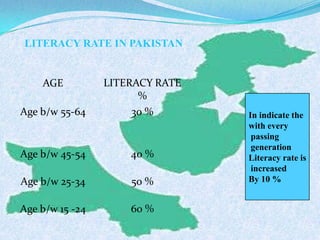
AGE LITERACY RATE
%
Age b/w 55-64 30 %
Age b/w 45-54 40 %
Age b/w 25-34 50 %
Age b/w 15 -24 60 %
LITERACY RATE IN PAKISTAN
In indicate the
with every
passing
generation
Literacy rate is
increased
By 10 %
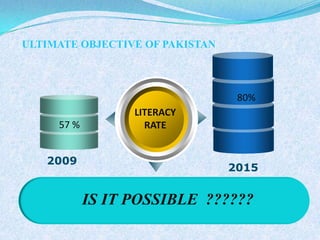
LITERACY
RATE
IS IT POSSIBLE ??????
57 %
50%
80%
2009
2015
ULTIMATE OBJECTIVE OF PAKISTAN
UNIVERSITY WORLD RANKING
During 1947-2003
not a single
university of
Pakistan could be
ranked among
the top 600
universities of
the world…......!!!
But today 5 to 6
Pakistani
universities
belong to the
prestigious group
of worlds best
universities ….!!!!
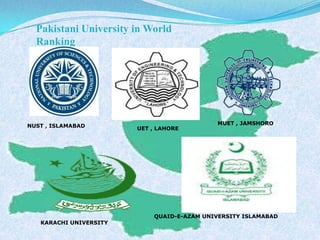
Pakistani University in World
Ranking
NUST , ISLAMABAD UET , LAHORE
KARACHI UNIVERSITY
QUAID-E-AZAM UNIVERSITY ISLAMABAD
MUET , JAMSHORO
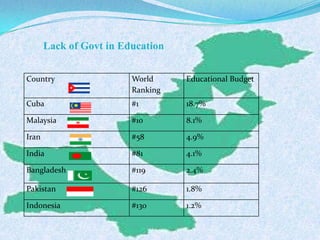
Country World
Ranking
Educational Budget
Cuba #1 18.7%
Malaysia #10 8.1%
Iran #58 4.9%
India #81 4.1%
Bangladesh #119 2.4%
Pakistan #126 1.8%
Indonesia #130 1.2%
Lack of Govt in Education
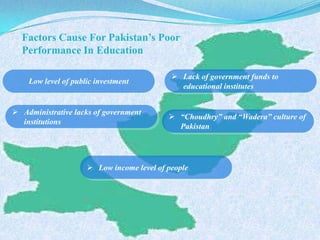
Factors Cause For Pakistan’s Poor
Performance In Education
Low level of public investment
 Lack of government funds to
educational institutes
 Administrative lacks of government
institutions
 “Choudhry” and “Wadera” culture of
Pakistan
 Low income level of people
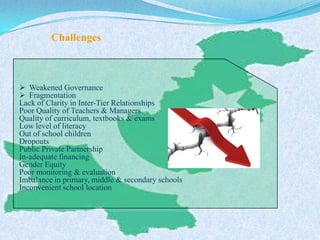
Challenges
 Weakened Governance
 Fragmentation
Lack of Clarity in Inter-Tier Relationships
Poor Quality of Teachers & Managers
Quality of curriculum, textbooks & exams
Low level of literacy
Out of school children
Dropouts
Public Private Partnership
In-adequate financing
Gender Equity
Poor monitoring & evaluation
Imbalance in primary, middle & secondary schools
Inconvenient school location
Reforms Undertaken
• Free education up to Matriculation.
• Grant of scholarships
• English language compulsory
• Budgetary allocations for education increased
• Encourage Private sector
• Improved Examination System
• Curriculum upgraded to ensure latest developments /
ideas in science and technology
• Format of the question papers for the Board examinations revised
• Teachers’Training and Knowledge:
• Technical / Vocational Education
• Career Counselling at higher secondary level
• Pre-service & in-service teacher training
IMPORTS AND EXPORTS OF
PAKISTAN
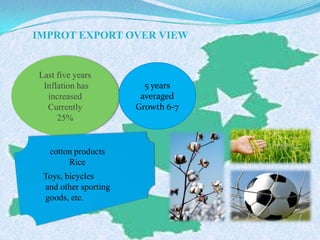
IMPROT EXPORT OVER VIEW
Last five years
Inflation has
increased
Currently
25%
5 years
averaged
Growth 6-7
cotton products
Rice
Toys, bicycles
and other sporting
goods, etc.
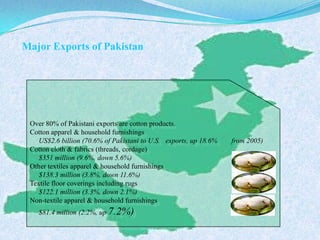
Major Exports of Pakistan
Over 80% of Pakistani exports are cotton products.
Cotton apparel & household furnishings
US$2.6 billion (70.6% of Pakistani to U.S. exports, up 18.6% from 2005)
Cotton cloth & fabrics (threads, cordage)
$351 million (9.6%, down 5.6%)
Other textiles apparel & household furnishings
$138.3 million (3.8%, down 11.6%)
Textile floor coverings including rugs
$122.1 million (3.3%, down 2.1%)
Non-textile apparel & household furnishings
$81.4 million (2.2%, up 7.2%)
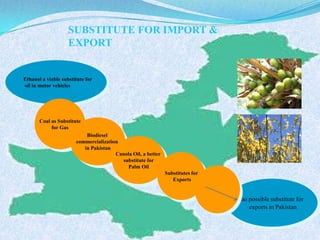
Ethanol a viable substitute for
oil in motor vehicles
Coal as Substitute
for Gas
Biodiesel
commercialization
in Pakistan
Canola Oil, a better
substitute for
Palm Oil
Substitutes for
Exports
no possible substitute for
exports in Pakistan
SUBSTITUTE FOR IMPORT &
EXPORT
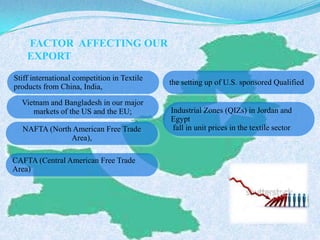
FACTOR AFFECTING OUR
EXPORT
Stiff international competition in Textile
products from China, India,
Vietnam and Bangladesh in our major
markets of the US and the EU; Industrial Zones (QIZs) in Jordan and
Egypt
fall in unit prices in the textile sector
the setting up of U.S. sponsored Qualified
CAFTA (Central American Free Trade
Area)
NAFTA (North American Free Trade
Area),
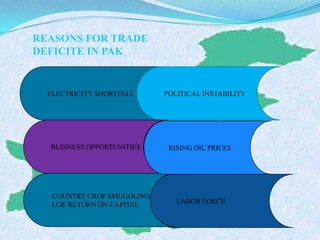
REASONS FOR TRADE
DEFICITE IN PAK
ELECTRICITY SHORTFALL
LABOR FORCE
POLITICAL INSTABILITY
BUISNESS OPPORTUNITIES
COUNTRY CROP SMUGGLING
LOE RETURN ON CAPITAL
RISING OIL PRICES
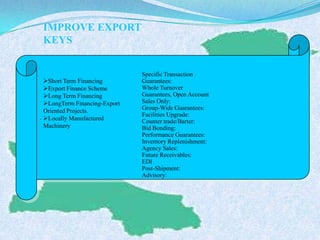
IMPROVE EXPORT
KEYS
.
Specific Transaction
Guarantees:
Whole Turnover
Guarantees, Open Account
Sales Only:
Group-Wide Guarantees:
Facilities Upgrade:
Counter trade/Barter:
Bid Bonding:
Performance Guarantees:
Inventory Replenishment:
Agency Sales:
Future Receivables:
EDI
Post-Shipment:
Advisory:
Short Term Financing
Export Finance Scheme
Long Term Financing
LongTerm Financing-Export
Oriented Projects.
Locally Manufactured
Machinery
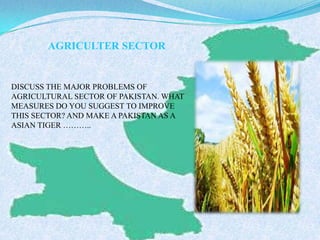
DISCUSS THE MAJOR PROBLEMS OF
AGRICULTURAL SECTOR OF PAKISTAN. WHAT
MEASURES DO YOU SUGGEST TO IMPROVE
THIS SECTOR? AND MAKE A PAKISTAN AS A
ASIAN TIGER ………..
AGRICULTER SECTOR
INTRODUCTION :
Agricultural sector is the backbone of our economy. But the
growth of agriculture in Pakistan is facing a lot of problems. Due
to various causes, per acre yield is very low in Pakistan as
compare to other developed countries.
Agriculture is central to economic growth and development in
Pakistan. Being the dominant sector it contributes 21.4 percent to
GDP, employs 45 percent of the country’s labour force and
contributes in the growth of other sectors of the economy
The agriculture growth this year stood at 3.3 percent as compared
to 3.5 percent during the last year.
PROBLEMS OF AGRICULTURAL SECTOR
Problems of agricultural sector are categorized as below:
TECHNO-ECONOMIC PROBLEMS
1) Limited Cultivable Area
The total area of Pakistan is about 79.6 million
hectares, out of which only 23.7 million hectares
(28%) area is used for agricultural purposes. About
8 million hectares area is idle and un-utilized. There
is vast sub-division and fragmentation of land
holdings, as a result modern technology cannot be
applied in agriculture sector.
2 Water Logging and Salinity
Water logging and salinity are twin problems of agricultural sector
due to salinity, deposits of salt in land have appeared on the surface
of land and they have adversely affected the performance of
agricultural sector. Water logging and salinity affect about 0.10
million acre of land in every year. It is not only waste of land but also
reduction in productivity.
3) Slow Growth of Allied Products
Allied products refer to those productions, which are not agricultural
but indirectly, help the farmer to improve his living
standard. Pakistan is in-sufficient in the production of fruits, milk,
poultry, fisheries, livestock and forestry. As a result not only our food
quality is poor but also industries such as furniture, textiles and dairy
cannot be developed.
4) Low Per Hectare Yield
The most important problem of agriculture is its low yield per hectare for
almost every major crop. 45.0% of labour force is engaged in this sector in
Pakistan while it is less than 5% in developed countries. But, other countries
of world are getting higher yield per hectare due to use of modern technology
and trained labour.
5) Inadequate Infrastructure
Rural infrastructure like, roads, storage facilities, transport, electricity,
education, sanitation and health facilities etc. is inadequate to meet the
requirement of growth of agriculture. Total length of farm-to-market road is
not only shorter but their condition is also poor. Many villages have no metal-
led road at all. Electricity is available to only 3/4 rural populations.
6) Uneconomic Land Holdings
Due to increasing population and division of land under the law of
inheritance, landholdings are subdivided over and over again. The
result is that very large number of farmers has less than 2 hectares
of area. Moreover holdings are scattered. It is difficult to use
modern machinery on small pieces of land.
7) Old Methods of Production
No doubt, mechanization of agriculture is increasing in Pakistan,
but in most of the areas, the old implements are still being used for
agricultural production. Old and orthodox techniques of production
cannot increase the production according to international levels.
8) Inadequate Supply of Agricultural Inputs
The supply of modern inputs like high yielding variety (HYV) seeds,
chemical fertilizers, pesticides, mechanized machinery etc. not only costly
but also inadequate and irregular in Pakistan. Numbers of fertilizer
producing units are just 10 in Pakistan.
9) Lack of Irrigation Facilities
Shortage of irrigation facilities causes a serious limitation in the expansion
of crop area in Pakistan. The lower water supplies, loses from water course
in the fields are the serious problems of farm sector. Actual surface water
availability is 91.8 million acre feet.
10) Inadequate Agricultural Research
The average crop yield in Pakistan is very low as compared to the
production levels of the advanced countries of the world. In order to raise
the potential of agricultural production, there should be continuous
improvement in the research for agricultural growth. Total agricultural
universities and colleges are only 16 in Pakistan.
11) Problem of Land Reforms
Land reforms have been implemented against the will of people.
There is an urgent need to conduct a proper land reform for improving
agricultural growth. Due to this problem agricultural production
cannot increase to desired level.
12) Defective Land Tenure System
Defective land tenure system is also responsible for low yield per acre
in agricultural sector. Landlords and feudal-lords live in posh urban
areas while tenants and peasants have no or less incentive for their
hard work. So, the productivity in agricultural sector remains low.
13) Subsistence Farming
Our farmer is attached with subsistence farming; a huge of portion of
production is consumed at farmer’s own house to support large family.
Hence, less portion of the production is available for market supply. It
causes low income of the farmers. Farming is not conducted at commercial
level in Pakistan.
14) Low Cropping Intensity
Cropping intensity means the number of crops grown on a piece of land in
one year. At the present stage of our development, there is low level of
cropping intensity as compared to advanced countries. Cultivable area
under double or multiple cropping is inadequate in Pakistan
15) Improper Crop Rotation
Proper turning round of crops is essential to re-establish the fertility of the
land. The constant cultivation of one crop or two; exhausts the fertility of
the soil. Proper rotation of crops is necessary in order to restore the fertility.
.
NATURAL PROBLEMS
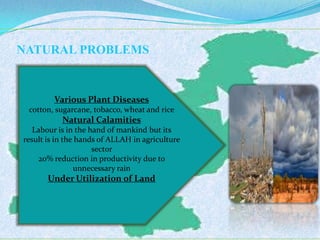
Various Plant Diseases
cotton, sugarcane, tobacco, wheat and rice
Natural Calamities
Labour is in the hand of mankind but its
result is in the hands of ALLAH in agriculture
sector
20% reduction in productivity due to
unnecessary rain
Under Utilization of Land
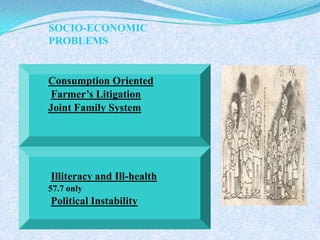
SOCIO-ECONOMIC
PROBLEMS
Consumption Oriented
Farmer’s Litigation
Joint Family System
Illiteracy and Ill-health
57.7 only
Political Instability
FINANCIAL PROLEMS
Lack of Credit
. About 50.8% poor borrow from landlords in Pakistan
Poor Financial Position of Farmers
57.4% poor are working for feudal-lords without wages
Instability in Market Prices
Shortage of Agricultural Finance
50.8% poor borrow from landlords at very high rate of interest.
.
Water Logging and Salinity Control
destroys about one million acre of land
every year in Punjab and Sindh
Construction of Dames
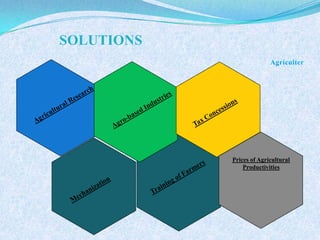
Supply of Agriculture Credit
Causes
20% reduction in total production
Provision of HYV Seed
MEASURES TO REMOVE
THESE PROBLEMS
Prices of Agricultural
Productivities
SOLUTIONS
Being an agrarian country, agricultural sector of Pakistan’s economy
is still backward. Use of modern techniques, provision of credit
facilities, basic infrastructure and agriculture research facilities are
needed to remove all the problems of agriculture sector.
Conclusion
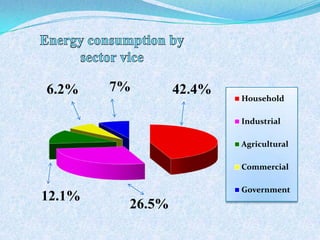
Energy play an important role in
the economic development of a
country.
In Pakistan supply of energy is
46.8 million tons & per capita
availability is 0.28 million tons per
year while consumption per year is
48.3 million tons.
ENERGY SECTOR
Household
Industrial
Agricultural
Commercial
Government
42.4%7%6.2%
12.1%
26.5%
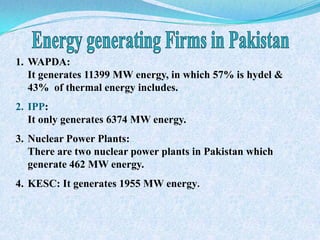
1. WAPDA:
It generates 11399 MW energy, in which 57% is hydel &
43% of thermal energy includes.
2. IPP:
It only generates 6374 MW energy.
3. Nuclear Power Plants:
There are two nuclear power plants in Pakistan which
generate 462 MW energy.
4. KESC: It generates 1955 MW energy.
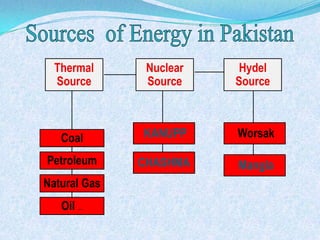
Coal
Petroleum
Natural Gas
Oil …
Thermal
Source
Hydel
Source
Nuclear
Source
KANUPP
CHASHMA
Worsak
Mangla
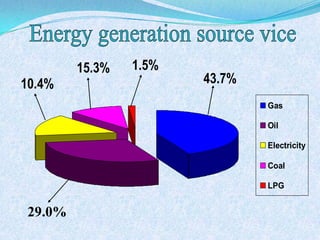
Gas
Oil
Electricity
Coal
LPG
43.7%10.4%
15.3% 1.5%
29.0%
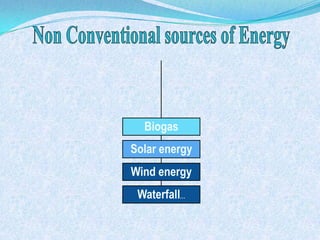
Biogas
Solar energy
Wind energy
Waterfall…
“Industry refers to that
sector of economy which is
related with manufacturing
and production of different
products”
Definition
 Industrial Sector is of great importance for economic
development of country.
 Industrial Sector is of great importance for economic
development of country. It is historical fact that
countries with strong industrial sector have showed
more economic growth and development industrial
sector have shows improvement in national income
and promoted living standard of population.
Textile industry
Sports industry
Telecom industry
Cement industry
Surgical industry
Sugar industry
Defense industry
Auto mobile industry
Fashion industry
Fertilizer industry
Oil & Gas Industries
Chemical industry
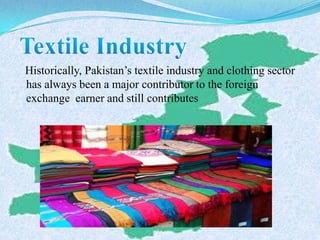
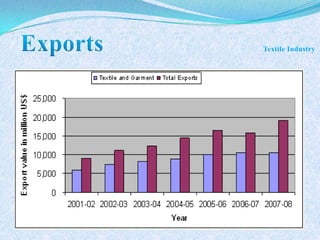
Historically, Pakistan’s textile industry and clothing sector
has always been a major contributor to the foreign
exchange earner and still contributes
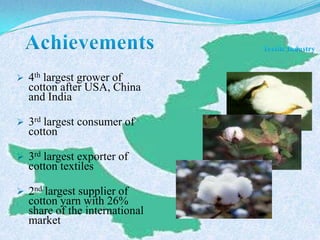
 4th largest grower of
cotton after USA, China
and India
 3rd largest consumer of
cotton
 3rd largest exporter of
cotton textiles
 2nd largest supplier of
cotton yarn with 26%
share of the international
market
Textiles products
Handicrafts
Power loom products
Scarf
Wool fabrics
Blanket
Winter shawls
Hand embroidered shawls
Over 1.3 million farmers, out of total of 5
million are involved in cultivation of this crop.
Industrial Sector is the second largest individual
sector of the economy accounting for
24% of the GDP
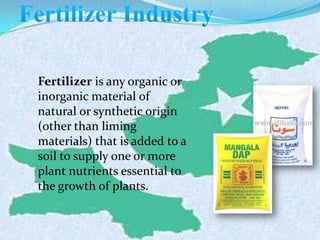
Fertilizer is any organic or
inorganic material of
natural or synthetic origin
(other than liming
materials) that is added to a
soil to supply one or more
plant nutrients essential to
the growth of plants.
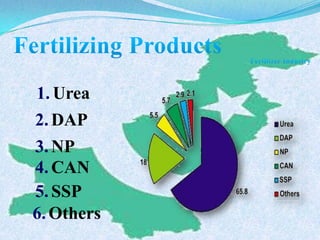
2.DAP
3.NP
4.CAN
5.SSP
6.Others
1. Urea
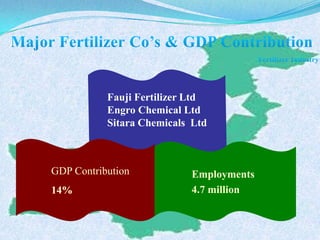
GDP Contribution
14%
Employments
4.7 million
Fauji Fertilizer Ltd
Engro Chemical Ltd
Sitara Chemicals Ltd
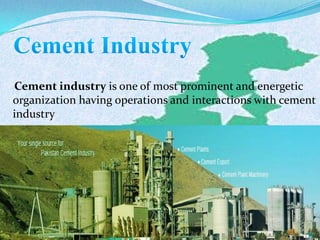
Cement industry is one of most prominent and energetic
organization having operations and interactions with cement
industry
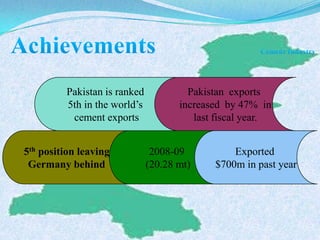
5th position leaving
Germany behind
Pakistan is ranked
5th in the world’s
cement exports
2008-09
(20.28 mt)
Pakistan exports
increased by 47% in
last fiscal year.
Exported
$700m in past year
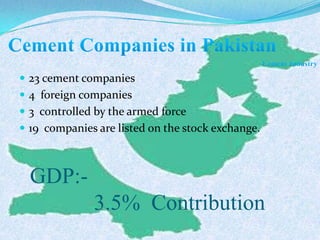
 23 cement companies
 4 foreign companies
 3 controlled by the armed force
 19 companies are listed on the stock exchange.
GDP:-
3.5% Contribution
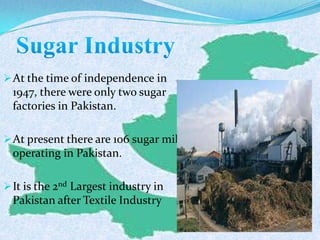
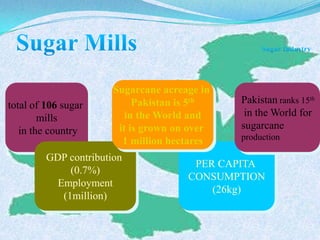
At the time of independence in
1947, there were only two sugar
factories in Pakistan.
At present there are 106 sugar mills
operating in Pakistan.
It is the 2nd Largest industry in
Pakistan after Textile Industry
PER CAPITA
CONSUMPTION
(26kg)
total of 106 sugar
mills
in the country
Pakistan ranks 15th
in the World for
sugarcane
production
GDP contribution
(0.7%)
Employment
(1million)
Sugarcane acreage in
Pakistan is 5th
in the World and
it is grown on over
1 million hectares
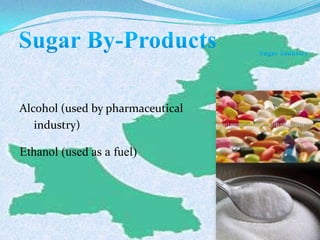
Alcohol (used by pharmaceutical
industry)
Ethanol (used as a fuel)
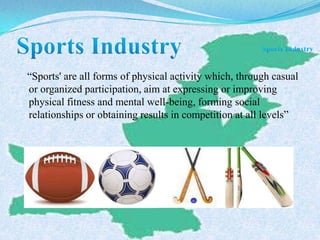
“Sports' are all forms of physical activity which, through casual
or organized participation, aim at expressing or improving
physical fitness and mental well-being, forming social
relationships or obtaining results in competition at all levels”
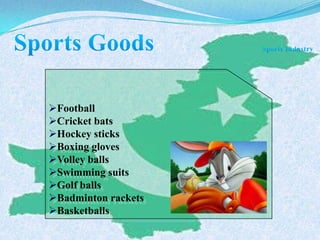
Football
Cricket bats
Hockey sticks
Boxing gloves
Volley balls
Swimming suits
Golf balls
Badminton rackets
Basketballs
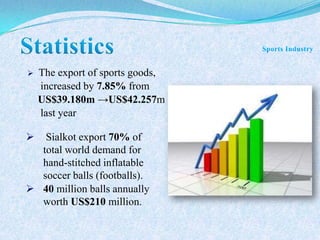
 The export of sports goods,
increased by 7.85% from
US$39.180m →US$42.257m
last year
 Sialkot export 70% of
total world demand for
hand-stitched inflatable
soccer balls (footballs).
 40 million balls annually
worth US$210 million.
Companies of various sizes 2,400
Employments more than 200,000
Exporting goods worth US$450 million
Large exporters (more than 250 employees)
Medium exporters (100–250 employees)
Small exporters (10–100 employees).
Commercial exporters (1–9 employees).
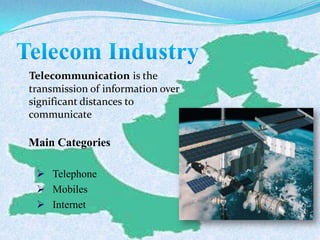
Telecommunication is the
transmission of information over
significant distances to
communicate
Main Categories
 Telephone
 Mobiles
 Internet
In 2008 Pakistan was the world’
s third fastest growing telecommunications market
Fixed-line subscriptions declined from a peak of
5.2 million in 2005-06 to 3.4 million in 2009-10
Pakistan traffic volume grew by 253 percent
compared to last year during the same period
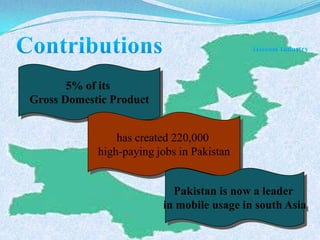
5% of its
Gross Domestic Product
has created 220,000
high-paying jobs in Pakistan
Pakistan is now a leader
in mobile usage in south Asia
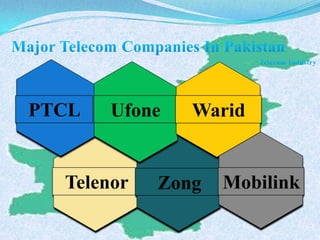
Telenor Zong
PTCL Ufone Warid
Mobilink
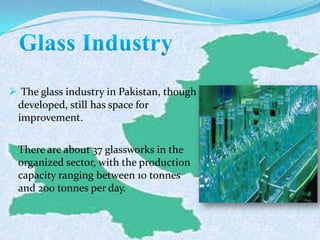
 The glass industry in Pakistan, though
developed, still has space for
improvement.
 There are about 37 glassworks in the
organized sector, with the production
capacity ranging between 10 tonnes
and 200 tonnes per day.
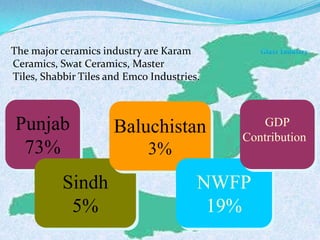
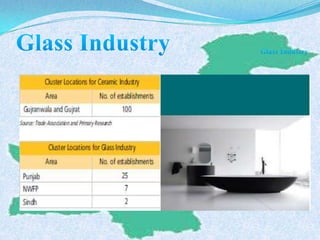
The major ceramics industry are Karam
Ceramics, Swat Ceramics, Master
Tiles, Shabbir Tiles and Emco Industries.
Punjab
73%
Sindh
5%
Baluchistan
3%
NWFP
19%
GDP
Contribution
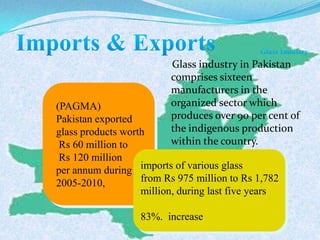
Glass industry in Pakistan
comprises sixteen
manufacturers in the
organized sector which
produces over 90 per cent of
the indigenous production
within the country.
(PAGMA)
Pakistan exported
glass products worth
Rs 60 million to
Rs 120 million
per annum during
2005-2010,
imports of various glass
from Rs 975 million to Rs 1,782
million, during last five years
83%. increase
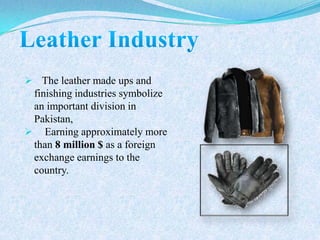
 The leather made ups and
finishing industries symbolize
an important division in
Pakistan,
 Earning approximately more
than 8 million $ as a foreign
exchange earnings to the
country.
JavaScript
Web application
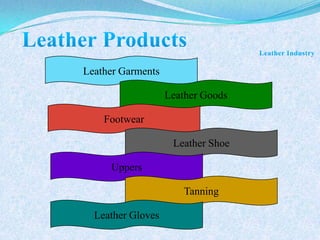
Leather Garments
Leather Goods
Footwear
Leather Shoe
Uppers
Tanning
Leather Gloves
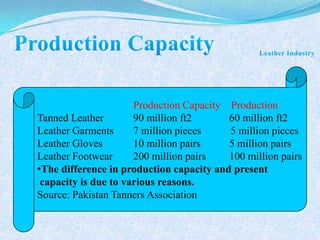
Production Capacity Production
Tanned Leather 90 million ft2 60 million ft2
Leather Garments 7 million pieces 5 million pieces
Leather Gloves 10 million pairs 5 million pairs
Leather Footwear 200 million pairs 100 million pairs
•The difference in production capacity and present
capacity is due to various reasons.
Source: Pakistan Tanners Association
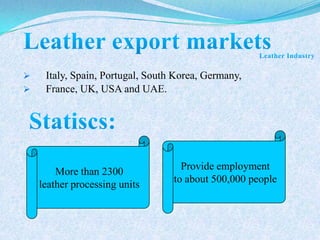
 Italy, Spain, Portugal, South Korea, Germany,
 France, UK, USA and UAE.
More than 2300
leather processing units
Provide employment
to about 500,000 people
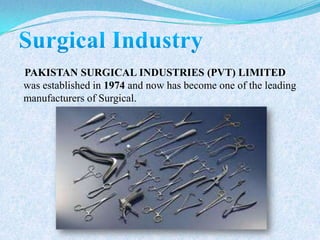
PAKISTAN SURGICAL INDUSTRIES (PVT) LIMITED
was established in 1974 and now has become one of the leading
manufacturers of Surgical.
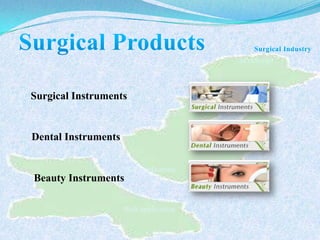
Surgical Instruments
JavaScript
Dental Instruments
Web application
Beauty Instruments
Web application
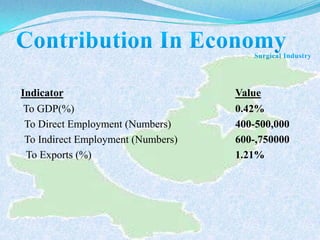
Indicator Value
To GDP(%) 0.42%
To Direct Employment (Numbers) 400-500,000
To Indirect Employment (Numbers) 600-,750000
To Exports (%) 1.21%
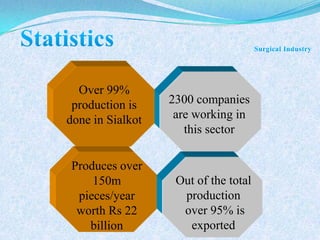
Produces over
150m
pieces/year
worth Rs 22
billion
2300 companies
are working in
this sector
Over 99%
production is
done in Sialkot
Out of the total
production
over 95% is
exported
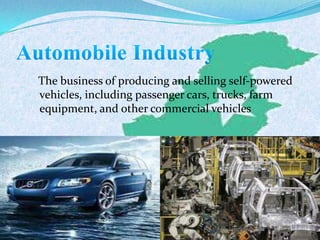
The business of producing and selling self-powered
vehicles, including passenger cars, trucks, farm
equipment, and other commercial vehicles
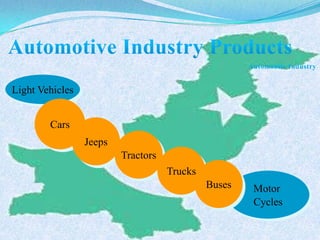
Light Vehicles
Cars
Jeeps
Tractors
Trucks
Motor
Cycles
Buses
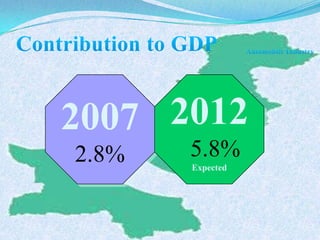
2007
2.8%
2012
5.8%
Expected
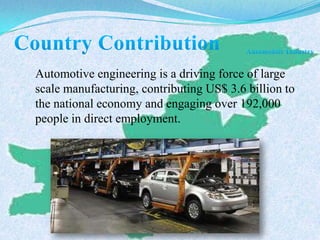
Automotive engineering is a driving force of large
scale manufacturing, contributing US$ 3.6 billion to
the national economy and engaging over 192,000
people in direct employment.
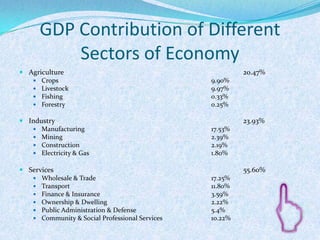
GDP Contribution of Different
Sectors of Economy
 Agriculture 20.47%
 Crops 9.90%
 Livestock 9.97%
 Fishing 0.33%
 Forestry 0.25%
 Industry 23.93%
 Manufacturing 17.53%
 Mining 2.39%
 Construction 2.19%
 Electricity & Gas 1.80%
 Services 55.60%
 Wholesale & Trade 17.25%
 Transport 11.80%
 Finance & Insurance 3.59%
 Ownership & Dwelling 2.22%
 Public Administration & Defense 5.4%
 Community & Social Professional Services 10.22%
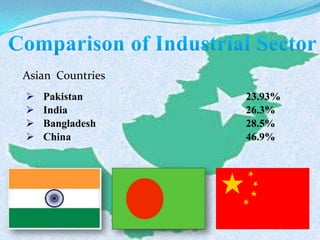
Comparison of
Industrial Sector
with other
Countries
Asian Countries
 Pakistan 23.93%
 India 26.3%
 Bangladesh 28.5%
 China 46.9%
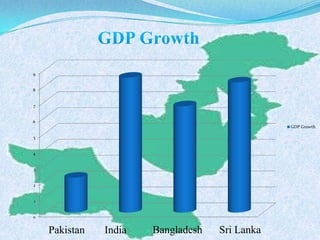
0
1
2
3
4
5
6
7
8
9
GDP Growth
Pakistan India Bangladesh Sri Lanka
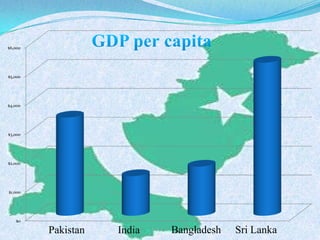
$0
$1,000
$2,000
$3,000
$4,000
$5,000
$6,000
Pakistan India Bangladesh Sri Lanka
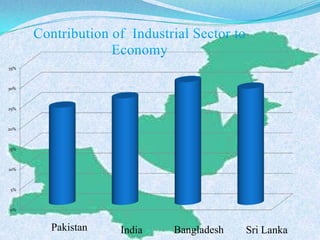
0%
5%
10%
15%
20%
25%
30%
35%
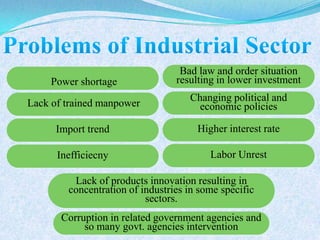
Power shortage
Lack of trained manpower
Import trend
Inefficiecny
Changing political and
economic policies
Bad law and order situation
resulting in lower investment
Higher interest rate
Labor Unrest
Lack of products innovation resulting in
concentration of industries in some specific
sectors.
Corruption in related government agencies and
so many govt. agencies intervention
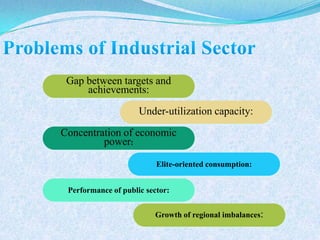
Gap between targets and
achievements:
Under-utilization capacity:
Concentration of economic
power:
Elite-oriented consumption:
Performance of public sector:
Growth of regional imbalances:
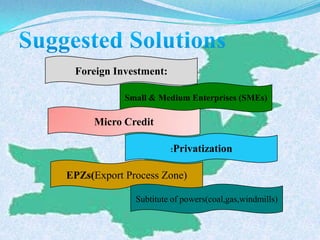
Foreign Investment:
Small & Medium Enterprises (SMEs)
Micro Credit
:Privatization
EPZs(Export Process Zone)
Subtitute of powers(coal,gas,windmills)
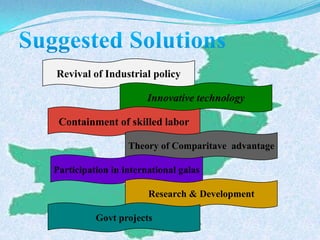
Revival of Industrial policy
Innovative technology
Containment of skilled labor
Theory of Comparitave advantage
Participation in international galas
Research & Development
Govt projects
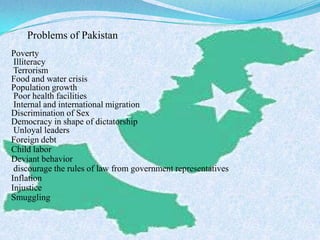
Problems of Pakistan
Poverty
Illiteracy
Terrorism
Food and water crisis
Population growth
Poor health facilities
Internal and international migration
Discrimination of Sex
Democracy in shape of dictatorship
Unloyal leaders
Foreign debt
Child labor
Deviant behavior
discourage the rules of law from government representatives
Inflation
Injustice
Smuggling
Illiteracy
Literacy rate: 49.9% educated populace ( Human
development Report Pakistan) placed at 136th position for
having just.
The primary completion rate in Pakistan, given by Date
Center of UNESCO, is 33.8% in females and 47.18% in
males, which shows that people in the 6th largest country of
the world are unable to get the basic education
Solution
Govt. should
Increase education budget
Establish more schools and appoint qualified and trained teachers
Technical education must be given to all the classes.
Promote primary education
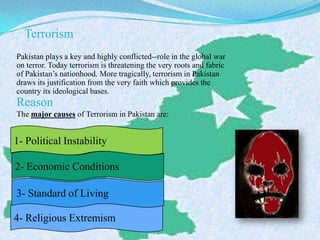
Terrorism
Pakistan plays a key and highly conflicted--role in the global war
on terror. Today terrorism is threatening the very roots and fabric
of Pakistan’s nationhood. More tragically, terrorism in Pakistan
draws its justification from the very faith which provides the
country its ideological bases.
Reason
The major causes of Terrorism in Pakistan are:
1- Political Instability
4- Religious Extremism
3- Standard of Living
2- Economic Conditions
War on Terrorism
War against terrorism is another very important reason
behind the economical problem.
War is affecting the world’s economy and is causing
problems like shortage of fuel, lack of funds, increase in
health problem etc.
War benefits none, someone is hurt badly and someone is
destroyed completely.
Solution
The real solution is to kill the root of Terrorism and
systematically change the attitude of those people’s who are
involved in terrorism
- Military operations against terrorists are also very necessary.
Education, Justice, Pour politics can stop the Terrorism..???
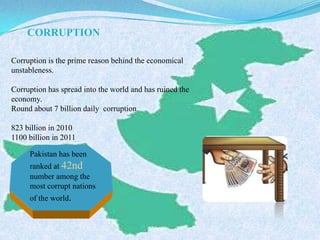
CORRUPTION
Corruption is the prime reason behind the economical
unstableness.
Corruption has spread into the world and has ruined the
economy.
Round about 7 billion daily corruption
823 billion in 2010
1100 billion in 2011
. Pakistan has been
ranked at 42nd
number among the
most corrupt nations
of the world.
 There are many reasons of unemployment like influx of machinery
that has replaced manpower.
 Unemployment is a major social problem caused by poor
economical system
 Lack of funds followed by unorganized system and lack of new
projects are causing unemployment worldwide.
 Increase in population
UNENPLOYMENT
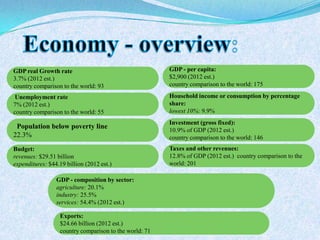
GDP real Growth rate
3.7% (2012 est.)
country comparison to the world: 93
Unemployment rate
7% (2012 est.)
country comparison to the world: 55
Population below poverty line
22.3%
Budget:
revenues: $29.51 billion
expenditures: $44.19 billion (2012 est.)
Household income or consumption by percentage
share:
lowest 10%: 9.9%
GDP - per capita:
$2,900 (2012 est.)
country comparison to the world: 175
Investment (gross fixed):
10.9% of GDP (2012 est.)
country comparison to the world: 146
Taxes and other revenues:
12.8% of GDP (2012 est.) country comparison to the
world: 201
GDP - composition by sector:
agriculture: 20.1%
industry: 25.5%
services: 54.4% (2012 est.)
Exports:
$24.66 billion (2012 est.)
country comparison to the world: 71
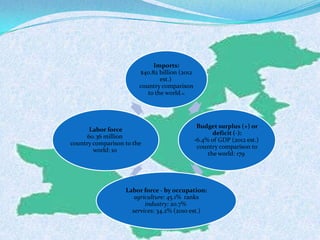
Imports:
$40.82 billion (2012
est.)
country comparison
to the world: 61
Budget surplus (+) or
deficit (-):
-6.4% of GDP (2012 est.)
country comparison to
the world: 179
Labor force - by occupation:
agriculture: 45.1% ranks
industry: 20.7%
services: 34.2% (2010 est.)
Labor force
60.36 million
country comparison to the
world: 10
Asian tiger Qaiser mayo

Asian tiger Qaiser mayo

  • 2.
    Pr esent edby: Name :Qai ser Hussai n Cl ass:Account i ng & Fi nance Rol l number : Bs 13116 Pr esent ed t o: Pr of Nasi r Chat t a
  • 3.
  • 4.
    INTRIDUCTION The Four AsianTigers or Asian Dragons is a term used in reference to the highly developed economies of Hong Kong, Singapore, South Korea and Taiwan after 1970. These regions were the first newly industrialized countries, noted for maintaining exceptionally high growth rates and rapid industrialization between the early 1960s and 1990s. By the 21st century, all four regions have since graduated into advanced economies and high-income economies. Now people say that all four countries are rich countries. All four Asian Tigers have a lot of people who are very educated and good at their jobs. They also did different things, and tried to do them better than other countries. For example, Hong Kong and Singapore became very good at international finance, while South Korea and Taiwan became very good at information technology. However, attention has increasingly shifted to other Asian economies which are now experiencing faster economic transformation A country is known as tiger of its continent if its economy is strongest among all other countries of same continent. But to make a country a tiger of its continent, betterments/improvements in many fields are required. Pakistan is the next country having the same vision. Pakistan has a semi-industrialized economy, which mainly encompasses textiles, chemicals, food processing, agriculture and other industries. Growth poles of Pakistan's economy are situated along the Indus River; diversified economies of Karachi and Punjab's urban centers coexist with lesser developed areas in other parts of the country. The economy has suffered in the past from decades of internal political disputes, a fast growing population, mixed levels of foreign investment and high defense spending. Foreign exchange reserves are bolstered by steady worker remittances, but a growing current account deficit – driven by a widening trade gap as import growth outstrips export expansion – could draw down reserves and dampen GDP growth in the medium term. But if we want to make Pakistan an Asian Tiger, we need to tie up all the broken ends and we will have to struggle each and every day, day and night to achieve our goal. Following Sectors still needs improvements if we want to make our country an Asian tiger.
  • 5.
    EDUCATION : Education isthe most important factor which plays a leading role in human resource development. It promotes productive and informed populace and creates opportunities for the socially and economically deprived sections of society.
  • 6.
    AGE LITERACY RATE % Ageb/w 55-64 30 % Age b/w 45-54 40 % Age b/w 25-34 50 % Age b/w 15 -24 60 % LITERACY RATE IN PAKISTAN In indicate the with every passing generation Literacy rate is increased By 10 %
  • 7.
    LITERACY RATE IS IT POSSIBLE?????? 57 % 50% 80% 2009 2015 ULTIMATE OBJECTIVE OF PAKISTAN
  • 8.
    UNIVERSITY WORLD RANKING During1947-2003 not a single university of Pakistan could be ranked among the top 600 universities of the world…......!!! But today 5 to 6 Pakistani universities belong to the prestigious group of worlds best universities ….!!!!
  • 9.
    Pakistani University inWorld Ranking NUST , ISLAMABAD UET , LAHORE KARACHI UNIVERSITY QUAID-E-AZAM UNIVERSITY ISLAMABAD MUET , JAMSHORO
  • 10.
    Country World Ranking Educational Budget Cuba#1 18.7% Malaysia #10 8.1% Iran #58 4.9% India #81 4.1% Bangladesh #119 2.4% Pakistan #126 1.8% Indonesia #130 1.2% Lack of Govt in Education
  • 11.
    Factors Cause ForPakistan’s Poor Performance In Education Low level of public investment  Lack of government funds to educational institutes  Administrative lacks of government institutions  “Choudhry” and “Wadera” culture of Pakistan  Low income level of people
  • 12.
    Challenges  Weakened Governance Fragmentation Lack of Clarity in Inter-Tier Relationships Poor Quality of Teachers & Managers Quality of curriculum, textbooks & exams Low level of literacy Out of school children Dropouts Public Private Partnership In-adequate financing Gender Equity Poor monitoring & evaluation Imbalance in primary, middle & secondary schools Inconvenient school location
  • 13.
    Reforms Undertaken • Freeeducation up to Matriculation. • Grant of scholarships • English language compulsory • Budgetary allocations for education increased • Encourage Private sector • Improved Examination System • Curriculum upgraded to ensure latest developments / ideas in science and technology • Format of the question papers for the Board examinations revised • Teachers’Training and Knowledge: • Technical / Vocational Education • Career Counselling at higher secondary level • Pre-service & in-service teacher training
  • 14.
  • 15.
    IMPROT EXPORT OVERVIEW Last five years Inflation has increased Currently 25% 5 years averaged Growth 6-7 cotton products Rice Toys, bicycles and other sporting goods, etc.
  • 17.
    Major Exports ofPakistan Over 80% of Pakistani exports are cotton products. Cotton apparel & household furnishings US$2.6 billion (70.6% of Pakistani to U.S. exports, up 18.6% from 2005) Cotton cloth & fabrics (threads, cordage) $351 million (9.6%, down 5.6%) Other textiles apparel & household furnishings $138.3 million (3.8%, down 11.6%) Textile floor coverings including rugs $122.1 million (3.3%, down 2.1%) Non-textile apparel & household furnishings $81.4 million (2.2%, up 7.2%)
  • 19.
    Ethanol a viablesubstitute for oil in motor vehicles Coal as Substitute for Gas Biodiesel commercialization in Pakistan Canola Oil, a better substitute for Palm Oil Substitutes for Exports no possible substitute for exports in Pakistan SUBSTITUTE FOR IMPORT & EXPORT
  • 20.
    FACTOR AFFECTING OUR EXPORT Stiffinternational competition in Textile products from China, India, Vietnam and Bangladesh in our major markets of the US and the EU; Industrial Zones (QIZs) in Jordan and Egypt fall in unit prices in the textile sector the setting up of U.S. sponsored Qualified CAFTA (Central American Free Trade Area) NAFTA (North American Free Trade Area),
  • 21.
    REASONS FOR TRADE DEFICITEIN PAK ELECTRICITY SHORTFALL LABOR FORCE POLITICAL INSTABILITY BUISNESS OPPORTUNITIES COUNTRY CROP SMUGGLING LOE RETURN ON CAPITAL RISING OIL PRICES
  • 22.
    IMPROVE EXPORT KEYS . Specific Transaction Guarantees: WholeTurnover Guarantees, Open Account Sales Only: Group-Wide Guarantees: Facilities Upgrade: Counter trade/Barter: Bid Bonding: Performance Guarantees: Inventory Replenishment: Agency Sales: Future Receivables: EDI Post-Shipment: Advisory: Short Term Financing Export Finance Scheme Long Term Financing LongTerm Financing-Export Oriented Projects. Locally Manufactured Machinery
  • 23.
    DISCUSS THE MAJORPROBLEMS OF AGRICULTURAL SECTOR OF PAKISTAN. WHAT MEASURES DO YOU SUGGEST TO IMPROVE THIS SECTOR? AND MAKE A PAKISTAN AS A ASIAN TIGER ……….. AGRICULTER SECTOR
  • 24.
    INTRODUCTION : Agricultural sectoris the backbone of our economy. But the growth of agriculture in Pakistan is facing a lot of problems. Due to various causes, per acre yield is very low in Pakistan as compare to other developed countries. Agriculture is central to economic growth and development in Pakistan. Being the dominant sector it contributes 21.4 percent to GDP, employs 45 percent of the country’s labour force and contributes in the growth of other sectors of the economy The agriculture growth this year stood at 3.3 percent as compared to 3.5 percent during the last year.
  • 25.
    PROBLEMS OF AGRICULTURALSECTOR Problems of agricultural sector are categorized as below: TECHNO-ECONOMIC PROBLEMS 1) Limited Cultivable Area The total area of Pakistan is about 79.6 million hectares, out of which only 23.7 million hectares (28%) area is used for agricultural purposes. About 8 million hectares area is idle and un-utilized. There is vast sub-division and fragmentation of land holdings, as a result modern technology cannot be applied in agriculture sector.
  • 26.
    2 Water Loggingand Salinity Water logging and salinity are twin problems of agricultural sector due to salinity, deposits of salt in land have appeared on the surface of land and they have adversely affected the performance of agricultural sector. Water logging and salinity affect about 0.10 million acre of land in every year. It is not only waste of land but also reduction in productivity. 3) Slow Growth of Allied Products Allied products refer to those productions, which are not agricultural but indirectly, help the farmer to improve his living standard. Pakistan is in-sufficient in the production of fruits, milk, poultry, fisheries, livestock and forestry. As a result not only our food quality is poor but also industries such as furniture, textiles and dairy cannot be developed.
  • 27.
    4) Low PerHectare Yield The most important problem of agriculture is its low yield per hectare for almost every major crop. 45.0% of labour force is engaged in this sector in Pakistan while it is less than 5% in developed countries. But, other countries of world are getting higher yield per hectare due to use of modern technology and trained labour. 5) Inadequate Infrastructure Rural infrastructure like, roads, storage facilities, transport, electricity, education, sanitation and health facilities etc. is inadequate to meet the requirement of growth of agriculture. Total length of farm-to-market road is not only shorter but their condition is also poor. Many villages have no metal- led road at all. Electricity is available to only 3/4 rural populations.
  • 28.
    6) Uneconomic LandHoldings Due to increasing population and division of land under the law of inheritance, landholdings are subdivided over and over again. The result is that very large number of farmers has less than 2 hectares of area. Moreover holdings are scattered. It is difficult to use modern machinery on small pieces of land. 7) Old Methods of Production No doubt, mechanization of agriculture is increasing in Pakistan, but in most of the areas, the old implements are still being used for agricultural production. Old and orthodox techniques of production cannot increase the production according to international levels.
  • 29.
    8) Inadequate Supplyof Agricultural Inputs The supply of modern inputs like high yielding variety (HYV) seeds, chemical fertilizers, pesticides, mechanized machinery etc. not only costly but also inadequate and irregular in Pakistan. Numbers of fertilizer producing units are just 10 in Pakistan. 9) Lack of Irrigation Facilities Shortage of irrigation facilities causes a serious limitation in the expansion of crop area in Pakistan. The lower water supplies, loses from water course in the fields are the serious problems of farm sector. Actual surface water availability is 91.8 million acre feet. 10) Inadequate Agricultural Research The average crop yield in Pakistan is very low as compared to the production levels of the advanced countries of the world. In order to raise the potential of agricultural production, there should be continuous improvement in the research for agricultural growth. Total agricultural universities and colleges are only 16 in Pakistan.
  • 30.
    11) Problem ofLand Reforms Land reforms have been implemented against the will of people. There is an urgent need to conduct a proper land reform for improving agricultural growth. Due to this problem agricultural production cannot increase to desired level. 12) Defective Land Tenure System Defective land tenure system is also responsible for low yield per acre in agricultural sector. Landlords and feudal-lords live in posh urban areas while tenants and peasants have no or less incentive for their hard work. So, the productivity in agricultural sector remains low.
  • 31.
    13) Subsistence Farming Ourfarmer is attached with subsistence farming; a huge of portion of production is consumed at farmer’s own house to support large family. Hence, less portion of the production is available for market supply. It causes low income of the farmers. Farming is not conducted at commercial level in Pakistan. 14) Low Cropping Intensity Cropping intensity means the number of crops grown on a piece of land in one year. At the present stage of our development, there is low level of cropping intensity as compared to advanced countries. Cultivable area under double or multiple cropping is inadequate in Pakistan 15) Improper Crop Rotation Proper turning round of crops is essential to re-establish the fertility of the land. The constant cultivation of one crop or two; exhausts the fertility of the soil. Proper rotation of crops is necessary in order to restore the fertility. .
  • 32.
    NATURAL PROBLEMS Various PlantDiseases cotton, sugarcane, tobacco, wheat and rice Natural Calamities Labour is in the hand of mankind but its result is in the hands of ALLAH in agriculture sector 20% reduction in productivity due to unnecessary rain Under Utilization of Land
  • 33.
    SOCIO-ECONOMIC PROBLEMS Consumption Oriented Farmer’s Litigation JointFamily System Illiteracy and Ill-health 57.7 only Political Instability
  • 34.
    FINANCIAL PROLEMS Lack ofCredit . About 50.8% poor borrow from landlords in Pakistan Poor Financial Position of Farmers 57.4% poor are working for feudal-lords without wages Instability in Market Prices Shortage of Agricultural Finance 50.8% poor borrow from landlords at very high rate of interest. .
  • 35.
    Water Logging andSalinity Control destroys about one million acre of land every year in Punjab and Sindh Construction of Dames Supply of Agriculture Credit Causes 20% reduction in total production Provision of HYV Seed MEASURES TO REMOVE THESE PROBLEMS
  • 36.
  • 37.
    Being an agrariancountry, agricultural sector of Pakistan’s economy is still backward. Use of modern techniques, provision of credit facilities, basic infrastructure and agriculture research facilities are needed to remove all the problems of agriculture sector. Conclusion
  • 38.
    Energy play animportant role in the economic development of a country. In Pakistan supply of energy is 46.8 million tons & per capita availability is 0.28 million tons per year while consumption per year is 48.3 million tons. ENERGY SECTOR
  • 39.
  • 40.
    1. WAPDA: It generates11399 MW energy, in which 57% is hydel & 43% of thermal energy includes. 2. IPP: It only generates 6374 MW energy. 3. Nuclear Power Plants: There are two nuclear power plants in Pakistan which generate 462 MW energy. 4. KESC: It generates 1955 MW energy.
  • 41.
  • 42.
  • 43.
  • 45.
    “Industry refers tothat sector of economy which is related with manufacturing and production of different products” Definition
  • 46.
     Industrial Sectoris of great importance for economic development of country.  Industrial Sector is of great importance for economic development of country. It is historical fact that countries with strong industrial sector have showed more economic growth and development industrial sector have shows improvement in national income and promoted living standard of population.
  • 47.
    Textile industry Sports industry Telecomindustry Cement industry Surgical industry Sugar industry Defense industry Auto mobile industry Fashion industry Fertilizer industry Oil & Gas Industries Chemical industry
  • 48.
    Historically, Pakistan’s textileindustry and clothing sector has always been a major contributor to the foreign exchange earner and still contributes
  • 49.
     4th largestgrower of cotton after USA, China and India  3rd largest consumer of cotton  3rd largest exporter of cotton textiles  2nd largest supplier of cotton yarn with 26% share of the international market
  • 50.
    Textiles products Handicrafts Power loomproducts Scarf Wool fabrics Blanket Winter shawls Hand embroidered shawls
  • 51.
    Over 1.3 millionfarmers, out of total of 5 million are involved in cultivation of this crop. Industrial Sector is the second largest individual sector of the economy accounting for 24% of the GDP
  • 53.
    Fertilizer is anyorganic or inorganic material of natural or synthetic origin (other than liming materials) that is added to a soil to supply one or more plant nutrients essential to the growth of plants.
  • 54.
  • 55.
    GDP Contribution 14% Employments 4.7 million FaujiFertilizer Ltd Engro Chemical Ltd Sitara Chemicals Ltd
  • 56.
    Cement industry isone of most prominent and energetic organization having operations and interactions with cement industry
  • 57.
    5th position leaving Germanybehind Pakistan is ranked 5th in the world’s cement exports 2008-09 (20.28 mt) Pakistan exports increased by 47% in last fiscal year. Exported $700m in past year
  • 58.
     23 cementcompanies  4 foreign companies  3 controlled by the armed force  19 companies are listed on the stock exchange. GDP:- 3.5% Contribution
  • 59.
    At the timeof independence in 1947, there were only two sugar factories in Pakistan. At present there are 106 sugar mills operating in Pakistan. It is the 2nd Largest industry in Pakistan after Textile Industry
  • 60.
    PER CAPITA CONSUMPTION (26kg) total of106 sugar mills in the country Pakistan ranks 15th in the World for sugarcane production GDP contribution (0.7%) Employment (1million) Sugarcane acreage in Pakistan is 5th in the World and it is grown on over 1 million hectares
  • 61.
    Alcohol (used bypharmaceutical industry) Ethanol (used as a fuel)
  • 62.
    “Sports' are allforms of physical activity which, through casual or organized participation, aim at expressing or improving physical fitness and mental well-being, forming social relationships or obtaining results in competition at all levels”
  • 63.
    Football Cricket bats Hockey sticks Boxinggloves Volley balls Swimming suits Golf balls Badminton rackets Basketballs
  • 64.
     The exportof sports goods, increased by 7.85% from US$39.180m →US$42.257m last year  Sialkot export 70% of total world demand for hand-stitched inflatable soccer balls (footballs).  40 million balls annually worth US$210 million.
  • 65.
    Companies of varioussizes 2,400 Employments more than 200,000 Exporting goods worth US$450 million Large exporters (more than 250 employees) Medium exporters (100–250 employees) Small exporters (10–100 employees). Commercial exporters (1–9 employees).
  • 66.
    Telecommunication is the transmissionof information over significant distances to communicate Main Categories  Telephone  Mobiles  Internet
  • 67.
    In 2008 Pakistanwas the world’ s third fastest growing telecommunications market Fixed-line subscriptions declined from a peak of 5.2 million in 2005-06 to 3.4 million in 2009-10 Pakistan traffic volume grew by 253 percent compared to last year during the same period
  • 68.
    5% of its GrossDomestic Product has created 220,000 high-paying jobs in Pakistan Pakistan is now a leader in mobile usage in south Asia
  • 69.
  • 70.
     The glassindustry in Pakistan, though developed, still has space for improvement.  There are about 37 glassworks in the organized sector, with the production capacity ranging between 10 tonnes and 200 tonnes per day.
  • 71.
    The major ceramicsindustry are Karam Ceramics, Swat Ceramics, Master Tiles, Shabbir Tiles and Emco Industries. Punjab 73% Sindh 5% Baluchistan 3% NWFP 19% GDP Contribution
  • 72.
    Glass industry inPakistan comprises sixteen manufacturers in the organized sector which produces over 90 per cent of the indigenous production within the country. (PAGMA) Pakistan exported glass products worth Rs 60 million to Rs 120 million per annum during 2005-2010, imports of various glass from Rs 975 million to Rs 1,782 million, during last five years 83%. increase
  • 74.
     The leathermade ups and finishing industries symbolize an important division in Pakistan,  Earning approximately more than 8 million $ as a foreign exchange earnings to the country. JavaScript Web application
  • 75.
    Leather Garments Leather Goods Footwear LeatherShoe Uppers Tanning Leather Gloves
  • 76.
    Production Capacity Production TannedLeather 90 million ft2 60 million ft2 Leather Garments 7 million pieces 5 million pieces Leather Gloves 10 million pairs 5 million pairs Leather Footwear 200 million pairs 100 million pairs •The difference in production capacity and present capacity is due to various reasons. Source: Pakistan Tanners Association
  • 77.
     Italy, Spain,Portugal, South Korea, Germany,  France, UK, USA and UAE. More than 2300 leather processing units Provide employment to about 500,000 people
  • 78.
    PAKISTAN SURGICAL INDUSTRIES(PVT) LIMITED was established in 1974 and now has become one of the leading manufacturers of Surgical.
  • 79.
    Surgical Instruments JavaScript Dental Instruments Webapplication Beauty Instruments Web application
  • 80.
    Indicator Value To GDP(%)0.42% To Direct Employment (Numbers) 400-500,000 To Indirect Employment (Numbers) 600-,750000 To Exports (%) 1.21%
  • 81.
    Produces over 150m pieces/year worth Rs22 billion 2300 companies are working in this sector Over 99% production is done in Sialkot Out of the total production over 95% is exported
  • 82.
    The business ofproducing and selling self-powered vehicles, including passenger cars, trucks, farm equipment, and other commercial vehicles
  • 83.
  • 84.
  • 85.
    Automotive engineering isa driving force of large scale manufacturing, contributing US$ 3.6 billion to the national economy and engaging over 192,000 people in direct employment.
  • 86.
    GDP Contribution ofDifferent Sectors of Economy  Agriculture 20.47%  Crops 9.90%  Livestock 9.97%  Fishing 0.33%  Forestry 0.25%  Industry 23.93%  Manufacturing 17.53%  Mining 2.39%  Construction 2.19%  Electricity & Gas 1.80%  Services 55.60%  Wholesale & Trade 17.25%  Transport 11.80%  Finance & Insurance 3.59%  Ownership & Dwelling 2.22%  Public Administration & Defense 5.4%  Community & Social Professional Services 10.22%
  • 87.
  • 88.
    Asian Countries  Pakistan23.93%  India 26.3%  Bangladesh 28.5%  China 46.9%
  • 89.
  • 90.
  • 91.
    Pakistan India BangladeshSri Lanka 0% 5% 10% 15% 20% 25% 30% 35%
  • 92.
    Power shortage Lack oftrained manpower Import trend Inefficiecny Changing political and economic policies Bad law and order situation resulting in lower investment Higher interest rate Labor Unrest Lack of products innovation resulting in concentration of industries in some specific sectors. Corruption in related government agencies and so many govt. agencies intervention
  • 93.
    Gap between targetsand achievements: Under-utilization capacity: Concentration of economic power: Elite-oriented consumption: Performance of public sector: Growth of regional imbalances:
  • 94.
    Foreign Investment: Small &Medium Enterprises (SMEs) Micro Credit :Privatization EPZs(Export Process Zone) Subtitute of powers(coal,gas,windmills)
  • 95.
    Revival of Industrialpolicy Innovative technology Containment of skilled labor Theory of Comparitave advantage Participation in international galas Research & Development Govt projects
  • 96.
    Problems of Pakistan Poverty Illiteracy Terrorism Foodand water crisis Population growth Poor health facilities Internal and international migration Discrimination of Sex Democracy in shape of dictatorship Unloyal leaders Foreign debt Child labor Deviant behavior discourage the rules of law from government representatives Inflation Injustice Smuggling
  • 97.
    Illiteracy Literacy rate: 49.9%educated populace ( Human development Report Pakistan) placed at 136th position for having just. The primary completion rate in Pakistan, given by Date Center of UNESCO, is 33.8% in females and 47.18% in males, which shows that people in the 6th largest country of the world are unable to get the basic education Solution Govt. should Increase education budget Establish more schools and appoint qualified and trained teachers Technical education must be given to all the classes. Promote primary education
  • 98.
    Terrorism Pakistan plays akey and highly conflicted--role in the global war on terror. Today terrorism is threatening the very roots and fabric of Pakistan’s nationhood. More tragically, terrorism in Pakistan draws its justification from the very faith which provides the country its ideological bases. Reason The major causes of Terrorism in Pakistan are: 1- Political Instability 4- Religious Extremism 3- Standard of Living 2- Economic Conditions
  • 99.
    War on Terrorism Waragainst terrorism is another very important reason behind the economical problem. War is affecting the world’s economy and is causing problems like shortage of fuel, lack of funds, increase in health problem etc. War benefits none, someone is hurt badly and someone is destroyed completely. Solution The real solution is to kill the root of Terrorism and systematically change the attitude of those people’s who are involved in terrorism - Military operations against terrorists are also very necessary. Education, Justice, Pour politics can stop the Terrorism..???
  • 100.
    CORRUPTION Corruption is theprime reason behind the economical unstableness. Corruption has spread into the world and has ruined the economy. Round about 7 billion daily corruption 823 billion in 2010 1100 billion in 2011 . Pakistan has been ranked at 42nd number among the most corrupt nations of the world.
  • 101.
     There aremany reasons of unemployment like influx of machinery that has replaced manpower.  Unemployment is a major social problem caused by poor economical system  Lack of funds followed by unorganized system and lack of new projects are causing unemployment worldwide.  Increase in population UNENPLOYMENT
  • 102.
    GDP real Growthrate 3.7% (2012 est.) country comparison to the world: 93 Unemployment rate 7% (2012 est.) country comparison to the world: 55 Population below poverty line 22.3% Budget: revenues: $29.51 billion expenditures: $44.19 billion (2012 est.) Household income or consumption by percentage share: lowest 10%: 9.9% GDP - per capita: $2,900 (2012 est.) country comparison to the world: 175 Investment (gross fixed): 10.9% of GDP (2012 est.) country comparison to the world: 146 Taxes and other revenues: 12.8% of GDP (2012 est.) country comparison to the world: 201 GDP - composition by sector: agriculture: 20.1% industry: 25.5% services: 54.4% (2012 est.) Exports: $24.66 billion (2012 est.) country comparison to the world: 71
  • 103.
    Imports: $40.82 billion (2012 est.) countrycomparison to the world: 61 Budget surplus (+) or deficit (-): -6.4% of GDP (2012 est.) country comparison to the world: 179 Labor force - by occupation: agriculture: 45.1% ranks industry: 20.7% services: 34.2% (2010 est.) Labor force 60.36 million country comparison to the world: 10