Economic Potential & it’s Utilization
Submitted to: Mrs. Farhat Naseem
Submitted by:
Kaynat Naseer Kayani AF-1440
Talha Sikandar AF-1375
Tazmeen Abbas AF-1432
Azhar Hussain AF-1433
Topics Included
 Economic potential
 Economic potential of Pakistan
 Benefits of Economic Potential
 Causes of Economic Growth
 How Pakistan improve its economic potential
What is Economic Potential
Economic potential is the potential of a region, nation, or
corporation for economic development and growth. Typically,
discussions of economic potential occur when available
resources have not yet been tapped and fully developed or
exploited, possibly because of missing infrastructure
Why is economy important
 The economy is an indicator of development and sustainability.
 A good economy ensures better chances of survival and development or a
state.
 If we understand the cycles and system in Economics, we can better
understand how to manage our money and society!
An overview of Pakistan’s Economy
 The economy of Pakistan is the 26th largest in the world in terms of purchasing
power parity (PPP), and 44th largest in terms of nominal GDP
 In 1947, Pakistan had 30 million people with per capita income of 100$. Agriculture
accounted for almost 50% of economic output with hardly any manufacturing, as all
industries were located in India.
 Therefore, it was unable to feed 30 million people and was dependent on imports
from the USA.
 From thereon, Pakistan has come a long way. Today with 170 million people, our
per capita income in 2008 was 1000$ which is ten times more than it was in the
beginning.
Economic Potential of Pakistan
 Scope of Economic Potential
 Factors that affect the Economic Growth of a Country
a) Human Recourse
b) Natural Resource
c) Capital Formation
d) Technological Development
e) Social and Political Factors
 Economic Corridors can Boost Pakistan’s Prospects of Becoming a
Regional Economic Hub
a) Infrastructure development
b) Industrial development
c) Urban development
 Reasons Behind the Failure to Realize Economic Potential
Growth Rate
Benefits of Economic Potential
Cost-effective energy efficiency improvements can have positive
macroeconomic impacts, boosting economic activity and often
leading to increased employment. Energy efficiency reduces the
amount of energy needed to deliver services, such as mobility,
lighting, heating and cooling. Lowering the cost of energy services
frees up resources for households, businesses and governments.
Comparison
Pakistan
 So if we measure in relation to where
the structure of economy. agriculture
has come down from 50% to 20%
 Within agriculture sector, there is a
change i.e. major crops are only 36% of
agriculture value added and 14% are
minor crops, fisheries. orchards, fruits
and vegetables. Thus, we are moving
in a direction where the same land and
same resources are being used more
efficiently in order to produce more.
USA
 As a contrast, agriculture is only 2.5%
in the US having a population of 300
million, out of which they not only
feed the entire population, but also
export to the rest of the world.
Therefore, it is important to
understand that when it is said that
agriculture is producing/contributing
more, it is the productivity of
agriculture rather than the share of
agriculture in GDP
.
Manufacturing and Industry
 Manufacturing and industry now account for 25% of the income: when we
recall there was not even a single industry worth its name at the time of
partition.
 So if we look where we were and where we are, I think the justification for
Pakistan in terms of betterment of economic conditions of Muslims in this
part is very strong.
 But, we have not lived up to our potential. We can do much better than this
Where are we lagging behind
In 1969, Pakistan exports of manufactured goods were higher than the combined
exports of Indonesia, Malaysia, Philippines and Thailand.
In 1960's Korea emulated Pakistan in its five years planning process.
The tragedy is that even a country such as Vietnam which was completely
devastated by the war has now overtaken Pakistan.
Ten years ago, India which was way behind Pakistan (till 1990's) is now way
ahead.
As an economist the biggest challenge is: how can we organize ourselves to
improve our economy.
Challenges to Pakistan Economy
 We Import More and Export Less.
 We Consume More and Save Less.
 Government Spends More than it Earns as Revenues
 Our Share in the World Trade is Shrinking
 We Face Energy and Water Shortages
 Crisis of Governance and Implementation Weaknesses
 Political Stability, Law and Order/Security
Challenges to Pakistan economy
1. We Consume More and Save Less.
 Out of every hundred rupees of our national income, we consume 85 rupees
and save only 15 rupees.
 Pakistan's saving rate is 6%. We need at least 24-25% investment rate to grow,
and if we want to rely on domestic savings, your saving rate should be 25%.
 India has 34% saving rates. While China's saving rate is 50%
Challenges to Pakistan economy
2.We Import More and Export Less.
 Till 2007-2008, 80% of our imports were financed by our export eamings.
 This ratio has come down to only 50%, it may go up to 60% but a gop of 40%
of financing needs in order to keep with the import level still exists.
 We have to change the attitude of preferring the imported goods in order to
fill in the gap b/w our imports and exports
Challenges to Pakistan economy
3. Government Spends More than it Earns as Revenues.
 Pakistan's government takes away 20% of national income as its own.
 80% is left in the private sector and 20% in the hands of the government is spent on
defense, debt servicing, development on education, health, general administration etc.
 The revenue generated is only 15% of the GDP at best, and in the worst days it is 12 to
13%.
 Out of the every rupee of income received by a Pakistani, on average, tax paid is only 9
paisas and 91 paisas remain with the individual.
 In 2007-2008, Pakistan's fiscal deficit was more than 7% which means its income or
revenues were only 13% of GDP whereas, expenditures were 20%.
 Therefore, fiscal deficits have to be financed from somewhere, so how do you finance
them: you either go again begging the external donors. or to the State bank of Pakistan.
Challenges to Pakistan economy
 The financing provided by the State bank of Pakistan is dangerous because it creates
high inflation in the economy, which is injurious to the middle class, those earning
fixed wages and salaries, and the poor.
 Therefore, there is an uproar in the country if the inflation rate goes up. In 1999, our
Debt to GDP ratio was 100%, which means that the entire national income was
pledged as debt.
 So Pakistan is way below the norm for developing countries.
 Many people say that defense takes away a lot of government expenditure.
 The fact is that defence expenditure is only 20% of government expenditure. It is only
4% of GDP. and is not such a large expenditure as compared to debt servicing which is
7-8% of GDP and almost 40% of government expenditure. Therefore, government has
to contain its fiscal deficit by raising revenues
Challenges to Pakistan economy
4. Our Share in the World Trade is Shrinking.
 In 1990. Pakistan's share was 0.2% of the world trade.
 After 20 years it has come down to 0.12% in a very buoyant world economy.
 World trade has been growing faster as compared to the world output. India in the same
period had doubled its share from 0.7% to 1.4%, while Pakistan is going the other way
and that is the reason why exports/imports imbalance is increasing.
 All our exports are to a few markets - the USA, EU and the Middle East
Challenges to Pakistan economy
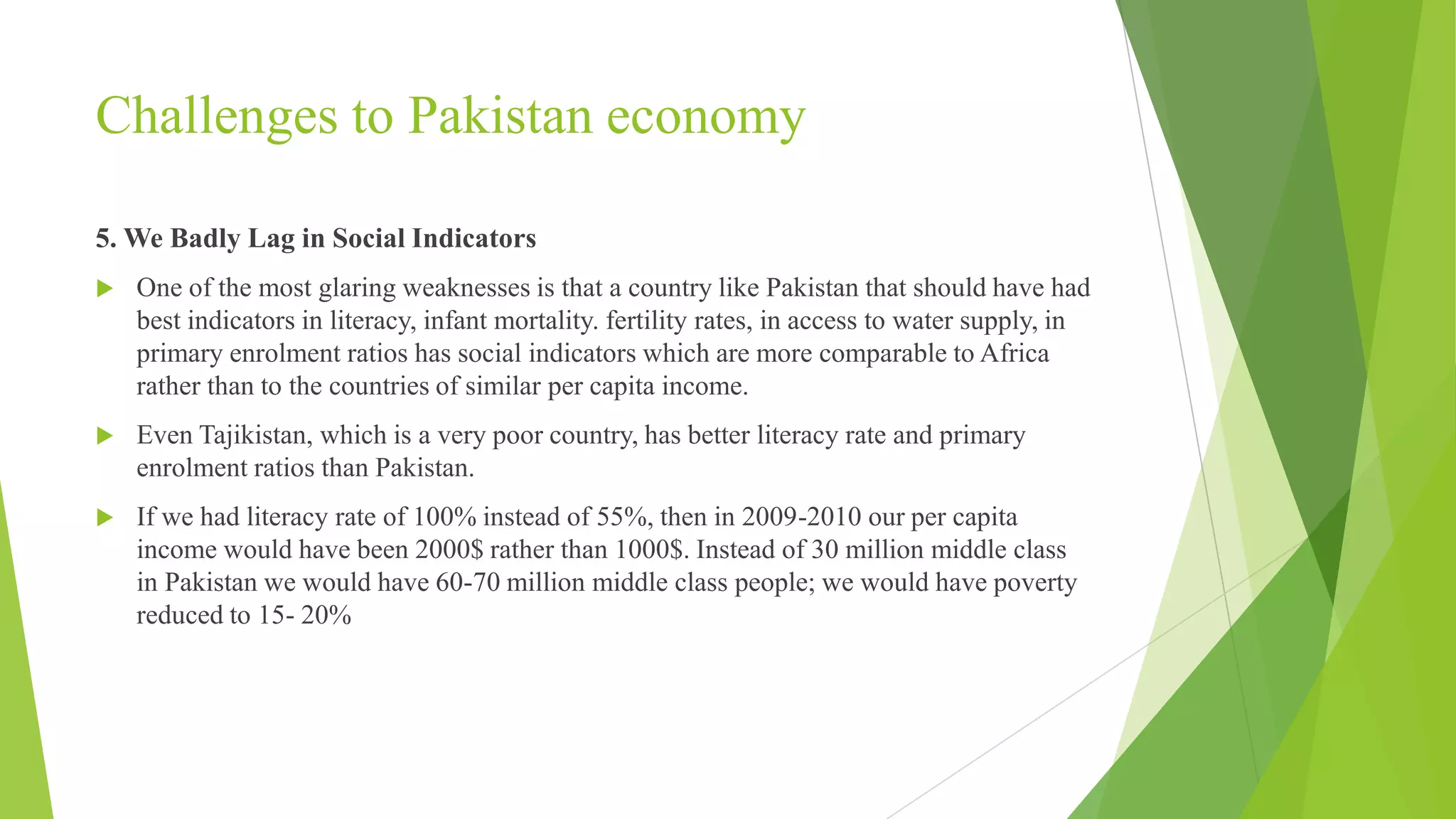
5. We Badly Lag in Social Indicators
 One of the most glaring weaknesses is that a country like Pakistan that should have had
best indicators in literacy, infant mortality. fertility rates, in access to water supply, in
primary enrolment ratios has social indicators which are more comparable to Africa
rather than to the countries of similar per capita income.
 Even Tajikistan, which is a very poor country, has better literacy rate and primary
enrolment ratios than Pakistan.
 If we had literacy rate of 100% instead of 55%, then in 2009-2010 our per capita
income would have been 2000$ rather than 1000$. Instead of 30 million middle class
in Pakistan we would have 60-70 million middle class people; we would have poverty
reduced to 15- 20%
Challenges to Pakistan economy
6. We Face Energy and Water Shortages.
 Another challenge we face today is energy and water shortages. and that is not because
we are not generating enough electricity or we are not having enough water. With the
losses of KESC from the point it has generated to the point they realize the billing is
45%, so 55% people are paying for those who are stealing the electricity. Government
of Pakistan out of its own limited resources is paying 200 billion rupees every year as
subsidies for electricity.
 No additional dams have been constructed since Tarbela in 1974. We have water course
losses of about 20-25%. Even then, the water is unequally distributed.
 The productivity of poor farmer is only one ton per acre as compared to 3 tons by large
holders
Challenges to Pakistan economy
7. Political Instability, Law and Order/Security
 The overall arching theme is that for a robust economy we should have political
stability, law and order and security.
 Until country has gotten rid of the image of political instability, poor law and order
situation and insecurity, where investors from all over the world hesitate from coming
to Pakistan and invest, we will not be able to make any progress in this country
Solutions to improve the economy
 How can we overcome these challenges and problems and improve our economy?
 A lot has been written and talked about, but I will focus on only a few action points.
Solutions to improve the economy
1. Change in National Psyche and Mindset.
 We as a nation are too much negative oriented and too much cynical where we find
everything wrong in this country.
 Unless we change our mindset and unless everybody who is doing what he is supposed
to do, carries out his or her task with sincerity and honesty, we are not going to go
anywhere.
 Media is muddying the water by their sensational stories and inviting so called experts
who contribute in projecting negative thinking and negative national psyche. Unless
we have a positive "can do" mentality, it will be difficult to progress. There are no
short cuts available.
Solutions to improve the economy
2. Building up of Human Capital
 There is no substitute to building up human capital. Picha public sector, NGOs, local
communities, philanthropih te to put their hands on deck and participate in making sure
th every child goes to school. Every high school graduate he technical and vocational
skill or goes for higher education
 Unless we build up human capital, we are just going to be behind because the world
economy is going to be a knowle based economy.
 Pakistan lags behind other countries in the institutions, Infrastucture and incentives for
human capital formation. We have no che but to accelerate the pace to catch up with
others.
Solutions to improve the economy
3. Use of Technology
 The technology is spreading like a wild fire. 95 million Pakistanis have mobile phones
today. We can use this technology in order to provide them banking services,
information on climate/weather. agriculture extension, health, education etc. It is a
powerful tool which can leapfrog a lot of time which we have wasted.
 Using technology particularly the information/communication technology for the
betterment of social and economic problems of Pakistan is something which needs to
be done.
Solutions to improve the economy
4. Young Labour Force
 Pakistan is one of the few countries which has a young labour force which can be
harnessed for its own and global economy.
 Japan, Europe, USA and after 2050 China are going to have aging population where
the ratio of old to young people is going to increase. India and Pakistan are two
countries where the ratio of younger people to the older ones is going to increase. If we
tool these young men and women properly, we increase the female labour force
participation, give them skills and knowledge, they can become the labour force for the
rest of the world.
 This will give a big boost to Pakistan's own economy.
Solutions to improve the economy
5. Governance, Devolution and Decentralization
 As the population is increasing, one cannot govern Pakistan sitting in Islamabad,
Karachi, Lahore, Peshawar or Quetta. One has to devolve powers, decentralize and
delegate authority, provide resources to the local/district governments so that they can
take decisions at their own.
 Sitting in Islamabad one cannot visualize what is needed in rural areas, but the people
in rural areas know exactly whether they need water, fertilizers or fruit processing
industry. Let us devolve powers to the people at the grassroots level and there would be
much better allocation and utilization of resources. There must, however, be
accountability of the local governments by the provincial governments and of
provincial governments by the federal government but not interference or usurpation of
powers.
 If we do that, then a lot more can happen with same amount of resources which are
being wasted today, and the economic growth rate can be raised from 6-7 percent
average to 8-9 percent annually.
Lets Revise the steps that we need to follow
 We must Change in National Psyche and Mindset.
 Building up of Human Capital
 Improve the use of Technology.
 Develop more and qualified Young Labour Force.
 Work efficiently on Governance, Devolution and Decentralization
Conclusion
 Pakistan and its people has a lot of potential and we are blessed with a whole lot of
natural resources.
 If the government plans wisely, and the people work hard, the economy of Pakistan
can be taken to a whole new level.
 We need to provide employment opportunities for young people and to train them in
the kind of the skills which are needed not only by the national economy but also by
the international economy.
 The moral is, that the government and every individual in the system needs to play
their part to help in the economical progress of the country.

Economic.pptx

  • 1.
    Economic Potential &it’s Utilization Submitted to: Mrs. Farhat Naseem Submitted by: Kaynat Naseer Kayani AF-1440 Talha Sikandar AF-1375 Tazmeen Abbas AF-1432 Azhar Hussain AF-1433
  • 2.
    Topics Included  Economicpotential  Economic potential of Pakistan  Benefits of Economic Potential  Causes of Economic Growth  How Pakistan improve its economic potential
  • 3.
    What is EconomicPotential Economic potential is the potential of a region, nation, or corporation for economic development and growth. Typically, discussions of economic potential occur when available resources have not yet been tapped and fully developed or exploited, possibly because of missing infrastructure
  • 4.
    Why is economyimportant  The economy is an indicator of development and sustainability.  A good economy ensures better chances of survival and development or a state.  If we understand the cycles and system in Economics, we can better understand how to manage our money and society!
  • 5.
    An overview ofPakistan’s Economy  The economy of Pakistan is the 26th largest in the world in terms of purchasing power parity (PPP), and 44th largest in terms of nominal GDP  In 1947, Pakistan had 30 million people with per capita income of 100$. Agriculture accounted for almost 50% of economic output with hardly any manufacturing, as all industries were located in India.  Therefore, it was unable to feed 30 million people and was dependent on imports from the USA.  From thereon, Pakistan has come a long way. Today with 170 million people, our per capita income in 2008 was 1000$ which is ten times more than it was in the beginning.
  • 6.
    Economic Potential ofPakistan  Scope of Economic Potential  Factors that affect the Economic Growth of a Country a) Human Recourse b) Natural Resource c) Capital Formation d) Technological Development e) Social and Political Factors  Economic Corridors can Boost Pakistan’s Prospects of Becoming a Regional Economic Hub a) Infrastructure development b) Industrial development c) Urban development  Reasons Behind the Failure to Realize Economic Potential
  • 7.
  • 8.
    Benefits of EconomicPotential Cost-effective energy efficiency improvements can have positive macroeconomic impacts, boosting economic activity and often leading to increased employment. Energy efficiency reduces the amount of energy needed to deliver services, such as mobility, lighting, heating and cooling. Lowering the cost of energy services frees up resources for households, businesses and governments.
  • 9.
    Comparison Pakistan  So ifwe measure in relation to where the structure of economy. agriculture has come down from 50% to 20%  Within agriculture sector, there is a change i.e. major crops are only 36% of agriculture value added and 14% are minor crops, fisheries. orchards, fruits and vegetables. Thus, we are moving in a direction where the same land and same resources are being used more efficiently in order to produce more. USA  As a contrast, agriculture is only 2.5% in the US having a population of 300 million, out of which they not only feed the entire population, but also export to the rest of the world. Therefore, it is important to understand that when it is said that agriculture is producing/contributing more, it is the productivity of agriculture rather than the share of agriculture in GDP .
  • 10.
    Manufacturing and Industry Manufacturing and industry now account for 25% of the income: when we recall there was not even a single industry worth its name at the time of partition.  So if we look where we were and where we are, I think the justification for Pakistan in terms of betterment of economic conditions of Muslims in this part is very strong.  But, we have not lived up to our potential. We can do much better than this
  • 11.
    Where are welagging behind In 1969, Pakistan exports of manufactured goods were higher than the combined exports of Indonesia, Malaysia, Philippines and Thailand. In 1960's Korea emulated Pakistan in its five years planning process. The tragedy is that even a country such as Vietnam which was completely devastated by the war has now overtaken Pakistan. Ten years ago, India which was way behind Pakistan (till 1990's) is now way ahead. As an economist the biggest challenge is: how can we organize ourselves to improve our economy.
  • 12.
    Challenges to PakistanEconomy  We Import More and Export Less.  We Consume More and Save Less.  Government Spends More than it Earns as Revenues  Our Share in the World Trade is Shrinking  We Face Energy and Water Shortages  Crisis of Governance and Implementation Weaknesses  Political Stability, Law and Order/Security
  • 13.
    Challenges to Pakistaneconomy 1. We Consume More and Save Less.  Out of every hundred rupees of our national income, we consume 85 rupees and save only 15 rupees.  Pakistan's saving rate is 6%. We need at least 24-25% investment rate to grow, and if we want to rely on domestic savings, your saving rate should be 25%.  India has 34% saving rates. While China's saving rate is 50%
  • 14.
    Challenges to Pakistaneconomy 2.We Import More and Export Less.  Till 2007-2008, 80% of our imports were financed by our export eamings.  This ratio has come down to only 50%, it may go up to 60% but a gop of 40% of financing needs in order to keep with the import level still exists.  We have to change the attitude of preferring the imported goods in order to fill in the gap b/w our imports and exports
  • 15.
    Challenges to Pakistaneconomy 3. Government Spends More than it Earns as Revenues.  Pakistan's government takes away 20% of national income as its own.  80% is left in the private sector and 20% in the hands of the government is spent on defense, debt servicing, development on education, health, general administration etc.  The revenue generated is only 15% of the GDP at best, and in the worst days it is 12 to 13%.  Out of the every rupee of income received by a Pakistani, on average, tax paid is only 9 paisas and 91 paisas remain with the individual.  In 2007-2008, Pakistan's fiscal deficit was more than 7% which means its income or revenues were only 13% of GDP whereas, expenditures were 20%.  Therefore, fiscal deficits have to be financed from somewhere, so how do you finance them: you either go again begging the external donors. or to the State bank of Pakistan.
  • 16.
    Challenges to Pakistaneconomy  The financing provided by the State bank of Pakistan is dangerous because it creates high inflation in the economy, which is injurious to the middle class, those earning fixed wages and salaries, and the poor.  Therefore, there is an uproar in the country if the inflation rate goes up. In 1999, our Debt to GDP ratio was 100%, which means that the entire national income was pledged as debt.  So Pakistan is way below the norm for developing countries.  Many people say that defense takes away a lot of government expenditure.  The fact is that defence expenditure is only 20% of government expenditure. It is only 4% of GDP. and is not such a large expenditure as compared to debt servicing which is 7-8% of GDP and almost 40% of government expenditure. Therefore, government has to contain its fiscal deficit by raising revenues
  • 17.
    Challenges to Pakistaneconomy 4. Our Share in the World Trade is Shrinking.  In 1990. Pakistan's share was 0.2% of the world trade.  After 20 years it has come down to 0.12% in a very buoyant world economy.  World trade has been growing faster as compared to the world output. India in the same period had doubled its share from 0.7% to 1.4%, while Pakistan is going the other way and that is the reason why exports/imports imbalance is increasing.  All our exports are to a few markets - the USA, EU and the Middle East
  • 18.
    Challenges to Pakistaneconomy 5. We Badly Lag in Social Indicators  One of the most glaring weaknesses is that a country like Pakistan that should have had best indicators in literacy, infant mortality. fertility rates, in access to water supply, in primary enrolment ratios has social indicators which are more comparable to Africa rather than to the countries of similar per capita income.  Even Tajikistan, which is a very poor country, has better literacy rate and primary enrolment ratios than Pakistan.  If we had literacy rate of 100% instead of 55%, then in 2009-2010 our per capita income would have been 2000$ rather than 1000$. Instead of 30 million middle class in Pakistan we would have 60-70 million middle class people; we would have poverty reduced to 15- 20%
  • 19.
    Challenges to Pakistaneconomy 6. We Face Energy and Water Shortages.  Another challenge we face today is energy and water shortages. and that is not because we are not generating enough electricity or we are not having enough water. With the losses of KESC from the point it has generated to the point they realize the billing is 45%, so 55% people are paying for those who are stealing the electricity. Government of Pakistan out of its own limited resources is paying 200 billion rupees every year as subsidies for electricity.  No additional dams have been constructed since Tarbela in 1974. We have water course losses of about 20-25%. Even then, the water is unequally distributed.  The productivity of poor farmer is only one ton per acre as compared to 3 tons by large holders
  • 20.
    Challenges to Pakistaneconomy 7. Political Instability, Law and Order/Security  The overall arching theme is that for a robust economy we should have political stability, law and order and security.  Until country has gotten rid of the image of political instability, poor law and order situation and insecurity, where investors from all over the world hesitate from coming to Pakistan and invest, we will not be able to make any progress in this country
  • 21.
    Solutions to improvethe economy  How can we overcome these challenges and problems and improve our economy?  A lot has been written and talked about, but I will focus on only a few action points.
  • 22.
    Solutions to improvethe economy 1. Change in National Psyche and Mindset.  We as a nation are too much negative oriented and too much cynical where we find everything wrong in this country.  Unless we change our mindset and unless everybody who is doing what he is supposed to do, carries out his or her task with sincerity and honesty, we are not going to go anywhere.  Media is muddying the water by their sensational stories and inviting so called experts who contribute in projecting negative thinking and negative national psyche. Unless we have a positive "can do" mentality, it will be difficult to progress. There are no short cuts available.
  • 23.
    Solutions to improvethe economy 2. Building up of Human Capital  There is no substitute to building up human capital. Picha public sector, NGOs, local communities, philanthropih te to put their hands on deck and participate in making sure th every child goes to school. Every high school graduate he technical and vocational skill or goes for higher education  Unless we build up human capital, we are just going to be behind because the world economy is going to be a knowle based economy.  Pakistan lags behind other countries in the institutions, Infrastucture and incentives for human capital formation. We have no che but to accelerate the pace to catch up with others.
  • 24.
    Solutions to improvethe economy 3. Use of Technology  The technology is spreading like a wild fire. 95 million Pakistanis have mobile phones today. We can use this technology in order to provide them banking services, information on climate/weather. agriculture extension, health, education etc. It is a powerful tool which can leapfrog a lot of time which we have wasted.  Using technology particularly the information/communication technology for the betterment of social and economic problems of Pakistan is something which needs to be done.
  • 25.
    Solutions to improvethe economy 4. Young Labour Force  Pakistan is one of the few countries which has a young labour force which can be harnessed for its own and global economy.  Japan, Europe, USA and after 2050 China are going to have aging population where the ratio of old to young people is going to increase. India and Pakistan are two countries where the ratio of younger people to the older ones is going to increase. If we tool these young men and women properly, we increase the female labour force participation, give them skills and knowledge, they can become the labour force for the rest of the world.  This will give a big boost to Pakistan's own economy.
  • 26.
    Solutions to improvethe economy 5. Governance, Devolution and Decentralization  As the population is increasing, one cannot govern Pakistan sitting in Islamabad, Karachi, Lahore, Peshawar or Quetta. One has to devolve powers, decentralize and delegate authority, provide resources to the local/district governments so that they can take decisions at their own.  Sitting in Islamabad one cannot visualize what is needed in rural areas, but the people in rural areas know exactly whether they need water, fertilizers or fruit processing industry. Let us devolve powers to the people at the grassroots level and there would be much better allocation and utilization of resources. There must, however, be accountability of the local governments by the provincial governments and of provincial governments by the federal government but not interference or usurpation of powers.  If we do that, then a lot more can happen with same amount of resources which are being wasted today, and the economic growth rate can be raised from 6-7 percent average to 8-9 percent annually.
  • 27.
    Lets Revise thesteps that we need to follow  We must Change in National Psyche and Mindset.  Building up of Human Capital  Improve the use of Technology.  Develop more and qualified Young Labour Force.  Work efficiently on Governance, Devolution and Decentralization
  • 28.
    Conclusion  Pakistan andits people has a lot of potential and we are blessed with a whole lot of natural resources.  If the government plans wisely, and the people work hard, the economy of Pakistan can be taken to a whole new level.  We need to provide employment opportunities for young people and to train them in the kind of the skills which are needed not only by the national economy but also by the international economy.  The moral is, that the government and every individual in the system needs to play their part to help in the economical progress of the country.