


























“Social Entrepreneurship
   and Undergraduate Research”

 Faculty Institute on Undergraduate Research
in the Arts, Humanities, and Humanistic Social
                    Sciences
                  June 27, 2012
Undergraduate Research and Social
          Entrepreneurship
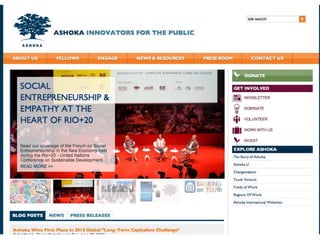
• Social entrepreneurship and Ashoka
• UR through the lens of my undergraduate
  teaching in 3 courses and “a dialogic
  curriculum”
• Engagement matters
• Some pitfalls
• Leading institutional change
List 10 people who inspire you.

Choose 3 people from your list
and identify the character traits
       that inspire you.
List 10 people who inspire you.

Choose 3 people from your list and
identify the character that enabled
     them to make a change.

 Write two paragraphs about how
 your life would be different if you
have more of these qualities in your
                life.
The Wall of
Inspiration
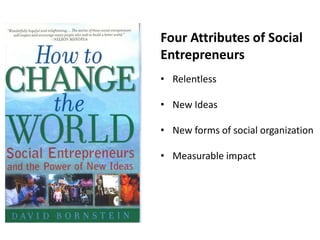
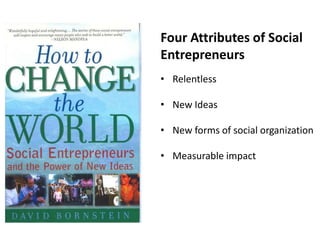
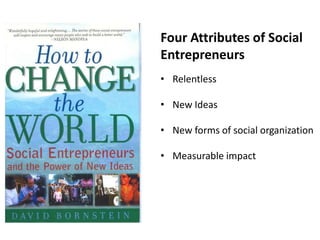
Four Attributes of Social
Entrepreneurs
• Relentless

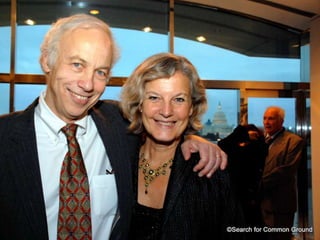
• New Ideas

• New forms of social organization

• Measurable impact
An introduction to changemakers and
        social entrepreneurs
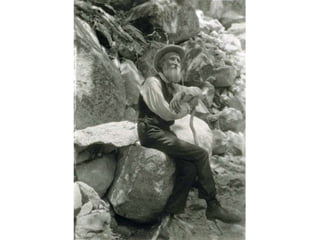
John Muir (U.S.), naturalist and conservationist,
established the National Park System and helped
found the Sierra Club.
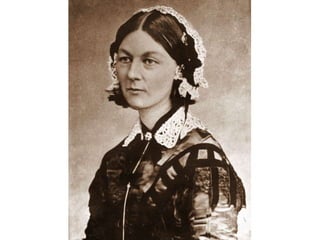
Florence Nightingale (U.K.), founder of
modern nursing, established the first school for
nurses and fought to improve hospital
conditions.
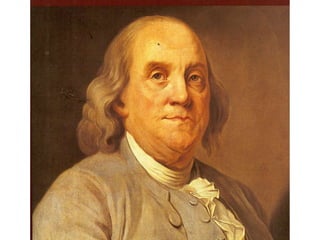
Benjamin Franklin (U.S.) Formed the first
public lending library in America.
Muhammad Yunus (Bangladesh), founder the
Grameen Bank and microfinance.
Who would you      Four Attributes of Social
add to this list   Entrepreneurs
that meets         • Relentless
these four
criteria?          • New Ideas

                   • New forms of social organization

                   • Measurable impact
Social entrepreneurship:
The application of entrepreneurial solutions
and sustainable business practices to the
world’s most challenging social problems.

The application of business practices in the
pursuit of a social and/or environmental
mission.
     “Understanding Social Entrepreneurship” by Jill
     Kickul and Thomas S. Lyons
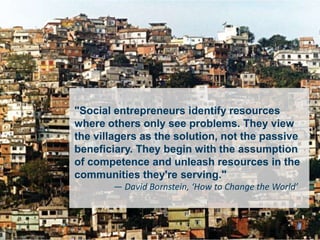
Sound Bytes 3 (Bornstein)


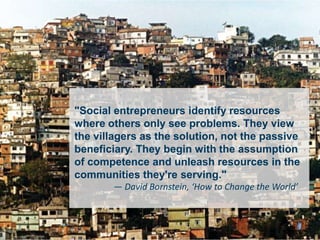
  "Social entrepreneurs identify resources
  where others only see problems. They view
  the villagers as the solution, not the passive
  beneficiary. They begin with the assumption
  of competence and unleash resources in the
  communities they're serving."
         — David Bornstein, ‘How to Change the World’
http://www.ssireview.org/articles/entry/ten_nonprofit_funding_models/
Four Attributes of Social
Entrepreneurs
• Relentless

• New Ideas

• New forms of social organization

• Measurable impact
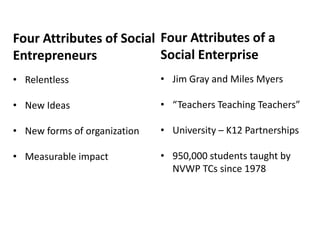
Four Attributes of Social Four Attributes of a
Entrepreneurs             Social Enterprise
• Relentless                  • Jim Gray and Miles Myers

• New Ideas                   • “Teachers Teaching Teachers”

• New forms of organization   • University – K12 Partnerships

• Measurable impact           • 950,000 students taught by
                                NVWP TCs since 1978
Funding Model
•   Fees for services
•   Grant money
•   University support
•   Development
Funding Model
•   Fees for services
•   Grant money
•   University support
•   Development
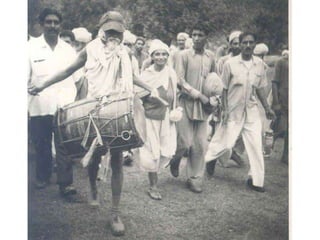
Vinoba Bhave & the Land Gift
        Movement

Asking those without land to share it
     with those who have none

           1 Million Acres
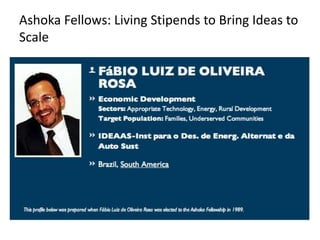
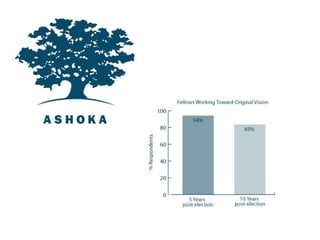
Ashoka Fellows: Living Stipends to Bring Ideas to
Scale
Influencer
 Making the Case: Social Innovation for Higher
                  Education
Thursday, J 26, 1:30-7pm, Ronald Reagan Building, Washington, DC
          uly
Sound Bytes 3 (Bornstein)


  "Social entrepreneurs identify resources
  where others only see problems. They view
  the villagers as the solution, not the passive
  beneficiary. They begin with the assumption
  of competence and unleash resources in the
  communities they're serving."
         — David Bornstein, ‘How to Change the World’
Resources
Ashoka: www.ashoka.org www.changmakers.com
www.ashokau.org
Aspen Institute: www.aspeninstitute.org
Echoing Green: www.echoinggreen.org
Net Impact: www.netimpact.org
Next Billion: www.nextbillion.net
Skoll Foundation: www.skollfoundation.org/skoll-
entrpreneurs
Social Enterprise Alliance: www.se-alliance.org
#socent
Resources
E-180: www.e-180.com
CSR Wire: www.csrwire.com
Change.org: www.change.org
Stanford Social Innovation Review
www.ssir.review.org
Fast Company: social responsibility:
www.fastcompany.com/topics/ethonomics
Social Edge: www.socialedge.org
Next Billion: www.nextbillion.net
Alltop: social entrepreneurship: http://social-
entrepreneurship.alltop.com
Undergraduate Research and Social
          Entrepreneurship
• Social Entrepreneurship and Ashoka
• Through the lens of my undergraduate
  teaching in 3 courses and “a dialogic
  curriculum”
• Engagement matters
• Some pitfalls
• Leading institutional change
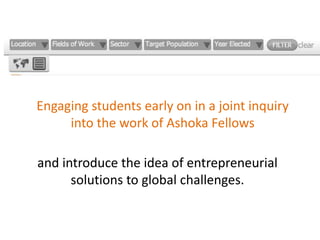
Engaging students early on in a joint inquiry
     into the work of Ashoka Fellows

and introduce the idea of entrepreneurial
      solutions to global challenges.
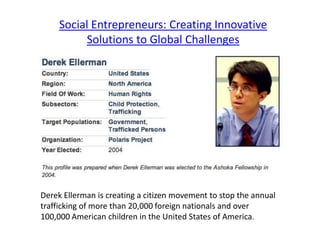
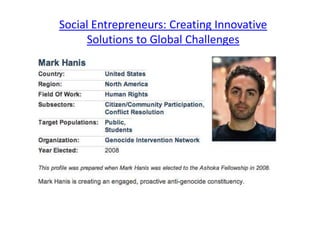
Social Entrepreneurs: Creating Innovative
          Solutions to Global Challenges


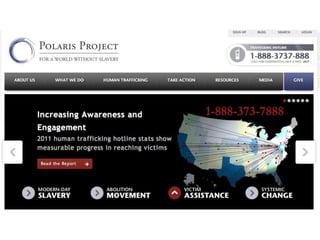
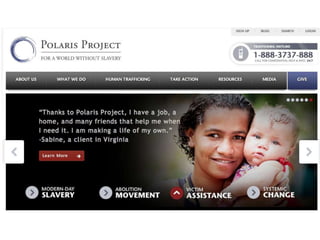
Derek Ellerman is creating a citizen movement to stop the annual
trafficking of more than 20,000 foreign nationals and over
100,000 American children in the United States of America.
Social Entrepreneurs: Creating Innovative
     Solutions to Global Challenges
Angola
Burundi (radio only)
Cote d'Ivoire
DR Congo
Ethiopia (radio only)
Indonesia
Kenya
Lebanon
Liberia
Morocco
Nepal
Pakistan
Palestine
Sierra Leone
Zimbabwe
Dialogic Curriculum (Stock, 1995):
                 Pillar 1
• Invite and empower students to join me in a
  broadly defined field of inquiry.


• Stock, P. The Dialogic Curriculum. Portsmouth,
  NH: Boynton Cook/Heinemann, 1995.
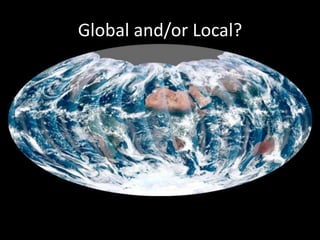
Global and/or Local?
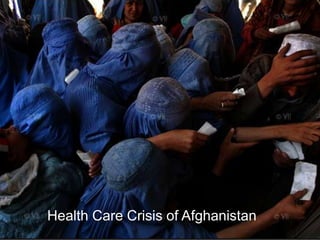
Health Care Crisis of Afghanistan
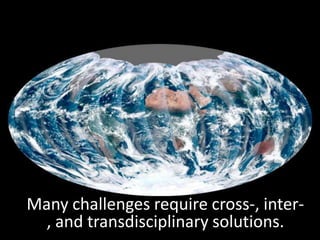
Many challenges require cross-, inter-
  , and transdisciplinary solutions.
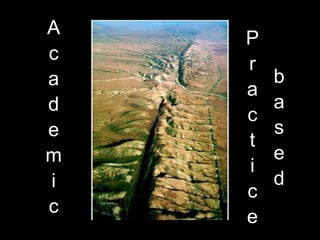
A
    P
c
    r
a       b
    a
d       a
    c
e       s
    t
m       e
    i
i       d
    c
c
    e
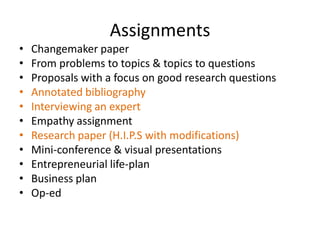
Assignments
•   Changemaker paper
•   From problems to topics & topics to questions
•   Proposals with a focus on good research questions
•   Annotated bibliography
•   Interviewing an expert
•   Empathy assignment
•   Research paper (H.I.P.S with modifications)
•   Mini-conference & visual presentations
•   Entrepreneurial life-plan
•   Business plan
•   Op-ed
Moving research away from
decontextualized knowledge
     towards a greater
understanding of agency and
          motives.
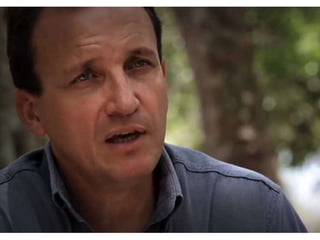
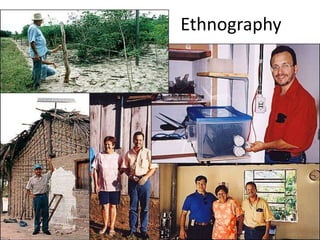
Fabio Rosa
                Agronomist
• Ashoka Fellow whose initiatives have focused
  on rural electrification and the use of
  sustainable energy sources.
Ethnography
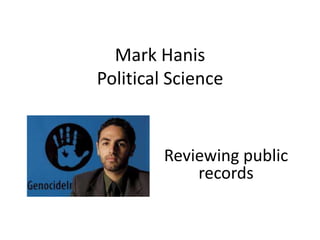
Mark Hanis
Political Science


         Reviewing public
             records
Assignments
•   Changemaker paper
•   From problems to topics & topics to questions
•   Proposals with a focus on good research questions
•   Annotated bibliography
•   Interviewing an expert
•   Empathy assignment
•   Research paper (H.I.P.S with modifications)
•   Mini-conference & visual presentations
•   Entrepreneurial life-plan
•   Business plan
•   Op-ed
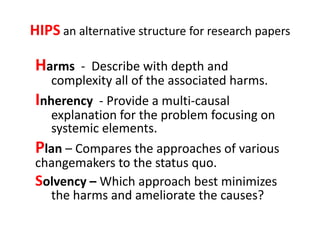
HIPS an alternative structure for research papers

Harms   - Describe with depth and
   complexity all of the associated harms.
Inherency - Provide a multi-causal
   explanation for the problem focusing on
   systemic elements.
Plan – Compares the approaches of various
changemakers to the status quo.
Solvency – Which approach best minimizes
   the harms and ameliorate the causes?
Dialogic Curriculum: Pillar 2
• Invite and empower students to join me in a
  broadly defined field of inquiry.
• Engaging diverse groups of learners as
  whole persons.
Assignments
•   Changemaker paper
•   From problems to topics & topics to questions
•   Proposals with a focus on good research questions
•   Annotated bibliography
•   Interviewing an expert
•   Empathy assignment
•   Research paper (H.I.P.S with modifications)
•   Mini-conference & visual presentations
•   Entrepreneurial life-plan
•   Business plan
•   Op-ed
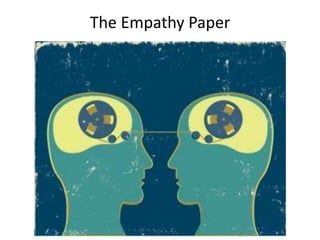
The Empathy Paper
The Empathy Paper
Task Description
Step 1: Write a vivid and compelling account that describes in as
much detail as possible the experience of someone who has first
hand experience with the global challenge you are
investigating. Try to capture the many complexities of the issue
that are made visible by the person's individual experience. Use
quotes, images, and any other material you can find to allow the
person's words and experience to take center stage for the
reader.

Step 2: Give a short 5-minute in-class presentations relating to
the material you have read.

Step 3: Bring excerpts from the eyewitness accounts you have
used. In class we will compare and contrast the reactions of
witnesses to different challenges.
Dialogic Curriculum: Pillar 3
• Invite and empower students to join me in a
  broadly defined field of inquiry.
• Engaging diverse groups of learners as
  whole persons.
• Fostering a highly interactive classroom
  culture in which knowledge is truly co-created
  from among a variety of rich inputs.
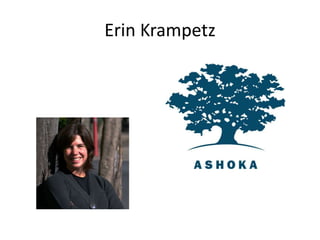
Erin Krampetz
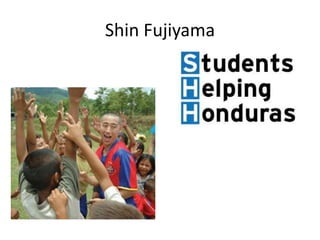
Shin Fujiyama
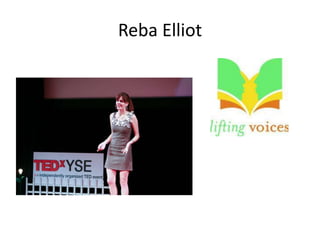
Reba Elliot
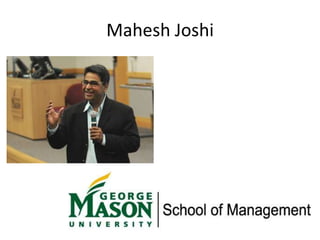
Mahesh Joshi
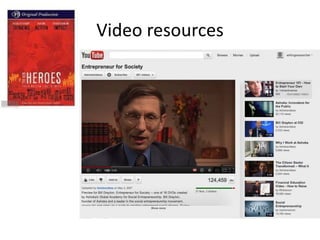
Video resources
Workshopping Assignments
•   Changemaker paper
•   From problems to topics & topics to questions
•   Proposals with a focus on good research questions
•   Annotated bibliography
•   Interviewing an expert
•   Empathy assignment
•   Research paper (H.I.P.S with modifications)
•   Mini-conference & visual presentations
•   Entrepreneurial life-plan
•   Business plan
•   Op-ed
ANABOLIC STEROIDS:
     More than a Drug


        Joshua Panwala
Son of Migrant: Ramazan Salman
Save Darfur

They Cannot Go Unnoticed
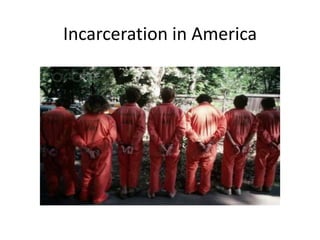
Incarceration in America
Creating playgrounds suitable for all children
Social Entrepreneurship: The Roots of
   Change College Changemakers
• Derek Ellerman
• Mark Hanis
• J.B. Schramm


• ASHOKA.ORG
HIV HEALTH CARE DELIVERY IN
  SOUTH AFRICA FAILURE: POLITICAL
  AND SOCIAL ISSUES.2009


Riem Elimam.
Education and Literacy
     in Ethiopia


       Eric Hosmer
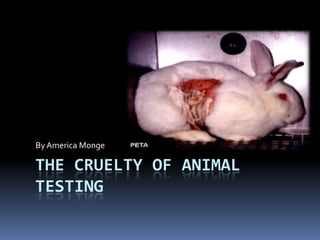
By America Monge

THE CRUELTY OF ANIMAL
TESTING
Hate Crimes
By: Stephanie Lai
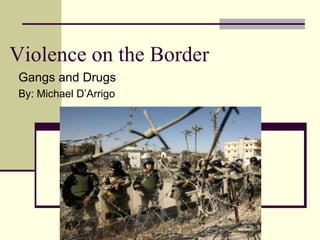
Violence on the Border
Gangs and Drugs
By: Michael D’Arrigo
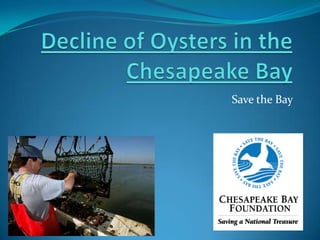
Save the Bay
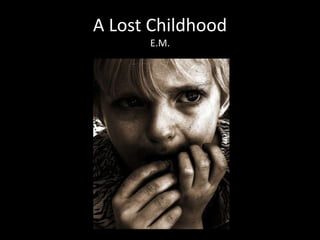
A Lost Childhood
      E.M.
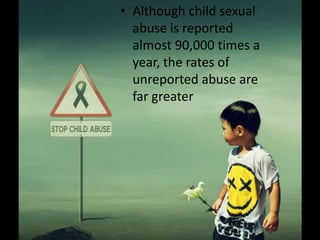
• Although child sexual
  abuse is reported
  almost 90,000 times a
  year, the rates of
  unreported abuse are
  far greater
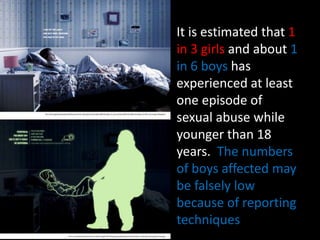
It is estimated that 1
in 3 girls and about 1
in 6 boys has
experienced at least
one episode of
sexual abuse while
younger than 18
years. The numbers
of boys affected may
be falsely low
because of reporting
techniques
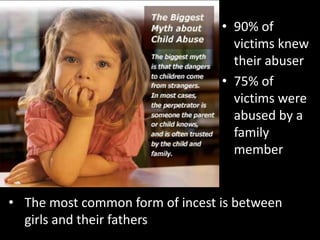
• 90% of
                                   victims knew
                                   their abuser
                                 • 75% of
                                   victims were
                                   abused by a
                                   family
                                   member


• The most common form of incest is between
  girls and their fathers
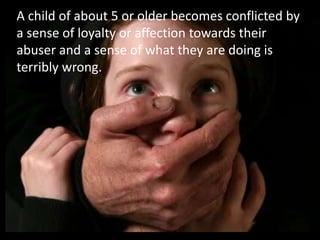
A child of about 5 or older becomes conflicted by
a sense of loyalty or affection towards their
abuser and a sense of what they are doing is
terribly wrong.
There are 2 statutes from
which definitions of child
sexual abuse can be found;
civil (child protective) and
criminal.
Felonies are punishable by 10-25 years in prison and
 up to $$20,000 in fines. There is a minimum 5 year
sentence for those found guilty of sex crimes against
                      children.
A definite correlation exists between childhood
sexual abuse and adult mental disorders. The long-
 term consequences can impact one’s personality
                    development.
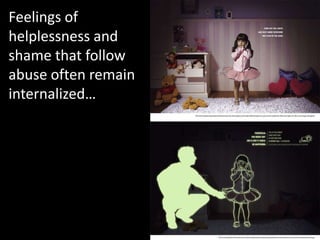
Feelings of
helplessness and
shame that follow
abuse often remain
internalized…
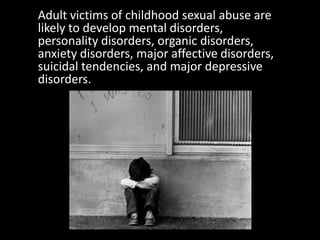
Adult victims of childhood sexual abuse are
likely to develop mental disorders,
personality disorders, organic disorders,
anxiety disorders, major affective disorders,
suicidal tendencies, and major depressive
disorders.
Seeking support after having been sexually abused as a
child benefits the well-being of the victim, and brings one
closer in the recovery process to regaining stability.


In 1997, Vicki Bernadet founded FADA. Since then,
many organizations providing support have opened
their doors in order to help victims regain
psychological stability.
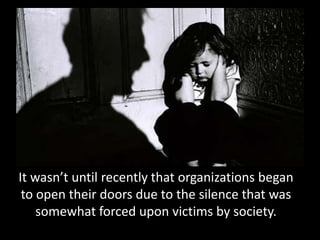
It wasn’t until recently that organizations began
 to open their doors due to the silence that was
    somewhat forced upon victims by society.
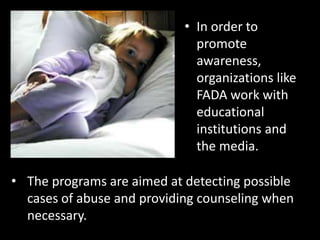
• In order to
                              promote
                              awareness,
                              organizations like
                              FADA work with
                              educational
                              institutions and
                              the media.

• The programs are aimed at detecting possible
  cases of abuse and providing counseling when
  necessary.
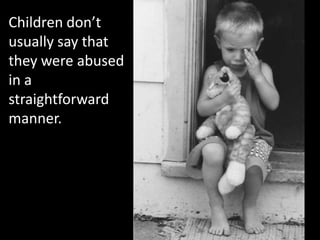
Children don’t
usually say that
they were abused
in a
straightforward
manner.
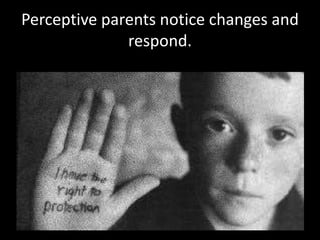
Perceptive parents notice changes and
              respond.
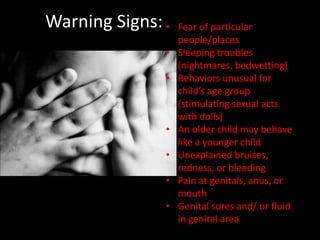
Warning Signs: •   Fear of particular
                   people/places
               •   Sleeping troubles
                   (nightmares, bedwetting)
               •   Behaviors unusual for
                   child’s age group
                   (stimulating sexual acts
                   with dolls)
               •   An older child may behave
                   like a younger child
               •   Unexplained bruises,
                   redness, or bleeding
               •   Pain at genitals, anus, or
                   mouth
               •   Genital sores and/ or fluid
                   in genital area
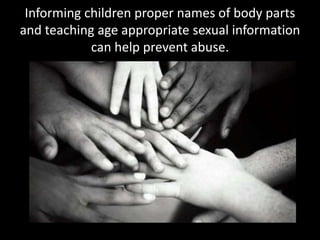
Informing children proper names of body parts
and teaching age appropriate sexual information
            can help prevent abuse.
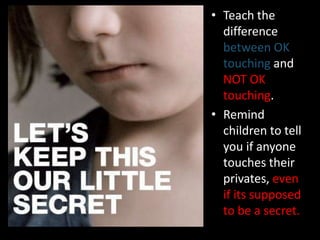
• Teach the
  difference
  between OK
  touching and
  NOT OK
  touching.
• Remind
  children to tell
  you if anyone
  touches their
  privates, even
  if its supposed
  to be a secret.
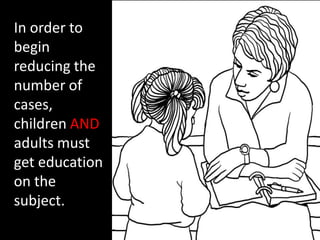
In order to
begin
reducing the
number of
cases,
children AND
adults must
get education
on the
subject.
Dialogic Curriculum: Pillar 4
• Invite and empower students to join me in a
  broadly defined field of inquiry.
• Engaging diverse groups of learners as
  whole persons.
• Fostering a highly interactive classroom
  culture in which knowledge is truly co-created
  from among a variety of rich inputs.
• Focus on what’s next for the learners.
Assignments
•   Changemaker paper
•   From problems to topics & topics to questions
•   Proposals with a focus on good research questions
•   Annotated bibliography
•   Interviewing an expert
•   Empathy assignment
•   Research paper (H.I.P.S with modifications)
•   Mini-conference & visual presentations
•   Entrepreneurial life-plan
•   Business plan
•   Op-ed
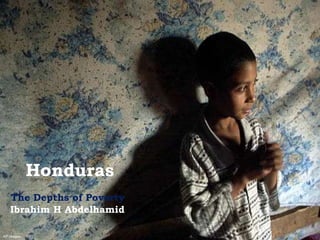
Honduras
   The Depths of Poverty
   Ibrahim H Abdelhamid

AP Images
HIV-AIDS EPIDEMIC IN
         INDIA

SPECIFICALLY TARGETING CHILDREN

          By: ISHMEET KAUR
Frank
Petricoin
“You are disturbed
by my words.
Good,” Wei said. “If
you don’t lie to
yourself anymore
about this world,
then you can see its
problems and what
is required to solve
those problems”
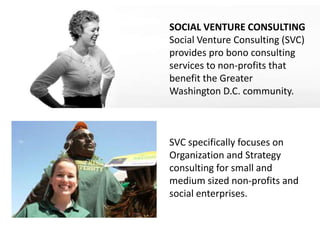
SOCIAL VENTURE CONSULTING
Social Venture Consulting (SVC)
provides pro bono consulting
services to non-profits that
benefit the Greater
Washington D.C. community.


SVC specifically focuses on
Organization and Strategy
consulting for small and
medium sized non-profits and
social enterprises.
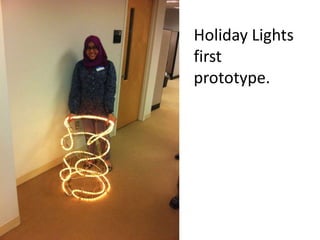
Holiday Lights
first
prototype.
To what end?
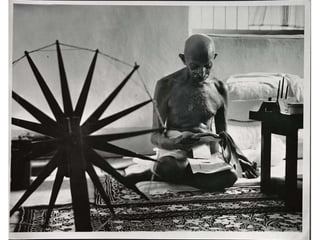
Mahatma Gandhi “I have not the shadow of a
doubt that any man or woman can achieve
what I have, if he or she would make the
same effort and cultivate the same hope and
faith.”
In addition to supporting the
research aspirations of its students and
faculty, our university can make no
greater contribution to
society than by educating a new
generation of socially responsible,
empathetic, and ethical leaders,
who take the initiative to affect society’s
progress themselves.
Four Attributes of Social
Entrepreneurs
• Relentless

• New Ideas

• New forms of social organization

• Measurable impact
Never doubt that a small group of
thoughtful, committed citizens can
change the world. Indeed, it is the only
thing that ever has.
Margaret Mead
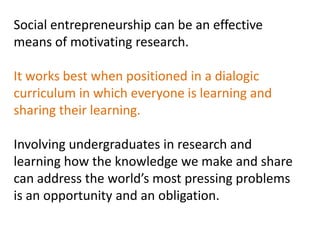
Social entrepreneurship can be an effective
means of motivating research.

It works best when positioned in a dialogic
curriculum in which everyone is learning and
sharing their learning.

Involving undergraduates in research and
learning how the knowledge we make and share
can address the world’s most pressing problems
is an opportunity and an obligation.
Thank you for your attention.


      progers2@gmu.edu
         @drprogers

Social Entrepreneurship and Undergraduate Research

  • 1.
    “Social Entrepreneurship and Undergraduate Research” Faculty Institute on Undergraduate Research in the Arts, Humanities, and Humanistic Social Sciences June 27, 2012
  • 3.
    Undergraduate Research andSocial Entrepreneurship • Social entrepreneurship and Ashoka • UR through the lens of my undergraduate teaching in 3 courses and “a dialogic curriculum” • Engagement matters • Some pitfalls • Leading institutional change
  • 4.
    List 10 peoplewho inspire you.
  • 5.
    List 10 peoplewho inspire you. Choose 3 people from your list and identify the character traits that inspire you.
  • 6.
    List 10 peoplewho inspire you. Choose 3 people from your list and identify the character that enabled them to make a change. Write two paragraphs about how your life would be different if you have more of these qualities in your life.
  • 7.
  • 8.
    Four Attributes ofSocial Entrepreneurs • Relentless • New Ideas • New forms of social organization • Measurable impact
  • 9.
    An introduction tochangemakers and social entrepreneurs
  • 11.
    John Muir (U.S.),naturalist and conservationist, established the National Park System and helped found the Sierra Club.
  • 13.
    Florence Nightingale (U.K.),founder of modern nursing, established the first school for nurses and fought to improve hospital conditions.
  • 15.
    Benjamin Franklin (U.S.)Formed the first public lending library in America.
  • 17.
    Muhammad Yunus (Bangladesh),founder the Grameen Bank and microfinance.
  • 18.
    Who would you Four Attributes of Social add to this list Entrepreneurs that meets • Relentless these four criteria? • New Ideas • New forms of social organization • Measurable impact
  • 19.
    Social entrepreneurship: The applicationof entrepreneurial solutions and sustainable business practices to the world’s most challenging social problems. The application of business practices in the pursuit of a social and/or environmental mission. “Understanding Social Entrepreneurship” by Jill Kickul and Thomas S. Lyons
  • 20.
    Sound Bytes 3(Bornstein) "Social entrepreneurs identify resources where others only see problems. They view the villagers as the solution, not the passive beneficiary. They begin with the assumption of competence and unleash resources in the communities they're serving." — David Bornstein, ‘How to Change the World’
  • 22.
  • 24.
    Four Attributes ofSocial Entrepreneurs • Relentless • New Ideas • New forms of social organization • Measurable impact
  • 26.
    Four Attributes ofSocial Four Attributes of a Entrepreneurs Social Enterprise • Relentless • Jim Gray and Miles Myers • New Ideas • “Teachers Teaching Teachers” • New forms of organization • University – K12 Partnerships • Measurable impact • 950,000 students taught by NVWP TCs since 1978
  • 27.
    Funding Model • Fees for services • Grant money • University support • Development
  • 29.
    Funding Model • Fees for services • Grant money • University support • Development
  • 33.
    Vinoba Bhave &the Land Gift Movement Asking those without land to share it with those who have none 1 Million Acres
  • 34.
    Ashoka Fellows: LivingStipends to Bring Ideas to Scale
  • 38.
    Influencer Making theCase: Social Innovation for Higher Education Thursday, J 26, 1:30-7pm, Ronald Reagan Building, Washington, DC uly
  • 43.
    Sound Bytes 3(Bornstein) "Social entrepreneurs identify resources where others only see problems. They view the villagers as the solution, not the passive beneficiary. They begin with the assumption of competence and unleash resources in the communities they're serving." — David Bornstein, ‘How to Change the World’
  • 45.
    Resources Ashoka: www.ashoka.org www.changmakers.com www.ashokau.org AspenInstitute: www.aspeninstitute.org Echoing Green: www.echoinggreen.org Net Impact: www.netimpact.org Next Billion: www.nextbillion.net Skoll Foundation: www.skollfoundation.org/skoll- entrpreneurs Social Enterprise Alliance: www.se-alliance.org #socent
  • 46.
    Resources E-180: www.e-180.com CSR Wire:www.csrwire.com Change.org: www.change.org Stanford Social Innovation Review www.ssir.review.org Fast Company: social responsibility: www.fastcompany.com/topics/ethonomics Social Edge: www.socialedge.org Next Billion: www.nextbillion.net Alltop: social entrepreneurship: http://social- entrepreneurship.alltop.com
  • 48.
    Undergraduate Research andSocial Entrepreneurship • Social Entrepreneurship and Ashoka • Through the lens of my undergraduate teaching in 3 courses and “a dialogic curriculum” • Engagement matters • Some pitfalls • Leading institutional change
  • 50.
    Engaging students earlyon in a joint inquiry into the work of Ashoka Fellows and introduce the idea of entrepreneurial solutions to global challenges.
  • 51.
    Social Entrepreneurs: CreatingInnovative Solutions to Global Challenges Derek Ellerman is creating a citizen movement to stop the annual trafficking of more than 20,000 foreign nationals and over 100,000 American children in the United States of America.
  • 54.
    Social Entrepreneurs: CreatingInnovative Solutions to Global Challenges
  • 57.
    Angola Burundi (radio only) Coted'Ivoire DR Congo Ethiopia (radio only) Indonesia Kenya Lebanon Liberia Morocco Nepal Pakistan Palestine Sierra Leone Zimbabwe
  • 58.
    Dialogic Curriculum (Stock,1995): Pillar 1 • Invite and empower students to join me in a broadly defined field of inquiry. • Stock, P. The Dialogic Curriculum. Portsmouth, NH: Boynton Cook/Heinemann, 1995.
  • 74.
  • 75.
    Health Care Crisisof Afghanistan
  • 76.
    Many challenges requirecross-, inter- , and transdisciplinary solutions.
  • 78.
    A P c r a b a d a c e s t m e i i d c c e
  • 79.
    Assignments • Changemaker paper • From problems to topics & topics to questions • Proposals with a focus on good research questions • Annotated bibliography • Interviewing an expert • Empathy assignment • Research paper (H.I.P.S with modifications) • Mini-conference & visual presentations • Entrepreneurial life-plan • Business plan • Op-ed
  • 80.
    Moving research awayfrom decontextualized knowledge towards a greater understanding of agency and motives.
  • 82.
    Fabio Rosa Agronomist • Ashoka Fellow whose initiatives have focused on rural electrification and the use of sustainable energy sources.
  • 83.
  • 84.
    Mark Hanis Political Science Reviewing public records
  • 85.
    Assignments • Changemaker paper • From problems to topics & topics to questions • Proposals with a focus on good research questions • Annotated bibliography • Interviewing an expert • Empathy assignment • Research paper (H.I.P.S with modifications) • Mini-conference & visual presentations • Entrepreneurial life-plan • Business plan • Op-ed
  • 86.
    HIPS an alternativestructure for research papers Harms - Describe with depth and complexity all of the associated harms. Inherency - Provide a multi-causal explanation for the problem focusing on systemic elements. Plan – Compares the approaches of various changemakers to the status quo. Solvency – Which approach best minimizes the harms and ameliorate the causes?
  • 87.
    Dialogic Curriculum: Pillar2 • Invite and empower students to join me in a broadly defined field of inquiry. • Engaging diverse groups of learners as whole persons.
  • 88.
    Assignments • Changemaker paper • From problems to topics & topics to questions • Proposals with a focus on good research questions • Annotated bibliography • Interviewing an expert • Empathy assignment • Research paper (H.I.P.S with modifications) • Mini-conference & visual presentations • Entrepreneurial life-plan • Business plan • Op-ed
  • 89.
  • 90.
    The Empathy Paper TaskDescription Step 1: Write a vivid and compelling account that describes in as much detail as possible the experience of someone who has first hand experience with the global challenge you are investigating. Try to capture the many complexities of the issue that are made visible by the person's individual experience. Use quotes, images, and any other material you can find to allow the person's words and experience to take center stage for the reader. Step 2: Give a short 5-minute in-class presentations relating to the material you have read. Step 3: Bring excerpts from the eyewitness accounts you have used. In class we will compare and contrast the reactions of witnesses to different challenges.
  • 92.
    Dialogic Curriculum: Pillar3 • Invite and empower students to join me in a broadly defined field of inquiry. • Engaging diverse groups of learners as whole persons. • Fostering a highly interactive classroom culture in which knowledge is truly co-created from among a variety of rich inputs.
  • 93.
  • 94.
  • 95.
  • 96.
  • 97.
  • 98.
    Workshopping Assignments • Changemaker paper • From problems to topics & topics to questions • Proposals with a focus on good research questions • Annotated bibliography • Interviewing an expert • Empathy assignment • Research paper (H.I.P.S with modifications) • Mini-conference & visual presentations • Entrepreneurial life-plan • Business plan • Op-ed
  • 99.
    ANABOLIC STEROIDS: More than a Drug Joshua Panwala
  • 100.
    Son of Migrant:Ramazan Salman
  • 101.
  • 102.
  • 103.
  • 104.
    Social Entrepreneurship: TheRoots of Change College Changemakers • Derek Ellerman • Mark Hanis • J.B. Schramm • ASHOKA.ORG
  • 105.
    HIV HEALTH CAREDELIVERY IN SOUTH AFRICA FAILURE: POLITICAL AND SOCIAL ISSUES.2009 Riem Elimam.
  • 106.
    Education and Literacy in Ethiopia Eric Hosmer
  • 107.
    By America Monge THECRUELTY OF ANIMAL TESTING
  • 109.
  • 110.
    Violence on theBorder Gangs and Drugs By: Michael D’Arrigo
  • 111.
  • 112.
  • 113.
    • Although childsexual abuse is reported almost 90,000 times a year, the rates of unreported abuse are far greater
  • 114.
    It is estimatedthat 1 in 3 girls and about 1 in 6 boys has experienced at least one episode of sexual abuse while younger than 18 years. The numbers of boys affected may be falsely low because of reporting techniques
  • 115.
    • 90% of victims knew their abuser • 75% of victims were abused by a family member • The most common form of incest is between girls and their fathers
  • 116.
    A child ofabout 5 or older becomes conflicted by a sense of loyalty or affection towards their abuser and a sense of what they are doing is terribly wrong.
  • 117.
    There are 2statutes from which definitions of child sexual abuse can be found; civil (child protective) and criminal.
  • 118.
    Felonies are punishableby 10-25 years in prison and up to $$20,000 in fines. There is a minimum 5 year sentence for those found guilty of sex crimes against children.
  • 119.
    A definite correlationexists between childhood sexual abuse and adult mental disorders. The long- term consequences can impact one’s personality development.
  • 120.
    Feelings of helplessness and shamethat follow abuse often remain internalized…
  • 121.
    Adult victims ofchildhood sexual abuse are likely to develop mental disorders, personality disorders, organic disorders, anxiety disorders, major affective disorders, suicidal tendencies, and major depressive disorders.
  • 123.
    Seeking support afterhaving been sexually abused as a child benefits the well-being of the victim, and brings one closer in the recovery process to regaining stability. In 1997, Vicki Bernadet founded FADA. Since then, many organizations providing support have opened their doors in order to help victims regain psychological stability.
  • 124.
    It wasn’t untilrecently that organizations began to open their doors due to the silence that was somewhat forced upon victims by society.
  • 125.
    • In orderto promote awareness, organizations like FADA work with educational institutions and the media. • The programs are aimed at detecting possible cases of abuse and providing counseling when necessary.
  • 126.
    Children don’t usually saythat they were abused in a straightforward manner.
  • 127.
    Perceptive parents noticechanges and respond.
  • 128.
    Warning Signs: • Fear of particular people/places • Sleeping troubles (nightmares, bedwetting) • Behaviors unusual for child’s age group (stimulating sexual acts with dolls) • An older child may behave like a younger child • Unexplained bruises, redness, or bleeding • Pain at genitals, anus, or mouth • Genital sores and/ or fluid in genital area
  • 129.
    Informing children propernames of body parts and teaching age appropriate sexual information can help prevent abuse.
  • 130.
    • Teach the difference between OK touching and NOT OK touching. • Remind children to tell you if anyone touches their privates, even if its supposed to be a secret.
  • 131.
    In order to begin reducingthe number of cases, children AND adults must get education on the subject.
  • 133.
    Dialogic Curriculum: Pillar4 • Invite and empower students to join me in a broadly defined field of inquiry. • Engaging diverse groups of learners as whole persons. • Fostering a highly interactive classroom culture in which knowledge is truly co-created from among a variety of rich inputs. • Focus on what’s next for the learners.
  • 134.
    Assignments • Changemaker paper • From problems to topics & topics to questions • Proposals with a focus on good research questions • Annotated bibliography • Interviewing an expert • Empathy assignment • Research paper (H.I.P.S with modifications) • Mini-conference & visual presentations • Entrepreneurial life-plan • Business plan • Op-ed
  • 135.
    Honduras The Depths of Poverty Ibrahim H Abdelhamid AP Images
  • 136.
    HIV-AIDS EPIDEMIC IN INDIA SPECIFICALLY TARGETING CHILDREN By: ISHMEET KAUR
  • 137.
  • 139.
    “You are disturbed bymy words. Good,” Wei said. “If you don’t lie to yourself anymore about this world, then you can see its problems and what is required to solve those problems”
  • 140.
    SOCIAL VENTURE CONSULTING SocialVenture Consulting (SVC) provides pro bono consulting services to non-profits that benefit the Greater Washington D.C. community. SVC specifically focuses on Organization and Strategy consulting for small and medium sized non-profits and social enterprises.
  • 145.
  • 148.
  • 151.
    Mahatma Gandhi “Ihave not the shadow of a doubt that any man or woman can achieve what I have, if he or she would make the same effort and cultivate the same hope and faith.”
  • 152.
    In addition tosupporting the research aspirations of its students and faculty, our university can make no greater contribution to society than by educating a new generation of socially responsible, empathetic, and ethical leaders, who take the initiative to affect society’s progress themselves.
  • 156.
    Four Attributes ofSocial Entrepreneurs • Relentless • New Ideas • New forms of social organization • Measurable impact
  • 163.
    Never doubt thata small group of thoughtful, committed citizens can change the world. Indeed, it is the only thing that ever has. Margaret Mead
  • 164.
    Social entrepreneurship canbe an effective means of motivating research. It works best when positioned in a dialogic curriculum in which everyone is learning and sharing their learning. Involving undergraduates in research and learning how the knowledge we make and share can address the world’s most pressing problems is an opportunity and an obligation.
  • 165.
    Thank you foryour attention. progers2@gmu.edu @drprogers

Editor's Notes

  • #7 Beginning where students are. This works for me to help establish a tone in my class.
  • #8 Personal relevance
  • #32 My first week in D.C. I was introduced by my friend Erin Krampetz
  • #40 My first week in D.C. I was introduced by my friend Erin Krampetz
  • #41 My first week in D.C. I was introduced by my friend Erin Krampetz
  • #42 My first week in D.C. I was introduced by my friend Erin Krampetz
  • #43 My first week in D.C. I was introduced by my friend Erin Krampetz
  • #50 http://www.youtube.com/watch?v=jk5LI_WcosQ
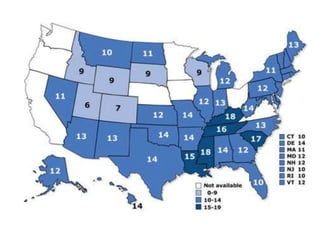
  • #68 Percentage of obese children by state in the u.s.
  • #136 Why should we care?-The United States supported the Honduran presidential election and looks to aid Honduras in getting on their feet if they can carry the majority of the responsibilities.They are not far from US so it is easier to help those who are closerHurricane Mitch devistated Honduras in 1998 after so much progress in government and infrastructure. Lowered the morale of the citizensThey hold 60% of all AIDS cases in central americaOne of the poorest Countires in the western hemisphere