1 | www.orionbiotechnology.com Confidential
Surveillance and Management of Anal
Intraepithelial Neoplasia in the HIV and
non-HIV Patient
Ian McGowan MD PhD FRCP
Chief Medical Officer at Orion Biotechnology
2 | www.orionbiotechnology.com Confidential
Disclosures
Ø Chief Medical Officer at Orion Biotechnology
Ø Chair of the Scientific Advisory Board at ABIVAX
Ø Senior Consultant at AELIX Therapeutics
3 | www.orionbiotechnology.com Confidential
4 | www.orionbiotechnology.com Confidential
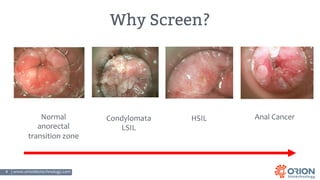
Why Screen?
Normal
anorectal
transition zone
Condylomata
LSIL
Anal CancerHSIL
5 | www.orionbiotechnology.com Confidential
Progression to Anal Cancer from AIN 3
• Retrospective review using the Surveillance,
Epidemiology, and End Results registry (1973-
2014)
• A total of 2074 patients with AIN 3 were identified
and followed for a median time of 4.0 years
• Of the cohort, 171 patients (8.2%) subsequently
developed anal cancer
• Median time from AIN 3 diagnosis to anal
cancer diagnosis was 2.7 years
Lee et al. Dis Colon Rectum 2018
6 | www.orionbiotechnology.com Confidential
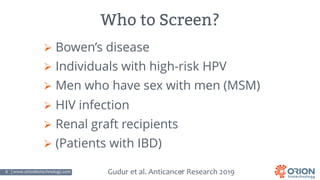
Who to Screen?
Ø Bowen’s disease
Ø Individuals with high-risk HPV
Ø Men who have sex with men (MSM)
Ø HIV infection
Ø Renal graft recipients
Ø (Patients with IBD)
Gudur et al. Anticancer Research 2019
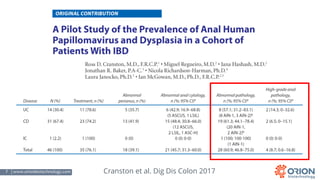
7 | www.orionbiotechnology.com ConfidentialCranston et al. Dig Dis Colon 2017
8 | www.orionbiotechnology.com Confidential
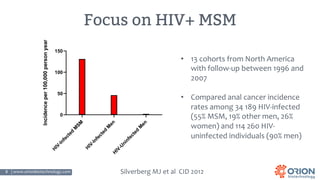
Focus on HIV+ MSM
H
IV-Infected
M
SM
H
IV-Infected
M
enH
IV-U
ninfected
M
en
0
50
100
150
Incidenceper100,000personyear
Silverberg MJ et al CID 2012
• 13 cohorts from North America
with follow-up between 1996 and
2007
• Compared anal cancer incidence
rates among 34 189 HIV-infected
(55% MSM, 19% other men, 26%
women) and 114 260 HIV-
uninfected individuals (90% men)
9 | www.orionbiotechnology.com Confidential
How Should We Screen?
Ø No national or international guidelines
Ø Screening recommendations
• American Cancer Society
• Infectious Diseases Society of America
• American Society of Colon and Rectal Surgeons
• New York State
• Centers for Disease Control (suggestion)
• British HIV Association
10 | www.orionbiotechnology.com Confidential
Options for Screening
Ø Education and awareness
Ø Symptom assessment
Ø Digital rectal examination
Ø Anal cytology
Ø HPV genotyping
Ø High resolution anoscopy (HRA)
11 | www.orionbiotechnology.com Confidential
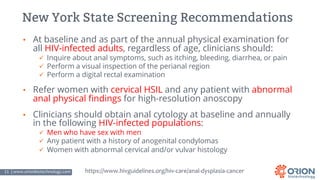
New York State Screening Recommendations
• At baseline and as part of the annual physical examination for
all HIV-infected adults, regardless of age, clinicians should:
ü Inquire about anal symptoms, such as itching, bleeding, diarrhea, or pain
ü Perform a visual inspection of the perianal region
ü Perform a digital rectal examination
• Refer women with cervical HSIL and any patient with abnormal
anal physical findings for high-resolution anoscopy
• Clinicians should obtain anal cytology at baseline and annually
in the following HIV-infected populations:
ü Men who have sex with men
ü Any patient with a history of anogenital condylomas
ü Women with abnormal cervical and/or vulvar histology
https://www.hivguidelines.org/hiv-care/anal-dysplasia-cancer
12 | www.orionbiotechnology.com Confidential
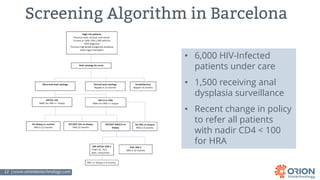
Screening Algorithm in Barcelona
• 6,000 HIV-Infected
patients under care
• 1,500 receiving anal
dysplasia surveillance
• Recent change in policy
to refer all patients
with nadir CD4 < 100
for HRA
13 | www.orionbiotechnology.com Confidential
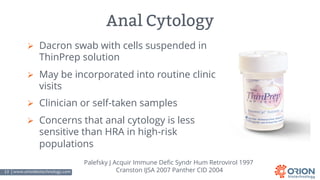
Anal Cytology
Ø Dacron swab with cells suspended in
ThinPrep solution
Ø May be incorporated into routine clinic
visits
Ø Clinician or self-taken samples
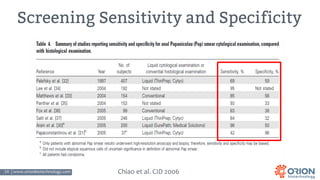
Ø Concerns that anal cytology is less
sensitive than HRA in high-risk
populations
Palefsky J Acquir Immune Defic Syndr Hum Retrovirol 1997
Cranston IJSA 2007 Panther CID 2004
14 | www.orionbiotechnology.com Confidential
Screening Sensitivity and Specificity
Chiao et al. CID 2006
15 | www.orionbiotechnology.com Confidential
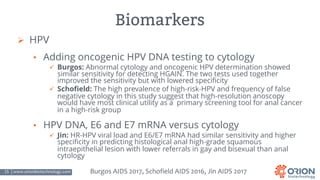
Biomarkers
Ø HPV
• Adding oncogenic HPV DNA testing to cytology
ü Burgos: Abnormal cytology and oncogenic HPV determination showed
similar sensitivity for detecting HGAIN. The two tests used together
improved the sensitivity but with lowered specificity
ü Schofield: The high prevalence of high-risk-HPV and frequency of false
negative cytology in this study suggest that high-resolution anoscopy
would have most clinical utility as a primary screening tool for anal cancer
in a high-risk group
• HPV DNA, E6 and E7 mRNA versus cytology
ü Jin: HR-HPV viral load and E6/E7 mRNA had similar sensitivity and higher
specificity in predicting histological anal high-grade squamous
intraepithelial lesion with lower referrals in gay and bisexual than anal
cytology
Burgos AIDS 2017, Schofield AIDS 2016, Jin AIDS 2017
16 | www.orionbiotechnology.com Confidential
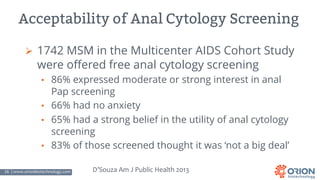
Acceptability of Anal Cytology Screening
Ø 1742 MSM in the Multicenter AIDS Cohort Study
were offered free anal cytology screening
• 86% expressed moderate or strong interest in anal
Pap screening
• 66% had no anxiety
• 65% had a strong belief in the utility of anal cytology
screening
• 83% of those screened thought it was ‘not a big deal’
D’Souza Am J Public Health 2013
17 | www.orionbiotechnology.com Confidential
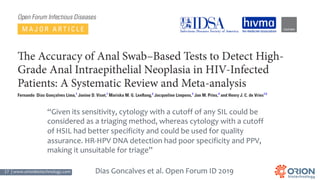
“Given its sensitivity, cytology with a cutoff of any SIL could be
considered as a triaging method, whereas cytology with a cutoff
of HSIL had better specificity and could be used for quality
assurance. HR-HPV DNA detection had poor specificity and PPV,
making it unsuitable for triage”
Dias Goncalves et al. Open Forum ID 2019
18 | www.orionbiotechnology.com Confidential
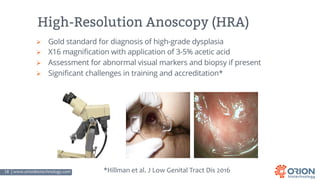
High-Resolution Anoscopy (HRA)
Ø Gold standard for diagnosis of high-grade dysplasia
Ø X16 magnification with application of 3-5% acetic acid
Ø Assessment for abnormal visual markers and biopsy if present
Ø Significant challenges in training and accreditation*
*Hillman et al. J Low Genital Tract Dis 2016
19 | www.orionbiotechnology.com Confidential
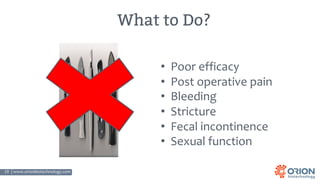
What to Do?
• Poor efficacy
• Post operative pain
• Bleeding
• Stricture
• Fecal incontinence
• Sexual function
20 | www.orionbiotechnology.com Confidential
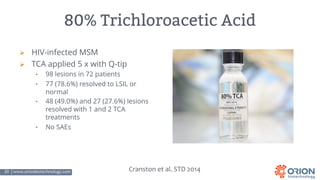
80% Trichloroacetic Acid
Ø HIV-infected MSM
Ø TCA applied 5 x with Q-tip
• 98 lesions in 72 patients
• 77 (78.6%) resolved to LSIL or
normal
• 48 (49.0%) and 27 (27.6%) lesions
resolved with 1 and 2 TCA
treatments
• No SAEs
Cranston et al. STD 2014
21 | www.orionbiotechnology.com Confidential
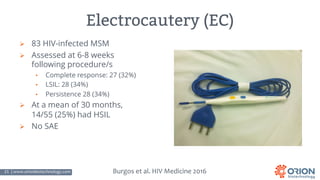
Electrocautery (EC)
Ø 83 HIV-infected MSM
Ø Assessed at 6-8 weeks
following procedure/s
• Complete response: 27 (32%)
• LSIL: 28 (34%)
• Persistence 28 (34%)
Ø At a mean of 30 months,
14/55 (25%) had HSIL
Ø No SAE
Burgos et al. HIV Medicine 2016
22 | www.orionbiotechnology.com Confidential
InfraRed Coagulation (IRC)
Ø An open-label, randomized, multi-site
clinical trial of HIV-infected adults with
biopsy-proven anal HSIL
Ø IRC versus active monitoring in 120
participants
Ø HSIL clearance:
• Occurred more frequently in the
treatment group as compared to active
monitoring group (62% vs. 30% P<0.001)
Ø No SAEs. Mild to moderate pain and
bleeding AEs
Goldstone et al. CID 2018
23 | www.orionbiotechnology.com Confidential
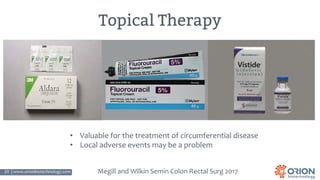
Topical Therapy
Megill and Wilkin Semin Colon Rectal Surg 2017
• Valuable for the treatment of circumferential disease
• Local adverse events may be a problem
24 | www.orionbiotechnology.com Confidential
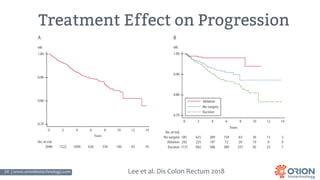
Treatment Effect on Progression
Lee et al. Dis Colon Rectum 2018
25 | www.orionbiotechnology.com Confidential
HSIL Regression
Ø To quantify incidence of, and risk factors for, progression to and
spontaneous regression of HSIL
Ø Retrospective review of patients during a period when HSILs were not
routinely treated (2004–2011)
Ø 574 patients: median age 45 years, 99.3% male and 73.0% HIV-infected,
median CD4 T-lymphocyte count was 500 cells/ml, 83.5% had
undetectable plasma HIV viral load. Median follow-up was 1.1 years
• Progression rate to HSIL was 7.4/100 person-years No risk factor for progression
to HSIL was identified
• 101 patients with HSIL, 24 (23.8%) patients had spontaneous regression
• Regression was less likely in older patients (Ptrend0.048)
• 2 patients progressed to cancer
Tong et al. AIDS 2013
26 | www.orionbiotechnology.com Confidential
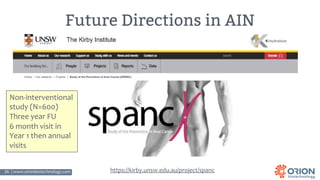
Future Directions in AIN
Surveillance
https://kirby.unsw.edu.au/project/spanc
Non-interventional
study (N=600)
Three year FU
6 month visit in
Year 1 then annual
visits
27 | www.orionbiotechnology.com Confidential
The Anchor Study
Ø Objective: To show that treatment of anal
HSIL will reduce the risk of invasive anal
cancer
Ø Randomized clinical trial enrolling 5000
HIV-infected adults age 35 or older with
anal HSIL
Ø Patients are directed to receive either
topical or ablative treatment at the
discretion of the clinician or being followed
up at 6 month intervals
Ø 5 Year follow-up with data in 2022
Ø Endpoint: anal cancer
https://anchorstudy.org/
28 | www.orionbiotechnology.com Confidential
Summary
Ø Anal cancer is 100 times more common in HIV+MSM than the general
population
Ø Screening for, and treatment of, anal HSIL is a biologically plausible
method of anal cancer prevention and HIV-infected MSM should be
prioritized
Ø Evidence supports minimally invasive treatment of anal HSIL to
prevent anal cancer rather than surgical intervention
Ø Anal dysplasia screening is acceptable to patients
Ø The ANCHOR study of HSIL treatment versus placebo and data from
the SPANC study will inform future clinical management of
populations at high-risk of anal cancer
29 | www.orionbiotechnology.com Confidential
Acknowledgements
Dr. Ross Cranston
Hospital Clinic, Barcelona,
Spain
cranston@clinic.cat
30 | www.orionbiotechnology.com Confidential
Thank You
31 | www.orionbiotechnology.com Confidential
Back Up Slides
31
32 | www.orionbiotechnology.com Confidential
32

ASCO 2019 presentation by Dr. Ian McGowan

  • 1.
    1 | www.orionbiotechnology.comConfidential Surveillance and Management of Anal Intraepithelial Neoplasia in the HIV and non-HIV Patient Ian McGowan MD PhD FRCP Chief Medical Officer at Orion Biotechnology
  • 2.
    2 | www.orionbiotechnology.comConfidential Disclosures Ø Chief Medical Officer at Orion Biotechnology Ø Chair of the Scientific Advisory Board at ABIVAX Ø Senior Consultant at AELIX Therapeutics
  • 3.
  • 4.
    4 | www.orionbiotechnology.comConfidential Why Screen? Normal anorectal transition zone Condylomata LSIL Anal CancerHSIL
  • 5.
    5 | www.orionbiotechnology.comConfidential Progression to Anal Cancer from AIN 3 • Retrospective review using the Surveillance, Epidemiology, and End Results registry (1973- 2014) • A total of 2074 patients with AIN 3 were identified and followed for a median time of 4.0 years • Of the cohort, 171 patients (8.2%) subsequently developed anal cancer • Median time from AIN 3 diagnosis to anal cancer diagnosis was 2.7 years Lee et al. Dis Colon Rectum 2018
  • 6.
    6 | www.orionbiotechnology.comConfidential Who to Screen? Ø Bowen’s disease Ø Individuals with high-risk HPV Ø Men who have sex with men (MSM) Ø HIV infection Ø Renal graft recipients Ø (Patients with IBD) Gudur et al. Anticancer Research 2019
  • 7.
    7 | www.orionbiotechnology.comConfidentialCranston et al. Dig Dis Colon 2017
  • 8.
    8 | www.orionbiotechnology.comConfidential Focus on HIV+ MSM H IV-Infected M SM H IV-Infected M enH IV-U ninfected M en 0 50 100 150 Incidenceper100,000personyear Silverberg MJ et al CID 2012 • 13 cohorts from North America with follow-up between 1996 and 2007 • Compared anal cancer incidence rates among 34 189 HIV-infected (55% MSM, 19% other men, 26% women) and 114 260 HIV- uninfected individuals (90% men)
  • 9.
    9 | www.orionbiotechnology.comConfidential How Should We Screen? Ø No national or international guidelines Ø Screening recommendations • American Cancer Society • Infectious Diseases Society of America • American Society of Colon and Rectal Surgeons • New York State • Centers for Disease Control (suggestion) • British HIV Association
  • 10.
    10 | www.orionbiotechnology.comConfidential Options for Screening Ø Education and awareness Ø Symptom assessment Ø Digital rectal examination Ø Anal cytology Ø HPV genotyping Ø High resolution anoscopy (HRA)
  • 11.
    11 | www.orionbiotechnology.comConfidential New York State Screening Recommendations • At baseline and as part of the annual physical examination for all HIV-infected adults, regardless of age, clinicians should: ü Inquire about anal symptoms, such as itching, bleeding, diarrhea, or pain ü Perform a visual inspection of the perianal region ü Perform a digital rectal examination • Refer women with cervical HSIL and any patient with abnormal anal physical findings for high-resolution anoscopy • Clinicians should obtain anal cytology at baseline and annually in the following HIV-infected populations: ü Men who have sex with men ü Any patient with a history of anogenital condylomas ü Women with abnormal cervical and/or vulvar histology https://www.hivguidelines.org/hiv-care/anal-dysplasia-cancer
  • 12.
    12 | www.orionbiotechnology.comConfidential Screening Algorithm in Barcelona • 6,000 HIV-Infected patients under care • 1,500 receiving anal dysplasia surveillance • Recent change in policy to refer all patients with nadir CD4 < 100 for HRA
  • 13.
    13 | www.orionbiotechnology.comConfidential Anal Cytology Ø Dacron swab with cells suspended in ThinPrep solution Ø May be incorporated into routine clinic visits Ø Clinician or self-taken samples Ø Concerns that anal cytology is less sensitive than HRA in high-risk populations Palefsky J Acquir Immune Defic Syndr Hum Retrovirol 1997 Cranston IJSA 2007 Panther CID 2004
  • 14.
    14 | www.orionbiotechnology.comConfidential Screening Sensitivity and Specificity Chiao et al. CID 2006
  • 15.
    15 | www.orionbiotechnology.comConfidential Biomarkers Ø HPV • Adding oncogenic HPV DNA testing to cytology ü Burgos: Abnormal cytology and oncogenic HPV determination showed similar sensitivity for detecting HGAIN. The two tests used together improved the sensitivity but with lowered specificity ü Schofield: The high prevalence of high-risk-HPV and frequency of false negative cytology in this study suggest that high-resolution anoscopy would have most clinical utility as a primary screening tool for anal cancer in a high-risk group • HPV DNA, E6 and E7 mRNA versus cytology ü Jin: HR-HPV viral load and E6/E7 mRNA had similar sensitivity and higher specificity in predicting histological anal high-grade squamous intraepithelial lesion with lower referrals in gay and bisexual than anal cytology Burgos AIDS 2017, Schofield AIDS 2016, Jin AIDS 2017
  • 16.
    16 | www.orionbiotechnology.comConfidential Acceptability of Anal Cytology Screening Ø 1742 MSM in the Multicenter AIDS Cohort Study were offered free anal cytology screening • 86% expressed moderate or strong interest in anal Pap screening • 66% had no anxiety • 65% had a strong belief in the utility of anal cytology screening • 83% of those screened thought it was ‘not a big deal’ D’Souza Am J Public Health 2013
  • 17.
    17 | www.orionbiotechnology.comConfidential “Given its sensitivity, cytology with a cutoff of any SIL could be considered as a triaging method, whereas cytology with a cutoff of HSIL had better specificity and could be used for quality assurance. HR-HPV DNA detection had poor specificity and PPV, making it unsuitable for triage” Dias Goncalves et al. Open Forum ID 2019
  • 18.
    18 | www.orionbiotechnology.comConfidential High-Resolution Anoscopy (HRA) Ø Gold standard for diagnosis of high-grade dysplasia Ø X16 magnification with application of 3-5% acetic acid Ø Assessment for abnormal visual markers and biopsy if present Ø Significant challenges in training and accreditation* *Hillman et al. J Low Genital Tract Dis 2016
  • 19.
    19 | www.orionbiotechnology.comConfidential What to Do? • Poor efficacy • Post operative pain • Bleeding • Stricture • Fecal incontinence • Sexual function
  • 20.
    20 | www.orionbiotechnology.comConfidential 80% Trichloroacetic Acid Ø HIV-infected MSM Ø TCA applied 5 x with Q-tip • 98 lesions in 72 patients • 77 (78.6%) resolved to LSIL or normal • 48 (49.0%) and 27 (27.6%) lesions resolved with 1 and 2 TCA treatments • No SAEs Cranston et al. STD 2014
  • 21.
    21 | www.orionbiotechnology.comConfidential Electrocautery (EC) Ø 83 HIV-infected MSM Ø Assessed at 6-8 weeks following procedure/s • Complete response: 27 (32%) • LSIL: 28 (34%) • Persistence 28 (34%) Ø At a mean of 30 months, 14/55 (25%) had HSIL Ø No SAE Burgos et al. HIV Medicine 2016
  • 22.
    22 | www.orionbiotechnology.comConfidential InfraRed Coagulation (IRC) Ø An open-label, randomized, multi-site clinical trial of HIV-infected adults with biopsy-proven anal HSIL Ø IRC versus active monitoring in 120 participants Ø HSIL clearance: • Occurred more frequently in the treatment group as compared to active monitoring group (62% vs. 30% P<0.001) Ø No SAEs. Mild to moderate pain and bleeding AEs Goldstone et al. CID 2018
  • 23.
    23 | www.orionbiotechnology.comConfidential Topical Therapy Megill and Wilkin Semin Colon Rectal Surg 2017 • Valuable for the treatment of circumferential disease • Local adverse events may be a problem
  • 24.
    24 | www.orionbiotechnology.comConfidential Treatment Effect on Progression Lee et al. Dis Colon Rectum 2018
  • 25.
    25 | www.orionbiotechnology.comConfidential HSIL Regression Ø To quantify incidence of, and risk factors for, progression to and spontaneous regression of HSIL Ø Retrospective review of patients during a period when HSILs were not routinely treated (2004–2011) Ø 574 patients: median age 45 years, 99.3% male and 73.0% HIV-infected, median CD4 T-lymphocyte count was 500 cells/ml, 83.5% had undetectable plasma HIV viral load. Median follow-up was 1.1 years • Progression rate to HSIL was 7.4/100 person-years No risk factor for progression to HSIL was identified • 101 patients with HSIL, 24 (23.8%) patients had spontaneous regression • Regression was less likely in older patients (Ptrend0.048) • 2 patients progressed to cancer Tong et al. AIDS 2013
  • 26.
    26 | www.orionbiotechnology.comConfidential Future Directions in AIN Surveillance https://kirby.unsw.edu.au/project/spanc Non-interventional study (N=600) Three year FU 6 month visit in Year 1 then annual visits
  • 27.
    27 | www.orionbiotechnology.comConfidential The Anchor Study Ø Objective: To show that treatment of anal HSIL will reduce the risk of invasive anal cancer Ø Randomized clinical trial enrolling 5000 HIV-infected adults age 35 or older with anal HSIL Ø Patients are directed to receive either topical or ablative treatment at the discretion of the clinician or being followed up at 6 month intervals Ø 5 Year follow-up with data in 2022 Ø Endpoint: anal cancer https://anchorstudy.org/
  • 28.
    28 | www.orionbiotechnology.comConfidential Summary Ø Anal cancer is 100 times more common in HIV+MSM than the general population Ø Screening for, and treatment of, anal HSIL is a biologically plausible method of anal cancer prevention and HIV-infected MSM should be prioritized Ø Evidence supports minimally invasive treatment of anal HSIL to prevent anal cancer rather than surgical intervention Ø Anal dysplasia screening is acceptable to patients Ø The ANCHOR study of HSIL treatment versus placebo and data from the SPANC study will inform future clinical management of populations at high-risk of anal cancer
  • 29.
    29 | www.orionbiotechnology.comConfidential Acknowledgements Dr. Ross Cranston Hospital Clinic, Barcelona, Spain cranston@clinic.cat
  • 30.
    30 | www.orionbiotechnology.comConfidential Thank You
  • 31.
    31 | www.orionbiotechnology.comConfidential Back Up Slides 31
  • 32.