1
Background: Community-acquired pneumonia (CAP)
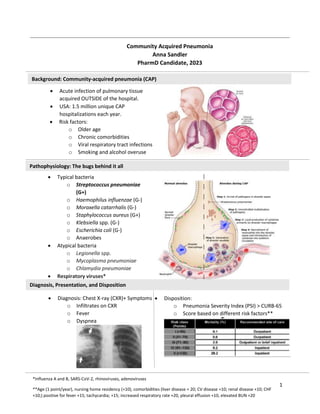
Pathophysiology: The bugs behind it all
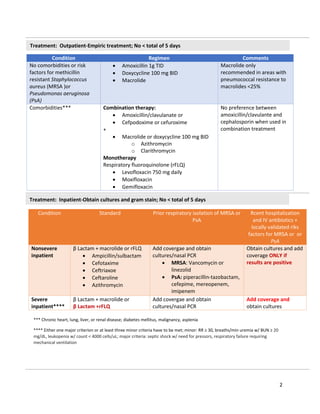
 Diagnosis: Chest X-ray (CXR)+ Symptoms
o Infiltrates on CXR
o Fever
o Dyspnea
o Cough
o
 Acute infection of pulmonary tissue
acquired OUTSIDE of the hospital.
 USA: 1.5 million unique CAP
hospitalizations each year.
Community Acquired Pneumonia
Anna Sandler
PharmD Candidate, 2023
 Risk factors:
o Older age
o Chronic comorbidities
o Viral respiratory tract infections
o Smoking and alcohol overuse
 Typical bacteria
o Streptococcus pneumoniae
(G+)
o Haemophilus influenzae (G-)
o Moraxella catarrhalis (G-)
o Staphylococcus aureus (G+)
o Klebsiella spp. (G-)
o Escherichia coli (G-)
o Anaerobes
 Atypical bacteria
o Legionella spp.
o Mycoplasma pneumoniae
o Chlamydia pneumoniae
 Respiratory viruses*
*Influenza A and B, SARS-CoV-2, rhinoviruses, adenoviruses
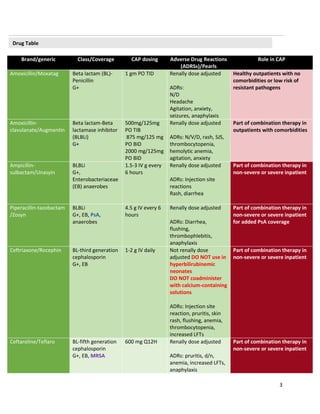
**Age (1 point/year), nursing home residency (+10), comorbidities (liver disease + 20; CV disease +10; renal disease +10; CHF
+10;) positive for fever +15; tachycardia; +15; increased respiratory rate +20, pleural effusion +10, elevated BUN +20
Diagnosis, Presentation, and Disposition
 Disposition:
o Pneumonia Severity Index (PSI) > CURB-65
o Score based on different risk factors**
2
Condition Standard Prior respiratory isolation of MRSA or
PsA
Rcent hospitalization
and IV antibiotics +
locally validated riks
factors for MRSA or or
PsA
Nonsevere
inpatient
β Lactam + macrolide or rFLQ
 Ampicillin/sulbactam
 Cefotaxime
 Ceftriaxoe
 Ceftaroline
 Azithromycin
Add covergae and obtain
cultures/nasal PCR
 MRSA: Vancomycin or
linezolid
 PsA: piperacillin-tazobactam,
cefepime, mereopenem,
imipenem
Obtain cultures and add
coverage ONLY if
results are positive
Severe
inpatient****
β Lactam + macrolide or
β Lactam +rFLQ
Add covergae and obtain
cultures/nasal PCR
Add coverage and
obtain cultures
Condition Regimen Comments
No comorbidities or risk
factors for methicillin
resistant Staphylococcus
aureus (MRSA )or
Pseudomonas aeruginosa
(PsA)
 Amoxicillin 1g TID
 Doxycycline 100 mg BID
 Macrolide
Macrolide only
recommended in areas with
pneumococcal resistance to
macrolides <25%
Comorbidities*** Combination therapy:
 Amoxicillin/clavulanate or
 Cefpodoxime or cefuroxime
+
 Macrolide or doxycycline 100 mg BID
o Azithromycin
o Clarithromycin
Monotherapy
Respiratory fluoroquinolone (rFLQ)
 Levofloxacin 750 mg daily
 Moxifloxacin
 Gemifloxacin
No preference between
amoxicillin/clavulante and
cephalosporin when used in
combination treatment
Treatment: Outpatient-Empiric treatment; No < total of 5 days
Treatment: Inpatient-Obtain cultures and gram stain; No < total of 5 days
*** Chronic heart, lung, liver, or renal disease; diabetes mellitus, malignancy, asplenia
**** Either one major criterion or at least three minor criteria have to be met; minor: RR ≥ 30, breaths/min uremia w/ BUN ≥ 20
mg/dL, leukopenia w/ count < 4000 cells/uL; major criteria: septic shock w/ need for pressors, respiratory failure requiring
mechanical ventilation
3
Brand/generic Class/Coverage CAP dosing Adverse Drug Reactions
(ADRSs)/Pearls
Role in CAP
Amoxicillin/Moxatag Beta lactam (BL)-
Penicillin
G+
1 gm PO TID Renally dose adjusted
ADRs:
N/D
Headache
Agitation, anxiety,
seizures, anaphylaxis
Healthy outpatients with no
comorbidities or low risk of
resistant pathogens
Amoxicillin-
clavulanate/Augmentin
Beta lactam-Beta
lactamase inhibitor
(BLBLi)
G+
500mg/125mg
PO TIB
875 mg/125 mg
PO BID
2000 mg/125mg
PO BID
Renally dose adjusted
ADRs: N/V/D, rash, SJS,
thrombocytopenia,
hemolytic anemia,
agitation, anxiety
Part of combination therapy in
outpatients with comorbidities
Ampicillin-
sulbactam/Unasyin
BLBLi
G+,
Enterobacteriaceae
(EB) anaerobes
1.5-3 IV g every
6 hours
Renally dose adjusted
ADRs: Injection site
reactions
Rash, diarrhea
Part of combination therapy in
non-severe or severe inpatient
Piperacillin-tazobactam
/Zosyn
BLBLi
G+, EB, PsA,
anaerobes
4.5 g IV every 6
hours
Renally dose adjusted
ADRs: Diarrhea,
flushing,
thrombophlebitis,
anaphylaxis
Part of combination therapy in
non-severe or severe inpatient
for added PsA coverage
Ceftriaxone/Rocephin BL-third generation
cephalosporin
G+, EB
1-2 g IV daily Not renally dose
adjusted DO NOT use in
hyperbilirubinemic
neonates
DO NOT coadminister
with calcium-containing
solutions
ADRs: Injection site
reaction, pruritis, skin
rash, flushing, anemia,
thrombocytopenia,
increased LFTs
Part of combination therapy in
non-severe or severe inpatient
Ceftaroline/Teflaro BL-fifth generation
cephalosporin
G+, EB, MRSA
600 mg Q12H Renally dose adjusted
ADRs: pruritis, d/n,
anemia, increased LFTs,
anaphylaxis
Part of combination therapy in
non-severe or severe inpatient
Drug Table
4
Cefuroxime/Ceftin BL-second
generation
cephalosporin
G+, EB
500 mg PO BID Renally dose adjusted
ADRs: Diarrhea,
thrombophlebitis, N/V,
increased LFTs
Part of combination therapy in
outpatients with comorbidities
Cefepime/Maxipime BL-fourth
generation
cephalosporin
G+, EB, PsA,
2g IV Q8H Renally dose adjusted
ADRs: Injection site
reactions, skin rash,
D/N/V
Part of combination therapy in
non-severe or severe inpatient
for added PsA coverage
Meropenem/Merrem BL-carbapenem
G+, EB, PsA,
anaerobes
1 g IV Q8H Renally dose adjusted
DDI with valproic acid
decreased levels+
increased risk of
seizures
ADRs: skin rash,
diarrhea, flatulence,
anemia, injection site
reaction, seizures,
Part of combination therapy in
non-severe or severe inpatient
for added PsA coverage
Doxycycline/Vibramycin Tetracycline
G+, MSSA, MRSA,
EB, Atypicals
100 mg PO BID Not renally dose
adjusted
Counseling: Sitting
upright to minimize
esophageal irritation,
photosensitivity,
separating from divalent
and trivalent cations by
2 hours
Avoid in pregnant
women and children > 8
years old due to binding
of growing teeth and
bones
ADRs: N/V/D
Healthy outpatients with no
comorbidities or low risk of
resistant pathogens or as part
of combination therapy in
outpatients with comorbidities
5
Levofloxacin/Levaquin rFLQ
G+, EB, PsA,
atypicals
750 mg PO or IV
once daily
Renally dose adjusted
BBW: Associated with
serious ADRs such as
tendinitis and tendon
rupture, CNS effects,
Contraindication:
Myasthenia gravis
ADRs: D/N/V,
photosensitivity,
hyperglycemia,
hyperkalemia, risk of
aortic aneurysm and
dissection
Counseling: seeking care
if sudden chest pain
occurs, separating from
cations
 Monotherapy in
outpatients with
comorbidities or risk
factors for resistant
pathogens
 Monotherapy in non-
severe inpatients
 Part of combination
therapy in severe
inpatients
Moxifloxacin/Avelox rFLQ
G+, EB, PsA,
atypicals,
anaerobes
400 mg PO or IV
daily
Not renally dose
adjusted
BBW: Associated with
serious ADRs such as
tendinitis and tendon
rupture, CNS effects,
Cis: Myasthenia gravis
ADRs: D/N/V,
hyperglycemia,
hyperkalemia, risk of
aortic aneurysm and
dissection, QTc
prolongation
Counseling: seeking care
if sudden chest pain
occurs, separating from
cations,
 Monotherapy in
outpatients with
comorbidities or risk
factors for resistant
pathogens
 Monotherapy in non-
severe inpatients
 Part of combination
therapy in severe
inpatients
6
Vancomycin/Vancocin Glycopeptide
antibiotic
G+, MRSA,
15 mg/kg IV
Q12H, adjusted
based on levels
At Advocate
Aurora Health
(AAH)-hospital-
based guidelines
Renally dose adjusted
Monitor target trough
levels
ADRs: Injection site
reactions,
nephrotoxicity,
ototoxicity, Red man
syndrome
Part of combination therapy in
non-severe or severe inpatient
for added MRSA coverage
Linezolid/Zyvox Oxazolidinone
G+, MRSA,
600 mg IV Q12H Not renally dose
adjusted
ADRs:
Thrombocytopenia, rare
peripheral or optical
neuropathy
Part of combination therapy in
non-severe or severe inpatient
for added MRSA coverage
Azithromycin/Zithromax Macrolide
G+, EB, atypical
Outpatient: 500
mg PO on first
day then 250
mg PO daily
Inpatient: 500
mg IV daily
Potent CYP3A4 inhibitor
Not renally excreted
ADRs: dose-related
diarrhea, QTc
prolongation
 Part of combination
therapy in outpatients
with comorbidities or
risk factors
 Potentially as
monotherapy in healthy
outpatients without
comorbidities
 Part of combination
therapy in non-severe
or severe inpatient
Clarithromycin Macrolide
G+, EB, atypical
Outpatient: 500
mg PO BID or
1000 mg PO
daily (ER
product)
Inpatient: 500
mg PO BID
Potent CYP3A4 inhibitor
Not renally excreted
ADRs: dose-related
diarrhea, QTc
prolongation>
azithromycin, metallic
taste
 Part of combination
therapy in outpatients
with comorbidities or
risk factors
 Potentially as
monotherapy in healthy
outpatients without
comorbidities
 Part of combination
therapy in non-severe
or severe inpatient
Color Meaning
Left column color Antibiotic class
Light green, right column Use in both outpatient and inpatient
Salmon pink, right column Use in outpatient
Red, right column Use in inpatient
G+: Gram positive, generally includes streptococcus, methicillin-susceptible Staphylococcus aureus (MSSA) , and enterococci; note, all
cephalosporins lack coverage against enterococci
7
1. House AA, Ronco C. Extracorporeal Blood Purification in Sepsis and Sepsis-Related Acute Kidney
Injury. Blood Purif. 2008;26(1):30-35. doi:10.1159/000110560
2. Jain S, Self WH, Wunderink RG, et al. Community-Acquired Pneumonia Requiring Hospitalization
among U.S. Adults. N Engl J Med. 2015;373(5):415-427. doi:10.1056/NEJMoa1500245
3. Metlay JP, Waterer GW, Long AC, et al. Diagnosis and Treatment of Adults with Community-
acquired Pneumonia. An Official Clinical Practice Guideline of the American Thoracic Society and
Infectious Diseases Society of America. Am J Respir Crit Care Med. 2019;200(7):e45-e67.
doi:10.1164/rccm.201908-1581ST
4. Ramirez JA, M File Jr. T, Shiela B. Overview of community-acquired pneumonia in adults.
UpToDate. Published online April 15, 2022
5. Ramirez JA, Wiemken TL, Peyrani P, et al. Adults Hospitalized With Pneumonia in the United
States: Incidence, Epidemiology, and Mortality. Clin Infect Dis. 2017;65(11):1806-1812.
doi:10.1093/cid/cix647
6. Pfuntner A, Wier LM, Stocks C. Most Frequent Conditions in U.S. Hospitals, 2011: Statistical Brief
#162. In: Healthcare Cost and Utilization Project (HCUP) Statistical Briefs. Agency for Healthcare
Research and Quality (US); 2006. Accessed June 25, 2022.
http://www.ncbi.nlm.nih.gov/books/NBK169248
Picture links:
 https://www.mayoclinic.org/diseases-conditions/pneumonia/symptoms-causes/syc-20354204
 https://www.uptodate.com/contents/image/print?imageKey=ID%2F118722&topicKey=ID%2F11
7561&source=see_link
 https://www.researchgate.net/figure/Pneumonia-Severity-Index-PSI-Score-and-
Interpretation_fig3_5667210
 https://www.mayoclinic.org/diseases-conditions/pneumonia/multimedia/chest-x-ray-showing-
pneumonia/img-20005827
References
8

ASandlerCAP topic discussion Final.docx

  • 1.
    1 Background: Community-acquired pneumonia(CAP) Pathophysiology: The bugs behind it all  Diagnosis: Chest X-ray (CXR)+ Symptoms o Infiltrates on CXR o Fever o Dyspnea o Cough o  Acute infection of pulmonary tissue acquired OUTSIDE of the hospital.  USA: 1.5 million unique CAP hospitalizations each year. Community Acquired Pneumonia Anna Sandler PharmD Candidate, 2023  Risk factors: o Older age o Chronic comorbidities o Viral respiratory tract infections o Smoking and alcohol overuse  Typical bacteria o Streptococcus pneumoniae (G+) o Haemophilus influenzae (G-) o Moraxella catarrhalis (G-) o Staphylococcus aureus (G+) o Klebsiella spp. (G-) o Escherichia coli (G-) o Anaerobes  Atypical bacteria o Legionella spp. o Mycoplasma pneumoniae o Chlamydia pneumoniae  Respiratory viruses* *Influenza A and B, SARS-CoV-2, rhinoviruses, adenoviruses **Age (1 point/year), nursing home residency (+10), comorbidities (liver disease + 20; CV disease +10; renal disease +10; CHF +10;) positive for fever +15; tachycardia; +15; increased respiratory rate +20, pleural effusion +10, elevated BUN +20 Diagnosis, Presentation, and Disposition  Disposition: o Pneumonia Severity Index (PSI) > CURB-65 o Score based on different risk factors**
  • 2.
    2 Condition Standard Priorrespiratory isolation of MRSA or PsA Rcent hospitalization and IV antibiotics + locally validated riks factors for MRSA or or PsA Nonsevere inpatient β Lactam + macrolide or rFLQ  Ampicillin/sulbactam  Cefotaxime  Ceftriaxoe  Ceftaroline  Azithromycin Add covergae and obtain cultures/nasal PCR  MRSA: Vancomycin or linezolid  PsA: piperacillin-tazobactam, cefepime, mereopenem, imipenem Obtain cultures and add coverage ONLY if results are positive Severe inpatient**** β Lactam + macrolide or β Lactam +rFLQ Add covergae and obtain cultures/nasal PCR Add coverage and obtain cultures Condition Regimen Comments No comorbidities or risk factors for methicillin resistant Staphylococcus aureus (MRSA )or Pseudomonas aeruginosa (PsA)  Amoxicillin 1g TID  Doxycycline 100 mg BID  Macrolide Macrolide only recommended in areas with pneumococcal resistance to macrolides <25% Comorbidities*** Combination therapy:  Amoxicillin/clavulanate or  Cefpodoxime or cefuroxime +  Macrolide or doxycycline 100 mg BID o Azithromycin o Clarithromycin Monotherapy Respiratory fluoroquinolone (rFLQ)  Levofloxacin 750 mg daily  Moxifloxacin  Gemifloxacin No preference between amoxicillin/clavulante and cephalosporin when used in combination treatment Treatment: Outpatient-Empiric treatment; No < total of 5 days Treatment: Inpatient-Obtain cultures and gram stain; No < total of 5 days *** Chronic heart, lung, liver, or renal disease; diabetes mellitus, malignancy, asplenia **** Either one major criterion or at least three minor criteria have to be met; minor: RR ≥ 30, breaths/min uremia w/ BUN ≥ 20 mg/dL, leukopenia w/ count < 4000 cells/uL; major criteria: septic shock w/ need for pressors, respiratory failure requiring mechanical ventilation
  • 3.
    3 Brand/generic Class/Coverage CAPdosing Adverse Drug Reactions (ADRSs)/Pearls Role in CAP Amoxicillin/Moxatag Beta lactam (BL)- Penicillin G+ 1 gm PO TID Renally dose adjusted ADRs: N/D Headache Agitation, anxiety, seizures, anaphylaxis Healthy outpatients with no comorbidities or low risk of resistant pathogens Amoxicillin- clavulanate/Augmentin Beta lactam-Beta lactamase inhibitor (BLBLi) G+ 500mg/125mg PO TIB 875 mg/125 mg PO BID 2000 mg/125mg PO BID Renally dose adjusted ADRs: N/V/D, rash, SJS, thrombocytopenia, hemolytic anemia, agitation, anxiety Part of combination therapy in outpatients with comorbidities Ampicillin- sulbactam/Unasyin BLBLi G+, Enterobacteriaceae (EB) anaerobes 1.5-3 IV g every 6 hours Renally dose adjusted ADRs: Injection site reactions Rash, diarrhea Part of combination therapy in non-severe or severe inpatient Piperacillin-tazobactam /Zosyn BLBLi G+, EB, PsA, anaerobes 4.5 g IV every 6 hours Renally dose adjusted ADRs: Diarrhea, flushing, thrombophlebitis, anaphylaxis Part of combination therapy in non-severe or severe inpatient for added PsA coverage Ceftriaxone/Rocephin BL-third generation cephalosporin G+, EB 1-2 g IV daily Not renally dose adjusted DO NOT use in hyperbilirubinemic neonates DO NOT coadminister with calcium-containing solutions ADRs: Injection site reaction, pruritis, skin rash, flushing, anemia, thrombocytopenia, increased LFTs Part of combination therapy in non-severe or severe inpatient Ceftaroline/Teflaro BL-fifth generation cephalosporin G+, EB, MRSA 600 mg Q12H Renally dose adjusted ADRs: pruritis, d/n, anemia, increased LFTs, anaphylaxis Part of combination therapy in non-severe or severe inpatient Drug Table
  • 4.
    4 Cefuroxime/Ceftin BL-second generation cephalosporin G+, EB 500mg PO BID Renally dose adjusted ADRs: Diarrhea, thrombophlebitis, N/V, increased LFTs Part of combination therapy in outpatients with comorbidities Cefepime/Maxipime BL-fourth generation cephalosporin G+, EB, PsA, 2g IV Q8H Renally dose adjusted ADRs: Injection site reactions, skin rash, D/N/V Part of combination therapy in non-severe or severe inpatient for added PsA coverage Meropenem/Merrem BL-carbapenem G+, EB, PsA, anaerobes 1 g IV Q8H Renally dose adjusted DDI with valproic acid decreased levels+ increased risk of seizures ADRs: skin rash, diarrhea, flatulence, anemia, injection site reaction, seizures, Part of combination therapy in non-severe or severe inpatient for added PsA coverage Doxycycline/Vibramycin Tetracycline G+, MSSA, MRSA, EB, Atypicals 100 mg PO BID Not renally dose adjusted Counseling: Sitting upright to minimize esophageal irritation, photosensitivity, separating from divalent and trivalent cations by 2 hours Avoid in pregnant women and children > 8 years old due to binding of growing teeth and bones ADRs: N/V/D Healthy outpatients with no comorbidities or low risk of resistant pathogens or as part of combination therapy in outpatients with comorbidities
  • 5.
    5 Levofloxacin/Levaquin rFLQ G+, EB,PsA, atypicals 750 mg PO or IV once daily Renally dose adjusted BBW: Associated with serious ADRs such as tendinitis and tendon rupture, CNS effects, Contraindication: Myasthenia gravis ADRs: D/N/V, photosensitivity, hyperglycemia, hyperkalemia, risk of aortic aneurysm and dissection Counseling: seeking care if sudden chest pain occurs, separating from cations  Monotherapy in outpatients with comorbidities or risk factors for resistant pathogens  Monotherapy in non- severe inpatients  Part of combination therapy in severe inpatients Moxifloxacin/Avelox rFLQ G+, EB, PsA, atypicals, anaerobes 400 mg PO or IV daily Not renally dose adjusted BBW: Associated with serious ADRs such as tendinitis and tendon rupture, CNS effects, Cis: Myasthenia gravis ADRs: D/N/V, hyperglycemia, hyperkalemia, risk of aortic aneurysm and dissection, QTc prolongation Counseling: seeking care if sudden chest pain occurs, separating from cations,  Monotherapy in outpatients with comorbidities or risk factors for resistant pathogens  Monotherapy in non- severe inpatients  Part of combination therapy in severe inpatients
  • 6.
    6 Vancomycin/Vancocin Glycopeptide antibiotic G+, MRSA, 15mg/kg IV Q12H, adjusted based on levels At Advocate Aurora Health (AAH)-hospital- based guidelines Renally dose adjusted Monitor target trough levels ADRs: Injection site reactions, nephrotoxicity, ototoxicity, Red man syndrome Part of combination therapy in non-severe or severe inpatient for added MRSA coverage Linezolid/Zyvox Oxazolidinone G+, MRSA, 600 mg IV Q12H Not renally dose adjusted ADRs: Thrombocytopenia, rare peripheral or optical neuropathy Part of combination therapy in non-severe or severe inpatient for added MRSA coverage Azithromycin/Zithromax Macrolide G+, EB, atypical Outpatient: 500 mg PO on first day then 250 mg PO daily Inpatient: 500 mg IV daily Potent CYP3A4 inhibitor Not renally excreted ADRs: dose-related diarrhea, QTc prolongation  Part of combination therapy in outpatients with comorbidities or risk factors  Potentially as monotherapy in healthy outpatients without comorbidities  Part of combination therapy in non-severe or severe inpatient Clarithromycin Macrolide G+, EB, atypical Outpatient: 500 mg PO BID or 1000 mg PO daily (ER product) Inpatient: 500 mg PO BID Potent CYP3A4 inhibitor Not renally excreted ADRs: dose-related diarrhea, QTc prolongation> azithromycin, metallic taste  Part of combination therapy in outpatients with comorbidities or risk factors  Potentially as monotherapy in healthy outpatients without comorbidities  Part of combination therapy in non-severe or severe inpatient Color Meaning Left column color Antibiotic class Light green, right column Use in both outpatient and inpatient Salmon pink, right column Use in outpatient Red, right column Use in inpatient G+: Gram positive, generally includes streptococcus, methicillin-susceptible Staphylococcus aureus (MSSA) , and enterococci; note, all cephalosporins lack coverage against enterococci
  • 7.
    7 1. House AA,Ronco C. Extracorporeal Blood Purification in Sepsis and Sepsis-Related Acute Kidney Injury. Blood Purif. 2008;26(1):30-35. doi:10.1159/000110560 2. Jain S, Self WH, Wunderink RG, et al. Community-Acquired Pneumonia Requiring Hospitalization among U.S. Adults. N Engl J Med. 2015;373(5):415-427. doi:10.1056/NEJMoa1500245 3. Metlay JP, Waterer GW, Long AC, et al. Diagnosis and Treatment of Adults with Community- acquired Pneumonia. An Official Clinical Practice Guideline of the American Thoracic Society and Infectious Diseases Society of America. Am J Respir Crit Care Med. 2019;200(7):e45-e67. doi:10.1164/rccm.201908-1581ST 4. Ramirez JA, M File Jr. T, Shiela B. Overview of community-acquired pneumonia in adults. UpToDate. Published online April 15, 2022 5. Ramirez JA, Wiemken TL, Peyrani P, et al. Adults Hospitalized With Pneumonia in the United States: Incidence, Epidemiology, and Mortality. Clin Infect Dis. 2017;65(11):1806-1812. doi:10.1093/cid/cix647 6. Pfuntner A, Wier LM, Stocks C. Most Frequent Conditions in U.S. Hospitals, 2011: Statistical Brief #162. In: Healthcare Cost and Utilization Project (HCUP) Statistical Briefs. Agency for Healthcare Research and Quality (US); 2006. Accessed June 25, 2022. http://www.ncbi.nlm.nih.gov/books/NBK169248 Picture links:  https://www.mayoclinic.org/diseases-conditions/pneumonia/symptoms-causes/syc-20354204  https://www.uptodate.com/contents/image/print?imageKey=ID%2F118722&topicKey=ID%2F11 7561&source=see_link  https://www.researchgate.net/figure/Pneumonia-Severity-Index-PSI-Score-and- Interpretation_fig3_5667210  https://www.mayoclinic.org/diseases-conditions/pneumonia/multimedia/chest-x-ray-showing- pneumonia/img-20005827 References
  • 8.