2
Impressionism
Impressionism is anart movement that
originated in France in 1860s. it centered on a
group of artist who were labeled as impressionists.
The name of the movement was coined by critics
from a painting by Claude Monet entitled
Impression: Soleil Levant.
Impressionist painting is characterized by
short brisk strokes of bright colors. The paint is
often applied impasto, an Italian word used to
describe the thickness and texture that can be
achieved with acrylic or oil plant.
4
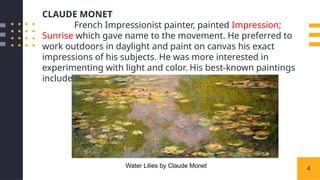
CLAUDE MONET
French Impressionistpainter, painted Impression;
Sunrise which gave name to the movement. He preferred to
work outdoors in daylight and paint on canvas his exact
impressions of his subjects. He was more interested in
experimenting with light and color. His best-known paintings
include Water Lilies series.
Water Lilies by Claude Monet
5.
5
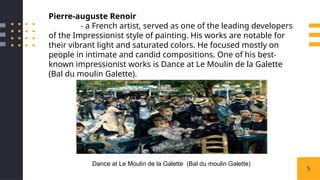
Pierre-auguste Renoir
- aFrench artist, served as one of the leading developers
of the Impressionist style of painting. His works are notable for
their vibrant light and saturated colors. He focused mostly on
people in intimate and candid compositions. One of his best-
known impressionist works is Dance at Le Moulin de la Galette
(Bal du moulin Galette).
Dance at Le Moulin de la Galette (Bal du moulin Galette)
6.
6
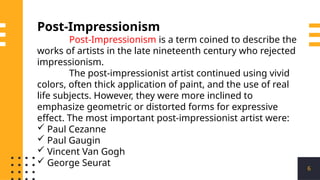
Post-Impressionism
Post-Impressionism is aterm coined to describe the
works of artists in the late nineteenth century who rejected
impressionism.
The post-impressionist artist continued using vivid
colors, often thick application of paint, and the use of real
life subjects. However, they were more inclined to
emphasize geometric or distorted forms for expressive
effect. The most important post-impressionist artist were:
Paul Cezanne
Paul Gaugin
Vincent Van Gogh
George Seurat
7.
7
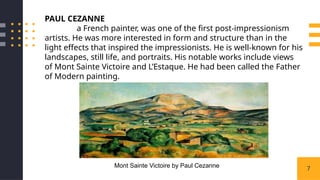
PAUL CEZANNE
a Frenchpainter, was one of the first post-impressionism
artists. He was more interested in form and structure than in the
light effects that inspired the impressionists. He is well-known for his
landscapes, still life, and portraits. His notable works include views
of Mont Sainte Victoire and L’Estaque. He had been called the Father
of Modern painting.
Mont Sainte Victoire by Paul Cezanne
8.
8
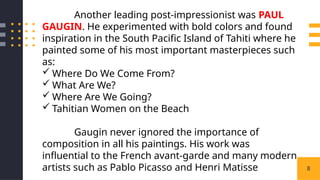
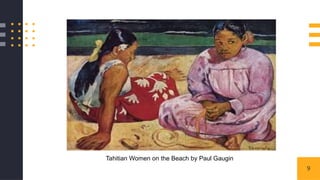
Another leading post-impressionistwas PAUL
GAUGIN. He experimented with bold colors and found
inspiration in the South Pacific Island of Tahiti where he
painted some of his most important masterpieces such
as:
Where Do We Come From?
What Are We?
Where Are We Going?
Tahitian Women on the Beach
Gaugin never ignored the importance of
composition in all his paintings. His work was
influential to the French avant-garde and many modern
artists such as Pablo Picasso and Henri Matisse
10
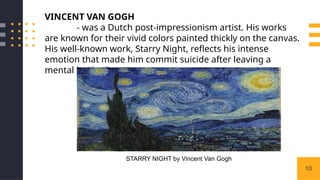
VINCENT VAN GOGH
-was a Dutch post-impressionism artist. His works
are known for their vivid colors painted thickly on the canvas.
His well-known work, Starry Night, reflects his intense
emotion that made him commit suicide after leaving a
mental institution.
STARRY NIGHT by Vincent Van Gogh
11.
11
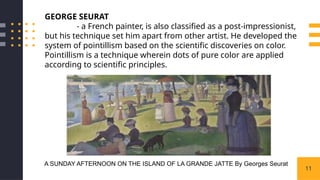
GEORGE SEURAT
- aFrench painter, is also classified as a post-impressionist,
but his technique set him apart from other artist. He developed the
system of pointillism based on the scientific discoveries on color.
Pointillism is a technique wherein dots of pure color are applied
according to scientific principles.
A SUNDAY AFTERNOON ON THE ISLAND OF LA GRANDE JATTE By Georges Seurat
13
Expressionism is anart movement that
has its root in France and Germany around
1910. Perhaps, this is the most significant phase
in the evolution of newer art form.
Expressionism was first used as a term to
describe a group of painters in Der Blaue Reiter
in Germany. Artists of this movement were the
first to forcefully show their freedom to paint a
subject in accordance with their feelings.
Expressionism
14.
14
The style ofthis period is characterized by the
distortion of form and strong colors through which
the artist gives visual form to inner emotion. The
emotional expressions showed in the work of an
expressionist could be described as involving fear,
anguish, violence, chaos, morbidity, tragedy, or
defeat.
Among the notable artworks during the
period of expressionism were:
The Scream (Edvard Munch’s)
Kirchner’s Street Scene/The Street (Ernst Ludwig)
Bridge of the Wind (Oskar Kokoschka’s)
15.
15
EDVARD MUNCH
- wasa Norwegian painter whose works
reflected a morbid obsession with sickness and
isolation. He was one of the members of Der Blaue
Reiter, one of the movements that served as
proponents of expressionism.
The imagery in his work appears like a
recurring nightmare – anger and violence are
manifested in the distortion of line with powerful
contrast of black and red.
16.
16
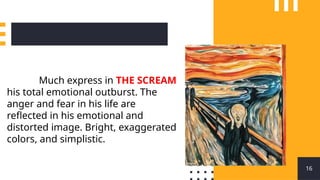
Much express inTHE SCREAM
his total emotional outburst. The
anger and fear in his life are
reflected in his emotional and
distorted image. Bright, exaggerated
colors, and simplistic.
17.
17
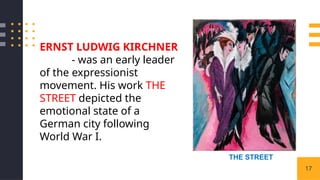
ERNST LUDWIG KIRCHNER
-was an early leader
of the expressionist
movement. His work THE
STREET depicted the
emotional state of a
German city following
World War I.
THE STREET
18.
18
OSKAR KOKOSCHKA
- wasan Australian artist, he
created still life paintings and a series
of portraits. Thick oil straight from the
tube squeezed directly on the canvass
is often applied in his works.
Bridge of the Wind (artwork)
19.
Cubis
m
19
- is oneof the movements that offered an
entirely different way of presenting subject matter
in art. This art movement was further developed by
Pablo Picasso and Georges Braque in the first
decade of the twentieth century. The both admired
Paul Cezanne because of his attempt to create a
highly structured language.
20.
20
- is aform of abstraction where
objects are reduced to cubes and
flattened into two dimensional shapes.
In cubism, the subject matter is broken
up, analyzed, and reassembled in an
abstract form.
21.
21
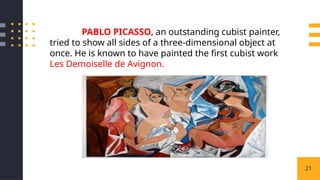
PABLO PICASSO, anoutstanding cubist painter,
tried to show all sides of a three-dimensional object at
once. He is known to have painted the first cubist work
Les Demoiselle de Avignon.
22.
22
- is ananti-art movement where artists deeply
rejected the bourgeois concept of art. In Dadaism,
the traditional subject matter is not recognizable.
The name dada was randomly chosen from French
language dictionary, meant either “hobbyhorse” or
one of a baby’s earliest sounds. The Dada
movement lasted until about 1923 in Europe and
the United States
Dadaism
23.
23
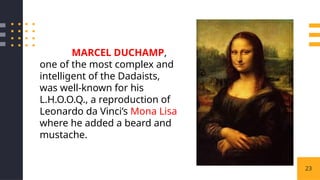
MARCEL DUCHAMP,
one ofthe most complex and
intelligent of the Dadaists,
was well-known for his
L.H.O.O.Q., a reproduction of
Leonardo da Vinci’s Mona Lisa
where he added a beard and
mustache.
24.
24
Surrealism
Surrealism was introducedin 1924
by the French writer and former Dadaist
Andre Breton. As a style, surrealism took
its root from the art of Dadaism.
Surrealism is an art movement that
drew its pulse from the psychoanalytic
theory of Sigmund Freud on free
association and dreams.
25.
25
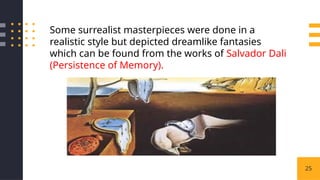
Some surrealist masterpieceswere done in a
realistic style but depicted dreamlike fantasies
which can be found from the works of Salvador Dali
(Persistence of Memory).
26.
26
Max Ernst, aGerman painter, invented
several techniques in exploring his fantastic
concepts. He invented frottage, which involves
making rubbings of textured surfaces, using the
marks as chance starting points for an image.
He also invented a similar technique called
decalcomania, which involved painting on glass
and then pressing it directly onto the canvas to
create a texture.
27.
27
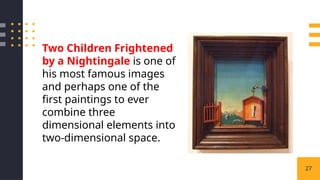
Two Children Frightened
bya Nightingale is one of
his most famous images
and perhaps one of the
first paintings to ever
combine three
dimensional elements into
two-dimensional space.
28.
Abstract
Realism
28
- is aform of art that sits between
realistic depiction of the world and a non-
representational abstraction.
- is a form of art that is mixture of realist
and abstract art.
29.
Pop Art
29
- isan art movement that reacted
against the dominance of abstract art. Artists
of this movement focused their interest on
familiar images of popular culture such as
commercial art, comic strips, posters,
billboards, among others.
30.
30
The word popwas first coined in 1954
by the British art critic Lawrence Alloway to
describe a new type of art that was inspired by
the imagery of popular culture. However, the
pop art movement, which originated in
England, was first introduced by Richard
Hamilton in an art show in 1956. His small
collage entitled Just What is it That Makes
Today’s Homes So Different, So Appealing?
Shows familiar images that the artist hoped to
show in a new style.
31.
31
Andy Warhol, anAmerican painter
and designer, is best known as a pioneer
of pop art. He exhibited his first stenciled
and silk-screened pieces, the green Coca
Cola Bottles and the famous Campbell’s
soup cans in 1962.
32.
32
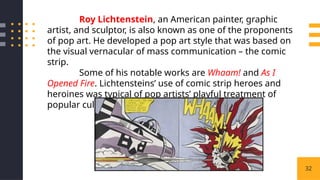
Roy Lichtenstein, anAmerican painter, graphic
artist, and sculptor, is also known as one of the proponents
of pop art. He developed a pop art style that was based on
the visual vernacular of mass communication – the comic
strip.
Some of his notable works are Whaam! and As I
Opened Fire. Lichtensteins’ use of comic strip heroes and
heroines was typical of pop artists’ playful treatment of
popular culture
33.
Optical Art/Op Art
33
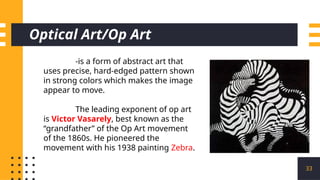
-isa form of abstract art that
uses precise, hard-edged pattern shown
in strong colors which makes the image
appear to move.
The leading exponent of op art
is Victor Vasarely, best known as the
“grandfather” of the Op Art movement
of the 1860s. He pioneered the
movement with his 1938 painting Zebra.