P A P E R
Machine learning
Presented By~
Swarup Saw 12100121131 CSE B
N a m e R o l l S t r e a m
PEC-CS701E
7th
Sem
Topic: AI vs Machine learning
S e c t i o n
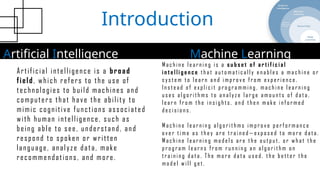
Artificial Intelligence Machine Learning
Artificial intelligence is a broad
field, which refers to the use of
technologies to build machines and
computers that have the ability to
mimic cognitive functions associated
with human intelligence, such as
being able to see, understand, and
respond to spoken or written
language, analyze data, make
recommendations, and more.
Introduction
M ac h i n e l e ar n i n g i s a s u b s e t o f a r t i f i c i a l
i n t e l l i g e n c e t h a t a u t o m a t i c a l l y e n a b l e s a m a c h i n e o r
s y s t e m t o l e a r n a n d i m p r o v e f r o m e x p e r i e n c e .
I n s t e ad o f e x p l i c i t p r o g r a m m i n g , m a c h i n e l e a r n i n g
u s e s a l g o r i t h m s t o a n a l y z e l a r g e a m o u n t s o f d a t a ,
l e a r n f r o m t h e i n s i g h t s , a n d t h e n m ak e i n f o r m e d
d e c i s i o n s .
M ac h i n e l e ar n i n g a l g o r i t h m s i m p r o v e p e r f o r m a n c e
o v e r t i m e a s t h e y ar e t r a i n e d — e x p o s e d t o m o r e d a t a .
M ac h i n e l e ar n i n g m o d e l s ar e t h e o u t p u t , o r w h a t t h e
p r o g r a m l e a r n s f r o m r u n n i n g a n a l g o r i t h m o n
t r a i n i n g d a t a . T h e m o r e d a t a u s e d , t h e b e t t e r t h e
m o d e l w i l l g e t .
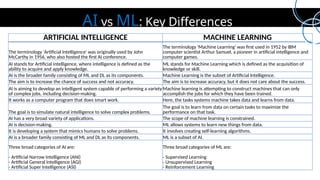
ARTIFICIAL INTELLIGENCE MACHINE LEARNING
The terminology 'Artificial Intelligence' was originally used by John
McCarthy in 1956, who also hosted the first AI conference.
The terminology 'Machine Learning' was first used in 1952 by IBM
computer scientist Arthur Samuel, a pioneer in artificial intelligence and
computer games.
AI stands for Artificial intelligence, where intelligence is defined as the
ability to acquire and apply knowledge.
ML stands for Machine Learning which is defined as the acquisition of
knowledge or skill.
AI is the broader family consisting of ML and DL as its components. Machine Learning is the subset of Artificial Intelligence.
The aim is to increase the chance of success and not accuracy. The aim is to increase accuracy, but it does not care about the success.
AI is aiming to develop an intelligent system capable of performing a variety
of complex jobs, including decision-making.
Machine learning is attempting to construct machines that can only
accomplish the jobs for which they have been trained.
It works as a computer program that does smart work. Here, the tasks systems machine takes data and learns from data.
The goal is to simulate natural intelligence to solve complex problems.
The goal is to learn from data on certain tasks to maximize the
performance on that task.
AI has a very broad variety of applications. The scope of machine learning is constrained.
AI is decision-making. ML allows systems to learn new things from data.
It is developing a system that mimics humans to solve problems. It involves creating self-learning algorithms.
AI is a broader family consisting of ML and DL as its components. ML is a subset of AI.
Three broad categories of AI are:
- Artificial Narrow Intelligence (ANI)
- Artificial General Intelligence (AGI)
- Artificial Super Intelligence (ASI)
Three broad categories of ML are:
- Supervised Learning
- Unsupervised Learning
- Reinforcement Learning
AI vs ML: Key Differences
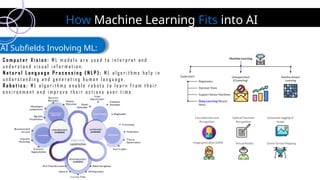
How Machine Learning Fits into AI
AI Subfields Involving ML:
C o m p u t e r V i s i o n : M L m o d e l s a r e u s e d t o i n t e r p r e t a n d
u n d e r s t a n d v i s u a l i n f o r m a t i o n .
N a t u r a l L a n g u a g e P r o c e s s i n g ( N L P ) : M L a l g o r i t h m s h e l p i n
u n d e r s t a n d i n g a n d g e n e r a t i n g h u m a n l a n g u a g e .
R o b o t i c s : M L a l g o r i t h m s e n a b l e r o b o t s t o l e a r n f r o m t h e i r
e n v i r o n m e n t a n d i m p r o v e t h e i r a c t i o n s o v e r t i m e .
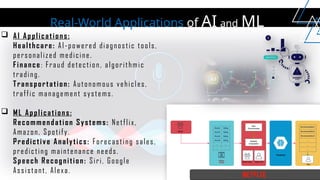
Real-World Applications of AI and ML
 AI Applications:
Healthcare: AI-powered diagnostic tools,
personalized medicine.
Finance: Fraud detection, algorithmic
trading.
Transportation: Autonomous vehicles,
traffic management systems.
 ML Applications:
Recommendation Systems: Netflix,
Amazon, Spotify.
Predictive Analytics: Forecasting sales,
predicting maintenance needs.
Speech Recognition: Siri, Google
Assistant, Alexa.
Challenges
AI ML
 E t h i c a l C o n c e r n s : A I s y s t e m s , e s p e c i a l l y i n s e n s i t i v e a r e a s l i k e
h e a l t h c a r e , l a w , a n d f i n a n c e , c a n m a k e d e c i s i o n s t h a t h a v e
s i g n i f i c a n t i m p a c t s o n p e o p l e ' s l i v e s . T h e r e a r e c o n c e r n s a b o u t h o w
t h e s e d e c i s i o n s a r e m a d e , t h e p o t e n t i a l f o r b i a s , a n d t h e l a c k o f
t r a n s p a r e n c y .
E x a m p l e : A I - d r i v e n p r e d i c t i v e p o l i c i n g h a s r a i s e d i s s u e s o f
r a c i a l b i a s a n d f a i r n e s s , a s t h e s e s y s t e m s m a y r e i n f o r c e
e x i s t i n g s o c i e t a l b i a s e s p r e s e n t i n t h e d a t a .
 J o b D i s p l a c e m e n t : T h e a u t o m a t i o n o f t a s k s b y A I p o s e s a r i s k o f
j o b d i s p l a c e m e n t a c r o s s v a r i o u s i n d u s t r i e s , l e a d i n g t o e c o n o m i c
a n d s o c i a l c h a l l e n g e s . W h i l e A I c a n c r e a t e n e w j o b s , t h e t r a n s i t i o n
c a n b e d i f f i c u l t f o r t h o s e i n r o l e s s u s c e p t i b l e t o a u t o m a t i o n .
E x a m p l e : M a n u f a c t u r i n g , c u s t o m e r s e r v i c e , a n d t r a n s p o r t a t i o n
i n d u s t r i e s a r e s e e i n g a r i s e i n a u t o m a t i o n , p o t e n t i a l l y r e d u c i n g
t h e n e e d f o r h u m a n l a b o r .
 D e c i s i o n - M a k i n g T r a n s p a r e n c y : M a n y A I s y s t e m s , e s p e c i a l l y t h o s e
p o w e r e d b y d e e p l e a r n i n g , o p e r a t e a s " b l a c k b o x e s , " w h e r e t h e
i n t e r n a l d e c i s i o n - m a k i n g p r o c e s s i s n o t e a s i l y i n t e r p r e t a b l e . T h i s
l a c k o f t r a n s p a r e n c y c a n b e p r o b l e m a t i c i n c r i t i c a l a p p l i c a t i o n s
w h e r e u n d e r s t a n d i n g t h e r a t i o n a l e b e h i n d d e c i s i o n s i s e s s e n t i a l .
E x a m p l e : I n h e a l t h c a r e , u n d e r s t a n d i n g w h y a n A I s y s t e m
r e c o m m e n d s a c e r t a i n t r e a t m e n t i s c r u c i a l f o r b o t h d o c t o r s a n d
p a t i e n t s .
 D a t a Q u a l i t y a n d B i a s : M a c h i n e l e a r n i n g m o d e l s a r e o n l y
a s g o o d a s t h e d a t a t h e y a r e t r a i n e d o n . P o o r q u a l i t y
d a t a o r d a t a t h a t c o n t a i n s b i a s e s c a n l e a d t o i n a c c u r a t e
o r b i a s e d p r e d i c t i o n s , p e r p e t u a t i n g e x i s t i n g i n e q u a l i t i e s .
E x a m p l e : A f a c i a l r e c o g n i t i o n s y s t e m t r a i n e d o n a
n o n - d i v e r s e d a t a s e t m a y p e r f o r m p o o r l y o n c e r t a i n
d e m o g r a p h i c g r o u p s .
 M o d e l I n t e r p r e t a b i l i t y : C o m p l e x m o d e l s , l i k e d e e p
n e u r a l n e t w o r k s , c a n b e d i f f i c u l t t o i n t e r p r e t , m a k i n g i t
c h a l l e n g i n g t o u n d e r s t a n d h o w a m o d e l a r r i v e s a t a
c e r t a i n p r e d i c t i o n o r d e c i s i o n .
E x a m p l e : I n f i n a n c i a l s e r v i c e s , r e g u l a t o r s r e q u i r e
e x p l a n a t i o n s f o r c r e d i t d e c i s i o n s , w h i c h c a n b e
d i f f i c u l t t o p r o v i d e w i t h c o m p l e x M L m o d e l s .
 C o m p u t a t i o n a l R e s o u r c e R e q u i r e m e n t s : T r a i n i n g l a r g e -
s c a l e m a c h i n e l e a r n i n g m o d e l s , e s p e c i a l l y d e e p l e a r n i n g
m o d e l s , r e q u i r e s s i g n i f i c a n t c o m p u t a t i o n a l r e s o u r c e s ,
w h i c h c a n b e c o s t l y a n d e n v i r o n m e n t a l l y t a x i n g .
E x a m p l e : T r a i n i n g a s i n g l e d e e p l e a r n i n g m o d e l c a n
r e q u i r e t h o u s a n d s o f G P U s a n d r e s u l t i n a l a r g e
c a r b o n f o o t p r i n t .
Future Trends
AI ML
 E x p l a i n a b l e A I ( X A I ) : A s A I s y s t e m s b e c o m e m o r e i n t e g r a t e d
i n t o c r i t i c a l a r e a s l i k e h e a l t h c a r e a n d f i n a n c e , t h e n e e d f o r
e x p l a i n a b i l i t y i s g r o w i n g . X A I a i m s t o m a k e A I d e c i s i o n s m o r e
t r a n s p a r e n t a n d u n d e r s t a n d a b l e t o h u m a n s .
E x a m p l e : D e v e l o p i n g A I m o d e l s t h a t p r o v i d e r e a s o n i n g f o r
t h e i r d e c i s i o n s , m a k i n g i t e a s i e r f o r u s e r s t o t r u s t a n d
v a l i d a t e t h e s y s t e m ’ s o u t p u t s .
 A I i n C r e a t i v e I n d u s t r i e s : A I i s i n c r e a s i n g l y b e i n g u s e d i n
c r e a t i v e f i e l d s s u c h a s a r t , m u s i c , a n d l i t e r a t u r e . A I t o o l s c a n
a s s i s t i n g e n e r a t i n g c o n t e n t , d e s i g n i n g p r o d u c t s , a n d e v e n
c r e a t i n g e n t i r e w o r k s o f a r t .
E x a m p l e : A I - g e n e r a t e d a r t w o r k b e i n g s o l d a t a u c t i o n s o r A I -
p o w e r e d t o o l s a s s i s t i n g m u s i c i a n s i n c o m p o s i n g n e w s o n g s .
 A I G o v e r n a n c e : A s A I b e c o m e s m o r e p e r v a s i v e , t h e r e i s a
g r o w i n g n e e d f o r g o v e r n a n c e f r a m e w o r k s t o e n s u r e e t h i c a l u s e ,
a c c o u n t a b i l i t y , a n d c o m p l i a n c e w i t h r e g u l a t i o n s .
E x a m p l e : G o v e r n m e n t s a n d o r g a n i z a t i o n s a r e d e v e l o p i n g
p o l i c i e s a n d r e g u l a t i o n s t o m a n a g e t h e d e v e l o p m e n t a n d
d e p l o y m e n t o f A I t e c h n o l o g i e s r e s p o n s i b l y .
 F e d e r a t e d L e a r n i n g : F e d e r a t e d l e a r n i n g a l l o w s m a c h i n e
l e a r n i n g m o d e l s t o b e t r a i n e d a c r o s s d e c e n t r a l i z e d
d e v i c e s w h i l e k e e p i n g d a t a l o c a l , e n h a n c i n g p r i v a c y a n d
s e c u r i t y .
E x a m p l e : I n h e a l t h c a r e , f e d e r a t e d l e a r n i n g c a n e n a b l e
h o s p i t a l s t o c o l l a b o r a t i v e l y t r a i n m o d e l s w i t h o u t
s h a r i n g s e n s i t i v e p a t i e n t d a t a a c r o s s i n s t i t u t i o n s .
 A u t o m a t e d M a c h i n e L e a r n i n g ( A u t o M L ) : A u t o M L a u t o m a t e s
t h e p r o c e s s o f s e l e c t i n g a n d t u n i n g m a c h i n e l e a r n i n g
m o d e l s , m a k i n g i t e a s i e r f o r n o n - e x p e r t s t o b u i l d
e f f e c t i v e m o d e l s a n d r e d u c i n g t h e t i m e r e q u i r e d f o r m o d e l
d e v e l o p m e n t .
E x a m p l e : A u t o M L t o o l s t h a t a u t o m a t i c a l l y s e l e c t t h e
b e s t m o d e l a r c h i t e c t u r e , o p t i m i z e h y p e r p a r a m e t e r s ,
a n d d e p l o y m o d e l s i n p r o d u c t i o n .
 Q u a n t u m M a c h i n e L e a r n i n g : Q u a n t u m c o m p u t i n g h a s t h e
p o t e n t i a l t o r e v o l u t i o n i z e m a c h i n e l e a r n i n g b y p r o v i d i n g
t h e c o m p u t a t i o n a l p o w e r n e e d e d t o s o l v e p r o b l e m s t h a t
a r e c u r r e n t l y i n t r a c t a b l e f o r c l a s s i c a l c o m p u t e r s .
E x a m p l e : Q u a n t u m m a c h i n e l e a r n i n g a l g o r i t h m s t h a t
c o u l d e x p o n e n t i a l l y s p e e d u p t r a i n i n g t i m e s f o r
c o m p l e x m o d e l s , o p e n i n g n e w f r o n t i e r s i n A I r e s e a r c h .
Conclusion
In today’s technology-driven world, both AI and ML play critical
roles in driving innovation, solving complex problems, and
transforming industries.
Understanding the distinction between AI and ML is crucial for
anyone involved in technology, business, or policy-making, as these
technologies will shape the future of work, life, and society. i.e. AI
is the overarching concept, while ML is a specific approach to
achieving AI.
https://ai.engineering.columbia.edu/ai-vs-machine-learning/
https://www.coursera.org/articles/machine-learning-vs-ai
References
Thank
Youuu

Artificial intelligence vs Machine learning

  • 1.
    P A PE R Machine learning Presented By~ Swarup Saw 12100121131 CSE B N a m e R o l l S t r e a m PEC-CS701E 7th Sem Topic: AI vs Machine learning S e c t i o n
  • 2.
    Artificial Intelligence MachineLearning Artificial intelligence is a broad field, which refers to the use of technologies to build machines and computers that have the ability to mimic cognitive functions associated with human intelligence, such as being able to see, understand, and respond to spoken or written language, analyze data, make recommendations, and more. Introduction M ac h i n e l e ar n i n g i s a s u b s e t o f a r t i f i c i a l i n t e l l i g e n c e t h a t a u t o m a t i c a l l y e n a b l e s a m a c h i n e o r s y s t e m t o l e a r n a n d i m p r o v e f r o m e x p e r i e n c e . I n s t e ad o f e x p l i c i t p r o g r a m m i n g , m a c h i n e l e a r n i n g u s e s a l g o r i t h m s t o a n a l y z e l a r g e a m o u n t s o f d a t a , l e a r n f r o m t h e i n s i g h t s , a n d t h e n m ak e i n f o r m e d d e c i s i o n s . M ac h i n e l e ar n i n g a l g o r i t h m s i m p r o v e p e r f o r m a n c e o v e r t i m e a s t h e y ar e t r a i n e d — e x p o s e d t o m o r e d a t a . M ac h i n e l e ar n i n g m o d e l s ar e t h e o u t p u t , o r w h a t t h e p r o g r a m l e a r n s f r o m r u n n i n g a n a l g o r i t h m o n t r a i n i n g d a t a . T h e m o r e d a t a u s e d , t h e b e t t e r t h e m o d e l w i l l g e t .
  • 3.
    ARTIFICIAL INTELLIGENCE MACHINELEARNING The terminology 'Artificial Intelligence' was originally used by John McCarthy in 1956, who also hosted the first AI conference. The terminology 'Machine Learning' was first used in 1952 by IBM computer scientist Arthur Samuel, a pioneer in artificial intelligence and computer games. AI stands for Artificial intelligence, where intelligence is defined as the ability to acquire and apply knowledge. ML stands for Machine Learning which is defined as the acquisition of knowledge or skill. AI is the broader family consisting of ML and DL as its components. Machine Learning is the subset of Artificial Intelligence. The aim is to increase the chance of success and not accuracy. The aim is to increase accuracy, but it does not care about the success. AI is aiming to develop an intelligent system capable of performing a variety of complex jobs, including decision-making. Machine learning is attempting to construct machines that can only accomplish the jobs for which they have been trained. It works as a computer program that does smart work. Here, the tasks systems machine takes data and learns from data. The goal is to simulate natural intelligence to solve complex problems. The goal is to learn from data on certain tasks to maximize the performance on that task. AI has a very broad variety of applications. The scope of machine learning is constrained. AI is decision-making. ML allows systems to learn new things from data. It is developing a system that mimics humans to solve problems. It involves creating self-learning algorithms. AI is a broader family consisting of ML and DL as its components. ML is a subset of AI. Three broad categories of AI are: - Artificial Narrow Intelligence (ANI) - Artificial General Intelligence (AGI) - Artificial Super Intelligence (ASI) Three broad categories of ML are: - Supervised Learning - Unsupervised Learning - Reinforcement Learning AI vs ML: Key Differences
  • 4.
    How Machine LearningFits into AI AI Subfields Involving ML: C o m p u t e r V i s i o n : M L m o d e l s a r e u s e d t o i n t e r p r e t a n d u n d e r s t a n d v i s u a l i n f o r m a t i o n . N a t u r a l L a n g u a g e P r o c e s s i n g ( N L P ) : M L a l g o r i t h m s h e l p i n u n d e r s t a n d i n g a n d g e n e r a t i n g h u m a n l a n g u a g e . R o b o t i c s : M L a l g o r i t h m s e n a b l e r o b o t s t o l e a r n f r o m t h e i r e n v i r o n m e n t a n d i m p r o v e t h e i r a c t i o n s o v e r t i m e .
  • 5.
    Real-World Applications ofAI and ML  AI Applications: Healthcare: AI-powered diagnostic tools, personalized medicine. Finance: Fraud detection, algorithmic trading. Transportation: Autonomous vehicles, traffic management systems.  ML Applications: Recommendation Systems: Netflix, Amazon, Spotify. Predictive Analytics: Forecasting sales, predicting maintenance needs. Speech Recognition: Siri, Google Assistant, Alexa.
  • 6.
    Challenges AI ML  Et h i c a l C o n c e r n s : A I s y s t e m s , e s p e c i a l l y i n s e n s i t i v e a r e a s l i k e h e a l t h c a r e , l a w , a n d f i n a n c e , c a n m a k e d e c i s i o n s t h a t h a v e s i g n i f i c a n t i m p a c t s o n p e o p l e ' s l i v e s . T h e r e a r e c o n c e r n s a b o u t h o w t h e s e d e c i s i o n s a r e m a d e , t h e p o t e n t i a l f o r b i a s , a n d t h e l a c k o f t r a n s p a r e n c y . E x a m p l e : A I - d r i v e n p r e d i c t i v e p o l i c i n g h a s r a i s e d i s s u e s o f r a c i a l b i a s a n d f a i r n e s s , a s t h e s e s y s t e m s m a y r e i n f o r c e e x i s t i n g s o c i e t a l b i a s e s p r e s e n t i n t h e d a t a .  J o b D i s p l a c e m e n t : T h e a u t o m a t i o n o f t a s k s b y A I p o s e s a r i s k o f j o b d i s p l a c e m e n t a c r o s s v a r i o u s i n d u s t r i e s , l e a d i n g t o e c o n o m i c a n d s o c i a l c h a l l e n g e s . W h i l e A I c a n c r e a t e n e w j o b s , t h e t r a n s i t i o n c a n b e d i f f i c u l t f o r t h o s e i n r o l e s s u s c e p t i b l e t o a u t o m a t i o n . E x a m p l e : M a n u f a c t u r i n g , c u s t o m e r s e r v i c e , a n d t r a n s p o r t a t i o n i n d u s t r i e s a r e s e e i n g a r i s e i n a u t o m a t i o n , p o t e n t i a l l y r e d u c i n g t h e n e e d f o r h u m a n l a b o r .  D e c i s i o n - M a k i n g T r a n s p a r e n c y : M a n y A I s y s t e m s , e s p e c i a l l y t h o s e p o w e r e d b y d e e p l e a r n i n g , o p e r a t e a s " b l a c k b o x e s , " w h e r e t h e i n t e r n a l d e c i s i o n - m a k i n g p r o c e s s i s n o t e a s i l y i n t e r p r e t a b l e . T h i s l a c k o f t r a n s p a r e n c y c a n b e p r o b l e m a t i c i n c r i t i c a l a p p l i c a t i o n s w h e r e u n d e r s t a n d i n g t h e r a t i o n a l e b e h i n d d e c i s i o n s i s e s s e n t i a l . E x a m p l e : I n h e a l t h c a r e , u n d e r s t a n d i n g w h y a n A I s y s t e m r e c o m m e n d s a c e r t a i n t r e a t m e n t i s c r u c i a l f o r b o t h d o c t o r s a n d p a t i e n t s .  D a t a Q u a l i t y a n d B i a s : M a c h i n e l e a r n i n g m o d e l s a r e o n l y a s g o o d a s t h e d a t a t h e y a r e t r a i n e d o n . P o o r q u a l i t y d a t a o r d a t a t h a t c o n t a i n s b i a s e s c a n l e a d t o i n a c c u r a t e o r b i a s e d p r e d i c t i o n s , p e r p e t u a t i n g e x i s t i n g i n e q u a l i t i e s . E x a m p l e : A f a c i a l r e c o g n i t i o n s y s t e m t r a i n e d o n a n o n - d i v e r s e d a t a s e t m a y p e r f o r m p o o r l y o n c e r t a i n d e m o g r a p h i c g r o u p s .  M o d e l I n t e r p r e t a b i l i t y : C o m p l e x m o d e l s , l i k e d e e p n e u r a l n e t w o r k s , c a n b e d i f f i c u l t t o i n t e r p r e t , m a k i n g i t c h a l l e n g i n g t o u n d e r s t a n d h o w a m o d e l a r r i v e s a t a c e r t a i n p r e d i c t i o n o r d e c i s i o n . E x a m p l e : I n f i n a n c i a l s e r v i c e s , r e g u l a t o r s r e q u i r e e x p l a n a t i o n s f o r c r e d i t d e c i s i o n s , w h i c h c a n b e d i f f i c u l t t o p r o v i d e w i t h c o m p l e x M L m o d e l s .  C o m p u t a t i o n a l R e s o u r c e R e q u i r e m e n t s : T r a i n i n g l a r g e - s c a l e m a c h i n e l e a r n i n g m o d e l s , e s p e c i a l l y d e e p l e a r n i n g m o d e l s , r e q u i r e s s i g n i f i c a n t c o m p u t a t i o n a l r e s o u r c e s , w h i c h c a n b e c o s t l y a n d e n v i r o n m e n t a l l y t a x i n g . E x a m p l e : T r a i n i n g a s i n g l e d e e p l e a r n i n g m o d e l c a n r e q u i r e t h o u s a n d s o f G P U s a n d r e s u l t i n a l a r g e c a r b o n f o o t p r i n t .
  • 7.
    Future Trends AI ML E x p l a i n a b l e A I ( X A I ) : A s A I s y s t e m s b e c o m e m o r e i n t e g r a t e d i n t o c r i t i c a l a r e a s l i k e h e a l t h c a r e a n d f i n a n c e , t h e n e e d f o r e x p l a i n a b i l i t y i s g r o w i n g . X A I a i m s t o m a k e A I d e c i s i o n s m o r e t r a n s p a r e n t a n d u n d e r s t a n d a b l e t o h u m a n s . E x a m p l e : D e v e l o p i n g A I m o d e l s t h a t p r o v i d e r e a s o n i n g f o r t h e i r d e c i s i o n s , m a k i n g i t e a s i e r f o r u s e r s t o t r u s t a n d v a l i d a t e t h e s y s t e m ’ s o u t p u t s .  A I i n C r e a t i v e I n d u s t r i e s : A I i s i n c r e a s i n g l y b e i n g u s e d i n c r e a t i v e f i e l d s s u c h a s a r t , m u s i c , a n d l i t e r a t u r e . A I t o o l s c a n a s s i s t i n g e n e r a t i n g c o n t e n t , d e s i g n i n g p r o d u c t s , a n d e v e n c r e a t i n g e n t i r e w o r k s o f a r t . E x a m p l e : A I - g e n e r a t e d a r t w o r k b e i n g s o l d a t a u c t i o n s o r A I - p o w e r e d t o o l s a s s i s t i n g m u s i c i a n s i n c o m p o s i n g n e w s o n g s .  A I G o v e r n a n c e : A s A I b e c o m e s m o r e p e r v a s i v e , t h e r e i s a g r o w i n g n e e d f o r g o v e r n a n c e f r a m e w o r k s t o e n s u r e e t h i c a l u s e , a c c o u n t a b i l i t y , a n d c o m p l i a n c e w i t h r e g u l a t i o n s . E x a m p l e : G o v e r n m e n t s a n d o r g a n i z a t i o n s a r e d e v e l o p i n g p o l i c i e s a n d r e g u l a t i o n s t o m a n a g e t h e d e v e l o p m e n t a n d d e p l o y m e n t o f A I t e c h n o l o g i e s r e s p o n s i b l y .  F e d e r a t e d L e a r n i n g : F e d e r a t e d l e a r n i n g a l l o w s m a c h i n e l e a r n i n g m o d e l s t o b e t r a i n e d a c r o s s d e c e n t r a l i z e d d e v i c e s w h i l e k e e p i n g d a t a l o c a l , e n h a n c i n g p r i v a c y a n d s e c u r i t y . E x a m p l e : I n h e a l t h c a r e , f e d e r a t e d l e a r n i n g c a n e n a b l e h o s p i t a l s t o c o l l a b o r a t i v e l y t r a i n m o d e l s w i t h o u t s h a r i n g s e n s i t i v e p a t i e n t d a t a a c r o s s i n s t i t u t i o n s .  A u t o m a t e d M a c h i n e L e a r n i n g ( A u t o M L ) : A u t o M L a u t o m a t e s t h e p r o c e s s o f s e l e c t i n g a n d t u n i n g m a c h i n e l e a r n i n g m o d e l s , m a k i n g i t e a s i e r f o r n o n - e x p e r t s t o b u i l d e f f e c t i v e m o d e l s a n d r e d u c i n g t h e t i m e r e q u i r e d f o r m o d e l d e v e l o p m e n t . E x a m p l e : A u t o M L t o o l s t h a t a u t o m a t i c a l l y s e l e c t t h e b e s t m o d e l a r c h i t e c t u r e , o p t i m i z e h y p e r p a r a m e t e r s , a n d d e p l o y m o d e l s i n p r o d u c t i o n .  Q u a n t u m M a c h i n e L e a r n i n g : Q u a n t u m c o m p u t i n g h a s t h e p o t e n t i a l t o r e v o l u t i o n i z e m a c h i n e l e a r n i n g b y p r o v i d i n g t h e c o m p u t a t i o n a l p o w e r n e e d e d t o s o l v e p r o b l e m s t h a t a r e c u r r e n t l y i n t r a c t a b l e f o r c l a s s i c a l c o m p u t e r s . E x a m p l e : Q u a n t u m m a c h i n e l e a r n i n g a l g o r i t h m s t h a t c o u l d e x p o n e n t i a l l y s p e e d u p t r a i n i n g t i m e s f o r c o m p l e x m o d e l s , o p e n i n g n e w f r o n t i e r s i n A I r e s e a r c h .
  • 8.
    Conclusion In today’s technology-drivenworld, both AI and ML play critical roles in driving innovation, solving complex problems, and transforming industries. Understanding the distinction between AI and ML is crucial for anyone involved in technology, business, or policy-making, as these technologies will shape the future of work, life, and society. i.e. AI is the overarching concept, while ML is a specific approach to achieving AI. https://ai.engineering.columbia.edu/ai-vs-machine-learning/ https://www.coursera.org/articles/machine-learning-vs-ai References
  • 9.